




Abstract
The apicomplexan protozoan parasite Toxoplasma gondii is a widely distributed etiological agent of foodborne illness. This parasite can cause production losses in livestock and serious disease in humans through consumption of contaminated meat. Pig meat is the most likely source of human infection, and wild boars may play a role in the transmission of T. gondii by serving as a reservoir host. This study aimed to investigate the seroprevalence of antibodies to T. gondii among farmed wild boars in China. In an 11-month survey, a total of 882 serum samples were obtained from farmed wild boars from three cities (Jilin City, Siping City, and Baishan City) in Jilin province, Northeast China and were tested for antibodies specific for T. gondii. Using modified agglutination test and a cutoff titer of 1:25, the prevalence of T. gondii infection in the examined samples was 10.0% (88 of 882). The highest seroprevalence was observed in animals from Jilin city (15.3%, 43/281) and followed by Siping (11.4%, 30/263) and Baishan (4.4%, 15/338). Logistic regression analysis revealed a significant correlation between the investigated geographic region and T. gondii infection. In addition, prevalence was higher in females compared to males, and the highest prevalence was detected in piglets. These findings indicate that farmed wild boars may become a source of foodborne toxoplasmosis, posing a food safety threat to the public health in the investigated areas. Implementation of effective measures to control T. gondii infection in farmed wild boars in China may be warranted.
Introduction
T
Toxoplasmosis is one of the most prevalent zoonotic parasitic diseases and is reported to be the third-leading cause of foodborne related deaths in the United States (Mead et al., 1999). Global seroprevalence of T. gondii varies from 1% to 100% depending on lifestyle, dietary habits (e.g., consumption of undercooked meat), environmental, socioeconomic, and hygienic conditions (Elsheikha, 2008; Furtado et al., 2011). In China, about 7.9% of the population is chronically infected with T. gondii, and the number of infected people is projected to increase (Jiang et al., 2014). Unfortunately, there is no effective vaccine, and anti-T. gondii chemotherapeutic drugs have limitations (Montoya and Liesenfeld, 2004; Serranti et al., 2011). The extremely broad host range and the various routes and means by which T. gondii can transmit among its hosts add more challenges to effective control of this ubiquitous parasite. Thus, while vaccination in humans or cats might be useful, it would not completely solve the problem of T. gondii infection as long as parasite transmission between hosts is not prevented. Therefore, control strategies should also aim to minimize the parasite transmission from animals to humans, and this requires more understanding of T. gondii epidemiology by obtaining quantitative data on its prevalence.
A number of studies on the prevalence of T. gondii in wild boars have been reported worldwide (Table 1), and T. gondii prevalence in pigs has been investigated in some regions of China (Table 1). Wild boar's meat is preferred in China because of its high nutritional value and palatable taste. In the meantime, wild pigs can serve as a vehicle for dissemination of T. gondii to humans (Choi et al., 1997). These facts suggest that wild boars can potentially serve as a source for human toxoplasmosis in China. There is a need to study the prevalence of T. gondii in farmed wild boars in China due to the potential public health impact. In an effort to improve the understanding of the epidemiology of toxoplasmosis in wild boars, the present study was carried out to determine the seroprevalence and risk factors associated with T. gondii infection in farmed wild boars in three major cities (Jilin, Siping, and Baishan) in Northeast China. Data about the occurrence of T. gondii in wild boars in China were discussed with respect to its implications for humans through the food chain and should help in any future parasite risk management strategies.
DAT, direct agglutination test; ELISA, enzyme-linked immunosorbent assay; IFAT, immunofluorescence antibody test; IHA, indirect hemagglutination test; LAT, latex agglutination test; MAT, modified agglutination test; MIDS, multispecies ID Screen; UN, unknown.
Materials and Methods
Ethics statement
This study was approved by the Animal Ethics Committee of Lanzhou Veterinary Research Institute, Chinese Academy of Agricultural Sciences. The wild boars from which blood samples were collected were handled in strict accordance with good animal practices as stipulated in the Animal Ethics Procedures and Guidelines of the People's Republic of China.
Study population and sample collection
This research took place between April 2015 and February 2016 and aimed to assess the seroprevalence of T. gondii in free-ranged farmed wild boars foraging on mountain pasture in three Northeastern Chinese cities in Jilin province (Fig. 1), where about 500,000 farmed wild boars were raised. Farms based in Baishan city had better farming and environmental conditions and were far from residential areas. Sampling strategy was optimized to obtain a reliable estimate of the prevalence of T. gondii in the investigated regions. Therefore, based on prevalence (P) of T. gondii in farmed wild boars in Jilin Province of 19.2% (Xu et al., 2015) with an accepted deviation of the true prevalence of 5% (d) and a confidence level of 95% (z = 1.96), the sample size was calculated as 247 [according to n = P (1 − P)z2/d2]. However, in the present study we aimed to examine more samples to maximize the reliability of the results. We randomly selected 882 wild boars from six piggeries in three cities as follows: Jilin (n = 281), Siping (n = 263), and Baishan (n = 338). Blood samples were collected from the precaval vein of wild boars using 18-gauge, 2.5" needles into 5 mL Vacutainer® blood collection tubes (Medical Equipment Factory, Liuyang City, Hubei Province). Sera were separated from blood samples in local veterinary stations and were transported to the laboratory and stored at −20°C until analysis. Information regarding geographic origin, gender, age, and sampling time was collected for each sample.
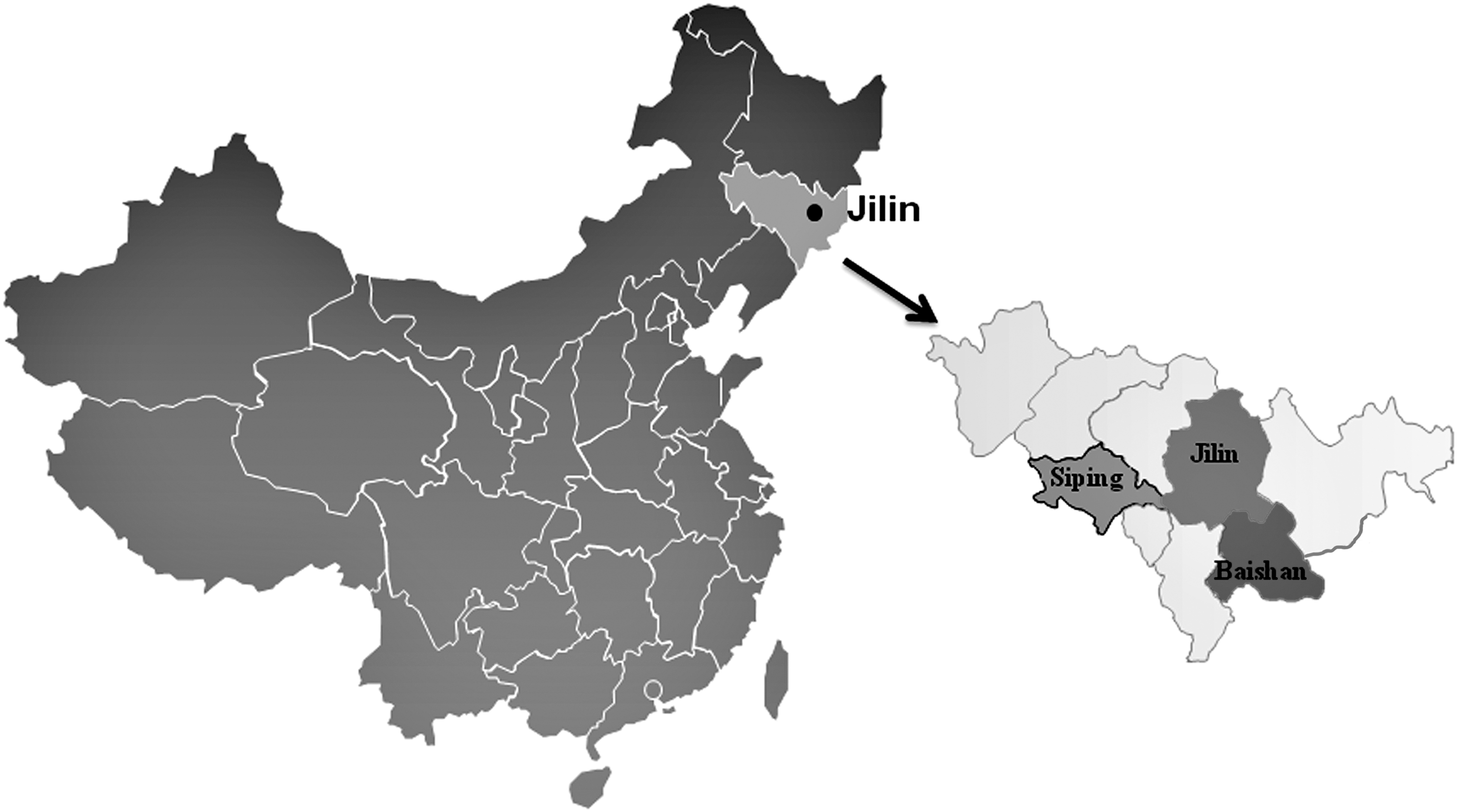
A map of China showing three cities, Jilin, Siping, and Baishan, in Jilin province, Northeast China where the serum samples of farmed wild boars were collected.
Detection of anti-T. gondii antibodies
The modified agglutination test (MAT) was used to detect the antibodies against T. gondii, and the test was carried out as described previously (Dubey, 2010; Wang et al., 2016). MAT has an acceptable level of sensitivity and specificity for the detection of T. gondii antibodies and has been widely used in serological investigations in a wide range of animals worldwide (Gauss et al., 2005; Richomme et al., 2009, 2010; Wu et al., 2012b; Coelho et al., 2014; Qin et al., 2015; Gennari et al., 2016; Wang et al., 2016). The MAT was performed at serum dilutions of 1:10, 1:25, 1:100, and 1:500. Results are considered positive when obtained at dilution of ≥1:25. Antibody titers <1:25 were considered “suspect” and were retested (Gauss et al., 2005; Wang et al., 2016; Wu et al., 2012b). Positive and negative control sera were included in each test. In the present study, the cutoff of 1:25 was used in accordance with previous investigations (Dubey, 1997; Forbes et al., 2012).
Statistical analysis
The variation in T. gondii seroprevalence (y) of wild boars by gender (x1), sampling time (x2), age (x3), and region (x4) was analyzed by χ2 test using SAS version 9.3 (SAS Institute, Inc.). In the multivariable regression analysis, each of these variables was included in the binary Logit model as an independent variable. The best model was validated by Fisher's scoring algorithm. All tests were two sided, and when the probability (p) value was <0.05 the results were considered statistically significant. Odds ratios (ORs) and their 95% confidence intervals (95% CIs) were obtained to explore the strength of the association between T. gondii-seropositivity and the risk factors considered above.
Results and Discussion
The lack of both T. gondii surveillance analysis in wild boars and etiological diagnosis in meat-borne T. gondii infection has limited our knowledge about the transmission links of the wild boar-borne T. gondii infection in China. Therefore, we conducted a cross-sectional survey from April 2015 to February 2016 to evaluate the seroprevalence of T. gondii infection in 882 farmed wild boars from three cities in Northeast China using the MAT assay.
Seroprevalence data
The study showed that 88 (9.9%, 95% CI 8.00–11.96) of the 882 tested serum samples are seropositive to T. gondii tested with titers of 1:25 (n = 69), 1:50 (n = 15), and 1:100 (n = 4) animals (Table 2), suggesting that wild boars are considered a potential source of exposure for humans in China. T. gondii seroprevalence reported in our study was lower than that reported in Finland 33.0% (65/197) (Jokelainen et al., 2012) and in Estonia 24.0% (113/471) (Jokelainen et al., 2015) by the direct agglutination test and in Poland 37.6% (138/367) (Witkowski et al., 2015) by the multispecies ID Screen. It is also lower than the 14–43.13% seroprevalence reported in wild boars in central Italy (Ranucci et al., 2013), Romania (Paştiu et al., 2013), Czech Republic (Bártová et al., 2006; Račka et al., 2015), Spain (Calero-Bernal et al., 2016), Sweden (Wallander et al., 2015), Korea (Kang et al., 2013), Latvia (Deksne and Kirjušina, 2013), Spain (Gauss et al., 2005), Portugal (Coelho et al., 2014), Mediterranean island (Richomme et al., 2010), France (Richomme et al., 2009), and United States (Diderrich et al., 1996). In contrast, seroprevalence of T. gondii in our study was higher than that reported in Switzerland (6.7%, 10/150) (Berger-Schoch et al., 2011), but similar to that reported in Slovak Republic (8.1%, 26/320) (Antolová et al., 2007) tested by ELISA and in Japan (6.3%, 11/175) (Matsumoto et al., 2011) by the latex agglutination test (Table 1). Interestingly, the wild boars investigated in our study had lower T. gondii seroprevalence compared with the remarkably high 11.3–70.00% T. gondii seroprevalence reported in intensive pig farms in China (Table 1). The relatively higher prevalence reported in some studies in Europe compared to China (Table 1) could be due to the fact that wild boars investigated in Europe were free ranging and, thus, have more opportunities to encounter the infection than the investigated animals in our study.
Preweaned.
CI, confidence interval; MAT, modified agglutination test; ORs, odds ratios.
Risk factors
The effect of multiple variables on T. gondii seropositivity was assessed by stepwise logistic regression analysis using Fisher's test. In the final model, only the geographic locality from which sera were collected had a significant effect on the risk of T. gondii infection (OR = 1.876, 95% CI 1.418–2.482). Wild boars tested from Baishan City (4.4%, 15/338; 95% CI 2.24–6.63) had the lowest T. gondii seroprevalence compared to animals tested from Jilin City (15.3%, 43/281; 95% CI 11.09–19.51) and Siping City (11.4%, 30/263; 95% CI 7.57–15.25); this difference was statistically significant (p < 0.0001) (Table 2). T. gondii transmission cycle in a piggery may be perpetuated by multiple factors, including (1) the contamination of the environment with oocysts from cat feces and (2) increased susceptibility to infection in piglets due to immature immune defenses. Hence, large numbers of stray cats that live in Jilin and Siping may be one of the reasons why seroprevalence of wild boars tested from Jilin and Siping was higher compared to animals from Baishan. This is not surprising, as cats are definitive hosts of T. gondii and oocysts secreted by cats represent a major source of T. gondii infection to wild boars. It is known that the prevalence of T. gondii in pigs can be affected by management systems where in poorly managed systems, seroprevalence in pigs can reach 68% (Gamble et al., 1999). Therefore, the better farming and environmental conditions (i.e., less contamination with oocysts) of wild boars in Baishan may have contributed to the reduction in the frequency by which intermediate host (boars) has access to oocysts of the definitive host, ultimately leading to a lower seroprevalence in wild boars from Baishan.
In addition, in this study we determined the prevalance of T. gondii in males and females, which was found to be 5.34% and 10.79%, respectively (Table 2). This finding is similar to that of previous studies in mice where female mice appeared to be more susceptible to infection with T. gondii than male mice (Roberts et al., 1995). However, other studies have not reported any correlation between the gender of pigs and anti-T. gondii seropositivity (Alvarado-Esquivel et al., 2015; Gebremedhin et al., 2015). In addition to gender-related differences, we studied T. gondii seroprevalence in different age groups, which was found to range from 5.38% to 30.30%. The highest seroprevalence tend to be in young piglets (<22 days) and with increasing age this gradually declined by as much as sixfold for the prevalence in pigs >66 days old (Table 2). This pattern of early acquisition followed by a gradual decline in prevalence is probably due to different husbandry practice, outdoor piggery density, or increased susceptibility in young pigs (Dubey, 1986).
Some limitations should be highlighted. First, the study design did not include collection of meat samples, and hence, we were not able to isolate any T. gondii strains for subsequent genotyping characterization. Second, we were unable to conclusively confirm the associations among geographic region, gender, age, year of study, and anti-T. gondii seropositivity in the multivariate analysis, probably due to the small (n = 882) and unbalanced sample size (619 and 263 in the year 2015 and 2016, respectively). Testing 882 animals from three cities is not representative of the prevalence of T. gondii in farmed wild boar population in China. The exact basis for association among geographic region, age, gender, and year of study remains to be elucidated. It is noteworthy that none of the previous prevalence studies or the present study have conducted direct statistical comparisons between pig populations from different regions and countries. This is probably due to the difficulty associated with controlling the confounding effects caused by differences in pig populations and designs and methodologies of the different studies, such as sampling site, sampling strategy, the type and age of pig included in the survey, specificity and sensitivity of the detection methods, and ecological and geographical factors.
In conclusion, we have estimated the prevalence of T. gondii in wild farmed boars in Northeast China, which provides new information for assessment of human exposure to T. gondii through consumption of wild boar meat. To our knowledge, our study is the first to demonstrate the presence of T. gondii infection in (9.9%) farmed wild boars in China, with the highest seroprevalence in Jilin (15.3%), followed by Siping (11.4%) and Baishan (4.4%). Region is a risk factor associated with T. gondii infection in the investigated wild boar populations. These results highlight the importance of T. gondii in farmed wild boars as a potential pathogen to be considered in the control of foodborne infection risks. In the future, more research is needed to isolate and characterize the genotypes of T. gondii strains present in farmed wild boars to dissociate the role of wild boars in foodborne T. gondii infection and to differentiate foodborne illnesses related to consumption of wild boars from those related to consumption of different types of meat.
Footnotes
Acknowledgments
Project support was kindly provided by the National Natural Science Foundation of China (Grant No. 31230073), the Fundamental Research Funds of Chinese Academy of Agricultural Sciences (Grant No. Y2016JC05), and the Agricultural Science and Technology Innovation Program (ASTIP) (Grant No. CAAS-ASTIP-2014-LVRI-03). Laboratoire de Parasitologie-Mycologie, Centre National de Référence de la Toxoplasmose, Centre de Ressources Biologiques Toxoplasma, Hôpital Maison Blanche, Reims Cédex, France, is thanked for providing the Toxoplasma MAT antigen.
Disclosure Statement
No competing financial interests exist.