




Abstract
No studies have reported the isolation of serotype Salmonella Isangi from cases of salmonellosis in mainland China. We investigated an outbreak of foodborne disease with salmonella and collected the samples from the patients and surplus foods. Salmonella strains were isolated and the serotype was identified according to the Kauffmann-White scheme. The relatedness of the isolates was determined using pulsed-field gel electrophoresis (PFGE) and whole genome sequencing (WGS). Antimicrobial susceptibility was conducted by the broth microdilution method. There were 74 diners in the case, 33 of which got ill, with an attack rate of 44.6% (33/74). A total of 24 samples were collected from the outbreak cases, six Salmonella Isangi strains were isolated and susceptible to all tested drugs. PFGE and WGS analysis suggested that the pathogen dissemination through a single or limited vector(s), the steamed fish and mixed food (fry spicy chicken, braised pork ribs, and goose leg), may be the source of infection or be cross-contaminated. We first report the characteristics of an outbreak and molecular strain relatedness of Salmonella Isangi in mainland China.
Introduction
N
Salmonella Isangi is a lesser known pathogen that was first reported by Jurukov (1967). Since then, many studies have reported Salmonella Isangi isolated from poultry carcasses and the processing environment (Geornaras and von Holy, 2001), stream waters (Huang et al., 2014), and human patients (Suleyman et al., 2016b). People infected with Salmonella Isangi may show complaints of diarrhea, fever, and altered sensorium symptoms (Kulkarni et al., 2009). The transmission of Salmonella Isangi may occur through direct contact with animals and contaminated water (Miller et al., 1995; Tauxe, 1996). Suleyman et al. reported the first nosocomial extended-spectrum β-lactamase (ESBL) Salmonella Isangi outbreak among surgical patients in the United States, which transmitted perhaps because of exposure to possibly contaminated transesophageal echocardiogram probes (Suleyman et al., 2016b). In China, a strain of Salmonella Isangi was isolated from adult eel feeds (used for eel farming) for the first time by Zheng et al. (1991). However, there is no outbreak of foodborne disease caused by the food contamination with Salmonella Isangi in mainland China that has been reported.
In April 2016, a foodborne disease outbreak of salmonellosis was identified in Haiyang, Shandong province; six isolated strains serovars were identified as Salmonella Isangi. We report the characteristics of an outbreak and molecular strain relatedness of Salmonella Isangi in mainland China for the first time.
Materials and Methods
Outbreak investigation and sample collection
Cases of salmonellosis were obtained through the Foodborne Disease Surveillance System, who attended two different rural banquets on April 16 and 19 in a same village in Haiyang. The Haiyang CDC was asked to investigate and collect samples from the patients who presented with symptoms (such as abdominal pain, diarrhea, fever, or vomiting), and surplus foods. Haiyang CDC interviewed all the patients or surrogates in the case, collected clinical, laboratory, demographic, and epidemiological information. Samples were placed in sterile plastic sample bags and chilled on ice during transport to the laboratory testing. All samples were analyzed on the day of arrival.
Isolates
The specimens were tested for Salmonella using the following protocol. Stool or rectal swab from patients was enriched in the selenite briliant green (SBG) sulfa enrichment broth (LB, Beijing, China), or 25 g of each surplus food was transferred to a sterile plastic bag containing 225 mL of lactose broth and incubated at 37°C for 24 h, and then, 1 mL portion of the pre-enrichment was added to 10 mL selenite cystine (SC) broth and incubated for 24 h at 37°C. Samples from the SC enrichment broth were plated on Hektoen Enteric agar (HKM, Guangzhou, China), xylose-lysine- deoxycholate agar (LB, Beijing, China), and Chromogenic Salmonella agar (Chromagar, Paris, France), respectively, for incubation at 37°C up to 24 h. Bacterial colonies showing morphological characteristics of Salmonella were identified by API 20E test strips according to manufacturer's procedures (bioMérieux, France).
Salmonella serotyping
According to the Kauffmann-White scheme, the isolated Salmonella were serotyped on slides using a microtiter agglutination test for O and H antigens as described in the manufacturer's instructions (SSI, Copenhagen, Denmark).
Antimicrobial susceptibility testing
The minimal inhibitory concentration (MIC) values of the antibiotics were determined with broth microdilution method recommended by Clinical and Laboratory Standards Institute (CLSI). The drug-sensitive test plate contains 16 different antibiotic agents: cefotaxime, tetracycline, cefoxitin, gentamicin, chloramphenicol, ciprofloxacin, trimethoprim/sulfamethoxazole, nalidixic acid, ceftriaxone, imipenem, cefepime, doxycycline, ampicillin, sulfamethoxazole, azithromycin, and amoxicillin/clavulanic acid 2:1 ratio. Escherichia coli ATCC25922 was used as quality control organism. MIC breakpoints were evaluated according to CLSI guidelines.
Pulse field gel electrophoresis
Pulse-field gel electrophoresis (PFGE) of the isolates was performed using the PulseNet standardized protocol (Ribot et al., 2006). Restriction endonuclease digestion was carried out using XbaI, BlnI, and SpeI, respectively (Takara, Dalian, China), and run on a CHEF-DR III (Bio-Rad Laboratories, Hercules, CA) over 19 h on 1% SeaKem gold agarose (Lonza, Rockland, MF) in 0.5 × Tris-borate-EDTA. BioNumerics software (Applied Maths, Kortrijk, Belgium) was used to calculate the percent similarity (Dice coefficient) of PFGE banding patterns.
Genome sequencing and bioinformatic analysis
Genomic DNA was isolated from overnight cultures and paired-end sequences (2 × 150 bp) were generated using the Illumina MiSeq® System. Sequence reads were assembled into draft continuous sequences (contigs) using BioNumerics v 7.6 (Applied Maths, Belgium). Whole genome single-nucleotide polymorphisms (wgSNP) and whole genome multilocus sequence typing (wgMLST) analysis were performed using Bionumerics v. 7.5 (Applied Maths, Belgium).
Results
Epidemiological characteristics and isolates
Through the investigation analysis, there were 74 diners (April 16, 49, and April 19, 25) who attended the two rural banquets, which were prepared by the same chefs. Patients in the first 10 h after the meal on April 16 and 2 h after the meal on April 19 and the timeline of the patients involved in the case are shown in the Figure 1. As of 6:00 PM on April 20, 33 of them got ill, with an attack rate of 44.6% (33/74), 16 were males and 17 were females, age range spanned from 27 to 77 years. Clinical symptoms of all 33 cases include diarrhea (93.9%), abdominal pain (87.9%), nausea (66.7%), fever (57.6%), dizziness (42.4%), vomiting (30.3%), and headache (24.2%) (Table 1).
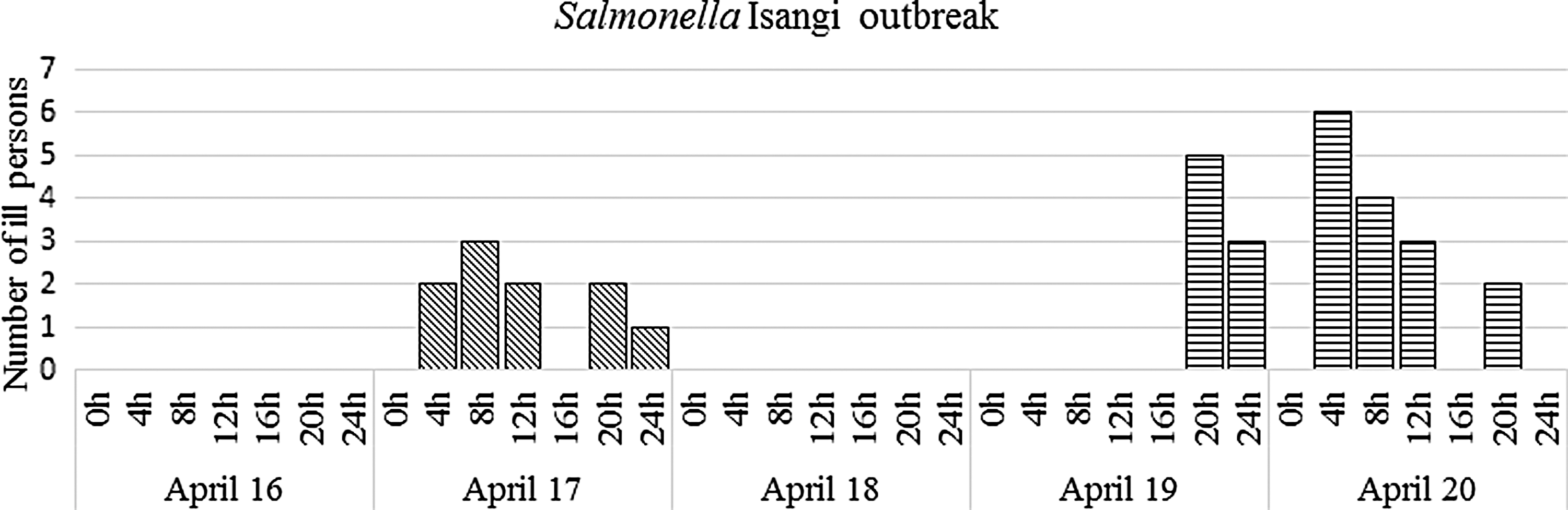
The timeline of the patients involved in the foodborne disease outbreak in Haiyang, Shandong province.
A total of 24 samples were collected and cultured from the case, including 6 rectal swabs and 3 stools from 9 patients, and 15 surplus foods. Six samples (6/24, 25%) were positive for Salmonella, including one from rectal swabs (1/6, 16.7% of the specimen type), one from stool (1/3, 33.3%), and four from surplus food (4/15, 26.7%). The surplus foods were braised pork balls, steamed fish, mixed food (fry spicy chicken, braised pork ribs, and goose leg), and stir-fry spicy squid, respectively. The serovars of isolates were identified as Salmonella Isangi (6, 7, 14: d: 1, 5) (Table 2).
Characteristics of patient: female, 66 years old, symptoms persist for 7 days: fever, headache, nausea and vomiting 6 times per day, abdominal pain, and diarrhea 20 times per day.
Characteristics of patient: female, 29 years old, symptoms: fever (38.8°C), headache, nausea and vomiting, abdominal pain, and diarrhea 8–10 times per day.
The three surplus foods were mixed up after the dinner rather than the beginning.
Antimicrobial susceptibility
Analysis of antimicrobial susceptibility testing result shows that all the six isolated Salmonella Isangi were consistent with the susceptible phenotype to all tested drugs.
Molecular subtyping by PFGE
A total of two PFGE patterns were generated for the six isolates after digestion by XbaI, with a similarity index ranging from 96.8% to 100%. Two isolates from patients (SDHY-P-SM-0001, 6) and two isolates from food (SDHY-F-SM-0003, 4) were 100% identical in clusters A, while the SDHY-F-SM-0002 and SDHY-F-SM-0005 isolated from food were included in clusters B. However, similarity between the two clusters was 96.8%. When the isolates were digested by BlnI or SpeI, the patterns' similarity index was 100% (Fig. 2).
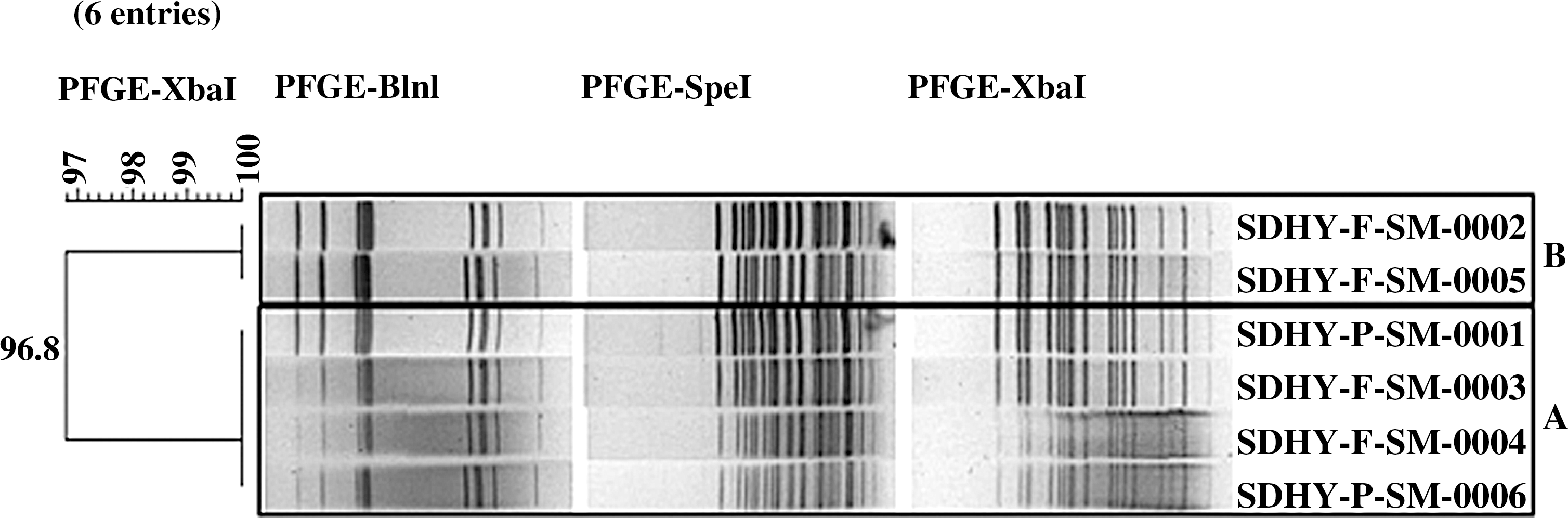
Pulsed-field gel electrophoresis (PFGE) analysis.
wgSNP and wgMLST analysis
Analysis using Bionumerics v. 7.5 was used to further resolve the genome sequences. All the six isolates differed in ≤2 core SNPs, there was no difference among the isolates SDHY-P-SM-6 (from patients), SDHY-F-SM-0003, 4, and 5 (from surplus food). Isolate SDHY-F-SM-0002 have the biggest diversity among all, which differed in 2 core SNPs. Isolate SDHY-P-SM-0001 differed from others in only 1 core SNP (Fig. 3). The six isolates generally clustered together using wgMLST analysis sharing >99% similar alleles (Fig. 4). The isolate SDHY-F-SM-0002 was an outlier, with just a slight difference in the outbreak isolates.
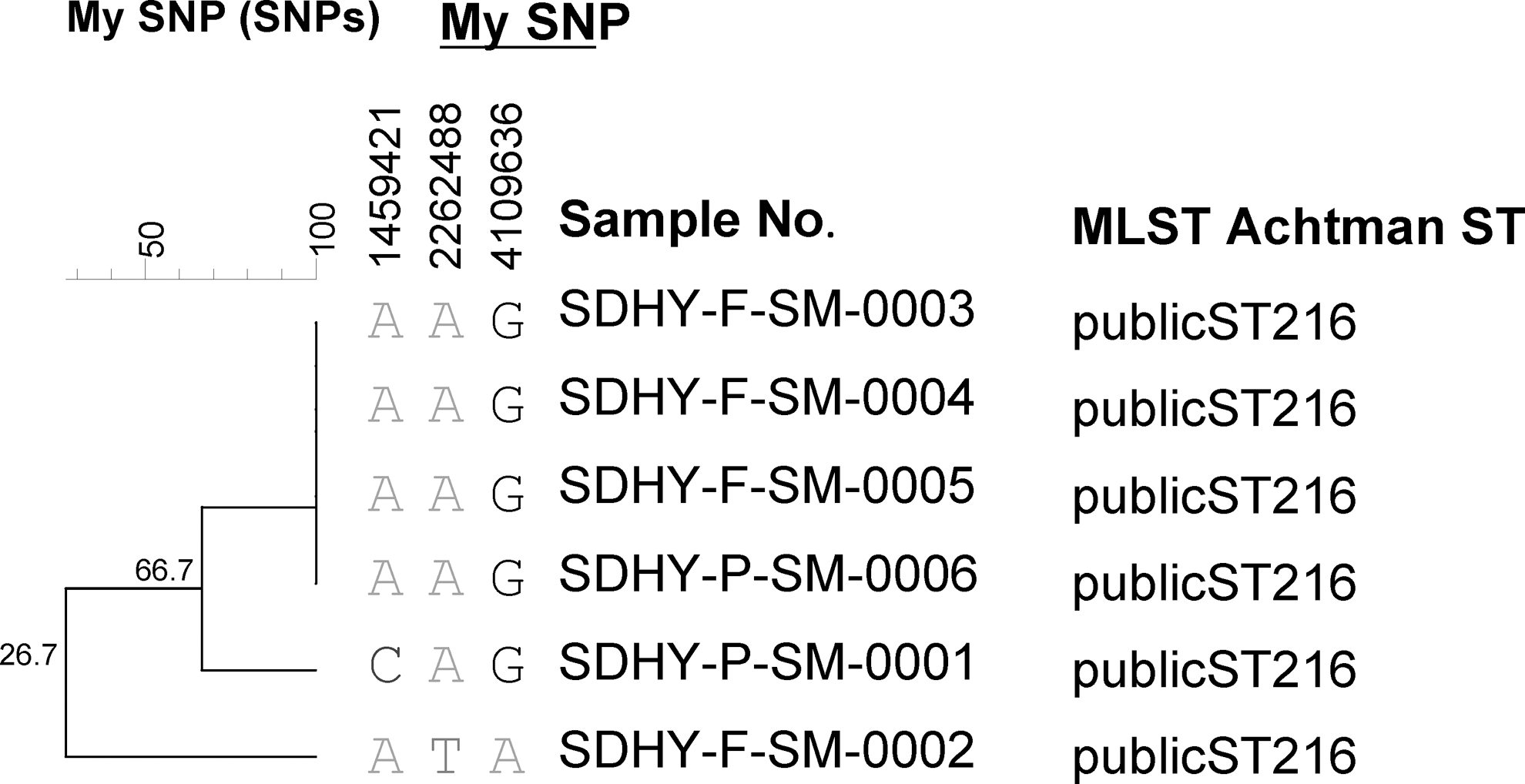
Whole genome single-nucleotide polymorphisms (wgSNP) analysis.

Whole genome multilocus sequence typing (wgMLST) analysis.
Sequence-based typing alleles were extracted from whole genome sequencing (WGS) data yielding complete sequence types for the six isolates representing the same ST216.
Discussion
Foodborne disease caused by nontyphoidal Salmonella had been a serious threat to global public health, causing an estimated 93.8 million illnesses and 155,000 deaths worldwide annually (Majowicz et al., 2010). Most Salmonella infections were associated with ingestion of contaminated food, with the correlation coefficient as high as 0.95 (Gomez et al., 1997). Although Salmonella Isangi was an uncommon serotype of nontyphoidal Salmonella, the isolation of Salmonella Isangi has become increasingly common abroad, accounting for 20% of the isolates in a nationwide surveillance program in South Africa (Wadula et al., 2006; Usha et al., 2008). However, the isolation of Salmonella Isangi was seldom reported in mainland China, and none has been reported from human sources. We report the first foodborne disease outbreak of Salmonella Isangi in mainland China.
WGS has become an essential tool for investigating the evolution, diversity, and pathogenicity of foodborne bacterial pathogens (Lienau et al., 2011; Cao et al., 2014). In the analyzed six isolated strains with PFGE and WGS, we found that all the isolates were highly related (≥96.8%) and contained the fewest differences in core genome SNPs and the greatest proportion of identical allele sequences in a wgMLST scheme. The ST216 has been reported in some countries and regions except mainland China (Enterobase Salmonella,
Antimicrobial resistance in bacterial pathogens has become more serious worldwide, and an increasing number of nontyphoidal salmonella isolates have become multidrug resistant in many countries. Many studies have promoted that Salmonella Isangi isolate could be anESBL producer and may have persisted because β-lactams were used for perioperative antibiotic prophylaxis (Govinden et al., 2006; Wadula et al., 2006; Suleyman et al., 2016a, b). However, the isolates from our case were sensitive to all the tested drugs. After empirically applying the drugs, all the patients' conditions were stable and recovered soon; no patient died as a result of Salmonella Isangi infection.
We are aware of several limitations in our study. There is less data from the outbreak on April 16th, and not all the samples were contained, such as the samples of chefs, kitchens, and dining environment, which could help us to figure out the pollution sources and paths of Salmonella Isangi infection.
Conclusion
In this study, we first reported that Salmonella Isangi leads to foodborne disease outbreaks and isolated it from patients in mainland China. The results suggest the pathogen dissemination was through a single or limited vector(s) and will be more sensitive for β-lactam antibiotic than the isolated Salmonella Isangi strains in other countries. Despite this, the great potential dangers of Salmonella Isangi that lead to foodborne disease could not be ignored, and the regulatory guidance for rural banquets should be paid enough attention to in China.
Highlights
1. We first reported the Salmonella Isangi leads to foodborne disease outbreak and isolated it from patients in mainland China.
2. All the Salmonella Isangi isolates were susceptible to all tested drugs, this is different from the other research.
3. PFGE and WGS analysis showed high similarity among the isolates, suggested that the pathogen dissemination through a single or limited vector(s).
4. The steamed fish and mixed food may be the source of infection or be cross-contaminated.
Footnotes
Acknowledgments
Supported by Shandong Province Science Foundation for Talent Cultivation (ZR2015PH059) and a sub-project of National Science and Technology Major Project. (2012ZX10004215-3).
Disclosure Statement
No competing financial interests exist.