




Abstract
Each year in the United States, ∼260,000 people get sick from contaminated fish. Fish is also the most commonly implicated food category in outbreaks. We reviewed the Centers for Disease Control and Prevention Foodborne Disease Outbreak Surveillance System for outbreaks resulting from consumption of fish during the period 1998–2015. We found 857 outbreaks associated with fish, resulting in 4815 illnesses, 359 hospitalizations, and 4 deaths. The median number of illnesses per outbreak was three (range: 2–425). The annual number of fish-associated outbreaks declined from an average of 62 per year during the period 1998–2006 to 34 per year during the period 2007–2015. Hawaii (221 outbreaks [26%]) and Florida (203 [24%]) reported the most outbreaks. Among 637 outbreaks (74%) with a confirmed etiology, scombrotoxin (349 [55%]) and ciguatoxin (227 [36%]) were by far most common. Most outbreak-associated illnesses were caused by scombrotoxin (1299 [34%]), Salmonella (978 [26%]), and ciguatoxin (894 [23%]). Most hospitalizations were caused by Salmonella (97 [31%]) and ciguatoxin (96 [31%]). Norovirus (105 average illnesses; range: [6–380]) and Salmonella (54 [3–425]) caused the largest outbreaks. Fish types implicated most often were tuna (37%), mahi-mahi (10%), and grouper (9%). The etiology-fish pairs responsible for the most outbreaks were scombrotoxin and tuna (223 outbreaks), scombrotoxin and mahi-mahi (64), and ciguatoxin and grouper (54). The pairs responsible for the most illnesses were scombrotoxin and tuna (720 illnesses) and Salmonella and tuna (660). Of the 840 outbreaks (98%) with a single location of food preparation, 52% were associated with fish prepared in a restaurant and 33% with fish prepared in a private home. Upstream control measures targeted to the most common etiologies and controls during processing and preparation could further reduce outbreaks caused by fish.
Introduction
E
We describe the epidemiology of fish-associated outbreaks in the United States from 1998 to 2015. This information can be used to target disease control strategies from fishing to consumption.
Materials and Methods
A foodborne disease outbreak is defined as the occurrence of two or more cases of a similar illness resulting from ingestion of a common food. The Centers for Disease Control and Prevention (CDC) conducts surveillance for foodborne disease outbreaks investigated and reported by local and state health departments in the United States through the Foodborne Disease Outbreak Surveillance System (FDOSS) (CDC, 2015a). The information collected for each outbreak includes month, year, and state in which an outbreak occurred; number of illnesses, hospitalizations and deaths; etiologic agents; food vehicles; locations and methods of food preparation; and factors contributing to occurrence of the outbreak.
We reviewed data reported to FDOSS for outbreaks associated with fish from 1998 to 2015. We included outbreaks in the analysis if the implicated food was fish or if a food containing fish, for example, sushi, was implicated and fish was reported to be the contaminated ingredient (IFSAC, 2015). In addition, we included outbreaks with a reported etiology of scombrotoxin, ciguatoxin, or puffer fish tetrodotoxin if the implicated food contained fish, for example, tuna burger, because fish is the source of almost all illnesses caused by these toxins. CDC considers the outbreak etiology to be confirmed if etiology-specific criteria were met, such as isolation of the etiologic agent from two or more ill persons, detection of organism in epidemiologically linked food, or a syndrome consistent with fish poisoning (CDC, 2013a). Suspect etiology outbreaks were those where an etiology was reported, but evidence was insufficient to meet the confirmation criteria. Unknown etiology outbreaks were those where no etiologic agent was reported.
We categorized fish types into groups by the common name for the fish family (e.g., tuna includes foods reported as tuna, wahoo, ahi, ono, yellowfin, albacore, and mackerel; jacks include foods reported as jacks, papio, amberjack, ulua, and hamachi). We reviewed several variables to determine whether the fish was eaten raw or cooked; we classified fish as raw if the word “raw” was included in the description of the implicated food. We analyzed data using Microsoft Access 2010 (Microsoft, Redmond, Washington, DC) and SAS, version 9.3 (SAS Institute, Cary, NC).
Results
From 1998 to 2015, state and local health departments reported 857 outbreaks associated with fish, resulting in 4815 illnesses, 359 hospitalizations, and 4 deaths. In addition, there were 317 ill people who visited the emergency room. The median number of illnesses per outbreak was three (range: 2–425). Outbreaks occurred in 42 states, Guam, Puerto Rico, and the District of Columbia. Hawaii and Florida reported the most, together accounting for 49% of fish-associated outbreaks. There were seven (<1%) multistate exposure outbreaks.
The average annual number of fish-associated outbreaks decreased from 62 in 1998–2006 to 34 in 2007–2015; however, outbreaks associated with fish did not change as a percentage of all outbreaks with food(s) implicated (8% from 1998 to 2006, 9% from 2007 to 2015) (Fig. 1). The number of outbreak illnesses varied greatly by year (range: 91–625). Outbreaks occurred more commonly in warmer months (55% from April to August).
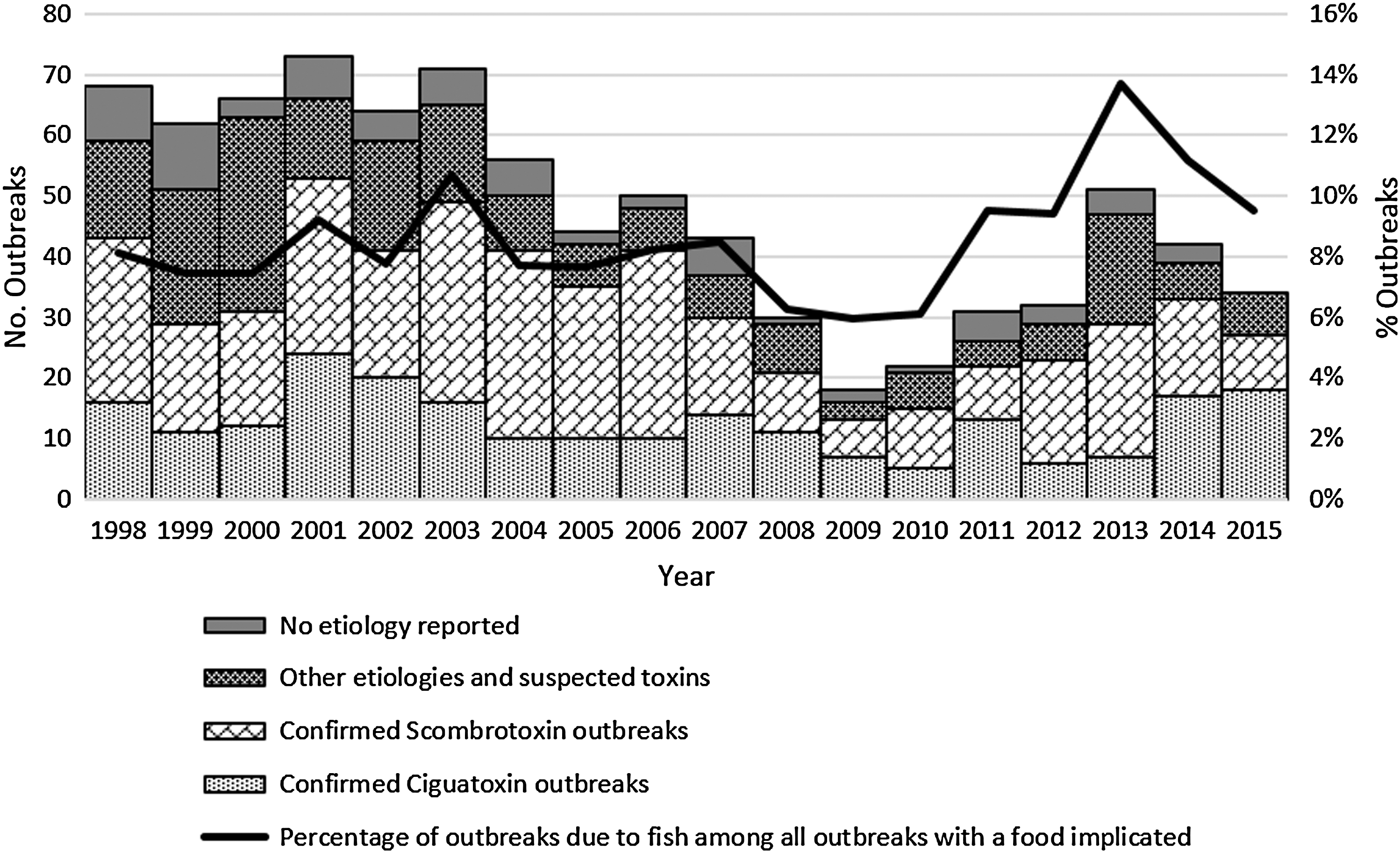
Number of fish-associated outbreaks and percentage of outbreaks due to fish among all outbreaks with a food implicated, United States, 1998–2015.
Among 857 outbreaks, 637 (73%) had a confirmed etiology, scombrotoxin (349 [55%]) and ciguatoxin (227 [36%]) were most common (Table 1). Salmonella (median 39 illnesses [range: 3–425]) and norovirus (13 [range: 5–380]) caused the largest outbreaks. Salmonella (97 [31%]) and ciguatoxin (96 [31%]) caused the most hospitalizations. Scombrotoxin (126 [40%]) caused the most emergency room visits, followed by ciguatoxin (104 [33%]). In most of the 144 outbreaks with a suspected etiology, the suspected agent was scombrotoxin (74 [51%]) or ciguatoxin (36 [25%]).
Includes only outbreaks in which the etiology met confirmation criteria (CDC, 2013a).
Includes gempylotoxin (1), seafood-associated rhabdomyolysis (sometimes referred to as Haff disease) (2), ichthyotoxic poisoning (3), puffer fish tetrodotoxin (2), mercury (1), and other unspecified chemical/toxins (2).
Includes Bacillus cereus (1) and Staphylococcus aureus enterotoxin (2).
Includes anisakiasis (1 outbreak), Campylobacter (1), Shiga toxin-producing Escherichia coli (1), Plesiomonas shigelloides (1), and both ciguatoxin and S. aureus enterotoxin (1).
The average annual number of outbreaks caused by scombrotoxin declined from 26 in 1998–2006 to 13 in 2007–2015 and by ciguatoxin from 14 to 11 outbreaks, respectively (Fig. 1). The percentage of fish outbreaks among all outbreaks with a confirmed etiology also declined over this time period from scombrotoxin (6% from 1998 to 2006, 1% from 2007 to 2015), and for ciguatoxin, from 3% to 1%, respectively. Outbreaks caused by scombrotoxin did not demonstrate a seasonal pattern, whereas those caused by ciguatoxin occurred more commonly in warmer months (69% from April to September).
The number of fish-associated outbreaks caused by Salmonella increased from 6 in 1998–2006 to 12 in 2007–2015. Outbreaks caused by Clostridium botulinum declined from 9 outbreaks in 1998–2006 to 5 in 2007–2015.
Tuna (318 outbreaks [37%]), mahi-mahi (87 [10%]), and grouper (74 [9%]) were reported in the most outbreaks (Table 2). The etiology-fish pairs responsible for the most outbreaks were scombrotoxin and tuna (223 outbreaks), scombrotoxin and mahi-mahi (64), ciguatoxin and grouper (54), and ciguatoxin and barracuda (49). The etiology-fish pairs responsible for the most illnesses were scombrotoxin and tuna (720 illnesses), Salmonella and tuna (660 illnesses), scombrotoxin and mahi-mahi (229 illnesses), and scombrotoxin and escolar (218 illnesses) (Table 2).
Etiologies are listed for outbreaks in which the etiology met confirmation criteria (CDC, 2013a). Outbreaks with suspect etiologies are tallied in a separate row.
Tuna includes foods reported as tuna, wahoo, ahi, ono, yellowfin, albacore, and mackerel. Mahi-mahi includes foods reported as mahi and dolphinfish; grouper includes roi and sea bass. Jacks include foods reported as jacks, papio, amberjack, ulua, and hamachi. Salmon includes foods reported as salmon, trout, and white fish. Snapper includes foods reported as snapper and wahanui.
Includes Kole (10 outbreaks), Marlin (10), Fish eggs (6), Cod (6), Palani (5), Puffer (5), Bass (4), Buffalo (4), Catfish (4), Goatfish (3), Hogfish (3), Kingfish (3), Swordfish (3), Other types ≤2 outbreaks each (27), Multiple fish types (11), and unspecified fish (63).
Includes gempylotoxin (1 outbreak), seafood-associated rhabdomyolysis (sometimes referred to as Haff disease) (2), ichthyotoxic poisoning (3), puffer fish tetrodotoxin (2), mercury (1), and other unspecified chemical/toxins (2).
Includes Bacillus cereus (1 outbreak) and Staphylococcus aureus enterotoxin (2).
Includes anisakiasis (1 outbreak), Campylobacter (1), Shiga toxin-producing Escherichia coli (1), Plesiomonas shigelloides (1), and both ciguatoxin and Staphylococcus aureus enterotoxin (1).
Of the 840 outbreaks (98%) in which food was prepared in a single location, 434 (52%) were associated with restaurants, 280 (33%) with private homes, and 126 (15%) were in other settings. Among 331 outbreaks caused by scombrotoxin in which food was prepared in a single location, fish was prepared in a restaurant in 76%. In contrast, among 217 outbreaks caused by ciguatoxin in which food was prepared in a single location, fish was prepared in a private home in 78%.
The implicated fish was reported to be raw or lightly cooked in 84 (13%) of 651 outbreaks with a reported preparation method. The setting of preparation was a restaurant in 53 (63%) outbreaks due to raw or lightly cooked fish. Tuna (55 outbreaks) and salmon (7 outbreaks) were the most common fish types reported to be consumed raw or lightly cooked. After excluding outbreaks caused by heat-stable agents (ciguatoxin and scombrotoxin), 31 outbreaks associated with raw or lightly cooked fish were caused by agents that could have been inactivated by cooking. Salmonella caused 8 (26%) of these, followed by C. botulinum toxin 5 (16%).
From 2009 to 2015, 184 (80%) of 231 reports contained information on the source of the fish. Among those, 54 (29%) were due to imported fish. Countries that were the source for more than three outbreaks were Indonesia (10 outbreaks), Bahamas (4), and Ecuador (4).
Discussion
The number of reported fish-associated outbreaks in the United States declined overall during the study period, reaching a nadir in 2009 before increasing slightly through 2013 and declining again. The overall decline is consistent with overall decreases in reporting for all foodborne outbreaks (CDC, 2013b). Furthermore, among all foodborne outbreaks, approximately half have a particular food implicated, and among these, the proportion associated with fish remained fairly constant. The proportion of outbreaks caused by scombrotoxin, ciguatoxin, and other etiologies fluctuated over this time period. The reasons for changes in the number of fish-associated outbreaks reported over time are not known and changes to surveillance are reflective of changes in fish outbreaks as well as foodborne outbreaks overall (Imanishi et al., 2014).
Many regulations targeted specifically at fisheries and fish products have been implemented during this study period. In 1997, the U.S. Food and Drug Administration (FDA) mandated processors of fish and fishery products to develop and implement hazard analysis critical control point (HACCP) systems in seafood processing operations, including imports (FDA, 1995). In response, the Association of Food and Drug Officials (2013) and the Seafood HACCP Alliance developed training programs to assist with the implementation of HACCP programs in commercial and regulatory settings. The FDA also published the first edition in 1996 and the fourth edition of the Fish and Fishery Products Hazards and Control Guide (FDA, 2011) to continue helping processors identify hazards associated with their products, formulate control strategies for those hazards, and maintain seafood safety. While these interventions are likely, in part, responsible for the overall decline in fish outbreaks, reasons for changes in recent years are unclear.
Ciguatoxin and scombrotoxin caused most fish-associated outbreaks. Ciguatoxins bioaccumulate in large reef-dwelling fish. Ciguatera fish poisoning is typically associated with fish caught recreationally, but some come from commercial sources (Hawaii Seafood Council, 2005). Because most ciguatoxin outbreaks involved fish prepared in private homes, this may suggest that the fish were caught recreationally and that advisories to avoid large predatory fish from tropical waters may not be reaching recreational fishers. Seven reports of outbreaks caused by ciguatoxin indicated that the fish consumed was recreationally caught and only one outbreak indicated commercial fishing; however, data on how or where fish were caught are not systematically collected in FDOSS. Careful selection of fish harvest locations by both recreational and commercial fishers could reduce the risk of ciguatoxin fish poisoning. In addition, prevention of ciguatoxin includes limiting consumption of certain reef fish, for example, barracuda and grouper, choosing fish that weigh <6 lbs, and avoiding parts of the fish where ciguatoxin concentrates, for example, the head and liver (CDC, 2015b).
Some states, such as Oregon and Florida, have programs to monitor harmful algal blooms that contribute to ciguatoxin in fish and issue advisories (Florida Fish and Wildlife Conservation Commission, 2016; Oregon Public Health Division, 2016). The Florida Department of Health partners with the National Oceanic Atmospheric Association (NOAA) to identify, document, and forecast harmful algal blooms in Florida's major water bodies and evaluate applicability for other coastal and inland areas; in 2013, there were over 100 subscribers to their bulletin (Andrew Reich, Florida Department of Health, personal communication). In addition, in June 2016, CDC began collecting national information through the One Health Harmful Algal Bloom System (OHHABS) to improve the understanding and prevention of HAB-associated illness (CDC, 2016b). Rising water temperatures contribute to formation of these blooms and the bioaccumulation of toxins in the food supply (NOAA, 2015).
Scombroid fish poisoning occurs when fish is inadequately refrigerated (CDC, 2007). Our data show that fish that contain high levels of histidine in muscle tissue (e.g., tuna) continue to be the most common source of scombroid fish poisoning, which is mediated by free histidine that can be decarboxylated to form histamine by bacteria in fish (Marrow et al., 1991; CDC, 2007). Half of the outbreaks occurred in Florida and Hawaii where the tropical climate might exacerbate the effects of improper temperature control. Proper temperature control at harvest, transport, and point of service would reduce the risk of scombroid fish poisoning.
Consumption of farm-raised fish has been increasing. During 1984 through 2009, world aquaculture production increased from 5 million to 63 million tons (World Bank, 2013). In 2014, about half of all seafood available for consumption in the United States was farm raised (NOAA, 2014). Raising fish away from toxic reefs mitigates the risk of ciguatoxin poisoning. Whereas a decrease in outbreaks caused by ciguatoxin and scombrotoxin may be a positive outcome of this change, in many fish farms, antimicrobial agents are frequently used in production, which may result in growth of antimicrobial-resistant bacteria associated with severe infections in humans (FDA, 2007; Heuer et al., 2009). Data on whether fish were farmed or caught wild is not systematically collected by FDOSS; obtaining this information may help in assessing prevention measures.
The largest outbreak, with 425 cases in 28 states, was caused in 2012 by the consumption of raw tuna contaminated with Salmonella (CDC, 2012). Overall, Salmonella-tainted fish caused 18 outbreaks and a large proportion of hospitalizations. Many outbreaks caused by Salmonella were large, involving many ill people. Preventing Salmonella contamination requires measures quite different from preventing toxin poisonings. Attention is needed to food safety measures during processing in addition to proper refrigeration. If those measures fail to prevent contamination, cooking fish to an internal temperature of 145°F (USDA, 2015) kills Salmonella and other harmful bacteria. Cooked fish should be kept separate from raw foods to prevent cross-contamination (CDC, 2016c).
Our analysis was subject to several limitations. First, the number of reported outbreaks likely underestimated the true number as not all sick people visit health facilities. The etiology of some outbreaks was not determined. Not all cases are reported to state health departments and not all outbreaks are reported to CDC, especially small outbreaks. For example, illnesses caused by ciguatoxin were common in the U.S. Virgin Islands (Morris et al., 1982); however, this territory does not usually report to FDOSS, likely because of competing priorities and limited resources of the health department (Wikswo et al., 2015). There are currently no reliable laboratory tests for human specimens that can confirm exposure to ciguatoxin (Friedman et al., 2008; Azziz-Baumgartner et al., 2012). Although scombrotoxin can be detected in urine, this test is not routinely performed (Marrow et al., 1991; Lavon et al., 2008). The gold standard for confirmation of these types of outbreaks includes detection of toxin in the fish above a certain threshold (∼30% of confirmed outbreaks) consumed by multiple individuals, which is only possible after an outbreak is recognized and epidemiologic links are made. CDC guidelines allow for confirmation based on clinical syndrome, which might introduce misclassification. Diseases with some similar symptoms can sometimes be difficult to distinguish. Furthermore, an implicated food is not identified for every outbreak.
Conclusions
Fish continue to cause many outbreaks and illnesses each year. Because scombrotoxin and ciguatoxin are heat stable, fishermen, fish processors, fish retailers, restaurant owners, and consumers must take preventive measures other than cooking. Avoiding commercial and recreational fishing along reefs known to be toxic can reduce the risk of ciguatera fish poisoning. Rapid chilling of fish immediately after harvest and appropriate temperature control from catch to table prevent scombroid fish poisoning. Finally, transporting, processing, cleaning, handling, cooking, and storing fish appropriately could reduce the risk of illness caused by bacteria and viruses.
Footnotes
Acknowledgments
The authors would like to acknowledge state and local health departments, Centers for Disease Control and Prevention (CDC) National Center for Environmental Health, U.S. Food and Drug Administration, the Florida Fish and Wildlife Conservation Commission, W. Steve Otwell, Thomas Swenarton, Wayne Bennett, Gerald L. Hasty, and Christine Wilcox for their support. The authors would also like to acknowledge Patricia Griffin from CDC Enteric Diseases Epidemiology Branch for her contributions. The findings and conclusions in this report are those of the authors and do not necessarily represent the official position of CDC/Agency for Toxic Substances and Disease Registry (ATSDR).
Disclosure Statement
No competing financial interests exist.