




Abstract
Toxoplasmosis is a foodborne zoonosis transmitted by Toxoplasma gondii, a cosmopolitan protozoan that infects humans through exposure to different parasite stages, in particular by ingestion of tissue cysts or tachyzoites contained in meat, primary offal (viscera), and meat-derived products or ingestion of environmental sporulated oocysts in contaminated food or water. The pig is an important species for infection: raw or undercooked pork consumption not subject to treatment able to inactivate the parasite represents a risk to consumers' health. Broadening knowledge of transmission ways and prevalence concerning this important pathogen in swine, together with a thorough acquaintance with hazard management are key elements to avoid T. gondii spreading within the swine production chain. This review aims to illustrate why toxoplasmosis should be regarded as a veterinary public health issue through a careful description of the parasite, routes of infection, and inactivation treatments, highlighting the main prevention lines from pig breeding to pork consumption.
Introduction
O
Pig production is spread worldwide (excluding countries with limitations of pork consumption) and is characterized by two main production systems: specialized intensive systems and free-range organic production (FAO, 2014). Pigs of intensive farms are kept indoors in close confinement systems with careful control of temperature, ventilation, and density of animals in each group. On the other hand, the organic production is characterized by extensive breeding where pigs are reared under organic conditions, from the land where they roam to the feed that they eat. According to the Food and Agriculture Organization, pork is the most consumed meat among terrestrial animals; therefore, the pig production sector represents an important part of the zootechnical sector (9.0% of the total EU breeding output) (FAO, 2014). Pig production is concentrated in a few countries, such as Denmark, Germany, Spain, France, the Netherlands, and Poland, which have more than two thirds of the breeding pigs of EU member states (Fig. 1). Specifically, the average share of pig production in breeding output is highest in Denmark (29%), followed by Belgium (20%), Spain (14.7%), and Germany (14.5%). Seasonal variations in pig reproduction are due to lower sow fertility in summer as well as other cultural factors, such as traditional celebrations. Pork production shows an economic cycle (which is less than two and half years), although its impact on farmer decision is less compared with major economic changes or animal crises.
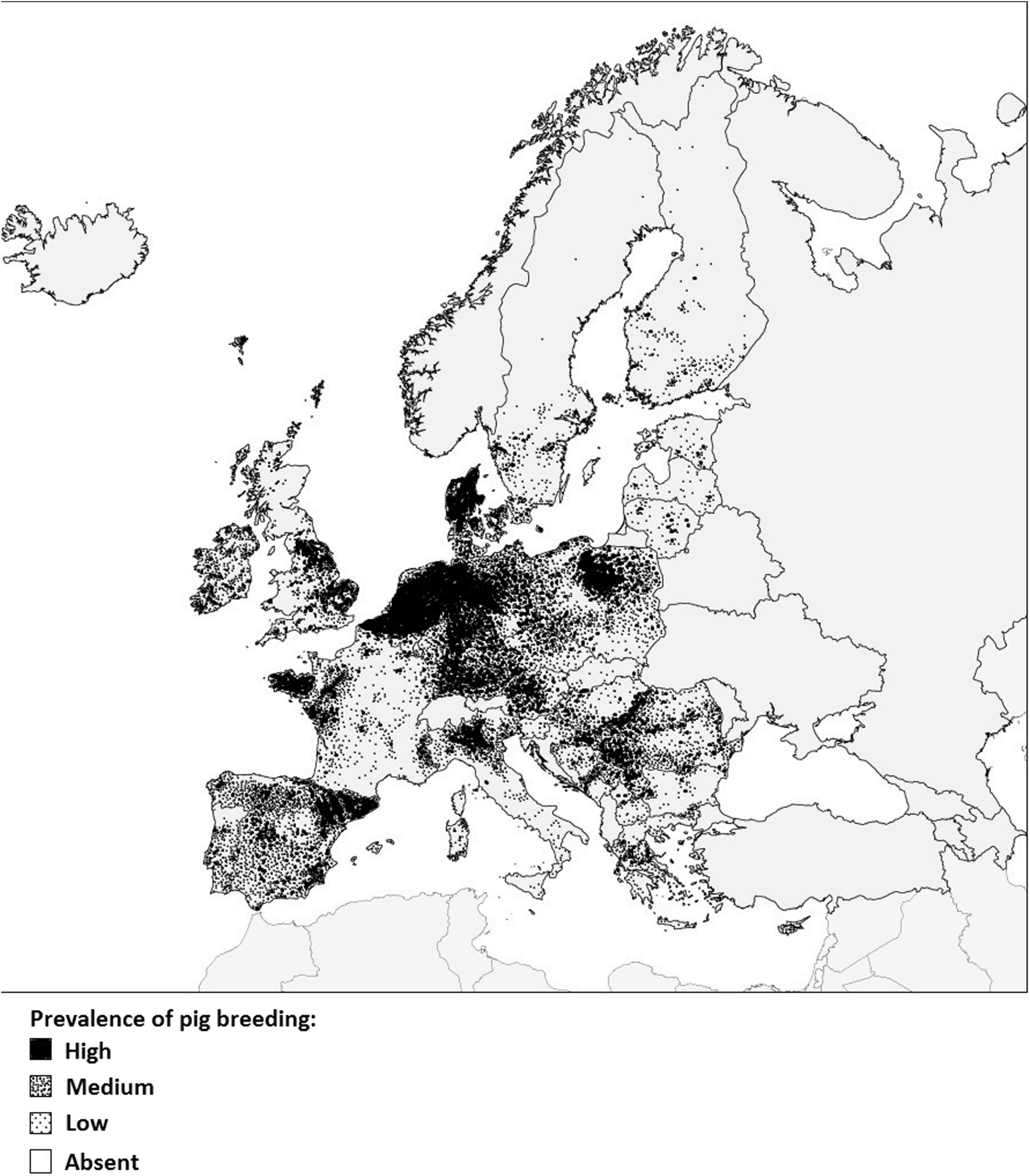
Areas of pig breeding within EU member states. The map was independently elaborated using published data on Eurostat 2014 (agr_r_animal).
In 2013, pig production in the 28-member states of EU reached 252.9 million units, of which more than 58% originated from four countries (Germany, Spain, France, and Poland). The EU external trade balances showed a surplus of around 1.2 million tons (raw and processed pork), which represent 5.4% of the total slaughtering in 2013. Four countries (Denmark, Germany, Spain, and the Netherlands) contributed to 75% of the total exports to third countries exports mainly destined to Russia, China, Japan, and South Korea (Eurostat-Statistic explained, 2014).
As part of domestic livestock, the pig represents the host to a wide range of zoonotic parasites. However, only few species of these parasites are able to infect humans through consumption of pork and pork products. Among meatborne parasites, the protozoa Toxoplasma gondii and Sarcocystis spp., along with helminths Trichinella spp. and Taenia spp., are the most important in the swine production chain. T. gondii is one of the most common zoonotic agents in humans in the European Union and it has been estimated to be the greatest of all parasitic infections, similar to salmonellosis and campylobacteriosis (Djurković-Djaković et al., 2013).
The European Food Safety Authority (EFSA, 2011a) qualitatively ranked T. gondii and other biological hazards according to the risk level (Table 1). The objective was to assess hazards to identify the most important pathogens in terms of public health as related to pork carcasses and potential foodborne infection, according to a specific algorithm (Fosse et al., 2008a, 2008b; Matagaras, 2008). Pathogens with a “low risk” category in terms of number of human cases, but a high frequency of lethal outcome, are also considered “medium risk” overall. This is applicable to Clostridium botulinum, Listeria monocytogenes, VTEC, and T. gondii (EFSA, 2011b; Scallan et al., 2011). A total of 1259 confirmed cases of human toxoplasmosis were reported in 2009 by 17 EU member states, with a EU notification rate of 0.65 on 100,000 inhabitants (EFSA, 2011b). The infection is usually asymptomatic even though most cases were detected during pregnancy screening in women (EFSA, 2007).
Measured during processing or retail, no data available at slaughterhouse level.
Data collected at slaughterhouse/processing plant/cutting plant/retail or unspecified sampling point.
Recently, it has been highlighted the importance of T. gondii on human health; indeed, among foodborne infections, it occupies the fourth highest place for number of hospitalizations and the third place for deaths compared to other etiologic agents responsible of foodborne illness. Reported clinical cases in immunocompetent patients were analyzed using several surveillance systems as the recent Foodborne Diseases Active Surveillance Network (FoodNet) to obtain a final epidemiological report (Mead et al., 1999). A French study has confirmed these data showing that toxoplasmosis is the third leading cause of death among foodborne infections (35 cases per year), preceded by Salmonella spp. (92–535 cases) and L. monocytogenes (78 cases) (Vaillant et al., 2005). Also, in the United States, this zoonosis is a current and outstanding public health issue. Epidemiological studies have highlighted the presence of T. gondii in 10–50% of adult population (Jones et al., 2001, 2007; Dubey and Jones, 2008). Latent infection is emerging as a novel risk factor in the neurobiology and psychiatric epidemiology of schizophrenia and bipolar and personality disorders (Pedersen et al., 2012; Torrey et al., 2012; Postolache and Cook, 2013), all associated with increased risk of suicidal self-directed violence. Neurological deficits, subtle personality shifts, and behavioral changes associated have also been reported, with evidence of both sex-linked and age-dependent effects, as well as prenatal depression and anxiety, motor vehicle accidents, migraine headaches, and national rates of homicide (Postolache and Cook, 2013).
Since T. gondii represents a potential hazard in fresh and processed meats, such as ready-to-eat (RTE) products, the objective of this review is to provide a detailed overview of T. gondii infection transmitted to humans by pork, outlining main lines of prevention. In particular, the pivotal role of meat as a source of infection will be discussed and strategies to reduce human infection through food consumption will be suggested.
Toxoplasma gondii
Life cycle
T. gondii (Apicomplexa, Coccidia) is an obligate intracellular protist, etiologic agent of toxoplasmosis (Fig. 2). In definitive hosts (cats and other felines), the sexual phase of the biological cycle takes place and leads to the formation of nonsporulated oocysts (Dubey and Jones, 2008). In intermediate hosts (warm-blooded animals such as mammals and birds), the extraintestinal phase of the life cycle, which ends with the formation of tachyzoites and finally tissue bradyzoites, is achieved (Taylor et al., 2007).

Toxoplasma gondii life cycle. The cat sheds nonsporulated oocysts through feces, which mature in 2–5 days (sporogony) in the environment. The sporulated oocysts infect the pig either by ingestion of environmental oocysts or through ingestion of bradyzoites contained in tissue cysts of intermediate hosts. Human infection is the direct consequence of contaminated food consumption or, more frequently, pseudocysts in raw or improperly cooked pork. The infection may be transmitted to fetus causing abortion and other lesions such as neonatal mortality (3%), hydrocephalus (1.9%), central nervous system abnormalities (2.7%), chorioretinitis (14%), and neonatal death (0.75%) (Havelaar et al., 2007).
All hosts, including humans, can be infected by one of three parasite forms that correspond to the three morphological stages: tachyzoites (in tissues, blood secretions, and excretions), bradyzoites (in tissue and organ cysts), or sporozoites (in oocysts of cat feces) (Dubey, 2008; Innes, 2010). The sexual phase of the life cycle occurs in the intestine of definitive hosts. The intestinal cells are infected by tachyzoites or bradyzoites present in ingested infected tissue or by sporozoites (oocysts in cat feces) in contaminated food or water. After fertilization in intestine cells, the female gamete becomes a zygote and then an immature oocyst, which is expelled with feces. The oocyst shed into the environment by cat (millions of oocysts after 1–3 weeks from ingestion of sporulated oocysts or tissue cysts) is very resistant and sporulates after 1–5 days, and thereby becomes infective for humans and other intermediate hosts. After the oocyst shedding phase, the cat develops immunity for a variable period of time for up to >6 years (Dubey, 2010). The relatively short oocyst shedding phase and the length of immunity explain the frequent negative results of coprologic investigation in seropositive cats (Lappin, 1996; Cenci-Goga et al., 2011).
In intermediate hosts, T. gondii undergoes two phases of asexual development: during the first phase, tachyzoites rapidly multiply in different types of host cells. In the second phase, tachyzoites of the last generation form tissue cysts within which bradyzoites slowly multiply by endodyogeny. Tissue cysts represent the terminal life-cycle stage in the intermediate hosts and are immediately infectious (Dubey, 2008).
Pig
The pig acquires infection either by ingestion of sporulated oocysts that contaminate feed and water or through ingestion of bradyzoites in tissue cysts of intermediate hosts (e.g., mice and rats), or other pigs in cases of cannibalism.
Pig infections are actually subclinical or featured by nonpathognomonic signs; in some cases, toxoplasmosis is manifested with a nonspecific set of symptoms characterized by dyspnea, asthenia, anorexia, hyperthermia, tachypnea, cough, cyanosis, diarrhea, and even death (Dubey, 2009). Rare cases of myocarditis and encephalitis have been reported (Anyarat et al., 2006; Dubey and Jones, 2008; Poljak et al., 2008). T. gondii is also associated with nervous system clinical signs (tremors and ataxia) as well as reproductive problems in sows, such as abortion, fetal mummification, stillbirth, and neonatal mortality (Cenci-Goga et al., 2011), and are often complicated by other factors (Dubey and Beattie, 1988). The well-documented case of infection followed by acute toxoplasmosis was described in 1979 when autopsy on 4-week-old pigs, after 14 days of diarrhea, revealed signs of lymphadenitis, pneumonia, encephalitis, and necrotizing enteritis, with tachyzoites detected in all lesions (Dubey et al., 1979).
The seroprevalence ranges from 0% to 64% in fattened pigs and from 3% to 31% in breeding females in Europe, whereas in the United States, low prevalence has been observed in farms with better management protocols (cat and rodent control) (Cenci-Goga et al., 2011). Specifically, T. gondii prevalence in intensive breeding ranges from 0% to 36% (van Knapen et al., 1995; Vostalovà et al., 2000; Villari et al., 2009; Ranucci et al., 2012; Turčekovà et al., 2013; Limon et al., 2017), while the outdoor access of pigs dramatically increases the risk for T. gondii infection in free-range organic production up to 95.2% (Kijlstra et al., 2004; Bacci et al., 2015). Regional differences within some European countries have been reported in literature. Farms located in regions with high temperatures and moderate rainfalls have a higher risk of infection than those located in regions below or above the average rainfalls, and a similar pattern has been reported outside Europe (Alvarado-Esquivel et al., 2014, 2015; Limon et al., 2017). Also, it has been hypothesized that the survival of oocysts might increase with humidity, while sporulation time might be reduced with high temperatures (Dubey, 2010; Opsteegh et al., 2016). However, there are other potential risk factors that should be considered during T. gondii risk assessment, such as farm characteristics, herd size, and management practices. In fact, it is well documented that lower prevalence (0–1%) is found in indoor farms with excellent management practices, whereas higher values, in certain cases above 60%, are found in farms where animals are not bred intensively (e.g., free-range farms or badly managed farms) (Dubey et Jones, 2008; Bacci et al., 2015; De Berardinis et al., 2015; Papatsiros et al., 2016).
How Toxoplasma May Infect Humans?
Human toxoplasmosis and transmission routes
The infection is usually transmitted to humans by the horizontal and vertical routes. It is believed that the majority of horizontal transmissions to humans are caused either by ingestion of oocysts in infected meat (meat-derived products or viscera) or by ingestion of soil, water, and contaminated food (fruits, vegetables, but also shellfish) with environmental sporulated oocysts (EFSA, 2011b).
In 2009, most cases of toxoplasmosis were reported among women aged 24–44 years and only 23 cases in infants (<12 months) where the congenital transmission was identified in two of them (mother-to-child) (EFSA, 2011b). Also, large outbreaks were confirmed for consumption of contaminated municipal water (Bowie et al., 1997; Heukelbach et al., 2007), and infection in an Italian teenager following the consumption of raw sausages has been recently reported (Vitale et al., 2014).
Immunocompromised people (such as patients with human immunodeficiency virus) and congenitally infected children are human categories at risk. Toxoplasma rarely causes serious illness in immunocompetent patients and acquired infection is usually asymptomatic in about 80% of individuals. When present, clinical symptoms usually appear 10–14 days after infection and are mainly characterized by fever, generalized lymphadenopathy or self-limiting, and mild flu-like syndrome or mononucleosis-like illness, which may persist for weeks or months in 3–20% of people with acute infection (EFSA, 2011b; Sepúlveda-Arias et al., 2014). Clinical suspicion arises when clinical symptoms and high concentrations of antibodies persist for several months or even years. Pneumonia cases have been described in immunocompetent people from South America and can be associated with genetically atypical and highly virulent strains of the parasite (Carme et al., 2002; Ajzenberg et al., 2004; Leal et al., 2007).
The vertical transmission occurs from infected mother to fetus (Feldman and Miller, 1956; Eichenwald, 1960), with severe consequences especially if the contact with the etiologic agent occurred during the first trimester of pregnancy (Hill and Dubey, 2002; EFSA/ECDC, 2014). Congenital toxoplasmosis is traditionally regarded as the most severe clinical form with an incidence of 1–15 cases per 10,000 infants born alive. The infections during the first stages of pregnancy may lead to miscarriage, death, or serious fetal damage, such as retinochoroiditis, endocranial calcification, hydrocephaly, and microcephaly (Havelaar et al., 2007; Jones et al., 2009).
In the later stages of pregnancy, instead, T. gondii infections are usually subclinical, even though retinochoroiditis and neurological disorders are sometimes found (Bossi and Bricaire, 2004). Many reports confirm that classic clinical manifestations (Sabin's tetrad—retinochoroiditis, intracranial calcification, hydrocephaly, and central nervous system abnormalities) are found in 5% of infected newborns, whereas in the majority of prenatal infections, there is no congenital disease. However, no treatments are able to eliminate T. gondii tissue cysts from an infected organ. This is why some experts suggest that pregnant women with documented seroconversion after conception should be treated with spiramycin (Jones et al., 2009).
Ocular toxoplasmosis is a consequence of prenatal infection only in one-third of cases and it is considered a possible consequence of postnatal infections (Cenci-Goga et al., 2011). Ocular lesions depend on the inflammatory intensity and the clinical manifestations typically develop in necrotizing retinitis with variations in lesion size, number, and aspect. Lesions can be either unilateral or bilateral, with reactivation occurring in 80% of cases. More rarely, but not less serious, are the manifestations of anterior uveitis and inflammation of the sclera and pupil (Hall et al., 2009).
Toxoplasma in Pork and Effect of Processing Technologies
T. gondii prevalence in the pig is not directly related to prevalence of viable parasitic forms in pork products. Infectious load is difficult to quantify since meat may undergo treatments, such as heating, freezing, salting, irradiation, high hydrostatic pressure, and many others that render the parasite nonviable (Hill et al., 2004, 2006). Due to the small size and low presence of T. gondii tissue cysts in infected meat (about one tissue cyst in 100 g of pork), molecular biology is needed for its detection since the parasite cannot be recognized by macroscopic analysis (Dubey, 2010). In terms of the effects of processing technologies, inactivation treatments of infected pork are interesting; however, many studies dealt with meat from experimentally infected pigs or tissue cysts of infected mice and only few evaluated the effects on meat from naturally infected pigs, as reported in Table 2.
Treatment efficacy are scored as – or +, where – indicates that procedure did not kill T. gondii and + indicates the full inactivation of the parasite.
Heat
The primary control factor to prevent T. gondii infection through food consumption is focused on the reduction of cross-contamination and adequate use of cooking temperature. The proper cooking of meat is definitely the first secure method to inactivate the parasite. Jacobs et al. (1960) showed that heating could inactivate tissue cysts of T. gondii, whereas parasite destruction takes place when the internal temperature of meat reaches 67°C. A linear regression equation has been developed to establish the time required to inactivate the parasite at different temperatures and times. The thermal death curve of T. gondii at 67°C, 61°C, 55°C, and 49°C has been 1, 6, 44, and 336 s, respectively (Dubey et al., 1990). It has also been demonstrated that tissue cysts heated to 52°C for 9.5 min, 49°C for 15.5 min, 60°C for 4 min, and 50°C for 10 min or less (Dubey et al., 1990) were infective, whereas at 61°C, cysts were generally killed instantaneously as a result of the correct core temperature. To ensure uniform distribution of heat throughout food without overcooking, it has been recommended to wrap the cooked meat in aluminum foil and let it stand for 15–30 min in oven cooking (Lundén and Uggla, 1992). Microwave cooking is regarded as being less efficient than conventional heating methods. The rapid heating by microwaves does not provide the cumulative time–temperature relationship necessary for destruction of microorganisms, and reflection of microwaves onto the food surface creates hot and cold spots (Knutson et al., 1987). A sufficiently high temperature reached during all of meat cooking is needed to minimize T. gondii risk infection; nevertheless, a survey demonstrated that about 9% of consumers cooked pork with a temperature less than 48°C (Ecolab-Ecosure, 2007), not sufficient to inactivate Toxoplasma tissue cysts.
Freezing
The effect of freezing on tissue cyst viability was first described in 1965 (Sommer et al., 1965). It was observed that freezing for 2 days at −20°C has been efficient to inactivate the parasite. Pigs fed with T. gondii-infected mice were used in a study showing that meat samples were inactivated by freezing 6–35 days at −25°C (Grossklaus and Baumgarten, 1968). However, other studies stated that freezing is not completely effective to kill encysted T. gondii (Dubey and Frenkel, 1973), even if the storage at −20°C has determined morphological changes (Callaway et al., 1968) and loss of infectivity (Work, 1968; Dubey, 1974). Later on, Kotula et al. (1991) have described a freeze-death curve for the inactivation of tissue cysts based on the presence or absence of infective stages in pork exposed to temperatures from −12.2°C to −1°C for periods of 17 h to 33 days. They demonstrated that tissue cysts were usually killed by freezing at temperatures lower than −12.4°C for at least 2 days (Kotula et al., 1991). Freezing pork for 3 days at −12°C, as well as −21°C for 2 days, is able to render tissue cysts nonviable; however, they remain viable for 22 days at −1°C and for 11 days at −6.7°C (Dubey et al., 1988, 1996). Overall, the freezing may kill T. gondii stages, but an adequate time period and temperature are necessary for complete parasite inactivation.
Smoking and salting
The parasiticidal effects of curing procedures such as salting, smoking, or fermentation have been studied in last decades. Curing treatment was historically introduced to preserve and increase the shelf life of meat. The use of sodium chloride (NaCl) in meat treatment is related to changes in osmotic pressure and temperature of maturation (Kijlstra and Jongert, 2009). Dubey (1997) studied the storage effect of T. gondii tissue cysts in 0.85%, 2.0%, 3.3%, and 6.0% aqueous NaCl solutions at different temperatures (4°C, 10°C, 15°C, and 20°C). It has been demonstrated that the survival time varies greatly with the concentration of salt solution and storage temperature. Under laboratory conditions, tissue cysts were killed in 6% NaCl solution at all temperatures examined (4–20°C), but survived in aqueous solutions at lower concentrations of salt for several weeks (Dubey, 1997). It has also been shown that the salting does not necessarily kill tissue cysts in homemade pork sausages (Navarro et al., 1992). In a study, T. gondii tissue cysts were killed by 3% NaCl after 3–7 days (Jamra et al., 1991). This is much longer than usual storage time for pork sausages and, thus, salting alone is probably not sufficient to prevent transmission to humans through tissue cysts.
The use of smoking coupled with salting explains the destruction of infective parasites, even when smoking is performed at a temperature normally insufficient to kill the pathogen (Lunden and Uggla, 1992). Results of studies on the Toxoplasma cysts sensitivity to osmotic changes have been contradictory. Jacobs et al. (1960) observed a slight parasiticidal effect using small changes in salt concentration, whereas Sommer et al. (1965) reported encysted T. gondii to survive 4 days in 8% NaCl. However, neither Sommer et al. (1965) nor Work (1968) found any viable parasites in pork salted or smoked by various domestic or professional methods.
Recent studies have shown that injection of >2% NaCl and/or 1.4% lactate salt solutions into experimentally infected pig meat could kill T. gondii, but concentration <1% NaCl solution determined inconsistent results. Lactate-based solutions or salt solutions may inactivate the parasite, while sodium phosphate has no destructive effect on it (Dubey et al., 2005). Also, sodium chloride at greater than 1%, sodium lactate, and potassium lactate are effective in decreasing the viability of tissue cysts (Hill et al., 2004, 2006); even the addition of sodium tripolyphosphate and sodium diacetate are not able to inactivate T. gondii when used alone or in combination.
The technological process of curing with salt could also kill T. gondii tissue cysts, even if inactivation depends on the synergistic interaction among salt concentration, maturation period, and temperature of storage (Kijlstra and Jongert, 2008; Mie et al., 2008). However, the process of curing does not completely inactivate T. gondii and occasionally some tissue cysts may survive the curing process (Buffolano et al., 1996; Warnekulasuriya et al., 1998; Gomez-Samblas et al., 2015; Herrero et al., 2017). Viable parasites were detected in 1.5% of cured meat samples investigated in the United Kingdom (Warnekulasuriya et al., 1998) and in 4.8% of samples in research carried out in Spain (Gomez-Samblas et al., 2015).
In relation to the time of curing, Bayarri et al. (2010) evaluated the viability of the T. gondii in naturally infected pigs using a mouse bioassay technique. Results of this study indicated that final curing salt concentration of 3.9% NaCl, 25 mg/Kg nitrate, and 3 mg/kg nitrite is able to inactivate Toxoplasma tissue cysts. Indeed, no viable parasites were found in the final product after 14 months of curing based on results of the indirect immunofluorescence assay, the histology, and PCR analyses. However, there could be areas where lethal concentrations of salt are unable to carry out their effect on bradyzoites due to the protection performed by the cyst wall and the presence of fat (Weiss and Kim, 2007). Recently, Gomez-Samblas et al. (2016) have observed that the traditional process of curing with dry salting followed by maturation of at least 7 months, in the case of ham legs, and 5 months for ham shoulders, leads to the loss of the infective capability of the parasite. The study was performed through a “magnetic-capture” method and a quantitative real-time PCR for the detection of T. gondii in infected pig tissues. Last, Herrero et al. (2017) demonstrated that it is safer to consume cured ham with a maturation period of more than 12 months due to an incomplete inactivation of the parasite rather than cured meat dried for only 9 months, based on evidences of real-time PCR and mouse bioassay of tissues.
Other technologies
The modern food processing technologies such as high hydrostatic pressure (HHP) or gamma irradiation might also be used as inactivation treatment (Dubey and Tayler, 1998; Aymerich et al., 2008). The use of HPP has been established as an antimicrobial technology (Shigehisa et al., 1991; Hayman et al., 2004). In swine, the HHP at 400 MPa is more effective to kill T. gondii at all three interval times (30, 60, and 90 s) compared to 200 and 100 MPa (Lindsay et al., 2006). Irradiation with doses between 0.4 and 0.7 kGy has been demonstrated to be effective to control the pathogen, especially for pork (Song et al., 1993; Dubey and Thayer, 1994; Kuticic and Wikerhauser, 1996; Dubey et al., 1998). Nevertheless, HHP and irradiation treatments have a significant impact in terms of costs; in fact, problems concerning effects on meat color and texture still have to be solved for consumers' acceptability (Brewer, 2004; Aymerich et al., 2008).
Control Measures for T. gondii in the Production Chain
Toxoplasmosis is a public health issue that should be treated through control programs in relation to the epidemiological situation of a determined region. Specifically, prevention may be carried out at four levels, including farm, slaughter, postslaughter processing, and consumers' level.
At the farm level, implementation of correct management measures can lead to a parasite-free pigsty. The level of infection in pigs depends especially on the farming system (EFSA, 2011a). Modern production technologies have shown a marked decrease of infection in meat-producing animals, such as pigs; however, public demand on foods of animal origin based on free-range and organic breeding might lead to an increase of T. gondii prevalence. Appropriate strategies to prevent infection of pigs should include a proper plan of rodents control, a prevention of access to cats, and an increasing level of cleaning and disinfection by giving decontaminated feed and water to animals, particularly the use of water from private sources (Kijlstra and Jongert, 2008; Villari et al., 2009).
At the slaughterhouse level, official antemortem and postmortem inspections are unable to ensure absence of cysts in pork carcasses; therefore, diagnostic laboratory tests, such as standardized serological or molecular biology methods, are necessary to identify positive pigs before the arrival at the slaughterhouse. Nevertheless, a possible measure on seropositive pigs in terms of parasite inactivation might be the decontamination of pork carcasses after slaughtering with freezing treatments, as the best options, although details of procedure need to be validated (Kijlstra and Jongert, 2008).
Due to zoonotic relevance, the EFSA have suggested the introduction of monitoring and surveillance programs for T. gondii infections in animals used for human consumption (EFSA, 2007). Such data are essential to elucidate the relative importance of various sources of human infections, to control disease, and to prevent reduction in quality of human life. In addition, only some countries regularly monitor toxoplasmosis in human beings, and so far, just a few EU member states have monitored T. gondii infection in animals.
Furthermore, the EFSA proposed to split up farms into several categories and it provided useful information to introduce strategies aimed to control healthy breeding, such as good hygienic and farming practices, focused on the reduction of parasite presence in farms by harmonizing epidemiological indicators for T. gondii (Table 3).
These recommendations are designed to assess parasite prevalence with the objective of categorizing farms and slaughterhouses according to their related risks. The epidemiological indicators involve the farm control according to terms and conditions of breeding, pigs' transport to slaughterhouse, and slaughtering methods. In addition, these indicators include minimum requirements for the monitoring and control of certain parameters, such as animal population and level of the food chain (where sampling has to be carried out), sampling strategy, type and details of samples, and diagnostic methods that should be used (EFSA, 2011a).
While the Commission Regulation (UE) No. 219/2014 modernized some specific requirements of the postmortem inspection of pigs, favoring visual inspection instead of palpation and incisions, it does not solve the Toxoplasma problem at slaughterhouse level. Hence, the categorization of risk for different types of farms (intensive systems and organic farms) would help the official veterinarian during antemortem and postmortem visits (EFSA, 2011a).
Postslaughter methods involve pork processing for human consumption and include all the procedures previously cited to inactivate parasites. To obtain Toxoplasma-free pork, the current recommendations about cooking and preparation of meat should be complied also for other foodborne illness associated with raw meat consumption, such as campylobacteriosis and salmonellosis. A combination of treatments may be implemented to assure noninfectivity of meat, especially for pregnant women (Breugelmans et al., 2004; Gollub et al., 2008). However, proper heating or freezing procedures ensuring the inactivation of the parasite should be recommended to consumers. New alternative techniques cannot be regarded as treatments of inactivation for T. gondii in pork due to lack of information about the effectiveness of fermentation, drying, use of spices, and organic acids with antimicrobial properties. This uncertainty is particularly alarming in RTE products that are not heat treated or frozen; therefore, in these cases, the most relevant tool to ensure its inactivation is a strict control of salt concentration or maturation period (Mie et al., 2008). Because the majority of meat from sows goes to further processing, the higher prevalence of T. gondii in sows is not a large risk for consumers. On the other hand, swine carcasses not thermally processed or frozen might represent a real risk for consumers' health.
Immunization is an effective method for preventing T. gondii infection and tissue cyst formation in animals and humans; specifically, scientific evidence supports that immunization with live-attenuated whole organisms of nonreverting mutations induces remarkably potent immune responses associated with the control of acute and chronic toxoplasmosis (Lu et al., 2009; Verma and Khanna, 2013). Regarding animals, the only available vaccine against toxoplasmosis is a live, attenuated, T. gondii S48 strain licensed for use in sheep in Europe and New Zealand (Wilkins et al., 1988; Buxton et al., 1991). The use of a live vaccine raises safety concern for use in food-producing animals since this vaccine could revert to a wild type that might cause tissue cyst formation. However, DNA vaccination has been shown to determine long-lived humoral and cellular immune responses in vivo in animals (e.g., mice), inducing the production of specific antibodies and both CD4+ T helper and CD8+ cytotoxic cells (Taylor et al., 2006; El Hajj et al., 2007; Yuan et al., 2011).
The modern trend steered toward meat production from organic breeding consumed raw or undercooked, with low concentrations of salt and additives (e.g., nitrites), has determined an increase of the zoonotic risk, as discussed in recent studies in Europe (Kijlstra et al., 2004; Bacci et al., 2015). The current scientific knowledge is outdated and not sufficient for a full risk assessment. For this reason, innovative studies on T. gondii inactivation focusing on modern processing technologies may contribute to outline new preventive measures for consumers and, as a whole, highlight a complete risk management for Toxoplasma in the swine production chain.
Footnotes
Acknowledgments
The authors wish to express their appreciation to the Post-Graduate Specialization School in Animal Origin Food Inspection, University of Teramo, for the financial support that enabled this review to be prepared.
Disclosure Statement
No competing financial interests exist.