




Abstract
Cross-contamination is one of the main factors related to foodborne outbreaks. This study aimed to analyze the cross-contamination process of Salmonella enterica serovar Enteritidis from poultry to cucumbers, on various cutting board surfaces (plastic, wood, and glass) before and after washing and in the presence and absence of biofilm. Thus, 10 strains of Salmonella Enteritidis were used to test cross-contamination from poultry to the cutting boards and from thereon to cucumbers. Moreover, these strains were evaluated as to their capacity to form biofilm on hydrophobic (wood and plastic) and hydrophilic materials (glass). We recovered the 10 isolates from all unwashed boards and from all cucumbers that had contacted them. After washing, the recovery ranged from 10% to 100%, depending on the board material. In the presence of biofilm, the recovery of salmonellae was 100%, even after washing. Biofilm formation occurred more on wood (60%) and plastic (40%) than glass (10%) boards, demonstrating that bacteria adhered more to a hydrophobic material. It was concluded that the cutting boards represent a critical point in cross-contamination, particularly in the presence of biofilm. Salmonella Enteritidis was able to form a biofilm on these three types of cutting boards but glass showed the least formation.
Introduction
F
Salmonella spp. are some of the main pathogens responsible for causing foodborne diseases. Salmonella enterica serovar Enteritidis and Salmonella enterica serovar Typhimurium are the most frequently isolated serovars from food (Carrasco et al., 2012; Spricigo et al., 2013; Srey et al., 2013; Wang et al., 2015). These bacteria can be transmitted during food handling due to various factors, such as inadequate manufacturing practices associated with inappropriate preservation of food during storage, insufficient cooking and cross-contamination between food and cutting boards (Carrasco et al., 2012; Soares et al., 2012).
The biofilm formation begins with an initial adhesion of the cells, followed by a microcolonies formation, production of extracellular polymeric substances, and maturation (Davey and O'Toole, 2000), allowing the bacterial persistence in different surfaces due to a greater resistance against environmental stress and disinfectants (Raza et al., 2011; Lianou and Koutsoumanis, 2012). The difficulty in removing biofilms from boards using standard hygienic procedures is associated with the occurrence of cross-contamination during food preparation.
Biofilm can be influenced by environmental factors and the genetic constitution of the strain (Melchior et al., 2009). The csgD (curli subunit gene D) and the adrA (agfD-regulated gene) genes are involved in the biofilm formation because fimbriae and cellulose are among the main components of the matrix in biofilms of Salmonella spp. (Liu et al., 2014). Gerstel and Römling (2003) demonstrated that csgD exerts a positive control over these two components of the extracellular matrix in Salmonella Typhimurium, directly influencing the adrA gene, which participates indirectly in cellulose production.
Salmonella can form biofilms on various abiotic surfaces, such as plastic, wood, glass, and stainless steel (Lianou and Koutsoumanis, 2012; Oliveira et al., 2014). Regarding cutting boards, a crucial aspect is the type of material and the ease to clean it. Thus, it seems that wooden boards are more difficult to wash and sanitize than those made from plastic and glass, due to their porosity (Moore et al., 2007; Carrasco et al., 2012).
The present study aimed to analyze the cross-contamination process of Salmonella Enteritidis from contaminated poultry to cutting boards and from thereon to cucumbers, using various cutting boards and before and after biofilm formation.
Material and Methods
Salmonella Enteritidis strains
Salmonella Enteritidis strains, previously isolated from poultry, were analyzed by polymerase chain reaction (PCR) to determine the presence of the csgD and adrA genes, and 10 out of 26 isolates encoding both genes were randomly selected for biofilm formation and cross-contamination tests.
Poultry samples Salmonella free for cross-contamination assay
Poultry samples were collected from supermarkets in Botucatu, SP, Brazil and transported under refrigeration to the laboratory. Before the test, part of the sample was aseptically reduced to 25 cm2 (5 × 5 cm) and frozen. The remaining sample was analyzed to determine the absence of Salmonella.
Detection of Salmonella spp
All culture media, except wherever specified, were from Oxoid (Basingstoke, United Kingdom). The traditional detection of Salmonella was performed according to Andrews et al. (2004). The identification was confirmed using the API 20E system (bioMérieux, Marcy-I'Étoile, France) and agglutination test, with polyvalent somatic and flagellar antisera (Probac, São Paulo, Brazil).
For PCR detection, 1 mL of the enriched broths (tetrathionate and Rappaport-Vassiliadis broths) was centrifuged at 10,000 g/10 min, and the cell pellet was analyzed according to Arnold et al. (2004). The size of the amplicon using invA primers was 284 bp. The PCR products were electrophoresed (Electrophoresis Power Supply Model EPD 600–AmershamPharmacia Biotech, Inc.) on a 1.5% agarose gel (Sigma-Aldrich) in Tris-borate-EDTA (TBE) buffer and the bands revealed with SYBR Safe (Invitrogen). The DNA fragments were comparatively analyzed with 50-bp DNA markers (Promega).
Detection of biofilm-producing genes in Salmonella Enteritidis
Salmonella strains were inoculated into brain heart infusion (BHI) broth at 35°C/24 h and PCR reactions were performed according to Arnold et al. (2004).
The primer pair csgD (forward: TGCGGACTCGGTGCTGTTGT; reverse: CAGGAACACGTGGTCAGCGG; 123 bp) was designed using the Primer-BLAST program (
Formation and quantification of biofilm
To verify if all 10 strains were biofilm producers, we used plastic, wood, and glass circles with a diameter of 1 cm. These materials were washed, dried, and autoclaved in a Petri dish. Next, with sterilized tweezers, each circle was placed on the bottom of a well in a 24-well plate. Plastic and wood circles were obtained by cutting samples from commercially sold boards.
The Salmonella strains were incubated in Luria−Bertani (LB) broth at 35°C/24 h. Next, the culture was diluted to 104 CFU.mL,−1 using Densichek (bioMérieux, Marcy-I'Étoile, France). Aliquots of 300 μL were distributed in triplicate into the wells, and the plates were incubated at 35°C/96 h. The samples of the various materials were transferred to a new plate. The purpose of this step was to avoid the quantification of biofilm eventually produced on polystyrene walls. Once on the new plate, the samples were washed three times with phosphate-buffered saline (PBS), pH 7.4, to remove cells that were not fixed and then stained with 1% crystal violet for 15 min. The dye was removed, and the plate was washed again. The biofilm was resuspended in 300 μL of glacial acetic acid for 15 min, which ensures the homogeneity of the stained material. A volume of 200 μL was transferred to a flat-bottomed 96-well microplate, and the optical density (OD) was read in an ELISA reader (Labsystems, Multiskan EX) at 595 nm. LB broth that was not inoculated was used as the blank, and an average of three wells was used to correct the OD values. LB broth inoculated with Salmonella Typhimurium ATCC 14028 was used as the positive control (Kim and Wei, 2009).
Salmonella strains were classified as strong, moderate, or weak biofilm producers, according to Stepanović et al. (2000).
Cross-contamination test, before and after washing, without biofilm
We evaluated three cutting boards used for food handling: plastic, wood, and glass. Before the test, a square (10 × 10 cm) of each material was marked, followed by sterilization in an autoclave.
Each Salmonella strain was incubated in BHI broth at 35°C/24 h and diluted to 104 CFU.mL−1 using the Densichek (bioMérieux, Marcy-I'Étoile, France), and 1 mL was uniformly spread on a chicken breast surface, previously thawed, and Salmonella-free. Next, each surface was contaminated by rubbing with the contaminated chicken for 30 s. This step was performed in duplicate to assure the transfer of Salmonella from the cutting surface to the cucumber because a cotton swab would capture most cells on the first rub (item a, below mentioned), leading to an undetectable count in the vegetable due to the low number of residual cells (item b, below mentioned). Besides plating, PCR tests were also performed from buffered peptone water (BPW) and from chromogenic agar for both items.
(a) On the first surface, a moistened cotton swab was rubbed on the area, and mixed in a tube with 3 mL of BPW, using a vortex. After incubation of the BPW at 35°C/24 h, a loop was streaked on chromogenic culture medium (CHROMagar Salmonella) and incubated at 35°C/24 h.
(b) On the second surface, we rubbed the cucumber (25 g of slices smaller than 10 cm, and prewashed and disinfected with 250 ppm chlorinated water for 15 min) in each surface. Next, the slices were homogenized in 225 mL of BPW, incubated at 35°C/24 h, and then plated on chromogenic agar.
As described above, the procedure was repeated but the contaminated boards were washed before they were exposed to the cucumber. The washing was performed with hot running water for 10 s, vigorously scrubbed with a new sponge moistened with neutral liquid detergent, rinsed in hot running water and dried. This cleaning procedure is usually done in most homes. The Salmonella sp. recovery was done as already described.
Cross-contamination test, before and after washing, with biofilm
The cross-contamination assays were performed as described. Overall, bacterial concentration, the incubation period, and temperatures were the same used to biofilm formation assay already described. But, we should perform the cross contamination in biofilm presence, we used a 10 × 10 cm square sterilized of each material in Petri dishes, and the volume of LB in each plate was 5 mL.
Scanning electron microscopy
We fixed the supports in 3% glutaraldehyde-PBS solution (pH 7.4) and dehydrated with acetone. The glass and plastic slides with the biofilm formed were examined using a scanning electron microscope (Quanta 200; Fei Company) under a 30-kV acceleration (Austin and Bergeron, 1995).
Statistical analysis
Cochran's test (significance level of 5%) was used to compare the biofilm production by Salmonella sp strains and in cross-contamination assays, using Sisvar software.
Results
All strains of Salmonella Enteritidis possessed the csgD and adrA genes. Thus, 10 out of 26 strains were randomly selected for the cross-contamination and biofilm formation assays. The strains were classified as weak, moderate, or strong biofilm producers or nonproducers, based on OD measurements (Stepanović et al., 2000) (Table 1). The glass surface differed significantly (p < 0.05) from wood and plastic, being the best material for preventing biofilm formation.
Materials followed by the same letter do not differ statistically among themselves in Cochran test (5%).
NP, not producer.
Recovery of Salmonella Enteritidis from cutting surfaces before and after washing
As expected, when the surfaces were unwashed after contact with the contaminated poultry, all strains were recovered. Regarding the washed surfaces, the wooden one showed the highest positivity in recovery of pathogens, occurring in 9 out of 10 tested strains. Fewer positive samples were observed on plastic and glass surfaces, 3 of 10 and 1 of 10, respectively. According to the Cochran test, both surfaces differed significantly from wood, showing them to be the easier materials to be sanitized, in the absence of biofilm (p < 0.05).
Recovery of Salmonella Enteritidis from cucumbers exposed to cutting surfaces in the presence or absence of biofilm
The results for the recovery of Salmonella Enteritidis from cucumbers handled on all cutting surfaces, before and after washing and in the presence or absence of biofilm, are shown in Table 2.
Materials followed by the same letter do not differ statistically among themselves; Cochran test (5%).
All samples of cucumbers displayed the presence of Salmonella Enteritidis, regardless of the cutting surface material unwashed. After washing, the wooden cutting surface showed the highest transfer of bacterial cells to cucumber, followed by plastic and glass surfaces, which again were shown to be the more hygienic materials, differing statistically from wood. On the contrary, all cucumber samples were contaminated with Salmonella Enteritidis, even after washing the cutting surface in the presence of biofilm (Fig. 1).
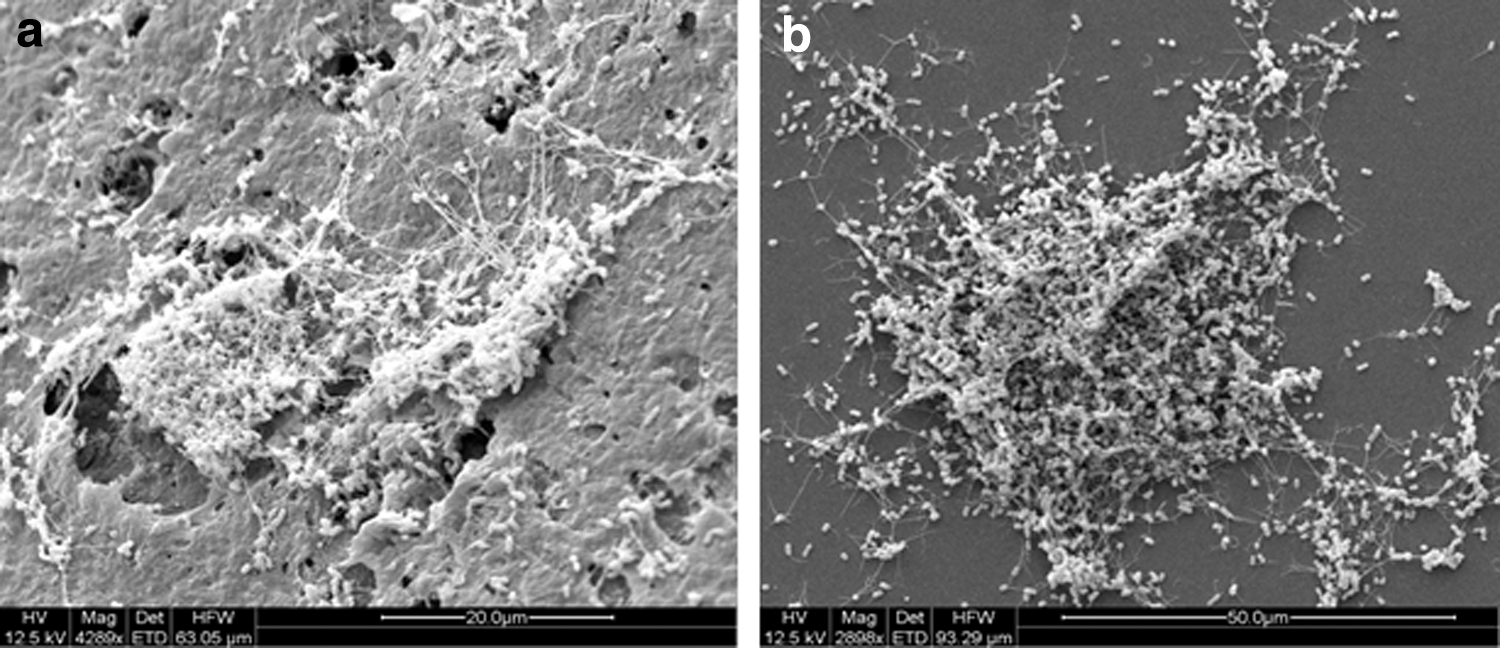
Biofilm of Salmonella Enteritidis.
Discussion
Although all strains were positive for both genes (csgD and adrA), just seven have expressed the matrix on the various cutting boards. This could have occurred because external factors can affect the biofilm formation. Besides, other genes can also be involved in biofilm formation. Stepanović et al. (2003) observed that the regulation of biofilm formation by Salmonella spp. is very complex because csgD expression is regulated by a dynamic interaction between nutrient flow and oxygen availability.
The cross-contamination between raw and processed foods by surface contact is hazardous because Salmonella can adhere to the surface and form a biofilm, resulting in a source of contamination (Adetunji and Isola, 2011; Carrasco et al., 2012). The adhesion of bacteria and subsequent biofilm formation depends on three factors, including bacterial cells, surface, and environmental factors. The surface of bacterial cells is negatively charged, making it adverse to adhesion due to strong electrostatic repulsion. However, the surface of many bacterial cells can have fimbriae, flagella, and lipopolysaccharides. Hydrophobic interactions between the surface of the cells and substrate can allow the cells to overcome the repulsive strength, resulting in adhesion and biofilm formation (Giaouris et al., 2014).
A variety of materials, such as wood, plastic, and glass are used as cutting boards, in food preparation. Thus, biofilm formation on hydrophobic (wood and plastic) and hydrophilic (glass) boards was analyzed. According to Stepanović et al. (2000) patterns, 70% of the strains could produce biofilm, as weak or moderate producers. Corroborating our results, Lu et al. (2011) found 62.9% of samples positive for biofilm formation and Stepanović et al. (2004) found similar results, while 72.9% were classified as biofilm producers. The extent of biofilm formation can vary significantly in the same species, between different strains, and serovars. Due to variation within species, together with other factors, such as the cutting board properties and nutrient availability, the same bacteria can produce a strong biofilm in one specific surface and be a weak producer in another (Srey et al., 2013). The highest production of biofilm occurred on wood (60%), followed by plastic and glass (40% and 10%, respectively). Studies carried out by Sinde and Carballo (2000) showed that Salmonella sp. and Listeria monocytogenes displayed better adhesion and biofilm production in hydrophobic than hydrophilic materials.
We can notice that those values were higher in wood and plastic than in glass. The physicochemical properties of the various materials used as cutting boards can influence the adhesion of microorganisms (Donlan and Costerton, 2002). Stepanović et al. (2004) reported that Salmonella showed a high capacity for biofilm formation on plastic boards. On evaluating biofilm formation by Listeria monocytogenes and Listeria spp. on wood, stainless steel, and glass boards, Adetunji and Isola (2011) found a higher biofilm formation on the wood surface. However, on evaluating biofilm formation by Salmonella spat various temperatures and on various materials, Oliveira et al. (2014) observed the highest number of nonbiofilm producing strains on glass, as found in our study.
In developed countries, there has been a decrease in the use of wooden boards as food contact surfaces because it is a porous, absorbent, and organic material that can be readily penetrated by bacteria, promoting cross-contamination incidents through acting as an important vehicle for the spread of pathogenic microorganisms responsible for foodborne infection (Adetunji and Isola, 2011). Conversely, glass would be the most indicated material for food handling boards due to its smooth surface and corrosion resistance, but it is a dangerous material due to splinters (Adetunji and Isola, 2011; Srey et al., 2013).
As we can observe in Table 2, as expected in cross-contamination assays, all isolates were recovered from all kinds of unwashed boards after contact with the contaminated poultry. After washing, the wooden board showed the highest positivity and the lowest positivity was observed on plastic and glass boards, respectively. Cogan et al. (1999) demonstrated that hygienic treatment of contact boards decreased cross-contamination by Campylobacter and Salmonella. Barker et al. (2003), who concluded that washing the utensils with a combination of water and detergent decreased the risk of microbiological contamination, described similar results.
Salmonella Enteritidis cells were recovered equally from cucumbers and from the various cutting boards, before and after washing and in the presence or absence of biofilm (Table 2). After the handling of contaminated poultry in cutting boards, Ravishankar et al. (2010) recovered lower Salmonella counts from them after cleaning with detergent, hot water, and scrubbing, as well as from the lettuce subsequently handled on these boards, showing this procedure helps in decreasing cross-contamination incidents on cutting board, but does not eliminate it. Soares et al. (2012) also observed a significant decrease in the contamination of cutting boards and in the number of Salmonella cells recovered from tomato samples using the same cleaning technique. These results demonstrated that this procedure decreased contamination but was not efficient in the complete removal of those pathogenic cells.
It has been noted that outbreaks of Salmonella spp. related to cross-contamination are likely because bacterial cells remain viable on the contact surface for a long period (Carrasco et al., 2012). Salmonella was recovered from cucumbers handled on cutting boards in the presence of biofilm before and after washing, showing how essential are hygienic practices during food handling to avoid cross-contamination and biofilm formation. Previous authors who used Salmonella in cross-contamination tests, such as Moore et al. (2007), Ravishankar et al. (2010), and Soares et al. (2012), also obtained these results, but they did not use biofilms.
All boards in contact with foods are likely to be colonized by microorganisms if hygienic practices are not properly carried out. Moreover, biofilms are known for their resistance to antimicrobials and sanitizing action, rendering them difficult to eradicate.
Conclusion
The presence of Salmonella Enteritidis on cucumbers handled on cutting boards with biofilm demonstrated the risk of cross-contamination during food handling. Given that cutting boards influence the capacity of bacteria to adhere and form a biofilm, they should be regularly sanitized. Moreover, plastic and glass are better materials for food handling boards, and it is highly recommended to avoid the use of wooden boards.
Footnotes
Acknowledgment
D.S.T.A. had a fellowship from Capes (Coordenação de Aperfeiçoamento de Pessoal de Nível Superior).
Disclosure Statement
No competing financial interests exist.