




Abstract
Salmonella Typhimurium is a common cause of foodborne illness in Australia. We report on seven outbreaks of Salmonella Typhimurium multilocus variable-number tandem-repeat analysis (MLVA) 03-26-13-08-523 (European convention 2-24-12-7-0212) in three Australian states and territories investigated between November 2015 and March 2016. We identified a common egg grading facility in five of the outbreaks. While no Salmonella Typhimurium was detected at the grading facility and eggs could not be traced back to a particular farm, whole genome sequencing (WGS) of isolates from cases from all seven outbreaks indicated a common source. WGS was able to provide higher discriminatory power than MLVA and will likely link more Salmonella Typhimurium cases between states and territories in the future. National harmonization of Salmonella surveillance is important for effective implementation of WGS for Salmonella outbreak investigations.
Introduction
T
Although Salmonella Typhimurium is believed to be endemic in layer flocks in Australia, there is no ongoing, systematic national surveillance of Salmonella in poultry farms (Chousalkar et al., 2016). Commercial egg farms and grading facilities are subject to a number of regulatory controls, including audits and inspections, which aim to ensure adequate biosecurity and food safety accountability in egg production to minimize Salmonella prevalence (Food Standards Australia New Zealand, 2012; Chousalkar et al., 2017). Additional standards at retail level provide through chain food safety control of egg-based foods. Despite these controls, outbreaks associated with eggs and raw egg products have increased across Australia, and ∼37% of sporadic Salmonella cases and 59% of Salmonella outbreak cases have been attributed to eggs (Glass et al., 2016; Moffatt et al., 2016; OzFoodNet Working Group, 2016a).
As Salmonella Typhimurium is the most common serotype in Australia, reference laboratories routinely perform multilocus variable-number tandem-repeat analysis (MLVA) for Salmonella Typhimurium isolates to help detect and investigate outbreaks. MLVA has been particularly useful in trace-back investigations of Salmonella Typhimurium outbreaks associated with eggs (Chousalkar et al., 2017).
Whole genome sequencing (WGS) has also shown to enable dramatic improvements in linking Salmonella cases related to outbreaks, as well as attributing potential food or environmental sources and tracing back to production. WGS has recently been applied to several nontyphoidal S. enterica outbreak investigations internationally (Angelo et al., 2015; Ashton et al., 2015; Inns et al., 2015, 2017). While not yet routinely performed on all nontyphoidal S. enterica isolates in Australia, WGS has been used in outbreaks and research studies.
Between November 2015 and March 2016, seven localized outbreaks of Salmonella Typhimurium MLVA type 03-26-13-08-523 (European convention 2-24-12-7-0212) were identified and investigated by Australian state and territory agencies: three in New South Wales, two in the Australian Capital Territory, and two in Queensland. Before these outbreaks, this MLVA profile was uncommon and had only once been associated with a notified outbreak in Australia (OzFoodNet Working Group, 2016b). Investigations into these seven outbreaks were initiated to identify the source of infection and implement control measures to prevent further cases. In this report, we describe the epidemiological and environmental investigations of these outbreaks and examine relatedness using WGS results, with the aim to provide further evidence of egg-associated salmonellosis in Australia.
Materials and Methods
Epidemiological investigations
Each outbreak was investigated by local public health officials. We defined an outbreak as two or more cases of Salmonella Typhimurium 03-26-13-08-523 who consumed a common food, or food from a common place. Outbreak-associated human cases were first identified locally from three sources: (1) following presentations of patients with gastroenteritis at a local emergency department, (2) from notifications of Salmonella infection either through routine case interviews or MLVA profiles, or (3) through the submission of a food complaint to food regulators.
Separate case definitions were generated for each of the outbreaks (Supplementary Table S1; Supplementary Data are available online at
Data entry, tabulation, and analysis were completed in Microsoft Excel. Tables were constructed to compare the attack rates of gastroenteritis for persons exposed and not exposed to each food item, followed by the calculation of univariate relative risks (RR) and 95% confidence intervals (CIs) for individual exposures to illness. The public health unit where the outbreak occurred led the individual outbreak investigations.
Food and environmental investigations
Food safety authorities in the affected states and territory inspected the implicated food premises. Where possible, food or environmental samples were collected for testing. The inspections and sampling at these premises aimed to identify any food safety hazards and detect contamination in food or the environment of the premises. We also conducted egg trace-back at the implicated food premises to identify if they were using a common egg supplier. We inspected an egg grading facility and the newest layer flock shed on the layer farm next to the grading facility, where we collected samples of chicken feces, feed, egg, and environmental swabs.
Microbiological investigation
The food and environmental samples collected from the implicated food premises in each outbreak were tested in the state or territory in which the outbreak occurred. Swab samples from the egg grading facility were tested using a modified Australian Standard 5013.10 (Standards Australia, 2009). This method incorporates nonselective liquid resuscitation and then screening for the presence of Salmonella using a commercial polymerase chain reaction kit. Liquid resuscitation broths positive for Salmonella are confirmed culturally using liquid selective enrichment and solid selective media for the isolation of Salmonella. Typical colonies were inoculated onto plate count agar and individual colonies confirmed by matrix-assisted laser desorption/ionization time of flight mass spectrometry. Confirmed Salmonella isolates from the grading facility were sent to the Microbiological Diagnostic Unit Public Health Laboratory (MDU PHL) for serotyping.
A number of isolates associated with these outbreaks were sequenced as part of a study to prospectively WGS Salmonella Typhimurium in the Australian Capital Territory (Ford et al., 2018). Serotyping and MLVA of the isolates were completed at MDU PHL in Victoria, the Institute for Clinical Pathology and Medical Research (ICPMR) in New South Wales, or Queensland Health Forensic and Scientific Services. Briefly, the antigenic formulae of isolates were determined using antisera and serotyped in accordance with the White-Kauffman-Le Minor scheme (Issenhuth-Jeanjean et al., 2014), and MLVA was performed as previously described (Lindstedt et al., 2004).
Sequenced isolates were then subcultured for purity, DNA extracted using Presto Mini gDNA Bacteria kit (GeneAid), and DNA libraries prepared using the Illumina Nextera XT kit (Illumina, Inc.). WGS was performed using the Illumina NextSeq 500 platform with 2 × 150 bp paired—end chemistry. The “Nullarbor” pipeline (
While this study aimed to prospectively WGS all Salmonella Typhimurium 03-26-13-08-523 isolates from the Australian Capital Territory, sequencing was not performed in real time. Isolates from outbreaks in Queensland were sequenced at MDU PHL and added into the analysis after the outbreaks had been identified and investigated. Additional isolates from outbreaks in New South Wales were sequenced just for this study at ICPMR and added into the analysis retrospectively.
Results
Epidemiological investigations
Between October 2015 and March 2016, there were 272 cases of Salmonella Typhimurium 03-26-13-08-523 notified in the Australian Capital Territory, New South Wales, and Queensland (Fig. 1). Of these, 115 (42%) cases were linked to 1 of 7 point-source outbreaks, with outbreak size ranging from 2 to 81 cases. In a cohort study of the first outbreak, persons eating mayonnaise containing raw egg were 3.6 times (RR 3.6, 95% CI 1.04-12.3) more likely to have developed illness than those who did not report eating the mayonnaise. In case interviews, cases linked to 3 of the other outbreaks also reported eating foods containing eggs at the implicated food premises. We did not identify a single suspected food source through case interviews in the remaining 3 outbreaks (Table 1).
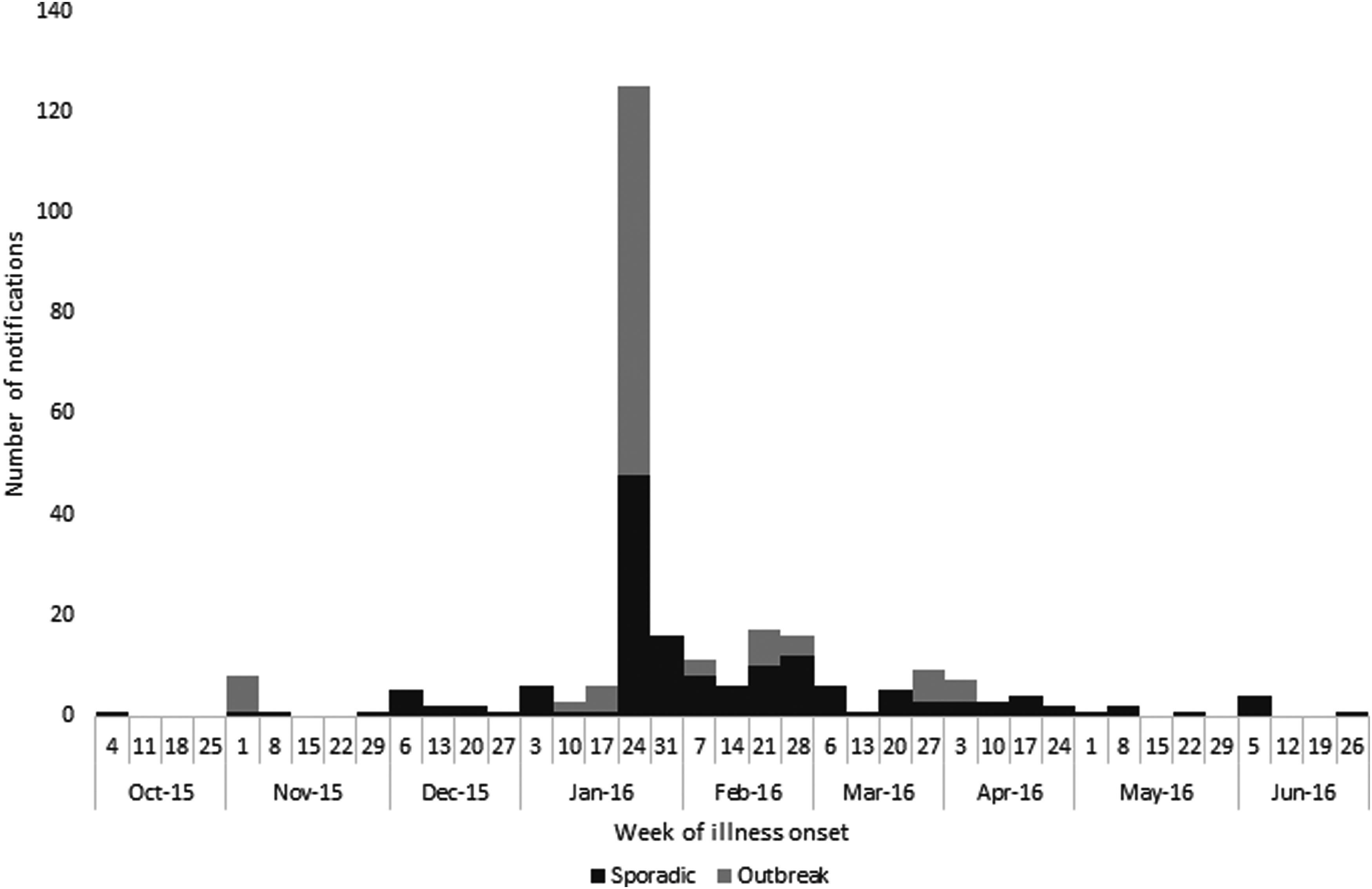
Epidemic curve of sporadic and outbreak Salmonella Typhimurium 03-26-13-08-523 case notifications by week in the Australian Capital Territory, New South Wales, and Queensland, Australia, October 2015 to June 2016. If illness onset date was unknown, specimen collection date was used.
Outbreak case definitions can be found in the Supplementary Data.
ACT, Australian Capital Territory; NSW, New South Wales; QLD, Queensland.
Food and environmental investigations
In 3 outbreaks, environmental investigations identified contributing factors at the premises associated with the outbreaks, including the use of raw egg foods, poor hygiene, poor food storage, and a lack of food safety knowledge. In the other three outbreaks, no food safety compliance issues were identified in the environmental findings. Food samples were collected in five outbreaks and environmental samples in three outbreaks (Table 1 and Supplementary Table S2).
Trace-back investigation
We identified the eggs used at food premises in five of the seven outbreaks (Table 1). In all five, eggs were produced by company X. We used egg stamps and purchase invoices to trace back the eggs used in the five outbreaks to the same grading facility. During the inspection of the grading facility, no food safety compliance issues were identified. The grading facility processes ∼1 million cage, barn, and free-range eggs per day, including about 120,000 from a farm onsite and 800,000 eggs from 15 different farms. As egg packaging with farm establishment number was not available from any of the outbreaks, and eggs from more than one farm were processed at the same facility on the egg stamp date, trace-back to the individual farm level from egg stamps and invoices was not possible (Fig. 2).
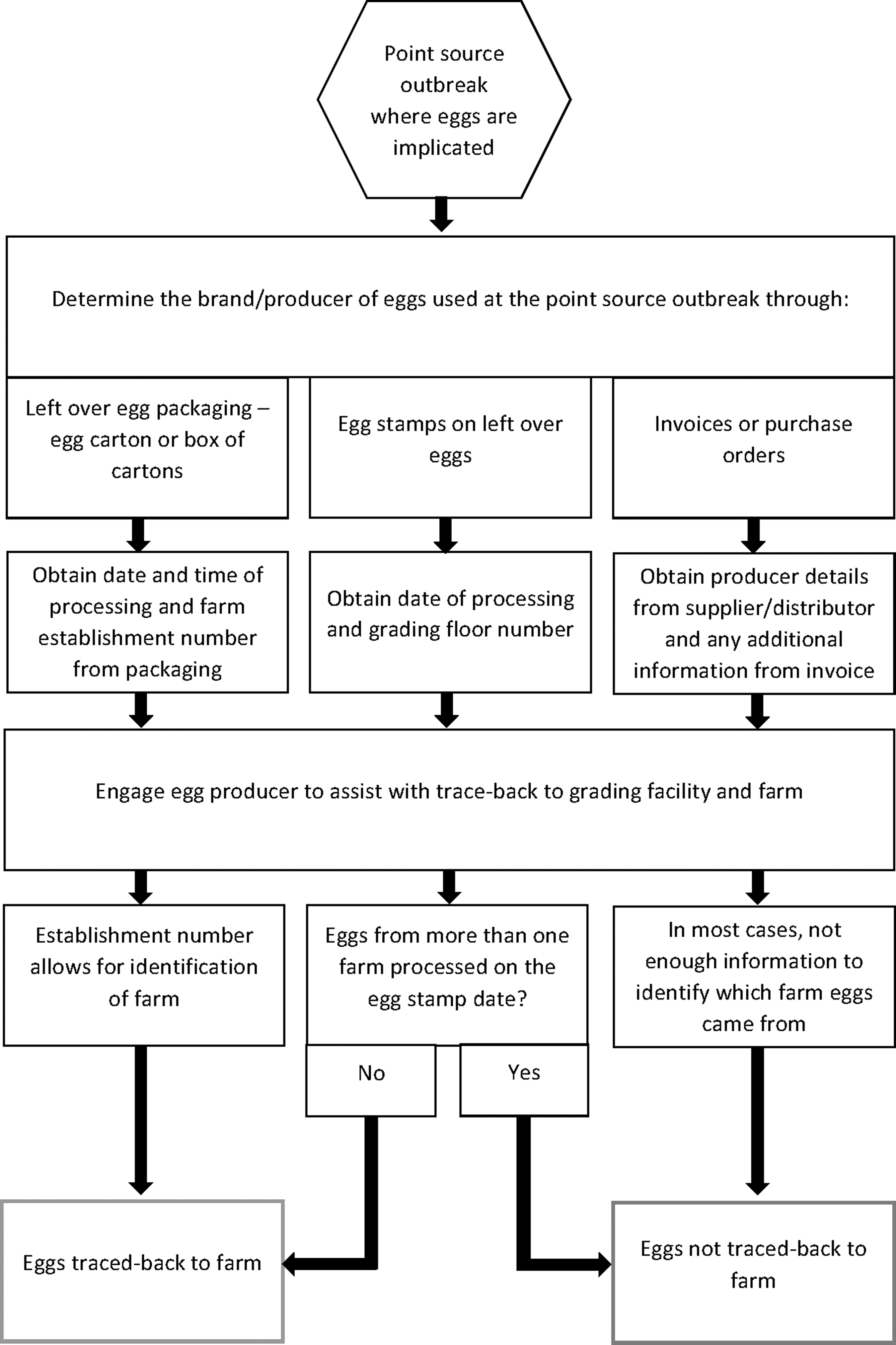
Flowchart describing egg trace-back process with a large commercial egg producer.
Microbiological investigation
Salmonella was only detected from food (ready-to eat salad items) and environmental samples collected from food premises in one outbreak (Table 1). Cross-contamination was suspected to be a contributing cause; so the 23 positive food and environmental samples detected in this outbreak were unable to indicate any one food as the source of contamination. A more detailed summary of each outbreak can be found in the Supplementary Data and Supplementary Tables 1 and 2.
Environmental swabs were taken from a new layer shed on one of the farms supplying eggs to the grading facility and from the grading facility itself, from chicken cloacae, a nesting rail, three egg conveyor belts, the preprocessed eggs, an egg pulp collection tub (prewash), and an egg pulp collection tub (postwash). Salmonella was cultured from the swab of the egg pulp collection tub (prewash). Of the three isolates serotyped, two were Salmonella subsp. I 16:I,v:- and one was Salmonella Singapore.
In total, 37 isolates of the outbreak MLVA profile were whole genome sequenced: 9 human isolates from the 2 outbreaks in the Australian Capital Territory, 13 human isolates from the 2 outbreaks in Queensland, 12 human isolates from the 3 outbreaks in New South Wales, and 2 food isolates (cucumber and onion) and 1 environmental swab isolate (mixing bowl) from 1 of the outbreaks in New South Wales. The isolates were clustered together and highly related, with 0–10 SNPs difference between all isolates tested (Fig. 3).
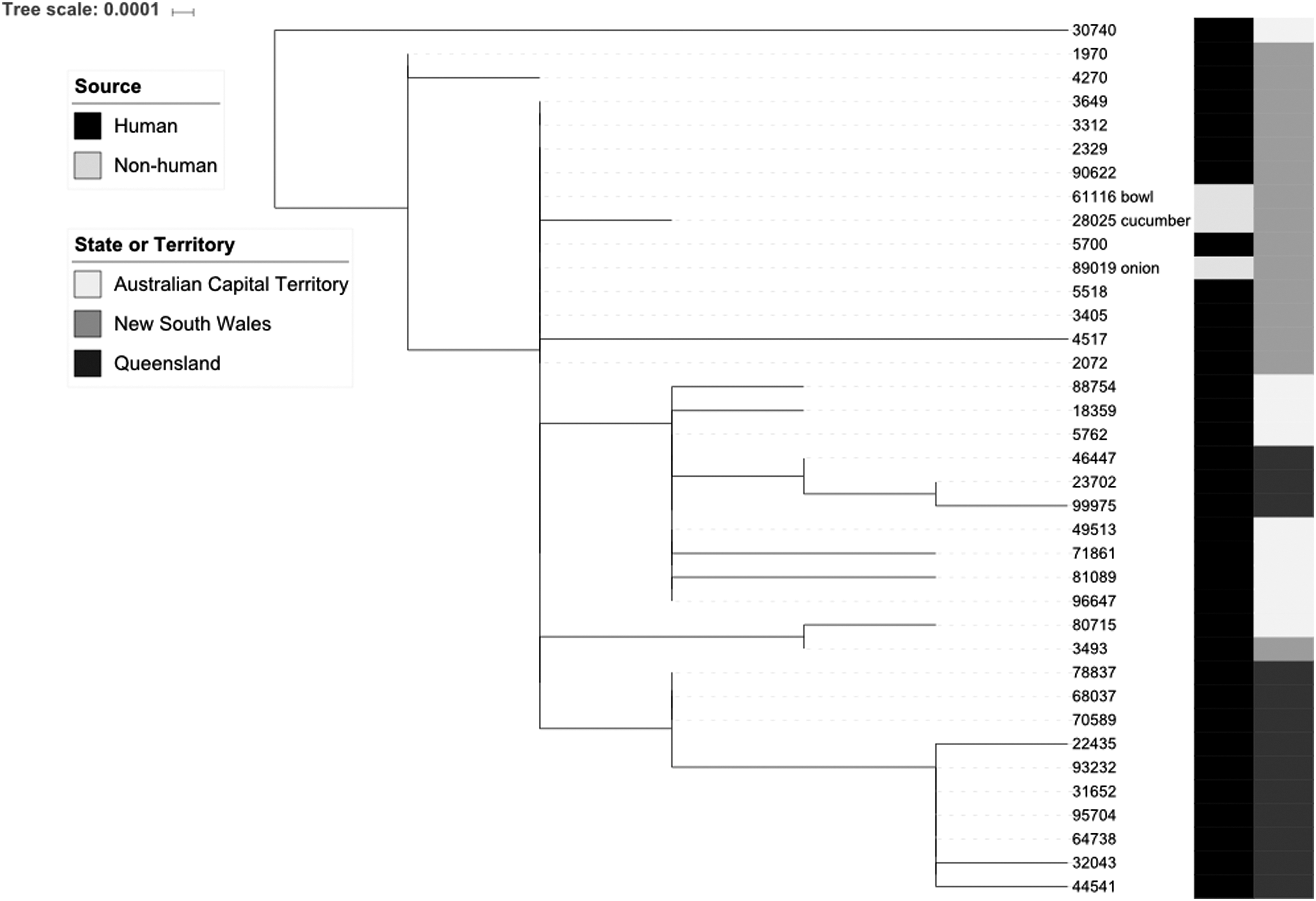
Maximum likelihood core genome SNP phylogeny of Salmonella Typhimurium 03-26-13-08-523 isolates from outbreaks in the ACT, QLD, and NSW, 2015–2016. Figure created with Interactive Tree of Life (iTOL) (
Discussion
WGS illustrates that human, food, and environmental isolates from seven outbreaks of Salmonella Typhimurium 03-26-13-08-523 across three Australian states and territories investigated between November and March 2016 were highly related. While MLVA and epidemiological investigations first identified the seven outbreaks and initiated investigations, WGS was able to provide significantly more discriminatory detail to show that outbreaks across jurisdictions were related. While systemic retail level failures were important contributing factors in several of the outbreaks and we were not able to definitively link the outbreaks through sampling, the WGS data and the food trace-back investigations suggest that the outbreaks were linked to a common source, likely to be eggs graded at the same facility. Salmonella Typhimurium 03-26-13-08-523 was not isolated from any samples at the egg grading facility; however, the facility was only sampled on one occasion.
These seven Australian outbreaks demonstrate how WGS can help to definitively link cases over wide geographic areas. This suggests that these outbreaks, and many Salmonella Typhimurium outbreaks occurring across Australia, (OzFoodNet Working Group, 2015) may not be isolated events, but associated with a common source. By linking more cases, WGS will help identify and prioritize these clusters for further investigation. If WGS is timely and cases can be linked together soon after their onset of illness, an outbreak can be detected and preventive measures taken sooner, ideally reducing the number of cases potentially affected. A limitation of this Australian investigation is that WGS results were not available in real time and were not used in immediate public health action. As Australia moves toward surveillance of nontyphoidal S. enterica using WGS, it will be important that Salmonella surveillance is harmonized nationally to effectively detect multistate outbreaks and take rapid public health action.
In this study, at the retail food service level, interventions were implemented in three outbreaks to address noncompliances with food safety standards (such as inadequate food handling practice) and to prevent further cases. Interventions such as these that target food handlers and the public to raise awareness about safe handling of eggs and raw egg products have helped to control Salmonella Typhimurium outbreaks (Stephens et al., 2007; Craig et al., 2013). At the production level, no interventions occurred due to these outbreaks. Eggs used by the individual food premises in this study could not be traced back to a specific farm without egg cartons or packaging. No specific reasons contributing to a higher prevalence of Salmonella on eggs were identified and Salmonella Typhimurium was not isolated at the grading facility.
Trace-back is often difficult, with a low prevalence of Salmonella, particularly Salmonella Typhimurium, on commercially produced eggs in Australia, and a failure to recover the outbreak strain on farms in 49% of Salmonella Typhimurium outbreaks where testing occurred between 2000 and 2011 (Daughtry et al., 2005; Chousalkar and Roberts, 2012; Moffatt et al., 2016). In addition, the egg distribution network is complex. Reducing the burden of egg-associated salmonellosis cases in Australia requires continued collaboration and communication between public health officers, food regulators, and industry groups to strengthen control measures at the point of production, at retail and wholesale, and at the consumer level (Craig et al., 2013; Moffatt et al., 2016).
To prevent egg-associated outbreaks such as the ones discussed in this study, additional Salmonella control measures across the supply chain, particularly at retail and on farm, have been implemented over the last few years. Some food safety regulators have implemented stronger requirements around the production and service of raw egg foods, including minimum levels for pH and maximum length of storage. This has been complemented by additional mandatory training for retail food service in cleaning and sanitizing procedures, use of raw egg foods, and general skills and knowledge. The Australian egg industry has increased the level of awareness of human salmonellosis as a significant issue. Strengthened industry education and food safety plans have been implemented, along with many laying flocks now vaccinated for Salmonella Typhimurium (Groves et al., 2016). Continued control measures are important for further prevention.
A limitation of this Australian outbreak investigation is that WGS was not performed on all human isolates during the time period with the outbreak MLVA and we could not exclude any outlier cases from the outbreaks. In addition, the impact of WGS data from food or environmental isolates on control measures at retail or production could not be evaluated, as it was not timely and no isolates from the egg grading facility were sequenced because none were typed as Salmonella Typhimurium.
In the United Kingdom, where isolates of Salmonella are routinely sequenced, WGS has been used successfully to investigate Salmonella outbreaks associated with eggs. Similar to the investigation described in this study, cases of Salmonella Enteritidis PT14b across the United Kingdom and Europe were found to be related through WGS and traced back to imported eggs from a German egg producer in 2014 (Inns et al., 2015). In addition, WGS of human and food isolates was used to retrospectively investigate an outbreak of Salmonella Typhimurium DT8 in the United Kingdom associated with a raw egg mayonnaise (Ashton et al., 2015). More recently, prospective WGS was used to help detect a Salmonella Enteritidis outbreak associated with eggs, including cases from the United Kingdom and Spain (Inns et al., 2017). In these examples and in the outbreaks described in this study, WGS has been a useful tool by providing improved discrimination, enhancing outbreak investigations occurring across states or countries, or assisting with trace-back and control measures.
While we were unable to link cases to eggs produced by company X through food and environmental testing at the grading facility, epidemiological evidence, egg trace-back, and WGS data indicate a likely common source for the cases in multiple-point source outbreaks occurring over several months in three Australian states and territories. The increase in egg-associated outbreaks and egg-associated salmonellosis since 2000 remains a concern in Australia (Moffatt et al., 2016). WGS is a tool that will provide more evidence to implement preventative measures at retail and at production, and will be most effective if WGS data are timely, nationally harmonized, and integrated with food and environmental isolates.
Footnotes
Acknowledgments
The authors would like to thank ACT Health, NSW Health, Queensland Health, and OzFoodNet. We would also like to thank the laboratories that performed the serotyping, MLVA, and WGS, including the ICPMR, the MDU PHL, and Queensland Health Forensic and Scientific Services. Doherty Applied Microbial Genomics is funded by the Department of Microbiology and Immunology at The University of Melbourne. The National Health and Medical Research Council, Australia, funded a Practitioner Fellowship GNT1105905 to B.P.H. and Project Grant GNT1129770 to B.P.H., D.A.W., and M.D.K. Finally, we would like to thank Milica Stefanovic and Sam McEwen for their contribution to this project. This research is supported by an Australian Government Research Training Program (RTP) Scholarship.
Disclosure Statement
No competing financial interests exist.
References
Supplementary Material
Please find the following supplemental material available below.
For Open Access articles published under a Creative Commons License, all supplemental material carries the same license as the article it is associated with.
For non-Open Access articles published, all supplemental material carries a non-exclusive license, and permission requests for re-use of supplemental material or any part of supplemental material shall be sent directly to the copyright owner as specified in the copyright notice associated with the article.
