




Abstract
Nontyphoidal Salmonella is an important foodborne pathogen with diverse serotypes occurring in animal and human populations. The prevalence of the organism on swine farms has been associated with numerous risk factors, and although there are strong veterinary public health controls for preventing Salmonella from entering food, there remains interest in eradicating or controlling the organism in the preharvest environment. In this study, using data collected via the U.S. Department of Agriculture (USDA) National Animal Health Monitoring System Swine 2012 study, we describe nontyphoidal Salmonella and specific serotype prevalence on U.S. grower–finisher swine operations and investigate associations between Salmonella detection and numerous factors via multiple correspondence analysis (MCA) and regression analysis. MCA plots, complementary to univariate analyses, display relationships between covariates and Salmonella detection at the farm level. In the univariate analysis, Salmonella detection varied with feed characteristics and farm management practices, reports of diseases on farms and vaccinations administered, and administration of certain antimicrobials. Results from the univariate analysis reinforce the importance of biosecurity in managing diseases and pathogens such as Salmonella on farms. All multivariable regression models for the likelihood of Salmonella detection were strongly affected by multicollinearity among variables, and only one variable, pelleted feed preparation, remained in the final model. The study was limited by its cross-sectional nature, timelines of data collection, and reliance on operator-reported data via a convenience sample.
Introduction
N
The objective of the current study was to characterize nontyphoidal Salmonella serotypes on U.S. swine farms with grower–finisher (G/F) pigs and to evaluate factors, or clusters of factors, associated with the organism's presence or absence using data collected via the U.S. Department of Agriculture (USDA) National Animal Health Monitoring System (NAHMS) Swine 2012 study. This study provides an update to previous USDA-NAHMS studies of factors associated with Salmonella prevalence on U.S. swine farms in 1995, 2000, and 2006 (Bush et al., 1999; Haley et al., 2012).
Methods
Study population and sampling
USDA-NAHMS conducts periodic studies of livestock commodities that typically include questionnaires of farm and animal health management and, for some species, collections of biological samples. Because one goal of USDA-NAHMS is to evaluate trends in health and management practices in animal production over time, the NAHMS Swine 2012 study questionnaires for farm management and animal health were very similar to previous NAHMS swine studies conducted in 2000 and 2006 (USDA-APHIS, 2009). Some of the participating states changed over the study periods; for example, of the 18 states that participated in either the 1995 or the 2012 studies, 11 states were the same, and 7 were different.
The NAHMS Swine 2012 study (USDA, 2015a, 2015b) was conducted from December 2011 through January 2013 and designed to represent ≥70% of U.S. swine operations and sites and ≥70% of the national inventory of pigs. For consistency with previous NAHMS studies, swine-producing operations with ≥100 pigs were eligible to voluntarily participate and were selected via stratified random sampling from the sampling frame of swine operations maintained by the USDA National Agricultural Statistics Service (NASS), stratified by state and herd size (USDA, 2015a, 2015b). The first phase of the study, a farm management survey (USDA, 2012a), was conducted by NASS; 2119 producers who voluntarily participated in the first phase were invited to participate in the second phase on animal health (USDA, 2012b) conducted between October 1, 2012 and January 31, 2013. Producers on 474 sites completed the second phase of the study; 330 of those maintained pigs in a G/F unit, that is, weaned market hogs weighing ≥60 pounds, and were eligible to have biological sampling conducted at their sites. Of these, 102 producers agreed to have sampling conducted and had questionnaires with complete data that were used in the current analysis.
Questionnaire data were collected to represent the farm or pen and were categorized as: (1) site characteristics and management, including rodent control, waste management, and sources and commingling of pigs; (2) health factors, including diseases reported and vaccinations administered within the previous year, and antimicrobial use and administration in the past 6 months; and (3) feed types and preparation. Some variables were dichotomized into an affirmative response (Yes), and a negative response (No or Don't Know). Categorical variables were also created for the number of diseases (0, 1–4, >4) and vaccinations (0, 1–6, >6) reported on a site.
Fecal samples were tested for Salmonella, Escherichia coli, and Enterococcus species. Up to 30 fresh pen-floor fecal samples from 6 different pens were collected per site. Samples were cooled immediately and shipped on ice within 24 hours to the USDA Agricultural Research Service, Athens, GA laboratory for culture and isolation. Laboratory methods have been described in full previously (Haley et al., 2012). In brief, for Salmonella isolation, fecal samples were enriched in selective media (GN Hajna; tetrathionate broth; Becton Dickinson and Co., Franklin Lakes, NJ) with the primary enrichment culture and then transferred for secondary selective enrichment and incubation to Rappaport-Vassiliadis R-10 broth. Broth from the secondary enrichment was streaked for isolation on selective agar (brilliant green sulfa and Xylose–Lysine–Tergitol-4) and incubated to produce presumptive Salmonella colonies, which were inoculated into triple sugar iron and lysine iron agar slants for biochemical confirmation. Up to three presumptive Salmonella colonies were serogrouped using serogroup-specific antisera. When all were of the same serogroup, a single isolate was selected for serotyping; if isolates differed by serogroup, one of each serogroup was submitted for serotyping. Antigenic formulae for somatic (O) and flagellar (H) antigens were used to determine serotype. Serotyping was performed at the National Veterinary Services Laboratory (Ames, IA).
Statistical analyses
Data from farm management and animal health surveys were merged with fecal sample testing results. Analyses were conducted at the farm level. If Salmonella was detected in at least one sample from a farm via culture and isolation, the farm was considered positive. All analyses were conducted with SAS and R statistical software (R Core Team, 2016; SAS Institute, Inc., 2017).
Multiple correspondence analysis (MCA), a multivariate exploratory technique for reduction and visualization of categorical data, was applied to farm-level variables to display relationships between covariates and Salmonella detection or nondetection (Greenacre, 1993; Sourial et al., 2010; SAS Institute, Inc., 2017). MCA is similar to principal component analysis (PCA) to create a low-dimensional representation of high-dimensional categorical data based on analysis of contingency tables. Inertia decomposition via MCA is analogous to variance decomposition in PCA, and reflects the relative variation accounted for in the canonical dimensions. In this study, the first two dimensions are displayed along with the percent of Greenacre-adjusted inertia relative to the total inertia for each dimension (SAS Institute, Inc., 2017). For MCA displays, covariates were categorized as: (1) reported diseases in the past year, (2) reported vaccinations in the past year, and (3) feed types, ingredients and processing.
In the univariate analysis, simple logistic regression was performed for Salmonella detection relative to each covariate. A significance level of p ≤ 0.20 was applied for covariate eligibility for testing in multivariable models. Multivariable modeling was conducted via multiple logistic regression. For all models, main effects and potential interaction terms were entered into models via a forward selection process. Selection of the “best” multivariable model was based on maintaining the maximum number of observations, coefficient significance (p ≤ 0.05), and minimizing the Schwartz Information Criteria.
Results
Questionnaire and pen-floor fecal sample data collected on 102 swine farms with G/F pigs in the NAHMS Swine 2012 study were used to evaluate Salmonella serotypes and risk factors for pathogen detection. From October 2012 through January 2013, 3012 fecal samples were collected from 461 pens on the 102 farms. Of these, Salmonella was cultured from 14.2% (429/3012) of samples, 31% (143/461) of pens, and 52.9% (54/102) of farms. There were 1134 Salmonella isolates derived from the 429 positive samples; of the isolates, 451 were serotyped and 29 different serotypes were identified. The top three serotypes (and percent farms positive) were Salmonella Typhimurium var 5- (21.6%), Salmonella Derby (18.6%), and S. I 4;[5];12;i- (11.7%) (Table 1). The number of different serotypes per farm ranged from one to seven.
Of the 3012 samples collected on 102 G/F farms, 1134 were positive for Salmonella via culture. Of the 1134 isolates, 451 were selected for serotyping.
G/F, grower–finisher.
The associations within groups of covariates and with Salmonella detection at the farm level are displayed in MCA plots (Figs. 1 –3). Covariates for diseases reported on farms (Fig. 1) were well-discriminated in Dimension 1 (along the horizontal axis) with points representing reports of disease presence (“_1”) visible to the right of the origin in Dimension 1 and reports of no disease to the left of the origin. Within the first two dimensions, detection of Salmonella (Fig. 1, Detect_1, lower right quadrant) was associated with operator reports in the past year of Glasser's disease (Glssr_1), porcine circovirus associated diseases (PCVAD_1), porcine reproductive and respiratory syndrome (PRRS_1), swine dysentery (Dys_1), atrophic rhinitis (AtrRh_1), and Salmonella (Salm_1). Similar clustering was apparent among covariates for reported vaccinations (Fig. 2). Salmonella detection was associated with vaccinating for Glasser's disease (Glssr_1), clostridial diseases (Clost_1), influenza (Flu_1), E. coli (Ecoli_1), and Leptospirosis (Lept_1). In addition to associations with disease and vaccination reporting, in both Figures 1 and 2, there appears to be greater variability (adjusted inertia) in two dimensions (horizontal and vertical axes) among variables for reporting diseases and Salmonella detection (Detect_1) when compared with not reporting diseases and nondetection (Detect_0).
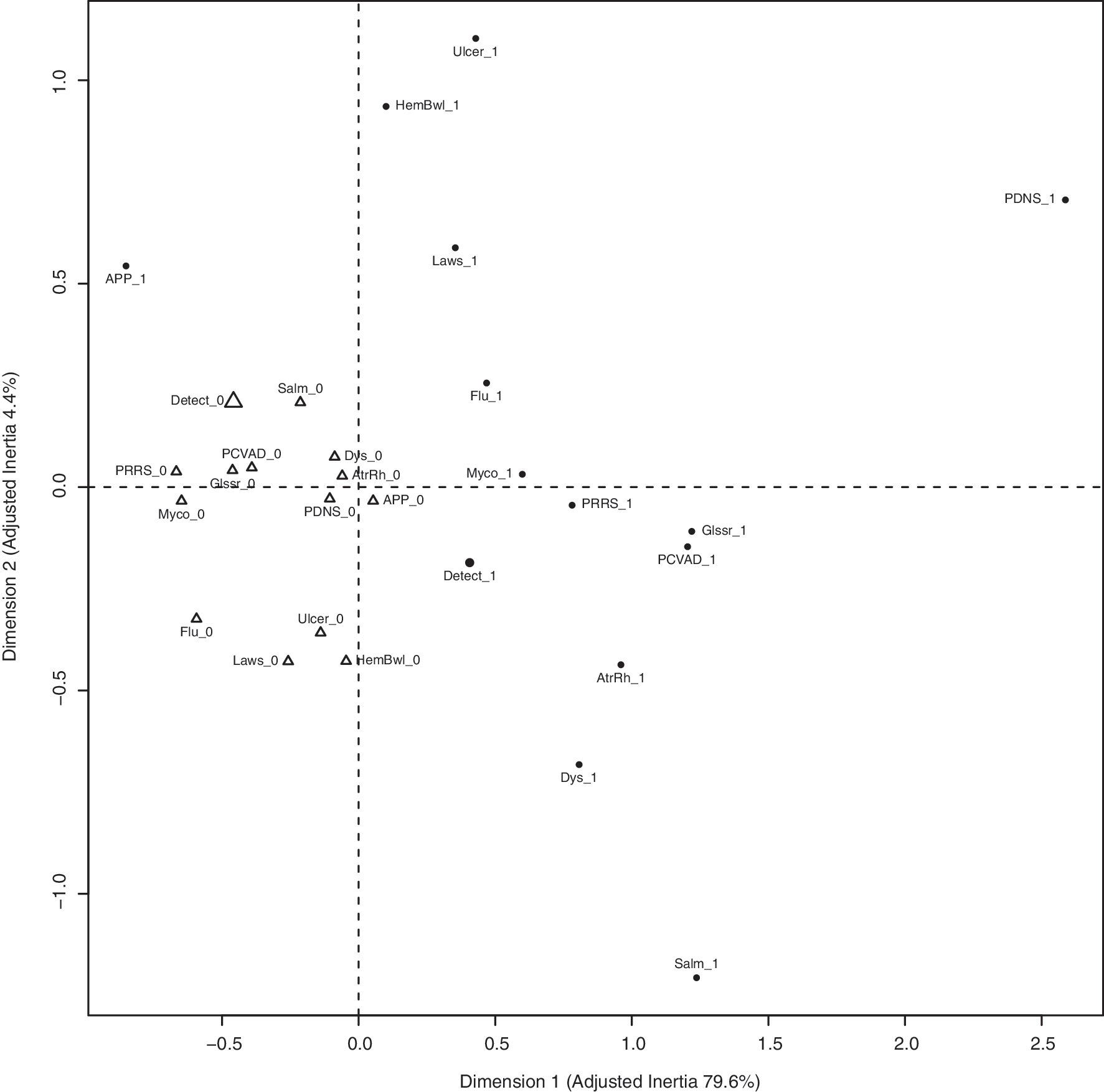
Relationship of Salmonella detection (Detect_0,1) and diseases reported on the farm in the past 12 months: Actinobacillus pleuropneumoniae (APP_0,1), Glasser's disease (Glssr_0,1), Mycoplasma hyopneumonia (Myco_0,1), Influenza (Flu_0,1), porcine reproductive and respiratory syndrome (PRRS_0,1), Salmonella disease (Salm_0,1), atrophic rhinitis (AtrRh_0,1), swine dysentery (Dys_0,1), hemorrhagic bowel syndrome (HemBwl_0,1), ileitis/Lawsonia intracellularis (Laws_0,1), gastric ulcers (Ulcer_0,1), porcine circovirus 2 (PCVAD_0,1), porcine dermatitis, and nephropathy syndrome (PDNS_0,1). For each operator-reported disease occurrence, “_1” indicates “Yes” and “_0” indicates “No or Don't Know.”
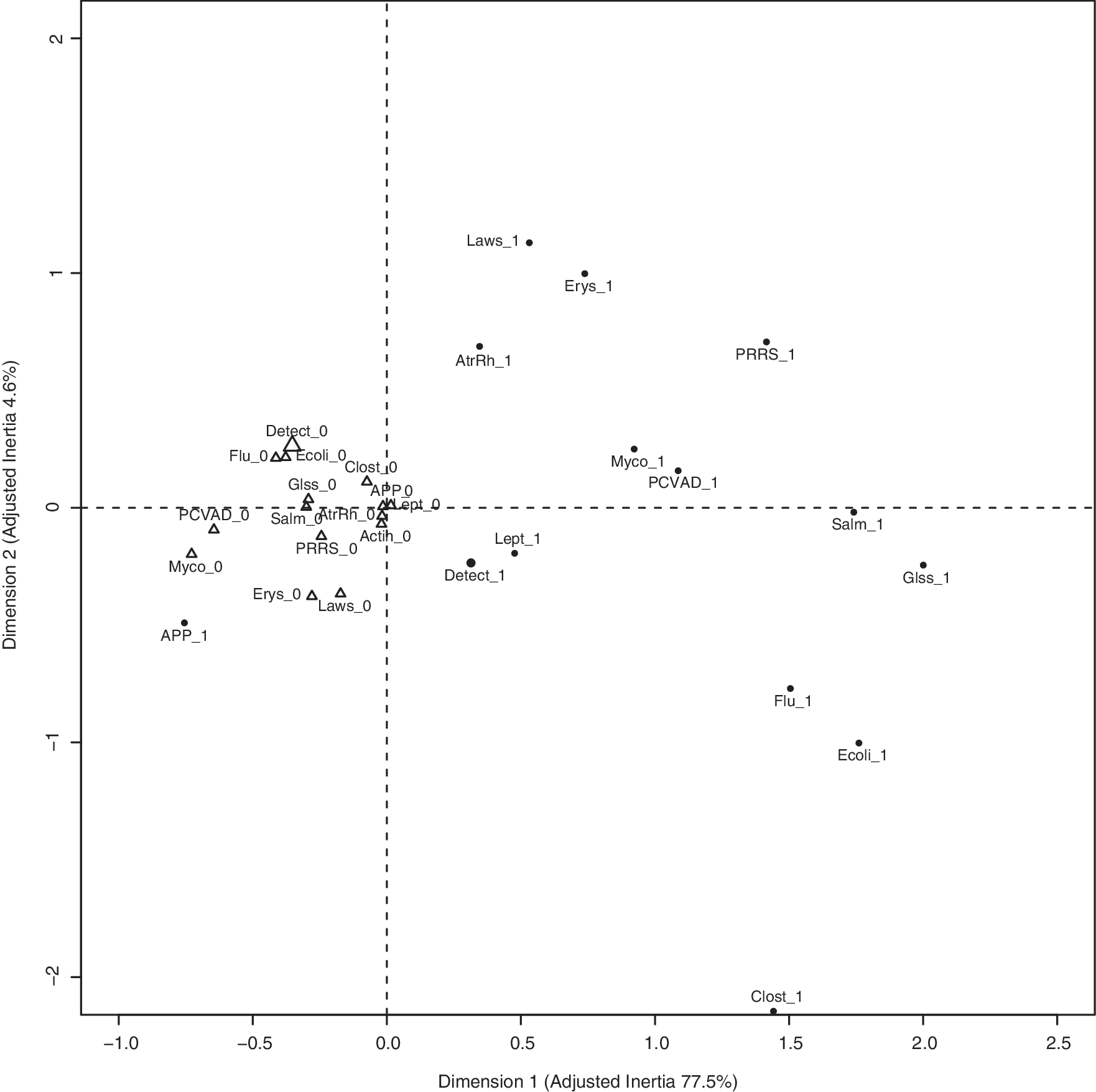
Relationship of Salmonella detection (Detect_0,1) and vaccination in the past 12 months for Actinobacillus pleuropneumoniae (APP_0,1), atrophic rhinitis (AtrRh_0,1), Clostridium spp. (Clost_0,1), Erysipelas (Erys_0,1), Escherichia coli (Ecoli_0,1), Glasser's disease (Glssr_0,1), ileitis/Lawsonia intracellularis (Laws_0,1), Influenza (Flu_0,1), Leptospirosis (Lepto_0,1), Mycoplasma hyopneumonia (Myco_0,1), porcine circovirus 2 (PCVAD_0,1), porcine reproductive and respiratory syndrome (PRRS_0,1), and Salmonella diseases (Salm_0,1). For each operator-reported vaccination administration, “_1” indicates “Yes” and “_0” indicates “No or Don't Know.”
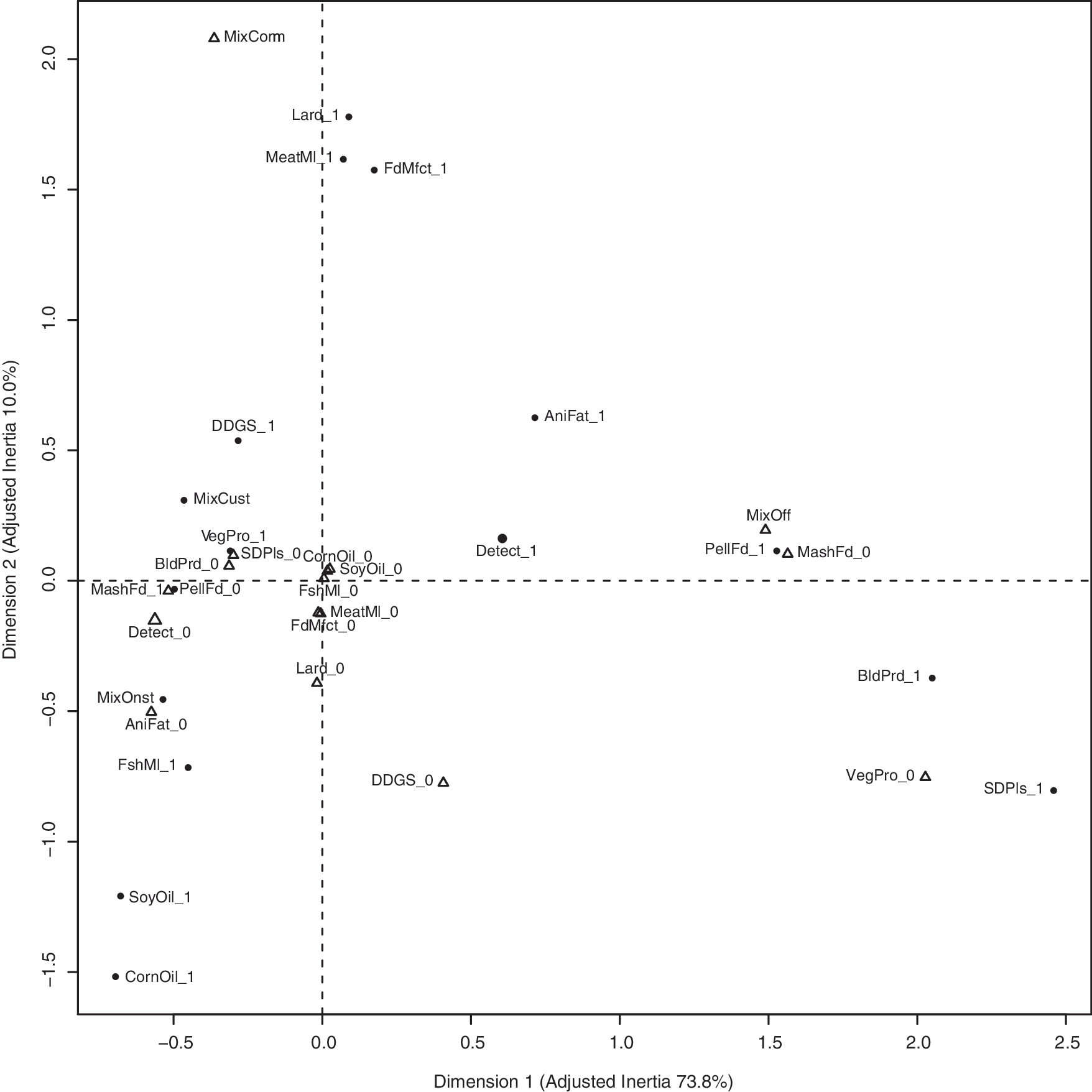
Relationship of Salmonella detection (Detect_0,1) and feed types and preparation: lard (Lard_0,1), animal fat (AniFat_0,1), soybean oil (SoyOil_0,1), corn oil (CornOil_0,1), spray-dried plasma (SDPls_0,1), blood products (BldPrd_0,1), fish meal (FshMl_0,1), meat meal (MeatMl_0,1), vegetable protein (VegPro_0,1), feed manufactured (FdMfct_0,1), dried distillers grains (DDGS_0,1); pelleted feed (PellFd_0,1), meal mash feed (MashFd_0,1), commercially mixed (MixComm), custom mixed (MixCust), mixed offsite (MixOff), mixed onsite (MixOnst). For each operator-reported response, “_1” indicates “Yes” and “_0” indicates “No or Don't Know.”
The MCA plot for feed types, ingredients, and preparation (Fig. 3) also indicates good discrimination in two dimensions and associations with Salmonella detection. On the horizontal access (points to the right of the origin, including Detect_1), Salmonella detection was associated with feeding some animal-based proteins and fats. Detection was most closely associated with pelleted feed preparation (PellFd_1); feeding animal fats (AniFat_1), Lard (Lard_1), and meat meal (MeatMl_1); and mixing feeds offsite (MixOff). Nondetection of Salmonella was associated with meal mash feeds (MashFd_1); feeding fish meal (FishMl_1), soy oil (SoyOil_1), and corn oil (CornOil_1); not feeding animal fats (AniFat_0); and mixing feeds onsite (MixOnst).
In the univariate farm-level analysis, many variables were independently associated with detection of Salmonella (Table 2, p ≤ 0.2, simple logistic regression). Elevated odds ratios (ORs) indicating potential risk factors were found with larger herd sizes, sites located in midwestern and eastern regions, larger number of diseases reported on sites, larger number of vaccinations administered on sites, pelleted feed preparation, feed proteins derived from animal products (e.g., blood meal and spray-dried plasma), and animal-derived sources of fats. Specific to reporting of Salmonella disease onsite, among those with operators who reported no occurrence or awareness of Salmonella onsite in the past year, 48% of sites had ≥1 positive sample. Among sites with operators who reported Salmonella disease on the site, 80% had ≥1 positive sample. Among operators of the 54 sites with Salmonella detected, 42 (78%) responded that Salmonella disease was not present or that they were not aware of it. Increased ORs were also found with administration of certain antimicrobials (tiamulin, lincomycin, and virginiamycin). Management practices, such as having an open facility type (providing natural ventilation with or without outdoor access for pigs) and rodent control via cats and traps, were associated with lower ORs. The logistic regression results complement those revealed and displayed in the multivariate correspondence analysis plots.
Odds ratios calculated via chi-square test rather than logistic regression due to zeroes in some cells.
CI, confidence interval; G/F, grower–finisher; PCVAD, porcine circovirus-associated diseases; PRRS, porcine reproductive and respiratory syndrome.
For multivariable models, determining a best-fitted model was heavily influenced by multicollinearity, and the covariate for pelleted feed formulation dominated all models. When the covariate for pelleted feed was included in any multivariable model, no other covariate from the univariate analysis met the criteria for remaining in the model.
Discussion
This study updates two earlier studies by USDA-NAHMS reporting Salmonella serotypes and factors associated with its prevalence on U.S. swine farms with G/F pigs (Bush et al., 1999; Haley et al., 2012). At 54%, the 2012 farm-level apparent prevalence was similar to that reported in the 2006 NAHMS study (52.6%) and higher than that in the 2000 (32.8%) and 1995 (38.2%) NAHMS studies (USDA-APHIS, 2009). Sample-level apparent prevalence was estimated at 14%. Estimates of Salmonella prevalence via pen-floor fecal sample culture may be influenced by serotype, intermittency of shedding, seasonal fluctuations, sample handling and processing, and test sensitivity (Rostagno and Callaway, 2012). Sensitivity for Salmonella detection based on fecal culture has been estimated at 92% (95% probability interval [75–99%]) (Wilkins et al., 2010), so, the true prevalence may have been slightly higher.
The serotypes recovered in 2012 were similar to those reported in 2000 and 2006 NAHMS studies. The Salmonella I 4;[5];12;i- serotype was first detected in the 2006 study, and its rank rose to the third most frequent in 2012. The pattern of increased detection of the Salmonella I 4;[5];12;i- serotype between the 2006 and 2012 studies is consistent with this serotype's emergence in other countries and animal species (Soyer et al., 2009) and among human cases in the United States between 2002 and 2013 (CDC, 2014, 2016; FDA, 2014).
MCA plots of the relationships between Salmonella detection and covariates suggest that detection tended to associate with reports of occurrence of some infectious diseases; however, there appeared to be tighter clustering of variables regarding absence of diseases with nondetection of Salmonella. In addition, Salmonella detection was associated with the administration of certain vaccinations and some feeding and farm management practices. The MCA plots depicting these associations and the compactness of clustering of Salmonella nondetection with absence of reported diseases and vaccinations on operations suggest that practices that reduce the presence of disease or need for vaccinations may also be effective in reducing Salmonella presence. Our results regarding vaccination are in contrast with those reported by Volkova et al. (2011), who found an association between administration of vaccinations and reduction of Salmonella prevalence in broiler flocks. They cite a possible multifactorial relationship, including improved chicken gastrointestinal tract physiology, immunostimulation lessening susceptibility to colonization by Salmonella, and reduction of concurrent immunosuppressive viral infections. In light of these conflicting results, further evaluation of the relationship between vaccinations and Salmonella prevalence in G/F pigs should be considered for future evaluation. Overall, these results reinforce the importance of biosecurity on swine farms and that the exclusion of pathogens and application of biosecurity measures may provide the best opportunities for mitigating the risks of introduction, establishment, and spread of foodborne pathogens such as Salmonella (Rostagno and Callaway, 2012; Andres and Davies, 2015).
Previous reports of risk factors for presence of Salmonella on swine farms included feed types and preparation, use of antibiotics, comorbidities, and presence of commensal pathogenic or nonpathogenic bacteria, larger herd size, certain facility factors, and sourcing and mixing of pigs (Rostagno and Callaway, 2012). Results of the univariate analyses in this study are consistent with previous reports. In this study, the variable for pelleted feed dominated all multivariable models at the farm level, and once it (or conversely, meal mash) was present in a multivariable model, no other variables were significantly associated with Salmonella detection. The relationship between increased Salmonella presence and pelleted feeds in finishing swine has previously been investigated, and a number of mechanisms have been hypothesized. These include reduction in digestion of coarse grains in nonpelleted feeds with subsequent fermentation in the large intestine, formation of volatile fatty acids, and lowered pH supporting a hostile growth environment for Salmonella (Lo Fo Wong et al., 2004). Two other feed-related variables that were significant in the univariate analysis, feed proteins derived from blood products as spray-dried plasma or blood meal/other blood ingredient, were not testable in multivariable models due to the small numbers of producers reporting their use. These feed ingredients may be important for further study, however, as all farms that fed blood-derived proteins had Salmonella detectable in fecal samples.
Operator-reported Salmonella disease on farms was positively associated with detection; however, Salmonella was detected on 48% of operations, where operators reported no Salmonella disease or awareness of it, and among the operations where Salmonella was detected, 78% of operators were not aware of it. These results are consistent with reports of subclinical carriage of Salmonella by pigs (Boyen et al., 2008), and subclinical colonization remains a challenge for management of Salmonella.
In this study, the relationships between Salmonella detection and antimicrobial use in G/F operations were complex, as the administration of different antimicrobials—tiamulin, lincomycin, virginiamycin—were significantly associated (p ≤ 0.05) with increased detection. Given the logistics and timelines of the study and the number and imprecision of measurements of antimicrobial covariates tested, it is possible that the reported associations are spurious or the result of confounding. However, relationships between antibiotic administration and Salmonella seroconversion have been previously reported (Beloeil et al., 2007) via a prospective study that demonstrated group-level antibiotic treatment of pigs during the fattening period was a risk factor for increased Salmonella seroprevalence. It has been hypothesized that antibiotic administration may have a damaging effect on the intestinal microbiome, resulting in decreased colonization resistance and providing Salmonella a competitive advantage for growth (Van der Wolf et al., 2001; Leontides et al., 2003; Beloeil et al., 2007).
There are several limitations to this study. This was a cross-sectional study based on a convenience sample, and associations within these types of studies do not establish causation. Because the reported prevalence and parameter estimates were derived from a convenience sample, they may not be nationally representative. Furthermore, covariate data were collected at the farm level, and therefore, the study has characteristics of an ecologic study, with associations between independent variables and outcomes measured at the group level rather than the individual level. There may also be a seasonal component to detecting prevalence of enteric pathogens and commensal pathogenic or nonpathogenic bacteria on farms and the seasonal effect with collections in the cooler winter months may have limited recovery of Salmonella in some farms in the study. Finally, in the interval between the completion of the farm management questionnaire and on-farm sampling, management practices may have changed.
In general, results from this study reinforce those reported from previous studies regarding the relationship of Salmonella prevalence and feeding pelleted feeds. In addition, several associations were revealed via MCA and regression analyses of Salmonella presence with other diseases and vaccinations on swine farms. These findings provide increasing evidence of the importance of the role of biosecurity in the preharvest environment for excluding and mitigating animal diseases and foodborne pathogens such as Salmonella.
Footnotes
Disclosure Statement
No competing financial interests exist.