




Abstract
Climate change is one of the major challenges of our time that pose unprecedented stress to the environment and threats to human health. The global impacts of climate change are vast, spanning from extreme weather events to changes in patterns and distribution of infectious diseases. Lack of rainfall associated with higher temperatures has a direct influence on agricultural production. This is compounded by a growing population forecasted to expand further with increasing needs for food and water. All this has led to the increasing use of wastewater worldwide. In this review, we more specifically discuss the use of untreated wastewater in agriculture in the Middle East and North Africa (MENA) countries, the most arid region in the world. This presents challenges for agriculture with respect to water availability and increasing wastewater use in agri-food chain. This in turn exerts pressures on the safety of food raised from such irrigated crops. Current practices in the MENA region indicate that ineffective water resource management, lack of water quality policies, and slow-paced wastewater management strategies continue to contribute to a decline in water resources and an increased unplanned use of black and graywater in agriculture. Radical actions are needed in the region to improve water and wastewater management to adapt to these impacts. In this regard, the 2006 WHO guidelines for the use of wastewater contain recommendations for the most effective solutions. They provide a step-by-step guide for series of appropriate health protection measures for microbial reduction targets of 6 log units for viral, bacterial, and protozoan pathogens, but these need to be combined with new varieties of crops that are drought and pest resistant. More research into economic local treatment procedures for wastewater in the region is warranted.
The Impact of Climate Change on Public Health and Agriculture
C
During extended global warming periods, agricultural yield will be detrimentally affected, posing risks to the quality and safety of food along with increased prices (Lake et al., 2012; Vermeulen et al., 2012). Water availability will affect food production differently depending on the geography of the region, the specific crops grown, and socioeconomic conditions of the population (Schmidhuber and Tubiello, 2007; Nunes et al., 2017). For instance, in sub-Saharan African countries, wheat was shown to be a susceptible crop; the current yield is projected to decline by 72% by the end of 21st century. Millet and sorghum are also affected by climate change and their yields are projected to decline <20% by the same period (Adhikari et al., 2015). More specifically, Taub et al. (2008) using meta-analysis projected that an increase in atmospheric CO2 reduced protein concentration in wheat, barley, rice, and potato from 10% to 15%, but less for soy (1.4%). The authors also noted that that extreme events such as the European flood events of 2002 and Hurricane Katrina in 2005 in the United States affected food safety and quality through exposure of agricultural land, groundwater, and surface water to heavy metals, agricultural residues, and hazardous wastes (including dioxins and polychlorinated biphenyls). Apart from atmospheric CO2 and periodic flooding, higher temperatures often have a negative effect, although variable, on growth and yields through less water availability that has to be compensated by the need for additional water sources, and drought-resistant crops (Adhikari et al., 2015; ICARDA, 2016).
Agriculture accounts for 70% of global freshwater use, and this is the most vulnerable of all sectors to water scarcity, particularly as urbanization is rapidly demanding more water resources away from agriculture (FAO, 2012). In addition to deforestation, urbanization, and overuse of aquifers, the scarcity is exacerbated by inappropriate land use (such as planning residential land in flood storage areas and inappropriate land disposal of trash and sewage effluent), chemical spills, leakage from storage tanks, transportation facilities, and overapplication and runoff of agricultural fertilizers (MED WWR WG, 2007; Xia et al., 2017). Frequent droughts combined with more frequent and intense wildfires will worsen the diminishing availability of water (MED WWR WG, 2007). However, as a climatic factor linked to using untreated sewage water or contaminated water sources for irrigation, frequent droughts may also predispose the crops, soil, and groundwater to microbial contamination (Yani and Alpas, 2017).
The use of contaminated water for crops will enhance the risk of foodborne and waterborne diseases (Hall et al., 2002; Lake et al., 2009). Increased rainfall through extreme weather events affects the distribution of human pathogens to crops and feed, and is likely to cause more diarrheal diseases as demonstrated in Nigeria and Ireland (Ahem et al., 2005; Tirado et al., 2010; Coffey et al., 2016; Yeni et al., 2017). Many outbreaks of known and emerging pathogens have been attributed to warmer temperatures around the world (D'Souza et al., 2004; Ukuku and Sapers, 2007; Lake et al., 2009; Miraglia et al., 2009; Tirado et al., 2010). For each rise in weekly temperature above 5°C, there is a 10% increase in the number of notifications of salmonellosis (D'Souza et al., 2004; Kovats et al., 2004).
The effects of climate change differ with the geographic location (Stewart et al., 2015) and the Middle East and North African countries (MENA) region is particularly affected as the most water scarce region in the world. In fact, much of the MENA region is expected to face “absolute” water scarcity by 2025 before most other countries (Abu Zeid, 2006). In this review, we delineate the impact of climate change effects on health and on agriculture, as a vulnerable sector. The review discusses the persistent challenges in the region with regard to water and wastewater issues and outlines the health implications of wastewater use in agri-food chain that could be exacerbated by the negative effects of climate change.
Use of Wastewater in Agriculture
Wastewater use and pathogen contamination of crops
In many regions of the world, wastewater is becoming an attractive option to address water scarcity and the need to conserve water resources (WWAP, 2017), and a tenth of the world's irrigated crops (3.5–20 million ha) are already watered by raw and untreated sewage or polluted river water (Pearce, 2004; van der Hoek, 2004; Jiménez, 2008). Wastewater consists of graywater, a combination of used water from domestic use, commercial establishments, including food processing plants, and institutions, including hospitals; industrial effluent, stormwater, and other urban sources; and agricultural, horticultural, and aquaculture runoff (UNEP and UN-Habitat 2010). However, wastewater may sometimes contain sewage (blackwater), knowingly or not to the user. Blackwater should be treated before it can be considered graywater (Hussain et al., 2002; van der Hoek et al., 2002; Raschid-Sally and Jayakody, 2008). Currently, over 80% of the wastewater generated globally flows back into the ecosystem without being treated or reused; this compares with about 30% in high-income countries (WWAP, 2017). In agriculture, land irrigated with unsafe wastewater is estimated to be ten times larger than the area using treated wastewater (Drechsel and Evans, 2010).
There are health concerns for untreated wastewater as a vector of chemical and biological hazards. Raw wastewater mainly comprises water (99.9%) together with relatively small concentrations of organic and inorganic solids (e.g., nitrogen, phosphorus, potassium compounds). It also contains a variety of inorganic substances and toxic elements from domestic and industrial sources and pathogens (van der Hoek et al., 2002). Heavy metals and some enteric pathogens can persist in water, wastewater, soil, and on crops up to 4 months in the case of Salmonella spp. and enteroviruses and many years for helminth eggs (Shuval, 2003). The extent of the concentrations of these differs with land use, seasons, regions, and countries (WHO, 2006). Although pathogens in wastewater are at much lower levels than coliform indicator organisms, they may be at high enough levels to contaminate food and lead to foodborne illnesses (FAO, 2008). Nonetheless, the distribution of many pathogens, including enteric pathogens such as Salmonella, Campylobacter, and Escherichia coli O157, is reliant on their capability to survive in different environments (Table 1) (FAO, 2008) and on climatological factors such as temperature and humidity (Hall et al., 2002; Lake et al., 2009). Similarly, the survival of hepatitis A virus (HAV) and poliovirus 1 is strongly affected by temperature (Nasser et al., 1993); regardless of the water type, the highest die-off of viruses was observed at 30°C, whereas at 10°C the titer of HAV and poliovirus 1 was reduced by 1 to 2 log10 after 90 days of incubation (Nasser et al., 1993). This research suggests that survival of pathogens in wastewater would be diminished in hot climates compared with those under colder conditions. Other studies have shown that concentrations per liter in municipal wastewater could be up to 7000 for pathogenic bacteria, 5000 for enteroviruses, 4500 for protozoa, and up to 600 for helminths (FAO, 1997).
Figures in brackets show the usual survival time (in days) in clean waters.
Source: FAO (1997).
The routes of transmission of pathogens to humans, particularly to highly exposed groups (e.g., farmers, their families, vendors, and local communities), can be direct through human contact with wastewater (ingestion through bathing and drinking or inhalation through aerosols) or indirectly through ingestion of contaminated crops during irrigation with wastewater (Fig. 1). Managing domestic animals on farms can expose workers to pathogens in fecal matter and wastewater, and contaminate feed and even resulting meat products (WHO, 2006). The major pathogens associated with the use of highly polluted water are E. coli and helminths whose resistant eggs can be found in the wastewater (Cifuentes, 1998; Amoah et al., 2007; Mara et al., 2007). The application of sewage effluents directly on land, both as a water source and fertilizer, has led to contaminated crops and human illnesses (Fatica and Schneider, 2011; Levantesi et al., 2012). Approximately 1.5 billion people in the world are infected by soil-transmitted helminths (Ascaris lumbricoides, Trichuris trichiura, and hookworm) (Bopda et al., 2016; WHO, 2017), and these may increase in countries with limited water sources (Fatica and Schneider, 2011; Levantesi et al., 2012).
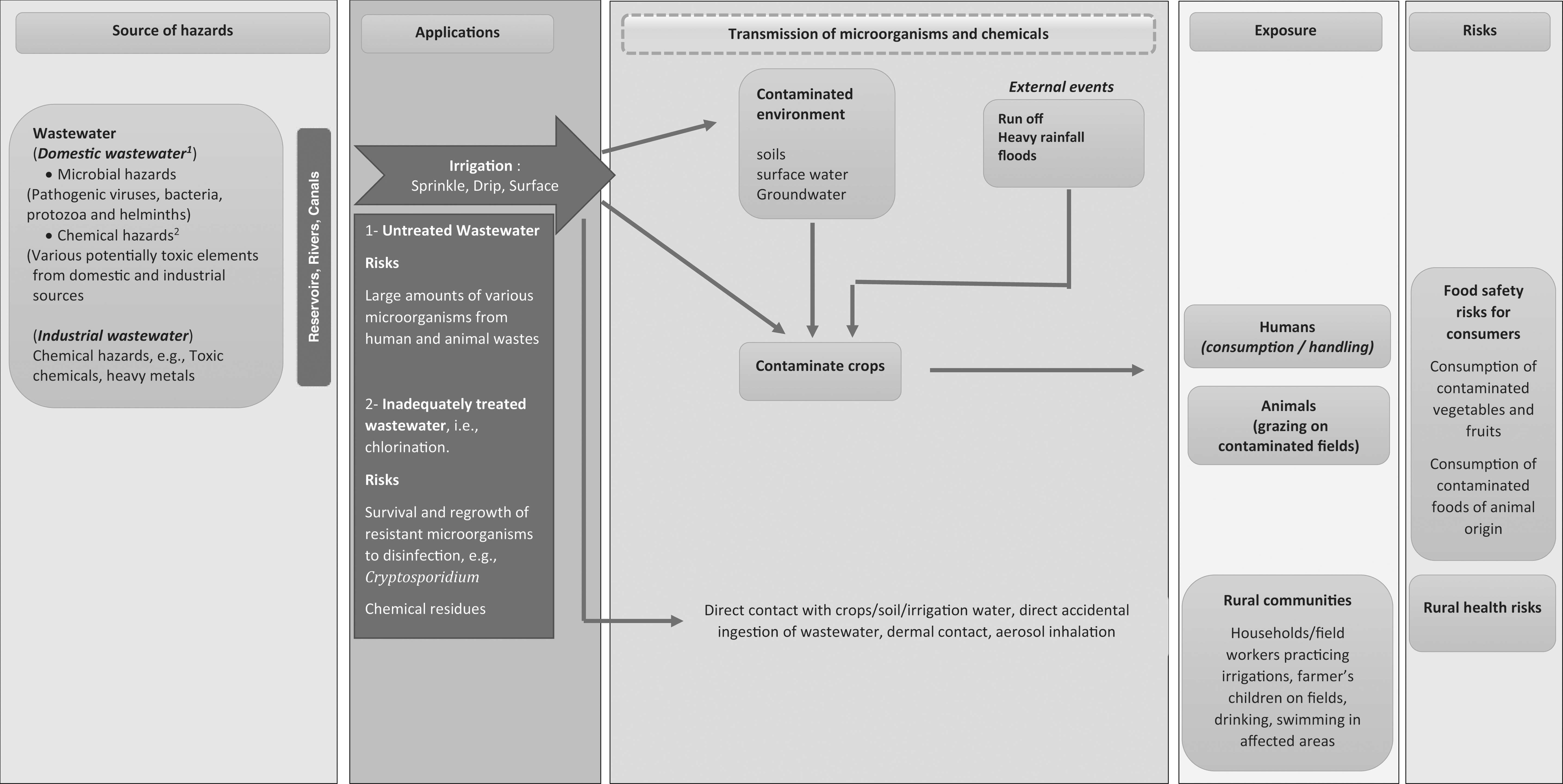
Exposure pathways to contaminants in wastewater via irrigation, floods, heavy rainfall, and crops. 1 In agricultural use of wastewater, the contaminants of greatest concern are usually the pathogenic micro- and macro-organisms. 2 Toxic materials may not be present in concentrations likely to affect humans, yet they might well be at phytotoxic levels.
Wastewater irrigation has also been implicated into transmitting Vibrio cholerae, Salmonella Typhi, and Shigella spp. through fresh salad crops irrigated with raw wastewater (Blumenthal and Peasey, 2002; Shuval, 2003; WHO, 2006). In Santiago, Chile (1977–1990), the number of typhoid fever cases peaked annually with the beginning of the irrigation season, following irrigation with raw wastewater of 16,000 ha of raw-consumed vegetables and salad crops, and also following the harvesting of sewage-irrigated vegetables (Shuval, 1984). In addition, fruits and vegetables are frequently contaminated with soil containing enteric pathogens arising from fields spread with manure or sewage sludge (Santamaria and Toranzos, 2003). Consuming contaminated crops, particularly raw or inadequately cooked, can lead to enteric (bacterial and viral origin) and intestinal parasitic infections (Cifuentes et al., 2000; Blumenthal and Peasey, 2002). This has been shown with Ascaris in Israel where salad crops or raw vegetables were consumed raw and irrigated with raw sewage (Shuval et al., 1985); levels of infection dropped dramatically when the supply of contaminated vegetables was cut off but increased again just as rapidly on reintroduction of the wastewater-irrigated crops. Cysticercosis infections in cattle in Australia and Denmark were related to their grazing on fields freshly irrigated with raw wastewater, or drinking from raw wastewater canals or ponds (Shuval et al., 1985). Several incidences of outbreaks of human gastroenteritis occurred after consumption of fruits and vegetables contaminated with Cyclospora and Giardia arising from water or raw sewage (Herwaldt and Ackers, 1997; Armon et al., 2002; Hoang et al., 2005) (Table 2).
Source: Adapted from WHO (2006).
TC, total coliforms.
Multiple factors influence the contamination level and the extent of the associated health risks with the use of wastewater in agriculture. The health risks vary with the types of crops grown, the irrigation method used, field ecological conditions, produce consumption rates, and plant anatomy (Amoah et al., 2007; Mok et al., 2014). For instance, crops that grow closer to soils such as root vegetables are much more susceptible to pathogen transmission from wastewater (Armon et al., 2002), and lettuce and other leafy green vegetables are likely to be more at risk of pathogenic contamination (Rosas et al., 1984; Solomon et al., 2002). Pathogens may attach to the leaves or be taken up by plant roots, and thus be incorporated into the edible plant tissue (Hirneisen et al., 2012; Ge et al., 2014; Wright et al., 2017). In fact, the increased risk of foodborne outbreaks has been linked to microbial internalization into crops grown on contaminated soil after storm or drought events (Ge et al., 2014). Fecal contamination levels in wastewater irrigated leafy vegetables such as spinach and lettuce may range between 103 and 107/100 g (Rosas et al., 1984; Anh et al., 2007), certainly high enough to cause infections (ICMSF, 1998). The health effects can also differ with water retention levels of crops; leafy vegetables such as lettuce and vegetables and cantaloupes with coarse surfaces retain higher amounts of irrigation water, compared with vegetables with soft surfaces such as bell pepper and cucumber (Shuval et al., 1997; Stine et al., 2005). Water retention levels were reported to be high on Chinese broccoli and flowering cabbage; the estimated risks for rotavirus contamination of these vegetables, including Chinese chard and lettuce, from wastewater reuse after overhead sprinkler irrigation in China exceeded the WHO guideline thresholds by 2–4 orders of magnitude (Mok et al., 2014).
Unfortunately, the link to human diseases and wastewater use has not been explored much in developing countries where wastewater is extensively used, including in the MENA region. Two studies in Australia and one in Israel showed that there were no adverse health effects of using graywater (Busgang et al., 2015), but these waters were not highly contaminated (e.g., 103 CFU fecal coliforms/100 mL in Israel) and none of these was used for irrigation of produce in developing countries (AL-Jaboobi et al., 2013). The appropriate use of municipal wastewater is planned in many MENA and other Mediterranean countries, Australia, Mexico, China, and the United States. However, there is no comprehensive inventory by country of the extent of treated or untreated wastewater used in agriculture (FAO, 2016). The economic, technical, regulatory, and institutional barriers and local cultures may limit the application of sophisticated treatment plants (Marvin et al., 2009; World Bank, 2010a) in view of other local priorities, such as securing access to safe drinking water and improving sanitation (Ensink and Hoek, 2007). The quality of the wastewater affects pathogen transmission to crops when coliforms can range from <103 to >105 CFU/100 mL (Castro de Esparza and Florez, 1990; Armon et al., 1994) and treatment of wastewater can substantially reduce bacterial levels. For instance, fecal coliforms decreased by 2 logs in biologically treated graywater compared with raw graywater (up to 7 logs), and if it was disinfected, typically no pathogens or indicator organisms remained (Table 3).
Numbers in brackets are typical mean orders of magnitude.
Source: Busgang et al., 2015.
n.d., nondetectable.
Water Scarcity and Water Resources and Its Management in the MENA Region
Water scarcity is characterized by a physical lack of water, the level of infrastructure development that controls storage, distribution, and access, and the institutional capacity to provide the necessary water services (FAO, 2012), and such deficiencies occur in many MENA countries (e.g., Egypt, Morocco, the Palestinian National Authority, Lebanon, and Tunisia) (OECD, 2010; Rached and Brooks, 2010; World Bank, 2010b; Abou Rayan and Djebedjian, 2016). Disputes over water lead to tension within communities, and unreliable water services are prompting people to migrate in search of better opportunities (Immerzeel et al., 2011). As the region's population continues to grow, per capita water availability will decrease 50% by 2050, and, if climate change affects weather and precipitation patterns as predicted, the MENA region may see more frequent and severe droughts and floods (Immerzeel et al., 2011). Gregoire (2012) assembled series of data from FAO and CRED (Centre for Research on the Epidemiology of Disasters) to present an imperative report on the increase in natural disasters in the MENA region. The results showed that the frequency of reported weather-related natural disasters more than doubled between the two periods 1988–1997 and 1998–2007, where 50 occurrences of droughts, floods, and extreme weather were reported in the former and 116 in the latter. Droughts have been associated with more intense rainfall, resulting in soil erosion, land degradation, excessive runoff, and flooding.
In the Arabian Peninsula and also in the Gaza Strip, the only sources of water are shrinking aquifers and costly desalination plants; overuse of aquifers in the past has led to saltwater intrusion, which limits their agricultural and urban use. Rivers provide irrigation sources in Egypt, Iraq, Iran, Sudan, Syria, Jordan, Lebanon, and the West Bank, but the water supply is mainly transboundary, which leads to international tension (Michel et al., 2012).
The overall conclusion for future decades of a study conducted as part of the World Bank initiative is that considerable changes in precipitation, increase in temperature above the global average (from <0.15°C to >1.7°C), and increased annual evapotranspiration are projected to occur in all MENA countries (Immerzeel et al., 2011). This will considerably affect the water availability in this region with an overall decrease in precipitation together with a higher evaporative demand (Immerzeel et al., 2011). The World Bank report concludes that the water shortage for the entire MENA region will be between about 40 and 200 km3, depending on the climate change projection for the period 2020–2030 based both on increases in demands and in reductions in supplies, increasing to 90–280 km3 per year in 2040–2050. To reduce the impact of these projections, the authors have proposed various strategies. Increasing the water supply is one that is certainly being done in many MENA countries; however, there may be economic or geographic/environmental limits to expand reservoir capacity or saltwater desalinization by means of using solar energy or fossil fuel. This is due to the lower unit cost of increased reuse of domestic and industrial water. Irrigation water can come from water already used for crops at $0.04/m3; and, depending on the type of treatment of domestic and industrial water, this can cost on average $0.30/m3 for irrigation reuse. This compares favorably with desalination by solar power ($1.50/m3 currently and $0.90/m3 in the future as technology is more efficient); desalination by fossil fuel is $1.00/m3 currently and will rise to $1.20/m3 in 2050 (Immerzeel et al., 2011). Farmers can also benefit from water stored in the soil (green water) as another strategy for productive water use.
Some countries have formally incorporated the Integrated Water Resources Management (IWRM) into their national water policies; nevertheless, institutional and regulatory reforms, and progress with respect to environmental monitoring and integration, climate change adaptation, stakeholder participation, knowledge sharing programs, and sustainable financing have not been adequately realized (AMCOW, 2012). Even though many MENA countries prohibit the agricultural use of untreated or partly treated wastewater, proper oversight remains a challenge (Qadir et al., 2007; Lazarova and Bahri, 2008; Faour-Klingbeil et al., 2016). The annual volume of wastewater discharged in untreated form in MENA countries is 57% of the total wastewater produced in the region; most of the partly treated, diluted, or untreated wastewater is used by urban and periurban farmers to grow a range of crops (Qadir et al., 2010). These numbers can largely differ among countries. For instance, treated wastewater currently represents approximately 5% of Tunisia's total available water; this is planned to increase to 11% by 2030 (Shetty, 2004). In Jordan, wastewater represents 10% of the current total water supply.
Wastewater used for irrigation in Pakistan contains high levels of E. coli and intestinal helminth eggs (Hussain et al., 2002). This is similar to high contamination levels of Giardia spp. and Ascaris eggs in mint, coriander, and lettuce in Morocco (Amahmid et al., 1999), Cryptosporidium oocysts and Giardia cysts in vegetables irrigated with raw sewage in Israel (Armon et al., 2002), and 35% of raw vegetables in Yemen irrigated with wastewater containing E. coli (AL-Jaboobi et al., 2013). Faruqui et al., (2004) found that 60% of farmers who produce vegetables in Dakar were infected with amoebae, roundworms, whipworm, or threadworms originating from wastewater. Aiat Melloul and Hassani (1999) reported an increase in Salmonella infection among children living in El Azzouzia, which was attributed to the widespread use of raw sewage in a Moroccan city. The authors indicated that the rate of Salmonella infection in the children of agricultural workers using untreated wastewater was significantly higher (39 · 33%) than in the children of nonagriculturists (24 · 58%), and higher in boys than girls, as the former were helping their parents on the field. High counts of S. aureus ≥5 log CFU/g have been found on vegetables, in the field or at the market, irrigated with untreated wastewater and polluted river water in Yemen, Lebanon, and Ghana, and chicken manure added as fertilizer may be one source (Aiat Melloul and Hassani, 1999; Pesewu et al., 2014; Faour-Klingbeil et al., 2016). Isolation of methicillin-resistant S. aureus from the raw sewage at treatment plants (Goldstein et al., 2012) strongly suggests that this pathogen should be of great concern in determining the health risks of wastewater use on crops.
The MENA region, in particular, is faced with the challenges of finding safe alternatives to freshwater to overcome water scarcity and the risks connected with the unplanned and uncontrolled wastewater irrigation. Graywater use has recently been a subject of intense discussions for its beneficial use to increase harvests and to economize on fertilizers along with resource conservation. However, to date, there has been no general consensus on its widespread use because of its potential public health risks for gastrointestinal diseases (Busgang et al., 2015). Several approaches have been planned to mitigate the health risks by controlling water and applications of strict regulations at the point of use and adoption of complex treatment technologies (WWAP, 2017). The WHO 2006 guidelines underscore how to use graywater based on the local risk assessment and health context. The guidelines propose the adoption of the most appropriate and effective measures. These measures can range from simple cessation of irrigation 2 days before harvesting to more sophisticated options such as constructed wetlands and waste stabilization ponds to improve the quality (Redwood, 2010). Crops irrigated with effluent from stabilization ponds with increased retention time from anaerobic pond through to the maturation pond had less contamination. Lettuce grown on soils containing >1200 Ascaris eggs had at harvest from the anaerobic pond more than 10 eggs/l, whereas <0.5 eggs and zero eggs were detected on lettuce from the facultative pond and maturation pond, respectively (Ayres et al., 1992). Stott et al. (1994) confirmed this finding by seeing lower contamination levels on crops (0.3 helminth egg per plant) and in the wastewater (from 10 to ≤1 egg/L) when wastewater quality was improved. Tertiary treatment of wastewater with chlorine improves the quality even further by eliminating most bacteria from treated effluent, including fecal coliforms (Reinthaler et al., 2003). However, the residual persistence of disinfection agents after the treatment is a recognized problem in wastewater sanitation. Some injured bacteria that are resistant to chlorine treatment may regrow under suitable conditions in water and pose public health risks (Rizzo et al., 2004). A study in Oman showed that treated sewage used for irrigation had the lowest counts of multiple antibiotic-resistant bacteria after chlorination, but their growth increased greatly when the chlorine concentration was decreased (Al-Bahry et al., 2009). Regrowth of indigenous bacteria in reclaimed water treated with low chlorine doses, after 24-h storage, was also reported by Li et al. (2013).
The AQUAREC 1 project proposes seven treatment-based quality categories for different types of reuse, with microbial and chemical limits for each category to be operating within a regulatory framework (Salgot and Huertas, 2006), indicating a serious approach to wastewater treatment and use in the European Union. A study in Oman showed the economic benefits and the enhanced agricultural yields of crops with the reuse of treated graywater and wastewater, whereas the ineffective treatment of sludge can lead to excessive amounts of heavy metals and antibiotic-resistant bacteria (Al-Bahry et al., 2014). Currently in the MENA region, formalizing the adoption of wastewater treatment is deterred by economic, social, and cultural reasons, and most importantly by policies that ignore these issues (Redwood, 2010). More specifically, apart from financial hurdles, there is social and cultural acceptability, limited physical resources for effective treatment, and inadequate knowledge of the environmental and health impacts (Scott et al., 2004; Qadir et al., 2009). These may be the reasons why few MENA countries have been able to implement substantial wastewater treatment and reuse programs, and what has been done in arid and semiarid areas is ineffective and falls back to unplanned and uncontrolled wastewater use, which in turn aggravates the burgeoning problem of water scarcity in the region (Qadir et al., 2009). In the water-scarce Gulf Cooperation Countries despite investments in secondary treatment plants, many facilities are overloaded and produce below quality effluent, due to changing population pressures and the time lag between the design and plant construction (UNESCWA, 2013). Investment plans overlooked the distinct climate conditions in those areas, which should be considered in planning and assessing the aerobic and anaerobic treatment options. Often, the effective implementation of wastewater treatment is hindered by a lack of coordination between national and municipal actors in sewerage networks, and water resource managers and operational staff of wastewater facilities (WWAP, 2017).
Lebanon is an example of a country in the MENA region that is endowed with significant water resources, but they are poorly managed. Only 8% of the wastewater is treated and the rest discharged into surface waters contaminating more pristine water sources with resulting risks to public health (Jurdi, 1992; BGR, 2013). To protect public health and facilitate the rational use of wastewater and excreta in agriculture and aquaculture, the WHO guidelines were first issued in 1973 and later updated in 1989 based on evidence of several epidemiological studies and potential microbial risks. In these 1989 guidelines, the microbiological standard for wastewater irrigation for crops consumed raw should achieve guideline concentrations of <1,000 fecal coliforms/100 mL, and <1 nematode egg/L. However, it became debatable if many developing countries could achieve these limits or conduct any approach to reduce the microbial risks relative to the significant costs of wastewater treatment, along with the lack of potable drinking water and appropriate sanitation (World Bank, 2010a). An acceptable level of risk in one country may not apply in another, and the reduction of the risk of helminth infections to nematode egg guideline level of ≤1 nematode egg/l by wastewater treatment may not apply to areas with high exposure to regularly flood-irrigated vegetables eaten by the local population (Blumenthal and Peasey, 2002). Thus, the application of quantitative microbial risk analysis (QMRA) to wastewater use in agriculture, and the DALY (disability-adjusted life year) metric to define the tolerable additional burden of disease and the comparison of disease burdens resulting from different health risks led to a revised version of WHO Guidelines for the Safe Use of Wastewater, Excreta and Greywater in 2006. This version, in addition to epidemiological studies, provided information on the assessment and management of risks associated with microbial hazards and chemical risks. The guidelines provide a practical approach to countries lacking means to develop wastewater treatment and to manage widespread irrigation with untreated wastewater. The current guidelines help countries evaluate what is a tolerable risk taking into consideration the unique social, economic, and environmental factors in each situation, rather than solely emphasizing the adoption of expensive treatment technologies to achieve standards (Einsik and van der Hoek, 2007). It adopted tolerable additional disease burden of ≤10–6 DALY/person/year for wastewater use in agriculture. This is achieved through microbial reduction targets of 6 log units for viral, bacterial, and protozoan pathogens by a combination of several appropriate health protection measures starting from wastewater generation to crop product consumption. Applications of these measures are associated with their own log reduction units that are practical locally to be able to achieve the DALY target (WHO, 2006).
Conclusion
This review illustrates that water resources are limited globally, and climate change projections point to increasingly higher temperatures coupled with larger urban centers demanding more water use. This puts pressure on existing agriculture practices to produce enough crops to feed local populations and generate export dollars. Since agriculture, particularly in arid regions such as MENA countries, uses much surface and groundwater, irrigation methods need to become more efficient, and recycling of wastewater is one approach that has been adopted to some extent by many countries. However, because wastewater may have been previously used for many purposes, it may contain pathogens and heavy metals. Unfortunately, epidemiological data are limited to showing links between human infections and those handling or consuming produce in contact with wastewater, and thus any local acute or chronic diseases claimed to be associated with wastewater can be considered speculative.
As global warming increases, we presume that health risks of wastewater use in agriculture may be exacerbated in the MENA region and other arid parts of the world due to an anticipated growing practice of wastewater irrigation practice to overcome water scarcity. From the regulatory perspective, clear water policies and implementation strategies that address water conservation and promote the use of treated wastewater in the agriculture sector are essential strategies for overcoming water scarcity and reducing the health risks. Building on the WHO (2006) guidelines for safe use of wastewater is important for governments to take seriously as a priority over other issues. Studies should be undertaken to measure more accurately short- and long-term risks of wastewater use in agriculture and to what extent infectious diseases and chronic illness are related to contamination of irrigated crops and washed produce. To reduce pathogen exposure, prevention and control strategies are feasible, if not always desirable by farmers. One is to avoid extensive use of untreated wastewater, at least for fresh produce. As already mentioned, many decades ago in Jerusalem when irrigation of vegetables and salad crops with wastewater was stopped, the number of cholera cases dropped dramatically (Shuval, 1984). Another approach is to limit its use to cereal crops or crops with products that have a terminal inactivation step like root crops that are cooked.
Excessive use of underground water and increasing dependence on food imports, threaten food security in the Arabian Peninsula. To combat desertification from wind and water erosion and salinization, ICARDA (2015) is bringing innovations in forage production combined with rangeland rehabilitation, with buffelgrass (Pennisetum ciliare) and spineless cactus (Opuntia ficus-indica x tuna) as well, as hydroponic irrigation systems for produce. Monocropping of wheat is further depleting soil fertility and increasing intensity of diseases and pests. Thus, many new improved varieties of bread and durum (Triticum spp.), fava beans (Vicia faba), chickpea (Cicer arietinum), and lentil (Lens culinaris) are being introduced by ICARDA (2016) and promoted to farmers along with their associated production technologies in MENA countries, with demonstrably higher yields and incomes. For instance, in Egypt, faba bean yield increased by 22.5%, in Lebanon, a winter chickpea, resistant to blight, drought, and cold, enabled farmers to see a 25% yield increase, and in Morocco, two new durum varieties introduced increased yield by >90%.
Coupled with improving safe and more efficient agricultural practices is the need for more use of treated wastewater that is economically attractive for developing countries, especially in arid or semiarid regions such as MENA. Because wastewater can consist of many sources, including some blackwater (human sewage and animal manure) (Naidoo et al., 2014), these should be categorized so that the appropriate treatment can be given for local use, including irrigation. Ways to maximize the beneficial use of wastewater nutrients but removing contaminants economically will be a challenge but should be researched for solutions. Water-saving drip-irrigation can be adopted for wastewater to reach roots without contamination of any edible components of some crops, as long as parasites, heavy metals, and other chemicals do not build up in the soil to render future crop growing and harvesting unproductive and unsafe.
Hydroponic applications with wastewater should also be explored for certain crops. Predicting extreme weather events, including hurricanes, may allow farmers to prepare for flooding, both on the short term and long term, with subsidies for more rapid drainage to avoid soil erosion, and also capturing infrequent but torrential downpours into reservoirs. Risks to public health from exposure of potable water and food to contaminated wastewater need to be better measured through ongoing surveys and surveillance studies for both microbiological and chemical hazards. More accurate public health information, local agricultural and processing practices, retailing and consumer preferences, and population knowledge will lead to better modeling of advance strategies for us to live with climate change and the need to both conserve potable water and to recycle already used water safely.
Footnotes
Disclosure Statement
No competing financial interests exist.