




Abstract
Our investigation focused on foodborne outbreaks related to meat and meat products, published in peer-reviewed journals in the period 1980–2015. Most of the outbreaks, investigated in this study, were caused by Escherichia coli and Salmonella, causing 33 and 21 outbreaks, respectively, mostly in Europe and the United States. In the E. coli outbreaks, the total number of reported cases was 1966, of which 1543 were laboratory confirmed. The number of cases requiring hospitalization was 476, of whom 233 cases had a hemolytic-uremic syndrome (HUS), and the reported deaths were 32. All of the E. coli outbreaks, except four, were caused by serovar O157:H7. The other four outbreaks were caused by the following serovars: O111:H8, O26:H11, O111, and O103:H25. Fresh processed meat products were the category most frequently implicated. In the Salmonella outbreaks, the total number of all reported cases was 2279, of whom 1891 were laboratory confirmed. The number of reported cases requiring hospitalization was 94, and seven were reported dead. Regarding Salmonella, eight serovars caused those outbreaks. The most common serovar causing Salmonella-related outbreaks was Salmonella Typhimurium. The food category most frequently implicated in those outbreaks was raw-cured fermented sausages. Other organisms linked to meat-associated outbreaks, but less frequently reported, were Staphylococcus aureus, Bacillus cereus, Clostridium perfringens, Clostridium botulinum, and Listeria monocytogenes. Issues of the burden of outbreaks, the challenges of comparing global outbreaks, food attribution, and how the meat industry works to meet consumer demands while maintaining food safety are discussed.
Introduction
A
Our investigation of foodborne outbreaks related to meat products is confined to the period 1980–2015 and is limited to bacterial foodborne pathogens, as most detected and reported outbreaks are caused by bacterial agents. Although bacterial foodborne agents and their diseases have been well studied in past years and reported cases are on a downward trend, the disease burden remains substantial and throughout the 1990s, until today three primary foodborne bacterial agents, that is, Salmonella, Campylobacter, and E. coli, have persisted (Newell et al., 2010).
Reports of outbreak investigations provide the most comprehensive data for determining the foods responsible for illnesses (Batz et al., 2005), but of course only represent a fraction of the real occurrence. However, attributing all illnesses to specific foods is challenging, as most agents are transmitted through a wide range of foods and linking them to a particular food is rarely possible except during an outbreak (Painter et al., 2013). One general method for attribution of the human disease burden of foodborne infections to specific sources is the “microbiological approach,” which involves isolation of the pathogen from the source and from ill humans (Pires et al., 2009).
Raw-cured fermented sausages are foods whose safety is based on the addition of salt and nitrite, drying, low pH and water activity (aw), competition from starter cultures, pretreatment of the meat, addition of antimicrobials, fermentation temperature, and storage conditions (Bacus, 1997; Riordan et al., 1998; Heir et al., 2010; Holck et al., 2011). The recognition of dry-fermented sausages as a potential threat to food safety has led some countries to introduce regulations to minimize the risks (Heir et al., 2010). Yet, several recent reports highlight the significance of fermented meats as a source of outbreaks (Moore, 2004). The food industry is challenged by public health authorities to reduce salt (Na+) content in their products. The question then arising is what is a “safe” reduced salt level. The meat industry has gradually responded to authorities' recommendations, and it is of interest whether outbreaks have been more often linked to low salt products or if there is any indication of more frequent outbreaks in this type of products.
The aims of this study were to review global outbreaks where red meat and meat products were incriminated as a source for outbreaks and their main clinical consequences involved, and thus poultry was not included. In particular, we wanted to illustrate different risks posed from raw-cured fermented meats and other main product categories, to better understand causes and to detect epidemiological trends in pathogens and meat products implicated.
Materials and Methods
Literature search
The primary literature search was undertaken using the Advanced Search Builder provided by PubMed (
Search settings in Web of Science were “All years” and language “Auto-select.” The following search terms were used in Web of Science: Web of Science search, “Language all, years 1980–2015: meat, fermented, outbreaks.” In total, 77 articles were obtained. PubMed searches resulted in 78 hits, using the above filters, and the following search details:((“meat”[MeSH Terms] OR “meat”[All Fields]) AND fermented[All Fields] AND (“epidemiology”[Subheading] OR “epidemiology”[All Fields] OR “outbreaks”[All Fields] OR “disease outbreaks”[MeSH Terms] OR (“disease”[All Fields] AND “outbreaks”[All Fields]) OR “disease outbreaks”[All Fields])) AND (“1985/01/01”[PDAT]: “2015/12/31”[PDAT]). The search was conducted in October 2015, and a final search and update were conducted in July 2016. Selected articles were then checked for other relevant references not obtained from direct searches. For the purposes of this study, we defined a foodborne disease outbreak as the occurrence of two or more similar illnesses, resulting from the ingestion of a common food. Bacterial foodborne outbreaks that were included were those that were published in peer-reviewed journals between January 1, 1980 and December 31, 2015 and were confirmed by laboratory diagnosis.
Inclusion criteria
In the screening process, we first reviewed titles to check if selected articles were appropriate. Then all abstracts were screened, and if abstracts were relevant, we checked the full-text article considering the following inclusion criteria: (1) At least two of the cases were laboratory confirmed, (2) the incriminated food was given, and (3) sufficient data were given on the cases. Exclusion criteria were the following: (a) no sufficient data are given to compare the results and (b) outbreaks due to poultry meats. Out of the 78 PubMed search results, 28 were further screened and 11 results were included in the study. Using the Web of Science search, out of the 77 results, 13 were further screened and 6 were included. Using the Google Scholar yielded 39 results that were further screened, and 17 of those met the study criteria. Further outbreak studies were screened from the related references. Duplicates were checked for year and characteristics of outbreaks and excluded from the study.
The outbreak details of all articles meeting our inclusion/exclusion criteria for etiology and food vehicle were entered into an Excel sheet and checked by two of the authors, before data analysis. Thus, we included all outbreaks reported in peer reviewed publications from 1980 to 2015, caused by any bacterial enteric pathogen, in which the implicated food item included beef, lamb, pork, and meat products thereof.
Entities and variables
We recorded variables from the entities Outbreak, Cases, and Incriminated products. Our database included (1) Outbreak, with variables: Year outbreak, Incriminated meat product, Main reason, Pathogen, Serovar, Country, State, International, Age Minimum, Age Median, Age Mean, and Age maximum; (2) Cases, with variables Diarrhea, Bloody diarrhea, hemolytic-uremic syndrome (HUS), Neurological, thrombotic thrombocytopenic purpura, Bacteremia/Septicemia, Nausea-vomiting, Abortion, Allergy, Hospitalization, and Death; and (3) Incriminated product, with variables Heat treatment, Salt content, nitrate/nitrite content, aw, pH, casings, drying, starter culture, and fat content.
Meat categories
The meat products linked to outbreaks of disease were classified into the following four categories, as defined in Annex I of Regulation (EU Commission [EC]) No. 853/2004 (EU Commission, 2004).
Fresh processed meat products
Hamburgers, barbecue meat, and fresh sausages were included in this category.
Salted dried meat products
Whole muscle cuts, such as ham and bacon, are treated with dry salt or a curing solution (pickling), dry-cured, smoked, and/or seasoned. Shoulders and legs of pork are the pieces most commonly cured. Examples of this type of products are dry-cured ham, cecina, jerky, and fenalår. In the European Union legislation, they are known as meat products.
Raw-cured fermented sausages
The meat can come from beef, veal, pork, lamb, or a combination of these species. Some sausages are made from meat that is cured and smoked before it is minced; most sausages are formed first (mincing, salting), and then cured, smoked, or treated by a combination of these processes. Production of dry and semidry sausages requires carefully controlled fermentation and drying. There is a variety of this kind of products, including chorizo and salami. The legislation describes those as meat products.
Cooked meat products
Cooked ham, frankfurters, bologna, and so on are typical products included in this category. Products such as mortadella, bologna, frankfurters, and many loaf types of luncheon meat are made from finely ground meat emulsions. Some cooked sausages are made from meat that is cured, smoked, or cooked before it is ground; other sausages are formed first, and then cured, smoked, cooked (in another category), or treated by a combination of these processes.
Data analysis
The Excel® database of meat-associated outbreaks included information on year of outbreak, median age of patients, agent, serovar, food incriminated, food category, main reason, number of cases, number of cases that were laboratory-confirmed, number of hospitalizations, deaths, and location and cases with HUS for the E. coli-related outbreaks. The variables that had enough data to be compared were statistically descriptive using mainly tables and graphs statistics in Excel or SPSS (IBM SPSS Statistics for Windows, Version 23.0; IBM Corp., Armonk, NY).
Results
The two organisms causing most reported meat-related outbreaks were verotoxin-producing E. coli (VTEC) and Salmonella. The details of the E. coli outbreaks (n = 33) is shown in Table 1. The details of the Salmonella outbreaks (n = 21) is shown in Table 2. In the E. coli outbreaks, the total number of reported cases was 1966, of which 1543 (78.4%) were laboratory confirmed. The number of cases requiring hospitalization was 476 (24.2%), of whom 233 (48.9%) cases had a HUS, and the reported deaths were 32 (1.6%). While in the Salmonella outbreaks, the total number of all reported cases was 2279, of whom 1891 (83%) were laboratory confirmed. The number of reported cases requiring hospitalization was 94 (4.1%), and seven (0.3%) were reported dead. Other organisms linked to meat-associated outbreaks, but less frequently reported, were Staphylococcus aureus, Bacillus cereus, Clostridium perfringens, Clostridium botulinum, and Listeria monocytogenes.
HUS, hemolytic-uremic syndrome; NA, not available.
Outbreaks due to E. coli
In our survey, 16/33 (48.5%) of the VTEC outbreaks were reported from the United States. Most (n = 29) of the outbreaks, were caused by serovar O157:H7 (87.8%), while the other four outbreaks were caused by the O111:H8, O26:H11, O111, and O103:H25. As shown in Figure 1, fresh processed meat products was the category most frequently implicated, in 17/33 (51.5%) of the outbreaks. The second meat category most frequently implicated was raw-cured fermented sausages, linked to 11/33 (33.3%) of the outbreaks. As shown in Figure 2, the most extensive outbreak, caused by E. coli O157:H7, with more than 600 cases was in 1992/1993, in the United States, and hamburgers were incriminated as the source of infection. The highest number of outbreaks (5) was seen in 2009 as shown in Figure 3. Four of the outbreaks had more than 100 cases. Three had 51–100 cases, 20 had 10–50 cases, while 6 had <10 cases.
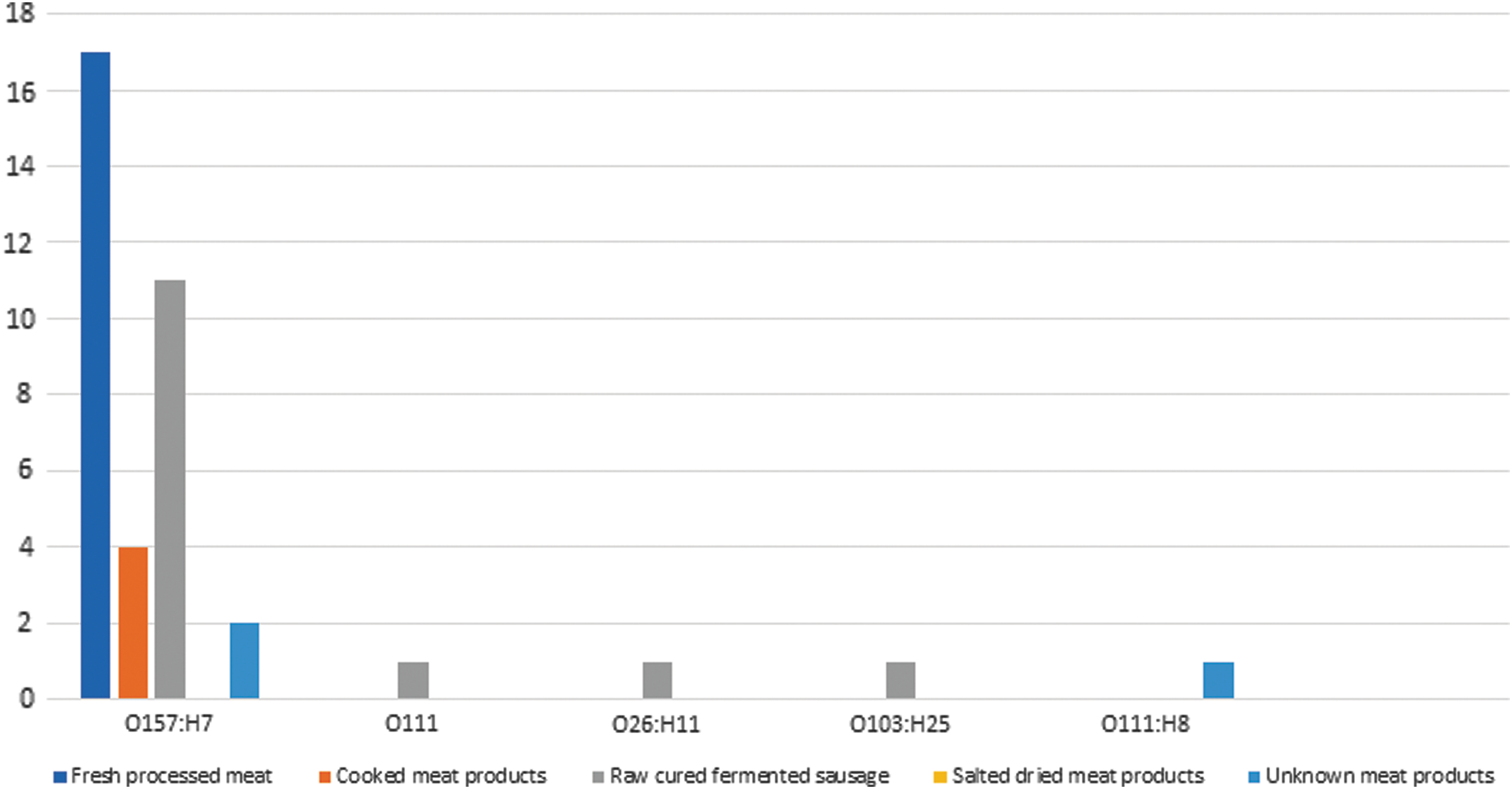
The distribution of Escherichia. coli serovars identified in the reported outbreaks as related to the meat categories implicated.

The size of the reported E. coli and Salmonella outbreaks as related to the total reported number of cases per outbreak-year.

Time-line trend graph for the reported E. coli and Salmonella outbreaks that shows number of outbreaks per year.
Table 3 shows the distribution of HUS cases by the total cases within a meat product category and out of the total cases. HUS cases were reported in raw-cured fermented sausages (16.4%), cooked meat products (13.4%), fresh processed meat (10.3%), and unknown meat products (3.6%). The corresponding percentage of HUS cases out of all cases was 5.9% in fresh processed meat, 3.2 in cooked meat products, 2.6 in raw-cured fermented sausages, and 0.1 in unknown meat products. In our survey, HUS was diagnosed in at least one patient in 79.4% of the outbreaks. In 6 of the outbreaks with E. coli, there were more than 10 cases of HUS in each outbreak. In three of those outbreaks, all the cases developed HUS. Of those, two outbreaks were caused by raw-cured fermented sausages, while fresh processed meats were incriminated in the third outbreak.
No outbreak was reported due to this category (NA).
Outbreaks caused by Salmonella spp.
As shown in Figure 4, in total, there were eight serovars that caused those outbreaks. The most common serovar causing Salmonella-related outbreaks was Salmonella Typhimurium, involved in 61.9% (13/21) of the total number of outbreaks. Figure 3 shows the time trends, which is the number of reported outbreaks per year. There were four outbreaks in 2005, of which the largest outbreak, with 525 cases of infection, occurred in Germany in the same year, where raw minced pork and fermented sausages were implicated, and it was caused by S. Bovismorbificans. The meat category most frequently implicated in the outbreaks (10/21) was raw-cured fermented sausages (47.6%). The spectrum of serovars isolated from raw-cured fermented sausages was broad, as five out of the eight different reported serovars were involved. Fresh processed meats and cooked meat products were implicated in 23.8% of the outbreaks. We did not record any Salmonella outbreak in peer-reviewed journals from 2010 to 2015.
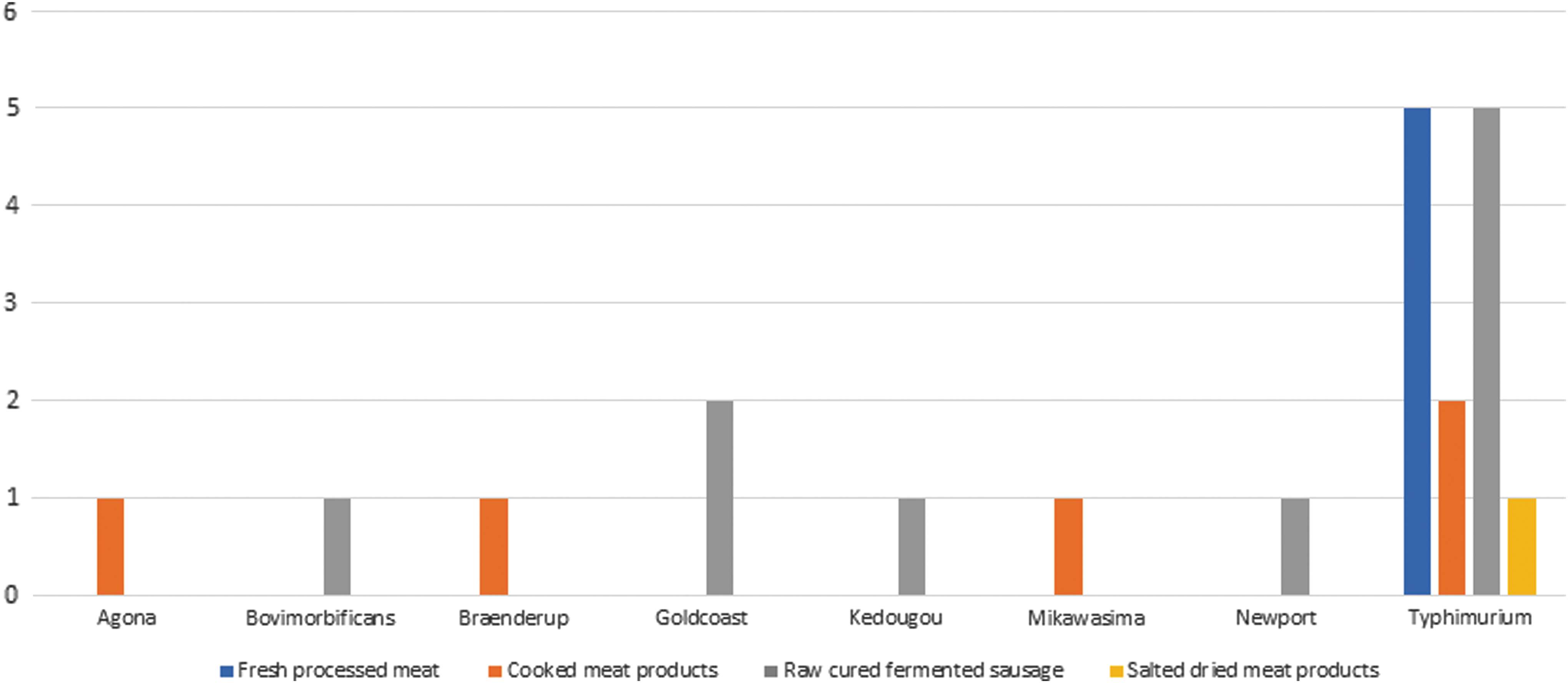
The distribution of Salmonella serovars identified in the reported outbreaks as related to the meat categories implicated.
Outbreaks caused by other bacterial pathogens
There were very few reported red meat-related outbreaks caused by other pathogens, other than VTEC and Salmonella. For some pathogens, there are simply too few outbreaks with identified food vehicles to estimate attribution. Regarding outbreaks caused by toxins of C. botulinum, an outbreak in Taiwan was attributed to fermented goat meat (Tseng et al., 2009), and a special outbreak in Alaska was attributed to fermented beaver tail and paw (CDC, 2001).
Clinical listeriosis mainly occurs in particular at-risk groups: pregnant women, elderly people, immunocompromised people, unborn babies, and neonates (Maertens de Noordhout et al., 2014). Human listeriosis is a relatively rare, but serious zoonotic disease associated with high hospitalization and high lethality rates in these vulnerable populations. Of all the zoonotic diseases under EU surveillance, listeriosis causes one of the most severe human diseases, but few outbreaks are reported each year and very few of them are associated with meat and meat products. Except for one outbreak reported in 2013, related to meat and meat products with 34 cases, listeriosis outbreaks involved 2–4 cases each, resulting in 51 cases, 11 hospitalizations, and 2 deaths (EFSA, 2015).
A multistate outbreak of listeriosis was reported in the United States in 1998 that caused illness in 108 persons residing in 24 states and caused 14 deaths and 4 miscarriages or stillbirths (Graves et al., 2005). The outbreak was associated with contaminated hot dogs. In a study in the United States on foods implicated in outbreaks, (1998–2008) it was reported that out of the confirmed outbreaks related to meat, 4/208 (1.9%) were caused by B. cereus, 71/208 (34.1%) were due to C. perfringens, and 45/208 (21.6%) were due to S. aureus (Bennett et al., 2013).
Food handling by a food worker after food preparation was mainly involved in Staphylococcus outbreaks, as the organism but not the toxins are usually eliminated by cooking and pasteurization. In contrast to C. perfringens and S. aureus, B. cereus outbreaks were most commonly associated with rice or fried rice dishes (Stewart, 2005; Stenfors Arnesen et al., 2008).
Discussion
Out of 9.6 million estimated annual domestically acquired foodborne illnesses in the United States, 1998–2008, with known etiology, caused by bacterial, viral, parasitic, and chemical agents, 1,174,257 (12.2%) were attributed to meat. Out of all foodborne illnesses (3,645,773) due to bacterial agents, in the study, 844,006 (23.2%) were attributed to meat (Painter et al., 2013). In the same study, an estimated 130/862 (15.1%) deaths each year due to bacterial agents were attributed to meat, and an estimated 5238/35,979 (14.6%) of annual hospitalizations due to bacterial agents were attributed to meat. Among the 839 strong evidence outbreaks of salmonellosis reported by 24 European Union member states in 2013, pig meat and products thereof accounted for 7.7%, while bovine meat and products thereof were identified as a source vehicle in 3.6% (EFSA, 2015).
In the EU, where the most commonly reported VTEC serovar in 2013 was, as in previous years, O157 (48.9%) of cases with known serovar, and serovar O26 was the second most common in meat (EFSA, 2015). This was in agreement with our study that the most commonly isolated serovar was also O157. Between 1983 and 2002, in a study in the United States, of human non-O157 Shiga toxin–producing E. coli (STEC) isolates from persons with sporadic illnesses, the most common serovars were O26 (22%), O111 (16%), O103 (12%), O121 (8%), O45 (7%), and O145 (5%) (Brooks et al., 2005). The more frequent isolation of non-O157 STECs has been shown to correlate nicely with the gradual introduction of culture-independent enzyme immunoassay tests in laboratories (Gould et al., 2013).
In 2014, 13 of the member states in the EU reported 39 outbreaks where VTEC was reported as the causative agent (excluding waterborne outbreaks). These outbreaks involved 270 cases and 34 hospitalizations, and 8 of these outbreaks were caused by VTEC O157. Meat and meat products were not incriminated in the strong evidence supported outbreaks, but four outbreaks were categorized originating from “bovine meat and products thereof” in the weak-evidence outbreaks (EFSA, 2015). In the same publication, 23 Member states in the EU reported a total of 1048 foodborne outbreaks (225 strong evidence, 823 weak evidence) caused by Salmonella (excluding one strong-evidence waterborne outbreak) (EFSA, 2015). These outbreaks involved 9226 cases, 1944 hospitalizations, and 14 deaths. Distribution of food vehicles in strong-evidence outbreaks, caused by Salmonella in the EU, 2014, was 225 outbreaks, 9.3% of the outbreaks were attributed to pig meat and products thereof, 3.1% to meat and meat products, 2.7% to buffet meats, and 2.2% to bovine meat and products thereof.
Salmonella Typhimurium was the serovar most frequently (40%) implicated in pigs and pig meat as well as bovine meat in strong-evidence outbreaks reported in the European Union (EFSA, 2015). In a study in the United States, 30 serovars caused beef-related outbreaks during 1973–2011, with the most common being Typhimurium (16 outbreaks), Newport (15), and Enteritidis (8). This is in agreement with our findings as the most common serovar causing Salmonella-related outbreaks was Salmonella Typhimurium. Outbreaks caused by serovars Newport and Typhimurium also accounted for more illnesses and hospitalizations than any other single serovar (Laufer et al., 2015).
The Listeria outbreak from Canada (Currie et al., 2015) demonstrated the need for improved listeriosis surveillance, strict control of L. monocytogenes in establishments producing ready-to-eat foods, and advice to vulnerable populations and institutions. However, even though being ready-to-eat products, no reported outbreak has been connected to raw cured-fermented sausages through all these years. This strongly indicates that bacteriological surveillance for Listeria and corrective actions such as retractions or recalls, from these products are not risk-based, for example, Food safety criteria (EU Commission, 2005).
We had to confine the analysis to those variables reported in most outbreaks in our study. This highlights an important gap in the literature. The medical community tends to report on outbreak and case entities, but focus very little on characterizing the incriminated products. The food science community tends to study the potential growth, survival, or decimation of pathogens under conditions relevant for production and distribution of foods. Similarly, National public health institutes have a long tradition of reporting outbreaks in scientific journals such as Eurosurveillance or Morbidity and Mortality Weekly Report (MMWR). National Food Authorities do not have the same tradition, and management of outbreaks and crises tend to stop after governmental actions, such as a retraction, recalls, and closure of production premises, take place. The rationale for corrective actions undertaken is seldom peer reviewed. Authorities have paid less attention to quality aspects of foods, and laboratory services are in many countries outsourced. Multidisciplinary competences are needed to draw sound conclusions from outbreak data, and it is our opinion that a deeper and applied understanding of microbiology, processing steps, and technological aspects of industrial production is needed, as well as peer-reviewed publishing of risk and event management.
Surveillance systems vary between countries, and thereby, the likelihood that an outbreak reported also depends on the country and its reporting systems (Callejon et al., 2015). Outbreaks were mainly reported from industrialized countries, and apparently represent a bias from available resources or priorities.
It has been reported that the more extensive an outbreak, the more likely it is to represent a major and unusual failure in food safety systems, the more likely it is to have been noticed and thoroughly investigated, and the more likely it is that the vehicle will be identified (Batz et al., 2012; Callejon et al., 2015).
Outbreaks from a nonconformant batch or resulting from systematic errors in large food producers are more easily detected in public surveillance systems (Callejon et al., 2015). From England and Wales, only 3% of outbreaks reported to national surveillance systems were published in peer-reviewed literature (O'Brien et al., 2006). It is also reported that, when the outbreak size varies by food category, attribution percentages based on a number of cases become skewed toward those foods more likely to cause extensive outbreaks (Batz et al., 2012). An effect of increased awareness and intensified laboratory testing increases the likelihood of detection. Increased notification rates were observed in the EU in the 2 consecutive years (EFSA, 2015) also for other serovars than O157 following the large outbreak caused by VTEC O104:H4 in Europe in 2011 (EFSA, 2011). Since the large outbreak in 1993, minced meat products have been put at the front of investigators' minds when STEC outbreaks occur, while a lot of other food items have emerged as essential sources or vehicles (Lynch et al., 2009; Heiman et al., 2015).
Based on calculation of Publication Bias Index (PBI) in the United Kingdom, it has been reported that peer-reviewed publications underestimate those outbreaks that are due to red meat and meat products, poultry, fish, and egg and egg products while overestimating the impacts of milk and milk products (O'Brien et al., 2006). Hence, the freshly processed meat category, containing big volume products, might be relatively overrepresented among the reported outbreaks.
Methods for Source Attribution
There are several methods for attribution of foodborne illnesses to their source. Five basic approaches to source attribution have been reported (Batz et al., 2012).
We categorized the meats according to the definitions given in the European Union Legislation and found them comprehensive and relevant.
Attribution approaches also differ in their points of attribution, where “point of production” approaches focus on primary food production activities, whereas “point of consumption” approaches, focus on food vehicles that directly lead to exposure (e.g., E. coli O157 in hamburgers) (Batz et al., 2005, 2012). Primarily, the outbreak articles tended to focus on the point of consumption (case–controls, bacteriological analyses of products), and secondarily the investigation turns at the point of production. Both governmental and industrial risk managers need insight in these investigations beyond the determination of the source of infection.
Food matrices and pathogen
The food matrix may affect virulence. In addition, more likely, serious illnesses, where patients are hospitalized, are probably more frequently detected and reported. Our results show that the majority of STEC outbreaks were rather small outbreaks compared to Salmonella outbreaks. The median number of cases was 21 for outbreaks caused by E. coli and 58 for Salmonella, respectively. Generally, outbreaks from small food producers are not easily detected as they cannot be easily distinguished from sporadic cases. Geographical or organizational collaboration and exchange of information are crucial for identification of outbreaks and sources of infection when the distribution of patients gets complicated in time or space. Our results indicate that likelihood for detection and notification depends on the severity of disease and not at least the presence of pathognomonic symptoms (HUS) or deviating bacteriological properties (sorbitol fermenting E. coli O157). Another example illustrating the impact of unusual appearance in the laboratory was an outbreak caused by a rare Salmonella phagevar (14b) easily distinguished in the laboratory from other Salmonella Enteritidis isolates (Guerin et al., 2006).
A shift has been observed in the type of beef implicated, from roast to ground beef (Laufer et al., 2015). While delicatessen-style roast beef cooked in commercial processing establishments was the predominant type during the 1970s and early 1980s, regulations on cooking and processing virtually eliminated this problem by 1987 and ground beef emerged as an important vehicle in the 2000s (Laufer et al., 2015). In our survey, Salmonella Typhimurium-related outbreaks were mainly caused by fresh processed sausages and the main reason for food implication was undercooking or inappropriate hygienic practices during preparation. Interestingly, no reported Salmonella outbreak has occurred after 2010, where meat and meat products have been incriminated as a source of infection. Possibly this reflects improved meat hygiene and not a publication bias.
Food production systems
In our survey, about 50% of the E. coli outbreaks, worldwide, were reported from the United States. It is reported that regarding O157, including sporadic cases, 88% were traced to ground beef and 89% occurred in the United States. High level of ground beef consumption at fast food restaurants and the availability of E. coli O157 diagnostic methods were hypotheses explaining the large number of U.S. outbreaks and cases (Hussein, 2006). However, this trend was not seen from the Salmonella data, where only 2 out of 21 outbreaks caused by meats were reported from the United States. This is probably partly due to a significantly different prevalence in value chains, maybe consumption patterns, while medical, including diagnostic tools, and reporting systems are unlikely explanatory factors. However, different production systems that may relatively favor STEC, but not Salmonella could also be of interest.
Risk management
Categorization schemes used for broad evaluation of risks across the entire food supply chain are likely to be quite different from those useful for targeted risk management (Batz et al., 2012). Risk managers need to combine information on outbreaks, incidence rates, and pathogens' abilities to survive and grow to perform appropriate Hazard Analysis and Critical Control Point (HACCP) analyses and make risk-based priorities. It is important that outbreak reports consider the relevant products' characterizations for pathogen growth and survival. A zero-risk level does not exist. An important question is therefore whether an outbreak occurred as a consequence of human errors such as sublethal heat treatment or evitable cross-contamination or if the outbreak is a result of an unlikely event. The Food Business Operators (FBOs) are responsible for producing safe food. The trade-off between having food to eat and trust in safe consumption cannot be omitted. It is therefore our opinion that the reactions toward the FBOs should be conditional depending on the likely causation of outbreaks; it is a significantly different case when an outbreak may result from blameworthy errors or neglecting hygienic rules or principles, or if the outbreak is due to a systematic but accepted weakness of the regulations, product, or the process.
Potential biases
We searched for the terms, “meat, fermented, outbreaks” as we were interested in particular, to illustrate different risks posed from raw-cured fermented meats and other main product categories. The inclusion of the term “fermented” may have generated a bias toward identifying more outbreaks generated by fermented meats. But we used different search resources to capture as many outbreaks as possible. We carried out a thorough search for published outbreaks in the literature. Outbreaks that occurred in the less developed countries and those that were reported in other languages than English as well as many of those reported to national surveillance programs may have been missed. Outbreaks that may cause many severe clinical outcomes or cause many deaths, or where incentives are given to produce publications, may result in publication bias. As such, the representativeness of our data remains uncertain.
Conclusions
The recognition of dry-fermented sausages as a potential threat to food safety has been recognized by several countries, and measures have been taken to reduce the risks. Thus, the aims of the study were to review global outbreaks where red meat and meat products were incriminated as a source for outbreaks, with a focus on fermented meats. Our review seems to indicate that the number of reported outbreaks linked to meats may have declined over the last decades. Meat-related outbreaks are still dominated by Salmonella and VTEC. It is difficult to be certain on whether this trend is real, as there are many reporting potential biases in this area. We were not able to find enough reports to conclude on the potential risk for the public linked to cured, fermented sausages.
Footnotes
Acknowledgment
The authors acknowledge the financial contribution of the Research Council of Norway (project 244403/E50).
Disclosure Statement
No competing financial interests exist.