




Abstract
Campylobacter spp. can be pathogenic to humans and often harbor antimicrobial resistance genes. Data on resistance in relation to fluoroquinolone use in beef cattle are scarce. This cross-sectional study of preharvest cattle evaluated Campylobacter prevalence and susceptibility to nalidixic acid and ciprofloxacin in feedlots that previously administered a fluoroquinolone as primary treatment for bovine respiratory disease. Twenty fresh fecal samples were collected from each of 10 pens, in each of five feedlots, 1–2 weeks before harvest. Feces were cultured for Campylobacter using selective enrichment and isolation methods. Genus and species were confirmed via PCR. Minimum inhibitory concentrations (MICs) of ciprofloxacin and nalidixic acid were determined using a micro-broth dilution method and human breakpoints. Antimicrobial use within each pen was recorded. Data were analyzed using generalized linear mixed-models (prevalence) and survival analysis (MICs). Overall, sample-level prevalence of Campylobacter was 27.2% (272/1000) and differed significantly among feedlots (p < 0.01). Campylobacter coli was the most common species (55.1%; 150/272), followed by Campylobacter hyointestinalis (42.6%; 116/272). Within-pen prevalence was not significantly associated with the number of fluoroquinolone treatments, sex, body weight, or metaphylaxis use, but was associated with the number of days cattle were in the feedlot (p = 0.03). The MICs for the majority of Campylobacter isolates were above the breakpoints for nalidixic acid (68.4%; 175/256) and for ciprofloxacin (65.6%; 168/256). Distributions of MICs for nalidixic acid (p ≤ 0.01) and ciprofloxacin (p ≤ 0.05) were significantly different among feedlots, and by Campylobacter species. However, fluoroquinolone treatments, sex, body weight, days on feed, and metaphylaxis were not significantly associated with MIC distributions within pens. We found no evidence that the number of fluoroquinolone treatments within feedlot pens significantly affected the within-pen fecal prevalence or quinolone susceptibilies of Campylobacter in feedlots that used a fluoroquinolone as primary treatment for bovine respiratory disease.
Introduction
I
Cattle and poultry are considered major reservoirs of Campylobacter, which are shed in their feces usually without causing any clinical disease (Besser et al., 2005; Humphrey et al., 2007). Human illness is frequently associated with consumption of undercooked meat and poultry, unpasteurized milk, and contaminated water (CDC, 2014). Human Campylobacter infections may be treated with a fluoroquinolone (Allos, 2001). Bovine respiratory disease (BRD) is the leading cause of morbidity and mortality in the U.S. feedlot industry, and several antimicrobials, including fluoroquinolones, are used to treat BRD (Miles and Rogers, 2014; Johnson and Pendell, 2017). Because antimicrobial drug use contributes to the emergence of drug-resistant organisms, the U.S. Food and Drug Administration (FDA) recommends that drugs used in both human and animals are used judiciously (FDA, 2012a). Judicious use of antimicrobials in food animals is defined as (1) limiting medically important antimicrobials to uses considered necessary for assuring the health and well-being of animals and (2) only using these drugs under the consultation and supervision of a veterinarian (FDA, 2012a).
The objectives of this cross-sectional study were to assess the prevalence and quinolone susceptibilities of Campylobacter isolated from fecal samples within pens of preharvest cattle in commercial feedlots that used a fluoroquinolone for initial treatment of BRD, and to evaluate associations between these measures of preharvest fecal shedding and previous within-pen drug use. These data enable estimates of Campylobacter prevalence and quinolone susceptibilities in pens of cattle with variable fluoroquinolone exposures, and an assessment of whether metaphylaxis (whole pen use of an antimicrobial to minimize an expected BRD outbreak), sex, initial body weight, and the number of days cattle were at the feedlot (“days on feed”) are significantly associated with fecal shedding of Campylobacter. Data regarding the pen-level risk factors in relation to the prevalence and quinolone susceptibilities of Salmonella in feces of preharvest cattle were previously published (Smith et al., 2016).
Materials and Methods
Study population
Five commercial feedlots in western Texas and western Kansas were selected for this study. Feedlots were selected as a convenience sample based on their use of a fluoroquinolone (Baytril® 100, Bayer U.S., LLC, Shawnee, KS) as first-line therapy for the treatment of BRD and proximity to the Kansas State University Pre-Harvest Food Safety Laboratory. Ten study pens with various levels of BRD treatments were selected by feedlot personnel based on their projected harvest dates. Data regarding sex, arrival body weight, days on feed, and antimicrobials administered to cattle within study pens (including all prophylactic, metaphylactic, and therapeutic treatments while at the feedlot) were retrieved from feedlot records.
Twenty freshly voided fecal samples were collected from the pen floor of each study pen (N = 10 pens/feedlot), which were approximately 1–2 weeks before harvest, within each feedlot (N = 200 samples/feedlot; 1000 samples total) between May and July of 2012. Cattle feces were collected using new plastic spoons, placed in individual Whirlpak bags (Nasco, Inc., Fort Atkinson, WI), and transported on ice to the Kansas State University Pre-Harvest Food Safety Laboratory for processing and analysis the following day.
Isolation and speciation of Campylobacter
Campylobacter were isolated from fecal samples using an enrichment culture method as described previously with minor modifications (Burrough et al., 2013). Briefly, each fecal sample was diluted 1:10 (1 g feces to 9 mL broth) in Mueller-Hinton (MH) broth (Becton Dickinson Co., Sparks, MD) containing selective (polymyxin B, rifampicin, trimethoprim, and cycloheximide; Oxoid, Cambridge, United Kingdom) and growth supplements (SS; sodium pyruvate, sodium metabisulfite, and ferrous sulfate; Oxoid) and incubated under microaerobic conditions (5% oxygen, 10% carbon dioxide, and 85% nitrogen) at 42°C for 48 h. Using a sterile, disposable cotton swab, the culture was transferred to a MH agar plate (Becton Dickinson Co.) with the same selective and growth supplements (MH+SS), streaked for isolation and incubated under microaerobic conditions at 42°C for 48 h. Three well-isolated Campylobacter suspect colonies per sample were restreaked onto MH plates and incubated at 42°C for 24–30 h under microaerobic conditions.
A multiplex PCR was used to identify Campylobacter genus (16S rRNA) and six species: jejuni, coli, lari, fetus, upsaliensis, and hyointestinalis subsp. hyointestinalis (Yamazaki-Matsune et al., 2007). Approximately two to three colonies were transferred to single cell lysis buffer (1 mL Tris-EDTA (1 × TE) +10 μL proteinase K [5 mg/mL]) for DNA extraction (Olah et al., 2006). Campylobacter coli NCTC 36572, jejuni ATCC 33560, hyointestinalis subsp. hyointestinalis ATCC 35217, lari ATCC 35222, fetus subsp. fetus ATCC 27374, and upsaliensis ATCC 49815 were used as positive controls. One confirmed isolate per sample was stored at −80°C in MH broth with 30% glycerol for susceptibility testing.
Antimicrobial susceptibility testing
An in-house microdilution method, based on a Clinical and Laboratory Standards Institute method (CLSI, 2008), was used to determine minimum inhibitory concentrations (MICs) of nalidixic acid and ciprofloxacin for Campylobacter isolates. A 1 mg/mL stock solution of ciprofloxacin and nalidixic acid (Sigma-Aldrich, St. Louis, MO) were prepared in sterile, distilled water based on the potency of the antibiotic. Nalidixic acid was tested at concentrations of 100, 50, 25, 12.5, 6.25, 3.125, 1.56, 0.78, 0.39, and 0.195 μg/mL and ciprofloxacin was tested at concentrations of 25, 12.5, 6.25, 3.125, 1.56, 0.78, 0.39, 0.195, 0.098, and 0.049 μg/mL.
Inoculum was prepared by inoculating a single Campylobacter colony in MH broth (without supplements) and incubating for 24–30 h at 42°C. The culture was then transferred to 3 mL MH II broth (cation-adjusted) using a sterile swab to achieve a turbidity equivalent to 0.5 McFarland standard. A 1:100 dilution of the inoculum was then prepared using MH II broth and 2.5% lysed horse blood.
Susceptibility testing was performed in 96-well microtiter plates (Becton and Dickinson Co.) and C. jejuni ATCC# 33560 was used to ensure the validity of the test. Plates were sealed with perforated plate covers and incubated at 37°C under microaerobic conditions for 48 h. Results were recorded as either growth or no growth (presence or absence of visible pellet) within each well. This process was performed separately for each antibiotic (ciprofloxacin and nalidixic acid) and to ensure accurate results, each isolate was tested in quadruplicate. The MIC was determined by the lowest concentration of antimicrobial agent that completely inhibited growth of the organism (CLSI, 2008). According to the 2010 National Antimicrobial Resistance Monitoring System (NARMS) 2010 Retail Meat Report, Campylobacter isolates were considered resistant to nalidixic acid and ciprofloxacin if the MIC was ≥64 μg/mL and ≥4 μg/mL, respectively (CLSI, 2010; FDA, 2012b). Because the dilution scheme used in this study did not target those exact concentrations, Campylobacter isolates were considered resistant if the MIC was >50 μg/mL for nalidixic acid and >3.125 μg/mL for ciprofloxacin.
Statistical analysis
Campylobacter within-pen prevalence and associations with antimicrobial use and demographic characteristics of the study pens were evaluated using linear mixed models. Models were fitted using binomial distribution, maximum likelihood estimation, complimentary-log-log link, Kenward-Roger degrees of freedom and Newton-Raphson and Ridging optimization procedures (Proc GLIMMIX SAS 9.3; SAS Institute, Inc., Cary, NC). Feedlot was included as a random intercept to account for the lack of independence among pens within feedlots.
Within-pen prevalence was modeled by including the number of Campylobacter positive samples in a pen (“events”) divided by the number of samples collected per pen (“trials”). The number of fluoroquinolone treatments, body weight at arrival, days on feed, sex (steers/heifers), and antimicrobial metaphylaxis (use/no use) were included as independent variables. The variable pertaining to the number of fluoroquinolone treatments was defined as the number of treatments per 100 cattle due to variability in pen size. Continuous variables that did not meet the linearity assumption (i.e., fluoroquinolone treatments per 100 cattle, body weight and days on feed) were categorized in quartiles.
Correlation analysis was performed before building the multivariable model to identify highly correlated variables (≥ |0.80|). Our variable of interest (fluoroquinolone treatments per 100 cattle) was forced into multivariable models regardless of its significance. Testing for a priori confounders and two-way interactions was performed by keeping those variables in the model that resulted in a >20% change in the magnitude of the association, or when the interaction term was statistically significant (p < 0.05). Following forward selection, if a variable was not significant (p > 0.05) it was not included in the multivariable model and prevalence estimates from the univariable model were reported. Residual diagnostics were used to assess model assumptions and overall model fit. Best linearized unbiased predictors were used to evaluate feedlot-level residuals, and Pearson and Deviance residuals were used to evaluate pen-level residuals.
Because susceptibility testing was performed in quadruplicate for all isolates, the mode MIC value was reported for each isolate. When two different MIC values for one isolate were recorded, the MIC value with the highest concentration was reported. If four different MIC values were recorded, the isolate was retested and either the mode or the highest MIC value was reported. The overall proportion of isolates at each MIC for both nalidixic acid and ciprofloxacin were summarized using descriptive statistics.
In lieu of dichotomizing susceptibility results in terms of susceptible or resistant, semi-parametric survival analysis was used to analyze pen-level distributions of the MIC values for isolates recovered within the five feedlots (STATA 10, StataCorp LP, College Station, TX). Cox proportional hazard shared frailty regression models were fitted to evaluate MIC distributions for nalidixic acid and ciprofloxacin and their association with feedlot of origin, species (C. coli, C. hyointestinalis, or “other”), number of fluoroquinolone treatments per 100 cattle, gender, metaphylaxis use, arrival body weight, and days on feed. The hazard was defined as isolates that failed to grow at a specific dilution (MIC value). Frailty was used to account for clustering within feedlot. Hazard ratios were documented for all variables tested (univariable model) and those variables found significant (p < 0.05) were included in the (multivariable) model, along with our exposure variable of interest (fluoroquinolone treatments per 100 cattle). The proportional hazard assumption was assessed using the log cumulative hazard plot and Schoenfeld residuals. Martingale residuals were used to evaluate model fit, and to evaluate outlying observations at the pen-level.
Results
Cattle demographics
Demographic characteristics of cattle within study pens across the five feedlots have been previously described (Smith et al., 2016). Briefly, a small majority (56%; 28/50) of the cattle in study pens were steers with one pen that included both steers and heifers. Pen-level mean body weights of cattle at arrival to the feedlot ranged from 289 to 317 kg across the five feedlots and the mean number of days on feed ranged from 96 to 199. All feedlots had at least one pen that received a metaphylaxis antimicrobial administration for the control of BRD and the mean number of fluoroquinolone treatments per 100 cattle ranged from 5 to 23 treatments, with no fluoroquinolone treatments administered to two pens within one feedlot (Feedlot C).
Campylobacter prevalence
Overall sample-level prevalence of Campylobacter isolated from cattle feces across all five feedlots was 27.2% (272/1,000). Prevalence varied significantly (p < 0.01) among feedlots ranging from 14.5% (29/200) to 40.0% (80/200) (Fig. 1). Within-pen prevalence ranged from 0 (0/20) to 60.0% (12/20). C. coli was the most common species (55.1%; 150/272) isolated, followed by C. hyointestinalis (42.6%; 116/272). Species could not be confirmed for six isolates (2.2%), because the PCR used for this study was designed to identify only major species (jejuni, coli, lari, fetus, upsaliensis, and hyointestinalis) of Campylobacter. C. jejuni was not isolated from any of the cattle feces collected in this study.
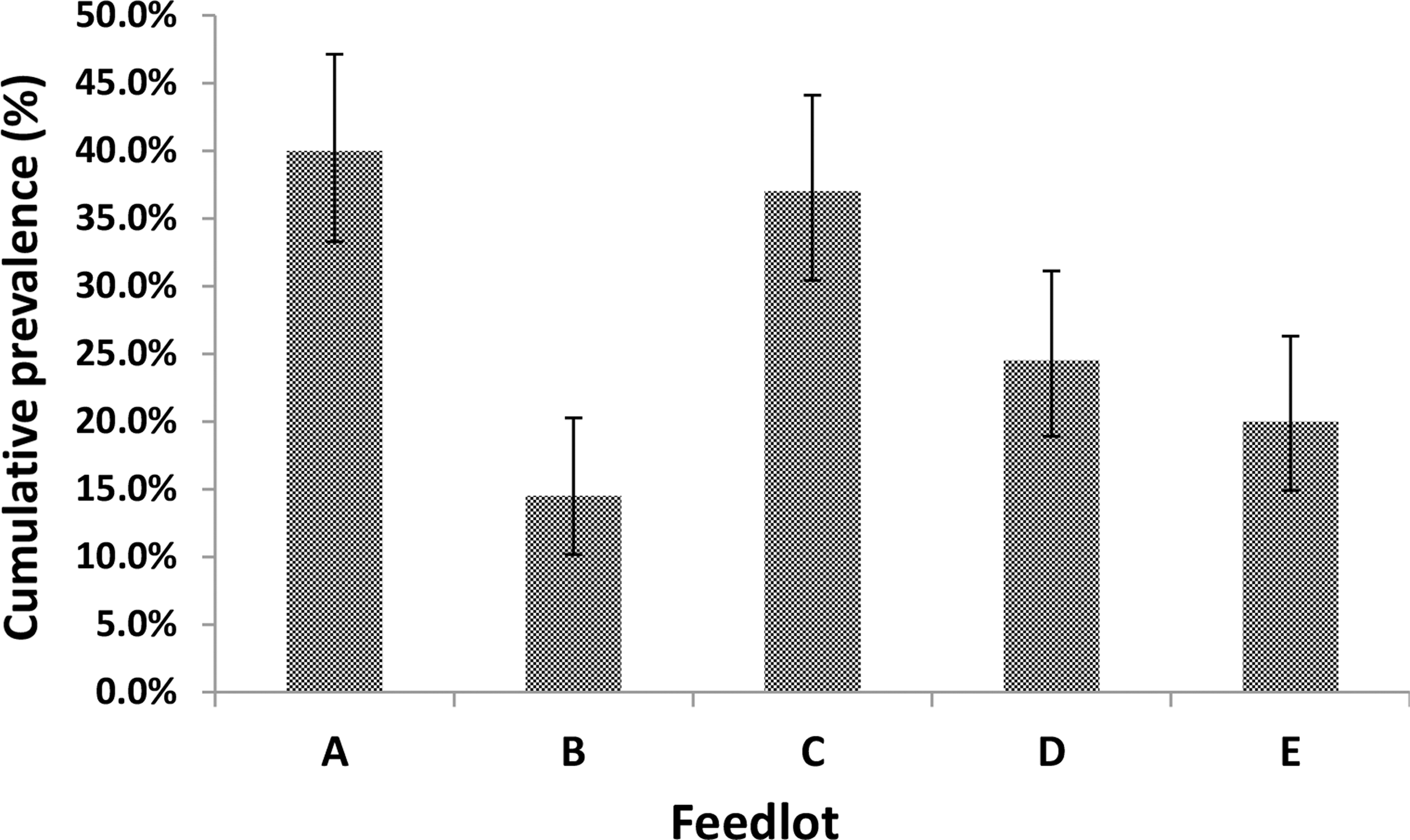
Cumulative Sample-Level Fecal Prevalence of Campylobacter for Five U.S. Commercial Feedlots (n = 200 total samples/feedlot; 20 from each of 10 pens). Error Bars Represent 95% Exact Confidence Intervals For Proportions.
Results from evaluating potential associations between the number of fluoroquinolone treatments, sex, metaphylaxis use, arrival body weight, the number of days on feed, and the within-pen prevalence of Campylobacter are illustrated in Table 1. The number of days that cattle had been in the feedlot was significantly associated with the within-pen prevalence (Table 1). The number of fluoroquinolone treatments per 100 cattle was not significantly associated with Campylobacter prevalence within pens (p = 0.63). However, it was forced into the multivariable model with the significant variable, “days on feed,” because it was considered the main variable of interest. Confounding and two-way interactions were not observed for any variables in the model. After accounting for the number of previous fluoroquinolone treatments, cattle that were fed for 102 to 145 days had a lower prevalence of Campylobacter (19.5%; 95% CI = 12.2–30.0) than cattle that were fed for 162–192 days (33.2%; 95% CI = 22.9–45.5; p = 0.03). No other statistically significant differences were found among the other (days on feed) quartiles.
Models included a random effect to account for lack of independence among pens within feedlots.
One pen that had both heifers and steers was removed from this analysis.
Column values with different superscripts differ (p < 0.05).
When testing whether the number of fluoroquinolone treatments within pens was associated with any of the Campylobacter species, results indicated that the number of fluoroquinolone treatments was not associated with the prevalence of C. coli (p = 0.39) or C. hyointestinalis (p = 0.85). Isolates that did not have species identified were not analyzed due to the small sample size (six isolates).
Antimicrobial susceptibility results
A total of 256 Campylobacter isolates were available for susceptibility testing. Of the isolates tested, 68.4% (175/256) were above the NARMS breakpoint for nalidixic acid and 65.6% (168/256) were above the NARMS breakpoint for ciprofloxacin. Of those isolates, 49.2% (126/256) were resistant to both antimicrobials.
MIC results for C. coli isolates from each feedlot are in Table 2. MICs ranged from 3.13 to >100 μg/mL for nalidixic acid and 0.05–25.00 μg/mL for ciprofloxacin across all feedlots, with most C. coli isolates having MIC of 100.00 μg/mL for nalidixic acid and MIC of 6.25 μg/mL for ciprofloxacin. MIC results for C. hyointestinalis isolates from each feedlot are in Table 3. MICs for these isolates ranged from 25.00 to >100.00 μg/mL for nalidixic acid and 0.20–25.00 μg/mL for ciprofloxacin, with most isolates having MIC >100.00 μg/mL for nalidixic acid and MIC of 25.00 μg/mL for ciprofloxacin.
NARMS nalidixic acid resistance breakpoint is ≥64 μg/mL.
NARMS ciprofloxacin resistance breakpoint is ≥4 μg/mL.
NARMS nalidixic acid resistance breakpoint is ≥64 μg/mL.
NARMS ciprofloxacin resistance breakpoint is ≥4 μg/mL.
Survival analysis revealed that the number of fluoroquinolone treatments within each pen, sex, arrival body weight, and days on feed categories were not significantly associated with the MICs for nalidixic acid or ciprofloxacin (Tables 4 and 5). However, the feedlot from where the isolates were obtained (p ≤ 0.01), Campylobacter species (p ≤ 0.01) and whether or not a metaphylaxis antimicrobial was used (p ≤ 0.05) were all unconditionally associated with MIC results for nalidixic acid (univariable models; Table 4). In the multivariable model, after forcing the variable pertaining to the number of fluoroquinolone treatments into the model, only feedlot (p ≤ 0.01) and Campylobacter species (p ≤ 0.01), remained significantly associated with MIC distributions (Table 4).
Univariable models included frailty to account for lack of independence among pens within feedlots.
Row values with different superscripts differ (p < 0.05).
Isolates where species was not identified were listed as “other.”
One pen was both heifers and steers and was removed from this analysis.
Univariable models included frailty to account for lack of independence among pens within feedlots.
Row values with different superscripts differ (p < 0.05).
Isolates where species was not identified were listed as “other.”
One pen was a both heifers and steers and was removed from this analysis.
Distributions of Campylobacter MICs for ciprofloxacin are given in Table 5. MIC distributions differed significantly among feedlots (p ≤ 0.01) and were associated with the species of Campylobacter (p ≤ 0.01). No other variables were unconditionally associated with MIC distributions (univariable model; Table 5). When our variable of interest (fluoroquinolone treatments per 100 head of cattle) was forced into the model, MIC distributions were still significantly different among feedlots and species (Table 5).
Discussion
This study provides preharvest Campylobacter prevalence estimates and quinolone susceptibility data for cattle in feedlots that administered a fluoroquinolone for the treatment of BRD. In addition, the results demonstrate that the number of fluoroquinolone treatments administered to a pen of cattle during the feedlot production phase was not significantly associated with the within-pen prevalence or MIC distributions for Campylobacter isolated from those pens before harvest.
Cumulative sample-level prevalence of Campylobacter was fairly low relative to other studies with 272 positive of 1000 samples (27.2%) collected across five feedlots. Though published Campylobacter data for beef cattle are relatively scarce, fecal prevalence estimates from previous studies have ranged from 20% to 70% (Beach et al., 2002; Bae et al., 2005; Gharst et al., 2006; Krueger et al., 2008; Abley et al., 2012). Campylobacter prevalence was highly variable across all feedlots and within pens of cattle. Prevalence in cattle is believed to be affected by numerous factors such as season, stress, farm management factors, and diet (Wesley et al., 2000; Sproston et al., 2011). Though all samples were collected within the same season and within a similar geographic region, factors such as feedlot management practices may have accounted for the variability in prevalence (Krueger et al., 2008; Hannon et al., 2009).
Campylobacter coli was the most prevalent species isolated for this study, followed by C. hyointestinalis. C. coli is pathogenic to humans, though C. jejuni is the species more commonly associated with foodborne illness (Allos, 2001; Taylor et al., 2013). While C. jejuni is typically one of the most prevalent species isolated from cattle (Wesley et al., 2000; Besser et al., 2005; Sproston et al., 2011), it was not isolated from any of the fecal samples in this study. The reason(s) for this difference in Campylobacter species recovered from feedlots tested here is unknown, but unlikely due to the previously validated isolation and identification methods.
The number of fluoroquinolone treatments, metaphylaxis use, body weight, or gender were not significantly associated with the within pen-prevalence of Campylobacter. However, prevalence significantly differed based on the number of days cattle were in the feedlot. Specifically, pens of cattle fed for 146–192 days had significantly more Campylobacter than cattle fed 102–145 days. This was similar to what Besser and others reported in 2005 where Campylobacter prevalence increased throughout the feeding period. However, the opposite was reported in another study where Campylobacter prevalence was the highest at feedlot entry (32.1%) and reduced to 11.8% at final sampling (Sproston et al., 2011). With the variability reported, it appears that the number of days cattle are in the feedlot may not be a consistent predictor of Campylobacter prevalence at harvest.
Numerous Campylobacter isolates recovered from fecal samples collected for this study were above the resistance breakpoint for both nalidixic acid (175/256; 68.4%) and ciprofloxacin (168/256; 65.6%). Since a large proportion of the isolates were C. coli, (55.1%; 141/256), these results could be expected. Previous studies in cattle have shown that C. coli, under fluoroquinolone selection pressure, tend to be resistant to quinolones (Englen et al., 2005; Inglis et al., 2006; Sanad et al., 2011; Gaudreau et al., 2014).
Unmeasured feedlot management and environmental factors may have contributed to the difference in distributions of MICs for nalidixic acid and ciprofloxacin among the five feedlots. It is unclear how long drug-resistant Campylobacter isolates survive in the feedlot environment and persist without (or with) antimicrobial selection pressure. However, enhanced fitness and transmission of resistant isolates in the environment may be affecting the variability in prevalence (Zhang et al., 2003, 2006; Luo et al., 2005).
The number of previous fluoroquinolone treatments within a pen was not significantly associated with MIC distributions of isolates recovered preharvest. Cattle are typically treated for BRD within the first 100 days in the feedlot (Babcock et al., 2009), and to ensure drug withdrawal times are met, many antimicrobials are not used before harvest. The prevalence of quinolone-resistant Campylobacter in cattle feces has been shown to decrease over time in cattle that received a fluoroquinolone, and those that did not (Smith et al., 2017). Therefore, the lack of an observed association between the number of previous fluoroquinolone treatments and the MIC distributions in isolates recovered 1–2 weeks before harvest is perhaps not surprising.
Data from this cross-sectional study are useful for evaluating the impact of fluoroquinolone therapy in feeder cattle and the potential association with preharvest prevalence of pathogenic bacteria and their susceptibility to human quinolones. There are, however, limitations to this study design (Mann, 2003). Without the history of fluoroquinolone use before cattle arriving at the feedlot, and without more comprehensive knowledge of the epidemiology (e.g., possibility of introduction of resistant isolates from the environment in the pens) of Campylobacter both within cattle and within their environment, causal inferences are limited. We can conclude, however, that the number of previous fluoroquinolone treatments for BRD within a feedlot pen was not significantly associated with the fecal prevalence of Campylobacter, and though MIC values for Campylobacter isolates were generally high, there was no evidence that the distribution of the MICs was associated with the number of fluoroquinolone treatments previously administered within study pens.
Footnotes
Acknowledgments
Funding for this research was provided by Bayer U.S., LLC, and the Department of Diagnostic Medicine/Pathobiology, College of Veterinary Medicine, Kansas State University. Investigators would like to thank the participating feedlots and their staff as well as staff and students at the Kansas State University, College of Veterinary Medicine, Pre-harvest Food Safety Laboratory.
Disclosure Statement
The first author (A. Smith) was a graduate student of Kansas State University and an employee of Bayer U.S., LLC, which markets a commercially licensed fluoroquinolone for the treatment and control of BRD. The remaining authors have no financial conflicts of interests.