




Abstract
The online e-pub version of the article entitled, Antibiotic Resistance in Salmonella Enteritidis Isolates Recovered from Chicken, Chicken Breast, and Humans Through National Antimicrobial Resistance Monitoring System Between 1996 and 2014” by Paudyal N, Pan H, Li X. Fang W. Yue M., Foodborne Pathog Dis [Epub ahead of print]; DOI: 10.1089/fpd.2017.2402 is being officially retracted from Foodborne Pathogens and Disease (FPD) due to a significant number of errors in reporting and miscalculations of the National Antimicrobial Resistance Monitoring System (NARMS) datasets reported in the paper.
Authors evaluated NARMS data, which are in the public domain, and analyzed a subset of NARMS data to address questions about a specific serotype of Salmonella in humans and chicken meat. Authors analyzed Salmonella Enteritidis isolates from humans, chicken and retail chicken meat, with their minimum inhibitory concentrations (MICs) to a range of commonly used antibiotics in the US collected over a period of 1996–2014 by NARMS, to segregate isolates based on their MIC value for a certain antimicrobial and evaluate their relationship along the foodborne transmission pathway. NARMS has data on more than 185,000 isolates that can be downloaded in an accessible format. To help make these large data sets more accessible, the NARMS teams continue to develop new tools to enable users to explore them according to their own interests. As a public health surveillance system, the goal is continuous improvement and open, transparent data sharing. The NARMS partners believe this is the best way to foster a collaborative effort to combat antibiotic resistance.
After the online-ahead-of-print version of the paper, which used a subset of NARMS data, was published, a significant concern was brought to the attention of the Editor-in-Chief of FPD indicating that the article contained several significant errors which could potentially lead to a misunderstanding of the resistance situation in the United States. Of particular import is with regard to the authors of the paper reversing the poultry and human resistance data found in Figure 2, which displays the overall antimicrobial resistance data and is a central element of the article. The authors correctly state it in the text, but the figure is incorrect.
Additionally, there appeared to be an accidental omission of a reference to a published article which shows a strong association between quinolone-resistant Salmonella Enteritidis infections in humans and international travel (O'Donnell et al., 2014) This appears to be a critical oversight given that the intention of the study was to analyze the NARMS data to help understand the dynamics of Salmonella transmission.
The authors of the published article were notified of this communication by the Editor of FPD and were provided an opportunity to respond, which they quickly did. The corresponding author, Dr. Min Yue, agreed that after he and his team reanalyzed the data, there were indeed errors in the published paper and supplied revised versions of Figure 2 and supplemental Figure 3, as well as providing a significantly revised version of the manuscript, based upon the criticisms levied against the published paper.
After giving the revised manuscript and figures very careful consideration, and after significant probing of his own, the Editor of FPD determined that the significantly revised manuscript, coupled with the multiple errors presented in the figures, is simply far too weighty for a correction statement to be issued, and determined a full retraction of the published article was warranted.
It is important to note that there is no indication whatsoever that the errors or miscalculations were intentional, and that Dr. Yue and his team quickly and honestly replied to the concerns raised about their work. However, in the interest of upholding the proper protocols of peer review, and in accurate and truthful reporting in the scientific literature, the Editor of Foodborne Pathogens and Diseases is issuing this full and formal retraction of the article.
Introduction
N
The extensive use of antibiotics in humans or animals (for nontherapeutic uses) is increasing alarmingly and is believed to be responsible for the selection of antibiotic-resistant bacteria (CDC, 2013; Van Boeckel et al., 2015). This happens both in commensal as well as pathogenic bacteria residing in the same ecological niche (Smith et al., 2002; Davies and Davies, 2010). There are growing concerns that antibiotic-resistant bacteria, including Salmonella, in animals may transfer to humans through animal products or direct contact with such animals. Characterization of isolates collected from animals, humans, and the meat products could effectively improve our understanding of Salmonella dynamics in this potential transmission chain.
The National Antimicrobial Resistance Monitoring System (NARMS) (
In this study, we analyzed 6819 S. Enteritidis isolates of chicken origin, with their minimum inhibitory concentrations (MICs) to a range of commonly used antibiotics, in the United States collected over a period of 18 years by NARMS, to evaluate their relationship along the food pathway.
Materials and Methods
Data source
The data, between 1996–2014 for humans' and 1997–2014 for chicken isolates, used in these analyses were obtained from the U.S. NARMS (updated in December 2016). This analysis focuses on the human (n = 4845), poultry (chicken [n = 1590], and meat [n = 370], isolates. Others of unknown origin [n = 14]) were omitted from the analysis owing to their small sample size. The data were reorganized using Pivot Table function in MS Excel to prepare for analysis.
Thirty-two antibiotics were tested for the antimicrobial MIC by the agar dilution method, in the NARMS database. We used only a subset of 13 antibiotics of various classes as grouped by NARMS: sulfa-TMP (COT) [folate pathway inhibitor]; ampicillin (AMP) [penicillin]; amoxicillin (AMC) [beta lactam inhibitor]; streptomycin (STR), kanamycin (KAN), and gentamicin (GEN) [aminoglycoside]; chloramphenicol (CHL) [phenicol]; tetracycline (TET) [tetracycline]; cefoxitin (FOX), ceftiofur (TIO), and ceftriaxone (AXO) [cephems]; and ciprofloxacin (CIP) and nalidixic acid (NAL) [quinolones]. These 13 antibiotics were chosen so as to represent at least one molecule for the major group of antimicrobials. We analyzed only the resistance pattern, the susceptible ones were excluded. The intermediate ones were included in the resistance category for analysis.
Statistical methods
The descriptive analyses (95% confidence interval, CI) and comparative mappings were performed with GraphPad Prism 7. Random Forest (classification of 1000 support tree with out-of-bag data used for testing) statistic was used to differentiate Salmonella population according to the MIC profiles. The Random Forest dissimilarity statistic was used because it can (1) use multidimensional scaling proximities to compare the samples in clustering, locating outliers, which deliver unexcelled accuracy and sensitivity in group or subpopulation detection; (2) balance error in class population with unbalanced datasets, which is essential for minimizing epidemiological sampling bias; and (3) analyze the mixed variable and large-scale data with missing value simultaneously. The analysis was done for three variations: with the MIC of the entire panel of 32 antimicrobials, with a subset of 13 antimicrobials, and with a subsubset of 10 antimicrobials to verify the consistency of the method in managing the missing data. Antibiotic-resistant bacteria population diversity based on the MIC values was estimated with Simpson's Diversity as discussed previously (Mather et al., 2013; Afema et al., 2015). Time factor was not considered for analysis.
Results
In Random Forest statistic, the MIC values (of 13 antimicrobials) were used to differentiate the individual isolates as chicken, chicken breasts, and human (Fig. 1). It categorized the aggregate population into two distinct groups as Population-I (with less diversity) and Population-II (with high diversity) (p < 0.001). The Population-I, which was tightly clustered, consisted of all the isolates from chicken and chicken breasts (Fig. 1A). This population also included 13.4% (n = 265) isolates of all human isolates (Fig. 1D). Population-II consisted purely of the human isolates (86.6% of all human isolates), with a greater diversity (wider spread over the area and arbitrarily clustered) than Population-I (p < 0.001).
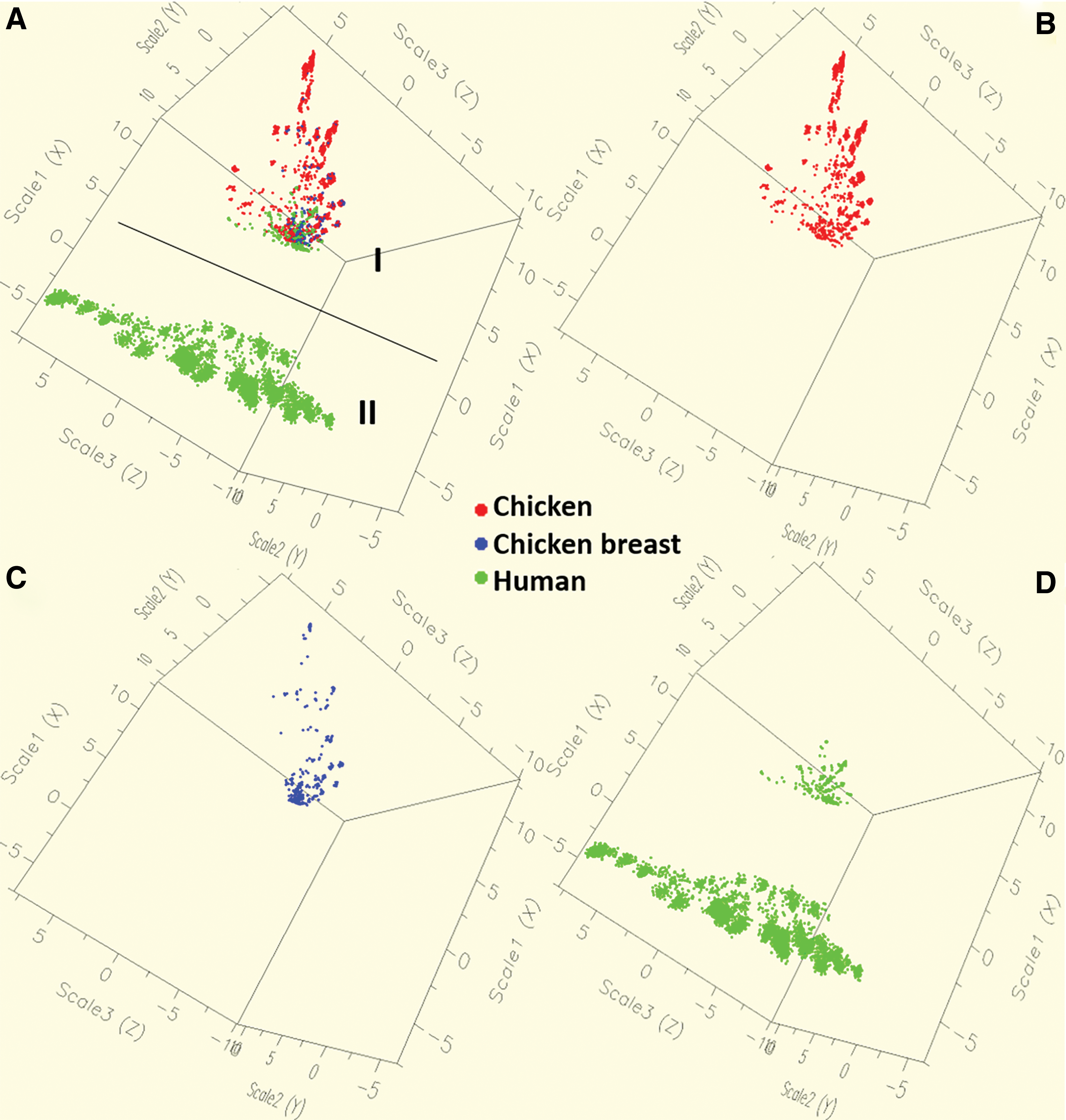
Three-dimensional view of the population structure of Salmonella Enteritidis isolated from humans and chickens (including chickens and chicken breasts) revealed by the Random Forest Matrix analysis based on the MIC values 13 antimicrobials—COT, sulfa-TMP; AMP, ampicillin; AMC, amoxicillin; STR, streptomycin; KAN, kanamycin; GEN, gentamicin; CHL, chloramphenicol; TET, tetracycline; FOX, cefoxitin; TIO, ceftiofur; AXO, ceftriaxone; CIP, ciprofloxacin; and NAL, nalidixic acid.
The analysis of two other variations (a subset of 10 or the entire panel of 32 antimicrobials) including those with or without data showed identical results. The details are given in Supplementary Figures S1 and S2 (Supplementary Data are available online at
The resistance percent was compared across the isolates from chicken and humans for 13 antimicrobials (Fig. 2). Please refer to the Supplementary Figure S3 for the individual details of chicken, chicken breasts, and humans. Resistance to tetracycline is comparable between the human and chicken isolates. Resistance toward ciprofloxacin and nalidixic acid was recorded only in the human isolates (all the chicken isolates were susceptible), whereas resistance toward amoxicillin was recorded only in the chicken isolates (all the human isolates were susceptible). The resistance of human isolates to the third-generation cephalosporins was at an average of 0.7% (95% CI 0.4–1.0) for the past (1996–2004) and at an average of 0.4% (95% CI 0.4–0.5) for the recent years (after 2004). The same for chicken and chicken breast isolate was at an average of 3.2%, (95% CI 2.5–3.9) and 20.2%, (95% CI 10.1–30.4), respectively. Tetracycline resistance in human clinical isolates had an average prevalence of 8.9% (4.8–16) for the years before 2004, while it was 2.7% (2.1–3.4) after 2004. The isolates from chicken breasts showed an average of 13.7% (range 5.1–25.2) tetracycline resistance after 2004, while the same was at an average of 2.3% (range 1.7–3.0) for isolates from chicken.
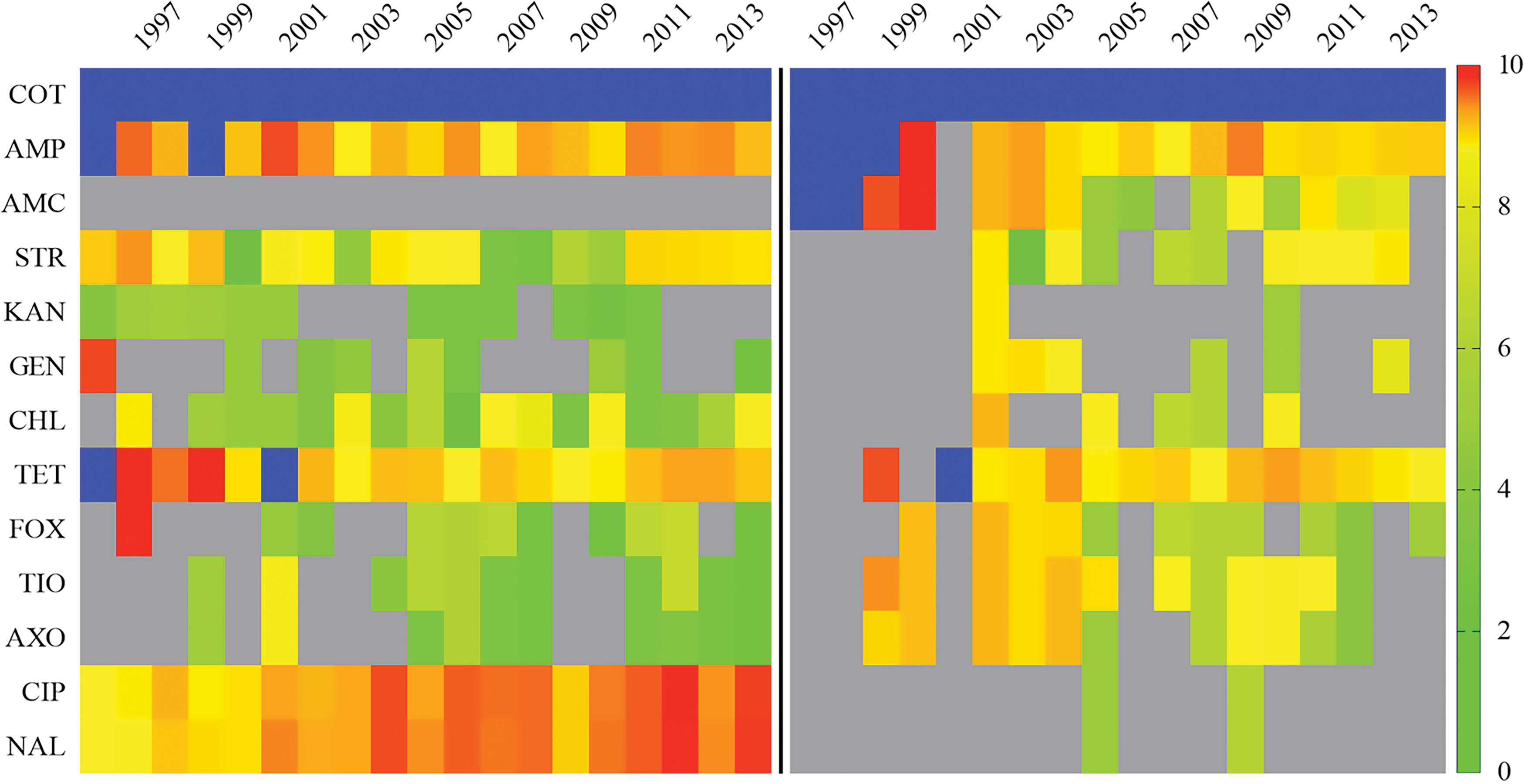
Antibiotic resistance (%) of Salmonella Enteritidis isolated from humans (right) and chicken (chicken and chicken breasts) (left) for multiple years (on the horizontal top axis), indicated by various degrees of color saturation in an individual cell. Color indicates degrees of resistance as categorized in the legend, ranging from 0.27% (green) to 10% (red). The dark blue color (in COT, AMP, and TET) indicates >10% (up to 100%) resistance. The antibiotics (on left vertical axis) are abbreviated as, COT, sulfa-TMP; AMP, ampicillin; AMC, amoxicillin; STR, streptomycin; KAN, kanamycin; GEN, gentamicin; CHL, chloramphenicol; TET, tetracycline; FOX, cefoxitin; TIO, ceftiofur; AXO, ceftriaxone; CIP, ciprofloxacin; and NAL, nalidixic acid. Gray boxes represent missing or empty data. Color images available online at
Discussion
Increase in the volume of meat consumed globally could be a significant driver of emergence and dissemination of antibiotic resistance bacteria, including Salmonella (Antunes et al., 2016). An understanding of the potential chain, among chicken, chicken meat, and human, is essential for rational implementation of strategies targeted for disrupting the foodborne transmission.
When used in conjunction, analysis of MIC data by Random Forest matrix, we detected only a small fraction of human isolates likely to have similar MICs as that of the chicken isolates, as revealed by closely aligned overlapping clusters (Fig. 1) or similar antibiotic resistance pattern (Fig. 2, the degree of color saturation). Various independent studies have also reported that chicken and human isolates possess variable diversity, either phenotypic or genotypic (Cho et al., 2008; Han et al., 2013). A pulsed-field gel electrophoresis analysis of human and chicken isolates of S. Enteritidis in the United States reported that these pathogens had distinct patterns with some overlaps that could not provide conclusive evidence of connection (Chai et al., 2012). Human S. Enteritidis isolates with closely related rapid amplification of polymorphic DNA profiles that differed from animals', and with a small portion of common profiles, have also been reported (Betancor et al., 2004). The assumption of distinct clusters between animal and human populations of Salmonella has been frequently reported across various countries or regions (Chu et al., 2009; Vaz et al., 2010; Papadopoulos et al., 2016; Acar et al., 2017; Zhu et al., 2017). Future work with whole-genome sequencing may provide additional information on the diversity of isolates across the food chain and the antibiotic resistance could be further confirmed based on the genetic materials.
In some countries, egg contaminated with S. Enteritidis is still an important food source for human infections; however, in the United States, implementation of Egg Quality Assurance Program (EQAP) and Egg Rule has reduced the infection incidents attributed to egg consumption (Braden, 2006). Some researchers opine that despite the high occurrence of S. Enteritidis in laying flocks, the frequency of egg contamination is normally relatively low (Martelli and Davies, 2012). Reduction of the chicken carriage and nonreported human disease outbreaks, linked with S. Enteritidis originating in the eggs, was observed after the Egg Rule (Pitesky et al., 2013; Denagamage et al., 2016; Wright et al., 2016), whereas 1% increase in egg produced under EQAP resulted in 0.14% decrease in the human disease incidence (p < 0.05) (Mumma et al., 2004). The absence of egg monitor samples in this analysis opens up a new window in understanding the dynamics of S. Enteritidis. Possible transmission pathways, other than food-animal chain, could probably play, if not more, an equally important role in transmission of antibiotic-resistant S. Enteritidis to humans.
Recognition of new foods such as nuts and raw sprouts as causes of S. Enteritidis outbreaks as well as increased attribution of beef, pork, and turkey to outbreaks have been reported in the United States (Wright et al., 2016). Outbreaks of food poisoning due to Salmonella in vegetables, with distinct genotype other than farm animals, have demonstrated that our understanding of these organisms must reach out beyond the conventional transmission dynamics (Berger et al., 2010; Dechet et al., 2014; Walsh et al., 2014; Da Silva Felicio et al., 2015; Herman et al., 2015; Ongeng et al., 2015; Pan et al., 2018). The human-associated S. Enteritidis may be circulating within the human population as previously confirmed by whole-genome sequencing analysis (Feasey et al., 2016).
An eminent threat is the occurrence of antibiotic resistance for third-generation cephalosporins commonly recommended to treat severe Salmonella infections. Chicken breast isolates have the highest antibiotic resistance rate (20.2%), which is 10 times more compared with the chicken and 100 times more compared with human isolates (for cefoxitin, ceftiofur, and ceftriaxone). Similarly, tetracycline resistance in chicken breast isolates is almost 10 times higher than the chicken or human isolates. Similar results have also been revealed in the past (Parmley et al., 2013; McNeece et al., 2014).
Our analysis, of S. Enteritidis of NARMS between 1996 and 2014, revealed a general difference in antibiotic resistance pattern between human isolates and chicken isolates.
Footnotes
Acknowledgments
The corresponding author (M.Y.) is funded by “National Program on Key Research Project of China (2017YFC1600103),” the “Fundamental Research Funds for the Central Universities,” the “Recruitment Program of Global Youth Experts,” and Zhejiang University “Hundred Talent Program.” We acknowledge all the individuals who have been involved with the US NARMS (CDC, FDA, and USDA) for their contribution in making the data available for this analysis.
Authors' Contributions
P.H. and N.P. contributed equally to this work, conducting the data analysis and prepared the draft article. X.L. and W.F. made contributions to refine and reorganize the data used in the article. M.Y. conceived the idea, collected data, and finalized the article.
Disclosure Statement
No competing financial interests exist.
References
Supplementary Material
Please find the following supplemental material available below.
For Open Access articles published under a Creative Commons License, all supplemental material carries the same license as the article it is associated with.
For non-Open Access articles published, all supplemental material carries a non-exclusive license, and permission requests for re-use of supplemental material or any part of supplemental material shall be sent directly to the copyright owner as specified in the copyright notice associated with the article.
