




Abstract
Wild boar populations around the world have increased dramatically over past decades. Climate change, generating milder winters with less snow, may affect their spread into northern regions. Wild boars can serve as reservoirs for a number of bacteria, viruses, and parasites, which are transmissible to humans and domestic animals through direct interaction with wild boars, through contaminated food or indirectly through contaminated environment. Disease transmission between wild boars, domestic animals, and humans is an increasing threat to human and animal health, especially in areas with high wild boar densities. This article reviews important foodborne zoonoses, including bacterial diseases (brucellosis, salmonellosis, tuberculosis, and yersiniosis), parasitic diseases (toxoplasmosis and trichinellosis), and the viral hepatitis E. The focus is on the prevalence of these diseases and the causative microbes in wild boars. The role of wild boars in transmitting these pathogens to humans and livestock is also briefly discussed.
Introduction
W
Wild boars can be infected with several pathogens, some of which are transmissible to domestic animals and humans (Cantlay et al., 2017; Cleveland et al., 2017). Cross-species disease transmission between wild animals, domestic animals, and humans is an increasing threat to human and animal health (Miller et al., 2017). An increase in the outdoor farming of domestic food-producing animals may raise the contact risk between domestic and wild animals and thus the transmission of pathogens. Concurrently, with increasing wild boar populations, wild boar hunting and the consumption of wild boar meat have increased in popularity (Ruiz-Fons, 2017). Contact with infected wild boars and consuming contaminated wild boar meat can be a source of brucellosis, salmonellosis, toxoplasmosis, trichinellosis, and tuberculosis in humans and other animals (EFSA, 2013; Brown et al., 2018). These zoonoses are among the top 10 diseases at the wildlife/livestock interface based on the number of publications (Wiethoelter et al., 2015).
The most important zoonotic pathogens transmitted by pork to humans in Europe are Salmonella, Yersinia, Toxoplasma, and Trichinella (EFSA, 2011; Felin et al., 2015). Brucella suis and Mycobacterium tuberculosis complex (MTC), found in domestic pigs and wild boars, can also be transmitted through contaminated meat to humans (Brown et al., 2018). Brucellosis and tuberculosis are two severe zoonotic diseases in humans, which are monitored in food-producing animals in several countries, especially countries free of tuberculosis and brucellosis in livestock. Eighteen of 28 European Union (EU) member states were officially declared free from bovine tuberculosis and bovine, ovine, and caprine brucellosis in 2016 (EFSA and ECDC, 2017).
There are also other pathogenic bacteria such as Campylobacter, Listeria monocytogenes, and Shiga toxin—producing Escherichia coli, which may be transmitted through contaminated meat (Ruiz-Fons, 2017). Several zoonotic viruses have been detected in domestic pigs and wild boars, but only hepatitis E virus (HEV) is transmitted through contaminated pork (Ruiz-Fons, 2017; Syed et al., 2018).
In this article, the prevalence of the most important foodborne infections in Europe and the causative microbes in wild boars is reviewed. The role of wild boars in transmitting these pathogens and, finally, the present measures for controlling these pathogens are shortly discussed.
Materials and Methods
The literature search was performed in Scopus using the keywords wild boar OR wild pig OR wild swine OR feral pig OR feral swine AND salmonella OR yersinia OR brucella OR mycobacterium OR trichinella OR toxoplasma OR HEV. Articles published from 2014 onward, including research articles and reviews written in English, were reviewed.
Results
In total, 423 articles, which met the search criteria, were published between 2014 and 2018 (until August 6, 2018) (Fig. 1). In total, 157 articles, which were dealing with prevalence, transmission routes, and control, were used in this review. In addition, two more articles about public health hazard in pigs and farmed game from 2011 to 2013, respectively, were included because of the important background information presented in the introduction part.
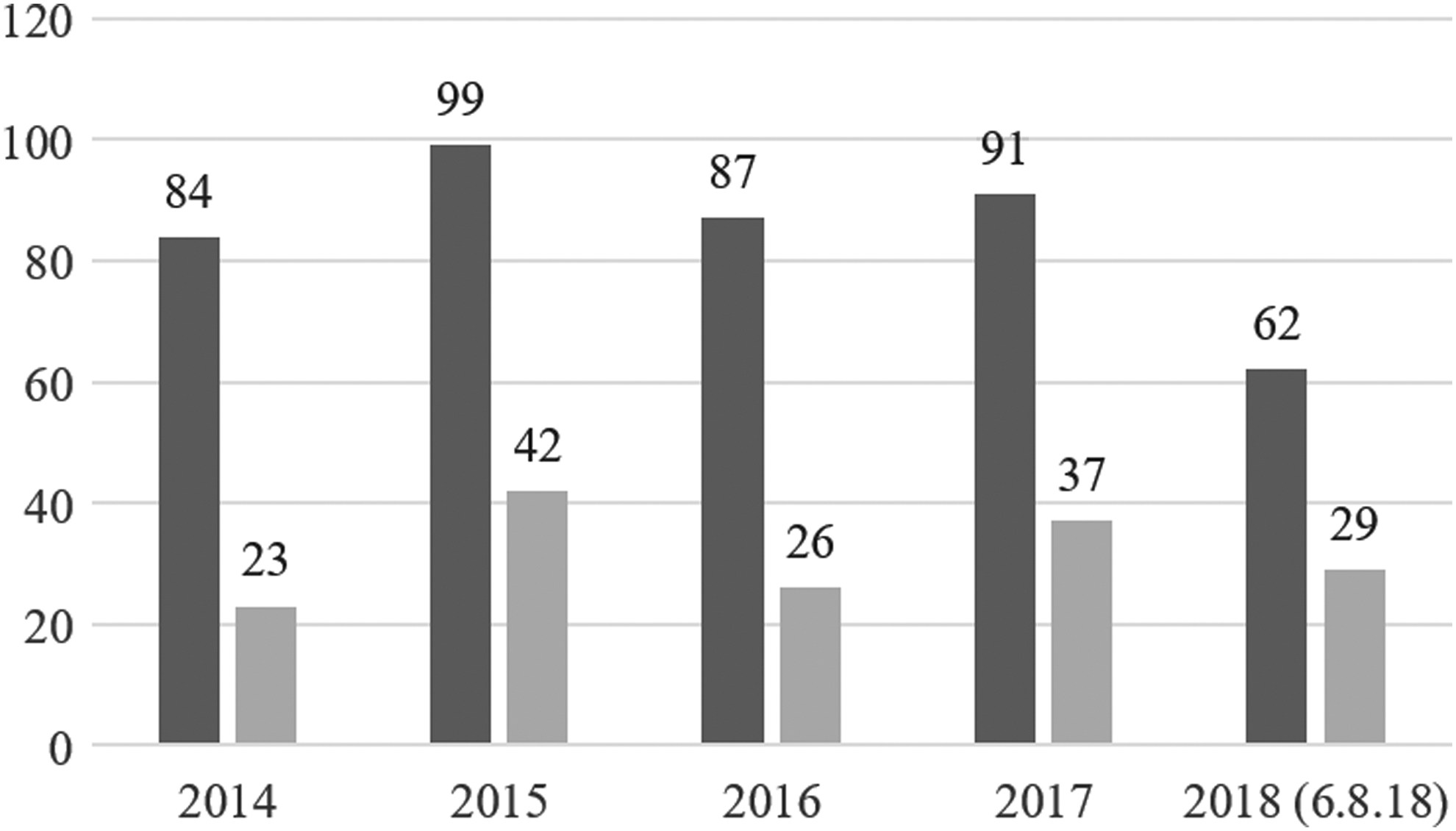
The number of articles published (in dark gray) between 2014 and 2018 (until August 6, 2018) and the number of articles included in this review (light gray).
The number of reviewed articles dealing with HEV was highest (46/157, 29%) (Fig. 2). Only 13 reviewed articles (8%) were dealing with Yersinia.
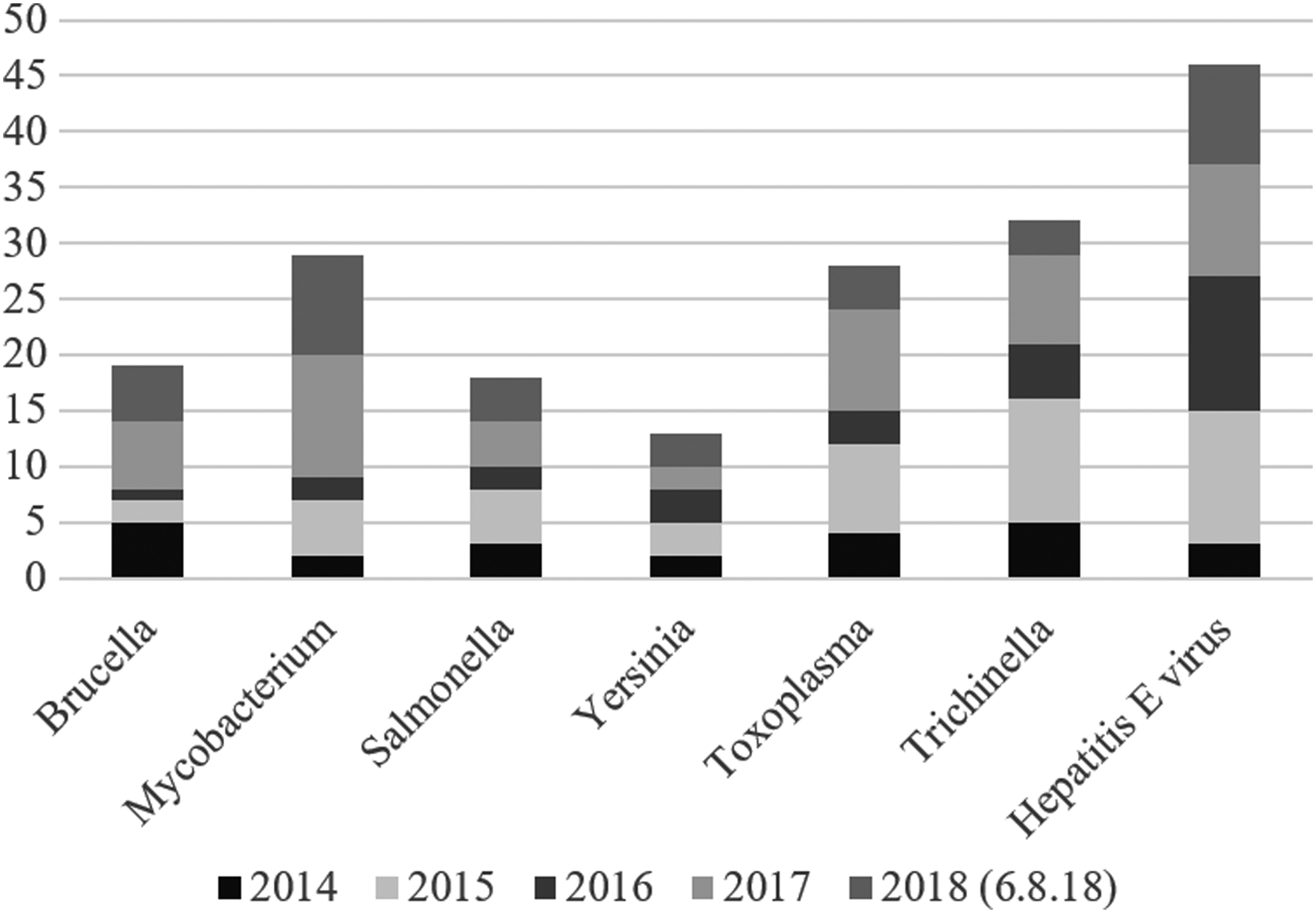
Distribution of reviewed articles dealing with different pathogens.
Foodborne bacteria in wild boar
Brucella suis
Brucella is a Gram-negative zoonotic pathogen causing brucellosis, which is a significant public health problem in many areas where the bacterium mainly persists in ruminants (Godfroid et al., 2014). Humans can acquire the infection through contact with infected food-producing animals, via inhalation of bacteria in aerosols, or consumption of contaminated food products. B. suis belonging to biovars 1, 2, and 3 is responsible for brucellosis in pigs, but biovar 2 is mainly found in wild boars in Europe (Godfroid et al., 2014; Grantina-Ievina et al., 2018). Infected pigs are usually asymptomatic, but the disease can cause abortion, orchitis, and infertility (Risco et al., 2014). Especially B. suis of biovars 1, 3, and 4 infects humans, causing chronic disease with undulating fever and joint pain (Godfroid et al., 2014). B. suis biovar 2 is rarely causing disease in humans probably due its lower virulence among humans. However, illnesses caused by B. suis biovar 2 have been reported in hunters (Mailles et al., 2017).
Brucellosis has mostly been eradicated from livestock, including domestic pigs in developed countries, and several European countries have even achieved a brucellosis-free status (Godfroid et al., 2014; EFSA and ECDC, 2017). However, brucellosis has been reported in wild boar populations in Australia, Europe, and the United States, with seroprevalence ranging between <1% and 59% (Table 1 and Supplementary Table S1; Supplementary Data are available online at
Seroprevalences of Pork-Related Zoonoses in Wild Boars
∑, Number of studies.
Twenty-two percent of wild boars in Georgia, United States, were recently reported to excrete B. suis in their feces (Lama and Bachoon, 2018). B. suis was also frequently found in lymph nodes (Pedersen et al., 2017a). Biovar 2 was detected in 4% of genital (testicular or vaginal) swabs of wild boars in Spain (Risco et al., 2014). This same type was also found in wild boar tonsils in Austria and in wild boar spleens in eastern Latvia (Glawischnig et al., 2018; Grantina-Ievina et al., 2018). Biovars 1 and 3, which are highly pathogenic to humans, were found in wild boars in the United States (Pedersen et al., 2014).
M. tuberculosis complex
Tuberculosis is a chronic infection caused by acid-fast mycobacterium: M. tuberculosis, Mycobacterium bovis, Mycobacterium caprae, and other members of the MTC (Díez-Delgado et al., 2018; Gagneux, 2018). M. bovis and M. caprae are the main causes of tuberculosis in farm and wild animals (Santos et al., 2015). They are genetically closely related to M. tuberculosis, which is mainly adapted to humans (Orgeur and Brosch, 2018). Eradication of bovine, ovine, and caprine tuberculosis has not been achieved in several European countries despite eradication programs (EFSA and ECDC, 2017). Tuberculosis in animals can cause infections in humans and economic losses for livestock production (Rivière et al., 2017; Maciel et al., 2018). Tuberculosis is transmitted mainly as an aerosol, and can also be transmitted through handling and consumption of contaminated food or handling of contaminated slaughter waste (Cano-Terriza et al., 2018).
Wild boars have mainly been infected by M. bovis and M. caprae, and also by Mycobacterium microti, which is a member of the MTC (Boniotti et al., 2014; Amato et al., 2018). Mortality due to tuberculosis is high (30%) among adult wild boars in an endemic area with a high-density wild boar population in Spain (Barasona et al., 2016). Recently, tuberculosis due to M. tuberculosis was reported in a dead wild boar in Korea (Seo et al., 2017). M. bovis was fairly recently detected in the lymph nodes and organs (lungs, liver, spleen, and kidney) of wild boars in Brazil, Korea, Spain, and Portugal using polymerase chain reaction (PCR) and culturing (Matos et al., 2016; Gortázar et al., 2017; Jang et al., 2017; Maciel et al., 2018) (Table 2 and Supplementary Table S2). A large number of MTC bacteria were excreted in the feces of wild boars in Portugal (Santos et al., 2015). In Spain, MTC was detected in fecal (4.5%), oral (13.6%), and nasal swabs (4.5%) showing that wild boars can shed mycobacteria in the environment by different routes (Barasona et al., 2017).
Detection of Pork-Related Zoonotic Pathogens in Wild Boars
∑, Number of studies.
Several serological studies have recently been conducted in Spain, and seroprevalence varied between 21% and 88% in these studies (Cano-Manuel et al., 2014; Che' Amat et al., 2015; Barasona et al., 2016, 2017; Pérez de Val et al., 2017; Cano-Terriza et al., 2018) (Table 1 and Supplementary Table S1). In areas where wild boar population density was very high, tuberculosis prevalence among wild boars exceeded 50% (Barasona et al., 2016). In Switzerland, tuberculosis prevalence in wild boars was low (2%) even though it is a re-emerging disease in dairy population (Beerli et al., 2015). The exposure to MTC in wild boars was low also in the United States (Pedersen et al., 2017c).
Salmonella enterica
Salmonella are Gram-negative enteric bacteria causing salmonellosis, which is a serious public health concern in both developed and developing countries (Pires et al., 2014). Illnesses are most commonly attributed to exposure to contaminated food. Salmonella have a variety of animal reservoirs and are able to infect a wide range of domestic and wild animals, including wild boars.
Antibodies to Salmonella were detected in wild boars in some studies, with seroprevalence varying between 4% and 49% (Cano-Manuel et al., 2014; Baroch et al., 2015; McGregor et al., 2015; Touloudi et al., 2015) (Table 1 and Supplementary Table S1). In Spain, a higher seroprevalence among female compared with male wild boars was probably related to higher intraspecific contacts and earlier breeding age in females compared with males (Cano-Manuel et al., 2014).
The isolation rates of Salmonella in wild boar varied between 5% and 44% (Sannö et al., 2014, 2018; Dias et al., 2015; Cummings et al., 2016; Glawischnig et al., 2018) (Table 2 and Supplementary Table S2). Salmonella were also isolated sporadically from the carcass meat of hunted wild boars (Mirceta et al., 2017). Sannö et al. (2014, 2018) isolated Salmonella in the feces, tonsils, and lymph nodes of hunted wild boars in Sweden, and reported the highest isolation rates in the tonsils.
Yersinia
Yersiniosis is a gastrointestinal infection in humans caused by Y. enterocolitica or Yersinia pseudotuberculosis (Fredriksson-Ahomaa, 2015). Human yersiniosis due to Y. enterocolitica bioserotype 4/O:3 is frequently reported in Europe (EFSA and ECDC, 2017). The infection is mostly characterized with a self-limiting enteritis and abdominal pain due to mesenteric lymph adenitis. Yersiniosis typically occurs through the consumption of pork contaminated with Y. enterocolitica 4/O:3, which has frequently been found in fattening pigs. However, bioserotype 4/O:3 appears to be a rare finding in wild boars (Bancerz-Kisiel et al., 2015).
Y. enterocolitica biotype 1A, which is not regarded as pathogenic, was isolated from tonsils and feces of wild boars, with a prevalence varying between 17% and 27% (Bancerz-Kisiel et al., 2015; von Altrock et al., 2015; Syczylo et al., 2018). Atypical Y. enterocolitica strains were found on wild boar carcasses in Poland (Bancerz-Kisiel et al., 2016). Wild boars also carry Y. enterocolitica serotype O:9, which is associated with human infections, in their tonsils and lymph nodes (Weiner et al., 2014), and sporadically excrete human pathogenic bioserotypes 2/O:9 and 4/O:3 in their feces (Bancerz-Kisiel et al., 2015; Syczylo et al., 2018). Antibodies to serotype O:9 of Y. enterocolitica may cross-react with Brucella antibodies, complicating the serology by false-positive results.
Y. pseudotuberculosis is mainly associated with wildlife worldwide (Reinhardt et al., 2018). Y. enterocolitica and Y. pseudotuberculosis were frequently detected in tonsils, and also in lymph nodes and feces of wild boars in Europe using PCR (Supplementary Table S2). Recently, antibodies to enteropathogenic Yersinia, including Y. enterocolitica and Y. pseudotuberculosis, were detected in 52–69% of wild boars in the Czech Republic, Latvia, and Spain (Arrausi-Subiza et al., 2016; Lorencova et al., 2016; Grantina-Ievina et al., 2018).
Foodborne parasites in wild boar
Toxoplasma
Toxoplasma is a zoonotic protozoan parasite widely distributed worldwide and can infect all mammalian and avian species, including wildlife (Ferroglio et al., 2014; Waap et al., 2016; Hadfield and Guy, 2017). Three distinct genotypes (I, II, and III) of Toxoplasma are circulating in wildlife and livestock (Battisti et al., 2018). Genotypes II and III predominate in humans. Toxoplasmosis may have serious consequences in certain groups, causing abortion and fetal abnormality in pregnant women, and encephalitis, brain abscesses, and death in immunocompromised patients (Rostami et al., 2017b). Cats and other felids are the only known definitive hosts, while wild boars can be intermediate hosts. An intermediate host is infected after ingestion of food or water contaminated with sporulated oocysts or by ingesting meat containing Toxoplasma cysts (Hadfield and Guy, 2017). This pathogen may be directly transmitted between domestic pigs and wild boars through cannibalistic behavior. It can be transmitted to humans via raw or undercooked meat of wild boars.
Toxoplasma seroprevalence in wild boars was reported to be between 5% and 51% (Table 1 and Supplementary Table S1). The highest prevalence (>20%) was reported in Europe (the Czech Republic, Estonia, Italy, Poland, Portugal, Slovakia, Spain, and Sweden), South Korea, and the United States (Coelho et al., 2014; Hill et al., 2014; Jeong et al., 2014; Jokelainen et al., 2015; Racka et al., 2015; Wallander et al., 2015; Witkowski et al., 2015; Calero-Bernal et al., 2016; Reiterová et al., 2016; Gerhold et al., 2017; Gazzonis et al., 2018; Malmsten et al., 2018). A lower prevalence (≤10%) was reported in Canada, China, and Greece (McGregor et al., 2015; Touloudi et al., 2015; Luo et al., 2017). In most studies, older animals had higher seroprevalences than younger ones probably due to their greater exposure to the parasite (Roqueplo et al., 2017). However, in northern China, the prevalence was highest among farmed wild boar piglets (Bai et al., 2017). Wild boars in Spain were frequently infected with Toxoplasma gondii genotypes I and II (Calero-Bernal et al., 2015). Genotype II was also identified in wild boars in Italy (Papini et al., 2018).
Trichinella
Trichinellosis is a parasitic zoonosis caused by Trichinella larvae, affecting human health. Fever, muscular pain, and diarrhea are the most typical symptoms (Heaton et al., 2018). The disease is mostly self-limiting, but can also be fatal (Messiaen et al., 2016). Trichinella has a worldwide distribution and infects both domestic pigs and wild animals such as wild boars (Rostami et al., 2017a). However, Trichinella has been largely eliminated from domestic pigs in most developed countries due to improved pork production practices (Holzbauer et al., 2014).
Trichinella infections in humans have still been reported in eastern European countries, but cases have significantly decreased in the past 5 years (Flis et al., 2017; Turiac et al., 2017). Humans typically become infected after eating raw or undercooked meat from domestic pigs raised under noncontrolled housing conditions or wild boars containing Trichinella larvae (Van De et al., 2015). Wild boar meat is currently the second most important source of human trichinellosis and has been responsible for several human outbreaks (Table 3). Examining wild boar meat for the presence of Trichinella before processing and marketing in Europe has been mandatory since 1992; however, wild boar meat intended for private use in not necessarily tested (Kärssin et al., 2016; Messiaen et al., 2016). Trichinella spiralis, Trichinella britovi, Trichinella nativa, and Trichinella pseudospiralis have been identified in wild boars (Pozio, 2015; Bilska-Zajac et al., 2016, 2017; Rostami et al., 2017a).
Outbreaks of Hepatitis E Virus and Trichinella Associated with Wild Boar Meat
Antibodies to Trichinella were detected in wild boars from four continents (Table 1 and Supplementary Table S1). In most of the countries (Australia, Greece, South Korea, and the United States), the seroprevalence was between 3% and 13% (Cuttell et al., 2014; Hill et al., 2014; Kim et al., 2015; Lee et al., 2015; Touloudi et al., 2015; Pedersen et al., 2017b). A high seroprevalence of 42% and 17% in Estonian wild boars was reported using enzyme-linked immunosorbent assay (ELISA) and western blot, respectively (Kärssin et al., 2016). In Italy, the seroprevalence was 22% and 10% using ELISA and western blot, respectively (Gómez-Morales et al., 2014). Clearly, a lower prevalence of Trichinella has been reported in the muscle tissue by the digestion method (Supplementary Table S2). The highest detection rates were between 2% and 4% reported in Latvia, Romania, Vietnam, Iran, and the United States (Hill et al., 2014; Thi et al., 2014; Kirjušina et al., 2015; Nicorescu et al., 2015; Rostami et al., 2018).
Foodborne viruses in wild boar
Hepatitis E virus
Hepatitis E is a zoonotic disease caused by HEV, a single-stranded RNA virus of the Hepeviridae family (Aprea et al., 2018; Syed et al., 2018). This species currently includes seven genotypes, HEV1–7, of which HEV1–4 have been identified in humans. HEV3 has mainly been identified in pigs and wild boars worldwide (Prpic et al., 2015; Pavio et al., 2017). HEV3 strains from wild boars circulating in Italy have shown to be genetically related to human and pig strains in Italy (Caruso et al., 2015; Di Profio et al., 2016; Aprea et al., 2018). HEV causes acute hepatitis, which is typically self-limiting, but can sometimes lead to chronic infection and hepatic failure (Pavio et al., 2017). Hepatitis E is an important human disease in developing countries, and is also considered an emerging disease in many industrial countries (Clemente-Casares et al., 2016; Spahr et al., 2018; Syed et al., 2018).
More than 16% of the German and Swedish populations have antibodies to HEV (Roth et al., 2016; Weigand et al., 2018). In Germany and Poland, 22% of the hunters carried antibodies to HEV, but in Estonia only 4% (Ivanova et al., 2015; Schielke et al., 2015; Baumann-Popczyk et al., 2017). HEV is transmitted through direct contact with infected pigs and the consumption of contaminated raw or undercooked pork products, including wild boar meat (Pavio et al., 2017; Brown et al., 2018; Faber et al., 2018). Liver from an infected pig is regarded as the main infection source (Renou et al., 2014; Mazzei et al., 2015; Risalde et al., 2017). Certain hepatitis E outbreaks have recently been reported due to contaminated wild boar meat (Renou et al., 2014; Rivero-Juarez et al., 2017) (Table 3).
High seroprevalences of hepatitis E (>30%) in wild boars were reported in Japan and several European countries (Hara et al., 2014; Larska et al., 2015; Mazzei et al., 2015; Schielke et al., 2015; Kukielka et al., 2016; Motoya et al., 2016; Spancerniene et al., 2016; Weiner et al., 2016; Žele et al., 2016; Thiry et al., 2017; Charrier et al., 2018) (Table 1 and Supplementary Table S1). In North-Central Italy, the seroprevalence of hepatitis E varied significantly between provinces: the lowest prevalence in wild boars was 4% and the highest 49% (Martinelli et al., 2015). Substantial differences between geographical areas were also reported in Switzerland (Burri et al., 2014).
HEV was recently detected in 2–34% of wild boars studied in Europe using PCR (Table 2). HEV was mostly detected in liver and blood samples, and also in fecal and muscle samples (Supplementary Table S2). High detection rates of HEV (>20%) were reported in the Czech Republic, France, Germany, Italy, Lithuania, Poland, Portugal, and Spain (Kubankova et al., 2015; Montagnaro et al., 2015; Jori et al., 2016; Mesquita et al., 2016; Anheyer-Behmenburg et al., 2017; Dorn-In et al., 2017; Rivero-Juarez et al., 2018; Spancerniene et al., 2018).
Transmission of foodborne zoonotic pathogens from wild boars to livestock and humans
Foodborne zoonotic pathogens have been detected in wild boars worldwide, indicating that wild boars are an important reservoir of foodborne zoonoses. The role of wild boars in transmitting foodborne zoonoses is still poorly understood. Transmission may occur directly through contact with infected wild boars or their carcasses and offal, or through handling and consumption of contaminated wild boar meat (Ruiz-Fons, 2017). Indirect transmission may occur through water, typically water from irrigation ponds, or food, such as agricultural crops, contaminated by feces of infected wild boars. Indirect transmission can also occur through livestock, especially outdoor pigs, and companion animals, such as hunting dogs, infected by wild boars or the meat and offal thereof (Franco-Paredes et al., 2017). Domestic pigs are particularly at risk of interpopulation transmission with wild boars because they belong to the same species and share the same community of potential pathogens (Pearson et al., 2014). Transmission can occur through different routes, including oral route, through the respiratory system, and through direct contact, for example, transmission through skin wounds (Ruiz-Fons, 2017).
Wild boar hunting and the consumption of wild boar meat are increasing, leading to greater chances of direct human exposure to wild boar zoonoses (Sannö et al., 2018). People handling wild boars, including hunters, slaughterhouse workers, and veterinarians, are especially at risk (Franco-Paredes et al., 2017). Direct transmission during hunting, especially during evisceration and skinning, may lead to infection through direct contact with the organs and tissues of infected wild boars. One typical route of Brucella infection is cutaneous exposure through skin wounds to body fluids and tissues from infected wild boars during field dressing and butchering of carcasses (Franco-Paredes et al., 2017; Mailles et al., 2017). HEV can also be transmitted to humans through cutaneous exposure to the blood or bloody fluids of infected wild boars during slaughter (Caruso et al., 2015; Schielke et al., 2015; Baumann-Popczyk et al., 2017; Miller et al., 2017). Direct transmission of enteric pathogens, such as Salmonella and Yersinia, can easily occur during field dressing through contaminated hands and equipment (Cummings et al., 2016). Mycobacterium is mainly transmitted by aerosol, and especially hunters, slaughterhouse workers, and veterinarians are at risk of developing tuberculosis through inhalation (Madeira et al., 2017). However, fecal shedding of wild boars has been reported in Spain and Portugal (Santos et al., 2015; Barasona et al., 2017).
The consumption of wild boar meat increases the risk of human exposure to foodborne infections. The exposure risk is influenced by eating habits, such as eating undercooked wild boar meat or cured and fermented wild boar sausages or other meat products, which are widespread habits among game meat consumers. The handling and consumption of undercooked meat, and especially liver and cured sausages containing the liver of infected wild boars, can result in HEV transmission and increase the risk of HEV infection in humans (Serracca et al., 2015; Szabo et al., 2015; Khuroo et al., 2016; Miller et al., 2017). Consumption of raw or undercooked wild boar meat also presents a significant risk for trichinellosis and toxoplasmosis (Calero-Bernal et al., 2016; Murrell, 2016).
Wild boars invading agricultural lands in search of food can contaminate crops and water with fecal pathogens. Wild boars excrete Salmonella and enteropathogenic Yersinia in their feces, increasing the contamination risk of crops and irrigation water (Cummings et al., 2016). B. suis was recently detected in wild boar feces, indicating that crops and water may also be contaminated with this pathogen through wild boar feces (Lama and Bachoon, 2018). Close contact between wild boars and livestock can result in pathogen transmission to food-producing animals with outdoor access (Jori et al., 2017). Wild boars may play an important role in the dissemination of HEV between domestic pigs and wild boars (Jori et al., 2016; Aprea et al., 2018). Biological indicators may help to understand and characterize contacts between wild and domestic animals in the future (Barth et al., 2017).
Control of foodborne zoonotic pathogens from wild boars
Wild boars may pose a threat to public and animal health, especially in areas where wild boar density is high. This raises concerns of direct and indirect human exposure to zoonotic agents (Touloudi et al., 2015; Franco-Paredes et al., 2017). Contact between wild boars and domestic animals, especially pigs, should be prevented (Madeira et al., 2017). Controlled housing conditions in pig herds decrease the exposure risk to infections from wild boars (Kärssin et al., 2016). However, outdoor farming may increase due to public demand for more ethical and natural animal production and higher quality meat products (Murrell, 2016; Jori et al., 2017). Especially, pigs with outdoor access in areas of high-density wild boar populations should apply biosecurity practices to prevent contact between them and wild boars (Pearson et al., 2016).
Intensive wild boar management for hunting purposes, including supplementary feeding, increases the prevalence of zoonotic pathogens in wild boars and the transmission risk of pathogens from wild boars to livestock and humans. Maintaining low wild boar population density and restricting the use of supplementary feeding are efficient management tools for controlling the spread of pathogens in the wild boar population and decreasing the transmission risk (Cano-Manuel et al., 2014; Risco et al., 2014; Boadella, 2015; Madeira et al., 2017). These control strategies are especially important for controlling tuberculosis in countries where livestock are considered officially free of tuberculosis in livestock (Payne et al., 2017).
Good hunting hygiene, especially during dressing in the field, is essential for meat safety (Franco-Paredes et al., 2017). People involved with hunting activities are at highest risk, and need to be trained about the potential risks of zoonoses and the importance of proper and careful carcass handling (Holzbauer et al., 2014). Good hygiene practices along the meat chain are required to control the spread of foodborne zoonotic bacteria from wild boars (Pedersen et al., 2017b). Systematic meat inspection of wild boar carcasses is essential to control Mycobacterium and Trichinella infections (Mentaberre et al., 2014; Faber et al., 2015; Fichi et al., 2015; Turiac et al., 2017).
Wild boar carcasses and offal should not be left in the field during hunting and dressing, because they can serve as infection sources for wild and domestic animals. Proper disposal of hunting waste is very important for controlling wild boar diseases and the transmission of pathogens to other grazing food-producing animals (Cano-Terriza et al., 2018; Carrasco-Garcia et al., 2018). The seroprevalence of MTC is very high in wild boars in areas where hunting waste has not been properly disposed of (Cano-Manuel et al., 2014; Pérez de Val et al., 2017). Infected wild boars may hamper the eradication of tuberculosis, brucellosis, and trichinellosis in livestock with outdoor access, especially in areas where wild boar population density is high (Nugent et al., 2015; Barasona et al., 2017; Rivière et al., 2017).
Wild boar meat consumers need to be informed of the potential risks of foodborne diseases and the importance of proper handling and cooking of wild boar meat (Holzbauer et al., 2014; Lhomme et al., 2015). Wild boar meat should be heat-treated to an appropriate temperature (internal temperature between 70°C and 75°C), and hands and kitchen surfaces should be thoroughly washed after preparing meat. Avoiding consuming raw sausages and salami (especially short-ripened products with high water activity) from wild boars is recommended (Turiac et al., 2017). Freezing meat before heat-treatment is an effective step to reducing the risk of meat-borne infections. Toxoplasma is sensitive to freezing and therefore only frozen wild boar meat should be used if raw pork products are consumed.
Conclusions
Wild boars may pose a threat to human and animal health, especially in areas where wild boar density is high. The interaction between wild boars and domestic animals facilitates the spread of zoonotic pathogens from wild boars to food-producing animals and the maintenance of zoonotic pathogens in wild boar populations. Wild boars can frequently be infected by foodborne pathogens such as Brucella, Mycobacterium, Salmonella, Yersinia, Trichinella, Toxoplasma, and HEV. However, seroprevalences to these pathogens differ highly between countries and regions. Wild boars may be an important reservoir for these zoonotic pathogens and an emerging threat to food safety. Preventive interventions are therefore needed, such as decreasing wild boar density, restricting supplementary wild boar feeding, and applying adequate biosecurity measures for livestock. Hunters should be trained on hunting hygiene and proper handling and disposal of wild boar carcasses and offal. Wild boar meat consumers should be advised to handle the meat properly and only eat sufficiently heat-treated meat and meat products. Additional research and monitoring of foodborne pathogens in wild boars are needed to better understand the transmission routes and to control the risks to human and animal health.
Footnotes
Disclosure Statement
No competing financial interests exist.
References
Supplementary Material
Please find the following supplemental material available below.
For Open Access articles published under a Creative Commons License, all supplemental material carries the same license as the article it is associated with.
For non-Open Access articles published, all supplemental material carries a non-exclusive license, and permission requests for re-use of supplemental material or any part of supplemental material shall be sent directly to the copyright owner as specified in the copyright notice associated with the article.
