




Abstract
To evaluate the Salmonella prevalence and its antimicrobial susceptibility in dual-purpose cattle farms, fecal (n = 3964; from cows and calves) and environmental samples (n = 334; personnel, feed, and water sources) were collected over a 1-year period at six farms in the eastern region of Zulia State, Venezuela. Salmonella detection was carried out using standard microbiological culture methods. From 453 isolated Salmonella, antimicrobial susceptibility was tested using a panel of 10 antibiotics by the disk diffusion test method. Overall, the prevalence of Salmonella at the farm was 10.4% (n = 410/3964), being positive for Salmonella in at least in one sample. Salmonella was found in 11% (222/2009) of cows and 9.7% (188/1937) of calves. The prevalence of environmental samples was 10.78% (36/334), where water sources and milkers' hands showed higher occurrence (p < 0.01). Among the Salmonella isolates recovered, 10.2% displayed resistance to tetracyclines, aminoglycosides, cephalosporins, penicillins, sulfonamides, quinolones and fluoroquinolones. Overall, multidrug resistance was 9.1%, and the most common combination was cephalothin–gentamicin–tetracycline, followed by gentamicin–norfloxacin–tetracycline. Over the course of this study, it was found that 100% of the evaluated farms had cattle shedding Salmonella and that the surrounding farm environments were contaminated, which contributed to the cycling of the pathogen at the farms and further contamination of the milk. However, only a low percentage of isolates exhibited significant antimicrobial resistance.
Introduction
S
In 2008, the Infectious Disease Society of America confirmed that the world would be in the midst of an emerging crisis of antibiotic resistance to microbial pathogens (Spellberg et al., 2008). Consequently, the development of antimicrobial resistance (AMR) is a major concern that needs to be addressed in livestock production due to the potential of AMR strains to be transferred to humans (Holmberg et al., 1984; Ryan and Steele, 1987; Villar et al., 1999) and cause a public health issue associated with treatment failure toward foodborne pathogen infections (Doyle et al., 2001; Doyle and Erickson, 2006). The emergence of AMR bacteria is not always monitored, or surveillance systems do not exist or are not as robust as the surveillance systems in developed countries. Therefore, there is a lack of information in these regions. Another problem frequently encountered in developing countries is the easy availability of antibiotics over the counter, facilitating the nonprescription use of antibiotics (Morgan et al., 2011).
In Venezuela, as other Latin American tropical countries, dual-purpose farming is a traditional system in which meat and milk are produced simultaneously using Bos indicus crossbred with dairy breeds (Holstein or Brown Swiss), which is usually accompanied by calf rearing through suckling. Commonly, females are raised for milk and the unwanted males and culled females are kept for beef. Most of the milk production is destined for fresh cheese manufacture. There is limited information available on Salmonella prevalence and AMR in dual-purpose cattle operations. Therefore, the objectives of this study were: (1) to evaluate Salmonella carrier status in crossbred dairy cows and calves; (2) to determine Salmonella prevalence in environmental samples and milk; (3) to determine AMR profiles of recovered Salmonella strains; and (4) to determine the relationship between climate variables, environmental sample prevalence, and cattle shedding.
Materials and Methods
Sample collection
A longitudinal study was carried out to determine Salmonella spp. prevalence in dairy herds in six dual-purpose farms located in the eastern region (surface 219 km2) of Zulia state, Venezuela. In this study, samples were collected from healthy lactating crossbred dairy cows (crossbred Holstein or Brown Swiss × Zebu) and their calves.
The farms in the region were solicited to participate through the Cattlemen Association eastern region of Zulia state chapter. The farms included in this study accepted to participate and were conventional farms that had at least 40 cows in lactation raising their calves, whose milk is for fresh cheese production (common final dairy product in the region). The farms were all open herds, with rotational grazing and provided certain supplementation strategy to the cattle (e.g., commercial feed, mineral, or chicken litter). The participating farms were grouped in two sets according to their geographical locations to facilitate sampling. Each group of farms was sampled in alternating months over a 1-year period, from March 2005 to February 2006. Consequently, each farm was sampled six times over 12 months. A total of 4280 samples were collected (Table 1), 2009 from dual-purpose cows and 1937 from calves (ages ranging from 1 d to 12 months of age). Additionally, 334 environmental samples were collected from the farms. A farm survey was conducted on each farm to collect basic information regarding farm production characteristics (Table 2). The climate of the sampled region was semi-arid, with average temperature of 29°C, average annual precipitation of 573 mm, a relative humidity of 75%, and two seasons, dry (December–March) and rainy (April–November) (Fig. 1).

Seasonal distribution of rainfall and temperature from March 2005 to February 2006. Source: INE (2007).
Number of Samples Collected for Detection of Salmonella from Farm, Age Group, and Environment
Total cattle by farm: A = 170; B = 180; C = 207; D = 149; E = 176; F = 207.
Farm Characteristics
Basic: keeping records manually, basic information covering basic reproductive data, milk production, and births.
Advanced: use record software program. Collect basic information plus information regarding mortality, morbidity, weight gain, vaccination, antimicrobial use, and withdrawal periods.
From cattle, ∼100 g of fresh fecal samples were collected from the rectum directly, and placed into sterile labeled plastic containers. A new sterile glove was used for the collection of each sample. From the farm environment, one composite sample from each of the following locations was collected on each sampling visit: water well (WATERW), water trough (WATERT), ponds/lagoons (POND), flies, soil, commercial animal feed (CFEED), chicken litter used in the animal diets (CLITTER), molasses, milk, and milkers' hands (HAND). At least eight flies (Musca domestica) were collected per farm and per visit using an insect net. Samples from soil around the barn were collected by wiping areas with sterile gauze pads soaked in buffered peptone water (BPW). HAND samples were collected by pouring 90 mL of BPW on HAND after milking. The workers scrubbed their hands against each other (60 s) during the process and the liquid was collected in sterile bags (Whirl-Pak®; SPECTRUM Nasco, Newmarket, ON). All the samples were transported in coolers (4–5°C) to the Microbiology laboratory, Faculty of Veterinary Science, University of Zulia, where they were processed in <4 h after collection.
Sample preparation, processing, and microbiological procedures
A total of 4 g of feces was removed from each sample container (fecal samples were previously homogenized), placed into a bag containing 36 mL tetrathionate broth (TT) (Difco®; Laboratories, Sparks, MD) and incubated at 42°C for 24 h. Environmental samples from soil (4 g), CFEED (4 g), CLITTER (4 g), POND (100 mL), WATERT (100 mL), molasses (4 g), milk (25 mL), HAND (90 mL BPW), and WATERW (100 mL) were diluted (1:10) with TT broth, and incubated at 42°C for 24 h. The flies were crushed and incubated in 20 mL of TT broth. After incubation, each sample was streaked for isolation onto Xylose Lysine Tergitol 4 (XLT4) Agar (BD, Franklin Lakes, NJ). Inoculated XLT4 plates were incubated at 35°C for 24 h. Up to five Salmonella characteristic colonies were chosen, if available. Presumptive-positive colonies from XLT4 plates were tested against a panel of biochemical testing for confirmation as previously described by Narvaez-Bravo et al. (2013b). All the isolates with typical biochemical results for Salmonella were tested for somatic antigens using polyvalent O antiserum (Difco®) for confirmation. Positive colonies were stored in Trypticase Soy Broth supplemented with 15% glycerol, at −80°C for further antimicrobial analysis. Reference Salmonella strains (ATCC 12323 and 9842) were used as positive controls to evaluate the quality of the media and reagents used in this research.
Antimicrobial susceptibility testing
Limited resources prevented antimicrobial susceptibility testing of all 453 recovered isolates; therefore, a subsample of 246 Salmonella strains were selected and subjected to antimicrobial susceptibility tests. The selection of the isolates was based on sample type, location, and number of strains recovered from each farm; these isolates represented all six farms (Narvaez-Bravo et al., 2016). Antimicrobial susceptibility of isolated Salmonella was tested with a panel of 10 antibiotics using the disk diffusion test method. The tested antibiotics were chosen because they were used commonly by the cattle producers in Venezuela. The results were interpreted by following the guidelines of the Clinical and Laboratory Standard Institute (CLSI, 2002). Antibiotic disks were obtained from BBL (BBL® Sensi-Disc; Becton, Dickinson, Germany). The following antibiotics were used (antimicrobial abbreviations and concentrations are shown in parentheses): amoxicillin–clavulanic acid (Amc, 20/10 μg), chloramphenicol (C, 30 μg), cephalothin (Cf, 30 mg), ciprofloxacin (Cip, 5 μg), gentamicin (Gm, 10 μg), imipenem (Imp, 10 mg), nalidixic acid (Na, 30 μg), norfloxacin (Nor, 10 μg), trimethoprim–sulfamethoxazole (Stx, 25 μg), and tetracycline (Te, 30 μg). Escherichia coli ATCC 25922 and Salmonella ATCC 12323, were used as controls.
Statistical analysis
The data collected were analyzed using SAS (Cary, NC) version 9.4 (SAS, 2012). Chi-squared analysis (Fisher's exact test) was used to test for differences among farms, cattle, and environments. Risk factors were analyzed with SAS simple logistic regression models (PROC LOGISTIC).
Results
Salmonella prevalence in dual-purpose cattle operations
Salmonella was recovered from 10.4% (447/4280) of the samples (Table 3). The frequency analysis determined significant differences (p < 0.01) among farms. The highest Salmonella prevalence was found in farm B (24.8%; 190/760), followed by farm E (13.3%; 97/731), and A (8.7%; 60/692). Salmonella prevalence, by cattle age group, showed that 11.05% (222/2009) of the cows and 9.71% (188/1937) of the calves were Salmonella asymptomatic carriers (Table 3; p = 0.2). The ages of the calves appeared to affect Salmonella asymptomatic carrier state. Calves older than 3 months shed more Salmonella 10% (121/1208) than younger calves (<3 months; [6.5%; 47/720]) (p = 0.008; not shown in table). Regarding environmental samples, 9.6% (32/334) of the tested samples were positive for Salmonella, but the prevalence tended to be different among environmental samples (p = 0.06). However, numerically POND (35.29%; 6/11), WATERT (14.89%; 7/47), soil (15.15%; 5/33), CLITTER (14.29; 1/7), and HAND (11.70%; 11/94) had higher prevalence (Table 3). It is worth noting that the raw milk samples had low presence (6.25%; 2/32) of Salmonella.
Prevalence of Positive Samples for Salmonella at the Different Dual-Purpose Farms, Cattle Age Group, and Environmental Samples
Chi-square analysis indicated the prevalence was different by farm (p < 0.0001). The percentages were calculated based on the number of samples per farm.
Chi-square analysis indicated the prevalence was not different by age (p = 0.2). The percentages were calculated based on the number of samples per age cattle group.
Chi-square analysis indicated the prevalence was different among environmental samples (p = 0.06).
CFEED, commercial animal feed; CLITTER, chicken litter used in the animal diet; HAND, milkers' hands; POND, ponds/lagoons; WATERT, water trough; WATERW, water well.
Over the sampling period, high positive sample percentages (≥ 10%) of Salmonella among farms or cattle were detected on April, July, October, and November (Fig. 2A, B) (p < 0.01), July was the month with the highest percentage (32%) of positives. However, the detection of Salmonella in environmental samples did not vary throughout the year (p = 0.39; Fig. 2C), but the percentage of positive samples was higher than 10% in most of the months; particularly June and July.
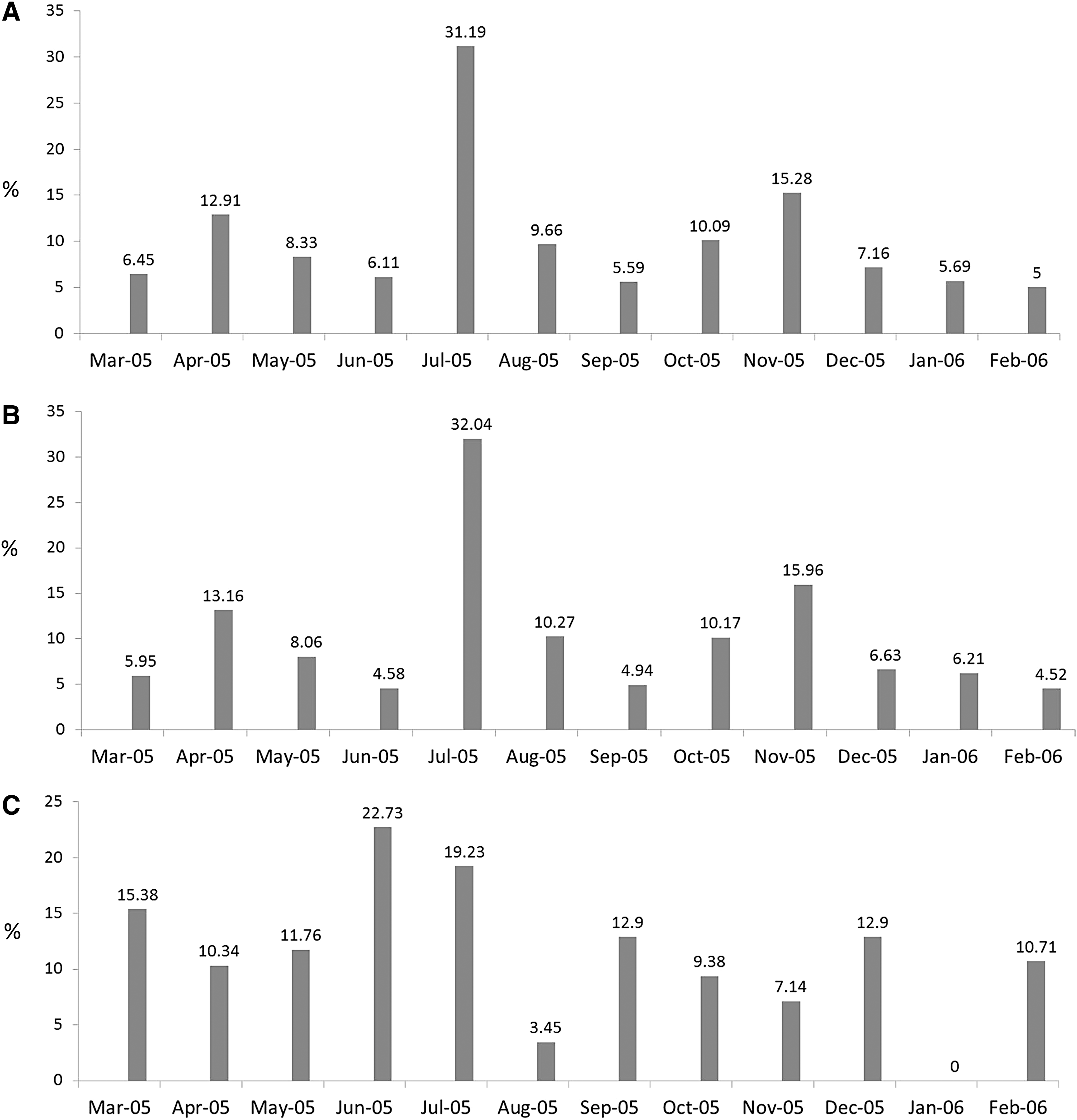
Salmonella prevalence (%) in the sampled farms
Salmonella risk factors
Only the variables with odds ratios (ORs) ≥1 were presented in Table 4. Positive correlations were detected between the presence of Salmonella in fecal samples with climate and environmental variables. According to simple logistic regression modeling, the risk of Salmonella presence in cows and calves was significantly increased for higher temperatures (average) and higher precipitation (p < 0.01). Cows in contact with positive environmental samples for Salmonella, such as WATERT, HAND, and soil, were more than two times likely to test positive for Salmonella (p > 0.05), particularly soil (OR 4.23; p = 0.31). At the same time, calves had an increased chance of testing positive for Salmonella from their mother by five times (p < 0.01), and they were almost six times likely to be positive for Salmonella in contact WATERT and two times in contact with HAND.
Risk Factors Associating Livestock, Climate, And Environmental Variables With Salmonella-Positive Animals
CI, confidence interval; OR, odds ratio.
Single drug resistance
Ten percent of the total isolates recovered from the different farms, displayed AMR to one or more antimicrobial drugs tested in this study (Fig. 3, p < 0.01). Salmonella isolates showed higher resistance to Te (46.3%; 114/246), Gm (29.7%; 73/246), Cf (11%; 27/246), and Amc (8.13%; 20/246) and lower resistance to Cip (0.41%; 1/246), C (0.41%; 1/246), Na (2.4%; 6/246), Nor (1.6%; 4/246), and Sxt (2.4%; 6/246) and all Salmonella isolates were susceptible to imipenem (0%; 0/246).
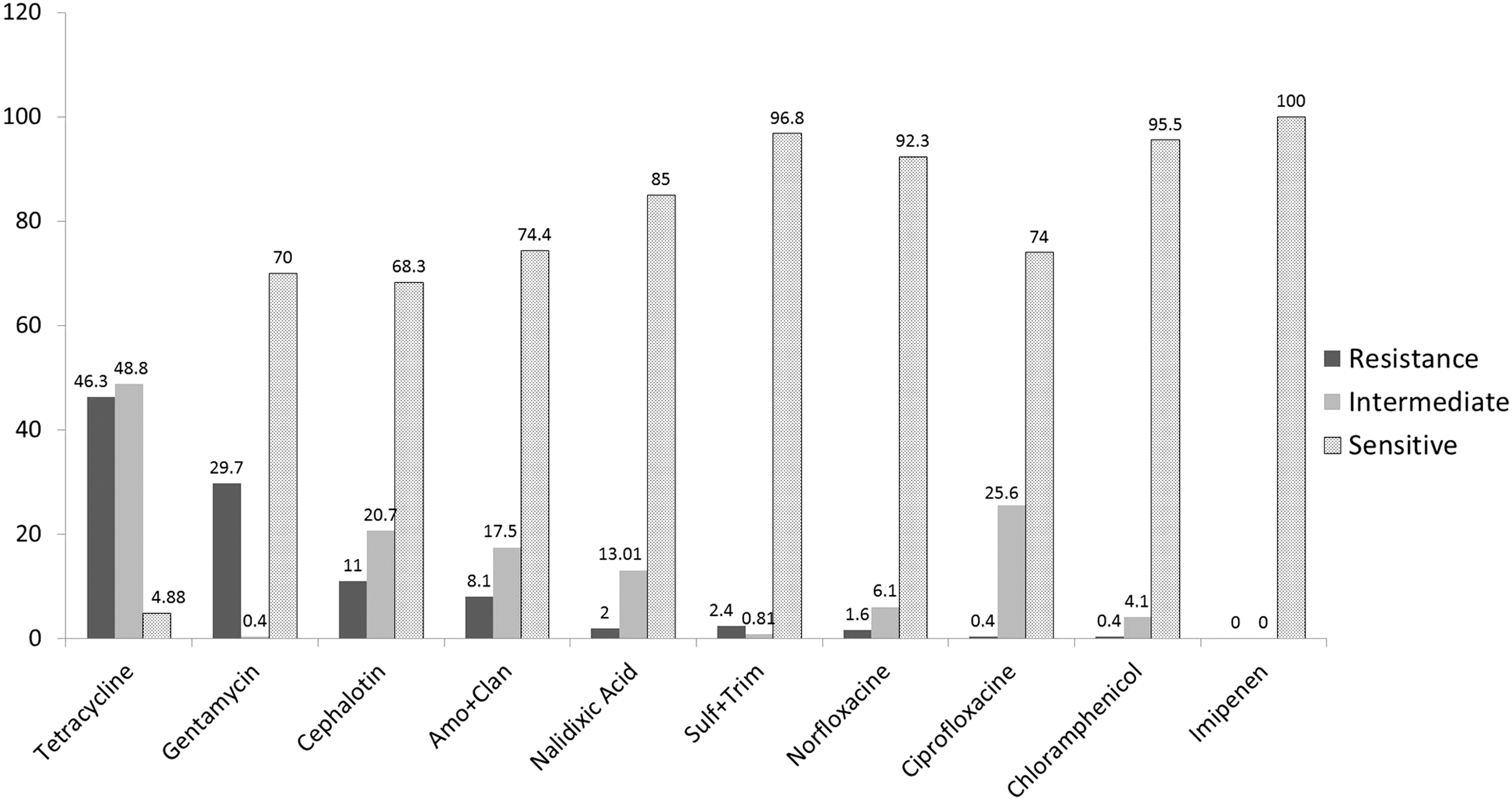
Salmonella spp. antimicrobial resistance by antibiotic. Chi-square analysis indicated difference on prevalence resistance among antibiotic type (p < 0.01).
Significant differences were found among farms (p < 0.01; not shown in tabular form); the highest incidence of resistance having been in farm B (58.7%). However, when segregated by age group (cows and calves), Salmonella resistance did not differ (Fig. 4; p = 0.4). The AMR displayed by Salmonella strains originated from the farm environments, showed resistance to fewer antibiotic classes when compared with Salmonella originating from fecal samples. Resistance was found for only 4 out of 10 drugs tested, Amc (10.53%; 2/19), C (5.26%; 1/19), Cf (15.8%; 3/19), and Te (47.37%; 9/19) (Fig. 4).

Salmonella spp. antimicrobial resistance recovered from cows, calves, and environmental samples. Chi-square analysis indicated no difference on prevalence resistance among sample and antibiotic type (p = 0.4). Amc, amoxicillin–clavulanic acid; C, chloramphenicol; Cf, cephalothin; Cip, ciprofloxacin; Gm, gentamicin; Imp, imipenem; Na, nalidixic acid; Nor, norfloxacin; Stx, trimethoprim–sulfamethoxazole; Te, tetracycline.
Multidrug resistance isolates
Isolates were defined as multidrug resistant when displaying resistance to three or more classes of antimicrobial agents (Schmidt et al., 2012). A total of 23 (9.1%) strains were categorized as a multidrug resistant; all of them were resistant to tetracycline. The most common combination was Cf-Gm-Te, followed by Gm-Nor-Te. Three strains showed resistance to four antimicrobials and one strain showed resistance to five antimicrobials (Table 5). Multidrug-resistant Salmonella were isolated primarily from cattle samples (15/23). Only one multidrug resistance strain (Amc-Cf-Te) was recovered from the environment, specifically from a WATERT sample.
Distribution of Multidrug-Resistant Salmonella by Resistance Phenotype and Origin (n = 23)
Farm on which the isolates were recovered.
Calves older than 3 months of age.
Amc, amoxicillin–clavulanic acid; Cf, cephalothin; C, chloramphenicol; Cip, ciprofloxacin; Environment, the strain was recovered from water trough; Gm, gentamicin; Imp, imipenem; Na, nalidixic acid; Nor, norfloxacin; Te, tetracycline; Stx, trimethoprim–sulfamethoxazole.
Discussion
The prevalence found in the current study was similar to Salmonella numbers previously reported in Venezuela (13.8%), specifically from slaughter facilities (Narvaez-Bravo et al., 2013b). In contrast, in the developed countries, such as the U.S., Salmonella prevalence has been reported between 5.4% to 7.3% in fecal samples from dairy operations (Wells et al., 2001); while in France, an overall Salmonella prevalence of 8.1% has been reported (Lailler et al., 2005). In our research, 100% of the tested herds had one or more animals that tested positive for Salmonella and its prevalence seems to be in a similar range (low to medium) of those reported in other countries when looking at individual farms (ranging from 4% to 24%; Table 3).
In developed countries with four distinct seasons, the summer months present the highest prevalence of Salmonella shedding in dairy cattle (Edrington et al., 2004, 2008). In contrast, the Venezuela region where this research was conducted, East coast of Maracaibo lake, has two distinct seasons (dry and rainy). However, the higher incidence of positive samples for Salmonella was during rainy season (p < 0.01), where the temperature and rainfall increased. It is notable there was a little variance in the temperature between rainy and dry seasons. Possibly, the microclimate on each farm could have had more influence on the incidence of Salmonella than the region temperature; nevertheless, in this research, temperature and humidity by farm were not measured. In addition, the OR obtained for the seasonality data here was >1, which indicated an association of Salmonella shedding and seasonality. Likavec et al. (2016) reported an association between thermal environment and Salmonella shedding in dairy cattle. They found an increase in Salmonella of 54% for every 5°C increment in average temperature and 29% for every 5-unit increase in the temperature humidity index, 72 h before sampling (Likavec et al., 2016). It is possible that variations in temperature and humidity during the days before the sampling took place, affected Salmonella fecal shedding.
Environmental sources of Salmonella could be the major contributing factors in spreading the Salmonella on the farm (Wray and Wray, 2000; Mohammed et al., 2016; Rodriguez-Rivera et al., 2016). In fact, 63% of the water sources available (WATERW, WATERT, and POND) for humans and livestock were contaminated with Salmonella, particularly WATERT, which presented a higher association with Salmonella in cows and calves. Other environmental samples might represent a risk of contamination in animals and could be related to management factors associated with production. For example, cows must often be suckled by the calf to initiate milk letdown, and then the workers tied the calf to the cow using ropes. Such manipulation can lead to more spreading of fecal material by HAND, which was observed during the sampling visits. Thus, providing hand-washing stations in-place could decrease Salmonella spreading and further reduce its presence in milk.
The misuse and overuse of antimicrobials by different sectors are accelerating the rise of bacteria resistant to antibiotics. The one health concept recognizes that health of people, animals, and the environment are interconnected and to secure health for each; a collaborative approach is needed (Lammie and Hughes, 2016). In the geographical region of participating farms, the most common antibiotics used for therapeutic purposes were oxytetracycline, enrofloxacin, and amoxicillin. Overall, AMR incidence in the current study was similar to those reported for Salmonella in the United States (Lundin et al., 2008). Ray et al. (2006) showed a similar Salmonella resistance for tetracycline (40.6%) in conventional dairy operations; however, for some drugs such as cephalotin, chloramphenicol, and amoxicillin–clavulanic acid, the resistance was higher (37.7%, 20.3%, and 31.9%, respectively) than those found in our study. Low resistance was also reported for ciprofloxacin (0%), gentamicin (10.1%), nalidixic acid (1.5%), and trimethoprim–sulfamethoxazole (1.5%), which were lower than the ones reported in our study (Ray et al., 2006). Salmonella resistance to tetracycline is often found in livestock (Kuang et al., 2015; Siriken et al., 2015; Sanchez-Maldonado et al., 2017), as it has been used in livestock for decades and by the participating farms, which explains its higher prevalence in the current study. The other two antibiotic groups, fluoroquinolones (enrofloxacin) and penicillins (amoxicillin), were not used frequently by the participating farms, which could be related with the low resistance found for those antibiotic classes in this study.
Antibiotics are categorized based on the indication and availability of alternative antimicrobials for the treatment of infections in human medicine (Health-Canada, 2009). Resistance to category III antibiotics (medium importance; Te and Gm), were frequently found among the Salmonella isolates screened in this study. Resistance to category I (very high importance; Amc, Cf, Cip, Nor, and Imp) and category II (high importance; Na and Stx) antibiotics was found in lower percentages (Health-Canada, 2009). Resistance of nontyphoidal Salmonella to fluoroquinolones and third-generation cephalosporins has been reported in humans (Burke et al., 2014). This is of great concern, since extended-spectrum cephalosporins are important for treating patients with severe Salmonella infections (Hohmann, 2001).
Overall, the surrounding farm environments and humans played an important role in Salmonella dissemination, which likely contributed to the cycling of the pathogens at the farm and the further contamination of milk. However, the majority of Salmonella spp., recovered the present low resistance to a broad range of antimicrobial drugs. The information provided by this research implies that simple preventive hygiene practices, such as handwashing, maintenance of clean water sources for the animals, and covered animal feed storage could help to prevent or decrease Salmonella cycling. Finally, although the data were collected in 2005–2006, the information is still relevant for Latin American cattle producer in the tropical region with similar production system and breed types. Consequently, more research is needed to monitor the risk factors, distribution, and evolution of Salmonella antibiotic resistance within tropical livestock populations.
Footnotes
Acknowledgments
This research was possible through the support of the CONDES (Consejo de Desarrollo Cientifico y Humanistico de la Universidad del Zulia), Ohio State University, and the microbiology laboratory of the Faculty of Veterinary Medicine, University of Zulia. A special thanks to all farms which collaborated and supported the research team during sample collection.
Disclosure Statement
No competing financial interests exist.