







Abstract
Antimicrobial resistance (AR) is a pressing public health concern, and agricultural operations such as dairy and beef cattle production have been implicated as potential sources of resistant bacteria or genetic elements. This study aimed to determine the prevalence of antimicrobial-resistant Escherichia coli from calf pens in 6 auction houses (56 manure composite samples) and 12 veal calf operations (240 fecal samples in 2 visits: after the calves arrived at the farm and shortly before the animals were sent to slaughter) in the Commonwealth of Pennsylvania. A total of 1567 generic E. coli were isolated and screened for resistance phenotypes. Resistant E. coli were isolated from all auction houses and farms sampled. Based on nonparametric Kruskal–Wallis tests, incremental prevalence of E. coli resistant to ampicillin, azithromycin, cefoxitin, ceftiofur, ceftriaxone, chloramphenicol, streptomycin, sulfisoxazole, trimethoprim-sulfamethoxazole, and tetracycline in the samples from auction houses and the first and second farm visits was observed (χ2 6.98–15.91, p < 0.05). Multidrug-resistant E. coli (resistant to more than three antimicrobial classes) were identified in 76.8%, 90.8%, and 100% of samples collected from the auction houses, first farm visits, and second farm visits, respectively. The presence of bla CTX-M-E. coli in 11 of the 12 farms presents the possibility of veal production environments being a reservoir for resistant genetic materials that may pose a risk to human health if they are transferred to human pathogens. Additional research on the impact of various management strategies in veal calf rearing is needed for a complete scenario of AR in these production environments.
Introduction
Antimicrobial resistance (AR) has become a pressing public health concern and has, in part, been attributed to the use of therapeutic and subtherapeutic antibiotics in animal agriculture (Langford et al., 2003; Ghosh and LaPara, 2007; Oliver et al., 2011). Antibiotics are used in farm animals to treat diseases, to prevent and control common infections, and as growth promoters (McEwen and Fedorka-Cray, 2002; APHIS, 2008; Barlow, 2011; Landers et al., 2012). In 2017, the Food and Drug Administration (FDA) fully implemented rules addressing the use of feed-based antibiotics in food animals, particularly the restriction of the use of any medically important antibiotics for growth promotion purposes, and the requirement for veterinarian oversight of the use of antibiotics used in feed (FDA, 2017).
Escherichia coli are a well-known reservoir of AR elements (Allen et al., 2010; Scallan et al., 2011; Majowicz et al., 2014). The National Antimicrobial Resistance Monitoring System (NARMS) reported that 41% of beef cow ceca and 24% of dairy cow ceca harbored E. coli resistant to at least one antimicrobial in 2015 compared with 17% of dairy cow ceca and 27% from beef cow ceca in 2013 (NARMS, 2014, 2017). Resistant fecal bacteria can lead to contamination of bulk tank milk and meat at slaughter (White et al., 2001; Arthur et al., 2008; Schmidt et al., 2015). Interestingly, resistant E. coli are more prevalent in the E. coli population of young dairy calves than in cows (Cao et al., 2019; Sato et al., 2005).
The majority of young male calves from dairy farms are sold, often through auction houses, and transported to farms where they are raised until 16–18 weeks of age or a slaughter weight of up to 500 lbs, and the meat is marketed as veal. In a survey of veal purchased at grocery stores in Ontario, Canada, 70% of the E. coli isolates from milk-fed and 54% of the E. coli isolates from grain-fed veal samples were resistant to at least one antimicrobial (Cook et al., 2011a, b). While not an expansive survey, these results suggest that veal calves are a potential source of antimicrobial-resistant bacteria.
Most veal production has recently transitioned to group housing (American Veal Association, 2016), which provides opportunities for movement of bacteria between animals, including those harboring AR genes (Sharma et al., 2008). Haenni et al. (2014) observed an increasing trend in extended-spectrum β-lactamase (ESBL)-producing Enterobacteriaceae carriage in French veal calves. However, there is little information available on carriage and distribution of AR in the U.S. veal industry.
The objective of this study was to determine the prevalence of resistance among commensal E. coli isolated from calves in auction houses and at veal calf operations in Pennsylvania.
Materials and Methods
Sample collection
A total of 56 composite manure samples from six auction houses and 240 fecal samples from 12 veal calf farms were collected (March–September 2015). Each auction facility was visited one time, while each farm was visited twice, soon after the calves arrived at the farm and shortly before the animals were sent to slaughter. At each farm sampling, 10 fecal samples were collected from individual calves. The second samplings were from the same cohort, but not necessarily the same animals. Manure composite samples were collected from bob calf pens (generally housing calves <1-month old) in six auction houses between March and April 2015. All samples were shipped overnight on ice to the USDA-Agricultural Research Service (Beltsville, MD).
Sample processing and bacterial analysis
Fecal samples and manure composite samples were processed in the same manner. Samples were suspended in buffered peptone water (10 g in 20 mL) with a BagMixer (Interscience, Woburn, MA), followed by streaking onto CHROMagar E. coli (CHROMagar, Paris, France). Randomly selected presumptive E. coli isolates (at least five per sample) were transferred onto Simmons Citrate (BD Diagnostics, Sparks, MD), MacConkey (Remel, Lenexa, KS), and L-Agar plates (Neogen, Lansing, MI). After 24 h of incubation (37°C), colonies exhibiting typical E. coli phenotype were selected for AR prescreening.
Antimicrobial susceptibility testing
For preliminary screening, all E. coli isolates were replica plated onto a panel of Mueller–Hinton agar supplemented with NARMS breakpoint concentrations (except ciprofloxacin) of ampicillin (32 μg/mL), cefoxitin (32 μg/mL), chloramphenicol (32 μg/mL), cefotaxime (4 μg/mL), tetracycline (16 μg/mL), streptomycin (64 μg/mL), kanamycin (64 μg/mL), or ciprofloxacin (2 μg/mL) and incubated for 18 h at 37°C (NARMS, 2013). When two or more isolates from the same sample showed the same resistance pattern, one was selected for further testing. Prescreening allowed for cost-efficient characterization of a larger number of isolates.
Resistance to 14 antimicrobials on the NARMS GN panel (CMV3AGNF; Table 1) was assessed using an automated system (Trek Diagnostic Systems, Westlake, OH). The breakpoint values used for each antibiotic and their abbreviations are in Table 1. Results were interpreted according to Clinical and Laboratory Standards Institute standards whenever available; alternatively, minimum inhibitory concentrations were interpreted according to NARMS (CLSI, 2012; NARMS, 2014, 2016). Enterococcus faecalis ATCC 29212, Pseudomonas aeruginosa ATCC 27853, and Staphylococcus aureus ATCC 29213 were used as reference strains.
Panel of Antimicrobials and the Breakpoints Used to Test Resistance in Escherichia coli Isolates
Breakpoints are based on CLSI standards. The breakpoint for streptomycin was not established by CLSI; so it was based on NARMS guidance.
CLSI, Clinical and Laboratory Standards Institute; NARMS, National Antimicrobial Resistance Monitoring System.
Analysis for bla CTX-M gene
The ESBL gene, bla CTX-M, was detected using a multiplex PCR protocol described by Woodford et al. (2006) with modified component ratios in the reaction mixture. The reaction mixtures (25 μL) consisted 50 pmol of each primer (Groups 1F, 1R, 2F, 2R, 9F, 9R, 8F, and 25F), 100 pmol of Group 8/25R primer, 200 μM of each deoxynucleoside triphosphate (Thermo Fisher Scientific, Waltham, MA), 2 mM MgCl2, 1.5 U Ampli Taq Gold enzyme, Ampli Taq Gold Buffer II (Thermo Fisher Scientific), and 1 μL of template DNA. E. coli strains N36254PS, N36410PS, and N40467 from the FDA-CVM were used as positive controls for CTX-M Groups 1 and 9.
Statistical analysis
For each antimicrobial, farm prevalence of resistant E. coli from the three sources (auction houses, and Farm visits 1 and 2) was compared using nonparametric Kruskal–Wallis test using JMP Pro 13 (SAS Institute, Inc., Cary, NC).
Results and Discussion
Prevalence of antimicrobial-resistant E. coli
E. coli are essentially ubiquitous in normal intestinal flora, and E. coli were isolated from every manure composite (n = 56) and fecal (n = 240) sample collected. A total of 1567 E. coli isolates (294 from auction house composite samples and 1273 from fecal samples) were preserved and further characterized. The on-farm isolates almost equally represented two collection visits (642 from visit 1 and 631 from visit 2). Based on prescreening of the 1567 E. coli isolates for sample-specific unique resistance patterns, 912 representative isolates were selected and further tested for susceptibility to 14 antimicrobials on the NARMS GN panel.
Each of the 6 auction facilities and 12 farms yielded at least 1 E. coli isolate resistant to 1 or more antimicrobials (Supplementary Table S1; Supplementary Data are available online at
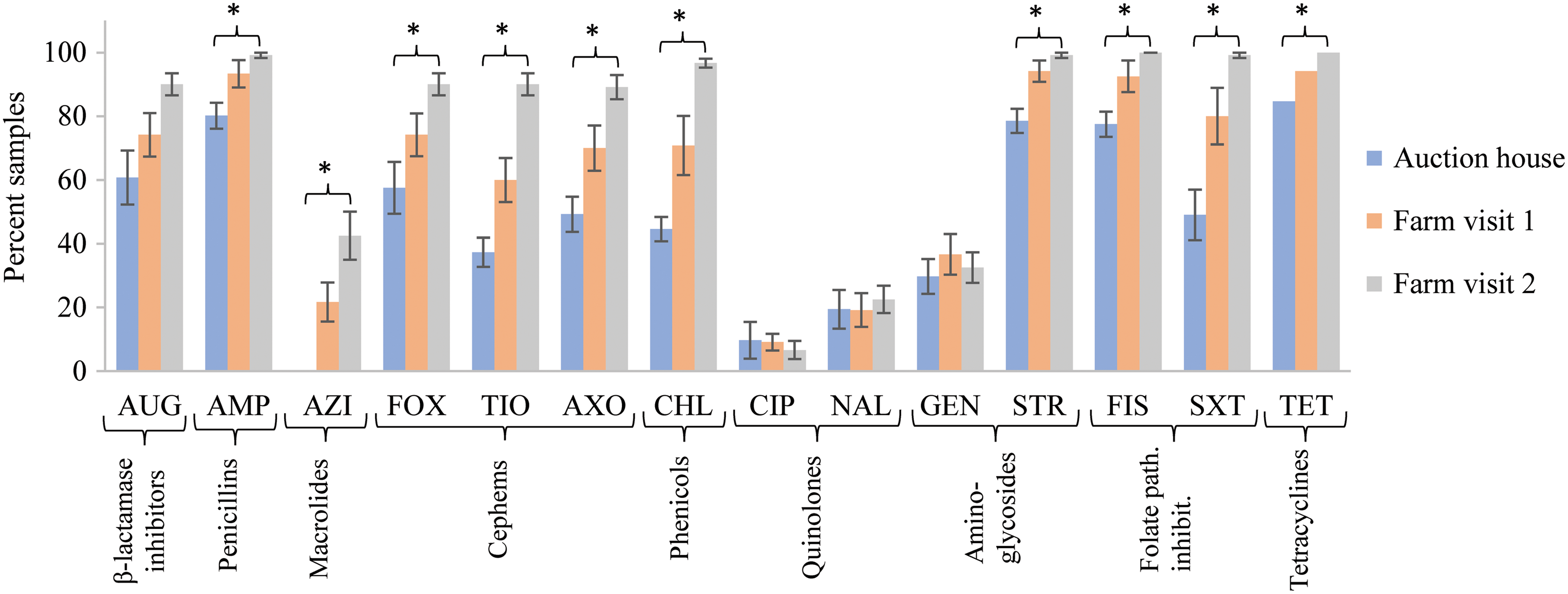
Percent of samples from three sampling groups (auction houses, Farm visit 1, and Farm visit 2) that contained at least one Escherichia coli isolate resistant to an antimicrobial on the NARMS GN panel. Error bars represent standard error of the means. *Significant difference among the three groups at p < 0.05. NARMS, National Antimicrobial Resistance Monitoring System. Color images available online at
Based on nonparametric Kruskal–Wallis tests, resistance to ampicillin, azithromycin, cefoxitin, ceftiofur, ceftriaxone, chloramphenicol, streptomycin, sulfisoxazole, trimethoprim-sulfamethoxazole, and tetracycline was significantly different among samples from auction houses, and first and second farm visits (χ2 6.98–15.91, p < 0.05). For these 10 antimicrobials, the prevalence of resistant E. coli was lowest in samples from the auction houses followed by the samples from the first farm visits, and then those from the second farm visits. This suggested an apparent age-related difference in the colonization by and shedding of resistant E. coli in veal calves. Incremental prevalence of resistant E. coli in the samples from auction houses and the first and second farm visits was also observed for amoxicillin-clavulanic acid, but not for ciprofloxacin, nalidixic acid, or gentamicin (χ2 5.63, p > 0.05).
Previous studies have found animal age to be a significant factor associated with gut colonization and shedding of resistant E. coli (Mathew et al., 2001; DeFrancesco et al., 2004; Khachatryan et al., 2004; Hoyle et al., 2004a, 2004b; Duse et al., 2015; Cao et al., 2019). A study involving seven cohorts of calves (0–8 months old) reported age-related declines in the carriage of ampicillin-resistant E. coli with peak prevalence during the first 4 months after the calves were born (Hoyle et al., 2004b). Berge et al. (2005) reported that 2-week-old calves were more likely to have highly resistant E. coli isolates than day-old calves, suggesting an age-related increase in carriage of resistant E. coli. Similarly, Gow et al. (2008), reported that 3-d-old or younger calves were less likely to harbor resistant E. coli than 10-d-old calves.
These trends in age-associated carriage of resistant E. coli indicate the involvement of multiple stochastic factors, including, but not limited to direct administration of oral antimicrobials, feeding colostrum from cows treated with antimicrobials at dry off, feeding waste milk (nonmarketable milk due to recent antimicrobial treatment or suboptimal quality), management strategies for raising veal calves (vs. dairy calves), and predominant breed of the herd, farm-type, and geographic location (Langford et al., 2003; Mirzaagha et al., 2011; Aust et al., 2013; Pereira et al., 2014a, b). Addressing these factors individually is necessary to compare temporal shifts in the carriage and shedding of resistant E. coli among farm animals.
In this study, resistance to antimicrobial classes, such as tetracyclines, β-lactams, aminoglycosides (except gentamicin), phenicols, and folate pathway inhibitors, was more common among samples collected from the bob calf pens in auction houses (44.6–82.1%) compared with macrolides and quinolones, which were observed in 0% and 10.7% of the auction house samples, respectively (Supplementary Table S1). Similar trends were also observed in the samples from the first and second farm visits with lower observed prevalence of macrolide and quinolone resistance (19.1–42.5%) compared with tetracyclines, β-lactams, aminoglycosides (streptomycin), phenicols, and folate pathway inhibitors (70.8–100%).
High prevalence of E. coli resistant to 11 antimicrobials (β-lactams, aminoglycosides, phenicols, folate pathway inhibitors, and tetracyclines) was previously reported among veal calf cohorts with reduced resistance to nalidixic acid (quinolone) in California (Berge et al., 2005). Lower levels of resistance to nalidixic acid and gentamicin (compared with ampicillin, chloramphenicol, streptomycin, tetracycline, sulfadiazine, and trimethoprim) among commensal E. coli from healthy dairy calves were also reported by DeFrancesco et al. (2004).
Distribution of multidrug-resistant E. coli in veal calf operations
In this study, at least one multidrug-resistant (MDR, resistant to more than three antimicrobial classes) E. coli was isolated from each of the auction houses and study farms (Supplementary Table S2). MDR E. coli were isolated from 76.8%, 90.8%, and 100% of samples collected from the auction houses, first farm visits, and second farm visits, respectively (Fig. 2). Different MDR trends were observed when the samples were categorized into individual farms or auction houses. MDR E. coli were isolated from 60%, 83.3%, 90%, 100%, 72.7%, and 68.8% of samples from the auction houses R1, R2, R3, R4, R5, and R6, respectively. Among the samples collected from the farms (A to L) during the first visits, MDR E. coli were identified in 50%, 60%, and 90% of samples from farms B, D, and H, respectively, while 100% of the samples from the rest of the farms harbored MDR E. coli.

Prevalence of Escherichia coli resistant to one or more classes of antimicrobials. Antimicrobials and classes are described in Table 1. Color images available online at
All the samples from each of the farms during the second visit had MDR E. coli, with only one sample (Farm K) harboring an E. coli isolate that was resistant to all nine classes. Although studies reporting high levels of MDR E. coli in healthy dairy calves are infrequent, 100% of the ceftiofur-resistant E. coli isolates from 96 calves in a PA dairy herd were MDR (Donaldson et al., 2006), and Orden et al. (2000) reported that 67.7% of E. coli isolates from dairy calves affected by neonatal diarrhea were MDR. As previously mentioned, there are many factors that may have contributed to the observed MDR E. coli prevalence in this study, although calf management protocols were not made available.
There were 124 different AR patterns observed among the E. coli isolates, 41, 82, and 72 from auction houses, first farm visits, and second farm visits, respectively (Supplementary Table S3). Among those patterns, 19 were common in isolates from all 3 sampling sources. All of the 41 resistance patterns identified in the auction houses were also observed in E. coli from either first or second farms visits, or both. Previously, Cook et al. (2011b) observed 101 different resistance patterns among E. coli isolates in fresh retail grain-fed veal obtained in Ontario, Canada. AR patterns that were observed in 50% or more of the auction houses or farms from this study are presented in Table 2.
The Antimicrobial Resistance Patterns Observed in Escherichia coli Isolates from 50% or More of the Veal Calf Fecal Samples and Composite Samples from Auction House Calf Pens
Values after each pattern are the percentage of auction houses or farms harboring E. coli with that resistance pattern. Farm-specific distribution of antimicrobial resistance patterns can be obtained from Supplementary Table S3.
At least one E. coli isolate with a resistance pattern of AMP-STR-FIS-TET-SXT was found in each of the three sample categories. It was also the most prevalent resistance pattern among the auction houses (observed in 66.7% auction houses). Some dominant patterns among the farm isolates during the first and second visits were AMP-STR-FIS-TET-SXT/AUG-AMP-FOX-TIO-AXO-STR-FIS-TET-SXT and AUG-AMP-FOX-TIO-AXO-STR-FIS-TET-SXT/AUG-AMP-FOX-TIO-AXO-CHL-STR-FIS-TET-SXT, respectively. Sample-specific distributions of AR patterns are presented in Supplementary Table S4.
The AMP-STR-FIS-TET pattern was observed in 8.9% of samples collected from the auction houses. AUG-AMP-FOX-TIO-AXO-STR-FIS-TET-SXT was the most prevalent pattern among the samples from farms during the first and second visits (23% and 48% samples, respectively). Mainda et al. (2015) observed that the resistance patterns among E. coli isolates from Zambian dairy cattle reflected the relative levels of antibiotic sales and concluded that distinct resistance patterns among the E. coli isolates indicate coselection of resistance alleles. Further studies combining phenotypic resistance patterns, genotypic patterns, and antibiotic usage are necessary for a complete scenario of AR in these production environments.
Prevalence of bla CTX-M genes in E. coli from veal calf feces
The bla CTX-M β-lactamases confer resistance to cephalosporins, a clinically important antimicrobial class (Wittum et al., 2010; Oliver et al., 2011; Davis et al., 2015). Although frequently recovered from both hospital- and community-acquired infections, bla CTX-M was first reported in U.S. livestock in 2010 (Mollenkopf et al., 2012). The increasing prevalence of extended-spectrum cephalosporin resistance is a global human and animal health concern (Hordijk et al., 2013). In this study, bla CTX-M + E. coli were isolated from 13.3% and 17.5% of farm samples during the first and second farm visits, respectively, and these bla CTX-M-harboring E. coli were isolated from first visits on 11 farms and second visits on seven farms (Table 3).
Prevalence of bla CTX-M + Escherichia coli in Veal Calf Fecal Samples
Values indicate representative bla CTX-M group.
Although bla CTX-M-carrying plasmids have been shown to persist in E. coli gut populations in the absence of antibiotic pressure (Cottell et al., 2012), plasmid-carrying E. coli may have decreased as a proportion of the total E. coli population in the five herds where they were undetected in the second visit. The increase in bla CTX-M + E. coli from several farms between the first and second visits may have been due to therapeutic cephalosporin administration, although farm antibiotic usage data were not made available.
Many bla CTX-M gene groups have been identified in dairy farm E. coli (Odenthal et al., 2016); however, in this study, only groups 1 and 9 were found. Mollenkopf et al. (2012) isolated bla CTX-M + E. coli from 9.4% of samples (70 of 747) from five bla CTX-M + dairy herds (20%). Davis et al. (2015) observed an overall prevalence of 4% bla CTX-M + E. coli from dairy farms. Due to the potential for horizontally transferring plasmids carrying one or more bla CTX-M gene groups, these veal calf-associated E. coli may serve as a potential source of cephalosporin resistance to clinically important pathogens.
Based on this analysis, there is an apparent high prevalence of diverse transmissible genetic resistance elements in fecal E. coli from young dairy calves at auction facilities as well as in veal calves. As mentioned above, resistance can persist in the absence of antibiotic pressure. However, especially in the past, dairy calves are generally more likely to be fed antibiotics (with the exception of ionophores) than cows. This has been shown to be positively associated with increased resistance in fecal E. coli (Berge et al., 2005).
In 2014, before the full implementation of the Veterinary Feed Directive, 37.6% of U.S. dairy farms fed medicated milk replacers to at least some of their preweaned calves (USDA, 2016) to control coccidia (decoquinate, lasalocid, and monensin), and prevent or treat diarrhea and pneumonia (chlortetracycline, oxytetracycline, and neomycin/oxytetracycline). A lack of adequate colostrum feeding, the stress of transport, and mixing of animals from many different sources at auction facilities and veal farms are factors that increase the risk of disease in young male dairy calves raised for veal. Antibiotics may therefore be administered to groups of veal calves as a preventive measure, or to treat outbreaks of disease in newly arrived animals. This may increase the pressure for resistance enrichment in fecal bacteria.
There was a high level of resistance to β-lactams, phenicols, aminoglycosides, and folate pathway inhibitors in the veal farm fecal E. coli isolates. Resistance to a specific antimicrobial is not always the result of exposure to that antimicrobial since resistance elements are often colocated on a plasmid. In that situation, selection for one of the elements leads to enrichment of additional resistance elements. This complicates the relationship between antimicrobial use and resistance in fecal bacteria and more information is needed to understand these dynamics.
Conclusions
There appears to be a significant prevalence of AR in the population of young dairy and veal calves sampled in this study. Farm-to-farm variations were observed in MDR E. coli prevalence and prevalence were highest in the older calves. The resistance patterns and the presence of bla CTX-M-E. coli on most of the farms suggest that these veal production environments are a reservoir for resistant genetic materials that may pose a risk to human health. Additional research on veal calf operations covering different geographic locations and management approaches, particularly antibiotic usage, needs to be carried out for a further understanding of the ecology of AR in these production environments and to identify potential avenues for mitigation.
Footnotes
Acknowledgments
The authors wish to express their gratitude to the producers who provided access to their animals during this study and to Laura Del Collo and Jakeitha Sonnier for excellent technical assistance.
Disclosure Statement
No competing financial interests exist.
References
Supplementary Material
Please find the following supplemental material available below.
For Open Access articles published under a Creative Commons License, all supplemental material carries the same license as the article it is associated with.
For non-Open Access articles published, all supplemental material carries a non-exclusive license, and permission requests for re-use of supplemental material or any part of supplemental material shall be sent directly to the copyright owner as specified in the copyright notice associated with the article.
