




Abstract
Culture method using enrichment broth and selective agar is one of the most common isolation methods for detecting Campylobacter jejuni from food. However, the overgrowth of competing bacteria in enrichment culture complicates the selective isolation of C. jejuni. In this study, we compared an enrichment/plating method for the isolation of C. jejuni from sprout samples with an enrichment/plating method with syringe or membrane filtration when transferring enriched broths to plates. Four types of sprout samples were artificially contaminated with various levels of C. jejuni and incubated in 100 mL of Bolton broth for 48 h. Enrichment broths were either directly transferred onto modified charcoal-cefoperazone-deoxycholate agar or filtered through membrane or with a syringe. A significantly higher (p < 0.05) isolation rate of Campylobacter positives was obtained with both filtration methods (58–61%) than with the method without filtration (10%). Membrane filtrations yielded 61%, whereas syringe yielded 58% positives. In most cases of unfiltered samples (98%), high competing flora covered most of the plate, making differentiation and picking of suspicious colonies difficult. However, less plates were contaminated with competing flora in both filtration methods. Only 5% of plates were contaminated in the syringe filtration method, whereas no competing flora was observed in membrane filtration (0%).
Introduction
C
To overcome the disadvantage of culture method, the direct application of membrane filters to the surface of the plating media has been previously used to exclude the unwanted microflora for the selective isolation of Campylobacter (Steele and McDermott, 1984; Kulkarni et al., 2002; Speegle et al., 2009; Jokinen et al., 2012). In our previous study, we reported that sample enrichment with a 0.65-μm pore size syringe filter might be a simple and useful option for increasing the recovery and selectivity rates (Chon et al., 2017). Few studies, however, have compared the use of syringe or membrane filtrations to culture method without filtration for the isolation of Campylobacter in RTE sprouts. In this study, we compared a culture method for the isolation of C. jejuni from sprout samples with a method that incorporated syringe or membrane filtrations.
Materials and Methods
Bacterial strain
C. jejuni NCTC 11168 was used for artificial inoculation in this study. The stock culture was inoculated onto Campy-Cefex agar without antibiotics (CCA w/o A; Accumedia, Baltimore, MD) and incubated at 42°C for 48 h for two passages under microaerobic conditions (5% O2, 10% CO2, 85% N2).
Inoculation of C. jejuni into RTE sprout samples
Four types of RTE sprouts (radish sprouts, broccoli sprouts, and two types of sprout mixes) were used in this study. Food samples for spiking experiments were collected from a retail market in the Gwang-jin region, Seoul, South Korea. One sprout mix (sprout mix A) is composed of broccoli, red radish, Chinese cabbage, bok choy, and tatsoi sprouts, and the other sprout mix (sprout mix B) is composed of red radish, Chinese cabbage, kohlrabi, and tatsoi sprouts.
To generate partial positives and partial negatives for statistical comparison of 20 subsamples, C. jejuni was artificially inoculated into a bulk sample. In brief, 1 mL of the bacteria suspension containing ∼4 log CFU (colony-forming unit) of C. jejuni NCTC 11168 was evenly spiked into bulk samples (500 g) by pipetting, as previously described (Chon et al., 2011). The inoculated bulk sample was resuspended at room temperature for 30 min and divided into 20 samples of 25 g each. An additional 25 g of uninoculated food sample was used as negative control.
Detection of C. jejuni in RTE sprout samples by culture method and two filtration methods
All experimental procedures for the detection of C. jejuni from RTE sprouts were conducted as described in the official isolation protocols of the Korea Food and Drug Administration (2014) with minor modification.
Each 25 g sample was put in a sterilized stomacher bag with 100 mL of Bolton broth (Oxoid, Hampshire, United Kingdom). After stomaching for 30 s, homogenated samples were pre-enriched in Bolton broth at 37°C for 4 h, and further enriched at 42°C for 44 h. All Bolton broth enrichments were processed following three separate pathways, culture method (unfiltered), membrane filtration, and syringe filtration method, as described in Figure 1. In the culture method without filtration, the unfiltered enrichment culture was inoculated onto a modified charcoal-cefoperazone-deoxycholate agar (mCCDA; Oxoid) plate by streaking with 10 μL sized disposable loop. For membrane filtration, five 20-μL drops (100 μL) of culture were inoculated on five area of a 0.65-μm pore size membrane filter (nitrocellulose membrane; Millipore, Schwalbach, Germany), as previously described (Speegle et al., 2009). The membrane filter was left in contact with the surface of a plate for 20 min. For syringe filtration, about 5 mL of each dilution was transferred into the syringe connected with a 0.65-μm pore size syringe filter (Minisart®; Sartorius, Goettingen, Germany). The syringe plunger was depressed immediately, after which each filtrate was collected in conical tubes, and streaked with 10 μL sized disposable loop on a mCCDA plate. All plates were incubated at 42°C for 48 h microaerobically. Suspected colonies were removed and subcultured, and identification of C. jejuni was confirmed by colony polymerase chain reaction, as previously described (Denis et al., 1999).
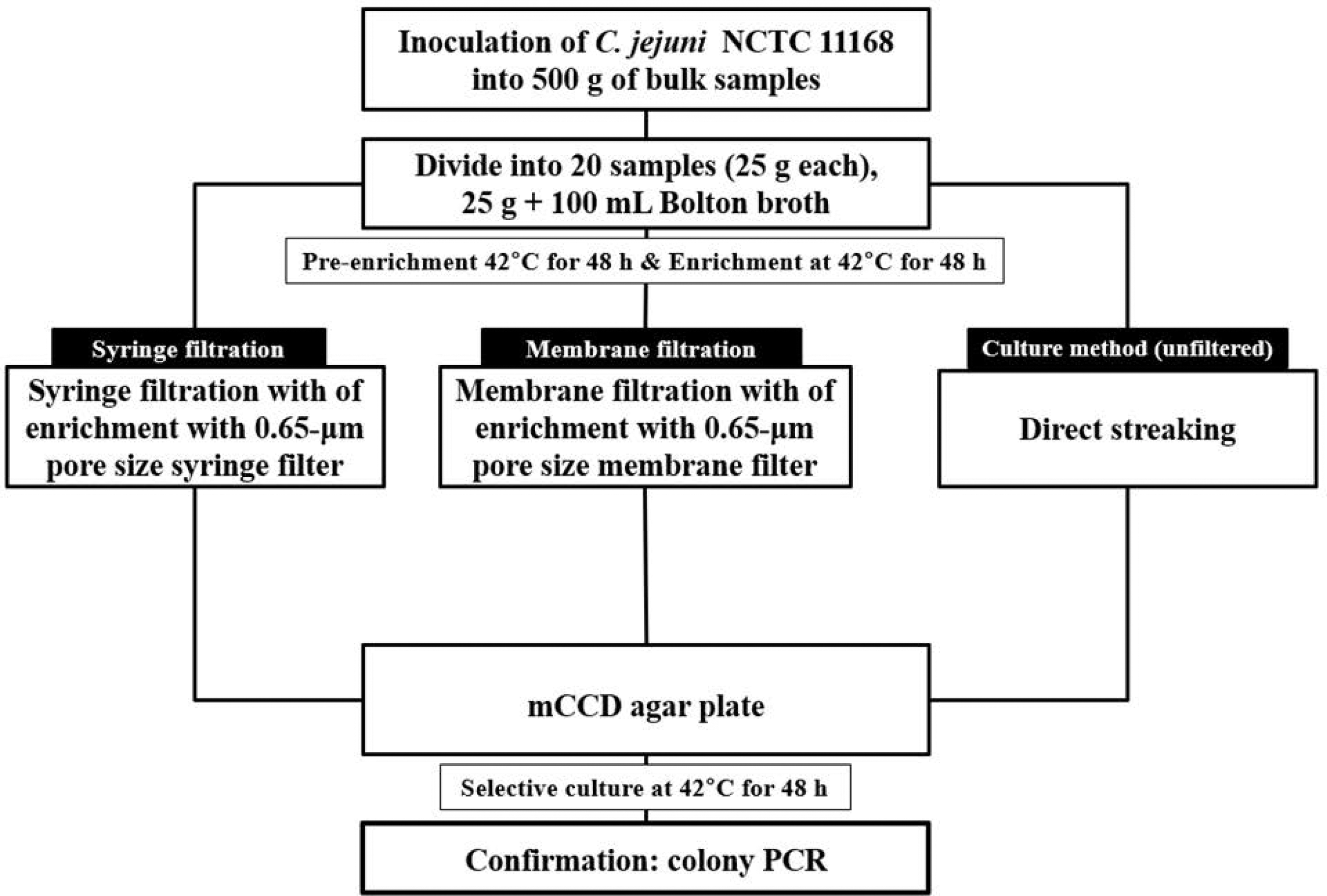
A proposed protocol for Campylobacter jejuni isolation from ready-to-eat sprouts. To generate partial positives and partial negatives for statistical comparison between 20 subsamples, C. jejuni NCTC 11168 was artificially inoculated into 500 g bulk samples. Comparison of competing flora on agar plates inoculated with unfiltered method, syringe-filtered, or membrane-filtered enrichments. mCCD, modified charcoal-cefoperazone-deoxycholate.
Data analysis
We compared the number of plates of C. jejuni in terms of isolation rate, as described in our previous studies (Chon et al., 2011). The number of positive plates for Campylobacter or competing flora was compared using McNemar's test in pairs. Statistical analysis was carried out using the GraphPad Instat software (Version 18.0; GraphPad Software, Inc., San Diego, CA).
Results and Discussion
The performances of the culture methods with or without filtration for the isolation of C. jejuni from four types of RTE sprout samples are compared in Table 1. Both filtration methods resulted in a significantly higher (p < 0.05) isolation rate of Campylobacter positives (58–61%) than the culture method (10%) without filtration. Although no statistical difference was observed (p > 0.05), membrane filtration (61%) yielded the highest positives compared with syringe filtration (58%; Table 1).
Comparison of the Number of Positive Plates for Campylobacter jejuni from Four Types of Ready-to-Eat Sprout Samples Subjected to Unfiltered, Syringe-Filtered, and Membrane-Filtered Enrichment Cultures
Different letters (a and b) within a row indicate significant difference in the recovery rate of C. jejuni (p < 0.05).
Comparison of competing flora on agar plates inoculated with unfiltered, syringe-filtered, or membrane-filtered enrichment is presented in Table 2. In unfiltered samples, most agar plates (98%) were contaminated with competing flora. In most unfiltered samples, high competing flora covered most of the plate, making differentiation and picking of suspicious colonies difficult. However, much less plates were contaminated with competing flora in both filtration methods. With the syringe filtration method, only 5% of plates were contaminated, whereas no competing flora was observed with the membrane filtration method (0%, Table 2). The number of competing flora on plates from syringe filtration was low and did not mask the suspicious colonies. Some competing flora on the mCCDA plates from syringe filtration were biochemically confirmed by using a VITEK 2 assay. Most strains were identified as Sphingomonas paucimobilis, followed by Aeromonas salmonicida (data not shown).
Comparison of the Number of Positive Plates for Competing Flora from Four Types of Ready-to-Eat Sprout Samples Subjected to Unfiltered, Syringe-Filtered, and Membrane-Filtered Enrichment Cultures
We previously reported that a combination of enrichment and syringe filtration results in a significantly higher isolation rate and minimal contamination of Campylobacter from chicken carcasses (Chon et al., 2017). However, few studies have evaluated the efficacy of filtration methods in fresh produce samples. We found that membrane filtration method yields the highest isolation rate of C. jejuni among tested methods (Table 1), even though no statistical difference was found with syringe filtration method (p > 0.05). The selectivity was also better in the membrane filtration method compared with other tested methods. No contaminated plate with competing flora was observed in the membrane filtration method, whereas 5% of plates were contaminated with competing flora when syringe filtration was used (Table 2). As described earlier, membrane filtration has been commonly used to exclude unwanted microflora during the selective isolation of Campylobacter. However, membrane filtration is associated with several technical difficulties, such as a lengthy filtration time. Campylobacter cells inoculated on a membrane filter covering the surface of plating media are allowed to pass through the membrane for 15–20 min (Steele and McDermott, 1984; Speegle et al., 2009). Furthermore, contamination of the plate can arise as a result of filter mishandling, which allows unfiltered liquid to come into contact with the agar surface (Speegle et al., 2009; Chon et al., 2017). However, syringe filtration saves time as the culture broth being immediately filtered in a few seconds right after the enrichment step. The possibility of contamination by mishandling is also much lower in the syringe filtration method as it does not involve direct handling of the filter paper.
Although cell motility and gravitation have been regarded as an essential driving force for the passage of cells through membrane filters (Steele and McDermott, 1984; Wilson and Aitchison, 2007; Speegle et al., 2009), positive pushing pressure appears to play a critical role in syringe filtration (Chon et al., 2017). The charge of the cell membrane is also a determining factor of target bacteria filtration. Official Campylobacter isolation protocol from U.S. Food and Drug Administration is currently adopting the use of 45 μm Zetapor filters for water sample. The filters have a positive charge, making the negative-charged Gram-negative bacteria are more effectively trapped in the filter (Hunt et al., 2001).
Our previous study was the first to report that syringe filtration method could be employed for Campylobacter isolation (Chon et al., 2017). In this study, we found that syringe filtration is still a reliable method for the isolation of C. jejuni in RTE sprouts. Enrichment incorporating syringe filtration may be a simple and useful option to increase recovery and selectivity rates and to decrease contamination and procedure time during C. jejuni isolation from fresh produce. However, the information generated by this study is limited because inoculation level between the syringe (10 μL, streaking) and membrane filtrations (100 μL) according to the methods described in previous studies we referred to (Speegle et al., 2009; Chon et al., 2017). Even though this difference may not have significant effect on the isolation rate for qualitative detection as presented in this study, it should be considered as an important factor for enumeration of C. jejuni in food samples.
The direct application of membrane filters to the surface of the plating media has been previously used to exclude the unwanted microflora for the selective isolation of Campylobacter. Campylobacters may be obtained from the top of membrane, or from the filtrates. For example, Fluoropore and Durapore filters with 0.2–0.5 μm pore size effectively retained campylobacter cells from water samples, whereas cellulose ester filters with 0.22–0.45 μm pore size did not (Oyofo and Rollins, 1993) unless the elution method was modified (Tissier et al., 2012). Even though many previous studies compared and evaluated the efficacy of filtration in clinical and water sample (Steele and McDermott, 1984; Bolton et al., 1988; Wilson and Aitchison, 2007; Jokinen et al., 2012), few studies have been conducted in food sample. Application of filtration in food samples is a bit different from other samples. The efficacy of the filter highly depends on the food matrix rather than size of bacteria, because food particles more easily clog the pores than bacteria. Thus, the application of filtration should be evaluated in foods on different experimental conditions. In the future study, the sensitivity and selectivity of various membrane filters with different membrane types and pore size should be evaluated in poultry meat and vegetable samples.
Footnotes
Acknowledgment
This study was supported by the National Research Foundation of Korea grant funded by the Korean government (MSIP; No. 2018R1A2A2A14021671).
Disclaimer
The views expressed herein do not necessarily reflect those of the US Food and Drug Administration or the US Department of Health and Human Services.
Disclosure Statement
No competing financial interests exist.