




Abstract
A microbiological survey was conducted to determine the presence of Salmonella spp. in raw commingled bulk tank milk (BTM) collected from the Pennsylvania dairies intended for pasteurization. The survey found 8.1% (10/123) of samples positive for Salmonella. Salmonella Cerro was the predominant serovar and genetic analysis of the Salmonella Cerro showed the existence of diverse yet closely related genotypes. Antibiotic susceptibility testing conducted on all isolates showed pan-susceptible pattern against 15 drugs covering 9 drug classes. The study helped determine the presence of Salmonella spp. in the commingled BTM, antibiotic susceptibility patterns, and serovars along with genotypic diversity among the predominant serovar, Salmonella Cerro.
The sale of milk and dairy products sale is regulated in the United States. Pasteurized milk reaching the market is considered free of major foodborne pathogens. Raw milk, on the contrary, can be a source of these pathogens and has been shown to cause foodborne illness (Oliver et al., 2009; CDC, 2017).
Surveillance of foodborne pathogen infections in dairy herds and data on shedding of these pathogens in milk is rather sparse. Several studies have determined levels of foodborne pathogens including that of Salmonella enterica in bulk tank milk (BTM). Salmonella spp. in BTM was reported with a range of 0.2–18.0% (Oliver et al., 2005; Jayarao et al., 2006; Van Kessel et al., 2013; Sonnier et al., 2018). A nationwide survey, however, reported the presence of Salmonella spp. in 27.1% of silo milk stored as raw commingled milk at the processor (Jackson et al., 2012).
Salmonella spp. shedding in a cattle herd can also be linked to the herd health and clinical disease status (Tewari et al., 2012). With the national average for S. enterica shedding in the silo milk reported as 27.1%, we wanted to study its prevalence in the commingled raw milk from Pennsylvania dairies. The antibiotic susceptibility patterns of recovered isolates were also analyzed to examine bacterial resistance. Salmonella Cerro was seen as the predominant serovar, and was further studied to determine the genotype diversity and its distribution.
Raw commingled milk (100 mL) destined for pasteurization was collected as part of a survey from Pennsylvania dairies. Samples were obtained from one or more milk tankers during each collection and transported on frozen ice packs to the laboratory. Samples were collected when tankers reached the processing plants. Milk tankers at 16 major dairy plants covering ∼350–400 dairy farms were sampled randomly. Each collection from a tanker represented a site, that is, pooled BTM milk from nearby dairy farms. Samples were analyzed within 48 h of receipt at the laboratory. A total of 123 milk samples were collected between January and September 2012, with sampling conducted to span three quarters, ranging from January to March, April–June, and July–September.
Milk samples were first screened using an Association of Official Agricultural Chemists-approved antibody-based VIDAS® Salmonella detection system (bioMérieux, Durham, NC). Then they were pre-enriched in 225 mL supplemented buffered peptone water (BPW) for 18–24 h. The enriched samples were analyzed using the VIDAS Salmonella detection system following manufacturer's instructions. Salmonella spp. were isolated from milk samples that were positive by the VIDAS Salmonella detection method by culturing pre-enriched BPW first in tetrathionate broth followed by plating on bismuth sulfite, xylose lysine deoxycholate, and Hektoen enteric agar plates. The isolates recovered with culturing were characterized as Salmonella spp. using biochemical reactions including testing on triple sugar iron (TSI) agar, lysine iron agar (LIA), and API20E kits (FDA, 2006). The Salmonella spp. serogrouping and serotyping were performed using agglutination. Pulse-field gel electrophoresis (PFGE) was conducted on the Salmonella Cerro isolates as described previously according to the PulseNet standardized protocol using XbaI restriction enzyme analysis to assess genotype diversity. Unique PFGE patterns, or pulsotypes, were defined using the Dice coefficient, and with an optimization of 1.5% and a position tolerance of 1.5%. The difference of one band was sufficient to call two PFGE patterns different. PFGE dendrograms were generated using BioNumerics version 6.6 as previously described (Sandt et al., 2013). Isolates were tested for antibiotic resistance by standard broth microdilution method using Trek Sensititre system® (Thermo Fisher Scientific, Oakwood Village, OH). Salmonella isolates were tested using a National Antimicrobial Resistance Monitoring System protocol for 15 drugs including amoxicillin/clavulanic acid, ampicillin, azithromycin, cefoxitin, ceftiofur, ceftriaxone, chloramphenicol, ciprofloxacin, gentamicin, kanamycin, nalidixic acid, streptomycin, sulfisoxazole, tetracycline, and trimethoprim/sulfamethoxazole (USDA, 2011). Minimum inhibitory concentrations for drugs were obtained based on breakpoints defined in the Clinical Laboratory Standards Institute guidelines (CLSI, 2018).
The VIDAS Salmonella assay found 10 of 123 (8.1%) milk samples positive for Salmonella spp. (Table 1). Salmonella spp. was isolated following culture method and identified using biochemical tests including API20E, TSI, and LIA reactions and isolates were serogrouped and serotyped. Salmonella Cerro was the predominant serovar (8/10) isolated from milk collected from the tankers at the 4 of 16 plants under study, along with the recovery of each one of Salmonella Muenster and Salmonella Montevideo. With quarterly sampling, persistence of Salmonella Cerro was observed during successive samplings (Table 1). No specific seasonal pattern was identified for Salmonella shedding during the quarterly sampling for the 9-month study period. However, during the summer the following serotypes not seen in the previous months were recovered: Salmonella serovars Muenster and Montevideo. Additional seasonal prevalence studies will be useful and are planned to see if there is increased shedding of Salmonella or certain Salmonella serovars during the summer months.
Presence of Salmonella spp. in Raw Commingled Bulk Tank Milk Collected from Pennsylvania Dairies
Raw commingled milk samples were tested for the presence Salmonella spp. using VIDAS® and samples were cultured and recovered Salmonella spp. isolates were confirmed and serotyped. Isolates were also tested for susceptibility against amoxicillin/clavulanic acid, ampicillin, azithromycin, cefoxitin, ceftiofur, ceftriaxone, chloramphenicol, ciprofloxacin, gentamicin, kanamycin, nalidixic acid, streptomycin, sulfisoxazole, tetracycline, and trimethoprim/sulfamethoxazole.
All Salmonella spp. isolates were tested against 15 antibiotics and were found to be pan-susceptible covering aminoglycosides, β-lactams, cephems, folate inhibitors, macrolides, penicillins, phenicols, quinolones, and tetracyclines group (Table 1).
The XbaI PFGE profiles of the Salmonella Cerro isolates recovered from the samples collected from the tankers collecting milk from different farm locations and delivering to the same plant in the same sampling quarter showed different patterns (Fig. 1, lanes 2 and 6), implying different genotypes or pulsotypes were circulating on these farms (with 89.6% similarity). Some PFGE genotypes persisted, when sampling was carried out more than 6 months apart at the same plant from milk tankers collecting from same location (Fig. 1, lanes 6 and 7). Overall, the isolates bore 96.3% resemblance to the previously reported PFGE-XbaI pattern (JCGX01.001) for the Salmonella Cerro. These finding provide support to earlier reports about observance of prolonged shedding of serovar Salmonella Cerro in infected cattle and circulation of diverse yet closely related genotypes of serovar Salmonella Cerro on the dairy farms (Tewari et al., 2012; Van Kessel et al., 2013).
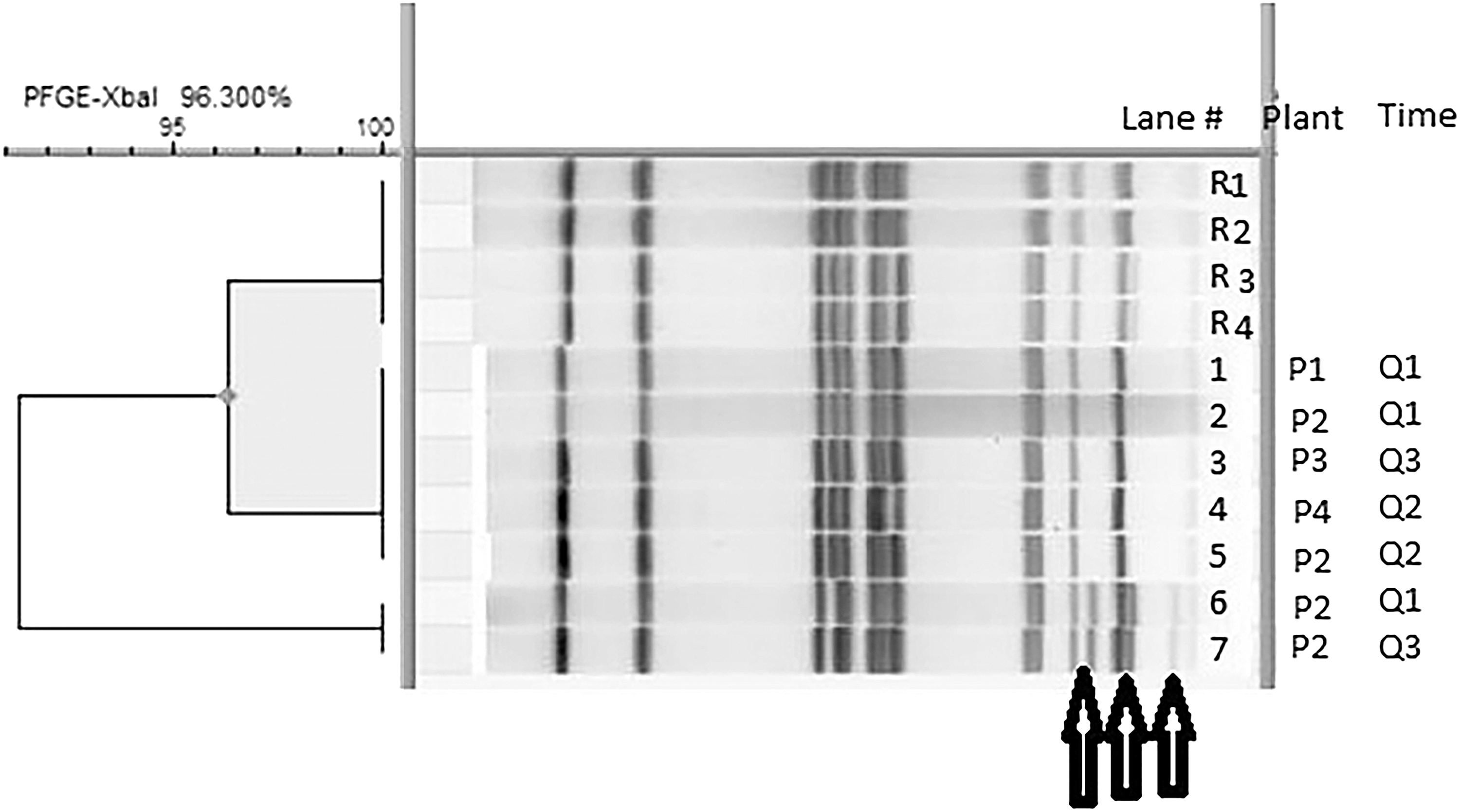
Dendogram and PFGE profiles representing genetic relationship among Salmonella Cerro isolates (based on XbaI enzyme digestion) showing unique patterns (depicted with arrows). Lanes 1–7 represent PFGE profiles of isolates recovered from milk collected from separate milk tankers sampled during the study time period (Q1, January–March; Q2, April–June; and Q3 July–September) delivering to different processing plants (P1–P4); lanes 2 and 6 highlight diverse profiles of isolates recovered from milks collected from same sampling quarter (collected during Q1, in January) and same plant location—P2, lanes 6 and 7 represent similar PFGE profiles of isolates from tankers collecting milk from same farms delivering to the same plant (P2) but with sampling interval of more than 6 months (Q1 in January and Q3 in July, respectively). The isolates were compared with previously reported reference isolates, R1–R4 are the reference isolates recovered from various sources including feces and environment with JCGX01.001 profile. PFGE, pulse-field gel electrophoresis.
Dairy farms are believed to be a source of many foodborne pathogens, including Campylobacter, Listeria, Salmonella, and Shiga toxin–producing Escherichia coli (Oliver et al., 2005). Isolation of Salmonella spp. from commingled milk samples was not unexpected as these organisms are frequently recovered from the animal environment. The level of Salmonella spp. reported in this study was more in line with the levels reported from the BTM analysis (Oliver et al., 2005; Jayarao et al., 2006; Van Kessel et al., 2013) and was lower than that reported from silo milk (Jackson et al., 2012). Higher isolation rate of Salmonella spp. in commingled silo milk at the plant was believed to be because of the pooling effect of the positive BTM (Steele et al., 1997). This however, was not observed in our study although BTM from each tanker represented milk pooled on an average from five dairy farms.
Our study focused mainly on the dairies in Pennsylvania, and found Salmonella serotype Cerro to be the predominant serotype. This observation is in agreement with previous reports of higher isolation rate of serotype Cerro from cattle in Pennsylvania (Tewari et al., 2012; Van Kessel et al., 2013). Salmonella serovar Cerro still continues to dominate other serovars recovered from bovine necropsy cases in Pennsylvania (years 2013–2017; data not shown). Salmonella serovars Muenster and Montevideo were also isolated in this study from milk. The National Animal Health Monitoring System Dairy 2014 study reported Salmonella serovars Cerro, Montevideo, and Newport as the most common Salmonella recovered. Most of the Salmonella isolates recovered in the Dairy 2014 study were pan-susceptible but 13.9% isolates were found to be resistant to one or more antibiotics, and the most common profile observed was resistance to ampicillin, chloramphenicol, streptomycin, sulfisoxazole, and tetracycline plus cephalosporins (Sonnier et al., 2018). The cephalosporin resistance is particularly significant because of its application in treatment of salmonellosis in humans (Sandt et al., 2013; Sonnier et al., 2018). All the isolates in our study were found to be susceptible in vitro to all the antibiotics tested. In addition, none of the samples showed any drug residues (data not shown) for β-lactams, pointing toward existence of good antibiotic stewardship on these dairy farms.
In conclusion, our study provided an estimate of the prevalence of Salmonella spp. in raw commingled milk from Pennsylvania, showed pan-susceptible pattern of Salmonella serovars, and presence of diverse genotypes of predominant serovar Salmonella Cerro being shed in milk suggesting need for on-farm control measures to reduce salmonellosis on the farm and pasteurization of commingled milk to prevent human infections.
Footnotes
Acknowledgments
The authors acknowledge support received from the technical staff at the Pennsylvania Department of Health and the Pennsylvania Department of Agriculture for carrying out the study.
Disclosure Statement
No competing financial interests exist.