




Abstract
This study evaluated virulence and resistance profiles of Escherichia coli in chicken carcasses from three retail systems in Vietnam. Fresh chicken carcasses from traditional markets and fresh and frozen chicken carcasses from supermarkets were sampled in Vietnam. E. coli isolates from carcass rinses were characterized for extraintestinal pathogenic E. coli (ExPEC) virulence factors (iucD, cnf, papC, tsh, KpsMT II, afa, and sfa) and for phenotypical antimicrobial resistance by Sensititre ARIS® as well as genotypically by polymerase chain reaction. An elevated proportion (30% to 70%) of samples resistant to antimicrobials critically important for human medicine was observed in routine isolates, with no significant differences between the three retail systems. Multidrug-resistant (MDR) ExPEC isolates of phylogroup B1 and, of greater concern, of phylogroup F were detected. Extended-spectrum β-lactamase (ESBL)- and AmpC β-lactamase-producing E. coli possessing bla CTX-M or bla CMY-2 resistance genes, respectively, were found. The presence of ExPEC with a high level of antimicrobial resistance (more than 50% of isolates) and MDR (91% of isolates) and detection of ESBL-producing E. coli underline the potential health threat for humans associated with mishandled chicken carcasses or consumption of undercooked chicken meat in Vietnam.
Introduction
The recent introduction of supermarkets in the early 2000s in Vietnam metamorphosed food accessibility and perception of consumers for quality products (Figuié and Moustier, 2009). Supermarkets attracting an emerging Vietnamese middle-class offer prepackaged fresh or frozen chicken carcasses of mechanically slaughtered birds from intensive farms (FAO, 2007). In contrast, traditional markets still accommodate neighborhood consumers for daily groceries, offering chickens slaughtered on-site and originating from less intensive farms. These farming systems differ with respect to their flock size (from 8 up to 20,000 head), feed sources, housing, management systems, and health care program, including drug use (FAO, 2008).
There is growing evidence that chicken carcasses could be an important reservoir for extraintestinal pathogenic Escherichia coli (ExPEC) causing human infections (Johnson et al., 2005; Ewers et al., 2009; Manges and Johnson, 2012). Virulence factors targeted for ExPEC detection were the aerobactin (iucD), the temperature-sensitive hemagglutinin (tsh), fimbriae (PapC, sfa/foc, and afa), capsular antigen (KpsMT II), and cytotoxic necrosis factor-1 (cnf). Presence of antimicrobial-resistant E. coli in raw chicken meat also represents a potential hazard to human health. E. coli resistant to antimicrobials of last resort were recently classified as one of six pathogens of major importance (WHO, 2014).
In Vietnam, extended-spectrum β-lactamase (ESBL)- and AmpC β-lactamase-producing E. coli are being detected with increasing prevalence in humans (Sheng et al., 2013). ESBL-producing E. coli have also been found in chicken feces (Nguyen et al., 2013), and the associated bla CTX-M gene has been detected in chicken carcasses from abattoirs (Pham, 2012). Worldwide, bla CTX-M-15 appears to have gained in importance with a high dissemination rate and frequent association with sublineages of E. coli sequence type 131 (ST131) (Mathers et al., 2015).
The objectives of this study were the following: (1) to evaluate the virulence of E. coli isolates in chicken carcasses originating from three retail systems in Vietnam; and (2) to estimate and compare individual antimicrobial resistance and multidrug resistance (MDR) of E. coli isolates in chicken carcasses among these retail systems.
Materials and Methods
Sampling
From June 14 to July 22, 2011, 12 whole chicken carcasses were collected per day from markets and supermarkets in the central most urban area of Hanoi, Vietnam for a total of 246 carcasses. Each supermarket was randomly selected on the day of collection and was paired to nearby markets. For each sampling day, six fresh carcasses from markets (all slaughtered on site) and six fresh carcasses from supermarkets were purchased. When frozen carcasses were available, four carcasses instead of six were collected from each retail source (“market,” “supermarket,” and “supermarket frozen”). Chicken carcasses were transported in insulated boxes on dry ice to the National Center for Veterinary Hygiene Inspection No. 1, Hanoi, Vietnam. Carcasses were kept in their original packaging and stored at 4°C for processing within 24 h.
Isolation of E. coli colonies (indicator E. coli collection)
A carcass rinse was done as previously described by the USDA Food safety and Inspection Service (Isolation and Identification of Salmonella from Meat, Poultry, Pasteurized Egg and Catfish Products, USDA). The carcass rinse broth was incubated (37°C ± 1°C) overnight and a full loop (10 μL) was inoculated on MacConkey agar plates. These primary cultures were shipped to the OIE Reference Laboratory for E. coli (EcL Laboratory) within 2 d. A sweep of colonies was suspended in tryptic soy broth (TSB) with 30% glycerol and stored at −80°C. To optimize E. coli retrieval from primary cultures, a protocol inspired by Gill et al. (2012) was used (Supplementary Fig. S1). Three typical lactose-positive colonies were randomly selected per sample, this being considered as the E. coli routine testing (indicator E. coli). All isolates were confirmed as E. coli by polymerase chain reaction (PCR) for detection of housekeeping gene uidA (Walk et al., 2009).
Isolation of potential ExPEC colonies (specific ExPEC collection)
From modified TSB (mTSB) with vancomycin (10 μg/L) and cefsulodin (3 μg/L) and Luria–Bertani broth enrichments, DNA templates were prepared by heat lysis as described (Maluta et al., 2014). Boiled cell suspensions were centrifuged, and resulting lysates used to perform PCR targeting the ExPEC-associated virulence genes tsh, papC, iucD, and cnf as described at
For specific testing of potential ESBL-/AmpC-producing isolates, 92 samples randomly selected approximately equally per source of retail from Vietnam were thawed and enriched in MacConkey broth containing ceftriaxone (1 mg/L) and passaged on MacConkey agar containing ceftriaxone (1 mg/L) (Agerso et al., 2012).
Phenotypic antimicrobial susceptibility testing
One isolate per carcass was randomly selected from indicator and specific collections and inoculated on blood agar plates before antimicrobial susceptibility testing. Minimal inhibitory concentration (MIC) was determined by the broth microdilution method using the standard susceptibility plate for Gram-negative bacteria (CMV2AGNF) for 15 antimicrobials and the automated Sensititre™ system (Trek Diagnostic Systems). Interpretive criteria and breakpoints were according to Clinical and Laboratory Standards Institute (CLSI 26th edition, 2016) guidelines, except for streptomycin where criteria were from the Canadian Integrated Program for Antimicrobial Resistance Surveillance (CIPARS) of 2008. The production of ESBL was confirmed using the custom-made plate ESB1F. E. coli strain ATCC 25922 was used as quality control for susceptibility testing.
MDR was defined as nonsusceptibility (i.e., isolate tested resistant, intermediate or nonsusceptible when using clinical breakpoints according to CLSI guidelines) to at least three different antimicrobial classes and possible extensive drug resistance as nonsusceptibility to at least one of all but two antimicrobial classes tested, as proposed by Magiorakos et al. (2012). The level of MDR for each isolate was scored from 0 to 9, representing the number of antimicrobial classes, to which the sample was nonsusceptible (Magiorakos et al., 2012). Potential ESBL producers were defined as E. coli isolates with a ceftriaxone MIC of ≥1 mg/L and AmpC β-lactamase producers as E. coli with a ceftriaxone MIC of ≥1 mg/L and a cefoxitin MIC of ≥32 mg/L but ESBL negative, as described by Denisuik et al. (2013).
Detection of β-lactamase resistance genes
Forty-three isolates, distributed among the various levels of MDR and collections of E. coli from chicken carcasses from Vietnam, were examined for five β-lactamase resistance genes (SHV, TEM, CMY, OXA, and CTX-M) by multiplex PCR as previously described (Mataseje et al., 2012) with some minor adjustments, including control strains ECL3482, PMON38, ECL12572, and CTX-M15.
Identification of bla CTX-M variants among ESBL-producing E. coli isolates
Variants of bla
CTX-M were determined for nine ESBL-producing bla
CMY-2 negative isolates using a group-specific PCR. PCR conditions were slightly modified (Supplementary Table S2). For group 1, only the 900 bp fragment was further processed when a positive reaction was confirmed. Fragments were conserved and washed with a QIAquick PCR purification kit (Qiagen) and sequenced using a 3500 Genetic Analyzer (Applied Biosystems). Sequences were compared and matched to RED-DB (
Statistical analyses
For the indicator collection, the association between retail source versus presence of antimicrobial resistance by drug was tested using exact chi-square, and the MDR score was compared between retail sources using the Wilcoxon test. Statistical significance was determined at p ≤ 0.05. Statistical analyses were performed using SAS 9.4 software.
Results
A total of 228 samples from chicken carcass rinses were recovered (103 from 8 markets, 99 from fresh carcasses at 6 supermarkets, and 26 from frozen carcasses at 2 supermarkets). Following random selection of one isolate per carcass, 82, 64, and 30 isolates were obtained for the indicator, potential ExPEC, and potential ESBL/AmpC-producer collections, respectively.
Virulence genes among potential ExPEC isolates
Among 64 isolates from ExPEC-positive samples, 7 isolates were considered as potential human ExPEC with virotype iucD:kps MT II or iucD:papC, 55 were possible ExPEC with virotype iucD or iucD:tsh, and 2 were non-ExPEC with virotype tsh or cnf (Table 1). On phylogenetic analysis, 53% of potential ExPEC isolates belonged to phylogroups A or B1, and 44% to phylogroup D, E, or F. Predominant phylogroups were B1 (n = 30) and F (n = 19) followed by A (n = 4) and E (n = 4) and D (n = 5). Potential human ExPEC isolates belonged to phylogroup F. No isolate of phylogroup B2 or C was detected.
Distribution of Phylogenetic Groups and Virulence Gene Profiles Among Extraintestinal Pathogenic Escherichia coli Isolates from Chicken Carcasses of Different Retail Origins in Vietnam
No isolate of phylogenetic group C or B2 was detected.
Total number of isolates tested in the ExPEC collection of E. coli.
Human ExPEC as defined by Johnson et al. (2005) (i.e., positive for ≥2 genes from papA/papC, sfa/foc, afa/dra, iutA et kpsMT II.)
Possible ExPEC when no virulence genes from Johnson were found as defined by Aslam et al. (2014).
Non-ExPEC when negative for tested virulence genes as defined by Aslam et al. (2014).
ExPEC, extraintestinal pathogenic E. coli.
Phenotypic antimicrobial resistance by drug
Indicator isolates from the three retail sources demonstrated similar profiles with about a third of the samples containing isolates resistant to ciprofloxacin, and more than 60% resistant to ampicillin, trimethoprim-sulfamethoxazole, sulfisoxazole, and tetracycline (Table 2). Between 40% and 75% of samples were resistant to nalidixic acid, aminoglycosides, and chloramphenicol. In contrast, less than 10% of the samples demonstrated resistance to the β-lactams. No statistical difference in the proportion of resistant samples per drug was observed between retail sources.
Resistance to Antimicrobials of High Importance in Human Medicine of Isolates from Chicken Carcasses by Retail Source in Vietnam
Category of human antimicrobial importance: (I) very high importance, (II) high importance, (III) moderate importance.
Isolates positive for one or more of the virulence genes: iucD/iutA, tsh, cnf, papA/papC, sfa/foc, afa/dra, and kpsM II. Samples were aggregated and considered resistant when at least one isolate from the same sample was resistant. One sample was excluded for conflicting resistance results.
Potential ESBL-producing isolates obtained following enrichment in Ceftriaxone (1 mg\L) broth and plates.
ESBL, extended-spectrum β-lactamase; SM, supermarket.
Antimicrobial classes: AMG, aminoglycosides; CPM, cephamycin; CPS, cephalosporins; FLQ, fluoroquinolones; FOL, folate inhibitors; MAC, macrolides; PEN, penicillin; PEN/I, penicillin+β-lactamase inhibitors; PHE, phenicols; TET, tetracyclines.
Antimicrobials: AMC, amoxicillin/clavulanic acid; AMP, ampicillin; AZI, azithromycin; CHL, chloramphenicol; CIP, ciprofloxacin; CRO, ceftriaxone; FOX, cefoxitin; GEN, gentamicin; KAN, kanamycin; NAL, nalidixic acid; SSS, sulfisoxazole; STR, streptomycin; SXT, trimethoprim-sulfamethoxazole; TET, tetracycline; TIO, ceftiofur.
More than 50% of ExPEC isolates were resistant to nalidixic acid, ampicillin, streptomycin, trimethoprim-sulfamethoxazole, sulfisoxazole, chloramphenicol and tetracycline. Less than 10% of ExPEC demonstrated antimicrobial resistance to amoxicillin/clavulanic acid, ceftiofur, ceftriaxone, and cefoxitin (Table 2).
In almost all potential ESBL/AmpC isolates, resistance to the third-generation cephalosporins and ampicillin was observed, and a high proportion of samples demonstrated resistance to most other antimicrobials (Table 2). As a high proportion of samples with resistance to cephalosporins and a relatively low proportion of resistance to cephamycins was observed in this testing, the presence of ESBL-producing E. coli was suspected and further investigated as discussed later.
Multidrug resistance
Most indicator E. coli isolates showed a nonsusceptibility to five or six antimicrobials, with more than 70% of the isolates from each retail source classified as MDR (Fig. 1). The MDR scores of the indicator E. coli isolates from the three retail sources were not statistically different, all having a median score of 5.
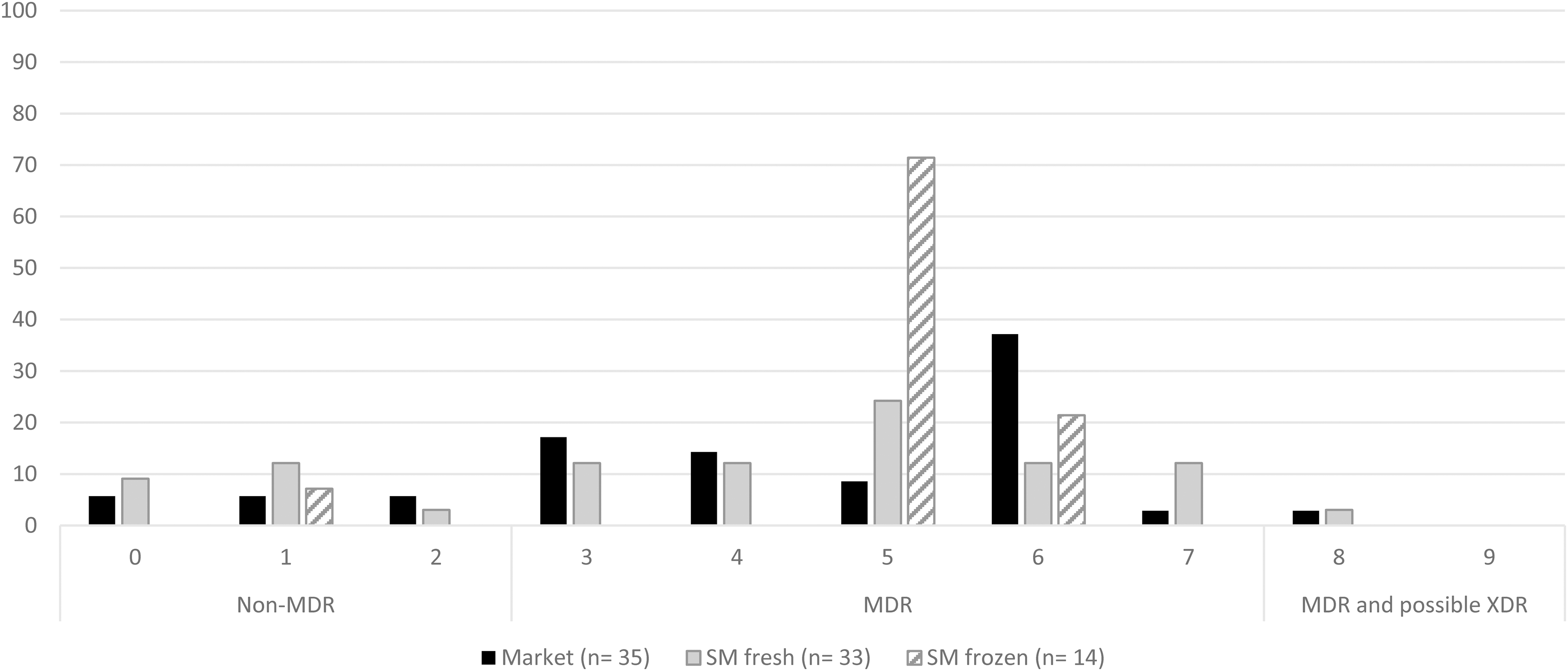
Distribution (%) of MDR and possible presence of XDR in indicator E. coli isolates from chicken carcasses at different retail sources in Vietnam. According to definition of Magiorakos et al. (2012), MDR was defined as isolates nonsusceptible to least one antimicrobial from three or more antimicrobial classes, and XDR as isolates nonsusceptible to at least one of all but two antimicrobial classes. MDR, multidrug resistance; SM, supermarket; XDR, extensive drug resistance.
Overall, 82% of indicator isolates, 91% of ExPEC isolates, and 97% of potential ESBL/AmpC isolates were MDR (Fig. 2). In all sets, possible extensive drug resistance was present.
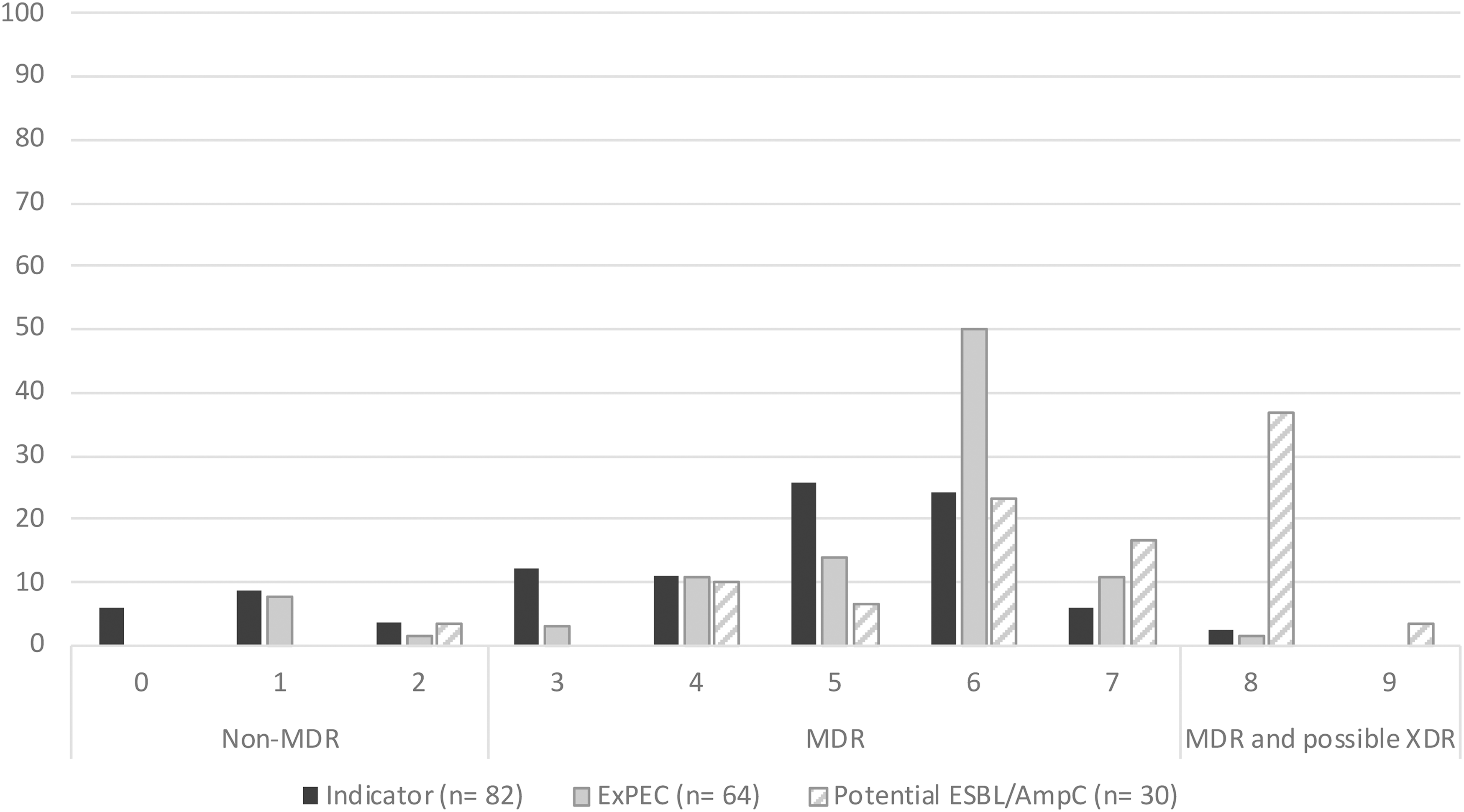
Distribution (%) of MDR and possible presence of XDR in indicator, potential ExPEC, and potential ESBL-/AmpC-producing E. coli isolates from chicken carcasses at retail in Vietnam. According to definition of Magiorakos et al. (2012), MDR was defined as isolates nonsusceptible to at least one for three or more antimicrobial classes, and XDR was defined as isolates nonsusceptible to at least one of all but two antimicrobial classes. Potential ESBL/AmpC isolates were positive for one or more of the virulence genes: iucD/iutA, tsh, cnf, papA/papC, sfa/foc, afa/dra, and kpsM II. Potential ESBL-/AmpC-producing isolates obtained following enrichment in ceftriaxone (1 mg\L) broth and plates. ESBL, extended-spectrum β-lactamase; ExPEC, extraintestinal pathogenic E. coli; MDR, multidrug resistance; XDR, extensive drug resistance.
Resistance profiles
Only 5% of the 82 indicator isolates had one of the resistance profiles CRO:TIO:FOX, CRO:TIO, or FOX, detected from fresh chicken carcasses from the market or supermarket (Table 3).
Presence of Potential Extended-Spectrum β-Lactamase and AmpC Antimicrobial Resistance Profiles in Escherichia coli from Chicken Meat in Vietnam
Potential AmpC β-lactamase producers defined as E. coli with a ceftriaxone MIC of ≥1 mg/L and a cefoxitin MIC of ≥32 mg/L but ESBL negative
Potential ESBL producers defined as E. coli isolates with a ceftriaxone MIC of ≥1 mg/L.
Isolates positive for one or more of the virulence genes: iucD/iutA, tsh, cnf, papA/papC, sfa/foc, afa/dra, and kpsM II.
ESBL-/AmpC-producing isolates obtained following enrichment in Ceftriaxone (1 mg\L) broth and plates.
CRO, ceftriaxone; FOX, cefoxitin; MIC, minimal inhibitory concentration; SM, supermarket; TIO, ceftiofur.
In the potential ExPEC isolates, the predominant profile was CRO:TIO (8%). For the ceftriaxone-enriched isolates, the most frequent profile was CRO:TIO followed by CRO:TIO:FOX and CRO for 87%, 10%, and 3% of the E. coli isolates, respectively (Table 3). To confirm the presence of ESBL or AmpC profiles, 10 isolates demonstrating nonsusceptibility to seven or more classes from the potential ESBL/AmpC collection were examined using the ESB1F MIC plate (Sensititre sytem; Thermo Fisher Scientific). Eight of these isolates were confirmed as ESBL. All tested isolates were also susceptible to carbapenems and to cefepime, a fourth-generation cephalosporin. Two isolates were not ESBL producers but demonstrated a phenotypic resistance profile compatible with AmpC β-lactamases (resistant to cephalosporin and cephamycin classes).
Detection of β-lactamase resistance genes and bla CTX-M variants
For the indicator E. coli collection, the resistance gene bla CTX-M was detected in 2 isolates of the 13 isolates tested, either alone or in combination with bla TEM, (Supplementary Table S3). Both isolates demonstrated resistance to TIO:CRO and FOX when resistance gene bla TEM was present. Excluding this isolate, all ampicillin-resistant isolates were bla TEM-positive. Nine of the 13 isolates possessed the bla TEM resistance gene.
For the ExPEC collection, the most frequent resistance gene detected among the 11 isolates was bla TEM alone or in combination with resistance gene bla CTX-M. Among seven isolates possessing resistance gene bla TEM, only five were ampicillin-resistant, whereas all three isolates with resistant gene bla CTX-M were resistant to ceftiofur and ceftriaxone.
For the potential ESBL/AmpC collection, most of the 19 isolates were positive for bla CTX-M alone or in combination with other resistance genes. On the contrary, the two potential AmpC β-lactamase-producing isolates were positive for the bla CMY-2 resistance gene, being bla CTX-M negative. Other resistance genes, such as bla TEM and bla OXA, contributed moderately to these profiles.
Among the nine possible XDR, bla CTX-M positive but bla CMY-2 negative, β-lactamase-producing E. coli isolates, the following CTX variants were found: bla CTX-M24 in three isolates, bla CTX-M14 in three isolates, bla CTX-M65 in two isolates, and bla CTX-M98 in one isolate. All ampicillin-resistant isolates were bla TEM-positive. The ceftriaxone-enriched protocol allowed recovery of ESBL isolates without enriching for the ampicillin-resistant isolates.
Discussion
Our results clearly showed that E. coli isolates from chicken carcasses in Vietnam are multidrug-resistant with a high proportion (from 28% to 100%) of resistance not only to antimicrobials considered of high importance in human medicine such as ciprofloxacin, ampicillin, trimethoprim-sulfamethoxazole, streptomycin, and sulfisoxazole but also to antimicrobials banned for use in livestock such as chloramphenicol (Kim et al., 2013). The rapid intensification of the poultry industry in Vietnam combined with limited poultry health support (Bagust, 1994) has compelled poultry producers to use antimicrobials to increase their profit margin (Ton and Scippo, 2010).
As few studies are available on antimicrobial use practices in Vietnam, it is difficult to explain the similarities between retailed chicken carcasses in markets and supermarkets. In fact, it has been reported that 28 to 34 different antimicrobials were commonly used in the feed or water in farms from different systems in Vietnam (Ton and Scippo, 2010; Nguyen, 2012). In addition, some reports cite noncompliance to product labeling in antimicrobial administration or withdrawal periods (Nguyen, 2012; Nguyen et al., 2013) or arbitrary use of multiple antimicrobials on the farm (Ton and Scippo, 2010). Use of combinations of antimicrobials has been reported for 64% of chicken producers (Carrique-Mas et al., 2014). Despite reported differences in farming systems in Vietnam, retailers of markets and supermarkets of the studied area appeared to be equally hazardous for exposing consumers to antimicrobial resistant or MDR E. coli.
Various profiles of antimicrobial resistance, including third and fourth generation cephalosporins and aminoglycosides, have been detected in E. coli isolates from patients with postsurgery infections in Vietnam (Sohn et al., 2002; Biedenbach et al., 2014). These infections could be associated with the widespread use of cephalosporins and fluoroquinolones in human medicine (Le et al., 2009; Nguyen et al., 2013). Also, manipulation of raw chicken meat or consumption of food cross-contaminated with raw chicken meat could lead to the ingestion of antimicrobial-resistant E. coli clones, contributing to their persistence in the intestine and subsequent infection of extraintestinal sites in humans (Bélanger et al., 2011).
Virulent extraintestinal E. coli have been demonstrated worldwide to belong mostly to phylogroup B2 and to group D (also referred to as phylogroup F in the New Clermont phylotyping method) in contrast to commensal strains from group A and B1 (Clermont et al., 2013). Recently, concern has been raised due to the emergence of a lineage of fluoroquinolone- and cephalosporin-resistant virulent strains belonging to the relatively minor phylogroup F, with clinical significance in human extraintestinal diseases (Vangchhia et al., 2016). In the current study, highly MDR ExPEC isolates of phylogroup F were found in Vietnamese chicken carcasses, suggesting potential risk of foodborne transmission to humans. Such strains have also been found in poultry meat in Australia and Denmark (Jakobsen et al., 2010; Vangchhia et al., 2016).
We did not examine the association between presence of virulence genes and the antimicrobial resistance phenotype in the present work. Nevertheless, the coexistence of virulence genes and antimicrobial resistance genes has been demonstrated, both in E. coli clones such as ST131 (Mathers et al., 2015) or plasmids (Leclerc et al., 2007) and could lead to the persistence of MDR, pathogenic E. coli. Infection with such isolates may compromise host health, complicate therapeutic choices, and increase treatment costs (Russo and Johnson, 2003).
To our knowledge, this study is the first to report the presence of ESBL-producing E. coli in chicken carcasses in Vietnam. Enrichment with ceftriaxone was key to revealing a surprisingly elevated proportion of samples positive for potential ESBL-producing E. coli, which was not detected in indicator E. coli obtained by standard methods commonly used in surveillance programs. Raw chicken meat could be a possible vehicle for acquisition of ESBL-producing isolates in Vietnamese as potentially in other countries (Doi et al., 2010). ESBL-producing isolates already constitute a concern in Vietnam for nosocomial human infections. Such isolates are currently being monitored in Asia for resistance to last-resort antimicrobial treatment options, such as carbapenems (Hawser et al., 2009). Notably, all E. coli isolates in our study were susceptible to carbapenems and cefepime (fourth-generation cephalosporin).
Potential ESBL-producing E. coli were mostly associated with the presence of the bla CTX-M resistance gene. This gene was detected in strains from the three retail sources, suggesting chicken carcasses from all origins as a potential exposure risk to the consumer. Detection of variant bla CTX-M14 (12%) from potential ESBL/AmpC isolates was in accordance with findings for poultry in Asia and other geographical areas (Canton et al., 2012; Ewers et al., 2012; D'Andrea et al., 2013). This variant was also found, although less predominantly than bla CTX-M27 (36%), in postsurgical infections from patients in Vietnam (Biedenbach et al., 2014). Interestingly, all variants from our study belong to Group 9 lineage, which was linked to E. coli clones STC405 and STC38.
The variant bla CTX-M-15 has disseminated efficiently throughout the world by unique clones such as the uropathogenic E. coli ST131 (Mathers et al., 2015), which may be already present in Vietnam (Pham, 2012). Similarly, sublineages of ST131 carrying the bla CTX-M gene also demonstrate resistance to other antimicrobials, such as fluoroquinolones, tetracycline, trimethoprim-sulfamethoxazole, and gentamicin, enhancing the public health risk (Mathers et al., 2015). Our finding of highly MDR isolates with the same antimicrobial resistance profile suggests the presence of such clones in chicken meat in Vietnam. Our results also confirmed the presence of AmpC β-lactamase-producing E. coli in chicken carcasses from Vietnam as described previously by Van et al. (2008), suggesting the use of ceftiofur in poultry farming in Vietnam or possible egg or hatchery transmission from imported breeders (Giovanardi et al., 2005).
Our results highlight the importance of promoting reduction and judicious use of antimicrobials in poultry farming worldwide to minimize the exposure of antimicrobial-resistant E. coli at the consumer level. Initiating on-going testing for ESBL- and AmpC β-lactamase-producing E. coli in carcasses through national surveillance would help assess the burden of exposure to highly resistant strains and to set realistic targets to tackle this global issue.
Conclusion
Mishandling of raw chicken carcasses or consumption of undercooked chicken meat from the market or supermarket in Vietnam presents a risk for consumer exposure to multidrug-resistant ExPEC- and β-lactamase-producing-E. coli. Further studies would be of interest to confirm current observations and to identify the main factors contributing to high levels of resistance.
Footnotes
Acknowledgments
We acknowledge the precious assistance of Dr. Bui Thi Phuong Hoa and her colleagues from the Department of Animal Health, National Center for Veterinary Hygiene Inspection No 1 (NCUHI1) (15/78 Duong Giai Phong, Phuong Mai, Dong Da district, Hanoi (Vietnam). I give my special thanks to Mrs. Nguyen Man Ha Anh for the cultural immersion and the support for the sampling.
This project was financially supported by the Chaire en Recherche Avicole (CRA), the Swine and Poultry Infectious Diseases Research Center (CRIPA) and the Canadian International Development Agency (CIDA) via a grant obtained by the Research Chair in Meat Safety (RCMS) of the University of Montréal.
Disclosure Statement
No competing financial interests exist.
Supplementary Material
Supplementary Figure S1
Supplementary Table S1
Supplementary Table S2
Supplementary Table S3
References
Supplementary Material
Please find the following supplemental material available below.
For Open Access articles published under a Creative Commons License, all supplemental material carries the same license as the article it is associated with.
For non-Open Access articles published, all supplemental material carries a non-exclusive license, and permission requests for re-use of supplemental material or any part of supplemental material shall be sent directly to the copyright owner as specified in the copyright notice associated with the article.
