




Abstract
This study describes the prevalence and concentration of Encephalitozoon cuniculi spores in pork meat and evaluates the effect of sausage fermentation on E. cuniculi infectivity for immunodeficient (severe combined immunodeficient) and immunocompetent (BALB/c and C57BL/6) mice. Using a nested polymerase chain reaction (PCR) approach, E. cuniculi genotype II was detected in the meat from 2 out of 50 pig carcasses at slaughter facilities, with 60–250 spores per gram detected by quantitative PCR. Under experimental conditions, 3000 E. cuniculi genotype II spores per gram of meat remained infective for mice following fermentation at 24°C for 48 h. Based on these findings, fermented meat products should be considered as a potential source of E. cuniculi infection in humans.
Introduction
With the global population set to reach 9 billion by 2050, access to safe and nutritious food is a major concern. Food can transmit bacterial, viral, parasitic, and fungal pathogens, causing widespread morbidity and mortality (Scott, 2003). Zoonoses such as brucellosis, salmonellosis, and listeriosis can be transmitted to humans through contaminated food or by direct contact with the live or slaughtered animal.
Specific measures against zoonoses exist in EU legislation relating to Veterinary Public Health [e.g., Regulation (EC) 2160/2003 on the control of Salmonella and other specified foodborne zoonotic agents, and Directive 2003/99/EC on the monitoring of zoonoses and zoonotic agents], but microsporidia are not included to these regulations. Developed countries have strict standards for food production that aim at preventing and reducing microbiological hazards in foods [e.g., Commission Regulation (EC) No 2073/2005 on microbiological criteria for foodstuffs, Food Safety System of New Zealand's Ministry for Primary Industries]. Yet, adherence to these hygiene standards does not guarantee the elimination of foodborne hazards, particularly zoonotic pathogens that infect production animals (Samelis et al., 1998; Hjertqvist et al., 2006; Conedera et al., 2007).
Microsporidia are intracellular spore-forming unicellular pathogens that infect a wide range of vertebrate and invertebrate hosts worldwide (Canning et al., 1986). Humans and domestic animals are infected with microsporidia belonging to the genera Encephalitozoon and Enterocytozoon (Fayer and Santin-Duran, 2014; Snowden, 2014), which cause opportunistic infections in individuals with deficient immunity (Canning and Hollister, 1992).
Polymerase chain reaction (PCR)-based detection methods have shown that Encephalitozoon cuniculi, Encephalitozoon intestinalis, and Enterocytozoon bieneusi are widespread in humans and animals (Fayer and Santin-Duran, 2014; Snowden, 2014). Recent studies have shown that E. cuniculi can survive and persist in immunocompetent humans and animals for a long time, even after chemotherapeutic treatment (Sak et al., 2011a,b; Kotková et al., 2013).
Most infections are thought to result from fecal–oral transmission of spores through contaminated food or water or from inhalation of infectious spores (Bryan and Schwartz, 1999). The evidence supporting waterborne transmission includes the detection of human pathogenic microsporidia in irrigation, recreation, and drinking water (Dowd et al., 1998; Thurston-Enriquez et al., 2002). However, considerably less is known about foodborne transmission. A recorded foodborne outbreak was associated with contaminated fresh produce served to hotel guests. Fruit and vegetables contaminated by urine and/or feces have been considered as the main source of infection (Calvo et al., 2004).
In production animals, E. cuniculi has been detected in swine, cattle, goats, sheep, and horses. Although clinical disease has been reported rarely in these animals, specific anti-E. cuniculi antibodies were found in up to 52% of swine (Malčeková et al., 2010), 36% of cattle (Halánová et al., 1999), 13% of goats (Cisláková et al., 2001), 95% of sheep (Singh et al., 1982), and 14% of horses (Goodwin et al., 2006).
Fermented meats are consumed without cooking, so they could serve as a source of human microsporidia, mainly E. cuniculi. Meat fermentation is characterized by a reduction in pH as a result of lactic acid production by lactic acid bacteria. The lower pH can inhibit bacterial pathogens (Chelule et al., 2010) and may also inhibit eukaryotic pathogens. Parasites like Trichinella spp., Cysticercus bovis or Cysticercus cellulosae, Toxoplasma gondii, and E. cuniculi, which may be present in the meat, cannot replicate, and therefore, control is focused on inactivation.
The present study aims at determining the effect of sausage fermentation on the infectivity of E. cuniculi spores. Moreover, we confirm the presence of E. cuniculi in fresh pork meat.
Materials and Methods
Fifty pigs (Czech Republic) originating from six pig farms across the Czech Republic and slaughtered at three slaughterhouses were included in the study. For each animal meat, samples from the shoulder, belly, and ham were placed in single sterile tubes and stored at 4°C before analysis, maximally for 48 h.
Tissue samples were homogenized by bead disruption using a FastPrep®–24 Instrument (MP Biomedicals, CA) and 0.5 mm glass beads (BioSpec Products, Inc., Bartlesville, OK) at a speed of 5.5 m/s for 1 min. Total DNA was extracted using the commercial column-based DNeasy Blood & Tissue Kit (both Qiagen, Hilden, Germany). Purified DNA was stored at −20°C before being used for PCR.
Encephalitozoon spp. were detected using a nested PCR protocol with microsporidian-specific primers to amplify a partial sequence of 16S rRNA gene (Katzwinkel-Wladarsch et al., 1996; De Bosscuere et al., 2007). The primary PCR contained 2 μL of template DNA, 10 μL of double × AmpONE™ HS-Taq premix (GeneAll Biotechnology Co., Ltd.), and 200 nM of each primer and molecular grade water up to a volume of 20 μL. The secondary reaction was similar, with the exception that 2 μL of the primary PCR product was used as the template. Negative (molecular grade water) and positive (DNA of E. intestinalis) controls were included in each PCR amplification.
PCR cycling conditions were as described previously (Katzwinkel-Wladarsch et al., 1996; De Bosscuere et al., 2007). Secondary PCR products were electrophoretically separated, visualized by ethidium bromide staining (0.2 μg/mL), and extracted using GenElute Gel Extraction Kit (Sigma, St. Louis, MO). Sequencing was carried out in both directions using an ABI 3130 Sequence Analyzer (Applied Biosystems, Foster City, CA). Sequence identity was determined by BLAST analysis (
Spores were quantified in samples using quantitative real-time PCR (qRT-PCR), performed according to the protocol of Wolk et al. (2002). Each set of PCR assays included an external DNA standard from a known number of E. cuniculi spores and a negative control (molecular grade water). Results were determined to be positive when the fluorescence signal crossed the baseline at ≤43 cycles. Total amount of spores in 1 g of individual tissue samples was calculated based on a standard curve derived from serial dilutions of spores in water and recalculated based on the number of β-actin copies in the tissue sample according to Sak et al. (2017a). For the purpose of qPCR analyses, DNA of E. cuniculi genotype II isolated from serial dilutions of spores containing 101 to 108 spores per milliliter in distilled water was used to create a standard curve.
Animal infectivity experiments were carried out to determine the infectivity of E. cuniculi spores after fermentation of meat products. Spores of E. cuniculi genotype II, cultivated at the Institute of Parasitology, Biology Centre of the Czech Academy of Sciences and purified from cells by centrifugation over 50% Percoll (Sigma-Aldrich), were used for experiments. Twenty immunocompetent BALB/c mice used for sausage production were infected using intragastric gavage with 107 spores of E. cuniculi genotype II in distilled water (dH2O).
During the acute phase of infection (35 days postinfection) (Kotková et al., 2013), the mice were euthanized, bled, decapitated, skinned, and eviscerated. Samples of the liver were tested by nested PCR (See Materials and Methods Section) to verify the infection as the liver belongs to the most often infected tissue in mice in acute phase of infection. Murine carcasses were hung at 4°C for 24 h before mincing on a cutter with a hole diameter of 2 mm. The ground meat was supplemented with 0.2 g of Pro Starters 21 (Progast, Czech Republic) per 1000 g, salted (1.5% w/w NaCl), mixed for 5 min, filled in a 10 μm thick plastic casing, and incubated for 48 h at 24°C. The pH of the sausage was measured after 48 h, and if it was lower than 5.0, the fermentation process was considered successful. Fermented sausages were stored in a refrigerator at 4°C.
The number of E. cuniculi spores in the meat used for sausage production was determined by qRT-PCR.
Groups of 8-week-old severe combined immunodeficient (SCID) mice and immunocompetent BALB/c and C57Bl/6 mice (three animals per group) were bred in plastic cages with sterilized wood-chip bedding situated in IVC Air Handling Solutions (Tecniplast, Buguggiate, Italy) with high-efficiency particulate air filters. All mice were supplied with a sterilized diet (TOP-VELAZ Praha, Czech Republic) and sterilized water ad libitum.
Three animals of each strain were separately fed overnight with 1 g of sausage at zero (immediately following), 1, or 2 weeks postfermentation. Animal groups perorally inoculated with microsporidian-free dH2O or a dose of 107 spores in dH2O were used as negative and positive controls, respectively. SCID, C57Bl/6, and BALB/c mice were euthanized at 21, 28, and 35 days postinfection, which corresponded to the acute phase of infection for each mouse strain (Kotková et al., 2013; Sak et al., 2017b). The spleen, liver, and kidney of each animal was aseptically removed and examined for the presence of microsporidia by nested PCR.
Spores were considered infective if any sample from a mouse was positive for E. cuniculi. PCR positive samples were sequenced to verify identity with the inoculum.
All experimental procedures were conducted in accordance with the law of the Czech Republic on the use of experimental animals and safety and use of pathogenic agents. The study was approved by the Institute of Parasitology, Biology Centre of the Czech Academy of Sciences and Institutional and National Committees (Protocol No. 100/2016).
Results
Pork meat screening
DNA of E. cuniculi was detected in meat from 2 of 50 slaughtered pigs examined in this study. The two positive animals originated from two different farms and were slaughtered at two different slaughterhouses. All obtained sequences shared 100% identity with each other and with the reference E. cuniculi genotype II (GQ422153) from GenBank. The number of E. cuniculi genotype II spores in pork meat ranged from 60 to 250 per gram.
Experimental mouse sausage preparation
All sausages had pH lower than 5.0 after 48 h of fermentation. All strains of mice became infected following feeding with fermented sausage containing 3000 E. cuniculi spores per gram. The spores remained infective for 2 weeks after fermentation, as shown in Figure 1, and the distribution of spores in tissues was similar to that in control animals, which were infected orally with 107 spores. Sequences from infected mice shared 100% identity with each other and with the E. cuniculi inoculum. None of uninfected controls became infected.
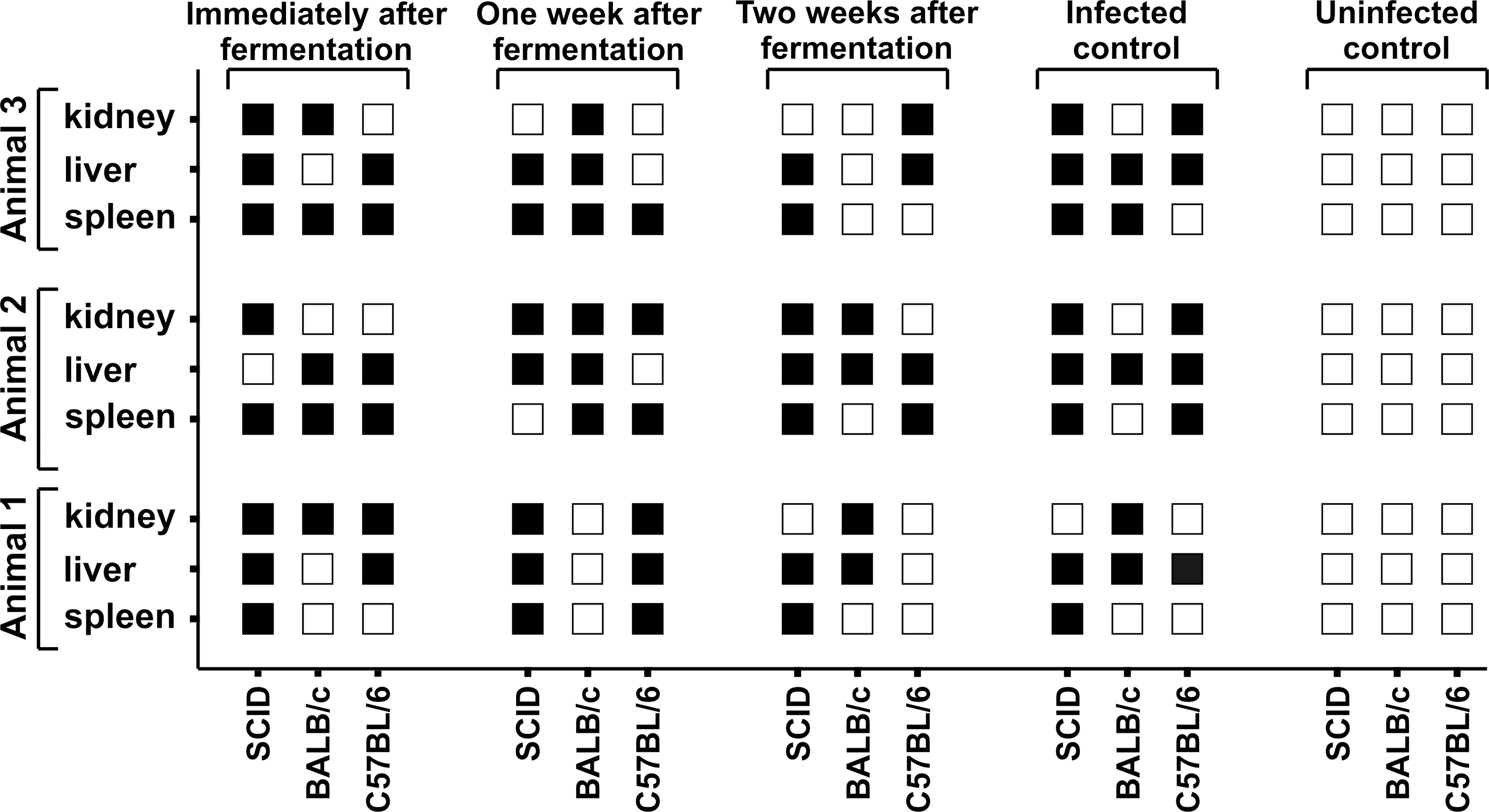
Presence of DNA of Encephalitozoon cuniculi genotype II in organs of immunocompromised (SCID, 21 days postinfection) and immunocompetent (BALB/c and C57BL/6, 35 days postinfection) laboratory mice fed with fermented sausage prepared from carcasses of experimentally E. cuniculi-infected mice containing 3000 spores per gram. Infected control—mice inoculated perorally with 107 spores in dH2O; uninfected control—mice inoculated perorally with microsporidian-free dH2O; black square indicates PCR positive sample; empty square indicates PCR negative sample. PCR, polymerase chain reaction; SCID, severe combined immunodeficient.
Discussion
Our study has shown that raw pork meat can contain up to 250 spores of E. cuniculi genotype II, a dose that is sufficient to establish an infection in immunocompetent and immunocompromised host as the infection dose did not seem to be a major factor in the establishment of infection (Jeklova et al., 2010).
Moreover, we found that fermentation of sausage, resulting in a decreased pH and increased salinity, a process that is sufficient to control species of Trichinella, Cysticercus, Sarcocystis, or Toxoplasma (van Sprang, 1984; Ballarini and Martelli, 2000; Guo et al., 2015), does not affect infectivity of E. cuniculi genotype II spores after 2 week storage at 4°C.
The sources of microsporidia and transmission routes are poorly understood. Increased awareness and better diagnostics have led to more accurate assessments of microsporidia prevalence in animals, including cattle, horses, goats, and pigs (Singh et al., 1982; Halánová et al., 1999; Cisláková et al., 2001; Goodwin et al., 2006; Malčeková et al., 2010). However, only part of animals shed detectable amount of spores in feces, namely only 9% of pigs shed E. cuniculi spores in feces (Reetz et al., 2009) and 2% and 6% of cattle shed spores in feces and urine, respectively (Abu-Akkada et al., 2015; Kváč et al., 2016).
The frequent occurrence of Encephalitozoon in production animals and the knowledge that spores disseminate to several tissues, including muscles, and persist at these sites during chronic infection (Kotková et al., 2013; Wagnerová et al., 2013) suggest that a microsporidia control intervention is necessary. Moreover, spores of Encephalitozoon are resistant to several environmental stresses that are used to control food- and waterborne hazards. Koudela et al. (1999) found that spores of Encephalitozoon in water are resistant to freezing and high temperatures. Similarly, Kváč et al. (2016) found that spores in milk are resistant to high-temperature short-time pasteurization.
As most case reports lack the actual source of microsporidia or it remains speculative, the presence of E. cuniculi in fresh pork meat and capability of spores to tolerate the pH shift and increased salinity during fermented sausage production which were previously considered to be crucial in spore deactivation (Weidner, 1972; Hashimoto et al., 1976; Undeen, 1978, 1983; Malone, 1984, 1990; De Graaf et al., 1993) set a new light on microsporidia epidemiology and showed potential contamination route across the food production chain.
Conclusions
Considering that 115 million tonnes of pork meat are consumed each year worldwide (FAO, 2018), E. cuniculi contamination of pork meat has been demonstrated, and fermentation is not effective at inactivating E. cuniculi spores; fermented pork products should be considered as an additional source of human E. cuniculi infections.
Footnotes
Acknowledgments
The authors thank all butchers for providing meat samples. The study was supported by the grant of Grant Agency of the Czech Republic (17-12871S) and the Grant Agency of University of South Bohemia (002/2016/Z).
Disclosure Statement
No competing financial interests exist.