




Abstract
The global incidence of human infections associated with extended-spectrum β-lactamase (ESBL)-producing Escherichia coli is increasing. Dairy animals are reservoirs of ESBL-producing E. coli, especially, third-generation cephalosporin (3GC)-resistant strains. To further understand the diversity of 3GC-resistant E. coli across animals of different age groups (e.g., pre- and postweaned calves, lactating cows, and dry cows) and farms, we used pulsed-field gel electrophoresis (PFGE) to characterize 70 fecal isolates from 14 dairy farms located in nine Pennsylvania counties. Results of this analysis indicated that 3GC-resistant E. coli were highly diverse and grouped into 27 PFGE clades (80% similarity cutoff) and 24 unique antimicrobial resistance patterns were observed among the isolates. For eight farms, clonal E. coli with the same resistance patterns were isolated from two or more age groups, indicating that strains were carried in both the calves and adult cows within the same herd. However, there were also several isolates with the same resistance pattern that were distributed to different clades, including isolates from different animal age groups on the same farm, suggesting different strains of E. coli within a farm harbored the same resistance-conferring elements. Results of this analysis indicated that 3GC-resistant E. coli were highly diverse, associated with multidrug resistance, and circulated through different (noncommingled) animal groups on individual farms.
Extended-spectrum cephalosporins (ESCs) were first used in the 1980s to treat infections with Gram-negative bacteria and to combat β-lactamase-mediated antibiotic resistance and have since been used to prevent and treat infections in both humans and food-producing animals (Food and Drug Administration, 2014). Subsequently, ESC-resistant bacteria (including Escherichia coli) have emerged due to dissemination of extended-spectrum β-lactamase (ESBL) genes that encode enzymes capable of hydrolyzing the ESCs (Bradford, 2001). The global incidence of ESBL-producing E. coli associated with human infections is increasing (de Been et al., 2014).
Dairy cows are significant sources of ESBL-producing E. coli (Mollenkopf et al., 2012; Cao et al., 2019). In a previous study of antimicrobial resistance (AMR) in Pennsylvania dairy herds, multidrug resistance was more often identified in fecal E. coli from pre- and postweaned calves than from dry and lactating dairy cows (Cao et al., 2019). On some farms, multidrug-resistant E. coli with the same resistance phenotypes (including 3GC-resistant) were isolated from the feces of calves and cows. It was unclear, however, if the 3GC-resistant E. coli strains were circulating in the herds or if phenotypically similar isolates from calves and cows were different strains that had acquired the same resistance-conferring genetic elements. The aim of this study was to explore the clonality of fecal 3GC-resistant E. coli isolated from different dairy animal age groups and farms.
Seventy 3GC-resistant E. coli isolates were selected from a total of 2370 isolates (Cao et al., 2019) to represent at least two animal age groups on each of 14 farms located in nine Pennsylvania counties. The isolates were either obtained through nonselective culture (Cao et al., 2019) or were isolated on MacConkey agar plates (Gibco Laboratories, Long Island, NY) supplemented with cefotaxime (4 μg/mL) or cefepime (32 μg/mL). Susceptibility to antimicrobials on the NARMS Gram-negative panel and the ESBL panel (CMV3AGNF, ESB1F, Sensititre™; Trek Diagnostic Systems, Westlake, OH) was tested as described previously (Cao et al., 2019) and screened for the plasmid-mediated AmpC β-lactamase (bla CMY-2) gene (Van Kessel et al., 2013). Pulsed-field gel electrophoresis (PFGE) was performed following the standardized PulseNet protocol for E. coli (Ribot et al., 2006), with the addition of thiourea (50 μM) to the gels and running buffers. PFGE profiles were analyzed using BioNumerics (Version 6.6; Applied Maths, Austin, TX), with manual band assignment, Dice band-based similarity (0.5% optimization and 1.5% tolerance), and Unweighted Pair Group Method with Arithmetic Mean (UPGMA) cluster analysis. Associations between clades and animal age groups, farms, or AMR patterns were determined using Pearson's chi-squared test of independence and Fisher's exact test (when chi-squared assumptions not met) in JMP Pro 13 (SAS Institute, Inc., Cary, NC).
When the XbaI-digested genomic DNA of the 3GC-resistant E. coli isolates was analyzed, the restriction digest patterns were diverse and the similarity of Dice index was ≥60% for all the isolates (Fig. 1). Based on 95% and 80% similarity cutoff cluster analysis, there were 46 or 27 unique clusters of digest patterns, respectively. At least two isolates from each of nine farms (not necessarily from the same animal age group) were indistinguishable (100% similarity), and it appears that farm-specific clonal 3GC-resistant E. coli may have been circulating within the herds. In addition, isolates from farms located in different, but adjacent, counties were indistinguishable (100% similarity), suggesting a regional dissemination of clonal 3GC-resistant E. coli. Based on Fisher's exact test, distribution of clades was not homogenous across the farms (p < 0.05). Mollenkopf et al. (2012) also observed that ESC-resistant E. coli from lactating cows on Ohio dairy farms were clustered within farm-specific PFGE clades, but information of clonality among E. coli from different animal age groups was not available. In this study, we did not detect age-specific clades and isolates from calves and cows were distributed across clades (p > 0.05). Although 3GC-resistant E. coli were more prevalent in calf versus cow feces (Cao et al., 2019), it appears that individual strains could colonize the gut of both age groups.
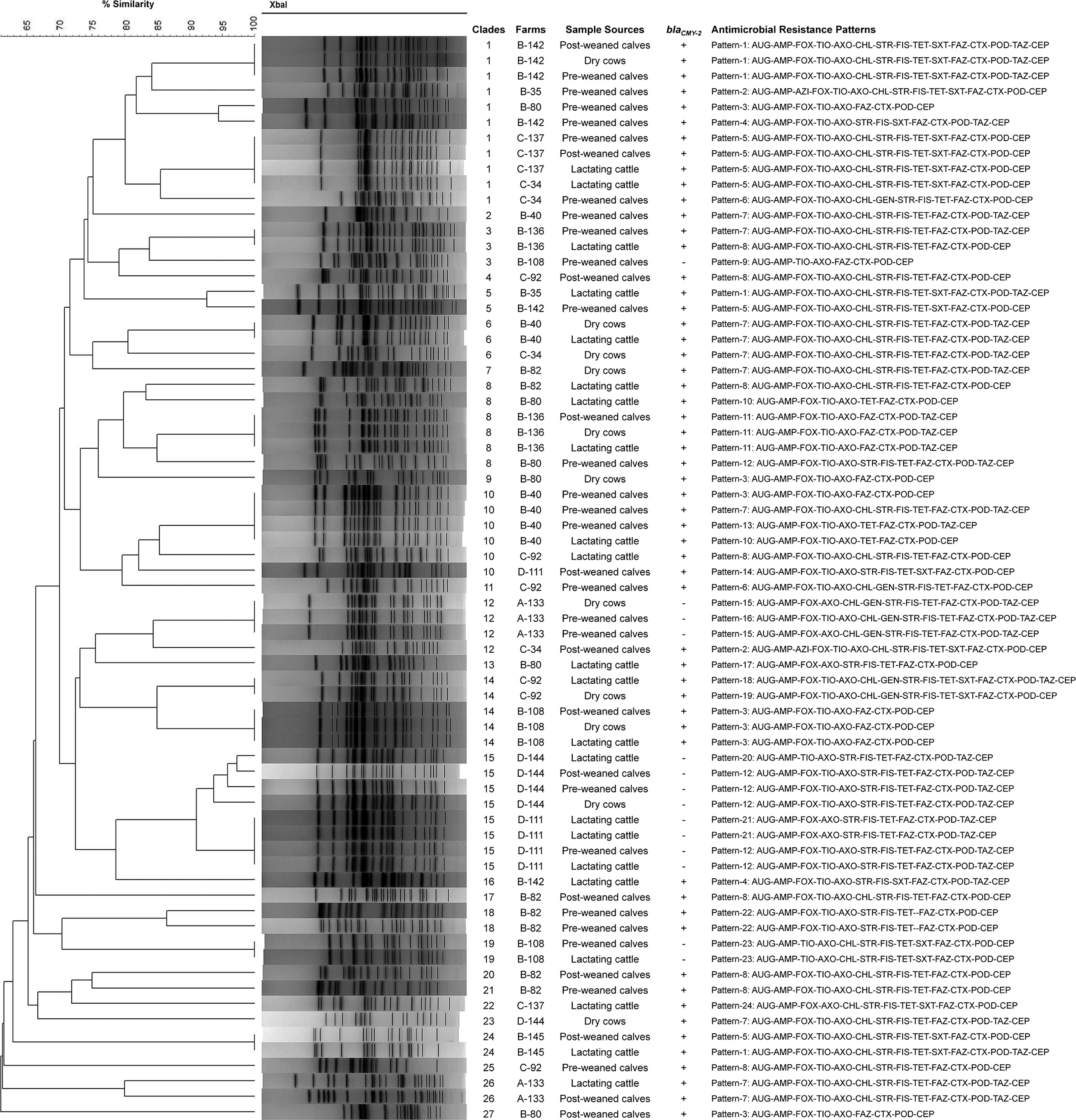
Dendrogram of pulsed-field gel electrophoresis of XbaI-digested 3GC-resistant Escherichia coli isolated from fecal composite samples of preweaned calves, postweaned calves, lactating cows, and dry cows on 14 farms located in nine Pennsylvania counties. Clades were distinguished using an 80% similarity cutoff. Nine counties were categorized into four regions (A, B, C, and D) and the farms were named with the region and farm identification numbers, for example, B-142. Presence of bla CMY-2 gene in the 3GC-resistant E. coli genomes was determined by polymerase chain reaction. 3GC, third-generation cephalosporin; AMP, ampicillin; AUG, amoxicillin-clavulanic acid; AXO, ceftriaxone; AZI, azithromycin; CEP, cephalothin; CHL, chloramphenicol; CTX, cefotaxime; FAZ, cefazolin; FIS, sulfisoxazole; FOX, cefoxitin; GEN, gentamicin; POD, cefpodoxime; STR, streptomycin; SXT, trimethoprim-sulfamethoxazole; TAZ, ceftazidime; TET, tetracycline; TIO, ceftiofur.
All of the 3GC-resistant E. coli were multidrug resistant (resistant to ≥3 antimicrobial classes) and all were resistant to cephalothin, cefazolin, ceftriaxone, cefotaxime, cefpodoxime, ampicillin, and amoxicillin/clavulanic acid. Among the non-β-lactam antibiotics, ≥80% of the isolates were resistant to streptomycin, sulfisoxazole, and tetracycline, whereas fewer were resistant to gentamicin (10%), azithromycin (2.9%), trimethoprim/sulfamethoxazole (30%), and chloramphenicol (58.6%). In total, 24 unique AMR patterns were identified (Fig. 1). There was a significant difference in the distribution of resistance patterns within individual clades (p < 0.05), and on several occasions, 3GC-resistant E. coli with the same resistance pattern were distributed to multiple clades. For example, four isolates exhibiting AMR PATTERN-8 were recovered from the feces of calves and adult cows on Farm B-82 and were dispersed into four different clades, indicating that different strains of E. coli within a farm harbored the same resistance-conferring elements. In contrast, similarly resistant E. coli from calves and cows on each of eight farms were clonal, and it appears that some resistant strains were carried in both the calves and adult cows within the same herd. Considering the high degree of E. coli diversity within a dairy farm (Son et al., 2009), phylogenetic group-specific or horizontally-acquired fitness elements that may be associated with AMR through linkage disequilibrium may have played a role in selection of these strains in dairy animals or the dairy farm environment.
Ibrahim et al. (2016) identified the plasmid-mediated bla CMY-2 gene in E. coli isolated from dairy animals. In this study, the bla CMY-2 gene was detected in 80% of the 3GC-resistant E. coli isolates. The bla CMY-2-negative strains were only isolated from four farms, and the observed differences in bla CMY-2 gene presence between farms were significant (p < 0.05).
The results of this study indicate that clonal 3GC-resistant E. coli can be carried by animals of different age groups on different farms. However, there is significant diversity among the population of 3GC-resistant E. coli and the selection pressures for individual strains have not been elucidated. Future work should focus on both on-farm management practices and genomic characteristics (for dissemination and maintenance) of antibiotic-resistant E. coli from dairy animals.
Footnotes
Disclosure Statement
No competing financial interests exist.