




Abstract
Salmonella is a worldwide foodborne pathogen causing human disease. Food handlers, who are potential carriers of Salmonella, may transmit the pathogen to consumers through food. To determine the prevalence of Salmonella enterica serovars among food handlers working in the catering industry in Nantong, China, a total of 214,542 food handlers' fecal samples were tested for Salmonella in the Nantong CDC (Centers for Disease Control) from 2012 to 2017. Among those tested, 193 (0.09%) were identified to be positive for Salmonella, and the highest detection rate was 0.16% during the period of July to September. Serotyping analysis showed that Salmonella enterica serovar Typhimurium was the predominant serotype (16.1%), followed by Salmonella Derby (13.5%), Salmonella Enteritidis (11.4%), and Salmonella London (11.4%). The high detection rate of Salmonella Derby was probably closely related to its high prevalence of the serotype in pork, which is the primary meat consumed by the Chinese. Antibiotic susceptibility analysis demonstrated that 73.4% of the isolates were multidrug-resistant (MDR) strains with predominant resistance to ampicillin (AMP, 64.6%), followed by resistance to sulfisoxazole (SUL, 58.1%), nalidixic acid (55.8%), and tetracycline (TET, 44.5%). Therefore, MDR Salmonella strain carriage among food handlers working in the catering industry might be a potential source of human salmonellosis, especially for the predominant MDR genotype isolates (32.3%) with resistance to AMP, SUL, and TET.
Introduction
S
In recent years, the number of foodborne multidrug-resistant (MDR) Salmonella isolates has increased rapidly due to the overuse of antibiotics in animals and humans. The MDR strains cause a heavy burden on clinical diagnosis and treatment of salmonellosis, and have become a significant public health problem in China and several other countries (Aslam et al., 2012; Kebede et al., 2014; Xu et al., 2017). Among 109 Salmonella strains isolated from 2524 childhood diarrhea stool samples in Beijing during 2010–2014, ∼50% were MDR strains, and 41.3% were resistant to four antimicrobials (Qu et al., 2016). Salmonella Typhimurium and Salmonella Enteritidis have previously been reported to be the main serotypes causing human salmonellosis, but an increasing number of other serotypes including Salmonella Infantis, Salmonella Derby, Salmonella Thompson, and Salmonella Newport have been isolated from patients (Kimura et al., 2005; CDC, 2013; Xu et al., 2017; Marder Mph et al., 2018).
In China, foodborne salmonellosis remains a significant public health problem and has attracted the attention of the government. Although sizable data have been previously obtained on human salmonellosis incidence in China including serotype and antimicrobial resistance profiles in Salmonella (Jiang et al., 2015; Xu et al., 2017; Yang et al., 2017), data regarding prevalence of Salmonella in food handlers were rarely collected and reported. In addition, owing to the high employee turnover rate, which is a common problem in the catering industry, surveillance of Salmonella carriage among food handlers is of great importance in the prevention and control of human salmonellosis. Therefore, this study was aimed at evaluating Salmonella carriage among food handlers working in the catering industry in Nantong, and obtaining detailed information regarding serotypes and antimicrobial resistance in the identified Salmonella isolates.
Materials and Methods
Samples collection and Salmonella isolation
A total of 214,542 food handlers working in the catering industry in Nantong underwent health examination in the Nantong CDC (Centers for Disease Control and Prevention) from 2012 to 2017. All of the food handlers should be in good condition without diarrhea. Fecal samples were collected by the sampling officers, and all the samples were immediately subjected to Salmonella detection following standard protocols as previously described (WHO, 2003). In brief, the samples were added to selenite cysteine broth and incubated at 35°C for 24 h to selectively enrich Salmonella. A loopful of each incubated sample was then inoculated onto xylose lysine deoxycholate (XLD, OXOID, England) and Salmonella Shigella (SS) agar plates, and cultured for 24 h at 37°C. Two or more presumptive Salmonella colonies were subcultured in triple sugar-iron-agar medium for further tests. The BD Phoenix™-100 (BD) system was used to confirm the bacterial species by using the Phoenix™ NIMC/ID-4 panel according to the manufacturer's instruction.
Serotyping
Serotyping of every isolate was performed using commercially available antisera kits (Tianrun Bio-Pharmaceutical Co. Ltd., Ningbo, China) and antisera (SSI, Denmark) in agglutination tests on the basis of O and H antigen detection following the manufacturer's instructions. The serotype of each strain was identified on the basis of the Kauffmann–White scheme. The Salmonella Typhimurium LT2 and Salmonella Enteritidis P125109 were used as the reference strains for Salmonella Typhimurium and Salmonella Enteritidis, respectively.
Antimicrobial susceptibility testing
The antimicrobial susceptibility of 164 human Salmonella isolates was determined using the Sensititre National Antimicrobial Resistance Monitoring System Gram-negative susceptibility plates (Customized version, Sensititre; Trek Diagnostic Systems, Inc., Westlake, OH) to the following 19 antimicrobial agents (antimicrobial abbreviations and dilution ranges are shown in parentheses): ampicillin (AMP, 2–64 μg/mL); ampicillin-sulbactam (AMS, 2–64 and 1–32 μg/mL); tetracycline (TET, 1–32 μg/mL); chloramphenicol (CHL, 2–64 μg/mL); cefazolin (CFZ, 0.5–16 μg/mL); cefotaxime (CTX, 0.25–8 μg/mL); ceftazidime (CAZ, 0.5–16 μg/mL); cefoxitin (CFX, 2–64 μg/mL); gentamicin (GEN, 1–32 μg/mL); imipenem (IMI, 0.25–8 μg/mL); nalidixic acid (NAL, 4–64 μg/mL); sulfisoxazole (SUL, 32–512 μg/mL); ciprofloxacin (CIP, 0.03–32 μg/mL); amoxicillin-clavulanic acid (AMC, 2–64 and 1–32 μg/mL); amikacin (AMI, 1–32 μg/mL); aztreonam (AZM, 1–32 μg/mL); cefepine (FEP, 0.25–16 μg/mL); meropenem (MEM, 0.06–4 μg/mL); and levofloxacin (LEV, 0.125–8 μg/mL). Isolates were freshly cultured and adjusted to the turbidity of a 0.5 McFarland standard in 5 mL of 0.9% saline solution. Then, 75 mL of saline suspension was transferred into 10 mL of Mueller–Hinton broth (Thermo Fisher OXOID), followed by transfer of 5 mL of inoculated Mueller–Hinton broth into each plate well. After incubation at 37°C for 16–20 h, plates were read manually with a microtiter plate holder. The minimum inhibitory concentration values of the antimicrobial agents against each isolate were determined and compared with the corresponding breakpoints following the guidelines set by the Clinical and Laboratory Standards Institute (CLSI, 2015). E. coli ATCC25922 and Staphylococcus aureus ATCC29213 with known antimicrobial resistance profiles were used as quality control organisms.
Ethical approval
The study protocol was performed following the ethical guidelines of the 1975 Declaration of Helsinki, and was approved by the Ethics Committee of the Chinese Centers for Disease Control and Prevention (CDC). Fresh feces of all the healthy food handlers were sampled after obtaining written informed consents.
Results
Prevalence of Salmonella among food handlers working in the catering industry
One hundred ninety-three Salmonella isolates were detected from 214,542 human fecal samples (0.09%). Overall, 116 of 128,937 female samples (0.09%) and 77 of 85,605 (0.09%) male samples were identified to be Salmonella positive. In the Salmonella-positive samples, all of the detected colonies identified showed the same serotype. As shown in Figure 1A, the detection rates in 2013, 2015, and 2017 were up to 0.1%, higher than those in 2012, 2014, and 2016. In addition, the Salmonella detection rate during July–September was 0.16%, which was the highest in the entire year. The Salmonella detection rate was higher in the second quarter than in the first and fourth quarters (Fig. 1B).

Prevalence and serotyping of Salmonella among food handlers working in the catering industry in Nantong, China. The detection rate of Salmonella among 214,542 food handlers working in the Nantong catering industry from 2012 to 2017 is shown (
A detailed study of the distribution of the 193 Salmonella isolates over 12 months showed that the month with the highest prevalence was August (25.4%), followed by September (16.1%) and May (14.0%) (Fig. 1C). A total of 107 Salmonella strains were isolated in these 3 months, which accounted for 55.44% of all of the isolates identified from 2012 to 2017. However, nine strains (9/193, 4.7%) were detected in the three winter months (December, January, and February).
Diversity of Salmonella serotypes
Among the 193 Salmonella isolates, 173 strains were identified to be in 28 serotypes, and 20 strains were not identifiable (Fig. 1D and Table 1). The 28 serotypes were distributed in 7 O groups or subgroups, including B, C1, C2, D, E1, E4, and F. The predominant O group was B, which represented 32.64% of the strains, followed by E1 (16.6%) and C1 (14.5%). In the B group, Salmonella Typhimurium remained the dominant serotype (31/193, 16.1%). It is noteworthy that Salmonella Derby (26/193, 13.5%) was the second most common serotype identified. In addition, the third most common serotype identified was shared by Salmonella Enteritidis and Salmonella London (22/193, 11.4%), distributed in D and E1 serogroups, respectively. The next two common serotypes identified were Salmonella Senftenberg (18/193, 9.3%) and Salmonella Thompson (11/173, 5.7%), belonging to E4 and C1 serogroups, respectively.
Serotype Identification in the 193 Human Salmonella Isolates
The results showed the number of Salmonella isolates identified by serotyping analysis based on the Kauffmann–White scheme.
Antibiotic resistance in the Salmonella isolates
Antibiotic susceptibility analysis of the human Salmonella isolates showed that the predominant resistance was to AMP (64.6%, 106/164), followed by that of SUL (58.1%, 75/129), NAL (55.8%, 72/129), TET (44.5%, 73/164), CFZ (38.4%, 63/164), CHL (37.2%, 61/164), gentamycin (22.6%, 37/164), and AMC (20.7%, 24/116). No isolates were found to be susceptible to all the detected antimicrobial agents tested (Fig. 2A). In addition, the multidrug resistance (MDR) rate among the strains was 73.4% (85/116), with resistance to three or more antimicrobial agents. Forty-four percentage (44.0%, 51/116) of the strains were resistant to 3–6 drugs, and 15.5% (18/116) of isolates showed resistance to ≥10 drugs (Fig. 2B). The predominant phenotype among the MDR isolates presented was AMP, SUL, and TET resistance, which took up 32.3% of the detected isolates. In addition, all of the Salmonella Typhimurium and Salmonella Enteritidis isolates were MDR strains.
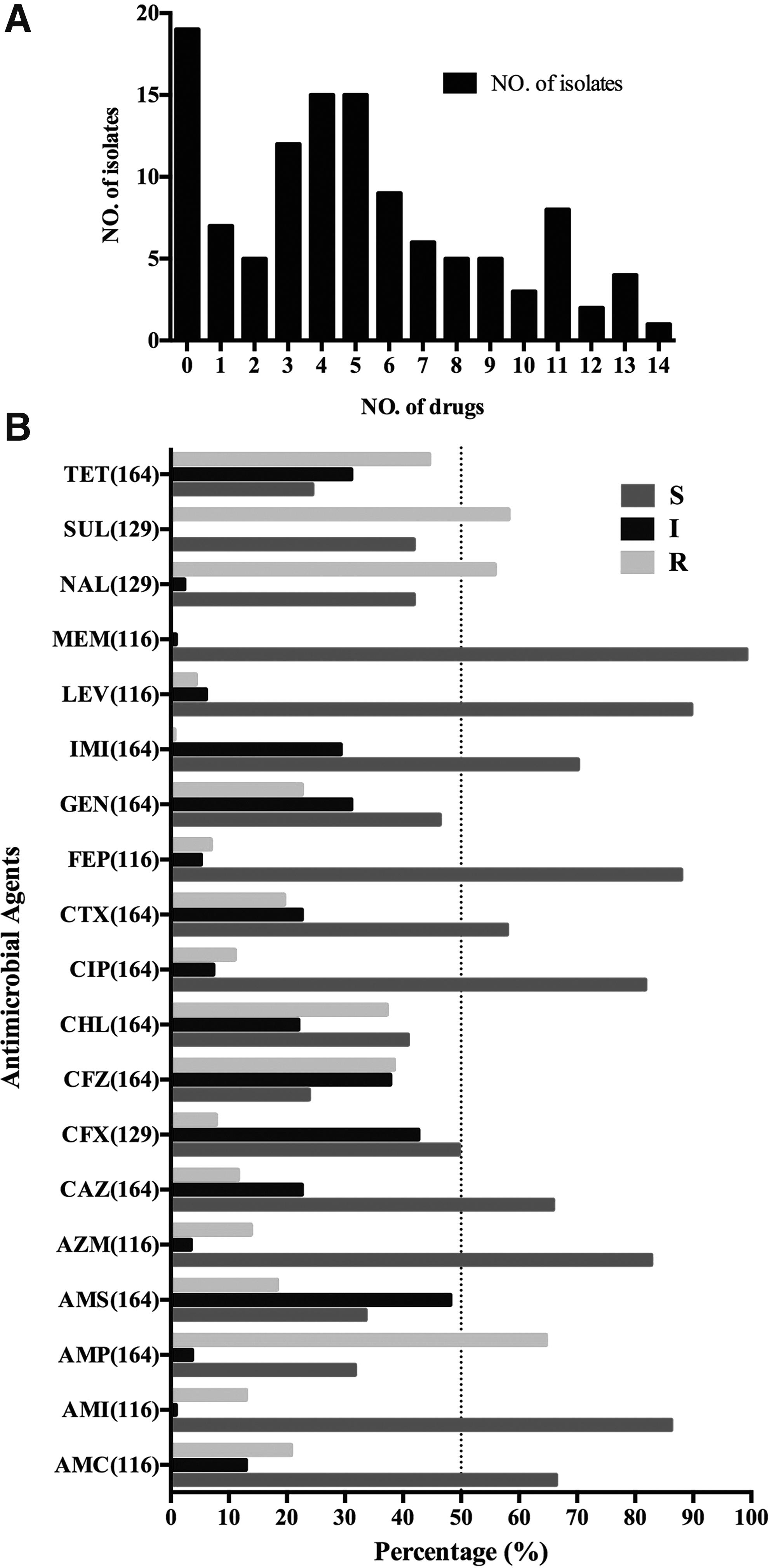
Antimicrobial resistance in the human Salmonella isolates. The number of isolates with resistance to 1–19 antimicrobial agents was calculated (
Discussion
Our study showed that only 0.09% food handlers worked in Nantong, China, were Salmonella carriers, which is a much lower estimate than that reported in previous studies of hospital food handlers in Beijing (9.5%) (Luo et al., 2010), and the reports in Ghana (2.3%), Ethiopia (3.4%), and Abuja (18%) (Feglo et al., 2004; Kebede et al., 2014; Woh et al., 2017). However, these previous studies focused on one specific group or area, and the sample sizes were small. This study detected the prevalence of Salmonella in a larger number of food handlers working in the Nantong catering industry from 2012 to 2017. Summer was confirmed to be the season associated with high Salmonella infection rate among the food handlers, which is also associated with the high prevalence of human foodborne salmonellosis (Li et al., 2014a; Yang et al., 2017).
Among the 193 Salmonella strains detected, Salmonella Typhimurium remained the main serotype carried by the food handlers in Nantong, as reported from 2005 to 2007 (Tang et al., 2010). The high prevalence of Salmonella Typhimurium in primary Chinese food products, including chicken and pork, led to the increased isolation of Salmonella Typhimurium from food handlers in this study. The next most common serotype found was Salmonella Derby. We speculated that the increasing number of Salmonella Derby isolates infecting humans is mainly due to the increased prevalence of Salmonella Derby in the pork and pig industry (Li et al., 2016; Zhou et al., 2017), with pork being the predominant meat consumed by the Chinese. The third most common serotypes found were Salmonella Enteritidis and Salmonella London, which are mainly found in chicken and pigs, respectively (Li et al., 2014b, 2018). In addition, Salmonella Thompson (5.7%) was another serotype found, and is of concern because 43 cases of human infection were found transmitted through food handler carriage of this serotype in the United States (Kimura et al., 2005).
Increase in MDR strains remained a significant problem in the Salmonella isolates identified among the food handlers in this study. More than 70% of the isolates were MDR, much higher than ∼10% from 2005 to 2007 in Nantong food handlers (Tang et al., 2010). This demonstrates continuing abuse of antimicrobial agents in animals or humans, which needs to be controlled immediately. AMP remained the drug against which most Salmonella isolates were resistant, with 64.6% of the isolates in this study showing AMP resistance, consistent with other studies on Salmonella strains isolated from food handlers (Marami et al., 2018). However, >50% of the strains showed resistance to NAL, which is higher than that reported in Ethiopia (15.4%) and Peninsular Malaysia (0%) (Garedew-kifelew et al., 2014; Woh et al., 2017). The increase in MDR Salmonella among food handlers is a matter of concern for the public health management system.
Conclusion
The prevalence of Salmonella among food handlers in Nantong, China, was not high, but 70% of the isolates were MDR strains; this is a potential source of drug-resistant human salmonellosis through food transmission. It is recommended that food handlers should be taught to practice personal hygiene and maintain health by the local food regularity authority to ensure food safety.
Footnotes
Acknowledgment
This study was financially supported by National KeyResearch and Development Program of China (2017YFD0500100) and Jiangsu Key Laboratory of Zoonosis (R1703).
Disclosure Statement
No competing financial interests exist.