




Abstract
This study examined the occurrence of histamine-producing bacteria (HPB) and histamine induction in retail sardine and mackerel in Egypt; and whether the fish vendors play a role in the transmission of HPB. Fish were collected from the fish markets, additionally; hand swab samples were taken from the fish vendors. All samples were cultured on modified Niven's medium (MNM); the positive colonies were subcultured on Violet Red Bile Glucose (VRBG) agar, followed by biochemical identification and histidine decarboxylase (hdc)-gene-PCR of the VRBG-positive isolates. The hdc-gene-positive fish and human isolates were subjected to partial hdc-gene-sequencing and phylogenetic analysis. Production of histamine in the fish muscles was measured by high-performance liquid chromatography. A higher percentage of sardine showed the presence of MNM-positive bacteria (84%) than mackerel (53%). Enterobacteriaceae was the dominant family; the most frequent species were Enterobacter cloacae, Raoultella planticola, Citrobacter freundii, and Enterobacter aerogenes. Higher proportion of the R. planticola isolates were hdc positive as compared with the other species. Only 32% sardine and 17% mackerel of the MNM-positive isolates carried the hdc gene. Fish muscles that contain hdc-positive bacteria exhibit higher levels of histamine (median 86; IQR 80–1112 mg/kg) than those with hdc-negative bacteria (48; 75–223 mg/kg). The level of histamine was significantly higher in sardine (109; 104–1094 mg/kg) than in mackerel (40; 49–106 mg/kg). The 20 fish vendor samples were MNM positive, 2 of them were hdc-gene positive. The close genetic relatedness between the human and fish strains isolated from the same markets suggests a possible bidirectional transmission of the HPB. This warns for the presence of HPB carrying hdc gene in retail sardine and mackerel, which is associated with a relatively high level of histamine. Regular inspection of the fish markets is required, including accurate determination of HPB by using a combination of the MNM culture, hdc-gene PCR, and measurement of histamine level.
Introduction
Fish is a low-calorie high-protein food; its consumption might result in some foodborne illnesses and outbreaks (Iwamoto et al., 2010). Of particular interest is histamine fish poisoning (HFP), which is caused by eating spoiled fish that contain high levels of histamine (Taylor et al., 1989; Visciano et al., 2012; Feng et al., 2016).
Scombroid and other dark muscle fish such as tuna, bonito, mackerel, blue fish, dolphin, sardine, carangids, herring, and anchovies are prone to form histamine, as their muscles are histdine-rich. (Choudhury et al., 2008; Feng et al., 2016). Histamine formation results from histdine decarboxylation through histamine-producing bacteria (HPB) containing histidine decarboxylase (HDC) enzyme. (Lerke et al., 1978; Ferrario et al., 2012; Wongsariya et al., 2016).
This process can start as soon as the fish dies and kept at temperature above 4°C for an extended period (FAO/WHO, 2012). Once the HDC enzyme is synthesized, it continues to produce histamine even if the bacteria get inactivated (EFSA, 2011; FDA, 2011). Cooking can inhibit the HPB and the HDC, while histamine cannot be degraded by cooking, smoking, or canning of fish, indicating that both raw and cooked fish might cause HFP (Hungerfood, 2010). Accordingly, the legal level of histamine should not exceed 200 mg/kg in marketed fish species rich in histidine (EFSA, 2011; FAO/WHO, 2012, 2018). The major HPB reported in fish are the family Enterobacteriaceae (Kim et al., 2003; Klanian et al., 2018). Of these, Morganella morganii, Enterobacter aerogenes, Enterobacter cloacae, Raoultella planticola, Raoultella ornithinolytica, and Photobacterium damselae are particularly high histamine producers. However, other species including Citrobacter freundi, Vibrio alginolyticus, and Escherichia coli are weak histamine producers (Takahashi et al., 2003).
So far, little information is available about HPB in Egypt. Therefore, the objectives of this study were to investigate the presence of HPB and histamine production in retail sardine and mackerel, two types of commonly consumed histidine-rich fish in Egypt; and to examine whether the fish vendors play a role in the transmission of the HPB. Accordingly, we collected muscle samples from the fish at the markets, as well as hand swab samples from the fish vendors. All samples were subjected to bacterial isolation and identification of HP-Enterobacteriaceae, followed by molecular detection of hdc gene among the isolates. The level of histamine in the fish muscles was measured by high-performance liquid chromatography (HPLC). The genetic relatedness of the fish and human isolates collected from the same markets was determined by partial sequencing of the hdc gene.
Materials and Methods
Samples
The study included apparently healthy frozen imported mackerel (n = 100) and fresh local sardine (n = 57); whole fish were taken and placed in sterile polyethylene bags. Hand swab samples were collected from the fish vendors (n = 20); none of them had allergic symptoms. One swab per individual was used, rubbed in the interdigital spaces, nails, palms, and on the back of the hands, then inoculated into sterile tubes containing 9 mL of 0.1% peptone water solution. Both fish and human samples were transported to the laboratory on ice. All samples were collected from randomly selected fish markets located in EL-Giza and Alexandria Governorates, during the period from March 2016 to April 2017. Protocols for collection of samples as well as all methods were performed in accordance with the guidelines and regulations of Cairo University Council, Faculty of Veterinary Medicine, Egypt. Written consent to use samples was obtained from each person.
Bacterial isolation and identification
Ten gram muscles were taken from the dorsal, abdominal, and tail parts of each fish. The muscles were inoculated into 9 mL of 0.1% peptone water, and homogenized using Stomacher® 400 blender (Seward lab, Worthing, United Kingdom) (Fletcher et al., 1998).
Isolation of HPB
The modified Niven's medium (MNM) was used for initial selection of HPB. One milliliter from each of the fish homogenates (mackerel, n = 100; sardine, n = 57) as well as the human hand swab suspensions (n = 20) were streaked separately into the MNM prepared according to Niven et al. (1981); Joosten and Northolt (1989); and Mavromatis and Quantick (2002). The plates were incubated at 37°C for 48–72 h and were examined every 24 h. The HPB colonies are purple in color surrounded by purple halo on a yellowish background.
Isolation of histamine-producing Enterobacteriaceae
The presumptive MNM-positive isolates (mackerel, n = 58; sardine, n = 44; humans, n = 20) were streaked onto plates of Violet Red Bile Glucose (VRBG; LAB M, Heywood, United Kingdom) agar, a selective medium for isolation of Enterobacteriaceae, and were incubated at 37°C for 24 h (Mossel, 1985). The suspected colonies were purified through subculture on Tryptic Soya Agar (LAB M) plates, and were examined for morphological and phenotypic traits. Typical colonies of Enterobacteriaceae are Gram negative, round, purple-pink surrounded by purple halo.
c. Biochemical identification
The VRBG colonies subcultured on Tryptic Soya Agar were subjected to the traditional oxidase biochemical test according to Shore and Isenberg (2007), and confirmed with API 20E kit (BioMérieux, Marcy-l'Étoile, France). API 20NE kit was used to confirm the identity of the non-Enterobacteriaceae strains that grew on the VRBG. The accuracy of the kit results was 100% as determined by API web software (BioMérieux).
III. Molecular detection of histidine decarboxylase (hdc) gene
All the MNM-VRBG-positive isolates (mackerel, n = 58; sardine, n = 44; humans, n = 20) were examined for the presence of the hdc gene. Genomic DNA was extracted using the rapid boiling method (Reischl et al., 1994) and subjected to conventional PCR using specific oligonucleotide primers: forward 5′-TGGGGTTATGTSACCAATGG-3′, reverse 5′
Sequencing of the PCR-amplified hdc-gene fragment
The amplified hdc-gene PCR product obtained from the fish (n = 6) and human (n = 2) samples collected from the same markets was purified using Qiaquick PCR Product extraction kit (Qiagen, Hombrechtikon, Switzerland). The purified PCR products were sequenced using BigDye Terminator V3.1 sequencing kit (Applied Biosystems, Waltham, MA; the obtained nucleotide sequences were deposited in the GenBank.
Phylogenetic analysis
The obtained nucleotide sequences were compared with those available in public domains using the NCBI-BLAST server, and were imported into the BioEdit program version 7.0.1.4 for multiple alignments using the BioEdit Clustal W program. Phylogenetic analysis was performed with the MEGA program version 7 using the neighbor-joining approach.
Measurement of levels of histamine in fish muscles using HPLC
Fish samples that showed the presence of MNM-VRBG-positive bacteria (mackerel, n = 49; sardine, n = 39) were subjected to HPLC. Preparation of samples was performed according to Frattini and Lionetti (1998). In brief, 5 g muscle from each sample was homogenized separately using 10 mL trichloroacetic acid extracting solution (Thermo Fischer Scientific, Waltham, MA) and centrifugation. The supernatant was filtered, mixed with 1 mL of 1 M NaOH (Thermo Fischer Scientific), and incubated at RT for 5 min. One milliliter of o-phthalaldehyde (Acros Organics, Geel, Belgium) and 3 mL ethyl acetate (Thermo Fischer Scientific) were then added, and the homogenate was precipitated by centrifugation. The pellets were dried on a rotatory evaporator, then resuspended in 1 ml acetonitrile (Thermo Fischer Scientific). A histamine dihydrochloride standard solution (Sigma-Aldrich, St. Louis, MO) was serially diluted in 0.1 M HCl (Thermo Fischer Scientific) to obtain the following concentrations: 0.5, 1, 2, 4, 8, 16, 32, and 64 mg/L. The standard and the processed samples were injected into intersil C18 columns (4.6 × 250 mm, size particle 5 μm; Agilent Technologies, Waldbronn, Germany); each determination was injected twice. The chromatographic separation was performed using 1050 HPLC (Agilent Technologies) according to Tahmouzi et al. (2011).
Calculation of histamine concentration
The histamine content in mg/kg fish was calculated using the following formula according to Jinadasa et al. (2016): [The level of histamine in the extract (mg/L) as extrapolated from the standard curve/sample weight (5 g)] × 10 (dilution factor).
Statistical analysis
Statistical analysis was done using NCSS 9 software program (NCSS, Kaysville). Two proportion Z test was used to compare the occurrence of HPB between mackerel and sardine. The same test was used to compare expression of hdc gene between HPB present in mackerel and those in sardine. Since the data of the histamine levels were not normally distributed, the Kruskal–Wallis test was used to analyze the difference in the level of histamine between sardine and mackerel as well as between hdc-gene-positive and hdc-gene-negative groups. On each occasion, significance level was observed at 0.05 (p ≤ 0.05).
Results
Occurrence of HPB carrying hdc gene in retail mackerel and sardine fish
Among the 100 examined mackerel samples, 53 (53%) were positive in MNM, a selective medium for selection of HPB (Table 1). Compared with mackerel, a significantly higher percentage (84%, 48/57) of sardine were positive in MNM. The majority of the MNM isolates grew on the Enterobacteriaceae-selective medium VRBG, as found in the mackerel (49 of the 53 MNM) and sardine (39 of the 48 MNM) strains. Biochemical identification confirmed that almost all of the VRBG-positive isolates are Enterobacteriaceae except for trivial numbers that were non-Enterobacteriaceae (Table 1). A variety of bacterial species were identified among the mackerel (n = 58) and sardine (n = 44) MNM-VRBG-positive isolates, the most common were E. cloacae, R. planticola, Citrobacter freundii, and E. aerogenes (Table 2). All the identified isolates were subjected to hdc-gene PCR; of the 58 mackerel MNM-VRBG-positive isolates, 9 (17%) carried the hdc gene; and among the 44 sardine MNM-VRBG-positive isolates, 12 (32%) harbored the hdc gene (Table 2). The proportion of hdc-positive strains were highest among R. planticola (7/15) than E. aerogenes (4/12), C. freundii (2/14), and E. cloacae (2/16).
Prevalence of Histamine-Producing Bacteria in Fish Based on Culture on Modified Niven's Medium, Followed by Culture on Violet Red Bile Glucose Agar
s denotes significant difference between mackerel and sardine using two proportion Z statistical test, p = 0.0002.
MNM, modified Niven's medium; VRBG, Violet Red Bile Glucose.
Identification of the Species of HPB-VRBG-Positive Strains Isolated from Fish as Performed by API20E and Number of Isolates That Carry Histidine Decarboxylase Gene(hdc) as Detected by PCR
Points to nonsignificant difference between mackerel and sardine as determined by two proportional Z statistical test, p = 0.0856.
HPB, histamine-producing bacteria.
Significantly higher level of histamine in the muscles of sardine than in mackerel
The production of histamine in the fish muscles that showed the presence of MNM-VRBG-positive bacteria was measured by HPLC (Fig. 1). Interestingly, there was an overall significantly higher level of histamine in the muscles of sardine (median 109; IQR 104–1094 mg/kg) than that observed in mackerel (40; 49–106 mg/kg). In addition, sardine containing hdc-gene-negative bacteria had higher level of histamine than mackerel with hdc-gene-negative bacteria. This was also the case between sardine containing hdc-gene-positive bacteria and mackerel with hdc-gene-positive bacteria. However, the level of histamine was higher in fish that contain hdc-positive bacteria (86; 80–1112 mg/kg) than in fish with hdc-negative bacteria (48; 57–223 mg/kg); the difference was not statistically significant (p = 0.37).

Comparing the concentration of histamine between mackerel and sardine in regard to the presence of HPB with or without hdc gene. The histamine level was measured in the fish muscles by using HPLC and was expressed as mg/kg. This was then compared between the species of fish (mackerel and sardine) as overall and in respect to the presence of hdc-negative HPB or hdc-positive HPB using Kruskal–Wallis (ANOVA). The results are presented as box plots, and the outliers appear in the form of gray circles. *n indicates significant difference between the hdc-negative HPB groups from mackerel and those from sardine. *p points to significant difference between the hdc-positive HPB from mackerel and those from sardine. *o indicates an overall significant difference between mackerel and sardine.
Finding of HPB in hand swabs from the fish vendors
Hand swabs were taken from humans working in contact with the fish at the same markets. All the 20 examined samples were positive in MNM and in VRBG media (Table 3). Different species of bacteria were detected, including Klebsiella pneumonia (n = 4), C. freundii (n = 4), E. cloacae (n = 3), Raoultella ornithinolytica (n = 2), E. aerogenes (n = 2), Serratia odorifera (n = 2), Acinetobacter baumannii (n = 1), Vibrio fluvialis (n = 1), and Salmonella cholerasuis (n = 1). The hdc gene was carried only by the A. baumannii and V. fluvialis isolates. The V. fluvialis isolate was confirmed by sequencing based on Vibrio-genus-specific 16s rRNA (Zheng et al., 2017).
Species of Histamine-Producing Bacteria Isolated from Hand Swabs of Fish Handlers
Genetic relatedness of the hdc gene among the fish and human isolates
The phylogenetic analysis of the hdc gene carried by the isolates collected from the same markets revealed clustering of the isolates into two main clusters based on their evolutionary relationship (Fig. 2). The first main cluster (Cluster I) includes two clades: clade I.1 with the R. planticola sardine strains and clade I.2 with the enteric strains (E. aerogenes mackerel and Erwinia spp. sardine). The second main cluster (Cluster II) also comprises two clades: clade II.1 that contains only the human Acinetobacter baummanii strain, while clade II.2 includes the V. fluvialis human strain and the Proteus mirabilis mackerel strain that showed ∼90% similarity.
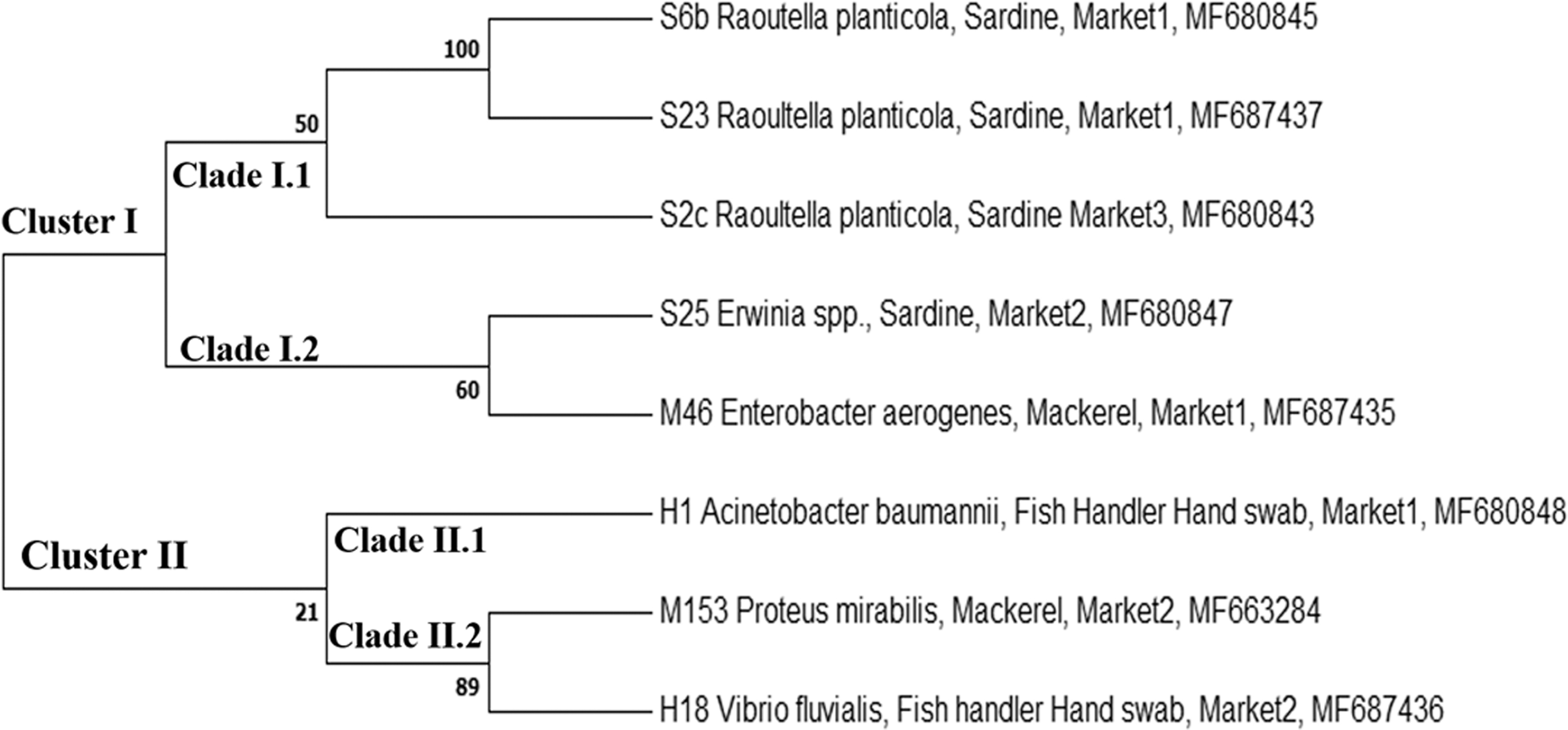
Identity and evolutionary relation between the HPB strains isolated from fish and humans based on sequencing of the hdc gene. Eight bacterial isolates from fish and hand swabs from the fish handlers were subjected to sequencing of histidine decarboxylase (hdc) gene and analysis using MEGA7. The results are presented in the form of Bootstrap consensus tree that describes the species of the bacteria and source of the isolates, as well as the accession numbers of the sequences deposited in the NCBI GenBank.
Discussion
In this study, we examined the occurrence of HPB-Enterobacteriaceae in retail mackerel and sardine, two types of histidine-rich fish commonly consumed in Egypt, and whether the fish vendors play a role in the transmission of these bacteria. Our results demonstrated that a significantly higher percentage of sardine (84%) samples showed the presence of HPB as compared with mackerel (53%). The majority of the HPB found in sardine (79%) and mackerel (85%) were Enterobacteriaceae, which is similar to other studies that reported a proportion of 83%, 93%, and 89% (López-Sabater et al., 1996; Kim et al., 2003; Tembhurne et al., 2013), respectively, indicating a significant role of Enterobacteriaceae in histamine production in fish (Koohdar et al., 2011; Klanian et al., 2018). Moreover, we observed the growth of a minor number of non-Enterobacteriaceae Gram-negative strains on the VRBG, including A. baumannii, A. calcoaceticus, Aeromonas hydrophila, and Pseudomonas luteola, which were further confirmed by API 20NE. In this regard, Eden and Arbon (2014) reported previously that, however, VRBG can allow the growth of some non-Enterobacteriaceae; it gives a better recovery of Enterobacteriaceae than other media such as MacConkey. The most frequent species of Enterobacteriaceae identified among the present mackerel and sardine isolates were E. cloacae, R. planticola, C. freundii, and E. aerogenes, which have been implicated in HFP in humans (Kanki et al., 2002; Hu et al., 2012).
Of particular interest is the higher proportion of hdc-gene-positive strains among R. planticola compared with the other bacterial species, as the role of R. planticola as HPB was underestimated for long time (Kanki et al., 2002; Alves et al., 2007; Puerta-Fernandez et al., 2013; Lam and Salit, 2014). In addition, recent studies signified the importance of R. planticola as a zoonotic agent (Ershadi et al., 2014; Westerveld et al., 2017). Furthermore, the hdc-gene PCR revealed that only 23.5% of the total MNM-VRBG-positive fish isolates carried the hdc gene, suggesting that the MNM is highly sensitive and might give false-positive results. Björnsdóttir et al. (2010) previously found that the MNM detects both low- and high HPB, while PCR fails to detect the presence of hdc gene in low HPB. This is in agreement with our findings that the histamine level was lower in muscles of fish that contain hdc-gene-negative bacteria (median 48; IQR 75–223 mg/kg) than in fish with hdc-gene-positive bacteria (86; 80–1112 mg/kg). Consistent with the MNM-culture results, the level of histamine was significantly higher in muscles of sardine than in muscles of mackerel.
The median (40 mg/kg) and IQR (49–106 mg/kg) levels found in mackerel were in agreement with the legal level of histamine (100–200 mg/kg) in histidine-rich fish placed in the markets during their shelf life (EFSA, 2011; FAO/WHO, 2012, 2018). In sardine, the median level of histamine (109 mg/kg) was also within the legal range, whereas the IQR (104–1094 mg/kg) warns for an elevated production of histamine in the muscles of sardine. The higher prevalence of HPB and levels of histamine among sardine as compared with mackerel agree with our observation that the sardine was caught locally in Egypt and sold unchilled as a sign of being fresh, whereas mackerel was imported frozen and sold chilled in the markets. In this aspect, it is claimed that the HPB is part of the fish gut and gill microbiome; once the fish dies, the HPB invade the muscles and start transformation of histidine to histamine (Kim et al., 2003; Dewall et al., 2006; Singh et al., 2012). Exposure of the dead fish to a temperature >4°C for an extended period of time increases the activity of the HPB and fastens histamine accumulation, while keeping the fish chilled immediately after catching prevents this process (Ferrario, et al., 2012; Wongsariya et al., 2016). Another source of HPB to the fish could be contamination from water or postcatch due to improper hygienic measures. There is a mounting evidence that the human gut microbiota are histamine producing (Feng et al., 2016; Pugin et al., 2017). Therefore, we examined the presence of HPB in hand swabs from the fish vendors (n = 20); all the human samples were MNM-culture positive. Like in fish, Enterobacteriaceae predominate among the human isolates; the most common species found in the vendors and fish collected from the same markets were C. freundii, E. cloacae, E. aerogenosa, K. pneumoniae, and A. baumannii. In addition, the close relatedness between the hdc gene carried by fish and human strains isolated from the same market suggests a possible bidirectional transmission of the bacteria, which might occur during handling or butchering of the fish (Kim et al., 2003; FAO/WHO, 2012, 2018). Furthermore, the high relatedness of the hdc gene among the same genus of Enterobacteriaceae (R. planticola) as well as different genus such as Erwinia spp. and E. aerogenes, is consistent with the suggestions that the hdc gene in the Gram-negative bacteria might originate from a common ancestor, which was exposed to some variations and deletions during the evolutionary divergence (Takahashi et al., 2003; Hattouri and Seifert, 2017). Taken together, we showed the occurrence of HPB associated with histamine production in muscles of retail sardine and mackerel in Egypt. The sardine samples showed a relatively high level of histamine than the legal limit, possibly due to temperature abuse. Histamine was found in fish muscles that contain hdc-gene-negative bacteria, but in lower levels than in muscles with hdc-gene-positive bacteria. The close relatedness between the hdc gene extracted from the fish isolates and those from the human isolates warns for possible transmission of the HPB between the vendors and the fish. This recommends the necessity for regular inspection of the fish markets to ensure proper storage of retail fish and application of hygienic measures.
Footnotes
Disclosure Statement
The author(s) declare no competing interests.