




Abstract
Bacillus cereus is a microorganism associated with food poisoning. It has been found in products, such as milk and dairy products. The aim of this study was to isolate and identify B. cereus group strains in artisan cheeses sold in southwestern Mexico, as well as its toxigenic profile, its psychrophilic ability, and its biofilm production. B. cereus isolation was performed on Mannitol Yolk Polymyxin (MYP) agar and this was molecularly confirmed by the amplification of the gyrB gene. Polymerase chain reaction was used to determine the toxigenic profile, amplifying conserved regions of hblABD and nheABC operons, which code for the subunits of Hbl and Nhe toxins, respectively, as well as ges and cytK genes, which code for toxin cereulide and cytotoxin K (Cytk). Frequency of B. cereus contamination in artisan cheeses was 29.48% (23/78), and the bacterium was isolated in similar quantities in all types of products. All strains were amylase positive, and 60.86% (14/23) were able to produce biofilm; 91.30% (21/23) of the strains were psychrophilic. In most of the strains, at least one gene related to enterotoxins was identified (21/23). B. cereus strains in this study have a high toxigenic potential, which increases the risk of food poisoning due to the consumption of artisan cheeses made in Mexico.
Introduction
The Bacillus cereus group includes B. anthracis, B. cereus, B. mycoides, B. pseudomycoides, B. thuringiensis, and B. weihenstephanensis. The most important subspecies are B. anthracis, B. cereus, and B. thuringiensis (Vilas-Boas et al., 2007). This group of bacteria is spore-forming Gram-positive bacilli with a wide spread in the environment, commonly found in raw or processed foods (Berthold-Pluta et al., 2015). The contamination can be mediated through various substrates, including soil, grain, and food equipment (Bartoszewicz et al., 2008).
Four major toxins from B. cereus have been identified, including nonhemolytic enterotoxin (Nhe), hemolysin BL (Hbl), and cytotoxin K (CytK), causing diarrhea, as well as cereulide inducing vomiting and liver failure (Stenfors Arnesen et al., 2008; Naranjo et al., 2011). The Hbl enterotoxin and Nhe are made up of three subunits; L2, L1 B, and NheA, NheB, NheC, respectively, whereas the cytotoxin K (CytK) is made up of a single protein from the family of barrels β (Bottone, 2010) encoded by the cytK gene (Lund et al., 2000). Cereulide is produced by a nonribosomal peptide synthetase, encoded by a plasmid-mediated cereulide synthetase gene cluster (Ehling-Schulz et al., 2006).
Dairy products have been seldom associated with human illness despite the frequent contamination with B. cereus (EFSA BIOHAZ Panel, 2016). The incidence of B. cereus on dairy farms and in dairy products has been reported elsewhere, particularly in China (Owusu-Kwarteng et al., 2017), Sweden (Christiansson et al., 1999), and Australia (Dréan et al., 2015). However, there are few reports focusing on the prevalence of B. cereus in dairy products in Latin America. Two reports of milk-related products have shown that B. cereus could be isolated from pasteurized milk (Reis et al., 2014) or dairy products (Aragon-Alegro et al., 2008). Until now, we know little about the prevalence, toxin profile, and biofilm of B. cereus in the milk production chain in México, especially at the dairy products.
Currently, cheese making is one of the most important industries in Mexico, and it uses ∼25% of the total milk produced in the country (Servicio de Información Agroalimentaria y Pesquera, 2018). The importance of this industry is reflected in the estimation that around 70% of all Mexican cheeses come from small-scale productions or artisan cheese makers (Cervantes-Escoto et al., 2008).
However, artisanal production of cheese at the dairy farm is a less standardized procedure thus creating variability in intrinsic product characteristic, including the microbiological quality (Lahou and Uyttendaele, 2017). Remarking that the cheeses are considered important risk products for foodborne diseases, particularly cheeses made from raw milk, have been highlighted as potential risk products (Verraes et al., 2015), because contaminated raw milk may represent a vehicle for introducing pathogenic microorganism into the food production chain. B. cereus can enter this way, by the spores located in the environment (Lan et al., 2017). Food processing plants can be established in the form of biofilms and, therefore, persist for prolonged periods of time (Kwon et al., 2017).
In addition, it should be considered that the contamination can be even after the treatment as reported for other microorganisms; due to the lack of adequate packaging; sale in deli retail establishments, where a wide variety of traditional cheeses are displayed and sold in consumer portions and may be handled; and also, the temperatures at which this product is displayed and stored (Tan et al., 2008; Lahou and Uyttendaele, 2017). Therefore, knowing its frequency in this type of risk products of importance in the country would estimate the risk of a food poisoning by B. cereus and establish the basis for research related to its survival and multiplication in these types of products and strategies of intervention for its control.
In the present study, first we isolated and identified B. cereus-like strains from artisanal cheeses. Second, the profile toxin (Nhe, Hbl, Cereulide, and CytK) was assayed by polymerase chain reaction (PCR). Third, psychrotolerant strains were determined by growth capacity at 7°C. Finally, crystal violet method was used to assess the biofilm production.
Materials and Methods
Collection sample
A total of 78 unpasteurized cow milk cheese samples were bought and transported in refrigerated temperature to the laboratory until microbiology processing, between January and March 2016, from streets and at markets from three zones in Chilpancingo, Guerrero, Mexico: San Francisco, Los Angeles, and Caminos. We considered the annual cheese production in the area for the calculation of the sample size, using the formula for a finite population (Ryan, 2013).
The 78 samples included the following: Fresco cheese (16 samples), Cotija cheese (16 samples), Adobero cheese (16 samples), Oaxaca cheese (15 samples), and Requeson (16 samples).
The Fresco cheese is a kind of cheese that is soft, fresh, unpressed, and unripened obtained by raw milk enzymatic coagulation. Requeson is whey cheese, obtained by heating at temperatures between 85°C and 90°C, the supernatant is obtained from enzymatic coagulation, and the new coagulated fraction is collected and freely drained. Oaxaca cheese, a fresh pasta “filata” cheese of Mexican origin, is made from raw milk, naturally acidified by the microflora present in milk. Cotija cheese is a Mexican handcrafted product made from raw cow milk whose ripening process occurs spontaneously and, presumably, it is influenced by environmental conditions. Adobero is a kind of cotija cheese, only has differences in the cheese surface, which is spicy (González-Córdova et al., 2016).
Microbiological analysis
All cheese samples were prepared for quantitative analysis of B. cereus by homogenizing 25 g cheese and 225 mL 0.8% NaCl solution for 1 min. Additional 10-fold dilutions were made using sterile 0.8% salt solution. For B. cereus, suitable dilutions were spread, plated at volumes of 0.1 mL on Mannitol Yolk Polymyxin (MYP) Agar (Bioxon, México), and incubated under aerobic conditions at 30°C. Typical colonies were counted after 24 h of incubation. We considered as suspicious colonies of B. cereus, the pink colonies with an opaque halo and were confirmed by beta hemolysis in trypticase soy agar supplemented with sheep blood. The detection limit of the culture method for cheese is 100 CFU/g.
Molecular identification and toxin gene profiling of B. cereus isolates
From bacterial cultures, a thermal shock was performed to obtain the chromosomal DNA. In brief, cells from one colony were suspended in sterile water, heated at 95°C for 3 min, and then placed on ice. After centrifugation, the supernatant was used as template for the molecular identification and toxin profile.
The differentiation of B. cereus group was targeted on gyrB gene (Wei et al., 2018) and the toxin gene profiles from nheABC, hblABD, ces, and cytK gene. The reaction mixes (25 μL) contained the following: 25 μL of REDTaq Ready Mix DNA polymerase (Sigma-Aldrich), 11 μL of sterile Milli-Q water, 0.5 μL of the genomic DNA template (concentration about 10–20 ng/μL), and 0.02 μM of each primer. The PCR cycling conditions and primers are showed in Table 1. Electrophoresis was performed on 2% agarose gels at 80 V for 120 min. The gels were stained with Midori Green (Nippon Genetics, Germany) and visualized with UV light. B. cereus ATCC 14579 (diarrheagenic) and VK4 strain (emetic) were used as control strains.
Polymerase Chain Reaction Cycling Condition and Primer Sequences
I, deoxyinosine; PCR, polymerase chain reaction.
Biofilm formation
Static biofilms were grown according to a protocol described previously (Hussain and Oh, 2018).
Analysis of presumed psychotropic properties
All strains were screened for their psychotropic growth at 7°C ± 1°C. They were plated on Tryptone Soya Agar (Oxoid, United Kingdom) and incubated at 7°C ± 1°C during 7 days. Growth was checked after 24, 48, 72 h and 1 week.
Statistical analysis
We present the log CFU/g in means and standard deviations. Log differences of CFU/g between the different types of cheeses were analyzed from the analysis of variance test.
Results
The prevalence of B. cereus group in Mexican artisanal cheese is shown in Table 2. Two of 16 (12.5%) Fresco cheese, 9 of 16 (56.25%) Requeson cheese, 6 of 16 (37.5%) Cotija cheese, 3 of 16 (18.75%) Adobero cheese, and 3 of 15 (20%) Oaxaca cheese samples were positive for B. cereus group with mean counts (log10 CFU/g) of 5.03 ± 0.69, 5.52 ± 0.62, 5.59 ± 1.14, 5.72 ± 0.47, and 4.66 ± 0.57, respectively (Table 2). All the isolates showed common phenotypic and biochemical characteristics that are consistent with identification of B. cereus group. In addition, they produced catalase, lecithinase, and reduced nitrate. The results from end point PCR using gyrB primers revealed that among the 23 strains of B. cereus, all the strains were amplified (100%) (Fig. 1).
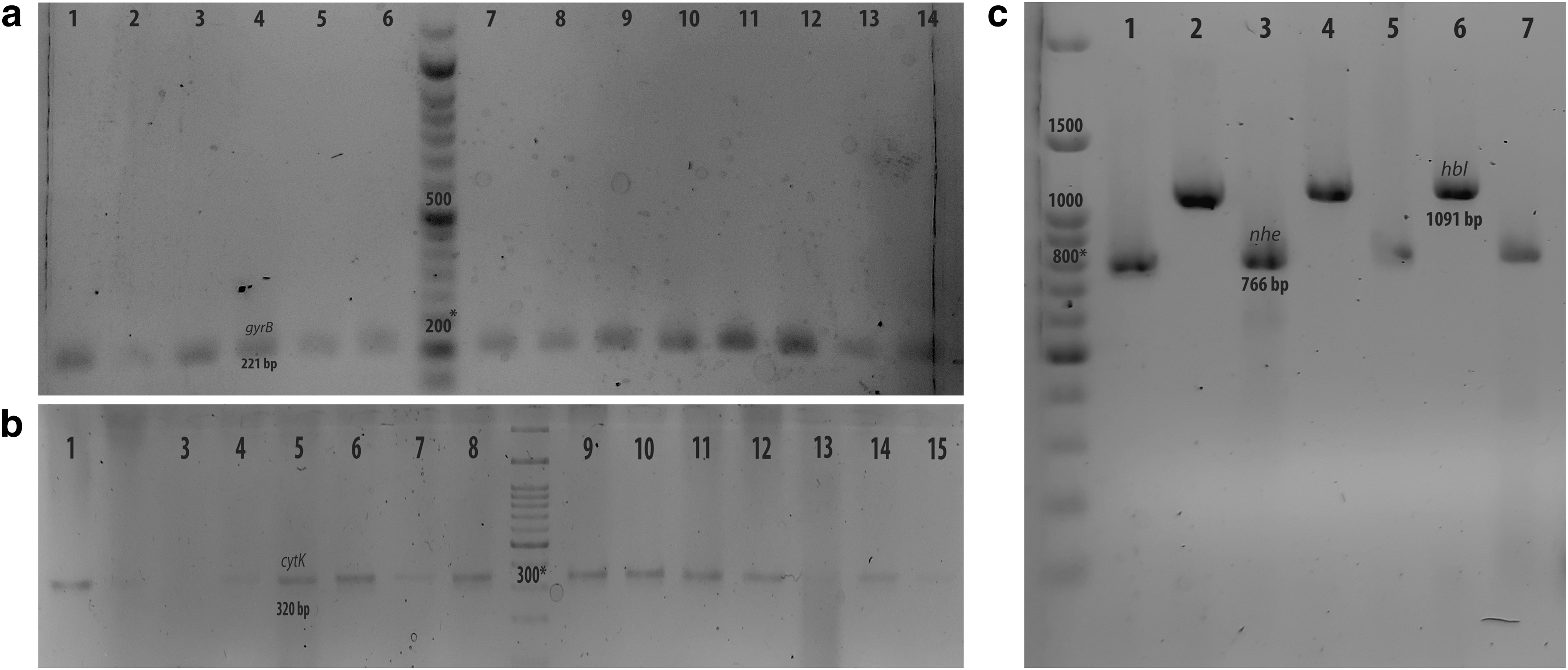
Agarose gel electrophoresis of the amplification by end point PCR of regions of the gyrB, cytK genes and the nheABC and hlbBCD operons.
Incidence of Bacillus cereus Group in Mexican Artisanal Cheese
The results represent media ± deviation standard.
Log differences of CFU/g between kinds of cheeses were analyzed from the analysis of variance test.
No statistically significant differences were found.
In B. cereus group, all the strains showed the amylolytic activity (100%), 14 of 23 (60.86%) strains produced biofilm, and almost all of B. cereus isolates (21/23, 91.30%) could grow at 7°C (Table 3).
Phenotypic Traits of Bacillus cereus Isolates
Reference number for control in the laboratory.
Proportion of biofilm produced in relation to the amount of biomass.
Reported in number of days of visible growth.
Specific toxin gene profiles turned out to be more common than others. Eight toxin gene profiles were detected in our survey, which covered a total of 23 isolates (Fig. 1) (Table 3). The most common toxin profile found among the latter isolates was toxin profile 1 (nhe+ , hlb+ , ces− , cytK+ ), where strains isolated from all types of cheese were found. Other profiles of less common toxigenic genes were 2 (nhe− , hlb− , ces− , cytK+ ) and 6 (nhe+ , hlb+ , ces− , cytK−) with three strains each. The toxigenic gene profile 8 included negative strains for all genes detected. In almost all profiles, isolated strains of Requeson cheese were included.
Discussion
B. cereus is spread widely in the environment, and it has a great ecological diversity, which improves its ability to contaminate many raw and finished food products, including milk and dairy products (Choma et al., 2000; Wijnands et al., 2006; Samapundo et al., 2011; Owusu-Kwarteng et al., 2017). It is worth mentioning that the use of lactose (a rare metabolic characteristic for this microorganism) has been frequently observed in isolates from dairy products as a strategy for enhancing nutrient acquisition (Owusu-Kwarteng et al., 2017). Therefore, various studies have associated other microorganisms, such as Listeria monocytogenes, with artisan cheeses made in southern Mexico (MacDonald et al., 2005; Jackson et al., 2011).
The frequency of B. cereus in this study was 28.4%, which is similar to that reported in other foods, such as meats (Tewari et al., 2015), pasteurized milk (Gao et al., 2018), and powdered milk (Reis et al., 2014). The frequency regarding dairy products is lower in comparison with other products, such as nunu (a yogurt-like milk product) and woagashi (soft cheese from West Africa) (Owusu-Kwarteng et al., 2017). These differences could be explained by the sanitary quality of the raw material or by the production processes to obtain the final product. Frequencies lower in this study (9.2%) were reported in foods with thermal processes during product packaging (Adame-Gomez et al., 2018).
An important finding in this study is the low frequency in fresh cheese in comparison to other cheeses included. This difference could be explained by the abundance of particular bacterial genera, such as enterococci, which have been described as a subdominant population in fresh cheese (Escobar-Zepeda et al., 2016). Many strains of enterococci are also known to produce antimicrobial peptides (enterocins) in the product, which may prevent the growth of B. cereus and hinder its presence and growth in the product (Muñoz et al., 2004; Renye et al., 2009).
Regarding the amount of B. cereus spores/vegetative cells found in the different types of cheeses, no statistically significant differences were found. Even then it is important to mention that in four artisanal products, different treatments were applied to obtain the final characteristics of the product. For example, for the preparation of cottage cheese, the whey from Fresco cheese is heated at 80°C for a specific amount of time (Kethireddipalli and Hill, 2015).
In the case of Oaxaca cheese, the dough with which the threads from the final product are made is immersed in hot water to achieve the appropriate texture, and Adobero and Cotija cheeses are ripened during a certain period of time to achieve the final texture (González-Córdova et al., 2016). B. cereus survival in the final product could be explained by its ability to produce spores and resist high temperature processes, which is something very common in most of these foods or by the ability to produce biofilm, as previously described in B. cereus. This last one has been related to an increase of its environmental resistance or as a recontamination mechanism during the preparation of the products (Rajkovic et al., 2008).
It is also important to consider the fact that in this study, an important number of strains (14/23) were able to produce biofilm. This can be formed in milk storage tanks, presses, or molds in which this product is placed, contributing to the systematic contamination of the product.
In several studies, lower CFU/g levels of B. cereus have been reported (Valero et al., 2002; Rosenquist et al., 2005; Fangio et al., 2010). The explanation may be related to the raw material used in these products, which is raw milk. In addition, it must be considered that soil is one of the main habitats of this microorganism where between 100 and 10,000 CFU/g of soil can be found (Garbeva et al., 2004). It is therefore hardly surprising that this raw material can be easily contaminated in the farm environment, and the microbial load in general, in addition to B. cereus (vegetative cells), will not decrease if it does not receive an adequate heat treatment (Shaheen et al., 2010), and even when the treatment is adequate, the spores can survive due to the characteristic of resistance (Setlow, 2014).
Another important characteristic that could explain these figures is that most of the strains of this study were psychrophilic; therefore, the number of microorganisms could increase depending on the storage and transport period of the product, considering that refrigeration is the main conservation mechanism of these products. In this way, the importance of the psychrophilic strains is due to the fact that they are related to the reduction of the shelf life of a product (Samapundo et al., 2011) or the increase in the number of microorganisms and this, in turn, becomes a food poisoning problem. As a group, the levels of this microorganism expressed in Log CFU/g are within the limit allowed by the FDA Log 6 CFU/g for other foods (cooked meat and vegetables, boiled or fried rice, vanilla sauce, custards, soups, and raw vegetable sprouts) (Center for Food Safety & Applied Nutrition, 2001); however, individually, a significant percentage of samples exceeded the limit.
This can become a food poisoning problem if the strains carry genes of related toxins to produce the emetic or diarrheic syndrome. It is important not to disregard the samples with lower numbers, because it has also been reported that it does not only depend on the number of microorganisms but also on the particular characteristics of the strain (EFSA BIOHAZ Panel, 2016).
In addition to psychrophilicity and biofilm production, it was also determined that the strains were able to degrade starch. This characteristic has been associated with the toxigenic profile of the strains, particularly with the production of the emetic toxin (Ehling-Schulz et al., 2006). This premise is not met due to the toxin gene of cereulide, given that the genes that are found in the operon bearing the same coding for this toxin were not found in this study. It is therefore not surprising due to the fact that low frequencies have been reported (Altayar and Sutherland, 2006; Chon et al., 2012) or its frequency is higher in Eastern countries and it is linked to isolated strains, particularly rice (Granum and Lund, 1997). It is also important to add that the inability of emetic strains to grow at low temperatures has been observed (Altayar and Sutherland, 2006; Carlin et al., 2006). This can be related to the high frequency of psychrophilic strains in the study.
However, when considering toxins other than cereulide, such as the nonhemolytic toxin, hemolysin BL, and cytotoxin K, a high number of amylase positive strains and genes of these toxins were found, similar to that previously reported (Hwang and Park, 2015). The toxigenic profile that includes the genes of the three enterotoxins was most frequently found, which is similar to that reported in other studies (Ehling-Schulz et al., 2006; Park et al., 2009; Chon et al., 2012; Hwang and Park, 2015), in addition to a high frequency of nhe genes in strains isolated from different foods (Guinebretière et al., 2002; Ankolekar et al., 2009; Chaves et al., 2012; Chon et al., 2012) and even in milk storage tanks (Ehling-Schulz et al., 2006) Table 4. It is important to note that, in at least four of the profiles (1, 2, 4, 5), the presence of the cytK gene is frequent in two of them (1, 2).
Toxin Gene Profiles of Bacillus cereus Isolates Obtained from Mexican Artisanal Cheese
“+” PCR product was formed (gene is present).
“-” No PCR product was formed (gene is absent) or null isolates.
PCR, polymerase chain reaction.
In this vein, several studies show that this gene is the most common one with frequencies of 40% to 75% after the genes of Nhe and Hbl enterotoxins (Samapundo et al., 2011; Owusu-Kwarteng et al., 2017). In other studies conducted in Mexico, the frequency of this gene has been high (Adame-Gomez et al., 2018) and even higher than the genes of hblABD and nheABC operons, which could be related to strains in this particular region.
The World Health Organization requires that small factories producing dairy products comply with the principles of the Codex Alimentarius, which are reinforced with the results of this study, which shows the presence of toxigenic strains of B. cereus in artisanal cheeses in Mexico. The implementation of Hazard Analysis of Critical Control Points has been reported in factories related to dairy products with good results (Allata et al., 2017). This is considered an important proposal in Mexico and with an important cost-benefit ratio for the producer, by offering safe products that are attractive to the consumer (Cusato et al., 2013; Psomas and Kafetzopoulos et al., 2015).
Conclusion
In this study, enterotoxigenic strains of B. cereus with ability to produce biofilm and amylase were found, which increases the risk of intoxication by the consumption of artisanal cheeses.
Footnotes
Disclosure Statement
No competing financial interests exist.
Funding Information
The work was financed by the “Programa Fortalecimiento de la Calidad Educativa” by the Secretaria de Educación Pública, México.