




Abstract
Campylobacter is well recognized as the leading cause of bacterial foodborne diarrheal disease worldwide with a very low outbreak reported in China. In May 2019, we investigated an outbreak of Campylobacter jejuni infections among students in a junior high school in Eastern China. Cases were interviewed to identify a common source of contamination. As cases were identified in the same school during a period of time, menus were reviewed and food items included in the questionnaire. Rectal swabs from school kitchen staff and suspected food items (raw chicken) from a local market from where the school food came were examined for C. jejuni. Pulsed-field gel electrophoresis and whole genome sequencing were performed to determine the relatedness of the isolates. To identify the source of the contamination, a case–control study was conducted. Forty-five cases were reported with diarrhea among 1696 students and staff. Stool samples for 10 of the 45 and 5 tested positive for C. jejuni. WGS analysis revealed a 0–4 single nucleotide variation in case-patient isolates. Although we were unable to identify the specific food item, a specific menu was identified as the potential source of the contamination (odds ratios = 20.82; 95% confidence interval = 6.472–66.957). In this menu, chicken was served. A food isolate collected from chicken in Zhejiang province in 2018 was positive for the same identical strain (5–7 single nucleotide polymorphisms). This is one of the few reports in China about outbreak caused by C. jejuni. This investigation illustrates the potential risk of outbreaks caused by Chinese cold dishes of chicken.
Introduction
Campylobacter jejuni is a common foodborne pathogen reported worldwide (Kaakoush et al., 2015; Costa and Iraola, 2019). Infection with C. jejuni causes diarrhea, fever, abdominal pain, and vomiting. In ∼1 in 1000 cases, C. jejuni infection resulted in severe polyneuropathy Guillain–Barré syndrome (Moffatt et al., 2017; Willison et al., 2016).
The Foodborne Diseases Active Surveillance Network indicates that Campylobacter has been the most commonly identified infection since 2013 in the United States (Tack et al., 2019). In 2018, 19.5 cases of Campylobacter infection were diagnosed for every 100,000 people (Tack et al., 2019). European Centre for Disease Prevention and Control (ECDC) reported that campylobacteriosis is the most commonly reported gastrointestinal disease in the European Union/European Economic Area (ECDC, 2018). In 2017, the overall notification rate was 64.9 cases per 100,000 population (ECDC, 2018). Reporting of Campylobacter infections is not mandatory in China, but big and/or severe outbreaks including those resulting from Campylobacter are monitored by the National Public Health Emergency Event Surveillance System since 2004.
C. jejuni infections in humans are mainly transmitted through the consumption of contaminated food and through feces. Poultry meat—especially chicken meat—is the most common source of infection in humans, along with raw milk, and other insufficiently heated meat and contaminated water (Kuhn et al., 2017; Pergola et al., 2017; Burakoff et al., 2018; Karki et al., 2018). Most cases of human C. jejuni infections are sporadic, C. jejuni outbreaks are rarely reported (Taylor et al., 2013).
In China, there are few reported outbreaks caused by C. jejuni (Zhang et al., 2010; Qu et al., 2019). According to the National Public Health Emergency Event Surveillance System and the local school health surveillance system, a junior high school reported many cases of acute gastroenteritis with fever and diarrhea from May 11 to May 24, 2019. Five cases confirmed for C. jejuni. To identify more cases and a possible source of the contamination, an epidemiological investigation was conducted and whole genome sequencing (WGS) was used to compare the strains (Llarena et al., 2017). This article reports the results of the epidemiological and microbiological investigation of the foodborne C. jejuni outbreak in China.
Materials and Methods
Case definition
Confirmed cases are students and staff members who had diarrhea or other gastrointestinal symptoms between May 8 and May 24 at the junior high school and tested positive for C. jejuni. Probable cases are students and staff who had diarrhea during the same period in this school without having a stool samples or either positive culture. Confirmed and probable cases were all interviewed using a standardized questionnaire. Questionnaires included demographic and clinical information and food exposures. As the school was suspected as the source of the contamination, menus during the period of May 8 through May 10, 3 d before the onset of the outbreak, were reviewed and food items were included in the questionnaires.
Epidemiological investigation
The junior high school of the outbreak is located in Zhoushan City, an island city in Zhejiang Province. Zhoushan City belongs to the subtropical monsoon climate zone, and the average daytime temperature in May is 25°C. This junior high school has 32 classes, 1553 students, and 143 staff. Only lunch was served at school. There is only one cafeteria in this school serving six kinds of lunch sets (lunch sets A–F) everyday. The lunch sets were provided based on the preparation and availability at the different periods. Students from different grades have different mealtimes in the order of grades from 7 to 9. Most of the students from the same grade have access to the same meal. The students of the same class order have lunch together.
Cases (confirmed and probable) who developed their symptoms on May 11–13 were included in the case–control study by questionnaires. Asymptomatic students from the same grade who did not have diarrhea during this outbreak and 2 weeks before this outbreak were defined as controls. Questionnaires included the following: basic demographic information (age and sex), contact history (contact with probable cases and boarders), and dietary condition (drinking water source, 72 h dietary history).
Sample collection and strain isolation
Ten students consulted a physician and had stool cultures. The stool samples from the 10 students and all the school kitchen staff were tested for the presence of Salmonella spp., enterotoxogenic Escherichia coli, Shigella spp., Campylobacter spp., and Norovirus by local Centers for Disease Control (CDC) investigators. According to “Food Safety Nutrition Standards for School Meals in China,” every food provided by school should be sampled and kept in special fridges for 48 h. However, as the incubation period of this outbreak was more than 2 d, food leftovers were not available. Because food leftovers were not available for laboratory investigation, the school's lunch menu was reviewed to identify a likely food source of the outbreak. Food samples will be collected if available and following the China national food safety standard-food microbiological inspection (GB4789.9, 2014).
For Salmonella spp. testing, the specimens were enriched in the selenite brilliant green (SBG) sulfa enrichment broth (Hopebio, Qingdao, China) at 37°C for 8 h. Samples from the SBG enrichment broth were plated on xylose–lysine–deoxycholate agar (Hopebio), and Chromogenic Salmonella agar (Chromagar, Paris, France), respectively, for incubation at 37°C up to 24 h. Bacterial colonies showing morphological characteristics of Salmonella were identified by API 20E test strips according to manufacturer's procedures (API bioMerieux, Vercieu, France).
For Shigella spp. testing, the stool samples were plated on xylose–lysine–deoxycholate agar (Hopebio), and MacConkey agar (Hopebio), respectively, for incubation at 37°C up to 24 h. Bacterial colonies showing morphological characteristics of Shigella were identified by VITEK 2 Gram-Negative Identification Card according to manufacturer's procedures (bioMerieux, Marcy l'Étoile, France).
For enterotoxogenic E. coli testing, the stool samples were plated on levine–eosin–methylene blue agar (Hopebio), and MacConkey agar (Hopebio), respectively, for incubation at 37°C up to 24 h. Bacterial colonies showing morphological characteristics of E. coli were identified by diarrheogenic E. coli detection kit (real-time PCR method) according to manufacturer's procedures (ABT, Beijing, China).
For Campylobacter spp. testing, all samples were pre-enriched with Preston selective broth supplemented with 5% sterile, lysed sheep blood, Campylobacter growth supplement and selective supplement (Oxoid Ltd., Basingstoke, United Kingdom). Samples were incubated at 42°C under microaerobic conditions (5% O2, 10% CO2, and 85% N2) for 24 h. Five 20-μL drops of the pre-enrichment (100 μL total) were applied to the 0.45-μm pore-size filter that was left in the surface of a Columbia blood agar plate. After 20 min, the filter was discarded. The plates were incubated at 37°C under microaerobic conditions for 48 h. Suspected Campylobacter colonies were identified by Gram stain, matrix-assisted laser desorption ionization time-of-flight mass spectrometry, 16S rRNA gene sequencing, and API Campy identification system test (API bioMerieux).
For Norovirus testing, nucleic acid was extracted from stool samples using the MagNA Pure (Roche). After extraction of viral RNA, reverse transcription was performed to convert Norovirus genomic RNA to complementary DNA. Real-time amplification and detection was then performed by Norovirus G1 and G2 Real-Time PCR Detection Kit (ABT). Two separate real-time PCR reactions were performed for each sample, one specific for Norovirus G1 and the second targeting Norovirus G2.
Pulsed-field gel electrophoresis typing
Pulsed-field gel electrophoresis (PFGE) method was performed for all C. jejuni isolates following the PulseNet standardized protocol (Ribot et al., 2001; CDC, 2011). In brief, restriction digestion was carried out by using 40 U SmaI (Takara, Dalian, China), and run on a CHEF Mapper PFGE system (Bio-Rad Laboratories, Hercules, CA) for 16 h on SeaKem gold agarose (Lonza, Rockland, MF) in 0.5 × Tris-borate-ethylenediaminetetraacetic acid. Salmonella enterica serovar Braenderup digested with XbaI (Takara) was used as the molecular reference marker. Gel images were analyzed by using BioNumerics software v. 7.6 (Applied Maths, Kortrijk, Belgium).
WGS and bioinformatic analysis
Paired-end libraries (2 × 150 bp) were constructed and sequencing was performed on an Illumina HiSeq X Ten instrument (Illumina, San Diego, CA) to obtain an average genome coverage of 570–800 × . After quality trimming (Qs ≥ 20) using BioNumerics v 7.6 (Applied Maths), de novo assembly was performed by read mapping to the reference genome (NCTC11168). Core genome multilocus sequence typing (cgMLST) results were derived using the C. jejuni/C. coli cgMLST scheme v 1.0, a cgMLST scheme of 1343 loci, in C. jejuni/C. coli PubMLST database (
Statistical analysis
Data were entered into an Epidata v. 3.0 (
Results
Epidemiological investigation
A total of 45 cases were identified in this outbreak. No staff members reported gastrointestinal illnesses. Among them, five were confirmed cases because they tested positive for C. jejuni and other cases are clinical cases and considered as probable cases. Illness onset occurred during May 11–24. Most of the cases began their symptom on May 12 and 13 (Fig. 1). Among 27 cases (confirmed and probable) who developed symptoms between May 11 and 13, 20 (74.1%) were male cases and 24 (88.9%) were in the eighth grade. The median age of students was 14.7 years (range was calculated: 13–17 years). The most frequent symptoms included diarrhea (100.0%), fever (81.5%), and abdominal pain (77.8%) (Table 1).
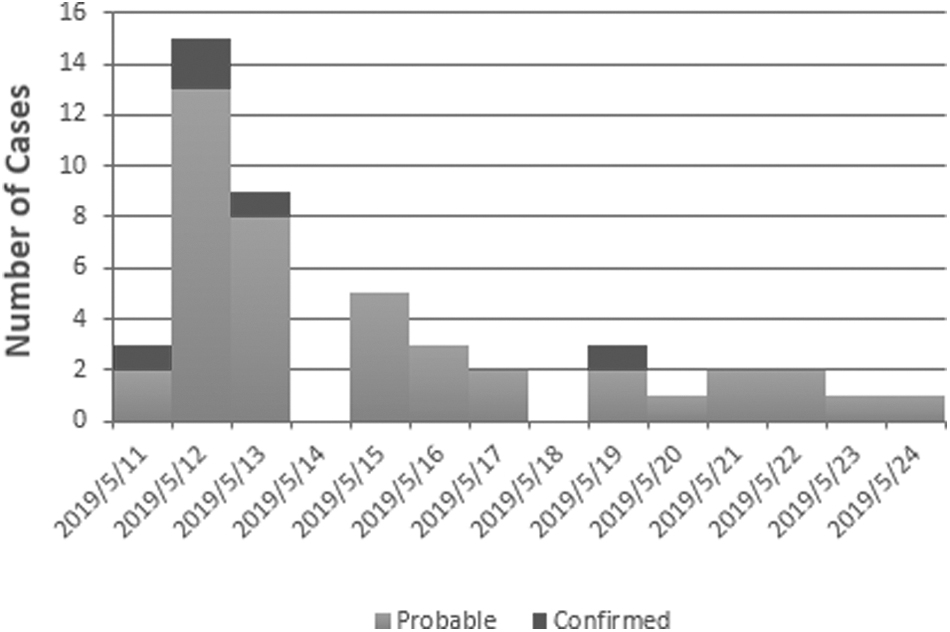
Number of Campylobacter cases (confirmed and probable) by onset dates during an outbreak in a school in Zhoushan, China, 2019.
Demographic Characteristics and Clinical Summary of Case-Patients Who Developed Their Symptoms on May 11–13 by Case Status, Campylobacter jejuni Outbreak Investigation, Zhoushan, 2019
Case–control study
A total of 27 cases (confirmed and probable cases) and 58 controls were enrolled in the case–control study. Univariate analysis indicated that two factors, grade (p < 0.05) and selection of lunch set F on May 9 (p < 0.05), were significant between the two groups (Table 2). Lunch set F (poached chicken with Scallion oil, scrambled egg with shrimp, and sauteed cabbage) on May 9 had 21 times greater odds of being consumed by cases compared with controls (OR = 20.82, p = 0.001; Table 2).
Univariate Analyses for Identification of Risk Factors for the Campylobacter jejuni Outbreak
OR, odds ratio; CI, confidence interval.
Microbiological analysis
Stools samples collected from 10 probable cases and 6 kitchen staff were negative for Salmonella spp., enterotoxogenic E. coli, Shigella spp. and Norovirus. A total of 28 samples were collected: 10 from stool samples from cases, 6 rectal swab sera collected from kitchen staff, and 12 food samples as raw chicken collected from local market from where the school food came. C. jejuni was isolated from 5 (50%) of the 10 samples of probable cases, 1 (16.7%) of the 6 samples of the kitchen staff, and 5 (41.7%) of the 12 samples of raw chicken.
All isolates were typed by PFGE (Fig. 2). Five isolates from case-patients (ZJH19-01, 2, 4, 5, and 8) showed 100% PFGE similarity between isolates and that outbreak-associated PFGE profile was different from all other analyzed strains. Namely, all other strains that were isolated from kitchen staff and chicken showed a PFGE similarity <70% to the outbreak strains. However, according to the local PFGE database, the outbreak-associated isolates in this outbreak of C. jejuni shared identical PFGE profile with an isolate (ZJC18-201), which was isolated from a rectal swab of chicken in a slaughterhouse in Zhejiang province on August 2018.
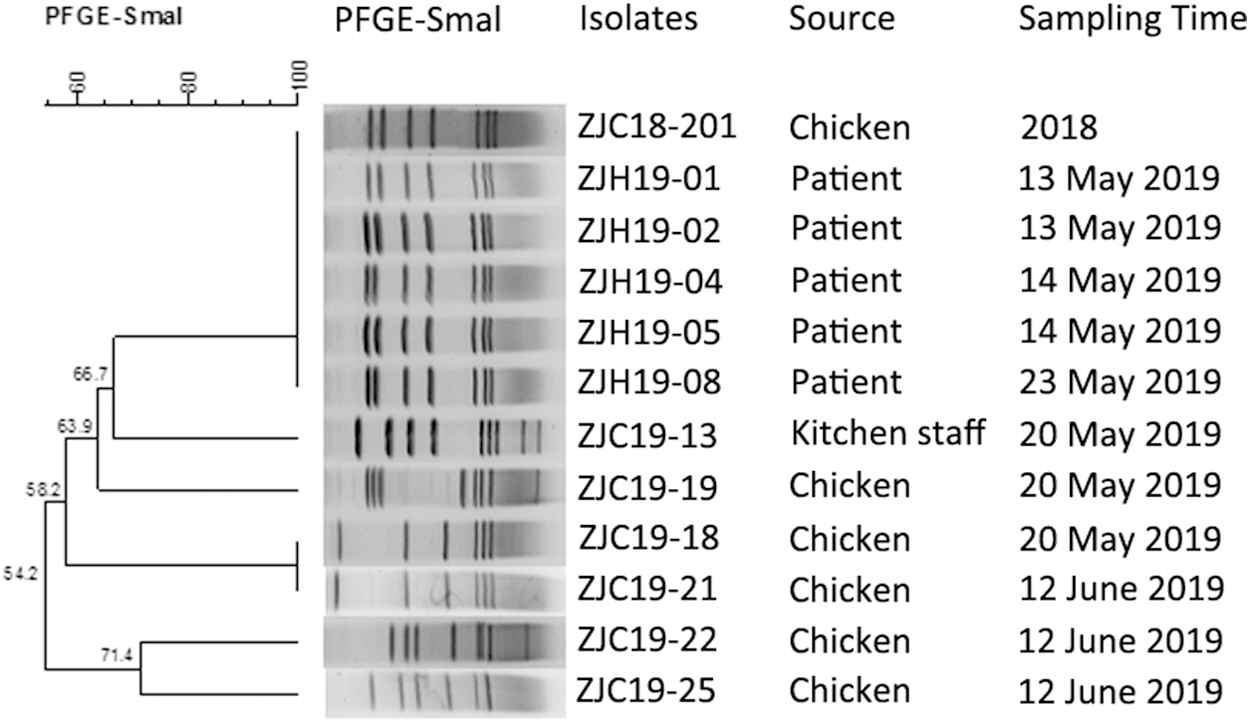
PFGE pattern and origin of the samples that tested positive for Campylobacter jejuni during an outbreak in a school in Zhoushan, China, 2019. PFGE, pulsed-field gel electrophoresis.
Four isolates coming from stool samples and one isolate collected from chicken in 2018 (ZJC18-201) was included in the WGS analysis. The cgMLST analysis showed that four case-patient isolates and the chicken isolate were generally clustered together sharing >99% similar alleles (Fig. 3). All four isolates from the outbreak case-patients differed in ≤4 core SNPs, and there was no difference between the isolates ZJH19-02 (onset in May 12) and ZJH19-08 (onset in May 19). All four case-patient isolates (ZJH19-02, 4, 5, 8) were highly similar (5–7 SNPs) with the chicken isolate (ZJC18-201). According to the MLST alleles extracted from WGS data, four outbreak isolates and the chicken isolate represented the same ST4268.
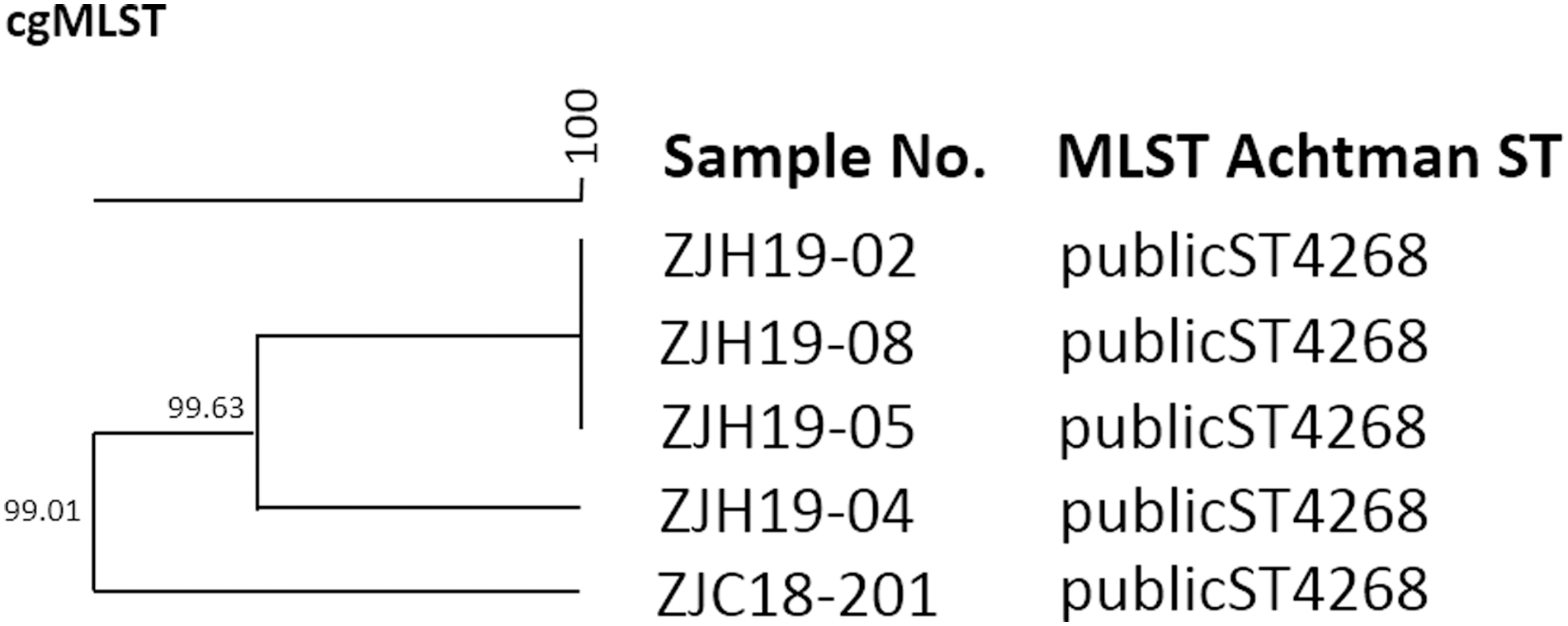
Results of the cgMLST among Campylobacter jejuni analysis during an outbreak in a school in Zhoushan, China, 2019. cgMLST, core genome multilocus sequence typing.
Discussion
This is the fourth outbreak of C. jejuni described in China to date. The first outbreak caused 36 cases of Guillain–Barré syndrome among 117 diarrheal cases that occurred in a township in northern China, and the suspected source of outbreak was contaminated water (Zhang et al., 2010). The second outbreak caused 36 cases of diarrhea in a high school in Beijing after a trip to another province in Southern China (Qu et al., 2019). The previous outbreak also happened in a high school in Hangzhou, a city 200 km from Zhoushan; this outbreak involved 84 cases total, including 15 culture-confirmed and 69 probable cases among the students (Yu et al., 2020). Between 1999 and 2008, 4936 Campylobacter outbreaks were reported by CDC in the United States (Batz et al., 2012). A total of 56 confirmed and 13 suspected outbreaks were recorded in the U.S. National Outbreak Reporting System between 2009 and 2010. Of these, 1550 illnesses and 52 hospitalized cases were reported (Hall et al., 2013). A total of 143 outbreaks were reported in England and Wales, United Kingdom between 1992 and 2009, among which 114 were the result of contaminated food or water, 2 to animal contact, and 22 to an unknown mode of transmission (Little et al., 2010). Big and/or severe outbreaks including those resulting from Campylobacter are monitored by the National Public Health Emergency Event Surveillance System since 2004, but campylobacteriosis is not a notifiable disease in China, which may be the reason that Campylobacter outbreaks were rarely reported in China.
The epidemiological curve suggested a common source of exposure. Furthermore, one unique strain being identified among stool specimen that were positive also lead us to a common source. Only 5 cases were confirmed among 45 cases. As the outbreak lasts about 11–12 d (Fitzgerald and Nachamkin, 2015; Kang et al., 2019), and patient may shed C. jejuni bacteria in their stool for several weeks after recovery (Olsen et al., 2001), secondary cases were possible. That is why, during the case–control study, we decided to include cases that occurred during the first days of this outbreak.
The rate of salmonellosis and campylobacteriosis has apparently increased around the world in the last decade (ECDC, 2018; Tack et al., 2019). The rise is largely attributed to a shift in eating habits, with consumption of raw or undercooked chicken (Rosenberg Goldstein et al., 2016). This shift in eating habits may have developed without fully understanding potential risks of raw or undercooked foods, as evidenced by rapidly expanding number of chicken, veal, or beef liver-associated campylobacteriosis outbreaks (Moffatt et al., 2016; Glashower et al., 2017; Lahti et al., 2017; Gaulin et al., 2018). According to a meta-analysis of major foodborne pathogens in Chinese food commodities, Campylobacter ranks second in terms of prevalence with an overall average prevalence at 10.8% (Paudyal et al., 2018).
A C. jejuni isolate detected from school kitchen staff in rectal swab is not closely related with those from infected students, suggesting that the outbreak is not attributed to the kitchen staff. Although we did not identify a vehicle from food leftovers or traceback sampling in local market from where the school food came, the combined epidemiological and microbiological evidence suggested that this outbreak was associated with consumption of half-cooked chicken. The confirmed cases in this outbreak were limited only to one junior high school. A meal was identified as the potential source of the contamination. The same strain of C. jejuni was identified in a chicken food samples making us believe that chicken may be the source of the contamination. Other specimen collected on humans (kitchen staff) and other chicken were positive for Campylobacter but involving different strains demonstrate the diversity of Campylobacter strain.
In lunch set F (poached chicken with Scallion oil, scrambled egg with shrimp, and sauteed cabbage), scrambled egg with shrimp and sauteed cabbage are fully cooked and divided into each lunch box directly, which prevent food poison. Chicken meat has been identified as one of the major food vehicles associated with outbreaks of campylobacteriosis (Moffatt et al., 2019). Raw chicken is often contaminated with C. jejuni (Skarp et al., 2016; Ju et al., 2018). The poached chicken with scallion oil is a popular Chinese dish that is prepared as follows: whole chicken is a bit undercooked for being juicy and silky, then submerged in a bowl of ice water and chopped into pieces. All these steps increase the possibility of C. jejuni infection, suggesting chicken could be a source of C. jejuni in this outbreak. Furthermore, WGS revealed 5–7 SNP variation between the outbreak-associated isolates and an isolate collected from chicken in a slaughterhouse in Zhejiang province in 2018; this indicates a very close genetic relationship among the isolates, further supporting the chicken source infection events described previously.
The students from different grades have different meal times in the order of grades from 7 to 9. The lunch sets (sets A–F) were provided based on the preparation and availability at different periods. On May 9, lunch set F was mainly provided during mealtime of eighth grade, which may be the reason that most of the cases occurred in the eighth grade.
MLST results showed that the outbreak strain belongs to a distinct sequence type (ST4268), which is rare. In 2008, ST4268 was first isolated from a diarrhea patient in Jiangsu Province (the ID in C. jejuni/C. coli PubMLST database is 8080), a province neighboring Zhejiang Province (Zhang et al., 2015). ST4268 has also been found in goose in Anhui Province (the ID in C. jejuni/C. coli PubMLST database is 47807), another neighboring province of Zhejiang (
The MLST phenotype that is completely different compared with the local (Hangzhou, Zhejiang) outbreak strains, which belongs to ST2988 and ST8149 (Yu et al., 2020), show great diversity in MLST phenotype, as widely documented in other countries (Zeng et al., 2016; Oh et al., 2017).
In conclusion, we report the recent C. jejuni outbreaks in China that was associated with consumption of a popular Chinese dish called poached chicken with scallion oil. This indicates the need for a regulatory guidance for consumption of undercooked chicken like poached chicken with scallion oil or sliced cold chicken. A C. jejuni epidemic clone ST4268 was responsible for this outbreak, and the occurrence of interprovince and interhost clonal disseminations of this ST highlight the necessity of surveillance for the clone to prevent its further dissemination in China.
Availability of Data
The raw sequence data set is available in the NCBI database with BioProject accession number PRJNA610147.
Footnotes
Disclosure Statement
No competing financial interests exist.
Funding Information
This work was supported by the National Key Research and Development Program of China (2017YFC1601503), 13th Five-Year National Major Science and Technology Projects of China (2018ZX10714002), and Medical and Health Science and Technology Project of Zhejiang (2018RC027, 2020KY524, WKJ-ZJ-1917).