




Abstract
Bacillus cereus spores are concerns for food spoilage and foodborne disease in food industry due to their high resistance to heat and various disinfectants. The aim of this study was to investigate the inactivation of B. cereus spores by slightly acidic electrolyzed water (SAEW) in comparison to sodium hypochlorite (NaClO) with same available chlorine content (ACC). In this study, the efficacy of SAEW with different concentrations of ACC (40, 60, 80, 100, and 120 mg/L) on the inactivation of B. cereus spores, and the effect of SAEW combined with mild heat treatment (60°C), was examined in pure culture suspensions. Heat resistance and pyridine-2,6-dicarboxylic acid (DPA) release of the spores were also determined. The results showed that the sporicidal effect of the SAEW was significantly higher compared with the NaClO with the same concentration of ACC. Furthermore, the inactivation efficacy was largely dependent on ACC and treatment time. Moreover, the sporicidal activity of the SAEW was significantly improved when combined with a mild heat treatment (60°C). The majority of the DPA was released from spores, and the spores exhibited less resistance to heat after SAEW treatment for 30 min. These findings indicate that SAEW could effectively inactivate B. cereus spores, making it a promising and environmentally friendly decontamination technology for application in the food industry.
Introduction
B
Thermal sterilization is a primary process to inactivate spores. However, high temperatures inevitably result in substantial changes in food quality, including the deterioration of nutrition, color, functionality, texture, and aroma (Lv et al., 2019). In view of this, the application of nonthermal technologies has appeared as an alternative to minimize changes in the sensory properties of food induced by high temperatures. In recent years, various nonthermal spore inactivation methods have been developed and are commonly applied, such as high pressure processing (HPP), ultrasonication, cold plasma, and radiation (Dobrynin et al., 2010; Cetin-Karaca and Morgan, 2018; Deng et al., 2019; Lv et al., 2019). Unlike the vegetative cells, it is difficult to effectively inactivate bacterial spores because of their high level of stress resistance. In addition, the high equipment cost and energy consumption of these methods hinder their extensive application in the food industry. Therefore, there is a need for the development of an effective, suitable, and environmental friendly disinfection method to reduce or eliminate bacterial spores.
Electrolyzed oxidizing (EO) water, with its characteristics of high efficiency, broad antimicrobial spectrum, low cost, and high level of safety, has been broadly applied in food production and processing in the food, livestock products, and agriculture (Hao et al., 2013; Hirayama et al., 2016; Athayde et al., 2017; Bing et al., 2019; Ogunniyi et al., 2020). Slightly acidic electrolyzed water (SAEW), with a pH of 5.0 to 6.5 and an oxidation reduction potential (ORP) of 800–1000 mV, is produced by electrolysis of hydrochloric acid (HCl) or in combination with sodium chloride (NaCl) in EO water generation equipment using an electrolysis chamber without the separating membrane (Forghani et al., 2015). It has been reported that SAEW has a strong bactericidal effect on foodborne pathogens and even bacterial spores (Liao et al., 2017b; Hussain et al., 2019). Although SAEW has been reported to be effective against a variety of microbial species, its sporicidal capacity in comparison to commonly used sodium hypochlorite (NaClO) has not been fully explored. In this study, the inactivation efficacy of B. cereus spores by SAEW with different available chlorine content (ACC), treatment time, and temperature was evaluated. In addition, heat resistance and pyridine-2,6-dicarboxylic acid (DPA) release of spores after SAEW treatment were also examined to determine the inactivation characteristics of SAEW on B. cereus spores.
Materials and Methods
Bacterial strain and spore preparation
Three B. cereus strains (ATCC 14579, RB223, and BR4) were used in this study. B. cereus ATCC 14579 was obtained from American Type Culture Collection. B. cereus RB223 and BR4 were isolated from mouse feces (mice were obtained from the Animal Experimental Center of Xi'an Jiaotong University [SCXK 2013-003]) and brown rice (purchased in a local supermarket), respectively. All experimental procedures and animal protocols were approved by the Laboratorial Animal Center of Xi'an Jiaotong University (Approval No. XJTU1AF2017LSK). Specific methods of isolation and identification of the B. cereus strains (RB223 and BR4) can be found in supporting information. Spores were prepared as previously described (Zhang et al., 2016c). Overnight cultures of Bacillus strains grown in trypticase soy broth (TSB; Beijing Land Bridge Technology Ltd., Beijing, China) were transferred to sporulation agar plates of trypticase soy agar (TSA; Beijing Land Bridge Technology Ltd.) supplemented with 50 mg/L manganese sulfate. Plates were sealed with parafilm and incubated at 37°C for 7 d. Spores were harvested by adding 20 mL of sterile cold deionized water on the surface of each plate and gently rubbing with a sterile glass rod. At least 90% of the cells formed spores after incubation (The percentage of spores to vegetative cells measured by coating counts after being treated in a water bath at 80°C or not). And spore formation was confirmed by phase contrast microscopy. The collected suspension was washed thrice by centrifugation (5804R; Eppendorf, Germany) at 5000 × g and 4°C for 15 min. The final pellets were resuspended in 0.85% NaCl (pH 6.78) and stored at 4°C in the dark until used.
Preparation of the treatment solutions
SAEW was prepared by the electrolysis of 10% NaCl +1% HCl solution (Analytical pure; Sichuan Xilong Chemical Engineering Co. Ltd., China) in a commercial EO water generator (Harmony-II; Beijing Rui Ande Technology Co. Ltd., Beijing China). Tap water (Yangling Xinhua Water Co., Ltd.) was used in the preparation of the SAEW. The pH and ORP of the SAEW were measured using a dual scale pH/ORP meter (FiveEasy Plus FE28; Mettler Toledo, China) with a pH probe (FE438) and an ORP probe (FE510). The ACC was determined with a colorimetric method using a Digital Chlorine Kit (Chlorometer Duo; Palintest Co., United Kingdom). SAEW (Initial ACC concentration was 132 mg/L) with ACC concentrations of 40, 60, 80, 100, and 120 mg/L was prepared by diluting with deionized water. A small amount of 6% HCl solution was added to adjust the pH values of SAEW. NaClO (Analytical pure, Guangdong Guanghua Sci-Tech Co. Ltd., China; actual active chlorine content is ≥5.5%) with the same ACC was also prepared. Sterile deionized water was used as a control in this study. The measurements were performed at room temperature (20–25°C). The physicochemical properties of the treatment solutions are presented in Table 1.
The Physicochemical Parameters of the Treatment Solutions
The total chlorine level of the NaClO is ≥5.5%. The measurements were performed at room temperature (20–25°C). All measurements were performed in triplicate.
ACC, available chlorine content; NaClO, sodium hypochlorite; ORP, oxidation reduction potential; SAEW, slightly acidic electrolyzed water.
Sporicidal test
B. cereus spores (∼7.5–8.0 log CFU/mL) were exposed to SAEW with different ACC levels and for different lengths of exposure. One milliliter of prepared spore suspension was transferred into 9 mL of treatment solution and mixed completely by vortex (Vortex-2; Shanghai Huxi Shiye Co. Ltd., China) for 10 s. After different periods of time, 1 mL of mixture was collected and mixed with 1 mL of phosphate-buffered saline containing 0.5% sodium thiosulfate (Na2S2O3, analytical pure; Tianjin Zhiyuan Chemical Reagent Co. Ltd., China) for 1 min to quench any remaining free chlorine (Liao et al., 2017b). A sample with 9 mL sterile deionized water was used as a control. The above preparations were carried out at room temperature (20–25°C). Counts of viable spores were obtained by spread plating 0.1 mL of appropriate serial dilutions of the cultures onto TSA. The plates were incubated at 30°C for 24 h before counting. If necessary, the plates were incubated additionally for 24 or 48 h. And the counts were also detected in the quenching solution by taking 1 mL of this mixed solution into 9 mL TSB for enrichment at 30°C for 24 h. Then, it was observed whether the cultures were clear or turbid.
The disinfection effect of combined treatments of SAEW or NaClO with mild heat on B. cereus spores
First, the properties of the solutions treated in a preheated water bath (60°C, HH-W21-420; Beijing Changfeng Instrument Co. Ltd., China) for different lengths of exposure time (1–50 min) were measured (Supplementary Data). The inactivation of the B. cereus spores after combined treatment of SAEW or NaClO in the presence of mild heat (20°C, 40°C, and 60°C) was estimated to determine the best temperature for inactivation of the spores. Briefly, volumes of 9 mL of SAEW or NaClO (control) were transferred to separate sterile tubes, and the caps were tightly closed. One milliliter of each spore suspension (∼7.5–8.0 log CFU/mL) was added to each tube under the same treatment conditions (ACC level: 60 mg/L; treated time: 2 min; three temperatures: 20°C, 40°C, and 60°C). Following each treatment, the next steps were the same as Sporicidal Test section.
Based on the previous results, the treatment solutions with 60 mg/L ACC applied for different lengths of exposure time (1, 5, 10, 15, 20, 30, and 50 min) on B. cereus spores in the presence of mild heat (60°C) were evaluated, following which the treatment steps for viable spore enumeration were performed as described above.
Heat resistance analysis
The heat resistance assay of B. cereus spores (ATCC 14579) treated by SAEW was conducted according to the following method in the previous study with some modifications (Leguérinel et al., 2007): the SAEW treated spores in capillary tubes were exposed to wet heat of 85°C for 20 min and then transferred immediately onto ice to cool down. Each sample was diluted appropriately and then spread on the TSA. Thereafter, the plates were incubated at 30°C for 24 h before enumeration. The relative loss of heat resistance rate of spores was calculated using the following formula:
where N0 and N are the number of survival spores before and after treatment with wet heat at 85°C for 20 min.
DPA determination
DPA contents in the B. cereus spores were measured at 440 nm using a modified colorimetric assay (Janssen et al., 1958). The spores were autoclaved for 20 min at 121°C as a positive control to determine the total DPA content. The DPA content was calculated according to the standard curve, in which the concentrations ranged from 5 to 200 μg/mL DPA. The following equation was used to calculate the relative DPA release from the spores:
where F1, F2, and F0 are the amounts of DPA released from the treated spores, autoclaved spores, and untreated spores, respectively.
Statistical analyses
Statistical analyses were performed using SPSS software (Version 24.0; SPSS, Inc., Chicago, IL). Data are presented as the mean ± SD (n = 3), and differences between means were tested by one-way ANOVA. All experiments were performed in triplicate, and each biological replicate included three technical replicates. The p-values <0.05 were considered to be statistically significant.
Results and Discussion
Effects of different SAEW and NaClO treatment times on B. cereus spores
The properties (ACC, pH, and ORP) of the treatment solutions used in this study are presented in Table 1. The aim of this study was to investigate the inactivation effect of SAEW compared with the widely used disinfectants like NaClO (unadjusted pH usually). In the previous study (Zhang et al., 2016a), pH of 5.0–6.5 showed no different effect on inactivation of bacteria, and it indicated that pH was not the primary factor for bacterial inactivation. Therefore, we only used the initial deionized water without pH adjusting. As treatment time increased, the spores of all three B. cereus strains were significantly reduced compared with those in the control group (p < 0.05). The maximum log reductions of 5.77, 5.47, and 5.41 log CFU/mL for B. cereus ATCC 14579, RB223, and BR4 spores were obtained after treatment with SAEW for 50 min. After exposure to NaClO for 30 or 50 min, the maximum log reductions of the spores of the three B. cereus strains were 3.15, 2.78, and 3.33 log CFU/mL, respectively (Fig. 1A–C). Initially, the number of three B. cereus strain spores was reduced quickly in SAEW treated group, whereas log reduction of spores was not obviously reduced after NaClO treatment. No other significant differences were observed between the SAEW and NaClO treatments in the reduction of the B. cereus spores originating from three different sources.
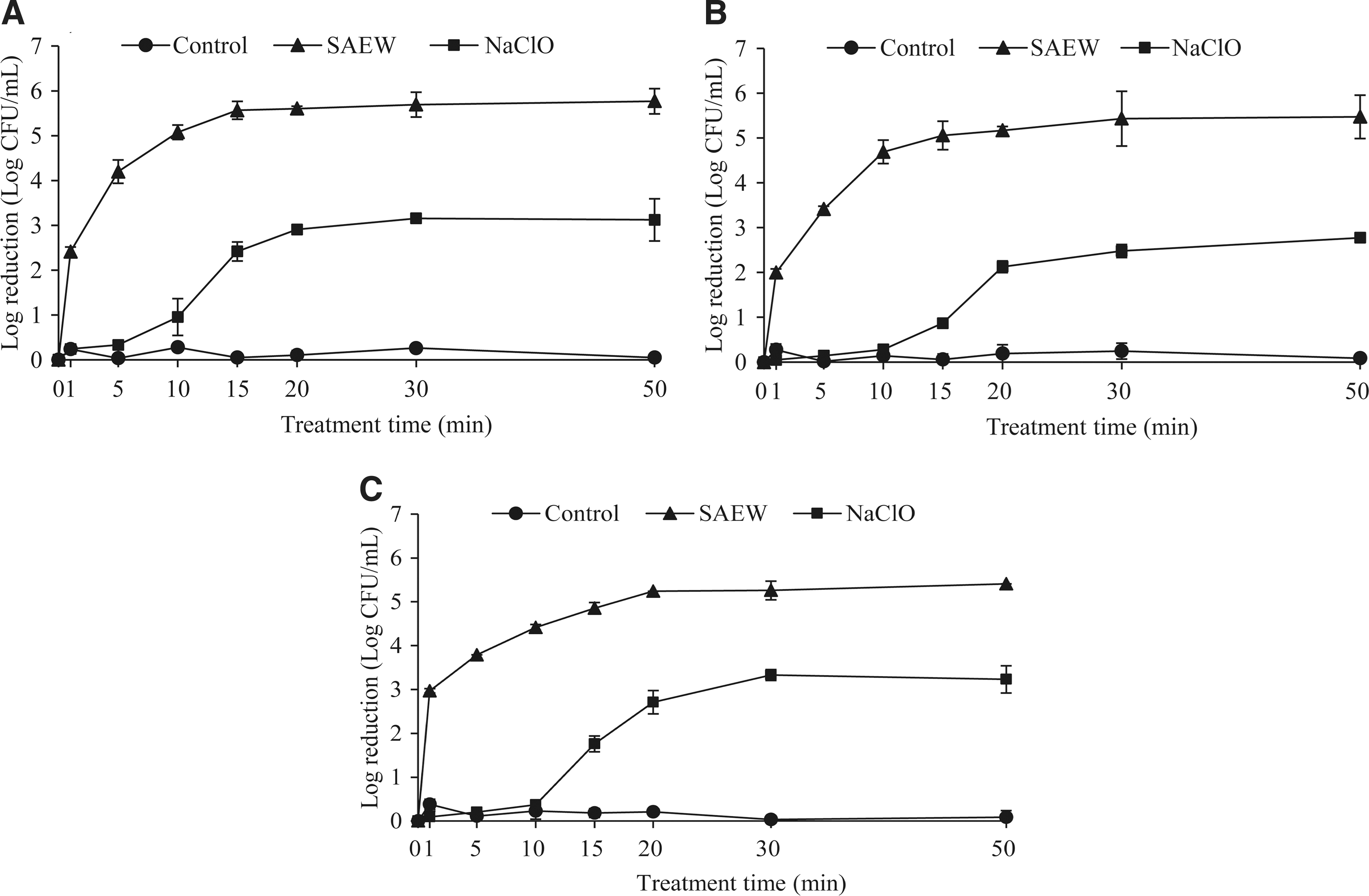
Effect of treatment time on inactivation of Bacillus cereus spores by SAEW and NaClO.
The SAEW exerted effective sporicidal activity on all three B. cereus strains compared with the NaClO under the same treatment conditions. These results concur with those in previous studies (Kim et al., 2000a; Vorobjeva et al., 2004; Zhang et al., 2016c). Zhang et al. (2016c) found that 5 min treatments of SAEW reduced pure cultured B. cereus spores to a nondetectable level with a log reduction of about 7.0 log CFU/mL. However, a reduction of 4 logs in the B. cereus spores was obtained in this current study after SAEW treatment for 5 min. The difference could be due to variations in the strains and experimental conditions (Ezeike and Hung, 2004), and the initial concentration of spore cell, the medium, and operation of the experiment also contribute to variations in the final results (Zhang et al., 2016b). In addition, EO water has also been reported to effectively inactivate other bacterial spores, including Bacillus subtilis spores (Tang et al., 2011; Zhang et al., 2016c) and Clostridium difficile spores (Tkhawkho et al., 2017). In this study, all three B. cereus strain spores showed high resistance to the NaClO treatments, particularly within the initial 10 min. Similarly, Hilgren et al. (2009) reported that ∼1.25 log CFU/mL of B. cereus ATCC 14579 spores was reduced after 10 min exposure to NaClO (total chlorine is 10%) with ACC of 500 mg/L at 20°C. Young and Setlow (2003) also found that B. subtilis spores showed high resistance to the NaClO (2.5 g/L, pH 11) treatments within 20 min. The SAEW exerted a comparatively higher inactivation activity on spores than the NaClO, indicating that it may be a potential decontamination method to use in the food industry in the future.
Effects of SAEW and NaClO with different levels of available chlorine on B. cereus spore inactivation
As shown in Figure 2, log reduction of the B. cereus spores significantly increased as the ACC in the SAEW was increased from 40 to 120 mg/L (p < 0.05). Compared to the initial population of B. cereus ATCC 14579 spores of 7.86 log CFU/mL, log reductions of 3.18, 3.89, 4.37, 5.25, and 5.76 were observed after the SAEW treatment (Fig. 2A). Similarly, the isolated spore populations of RB223 and BR4 were reduced from an initial 7.57 log CFU/mL to 3.20, 3.98, 4.45, 5.70, and 6.32 log reductions and 2.15, 3.35, 4.91, 5.41, and 5.99 log reductions, respectively, when treated for 2 min with SAEW with ACC of 40 to 120 mg/L (Fig. 2B, C). There were no obvious differences in the reductions of B. cereus 14579, RB223, and BR4 spores treated by SAEW and, indeed, the SAEW effectively exerted inactivation activity on the B. cereus spores. The results showed that the short treatment of 2 min was insufficient time for NaClO to inactivate the spores, regardless of the level of ACC. This study, therefore, found that SAEW with different ACCs can effectively inactivate B. cereus spores in suspension. In this study, results indicated that the three B. cereus spore populations treated with SAEW at ACC of 60 mg/L for 2 min achieved log reductions of 3.89, 3.98, and 3.35, respectively. These results are consistent with the study reported by Kim et al. (2000a), in which B. cereus spores treated with AEW with ACC of 56 mg/L for 2 min underwent a similar (3.5) log reduction.
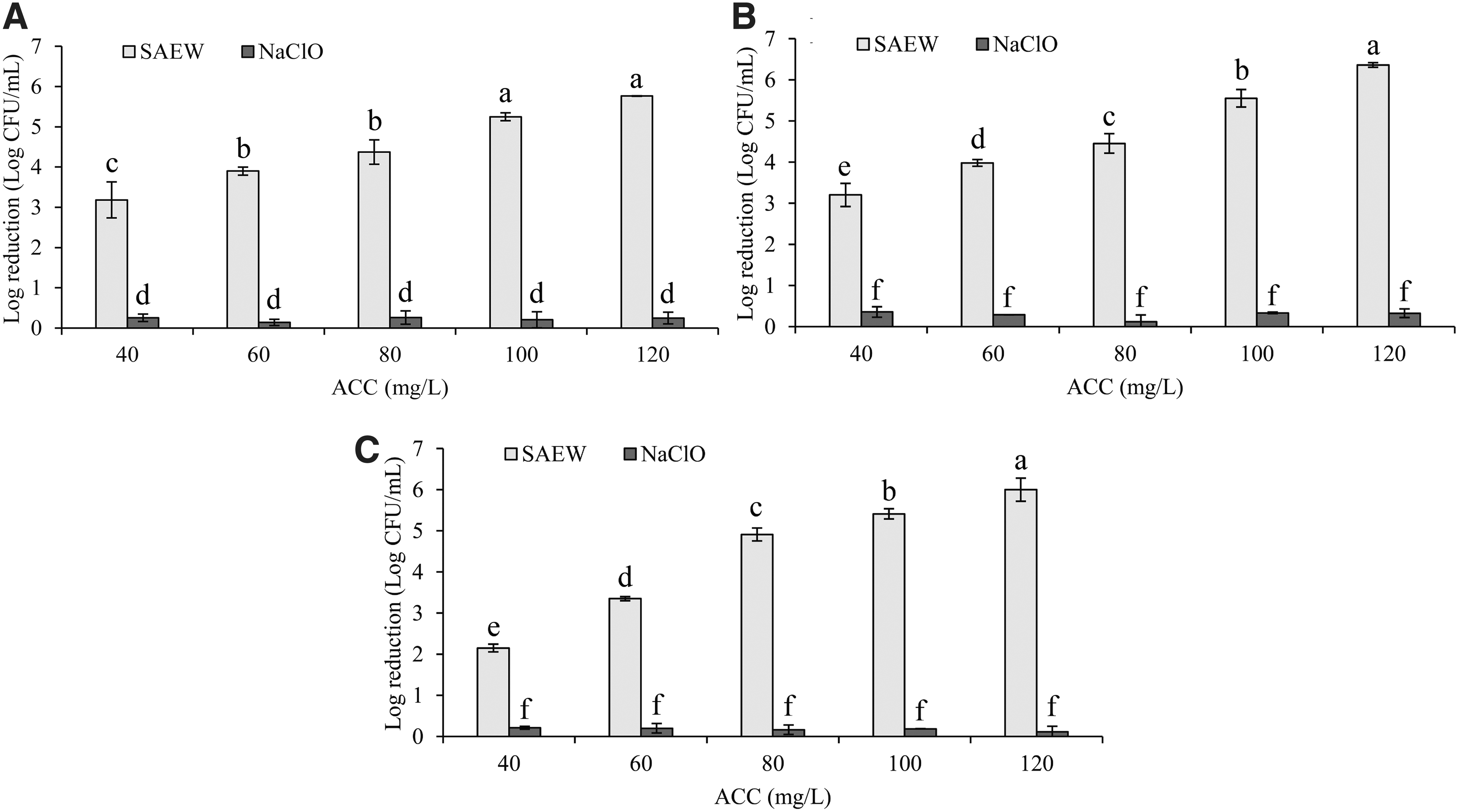
Effect of ACC on inactivation of Bacillus cereus spores by SAEW and NaClO.
In addition, our results found that the B. cereus spore was more resistant to NaClO than to SAEW treatment. This difference between SAEW and NaClO may be due to SAEW likely being in a different equilibrium state to NaOCl, which could be influenced by various factors, including pH, temperature, and light (Len et al., 2002). In pH of 5.0–6.5, HOCl (∼95%) of SAEW is the main form of active chlorine compound and is thought to be responsible for microbial inactivation. Previous study has showed that HOCl has an 80-fold stronger bactericidal efficacy compared with ClO− at an equivalent concentration (Cao et al., 2009). Fukuzaki (2006) explained that HOCl could inhibit the enzyme activity essential for microbial growth and damage the membrane and DNA because it could penetrate through the walls and membranes of microbial cells. However, HOCl dissociates to OCl− at high pH and Cl2 at low pH values. In this study, NaClO with the pH values of ∼9.0, a high amount of OCl− was formed. HOCl and OCl− proportions of SAEW and NaClO influenced the spore inactivation. The ORP and ACC of EO water were also found to decline substantially with an increase in pH from the acidic to the basic region (Rahman et al., 2016). Some researchers have suggested that low pH and high ORP of EO water also influence its bactericidal effect (Kim et al., 2000b; Park et al., 2004). However, very few studies have investigated the mechanism of the germicidal action on spores in EO water. Therefore, to evaluate the inactivation characteristics and mechanism of SAEW on B. cereus spores, the factors that influence antimicrobial activity (ACC, ORP, pH, temperature, water hardness, and treatment time) and the equilibrium of HOCl, Cl2, OCl− should be considered in SAEW applied to targeted microorganisms.
Effect of SAEW and NaClO combined with mild heat treatment on B. cereus spores
As shown in Figure 3, log reductions of the spores treated by SAEW were improved through elevated temperature (p < 0.05). In addition, significant differences were observed between the reductions obtained with SAEW and NaClO at all temperatures (p < 0.05). In this study, SAEW and NaClO combined with a mild heat treatment of 60°C improved the inactivation on B. cereus spores significantly more than with the lower treatment temperatures of 20°C and 40°C. Similarly, previous research found that low-acidic EO water (pH 5.5–6.5) with ACC of 20 mg/L reduced B. cereus spores by 1.35 logs, but that this rose to more than 5.86 logs after 4 min treatment at 40°C and 50°C, respectively (Kamikado et al., 2004).
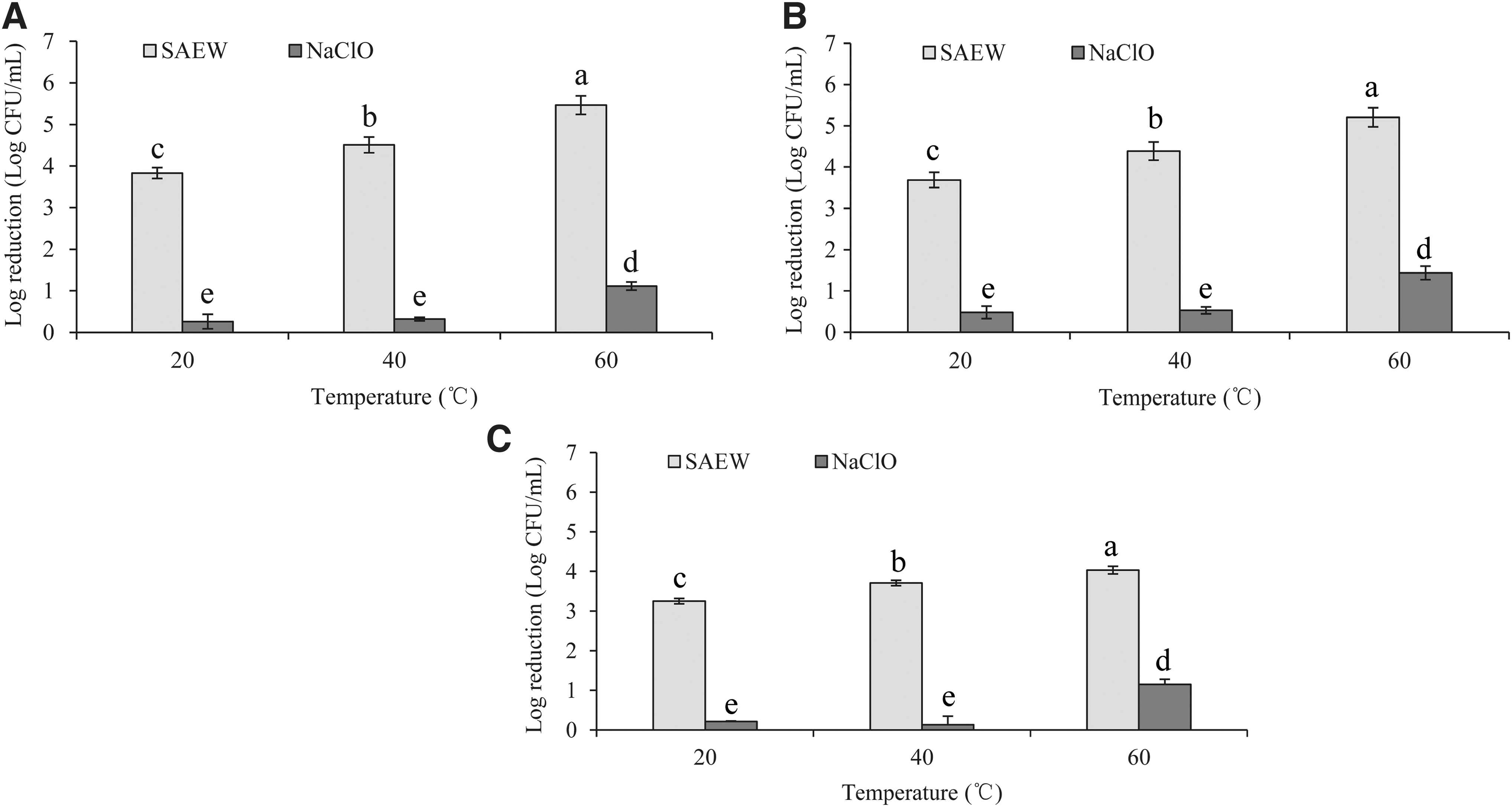
Inactivation of Bacillus cereus spores by SAEW and NaClO combined with different mild heat.
Mild heat treatment of 60°C was, thus, used in this study to investigate its synergistic inactivation of spores when used in combination with SAEW and NaClO. As shown in Supplementary Figure S1 (Supplementary Data), the properties (ACC, pH, and ORP) of the treatment solutions (SAEW and NaClO) were relatively stable during heat treatment at 60°C. In Figure 4, it was evident that the addition of mild heat (60°C) significantly enhanced the inactivation effect of SAEW on the three strains of B. cereus spores (p < 0.05). In particular, for B. cereus ATCC 14579 and RB223 spores, additional reductions of 2.44 and 1.64 log CFU/mL and 1.89 and 1.38 log CFU/mL were achieved after treatment with SAEW and mild heat for 1 and 5 min, respectively, in comparison to SAEW treatment alone. Hussain et al. (2019) reported that treatment with SAEW at 60°C for 10 min resulted in additional reductions of B. cereus ATCC 10987 spores and B. cereus ATCC 14579 spores at 0.76 and 0.59 log CFU/mL, respectively.
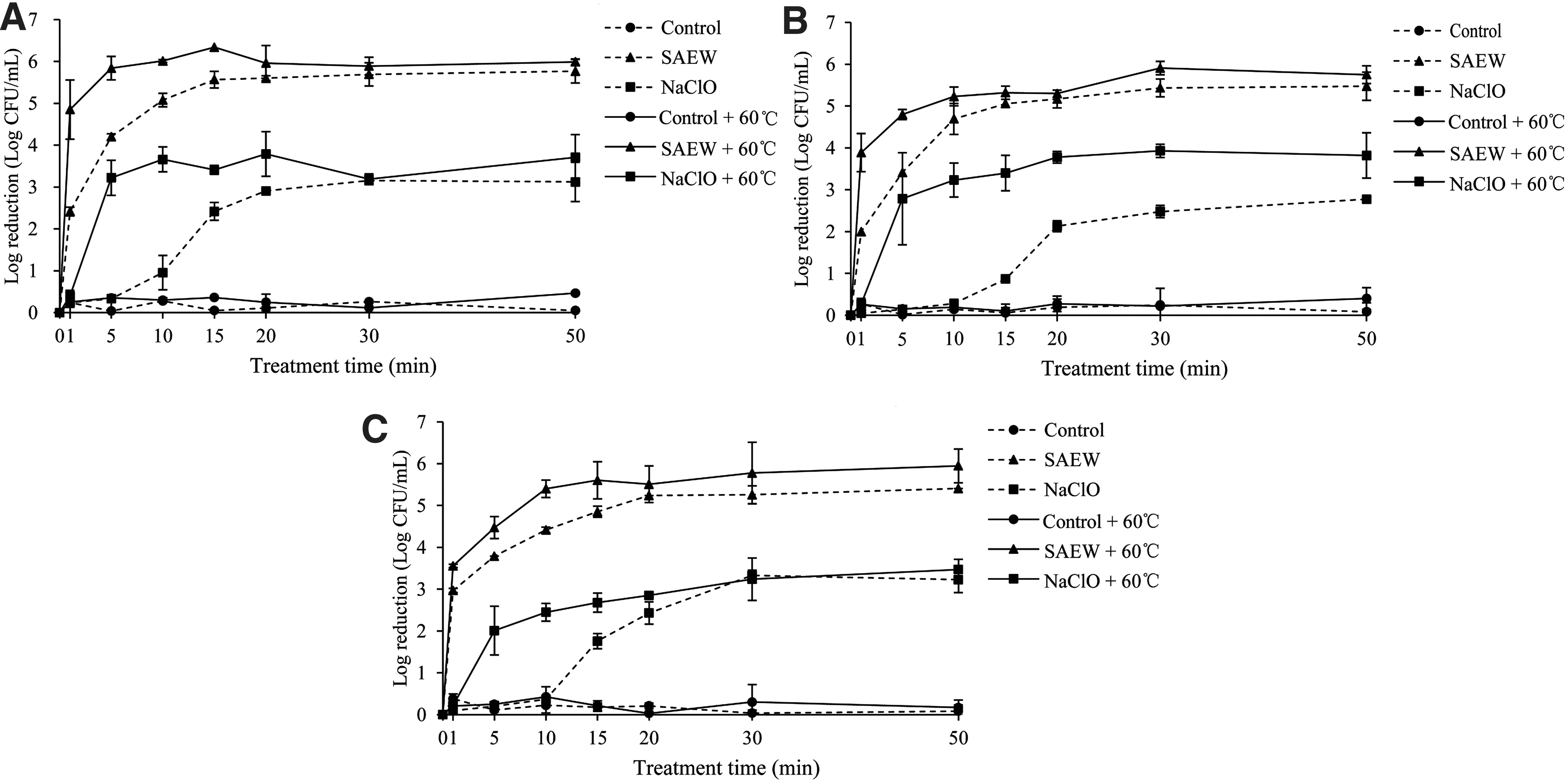
Effect of treatment time on inactivation of Bacillus cereus spores by SAEW and NaClO in the presence of mild heat (60°C).
EO water in combination with heat treatment has been evaluated for its sanitizing effect on a variety of food products (Rahman et al., 2011; Xie et al., 2012; Liu et al., 2019). Evidently, the sanitizing efficacy of SAEW is improved with increasing temperature, and SAEW does not significantly affect the quality characteristics (Cao et al., 2009; Hussain et al., 2019). Currently, several nonthermal sterilization technologies have been developed, such as HPP, ultraviolet, ultrasound, pulsed electric field, and nonthermal plasma (Deng et al., 2019). It has been reported that HPP performed an effective inactivation on spores, which contains two steps, including first germination induction and final inactivation. Nevertheless, not all spores can be induced to germinate by HPP (Borch-Pedersen et al., 2017; Wang et al., 2017). In addition, the high equipment cost and energy consumption of HPP also hinder its extensive application in the food industry. Cold plasma has also been used to inactivate spores in the food products. However, the type of food has a significant effect on its inactivation that cold plasma sterilizes better in solid foods, especially those with low water activity, such as wheat grains and powders (Liao et al., 2019). What's more, cold plasma technology has its own drawbacks, like the relatively short working distance, poor penetrability, and so on (Liao et al., 2017a). Therefore, SAEW is a promising and effective alternative to conventional sterilization technologies for controlling microbial contamination in food products. However, the mechanism by which SAEW inactivates spores is poorly understood and needs further scientific investigation.
Our study indicated that SAEW or NaClO combined with mild heat (60°C) exhibited a synergistic effect of inactivation on B. cereus spores. Previous study reported that nutrient germination of Bacillus species spores occurs through germinant receptors in spores' inner membrane in a process stimulated by sublethal heat activation (Luu et al., 2015). Lovdal et al. (2011) indicated that sublethal heat treatment could activate dormant spores, promoted spore germination, and subsequently be inactivated by mild heat treatment. Therefore, it is speculated that heat activation promotes spore germination and is more susceptible of spore inactivation, which can contribute to the synergistic inactivation under thermal treatments. To confirm our results, the heat resistance and DPA release of B. cereus spores after SAEW treatments were evaluated.
Heat resistance analysis
Dormant spores are resistant to chemical agents owing to their chemical composition and uniquely complex structure (Setlow, 2006). Generally, spores either germinate or their structural damage results in a loss of resistance to heat stresses (Setlow, 2003). Therefore, an exploration of the heat resistance levels of B. cereus spores after SAEW treatment will provide valuable insight. The strain of ATCC 14579 was used in the subsequent assay (heat resistance and DPA release), based on the previous findings. In Figure 5, the loss of heat resistance of B. cereus spores treated by SAEW increased in line with the increase in SAEW treatment time. When the SAEW treatment time was increased to 15 min, the loss of heat resistance reached a maximum value of 47.94%; however, rate of diminishing heat resistance in the spores greatly decreased when the treatment time exceeded 15 min (Fig. 5A). The reduced loss of resistance in the spores after more than 15 min SAEW treatment may be due to the fact that ACC decreased after 15 min. The results further showed that the SAEW treatment increased the loss of heat resistance of spores significantly more than did the NaClO, although similar tendencies were observed in both treatments. As is shown in Figure 5B, loss of heat resistance significantly increased when the B. cereus spores were treated by SAEW with increasing levels of ACC, from 40 to 100 mg/L (p < 0.05). However, no significant difference was observed in the loss of heat resistance by NaClO treatments with various ACCs.

Loss of heat resistance of Bacillus cereus spores by SAEW and NaClO at different conditions.
DPA release in B. cereus spores
As shown in Figure 6, the results indicated that SAEW treatment resulted in a high level of release of DPA. The DPA concentration of 42.71 ± 1.06 μg/mL after being autoclaved at 121°C for 20 min was used as the maximum detectable DPA content (positive control). The relative DPA release of B. cereus spores increased significantly with elevated treatment time. In this study, 80.92% of DPA was released after 30 min SAEW treatment, while 16.18% was released during the NaClO treatment (Fig. 6A). In addition, with increasing ACC, the relative DPA release of spores also increased markedly (p < 0.05); however, it was not as obvious in the NaClO treatment group (Fig. 6B).
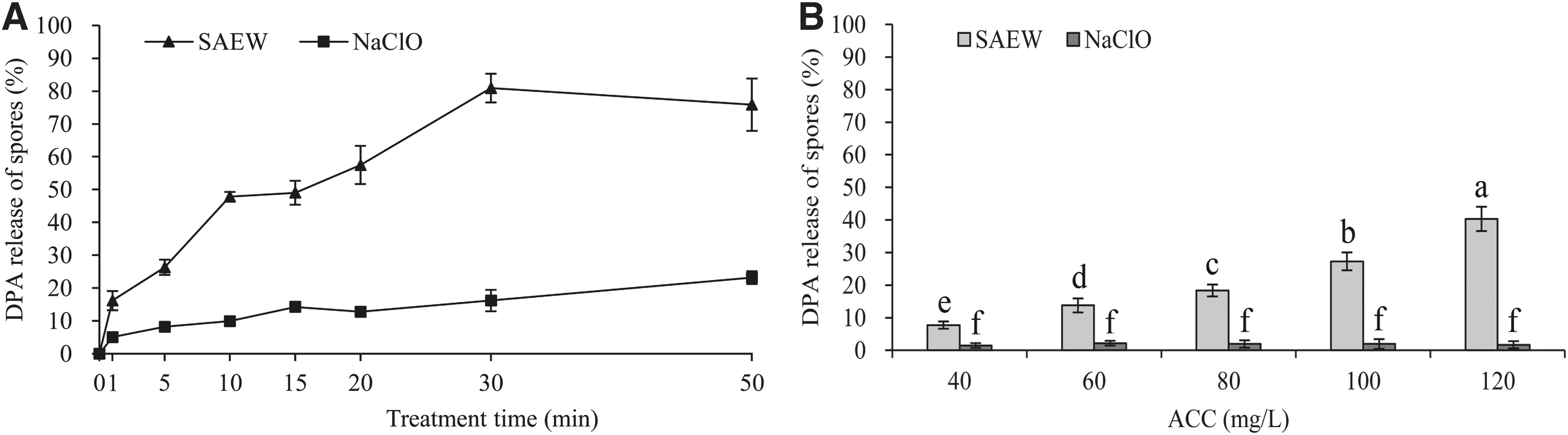
DPA release of Bacillus cereus spores by SAEW and NaClO at different conditions.
It is evident that the NaClO treatment caused little DPA release, whereas the SAEW treatment resulted in a significant DPA release, which increased as the treatment time extended. Conversely, increasing the ACC levels in the SAEW resulted in only a partial release of DPA; however, it is possible that the short SAEW treatment time (2 min) was not sufficiently long to activate the release of DPA. Previous research has reported that hypochlorite (2.5 g/L, pH 11) or chlorine dioxide treatment could not cause large DPA release of the spore's core, but hypochlorite- and chlorine dioxide-treated spores much more readily released DPA upon a subsequent normally sublethal heat treatment than did untreated spores (Young and Setlow, 2003). This is in agreement with our study, in which the NaClO treatment caused little DPA release. Under the condition of mild heat (60°C) treatment, SAEW or NaClO showed a stronger effect of inactivation on B. cereus spores. Large DPA release and heat resistance reduction of spores are considered as an indicator in spore germination (Setlow, 2003). The spore's core has a high concentration of calcium and other divalent ions chelated with DPA. When the majority of the DPA is released from the spore's core, enzymes, DNA, ribosomes, and tRNAs in the spore's core will be replaced by water in a process called core hydration (Setlow, 2003, 2006). Thus, the results of loss of heat resistance reduction found in this study may be partially due to spore core hydration. However, it needs to be further confirmed whether SAEW treatment will cause B. cereus spore germination.
There are some limitations in this study. Here, only three B. cereus strains were investigated, and a few more genetically different strains should be added to examine general and significant implications for this study. The specific reasons for the inactivation of B. cereus spores by SAEW and NaClO have not been explored deeply in this study. Variation in equilibrium of the components (HOCl, OCl−, Cl2) of SAEW and NaClO, influenced by pH especially, also requires further scientific investigation. And if the specific concentration of HOCl, OCl−, and Cl2 for both SAEW and NaClO solutions is examined, it will be useful to demonstrate the difference of the inactivation efficacy. In addition, the study demonstrated the effect of three variables ACC, treatment time, and temperature separately. It is necessary to investigate the inactivation efficacy of SAEW in combination with mild heat treatment (40°C and 60°C) at different time intervals on B. cereus spores in our future study.
Conclusions
SAEW with various levels of ACC and at different treatment times effectively inactivated B. cereus spores compared with NaClO. Moreover, the SAEW performed a synergistic effect when combined with mild heat (60°C). SAEW treatment also caused release of the majority of DPA, which resulted in loss of heat resistance of B. cereus spores. These findings indicate that SAEW may be a promising and environmentally friendly decontamination technology for application in the food industry. Moreover, the equilibrium of HOCl, OCl−, and Cl2 of SAEW or other disinfectant like hypochlorite should be considered in the process of the disinfection. It is also important to control water parameters (particularly pH), which is an obvious advantage of SAEW compared with NaClO.
Footnotes
Disclosure Statement
No competing financial interests exist.
Funding Information
This work was supported by the National Natural Science Foundation of China (Grant No. 31801658, 31801659) and Shaanxi Key Research and Development project (2019SF-259).
Supplementary Material
Supplementary Data
Supplementary Figure S1
References
Supplementary Material
Please find the following supplemental material available below.
For Open Access articles published under a Creative Commons License, all supplemental material carries the same license as the article it is associated with.
For non-Open Access articles published, all supplemental material carries a non-exclusive license, and permission requests for re-use of supplemental material or any part of supplemental material shall be sent directly to the copyright owner as specified in the copyright notice associated with the article.
