




Abstract
In 2019, transferable plasmid-borne tet(X3)/tet(X4) genes conferring high-level tigecycline resistance were identified in Enterobacteriaceae and Acinetobacter. These transferable tet(X) variants are associated with different plasmids and could further spread and disseminate through associated mobile plasmids, raising public concern. In this study, we report the identification and characterization of two novel plasmids carrying tet(X4) in Escherichia coli isolated from retail chicken meat. We believe that our study contributes to our understanding of the genetic environment of tet(X4) and their transferability and capability of recombination and integration with other resistance genes in plasmids.
Tigecycline, a tetracycline-class antimicrobial agent, is a last-resort antibiotic for the treatment of multidrug-resistant Gram-negative bacteria, especially carbapenemase-resistant Enterobacteriaceae. Tet(X) is a flavin-dependent monooxygenase that catalyzes the degradation of tetracyclines and was first isolated from the human commensal Bacteroides fragilis (Guiney et al., 1984; Yang et al., 2004; Moore et al., 2005). To date, seven types of tet(X) have been characterized in various bacterial species. The first three characterized types, tet(X), tet(X1), and tet(X2), are either nonfunctional or confer low-level resistance to tigecycline (Moore et al., 2005). In 2019, transferable plasmid-borne tet(X3)/tet(X4) genes conferring high-level tigecycline resistance were identified in Enterobacteriaceae and Acinetobacter (He et al., 2019; Sun et al., 2019). The other two tet(X) variants, tet(X5) and tet(X6), were discovered recently (Wang et al., 2019; Liu et al., 2020). These transferable tet(X) variants are associated with different plasmids and could further spread and disseminate through associated mobile plasmids, raising public concern (Bai et al., 2019; Chen et al., 2019; Fang et al., 2019). In this study, we report the characterization of two novel plasmids carrying tet(X4) in Escherichia coli isolated from retail chicken meat.
During routine surveillance, five tet(X4)-positive isolates were obtained from retail chicken meat purchased from supermarkets in Sichuan province, China. The antimicrobial susceptibility assay using the broth microdilution method indicated that all five strains were resistant to tigecycline (32 mg/L) and also showed resistance to ampicillin, ampicillin/sulbactam, chloramphenicol, tetracycline, trimethoprim, and sulfamethoxazole. Conjugation assays demonstrated that tigecycline resistance in these tet(X4)-positive isolates could be successfully transferred into the recipient E. coli strain J53 by filter mating, with transfer efficiencies ranging from 1.2 × 10⁻⁴ to 4.5 × 10⁻⁵. These results suggested that tet(X4) might be located on conjugative plasmids in these E. coli isolates.
To better understand these tet(X4)-positive isolates and characterize the genetic environment of tet(X4), a hybrid sequencing strategy using Illumina short-read and MinION long-read technology was used to generate the complete genomes, as previously described (He et al., 2019). As reported by the original tet(X4)-harboring plasmid p47EC from E. coli, the tet(X4) gene was carried within a cassette [ISCR2-ORF-abh-tet(X4)] flanked by ISCR2 and showed >99% identity with that of plasmid p47EC (He et al., 2019). In addition to tet(X4), ResFinder 3.2 (
In the E. coli CD58-3/CD74-2 strain, tet(X4) was located on a 44.7 kb IncX1 plasmid pCD58-3-2/pCD74-2-2 (Fig. 1), co-carrying the aph(6)-ld, floR, qnrS1, sul3, and tet(A) genes. A basic local alignment search tool of nucleotides (BLASTN) search against the National Center for Biotechnology Information (NCBI) database showed that the pCD58-3-2/pCD74-2-2 plasmid had 63% coverage and 99% identity to plasmid p1916D18-1, which was isolated from E. coli from pig (CP045998). Sequence comparison indicated that these plasmids shared plasmid backbones similar in terms of the plasmid replication region and a multidrug resistance region 1 (MRR1) [e.g., tet(X4), floR, and tet(A)]. The pCD58-3/pCD74-2 plasmid also contained a multidrug resistance region 2 (MRR2) [e.g., bla TEM-1b, qnrS1, and aph(6)-ld], with a length of 11.6 kb, which was remarkably similar to a region on plasmid pNVI2422 (MH507589) from the E. coli isolate MH507589. In addition, the tet(X4) gene was identified in a circular intermediate, flanked by two intact copies of the insertion sequence ISCR2 in the same orientation that has been previously shown to promote the transfer of tet(X4).
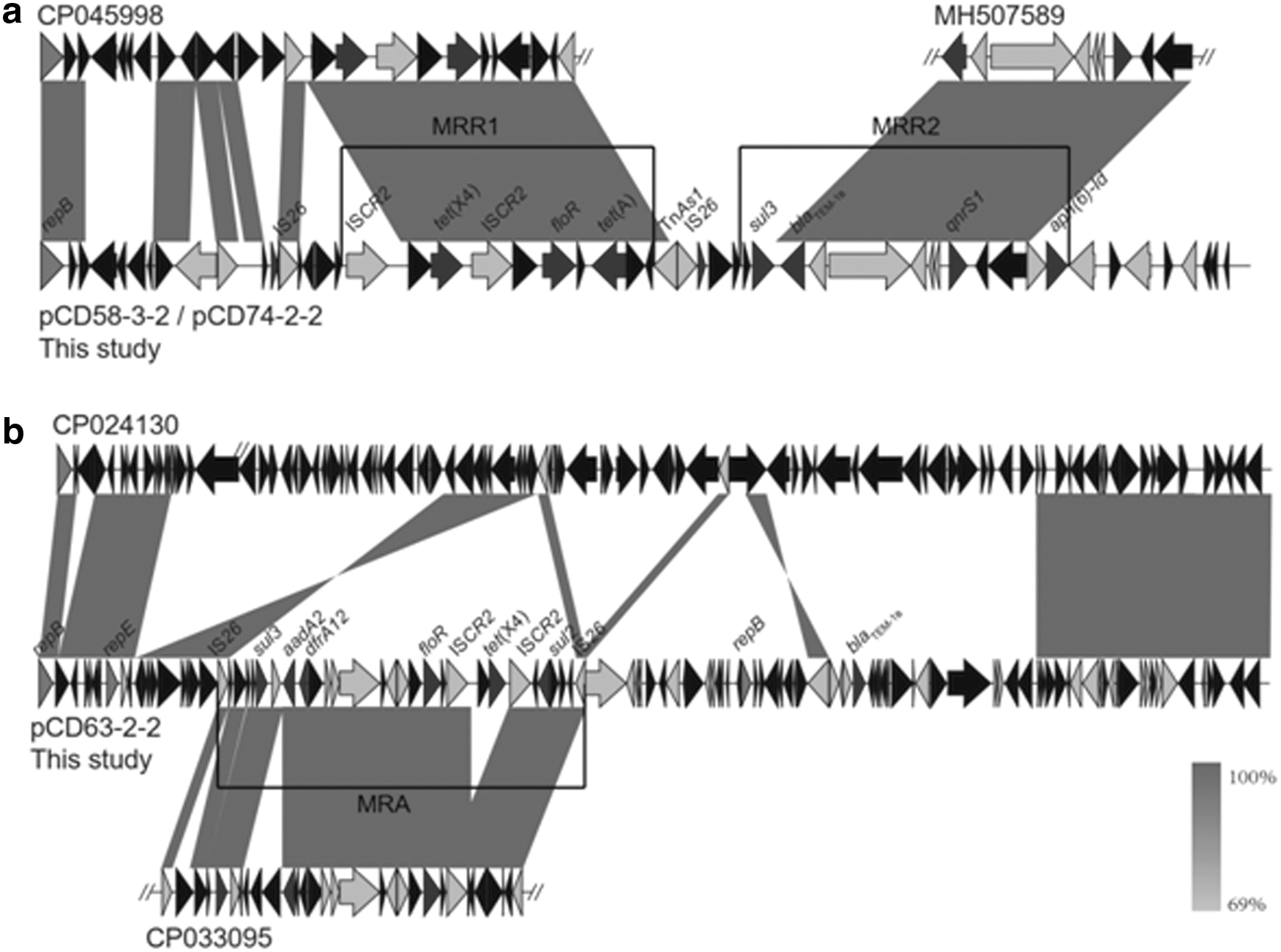
Genetic environment of tet(X4).
Plasmid pCD63-2-2 (Fig. 1) had a size of 89,748 bp, with a GC content of 51%, and it contained 121 open reading frames (ORF). Further analysis of pCD63-2-2 revealed that it was a hybrid plasmid composed of the IncFIA, IncFIB, and IncX1 replicons. A BLASTN search found that it had a similar plasmid backbone structure to that of plasmid p14EC001c provided in the NCBI database (CP024130), with 46% coverage and 99% similarity. Plasmid pCD63-2-2 contained a multidrug resistance area (MRA) (26.8 kb) flanked by two reverse copies of insertion sequence 26 (IS26). This MRA was almost identical to a region on plasmid pCP53-92k (CP033095) but lacked a 4608 bp fragment deletion. It is worth noting that the 4608 bp fragment with the aph-tet(X4)-ISCR2 gene arrangement was identical with the previously reported circular intermediate structure of tet(X4) (He et al., 2019). Therefore, we suspect that the circular intermediate of tet(X4) was first transferred into the aforementioned MRA, and then, plasmid pCD63-2-2 was finally formed through the recombination of genetic content from different plasmids.
In summary, our study reports the presence of tet(X4)-positive E. coli in retail chicken meat and the characterization of two novel tet(X4)-carrying plasmids. Previous reports and our study suggest that the cassette containing tet(X4), flanked by the ISCR2 sequence, is highly active and mobile, and can be present in various plasmids. It is reasonable to speculate that tet(X4) and its variants would be problematic resistance determinants in the future, given their transferability and capability of recombination and integration with other resistance genes in plasmids. Taken together, a systematic surveillance of tet(X4) in animals, environments, and humans should be urgently considered to control the dissemination of tigecycline resistance, and the use of tetracycline class antibiotics should be concerned. Further understanding of the tet(X4) plasmid-mediated resistance mechanisms could help us with the judicious application of tetracyclines and eliminate the threat imposed on public health.
Accession Number(s)
The genomic sequences of E. coli have been deposited in GenBank under the BioProject numbers PRJNA610125 (the data have not been released; see details in Supplementary Data).
Footnotes
Disclosure Statement
No competing financial interests exist.
Funding Information
This study was financially supported by the National Key Research and Development Program of China (2017YFC1601501).
Supplementary Material
Supplementary Data
Supplementary Table S1
References
Supplementary Material
Please find the following supplemental material available below.
For Open Access articles published under a Creative Commons License, all supplemental material carries the same license as the article it is associated with.
For non-Open Access articles published, all supplemental material carries a non-exclusive license, and permission requests for re-use of supplemental material or any part of supplemental material shall be sent directly to the copyright owner as specified in the copyright notice associated with the article.
