




Abstract
Consumption of raw food, especially smoked fish, meat, soft cheeses, and vegetables, contaminated with Listeria monocytogenes can cause listeriosis, which can be invasive in pregnant women, elderly, and immunocompromised and diabetic patients. Through June to November of 2017, 11 patients developed invasive listeriosis in a small area of northern Italy. In the same period, 15 food samples (ready-to-eat seafood, raw vegetables, cheese samples, and salami) collected during the routine screening programs in the same area were found to be contaminated with L. monocytogenes. We characterized the isolates to determine the relatedness of L. monocytogenes strains isolated from patients and isolates from food samples and food-processing plants. Whole genome sequencing analysis showed that multiple L. monocytogenes strains were circulating in the area and no association was found between clinical and food isolates.
Introduction
L
Food contamination by L. monocytogenes can result in food product recalls, severe illnesses, and outbreaks. A mild form of listeriosis can affect people who ingested contaminated food, causing febrile gastroenteritis. Pregnant women, the elderly, or immunocompromised people are at greater risk of developing invasive listeriosis, often resulting in serious complications, including bacteremia and meningitis (Drevets and Bronze, 2008; Madjunkov et al., 2017). The annual fatality rate of this illness ranged from 12.7% to 20.5% in the European Union and European Economic Area during the period 2008–2015. Therefore, the notification of cases is mandatory in most industrialized countries, including Italy (Ricci et al., 2018). Although the incidence of listeriosis reported in Europe is less than 1 per 100,000 people, confirmed cases of listeriosis have increased between 2008 and 2017. In 2017, 2480 confirmed cases of invasive listeriosis were registered in Europe (ECDC/EFSA, 2018).
Whole genome sequencing (WGS) and genomic analyses are essential tools for epidemiological surveillance, rapid outbreak detection, and control of infectious diseases, which has been proved recently during several multicountry outbreaks that occurred across Europe (Schjorring et al., 2017; EFSA and ECDC, 2018).
In 2016, the incidence of listeriosis in Italy was lower (0.19–0.22/100,000 inhabitants) than the average in Europe (0.33–0.44/100,000 inhabitants) (Amato, 2016). In Italy, most cases (n = 66) were reported in the Lombardy region (northern Italy), which included 6 clusters and 12 sporadic cases. From 2011 to 2016, our provincial reference center for listeriosis registered a mean of 3.8 cases/year (range 1–5 cases/year) in the Pavia province of the Lombardy region. This number even takes into account a foodborne outbreak (which occurred in 2015) associated with the consumption of organic goat cheese (Comandatore et al., 2017). In the same province, 11 cases of listeriosis were reported in 2017. The aim of this study is to characterize and determine the relatedness of L. monocytogenes strains isolated from patients in the province of Pavia in 2017 and those isolated from food samples and food-processing plants in the same period.
Materials and Methods
Samples
Between June and November 2017, 11 patients displaying symptoms suggestive of invasive listeriosis were hospitalized at Fondazione IRCCS Policlinico San Matteo, an 800-bed teaching hospital in Pavia (northern Italy). Ten isolates from 10 patients were analyzed. The isolate from patient 11 (PT_11) was not sequenced.
In the same area, the food hygiene service of Istituto Zooprofilattico della Lombardia e dell'Emilia Romagna analyzed 205 food samples and 136 surface swabs for L. monocytogenes during the routine screening programs required by the Regional Plan for Food Control and following reports of suspected listeriosis outbreaks. Samples collected in the period between 90 d before the onset of symptoms in the first patient (PT_1) and 3 weeks after the onset of symptoms in the patient who developed listeriosis later (PT_10) were considered in this retrospective analysis (Fig. 1).
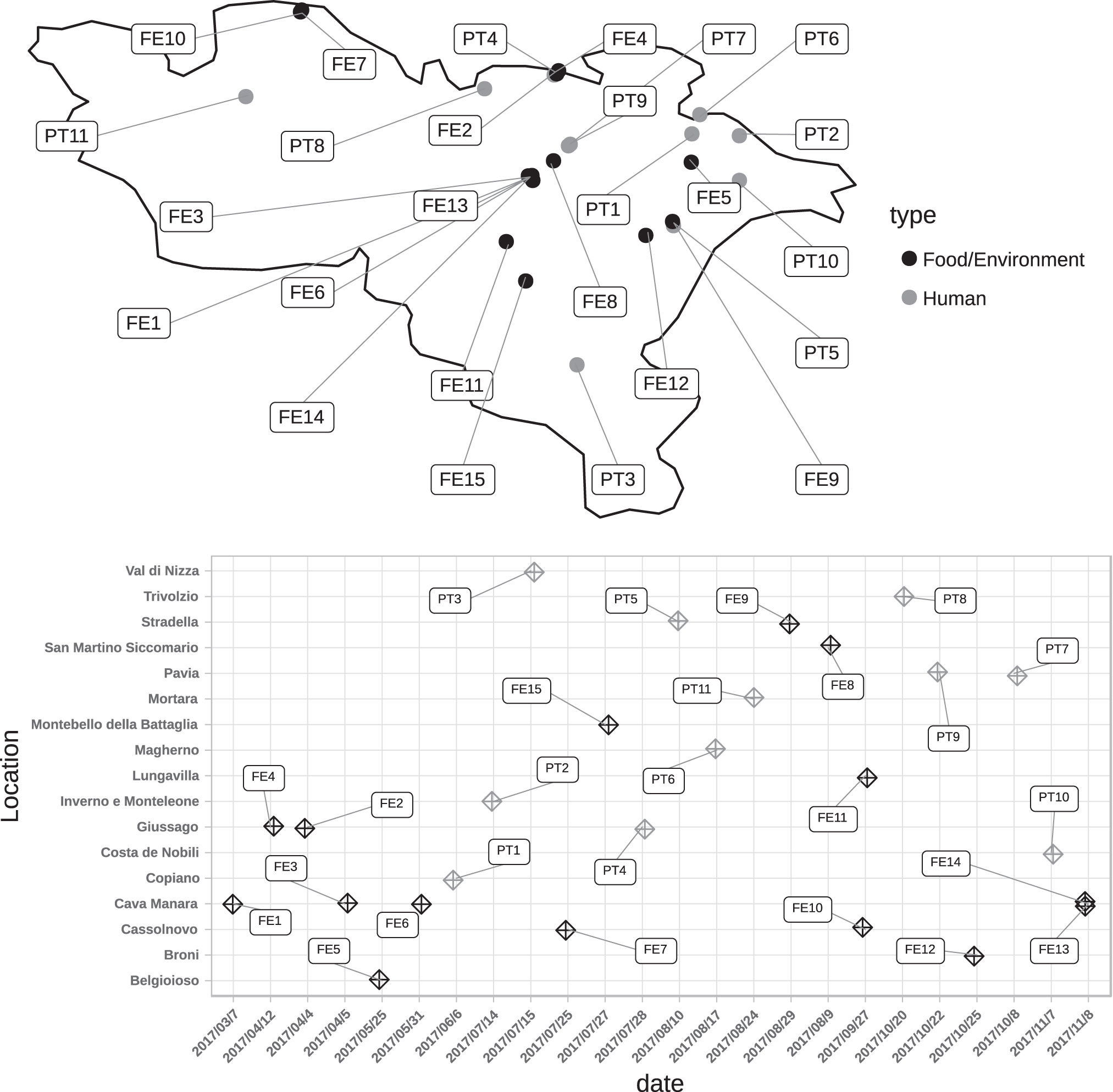
Geographical and temporal distribution of Listeria monocytogenes isolates in the province of Pavia. The upper part of the figure displayed the geographical location of each sample, while the bottom part showed the sampling timeline from March to November 2017.
Food samples included ready-to-eat food (n = 73), cheese (n = 45), water and preserving liquid used in cheese production (n = 17), milk (n = 15), salami (n = 13), bean sprouts (n = 12), fish (n = 8), ice cream and yogurt (n = 8), unprocessed meat (n = 7), and fruit, vegetables, and spices both raw and processed (n = 7). Surface swabs of 12 food production plants were also included.
Isolation from clinical isolates
Blood samples obtained from 10 adult patients were inoculated in BD BACTEC Plus aerobic/F culture vials. Blood culture from a newborn and cerebrospinal fluid (CSF) were inoculated in BD BACTEC Peds Plus/F culture vials. Both culture vials were purchased from Becton Dickinson (Heidelberg, Germany). All the culture vials were incubated at 37°C in the BACTEC FX automated blood culturing system (Becton Dickinson, Heidelberg, Germany) until bacterial growth was detected. Positive cultures were observed after Gram staining and subcultured onto sheep blood agar and chocolate agar (bioMerieux, Marcy-l'Etoile, France).
Detection and quantification from food isolates and surfaces
Real-time PCR was performed using the iQ-Check™ L. monocytogenes II PCR Detection Kit (Bio-Rad, Segrate, Italy) (AFNOR BRD 07/10–04/05 validation) in the enrichment of food samples in Fraser broth half concentration (bioMerieux) incubated for 18–24 h at 30°C. The isolation of the pathogen was performed for all positive samples according to standard EN ISO 11290-1:2017, which required a second enrichment in Fraser broth and plating onto ALOA medium and Oxford agar. All the media were purchased from bioMerieux. Quantification was performed as recommended by standard EN ISO 11290-2:2017.
For surface swabs, a 10-cm2 area was sampled, as suggested by standard ISO 18593:2004 (swabbing material: prehydrated cellulose 3M™ sponge-stick; 3M, Maplewood, MN, USA). Swabs were enriched in Fraser half concentration and processed according to standard EN ISO 11290-1:2017.
Detailed methods for L. monocytogenes isolation and quantification are shown in Supplementary Data.
Matrix-assisted laser desorption/ionization time-of-flight species identification
Species identification was performed by matrix-assisted laser desorption/ionization time-of-flight mass spectrometry, MicroflexTM LT (Bruker Daltonik GmbH, Bremen, Germany), using α-cyano-4-hydroxycinnamic acid (Bruker Daltonik GmbH) dissolved in 30:70 [v/v] acetonitrile:0.1% trifluoroacetic acid in water as the matrix. Spectra were compared with the Bruker Biotyper 3.1 database.
Antibiotic susceptibility testing
Susceptibility to ampicillin (2 μg), penicillin G (1 UI), erythromycin (15 μg), meropenem (10 μg), and trimethoprim sulfamethoxazole (1.25/23.75 μg) (Oxoid) was determined for the 26 strains following the European Committee on Antimicrobial Susceptibility Testing (EUCAST) standardized disk diffusion method for L. monocytogenes (EUCAST, 2017).
WGS and genome analysis
Twenty-five L. monocytogenes isolates, 10 human and 15 food related, were sequenced with the Illumina technology (Supplementary Data). The final human isolate was not sequenced because it was no longer viable. Reads were assembled using MIRA 3.0 using the manifest command, “job = genome,denovo,accurate and technology = solexa” (Chevreux et al., 1999; Chevreux, 2004).
The sequence types (STs) were determined in silico from each sample read using SRST2, with default parameters (Inouye et al., 2014).
Phylogenies
Phylogenetic analysis was executed for genomes belonging to STs found both in human and in food/environmental isolates, using the same pipeline described by Gona et al. (2020) (Supplementary Data).
The coreSNP alignments (see Supplementary Data) were used to infer phylogeny using RAxML (Stamatakis, 2014), with 100 bootstrap replicates, considering ascertainment bias with Lewis correction (Lewis, 2001), thus selecting the model ASC_GTRGAMMAX. Phylogenies were visualized using iTOL (Letunic and Bork, 2019).
The distribution of coreSNP distances among the strains was assessed through a distance matrix for each of the three alignments, using R with the APE package (R Development Core Team, 2008). To assess the presence of epidemiological correlation, the coreSNP cutoff threshold was set at 7 SNPs, a value previously identified as correct to ascertain outbreaks of L. monocytogenes (Haldebedel et al., 2018).
Genomic analyses: virulence factors and antibiotic resistance genes
Antibiotic resistance genes were searched in the 25 genomes. Searches were performed using ABRicate with default parameters (
The presence of genes encoding for resistance to disinfectants such as quaternary ammonium and benzalkonium chloride-associated cassettes was also investigated. Protein sequences of the disinfectants' resistance factors were retrieved manually from NCBI and searched in the novel genomes using tBLASTn, accepting only the exact matches.
Ethical statement
The study was designed and conducted in accordance with the Helsinki Declaration and approved by the Ethics Committee of Policlinico San Matteo in Pavia, Italy (internal project code: 08022298/13). The present study is a retrospective study performed on bacterial isolates from human samples that were obtained as part of routine hospital care.
Results
Eleven patients were hospitalized for listeriosis in Pavia province in 2017. This number is well above the average 3.8 cases/year previously recorded and suggested the possible occurrence of an outbreak. The median age of patients was 68 years (range 0–77), 6 of 11 were males, and all of them lived in the province of Pavia (Table 1). In 8 of 11 patients, L. monocytogenes was isolated exclusively from blood cultures, in one patient only from CSF, and in two patients from both materials. Five of 11 patients presented risk factors, including cancer and Hepatitis C virus-related liver disease (Table 1). One patient was a newborn who became infected in utero. Six patients developed sepsis, three developed meningitis, and one had both. Six patients died.
Characteristics of the 11 Patients
CSF, cerebrospinal fluid; NA, not available.
In parallel, 15 L. monocytogenes isolates were obtained from 10/205 (4.87%) food samples and 5/136 (3.70%) food-processing surfaces (mainly kitchen utensils and food preparation surfaces) swabbed in the same period. All the positive surface swabs were collected from the same Gorgonzola PDO cheese-producing plant (Table 2). Only two food samples, the unpasteurized onion FE_4 and the cold-smoked salmon FE_9, had an L. monocytogenes bacterial load above the limit of 100 (CFU, colony-forming units/g, indicated by ISO 11290-2 2017; FE_4 had 170 CFU/g and FE_9 had 110 CFU/g.
Characteristics of the 15 Food Samples
Genome assembly of the Illumina reads resulted in a good quality draft (average size = 3,010,944 bp, average number of contigs = 93, average N50 = 544,763 bp, and average coverage = 113.87). The ST found most frequently in this study was ST1 (20%, 5 isolates), followed by ST2, ST325, ST121, and ST155, each accounting for three isolates each (12%) (Table 3). Three STs were found both in patients and in food samples: ST1, ST2, and ST8. Figure 2 shows the phylogenies of the isolates belonging to these three STs, contextualized with similar genomes obtained from the PATRIC database. No monophyly was detected with phylogenies, thus there was no relatedness between human and food/environmental isolates.

Phylogenies of isolates belonging to ST1, ST2, and ST8 sampled from food/environment and patients in the province of Pavia. Similar genomes for each STs were retrieved from the PATRIC database. Similar genomes were selected based on Jaccard distance. Phylogenetic reconstructions were coreSNP based and performed using the RAxML software. ST, sequence type.
Sequence Types of 10 Listeria monocytogenes Isolates from Patients and 15 Isolates from Food-Related Samples
CSF, cerebrospinal fluid; PT, patient; FE, food-related sample.
Five isolates were obtained from a Gorgonzola cheese-processing plant during 2017, three belonging to ST325 (FE_1, FE_6, and FE_14) and two to ST193 (FE_3 and FE_13), while three STs, ST3, ST121, and ST155, were found exclusively in food samples. ST121 strains were isolated exclusively from fish products and displayed qacH (CUL63314.1) and smr (QED89903.1-QED89904.1) genes involved in the resistance to quaternary ammonium compounds, while the three ST325 isolates showed brcA (AFN94066.1) and brcC (AFN94068.1) for resistance to benzalkonium chloride.
All isolates characterized in this study share the presence of genes for important virulence factors, including the internalin genes, inlA (NP_463962) and inlC (NP_465311); the flagellar genes, flaA (NP_464217.1), flgB (NP_464237.1), flgC (NP_464238.1), flgD (NP_464223.1), fliE (NP_464239.1), and fliQ (NP_464204.1); the adherence and invasion genes, iap/chwA, lap (NP_465159), and lpeA (NP_465372); and the LIPI-1 (Listeria pathogenicity island 1) genes, actA (NP_463735), hly (NP_463733), mpl (NP_463734), plcA (NP_463732), plcB (NP_463736), and prfA (NP_463731), required for the intracellular cycle of the bacteria (Fig. 3) (Mauder et al., 2006; Radoshevic and Cossart, 2018).

Distribution of virulence genes: presence is indicated in gray and absence in white in each novel isolate genome. To highlight the virulence trend between the close strains of Listeria monocytogenes, the matrix was ordered and grouped by ST.
All isolates were susceptible to all the antibiotics tested, according to EUCAST standards (EUCAST, 2017). Resistance genes, fosX and fosX_2 (AL591981), encoding for resistance to fosfomycin were found in all the sequenced isolates from patients and from food and in three of five isolates from surface samples. The norB gene (HE999704.1), encoding for an efflux pump, which confers resistance to fluoroquinolones, was found in all isolates obtained from surface swabs, in 4 of 10 isolates from food samples, and in one clinical isolate (PT_7).
Discussion
The increase in incidence of listeriosis in Pavia province between June and November 2017 suggested the presence of one or more food products sold in that area, which were contaminated with L. monocytogenes. In silico Multilocus sequence typing performed on 25 isolates showed that most isolates (n = 5) belonged to ST1, detected in four patients and a mozzarella sample. ST2 and ST8 were also common. L. monocytogenes ST2 was isolated from two patients and an unpasteurized onion, sampled at a catering service that also supplied several canteens. ST8 was found in both a patient and in a raw red pepper sampled from the same catering service that was the source of an isolate of ST2. No monophyletic cluster, including isolates from patients and from food samples, was found in the isolates of ST1, ST2, and ST8 (Fig. 2). Two strains of ST1, isolated a month apart from PT_4 and PT_6 who lived in different towns roughly 30 km away from each other, were the closest in ST1, differing by 16 SNPs. These two strains' closest relatives were two strains isolated from wild boars in Italy in 2008, suggesting that these ST1 strains were circulating in Italy since the late 2000s.
In addition, for ST2 and ST8, no link was found between the infected patients and a food source. Two ST2 isolates from patients (PT_8 and PT_9) were the closest among the isolates of this study (Fig. 2), having 15 SNPs, while the two ST8 strains differed by 63 SNPs.
In other studies (Comandatore et al., 2017; Schjorring et al., 2017; Haldebedel et al., 2018; Cabal et al., 2019), genomic analyses, thanks to their high discriminatory power, established a link between human and food strains, while in this study, the use of these analyses alone did not provide the source of infections. Several factors led to this result: the scarce information on patients' food exposure, long period of incubation of L. monocytogenes in patients, long shelf life of foods that are often contaminated by L. monocytogenes, and lack of a prompt investigation.
As it happens in other countries, also in Italy, when patients are diagnosed with listeriosis, they receive a questionnaire aimed at collecting information about their food history before the onset of symptoms. The information provided by additional patients is then compared to find potential common food sources. In this study, none of the patients gave indications on their food history. In listeriosis, the long period of incubation of L. monocytogenes broadens the variety of food that can be the cause of the infection and requires investigating patients' food history up to 2 months before the onset of symptoms, complicating the epidemiological analysis. Moreover, L. monocytogenes often contaminates processed foods, sometimes with low bacterial load. The long shelf life of these products and packaging (e.g., modified atmosphere) allow L. monocytogenes to grow to levels above 100 CFU/g at the end of the shelf life (EFSA, 2013). Furthermore, most of these foods are often consumed without cooking, thus allowing the ingestion of high loads of viable bacteria. Finally, the lack of sampling of leftovers of the food consumed by the 11 infected patients contributed to this lack of success in elucidating a common source of infection.
In addition to these factors, the high median age of most patients and the presence of the newborn infected in utero underline the need to educate the part of population at greater risk of invasive listeriosis on adequate conservation of food, especially when temperatures increase.
Twenty-five strains circulated in the Pavia province between June and November 2017, 10 strains infected patients and 15 were found in food and food-related samples. Only two samples had a bacterial load above the acceptable limit and so only in the case of these two samples was a notification sent to the local authorities and the products were recalled.
This investigation suggested a high number of circulating L. monocytogenes strains, especially for a small area such as the Pavia province. The presence of these strains in food, if not monitored, could potentially cause outbreaks, also running over periods of several months. Routine and real-time surveillance of food is essential to contain the risk of listeriosis, and routine, real-time, and integrated laboratory surveillance of listeriosis cases is crucial to public health. Future studies and sampling plan should also consider increasing the number of samples.
This investigation also provided evidence of the necessity of the complementation of genomic analyses for a prompt and effective epidemiological investigation to identify the source of sporadic listeriosis cases and to intervene and prevent future cases.
Conclusions
Using retrospective MLST and SNP analyses of food and food-associated surface isolates, we were not able to identify a clear genomic match between a contaminated food source and infected patients. This study highlights the importance of reporting the presence of more pairs of isolates differing by few SNPs. These strains possibly survive and spread in food-processing factories and occasionally give rise to clinical cases. While food screening in this case has not been able to pinpoint the exact causative agent, we found some pairs of genomes that present only few SNPs of difference. We can hypothesize these to be close relatives that probably differentiated. Overall, the presented epidemiological picture shows the presence of multiple strains circulating in the area and warrants continuous and careful surveillance.
Footnotes
Acknowledgments
The authors thank Erika Scaltriti and Stefano Pongolini for DNA sequencing support. They thank Nathaniel Hampton Everett for the manuscript revision.
Authors' Contributions
Isolation of strains and microbiological analyses were performed by C.M., M.C., and G.A. Bioinformatic analyses were performed by G.B.B., S.G., M.C., and D.S. Supervision was performed by M.C., B.M., D.S., P.M., and P.C. Writing of the original draft was performed by C.M., G.B.B., S.G., and G.A. Writing, revision, and editing were performed by M.C., D.S., P.M., and P.C. All authors have read and agreed to the published version of the article.
Disclosure Statement
No competing financial interests exist.
Funding Information
No funding was received for this article.
Supplementary Material
Supplementary Data
References
Supplementary Material
Please find the following supplemental material available below.
For Open Access articles published under a Creative Commons License, all supplemental material carries the same license as the article it is associated with.
For non-Open Access articles published, all supplemental material carries a non-exclusive license, and permission requests for re-use of supplemental material or any part of supplemental material shall be sent directly to the copyright owner as specified in the copyright notice associated with the article.
