




Abstract
In this study, we investigated the prevalence, serovar distribution, and antimicrobial resistance pattern of Salmonella isolates from vegetable, fruit, and water samples in Ho Chi Minh City, Vietnam. Salmonella was detected in 75% (30/40), 57.1% (12/21), 17.5% (28/160), and 2.5% (1/40) of river water, irrigation water, vegetable, and ice water samples, respectively. However, no Salmonella was isolated from 160 fruit and 40 tap water samples examined. A total of 102 isolates obtained from 71 samples belonged to 34 different serovars, of which Salmonella Rissen was the most prevalent, followed by Salmonella London, Salmonella Hvittingfoss, and Salmonella Weltevreden. Certain Salmonella serovars such as Newport, Rissen, and Weltevreden were isolated from both vegetable and water samples. Antimicrobial resistance was most commonly observed against tetracycline (35.3%), followed by chloramphenicol (34.3%), ampicillin (31.4%), trimethoprim/sulfamethoxazole (23.5%), and nalidixic acid (10.8%). Of 102 isolates analyzed, 52 (51%) showed resistance to at least 1 antimicrobial class whereas 27 (26.5%) showed multidrug resistant (MDR) phenotype, being resistant to at least three different classes of antimicrobials. Determination of the presence and type of β-lactamase genes showed the cooccurrence of bla TEM-1 and bla CMY-2 in one Salmonella Agona isolate from a river water sample. Taken together, these data indicated that both environmental water and vegetables were contaminated with Salmonella, including MDR strains, and that environmental water used in irrigation might have been the source of Salmonella contamination in the vegetables.
Introduction
Antimicrobial resistance of pathogenic bacteria is a major problem that hinders the treatment and control of bacterial infections (CDC, 2019). It is predicted that if the current trend of increasing antimicrobial resistance continues, 10 million lives a year, and 100 trillion USD equivalent of world GDP might be at risk by 2050 (O’ Neill, 2014). Of particular importance in this regard is treatment failure of Salmonella infections, often due to the emergence of resistance to multiple antimicrobials. Salmonella is an important cause of foodborne diseases in the world. According to the Centers for Disease Control and Prevention in the United States, about 53.4% of all foodborne disease outbreaks from 2006 to 2017 were caused by Salmonella (Liu et al., 2018), which is also the fourth cause of childhood diarrhea in southern Vietnam (Nguyen et al., 2016). Occurrence of salmonellosis is linked to the consumption of undercooked and contaminated meat, vegetable, fruit, and water, or to contact with animals (Sánchez-Vargas et al., 2011). Although Vietnam has not yet completed its nationwide surveillance program for monitoring foodborne diseases, notably one Salmonella outbreak linked to stuffed bread in a bread takeaway shop was reported in Ben Tre City, Vietnam (Vo et al., 2014).
Antimicrobial resistance is widespread among Salmonella, and multidrug resistant (MDR) Salmonella demonstrating resistance to three or more antimicrobial classes have been reported worldwide. Besides, the occurrence of Salmonella exhibiting conventional antimicrobial resistance, extended-spectrum β-lactamase (ESBL), and AmpC-β-lactamase (AmpC)-producing Salmonella have also been reported in human and poultry in the United States, Canada, and Colombia (Castellanos et al., 2019) as well as in children with diarrhea in Peru (Granda et al., 2019) and in poultry and fish in Vietnam (Nguyen et al., 2016). These β-lactamases are able to inactivate most β-lactam antibiotics, including third-generation cephalosporins and monobactams, which are widely used to treat bacterial infections, particularly the complicated or invasive Salmonella infection in humans (Sánchez-Vargas et al., 2011). Resistance to β-lactams limits the choice of antimicrobials for treatment of salmonellosis, especially if the strain is resistant to multiple antimicrobial classes.
Foodborne disease outbreaks linked to fresh products (fruits and vegetables) occur due to various factors, including contamination by sewage, soil, and irrigation water polluted with fecal material. Salmonella has been detected in surface waters in Canada, the United States, and Mexico. The pathogen has also been detected in drinking waters in India and Nigeria (Levantesi et al., 2012) as well as in irrigation water in Australia and the United States (Liu et al., 2018). Importantly, water has always played a key role as a vehicle for the transmission of these pathogens by the fecal-oral route (Liu et al., 2018). The global trend of consuming a healthy diet, which includes raw fruits and vegetables as a source of vitamins, minerals, bioactive compounds, and fiber, may be hampered due to the risk of foodborne illness such as salmonellosis (Liu et al., 2018).
In Vietnam, the information about foodborne disease outbreaks associated with vegetables, fruits, and waters have not been adequately documented yet, although a few studies reported on the prevalence of bacterial and parasitic contamination of vegetables. These studies found frequent contamination with aerobic bacteria and Escherichia coli whereas Salmonella, which was rarely tested, was detected in 17.6% samples (Chau et al., 2014). According to Ha et al. (2008), E. coli was detected in 80% and 76% of irrigation water linked to vegetable and vegetable wash water, respectively. Further, it has been reported that the contaminant bacteria exceeded the permissible limits in river and canal waters in Ho Chi Minh City (HCMC) (Ha et al., 2008; Vnexpress news, 2019). Although HCMC, the commercial center of Vietnam, is crowded with a population of nearly 8.4 million people, studies regarding analysis on Salmonella contamination of vegetables, fruits, as well as waters from different sources have not been conducted adequately. Therefore, in this study, we investigated the prevalence and serovar of Salmonella in various food and water sources in HCMC, and to gain further insights, analyzed their antimicrobial resistance patterns.
Materials and Methods
Sample collection
A total of 160 vegetable and 160 fruit samples were collected from three supermarkets and a traditional wet market in HCMC during the period of June to July 2016. Two rounds of sampling were performed in every supermarket or traditional wet market. Most of the vegetables and fruits included in the sampling are usually sold intact without cutting, except for banana flower, splitting water morning glory, chopped lemon grass (bulb was cut off), durian, jackfruit, and watermelon. The details of vegetable and fruit samples analyzed in this study are presented in Table 1 and Supplementary Table S1.
Prevalence and Serovar of Salmonella in Vegetable, Fruit, and Water Samples in Vietnam
Salmonella was not detected in fruit (160), bud and stem vegetable (9), and tap water (40).
160 vegetable and b141 water samples include 9 bud and stem vegetable and 40 tap water, respectively.
In addition, 141 diverse water samples were collected from all districts in HCMC in September 2016. The sites of collection of river water samples are shown in Figure 1 and Supplementary Table S2. Sampling sites are located in the semi-urban locality, which is less populated, and with major agriculture activities. Irrigation water samples were collected from different canals, which are linked to the large river (upstream of various tributaries from which river water samples were collected). Samples were collected during June to July and September, which are periods of rainy season in Vietnam. Climatic conditions during this period include an average day temperature of 32–34°C, heavy rainfall (294 mm/month), and high humidity (80%). Each sample (≥100 g of vegetable or fruit sample and ≥200 mL water sample) was placed into a sterile plastic bag, kept in an icebox, and transported to the Microbiology Laboratory at the Institute of Public Health, HCMC, Vietnam. All samples were analyzed within 24 h of their collections.
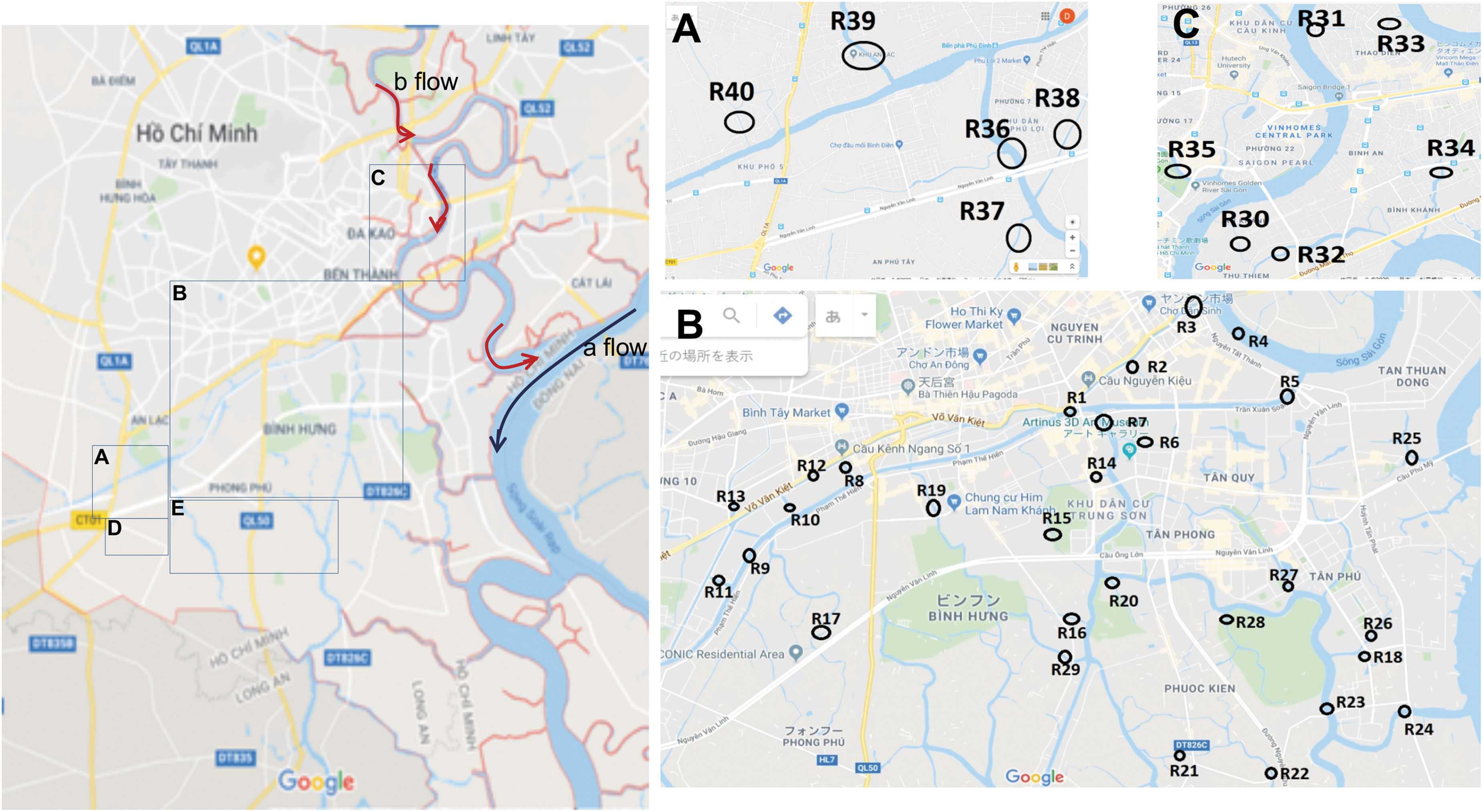
The locations of river and irrigation water samples collected in this study.
Salmonella isolation and serotyping
Fruits with skin were individually washed and surface-sterilized with 70% ethanol before peeling and cutting. Fruits, which are consumed without peeling, as well as vegetables were washed in sterile distilled water.
For isolation of Salmonella, 25 g of each vegetable or fruit sample was homogenized in 225 mL of buffered peptone water (BPW; Merck KGaA, Darmstadt, Germany), and the homogenate was incubated at 37°C for 18–20 h. For water samples, 100 mL of each sample was filtered by using sterile membrane filter (0.45 μm pore sized Whatman filter; GE Healthcare Life Sciences, USA) and the membrane was immersed in 50 mL of BPW in a sterile plastic bag, and incubated at 37°C for 18 h. After incubation, 100 μL of the enriched culture was used to inoculate 10 mL of Rappaport-Vassiliadis broth (Merck KGaA) and cultured at 42°C for 24 h. A loopful of each culture was streaked onto xylose lysine desoxycholate agar (Merck KGaA) and Chromagar Salmonella (CHROMagar Microbiology, Paris, France), and the plates were further incubated at 37°C for 24 h. A maximum of three suspected Salmonella colonies from each sample were streaked onto trypticase soy agar (Merck KGaA), and they were incubated at 37°C for 18 h. Selected colonies were picked and examined for their biochemical properties by using triple-sugar iron agar (Merck KGaA) and lysine indole motility medium (Nissui Pharmaceutical Co., Ltd., Tokyo, Japan). The isolates showing typical nontyphoidal Salmonella characteristics were confirmed as Salmonella enterica and their serovars were determined by using Salmonella O and H antisera (Denka Seiken Ltd., Tokyo, Japan; SSI Diagnostica, Hillerød, Denmark) according to the Kauffmann and White scheme (Grimont and Weill, 2007).
Pulsed-field gel electrophoresis
Pulsed-field gel electrophoresis was performed according to the Pulse Net USA protocol with some modifications. In brief, Salmonella isolates were inoculated onto trypticase soy agar (Becton Dickinson and Company) supplemented with 5% de-fibrinated sheep blood (Nippon Bio-Supp, Center, Tokyo, Japan) and the plates were incubated at 37°C for 14–18 h. Salmonella colonies were resuspended in 2 mL of cell suspension buffer (CSB; 100 mM Tris-HCl buffer [pH 8.0], 100 mM ethylenediaminetetraacetic acid [EDTA]). Absorbance at 600 nm of the suspension was adjusted to 1.4 with CSB. An aliquot of the cell suspension (400 μL) was transferred to a 2.0 mL tube and 20 μL of proteinase K (20 mg/mL; P-8044, Sigma-Aldrich) was added. Four hundred micro-liter of melted 1% seakem gold agarose (Lonza Rockland, ME, USA) was added, mixed by pipetting, dispensed into disposable plug molds (Bio-Rad Laboratories), and allowed to solidify at room temperature for 20 min. The plugs were transferred to fresh tubes containing 5 mL of cell lysis buffer (1 M Tris-HCl buffer [pH 8.0], 0.5 M EDTA, 1% sarcosyl [N-lauroylsarcosine sodium salt]) supplemented with 75 μL of proteinase K (20 mg/mL) and incubated at 55°C for 2 h in a shaking incubator. The plugs were washed three times with 10 mL of preheated (50°C) sterile distilled water at 50°C for 15 min followed by four times with preheated (50°C) sterile Tris-EDTA [TE] buffer (10 mM Tris-HCl [pH 8.0], 1 mM EDTA) at 50°C for 15 min. Then, the plugs were stored in fresh TE buffer at 4°C until they were subjected to restriction digestion.
Genomic DNA in the plugs was digested with 30 U of XbaI (TaKaRa Bio, Inc., Shiga, Japan) at 37°C for 2 h. The plug was placed into the well of 1.0% pulsed-field certified agarose (Bio-Rad Laboratories, Inc.) and electrophoresed. XbaI-digested Salmonella Braenderup H9812 was used as a molecular size marker. PFGE was conducted in a CHEF Mapper (Bio-Rad Laboratories, Inc.) containing fresh 0.5 × TBE buffer (45 mM Tris, 45 mM boric acid, 1 mM EDTA) at 6 V/cm2, with a switch time of 2.2–63.8 s at 14°C for 20 h. The gel was then stained with ethidium bromide, and the image of DNA fingerprints was captured as described earlier.
Antimicrobial susceptibility test
All Salmonella isolates were examined for antimicrobial susceptibility by the disc diffusion method using Mueller-Hinton agar (Oxoid, Limited, Basingstoke, United Kingdom) according to the protocol of the Clinical and Laboratory Standards Institute (CLSI, 2018). Twelve different antimicrobial disks (Becton, Dickinson and Company, MD, USA) were used as follows: 10 μg ampicillin (AMP), 30 μg tetracycline (TET), 30 μg kanamycin (KAN), 30 μg chloramphenicol (CHL), 10 μg gentamicin (GEN), 23.75 μg trimethoprim and 1.25 μg sulfamethoxazole (SXT), 5 μg ciprofloxacin (CIP), 30 μg nalidixic acid (NAL), 200 μg fosfomycin (FOF), 30 μg cefoxitin (FOX), 30 μg cefotaxime (CTX), and 30 μg ceftazidime (CAZ). The results were interpreted as susceptible, intermediate, or resistant based on the zone size of growth inhibition according to the CLSI guideline (CLSI, 2018). E. coli ATCC 25922 was used as a quality control organism in this assay. MDR was defined as the isolate being resistant to three or more different antimicrobial classes.
ESBL phenotype of CAZ or CTX-resistant Salmonella isolates was examined by the double-disk synergy test using antimicrobial agents containing 30 μg CTX, 30 μg CTX plus 10 μg clavulanic acid or 30 μg CAZ, and 30 μg CAZ plus 10 μg clavulanic acid. Salmonella isolates showing resistance to FOX were considered as a possible AmpC-producing Salmonella (Mataseje et al., 2009).
Detection of β-lactamase genes by PCR
Salmonella isolate producing ESBL was examined for the genes responsible for ESBL and AmpC by a multiplex PCR for detection of bla CTX-M, bla TEM, and bla SHV and family-specific plasmid-mediated ampC genes, respectively (Nguyen et al., 2016). Briefly, a colony of an isolate, which expressed a phenotype consistent with an ESBL-producing organism, was suspended in 100 μL of TE buffer. The suspension was boiled for 10 min and centrifuged at 15,000 g at 4°C for 3 min, and the resulting supernatant was used as a source of template DNA. The multiplex PCR was performed by using QIAGEN Multiplex PCR Plus kits (Qiagen, Hilden, Germany) according to the manufacturer's guidelines. Thermocycle parameters consisted of a denaturation step at 95°C for 5 min, followed by 25 cycles at 95°C for 30 s, 60°C for 90 s, and 72°C for 90 s, and a final extension step at 68°C for 10 min. The amplified products were analyzed by electrophoresis on 2% agarose gel.
Sequencing of PCR-amplified β-lactamase genes
PCR amplicons of bla CTX-M and bla CMY group gene were sequenced to confirm their identities. PCR products were purified with Dynabeads® Sequencing Clean-Up (Thermo Fisher Scientific, Inc., Waltham, MA, USA). Sequencing reaction was performed by using BigDye Terminator v3.1 Cycle Sequencing Kit (Thermo Fisher Scientific, Inc.) and PCR primers as previously described (Nguyen et al., 2016). Sequence analysis was performed on an Applied Biosystems 3130XL Genetic Analyzer (Thermo Fisher Scientific, Inc.). The obtained nucleotide sequences were compared with previously described sequences from the GenBank database by using the BLAST program (Altschul et al., 1997).
Statistical analysis
The prevalence of resistant isolates from each food type was analyzed by using Fisher's exact test. For all comparisons, the significance level was set at p < 0.05.
Results
Occurrence of Salmonella in fruit, vegetable, and water
Out of 461 samples of fruit, vegetable, and water analyzed, 71 (15.4%) were contaminated with Salmonella. Details of the prevalence and serovar of Salmonella isolates in various samples are presented in Table 1. River water samples were mostly contaminated, and Salmonella was isolated from 75% of all river waters tested. Samples of irrigation water were also contaminated with Salmonella at high frequency (57.1%), and contamination of various vegetables ranged from 6.7% to as high as 25% (Table 1).
A total of 102 Salmonella isolated from various sources belonged to 34 different serovars, as shown in Table 1. The highest serovar diversity (24 serovars) was found in isolates from river water samples, followed by leaf vegetable (13 serovars), irrigation water (12 serovars), and fruit vegetable (4 serovars) samples. The most prevalent Salmonella serovar from vegetables was Salmonella Rissen (25%; 8/35), followed by Salmonella Newport (17.1%, 6/35) and Salmonella London (14.3%, 5/35). In water samples, Salmonella Hvittingfoss (10.4%; 7/67), Salmonella Weltevreden (9.0%; 6/67), and Salmonella Brunei (7.5%; 5/67) were the predominant serovars.
Clonal relationship of Salmonella isolates by PFGE
PFGE analysis was carried out for the Salmonella isolates of same serovars in different sources. A total of 15 Salmonella serovars were examined for clonal relationship, which were isolated from more than one source (Supplementary Table S3). Out of the 15 Salmonella serovars tested, 8 serovars showed circulating clones among different sources (Fig. 2). This includes Salmonella Rissen, Salmonella Newport, Salmonella Apeyeme, Salmonella London, Salmonella Thompson, Salmonella Albany, Salmonella Agona, and Salmonella Meleagridis. For example, Salmonella Rissen clonal isolates were found in fruit vegetable and river water. Similarly, Salmonella Thompson clones were isolated from leaf vegetable, river water, and irrigation water (Fig. 2).
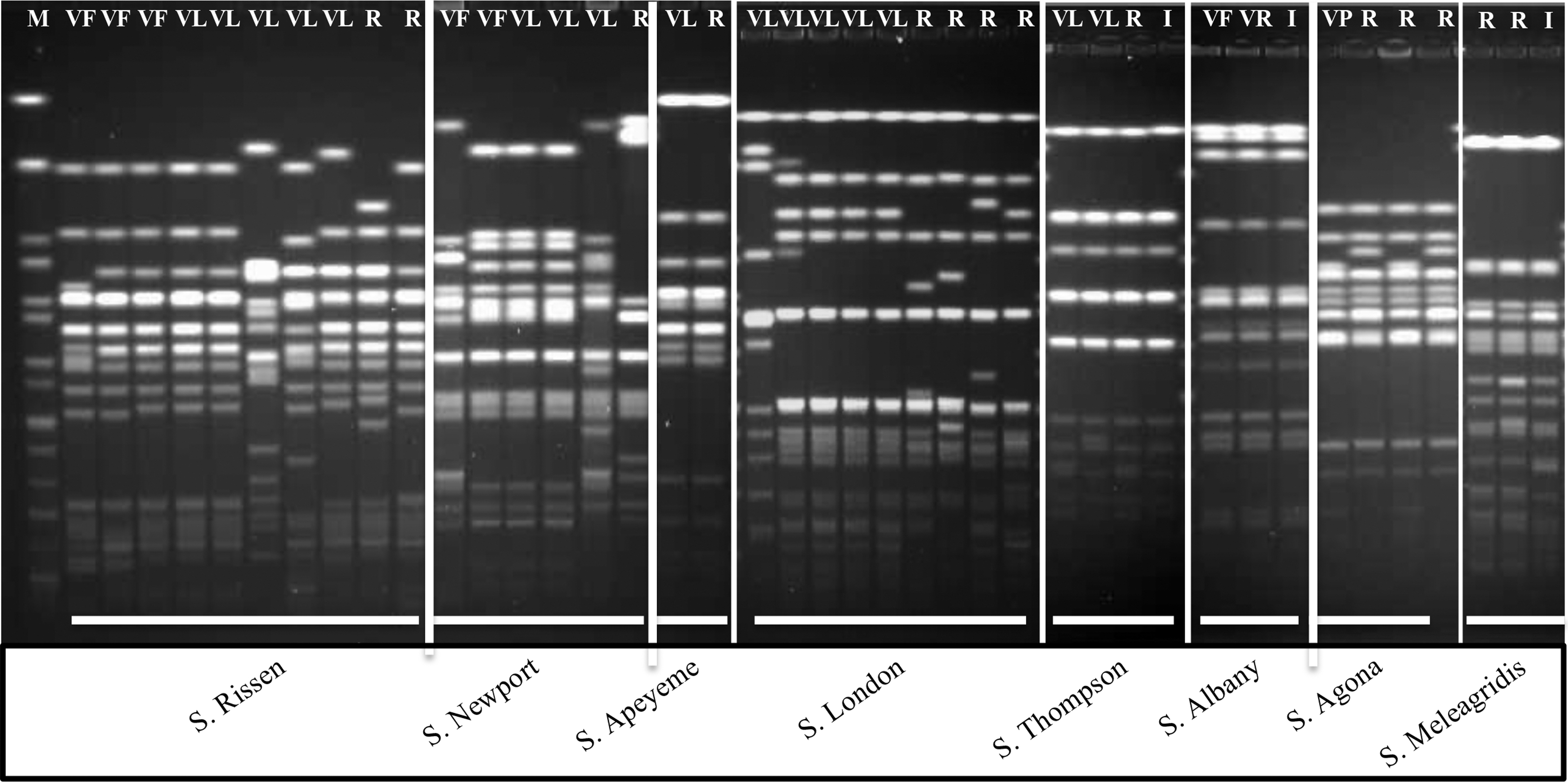
PFGE profiles of common Salmonella serovars from different sources. Only serovars showing clonal relationship are shown. Salmonella genomic DNA was digested with XbaI. M. Xba I digested Salmonella Braenderup strain H9812 was used as a marker. VF, fruit vegetable; VL, leaf vegetable; VR, root vegetable; VP, popped vegetables; R, river water; I, irrigation water.
Antimicrobial resistance of Salmonella isolates
Antimicrobial resistance of the 102 isolates against 12 different antimicrobials is presented in Table 2. The highest rate of antimicrobial resistance was observed against TET (35.3%), followed by CHL (34.3%), AMP (31.4%), SXT (23.5%), and NAL (10.8%). KAN, GEN, CIP, FOF, FOX, CTX, or CAZ-resistant isolate was detected at below 5%. Notably, one Salmonella Agona strain S751 isolated from river water was resistant to CTX, CAZ, and FOX, and five Salmonella isolates, belonging to Agona, Bareilly, Brunei, Corvallis, and Kentucky serovars, obtained from river water samples were FOX-resistant in addition to other antimicrobials (Table 3).
Antimicrobial Resistance of Salmonella Isolates from Vegetable and Water Samples
AMP, ampicillin; TET, tetracycline; KAN, kanamycin; CHL, chloramphenicol; GEN, gentamicin; CIP, ciprofloxacin; NAL, nalidixic acid; FOF, fosfomycin; FOX, cefoxitin; CTX, cefotaxime; CAZ, ceftazidime; SXT, trimethoprim/sulfamethoxazole. None of the Salmonella isolates were resistant to FOF.
p-Value = 0.1398, Fisher's exact test.
Resistance Pattern and Serovar of Salmonella Isolates from Vegetable and Water Samples
AMP, ampicillin; TET, tetracycline; KAN, kanamycin; CHL, chloramphenicol; GEN, gentamicin; CIP, ciprofloxacin; NAL, nalidixic acid; FOF, fosfomycin; FOX, cefoxitin; CTX, cefotaxime; CAZ, ceftazidime; SXT, trimethoprim/sulfamethoxazole
ampC-harboring Salmonella.
NA, not applicable.
Further, breakdown of antimicrobial resistance patterns based on Salmonella serovars and origins is shown in Table 3. Of the 102 isolates, 50 (49%) were susceptible whereas 52 (51%) showed resistance to at least one class of antimicrobial. Among 52 resistant isolates, 27 (26.5%) showed the MDR phenotype being resistant to at least three different classes of antimicrobials. Importantly, three Salmonella Albany, one Salmonella Give, and one Salmonella Kentucky were resistant to five or more antimicrobials, including NAL or CIP. The most common MDR phenotype was AMP, TET, CHL, and SXT (13 isolates, 12.7%), followed by AMP, TET, CHL, NAL, and SXT (4 isolates, 3.9%).
ESBL and AmpC phenotype and genotype
Production of β-lactamase and presence of genes for ESBL and AmpC in one CTX-CAZ-FOX-resistant isolate, and four other FOX-resistant isolates were examined by the double-disk diffusion method and PCR, respectively. bla TEM-1 and bla CMY-2 genes were detected by PCR and confirmed by sequencing in Salmonella Agona strain S751, which was resistant to CTX-CAZ-FOX.
Discussion
Salmonellosis outbreaks due to nontyphoidal Salmonella stand out as a major foodborne or waterborne disease worldwide and are associated with various items such as meat products, seafoods, vegetables, fruits, and waters. We have previously reported the prevalence of ESBL- and AmpC-producing Salmonella isolates obtained from meat and seafood samples in Vietnam (Nguyen et al., 2016). In Vietnam, some vegetables are partially cooked at 35–40°C for a short time, or consumed raw. In this study, therefore, we surveyed the prevalence of Salmonella contamination in fruits and vegetables from supermarkets and a traditional market as well as water samples in HCMC, Vietnam. Salmonella was isolated from 75% of river water samples analyzed. Although this level of contamination was similar to that reported in the United States (79.2% [57/72]; Haley et al., 2009), it was significantly higher than that reported in a previous domestic study (42.9% [3/7]; Phan et al., 2003). The percentage of Salmonella in irrigation water samples was 57.1%, which is significantly higher than that reported in the United States (29.4% [50/170]; Liu et al., 2018). However, the variation in apparent contamination level could be due to various factors such as sample volume and method used in different studies, the proximity of livestock and agricultural activities, settlements, or municipal wastes to the river as well as weather conditions (Haley et al., 2009; McEgan et al., 2014). According to the Ministry of Natural Resources and Environment, the HCMC municipal government treats just 21.2% of its total daily wastewater discharge (Vnexpress news, 2019). Large amounts of untreated wastewater from industries as well as from small slaughterhouses are directly discharged into rivers in HCMC (Nguyen et al., 2017). Thus, river and canal waters could be reservoirs for pathogenic bacteria, including Salmonella in HCMC, Vietnam. It is noteworthy to emphasize that no Salmonella was isolated from tap water in HCMC.
The contamination rate of Salmonella in vegetables was 17.5%, which is similar to that of the previous studies in Vietnam (17.6% [19/108]; Chau et al., 2014). The presence of Salmonella in vegetables could be due to the extent of polluted irrigation water or soil, washing of vegetables in canals, as well as contamination during transportation and storage (Ha et al., 2008; Liu et al., 2018). Further, water is sprayed to vegetables at markets to maintain their freshness. In Vietnam, the source of water for irrigation or washing of vegetables are rivers and canals, which are seriously polluted (Ha et al., 2008; Vnexpress news, 2019). Indeed, 13 out of 16 Salmonella serovars from vegetables were also isolated from river and irrigation waters. Moreover, the results of the PFGE analysis demonstrated the presence of clonal isolates in vegetables, river water, and/or irrigation water (Fig. 2). The results of PFGE analysis suggest that water might be the source of Salmonella contamination in vegetables.
In this study, predominant Salmonella serovars detected in the vegetables were Salmonella Rissen, Salmonella Newport, and Salmonella London. It should be noted that Salmonella Newport was ranked as the third most frequent causative agent in humans globally in 2002 (Galanis et al., 2006). Notably, Salmonella Newport was associated with salmonellosis outbreak in the United States due to the consumption of contaminated tomatoes (Greene et al., 2005). Salmonella Rissen has also marked epidemiological significance since it was also reported as a predominant Salmonella serovar in pork and chicken in Thailand (23% [7/31]; Lertworapreecha et al., 2016) and in pork and beef in HCMC, Vietnam (11.3% [38/336]; Nguyen et al., 2016), and it has been reported to be the most common non-human serovar in Asia (Galanis et al., 2006).
A noteworthy finding of this study is that there was marked similarity in Salmonella serovars isolated from vegetable and river or irrigation water samples. Also, 34 Salmonella serovars isolated from vegetable and water samples were similar to those of our previous study, which surveyed Salmonella contamination in pork, beef, and chicken in HCMC, Vietnam (Nguyen et al., 2016). Similar to the study by Nguyen et al. (2016), possible contamination of vegetables with pathogenic bacteria from irrigation water has also been previously demonstrated (Liu et al., 2018). Moreover, the “VAC” (Vegetable, Aquaculture, Cage of animal) and “IAA” (Integrated Agriculture-Aquaculture) models are popularly incorporated in Vietnam. Animal manure is directly discharged into the aquaculture and subsequently water from the aquaculture is reused for vegetables and cages of animals. Therefore, these models might have contributed toward spreading the pathogenic bacteria among vegetables, aquacultures, animals, and humans. These data suggest that Salmonella excreted from food animals and humans might contaminate environmental waters and, subsequently, vegetables through contaminated environmental waters.
Besides the presence of Salmonella in the vegetable and water samples, antimicrobial resistant Salmonella is a serious public health concern as it may cause potential treatment failure. The frequency of antimicrobial-resistant Salmonella in vegetable and water samples was high (51.0%) (Table 2). The rate of MDR Salmonella was also as high as 26.5%.
Resistance to TET, CHL, AMP, and SXT was the most commonly observed in Salmonella isolated in the present study (Table 2). These antimicrobials are widely used in the aquaculture system (Pham et al., 2015) and agricultural field (Braun et al., 2019), as well as for the treatment of diarrhea in human due to their low cost and easy availability in the retail pharmacy in Vietnam (Nguyen et al., 2005). Although CHL is prohibited for use in animal husbandry in Vietnam, thiamphenicol and florfenicol, which are CHL derivatives, are still allowed to use in livestock and aquaculture (MARD, 2010). Nowadays, CIP is the second line of therapeutic agent for human salmonellosis (Nguyen et al., 2016). However, in this study, Salmonella isolates resistant to CIP and NAL were found in river water samples (Table 3). In another study, enrofloxacin whose major metabolite is CIP was detected in aquaculture in Vietnam (Pham et al., 2015) although the Ministry of Agriculture and Rural Development of Vietnam has prohibited its use in aquaculture since 2012 (VMARD, 2012). Nguyen et al. (2016) also reported that CIP-resistant Salmonella was isolated from the poultry, fish, and shrimp in HCMC. Hoa et al. (2011) reported that the “VAC” model might have contributed to the spread and increase in the AMR bacteria among humans, animals, foods, and waters by the transfer of MDR bacteria themselves and the horizontal transfer of resistant genes. Nevertheless, it is recommended for the Vietnamese government to strictly control the antimicrobial usage in humans, as well as livestock, aquaculture, and agriculture to restrict the spread of antimicrobial-resistant bacteria.
Antimicrobial-resistant Salmonella isolates from vegetable and water samples showed decreased susceptibility to FOX, CTX, and CAZ. Through PCR and DNA sequencing the β-lactamase genes were detected and identified. bla TEM-1 and bla CMY-2 co-occurred in one Salmonella Agona strain S751 from a river water sample. Further studies regarding the molecular mechanisms involved in possible horizontal transfer of bla TEM-1 and bla CMY-2 genes among Salmonella Agona strain S751 and other bacteria are under way in our laboratory.
In conclusion, this study provides important information regarding the distribution and epidemiology of Salmonella, their serovar and antimicrobial resistance in the environment, including fresh food and water samples in Vietnam. A Salmonella Agona strain harboring CMY-2-plasmid, which is transferable, was isolated from river water in Vietnam for the first time. Fresh foods and environmental waters were contaminated with Salmonella, some of which were resistant to antimicrobials. Further studies are necessary to understand the route of infection as well as to plan for preventive measures, in view of serious public health threats from the emergence and spread of MDR Salmonella in Southeast Asia, including Vietnam. Setting SMART goals would be one of the approaches to be considered.
Footnotes
Acknowledgments
This study was performed in partial fulfillment of the requirements of a PhD thesis for D.T.A.N. from the Graduate School of Life and Environmental Sciences, Osaka Prefecture University, Osaka, Japan.
Disclosure Statement
No competing financial interests exist.
Funding Information
This study was supported by Japan Society for the Promotion of Science RONPAKU (Dissertation Ph.D.) program (R11713) and the basic research grant from Osaka Prefecture University.
Supplementary Material
Supplementary Table S1
Supplementary Table S2
Supplementary Table S3
References
Supplementary Material
Please find the following supplemental material available below.
For Open Access articles published under a Creative Commons License, all supplemental material carries the same license as the article it is associated with.
For non-Open Access articles published, all supplemental material carries a non-exclusive license, and permission requests for re-use of supplemental material or any part of supplemental material shall be sent directly to the copyright owner as specified in the copyright notice associated with the article.
