




Abstract
Our study aimed to determine the prevalence of Campylobacter jejuni isolated from raw milk, cheese, and human stool samples in Beni-Suef Governorate, Egypt, and to characterize the antibiotic resistance profile and virulence genes of the isolates. An additional objective was to evaluate the effectiveness of cinnamon oil and Lactobacillus acidophilus La5 for controlling C. jejuni in cheese. A total of 200 samples of raw milk and dairy products, including 50 samples of raw milk and 150 samples of three different types of cheese were used. Fifty-three human stool samples were also collected. The samples were tested for the presence of C. jejuni using culture and molecular methods. Campylobacter spp. were isolated from 9.5% (19/200) of the raw milk and cheese samples. The highest prevalence was observed in milk samples (18%), followed by Kareish cheese (14%) and Talaga cheese (6%). In contrast, C. jejuni was not found in any of the Feta cheese samples. Of the human stool samples, 21 (39.6%) were positive for C. jejuni. Of the isolates, 60–90% were highly resistant to the antimicrobial agents tested, that is, nalidixic acid, ciprofloxacin, and tetracycline. Virulent cadF and cdtA genes were detected in all isolates. As milk and dairy products are important sources of contamination, reducing the level of C. jejuni in them will lower the risk to consumers. We showed that L. acidophilus La5 was able to control C. jejuni in Kareish cheese, but cinnamon oil was less effective.
Introduction
Campylobacteriosis is a leading foodborne zoonotic bacterial disease worldwide (World Health Organization, 2013; EFSA, 2014) and is caused by several species of the genus Campylobacter. Campylobacter jejuni and C. coli are the most important species responsible for human infections (Bolton, 2015). C. jejuni is more virulent with lower infective dose in humans and is implicated in most cases of foodborne illness caused by Campylobacter (Gharst et al., 2013). This species is considered the most prevalent and is also associated with autoimmune complications such as Guillain-Barré syndrome (EFSA, 2014). Milk and dairy products are considered to be important sources of human infection with Campylobacter (Taylor et al., 2013).
Milk and dairy products act as excellent growth media for many pathogenic agents. World Health Organization (2013) stated that raw milk and dairy products act as the second leading source of C. jejuni food poisoning worldwide. It has been shown that 29% of Campylobacter outbreaks in the United States are owing to consumption of raw dairy products (Taylor et al., 2013). Drinking raw or unpasteurized milk or consuming dairy products harboring C. jejuni was implicated in enteric outbreaks in England and Wales (Djuretic et al., 1997).
Campylobacter usually causes self-limiting symptoms with fever, abdominal pain, and bloody diarrhea (Lubbert, 2016). To exert their pathogenic effect, C. jejuni exploit a number of virulence modes such as adhesion, invasion, and cytolethal toxins (Bolton, 2015). The cadF gene is responsible for different invasion steps of the microorganism, and the cdtA gene is responsible for cytotoxin production (Patrone et al., 2013). The dnaJ virulence gene allows C. jejuni to resist environmental stress, and the ciaB gene plays a role in epithelial cell invasion (Reddy and Zishiri, 2018). Polymerase chain reaction (PCR) is widely used for rapid diagnosis, identification, and confirmation of species as well as detection of virulence genes and amplification of the 16S rRNA gene (Englen et al., 2003).
The frequent usage of antibiotics, mainly macrolides and fluoroquinolones, in treatment of C. jejuni infection has led to increase of bacterial resistance to such antibiotics (Wieczorek and Osek, 2015). This increases the need for new alternatives for their control, such as use of natural compounds with antimicrobial properties (Holley and Patel, 2005). Essential oils (EOs) are lipophilic in nature, colorless to slightly yellow, insoluble in water, soluble in organic solvents, extracted from plants, and harbor many natural biologically active components that have antimicrobial and antioxidant properties (Amatiste et al., 2014; Yousefi Asli et al., 2017). Several studies on the bactericidal effect of cinnamon powder or oil have been carried out. The bactericidal effect of cinnamon powder varies according to the type of food to which it is added (Ting and Deibel, 1991; Sofia et al., 2007). Moreover, probiotics can be added to dairy foods to reduce or eliminate pathogenic bacteria (Marteau, 2001). Lactobacillus species were used to control intestinal pathogenic bacteria as well stimulating the host immune response (Nakazato et al., 2011). Lactobacillus species have the ability to prevent the growth and toxin production of pathogenic bacteria such as Campylobacter species (Saint-Cyr et al., 2016).
Therefore, the aims of this study were (i) to determine the prevalence of C. jejuni in raw milk, cheese, and human stool samples in Beni-Suef Governate, Egypt, as well as assessing their antibiotic resistance profile, and virulence genes; and (ii) to assess the survival of C. jejuni in laboratory-manufactured Kareish cheese with addition of probiotic L. acidophilus or cinnamon EO.
Materials and Methods
Sample collection and preparation
A total of 200 samples of raw milk and cheese were collected from local markets, dairy shops, and supermarkets widely distributed across Beni-Suef Governorate, Egypt; including 50 samples from each of raw milk, Talaga cheese (a pasteurized white soft cheese), Feta cheese (a pasteurized white soft cheese), and Kareish cheese (an unpasteurized white, soft homemade cheese). The samples were collected in their sealed packages during 2019. Samples were transferred to the laboratory in an icebox within 2 h from purchase for examination (ISO, 2017a).
A total of 53 human stool samples were collected from people suffering from gastrointestinal disturbance attending an outpatient clinic between January and June 2019. Samples were collected in sterile cups labeled with the data of each sample then transferred to laboratory in icebox for further examination. The study was carried according to the ethical guidelines of Institutional Animal Care and Use Committee of Beni-Suef University and Institutional Review Board (Faculty of Medicine, Beni-Suef University, Egypt).
Isolation and identification of C. jejuni
Raw milk samples (50 mL) or cheese samples (50 g) were stomached first using 50 mL 0.1% peptone water, then centrifuged at 20,000 × g for 40 min. Pellets were resuspended in 10 mL Bolton broth supplemented with Bolton broth supplement and lysed horse blood (Oxoid, Basingstoke, United Kingdom), and then transferred to 90 mL Preston selective enrichment broth and incubated at 42°C for 48 h in microaerophilic condition (an atmosphere consisting of 5–6% oxygen, 10% carbon dioxide, and 84–85% nitrogen) using anaerobic jar and CampyGen (Oxoid).
For human stool samples, 1 g samples were inoculated into 9 mL Preston broth supplemented with lysed horse blood and Preston selective supplement and incubated in a microaerophilic condition at 42°C for 48 h. A loopful from each milk, cheese, and human stool sample broth was streaked onto Preston Campylobacter selective agar base supplemented with Preston supplement lacking horse blood and incubated in anaerobic conditions for 48 h at 42°C. Characteristic colonies (gray-brown colored) were selected for further identification using Gram staining, oxidase, and catalase test, and Hippurate hydrolysis (FDA, 2001; ISO, 2017a).
Detection of virulence genes of C. jejuni
Isolates collected from raw milk, cheese, and human stool samples and identified as C. jejuni were subjected to PCR for further identification. Extraction of DNA from the isolates was carried out following the manufacturer's recommendations using QIAamp Mini kit (Qiagen GmbH, Hilden, Germany).
PCR amplification
Oligonucleotide primer was supplied from Metabion (Planegg-Steinkirchen, Germany) as given in Table 1. DNA (5 μL) was assayed in a 25 μL reaction mixture containing 12.5 μL of EmeraldAmp Max PCR Master Mix (Takara Bio, Kusatsu, Japan), 1 μL of each primer of 20 pmol concentration and 5.5 μL of RNA-free water. The reaction was performed in an Applied Biosystems 2720 thermal cycler (Foster City, CA) as mentioned in Table 1.
Primers Sequences, Target Genes, Amplicon Sizes, and Cycling Conditions
Analysis of the PCR products
PCR products were separated by electrophoresis on 1.5% agarose gel (AppliChem, Darmstadt, Germany) in 1 × Tris/Borate/EDTA (TBE) buffer at room temperature using gradients of 5 V/cm. For gel analysis, 15 μL of the product was loaded in each gel slot. A gene ruler 100 bp ladder (Ferments, Leon-Rot, Germany) was used to determine the fragment size. The gel was photographed by a gel documentation system (Alpha Innotech, Biometra, San Francisco, CA) and the data were analyzed through the provided software.
Antibiotic resistance profile
Isolates were tested for their antimicrobial resistance/susceptibility pattern by Kirby–Bauer disk diffusion method using antibiotic disks of 5.5 mm diameter on 20 isolates (10 isolates from milk and cheese, and 10 from human isolates) according to CLSI (2016). Isolates were tested for sensitivity to clarithromycin (15 μg), streptomycin (10 μg), ciprofloxacin (15 μg), amikacin (10 μg), amoxicillin/clavulanic acid (30 μg), chloramphenicol (30 μg), ampicillin (10 μg), alidixic acid (30 μg), trimethoprim–sulfamethoxazole (30 μg), and tetracycline (30 μg) (Oxoid) using Muller–Hinton agar media supplemented with 5% defibrinated sheep blood and incubated at 42°C for 48 h in a microaerophilic condition. The diameter of the zones of complete inhibition was measured and compared with the zone size interpretation chart provided by the supplier and was graded as susceptible (S), and resistant (R).
In vitro control
The cinnamon EO concentration used was selected according to previous studies (Tayel et al., 2015; Zhang et al., 2016) to determine its effect against C. jejuni. The cinnamon EO was purchased from El-Gomhoria Company (Cairo, Egypt) and stored in tightly closed glass bottles at 4°C until use. To facilitate dissolution of the cinnamon oil, all volumes used were diluted, before inoculation, to 2 mL using Tween 20 as a safe food emulsifier (Sigma-Aldrich, Steinheim, Germany). Tween 20 showed no inhibitory effect on the inoculated C. jejuni.
Lactobacillus acidophilus
La5 were obtained from the Canadian Research Institute for Food Safety. It was grown in De Man, Rogosa, and Sharpe (MRS) broth for 48 h at 37°C.
Manufacture and treatment of Kareish cheese
Fresh Kareish cheese was processed using skimmed milk that was pasteurized at 63°C for 30 min, followed by addition of 3% salt. A fresh culture of C. jejuni that was isolated from Kareish cheese in this study was added to the whole milk to give an initial count of ∼107 colony-forming unit (CFU)/mL. The initial count was targeted to that value following a previous study by El-Sharoud (2009). Rennet (Chr. Hansen, Hamilton, New Zealand) was added, after which the milk was divided equally into four portions: the first was the control, the second was treated with 1% cinnamon oil, the third was treated with 1.5% cinnamon oil, the fourth was treated with L. acidophilus La5 at concentration of 107 CFU/mL. All samples were incubated at 40°C for 2–3 h for curd formation. Resultant cheese was stored in refrigerator at 4°C for 30 d. Counts of C. jejuni were performed from day 0, then daily for 1 month using the standard plate technique. Tenfold serial dilutions of Kareish cheese samples (25 g) were prepared and streaked onto Preston Campylobacter selective agar base supplemented with Preston supplement and incubated in anaerobic conditions for 48 h at 42°C using anaerobic jar and CampyGen (Oxoid) (ISO, 2017b).
Statistical analysis
Statistical analysis of the data was carried out using SPSS software version 20 (SPSS, Chicago, IL). Significant differences between the samples were evaluated using one-way analysis of variance method at the 5% significance level.
Results and Discussion
C. jejuni in raw milk and cheese
C. jejuni was isolated from 9.5% (19/200) of the raw milk and cheese samples (Table 2; Fig. 1). The highest prevalence was observed in the milk samples (18%), followed by Kareish cheese (14%) and Talaga cheese (6%). In contrast, C. jejuni was not isolated from any of the Feta cheese samples, which could be attributed to pasteurization of milk used in manufacturing of this product and good hygienic measures during handling and processing.
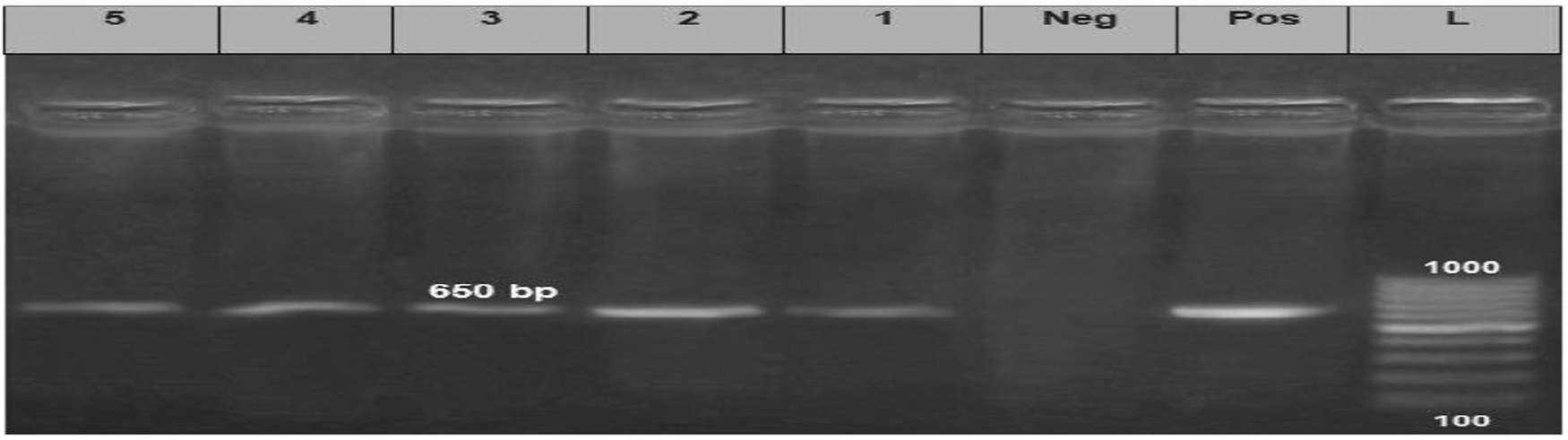
Agarose gel electrophoresis of PCR products amplified by PCR. Primer detecting gene Campylobacter jejuni 23S rRNA 650 bp. Lane L: Ladder, Pos: positive control; Neg: negative control; Lanes 1–5: C. jejuni positive isolates. PCR, polymerase chain reaction.
Incidence of Campylobacter Species in Examined Milk and Milk Products Sample
High prevalences of C. jejuni in raw milk were obtained by Yang et al. (2003) and El-Zamkan and Abdel Hameed (2016), who found it in 27.3% and 20% of samples, respectively. In contrast, lower percentages of 4.4% and 4% in raw milk samples were recorded by El-Sharoud (2009) and Barakat et al. (2015), respectively.
Kareish cheese is a homemade popular dairy product that may be consumed daily or frequently in Egyptian society; this product is prepared from raw milk, so it is susceptible to contamination by various microorganisms during processing, handling, or sale. In our study Kareish cheese had an isolation rate for C. jejuni of 14%, which is similar to the finding of El-Zamkan and Abdel Hameed (2016), but a lower finding of 6.7% was reported by Barakat et al. (2015). Higher rates (52%) for Campylobacter in Kareish cheese were reported by El-Kholy et al. (2016). Even lower results were reported by El-Sharoud (2009) who found Campylobacter in 2.6% of milk and dairy products, but failed to isolate Campylobacter from Kareish cheese sample, although detecting C. jejuni in 11% of fresh Domiati cheese samples.
C. jejuni is highly virulent with low infective dose in humans (Gharst et al., 2013). Unfortunately, raw milk samples and Kareish cheese show high isolation rates, indicative of the poor hygienic conditions and practices adopted in this region. Raw milk or unpasteurized products may be contaminated from fecal sources in the environment during milking or during storage, transportation, or processing (Callon et al., 2008). Consumption of raw or unpasteurized dairy products could facilitate the transmission of C. jejuni causing intestinal diseases outbreaks (Muehlherr et al., 2003; El-Sharoud, 2009).
C. jejuni in fecal samples
C. jejuni ranks among the most prevalent organisms causing diarrheal illness worldwide. Our study revealed that of human stool samples examined, 21 (39.6%) were positive for C. jejuni, from which 12 (48%) patients presented with diarrhea and 9 (32.1%) showed no diarrheal signs. The Campylobacter species detected in the stool samples was C. jejuni (Table 3; Fig. 1). The high positive rate of C. jejuni in human stool samples might be owing to preselection of the sample from people suffering from gastrointestinal disturbance. C. jejuni has emerged as the most frequent cause of human gastroenteritis, mainly enterocolitis, which can affect persons of all ages (Man, 2011). C. jejuni is the primary cause of 80–95% of Campylobacter infections in humans (Ragimbeau et al., 2014). Close animal contact and low hygienic conditions provoke the sustainable spread of foodborne pathogens including Campylobacter. Coker et al. (2002) recorded that Campylobacteriosis has become endemic in developing countries with highest infection in children younger than 5 years. Higher isolation rate of C. jejuni from fecal samples and clinical human samples were recorded by Liuque et al. (2017) and Reddy and Zishiri (2018) with 64.5% and 83%, respectively. Conversely, a lower isolation rate was reported by Aboderin et al. (2002) in Nigeria with 6.4% and Hassanain (2011), Zaghloul et al. (2012), and Ghoneim et al. (2017) in Egypt with 16.7, 6.6, and 5% respectively.
Prevalence of Campylobacter Species in the Examined Human Stool Sample
Antibiotic resistance profiles of C. jejuni isolates
Spread of drug-resistant pathogens has become an ongoing challenge to sustainable treatment options with serious public health consequences. Regrettably, isolates of C. jejuni in this study exhibited resistance to most of the antimicrobial agents tested (Table 4). Isolates from milk and dairy products showed resistance to nalidixic acid, ciprofloxacin, tetracycline, and ampicillin (90%, 70%, 80%, and 70%, respectively). In addition, human stool sample isolates revealed high resistance to nalidixic acid, ciprofloxacin, and tetracycline (70%, 60%, and 70%), respectively. The overuse of antibiotics in farm animals either for disease treatment, as prophylactics, and/or for growth promotion may raise the risk of transmission of drug-resistant pathogens and/or resistance genes to humans. All sample types revealed different degrees of sensitivity to other antibiotics used including macrolide drugs. High resistance of C. jejuni isolated from milk samples to tetracycline and ciprofloxacin were recorded by Elmali and Can (2019). Another work by Schiaffino et al. (2019) found that 77.4% of C. jejuni from stool samples were resistant to ciprofloxacin. Liuque et al. (2017) reported high resistance to quinolones (nalidixic acid, 90.4%; ciprofloxacin, 88.7%) and tetracycline (96%). In line with our results, Schiaffino et al. (2019) reported that amoxicillin plus clavulanic acid was the most effective drug formulation for C. jejuni control. For the treatment of Campylobacter infection, both macrolides and fluoroquinolones are used leading to overwhelming resistance to these drugs (Zendehbad et al., 2015; Bolinger et al., 2018). The results from our work revealed an increased resistance to macrolides and especially fluoroquinolones, emphasizing the need for new antimicrobial agents for the treatment of Campylobacter infections. For effective prevention, the inclusion of a mild heating step in combination with good hygiene practices is sufficient to control C. jejuni in milk and cheese.
Antibiotic Susceptibility Pattern of Isolated Campylobacter jejuni Strains Based on Inhibitory Zone Diameters Using Disk Diffusion Method
The experiment was repeated three times.
S, susceptible; R, resistant.
Virulence genes in the examined isolates of C. jejuni
C. jejuni possesses a group of virulence factors leading to pathogenicity; these factors include adhesion, invasion, and production of cytolethal distending toxins (Bolton, 2015). In our work both cadF and cdtA genes were detected in all samples. Conversely, there was no positive result for dnaJ and ciaB genes from any samples as given in Figure 2. Elmali and Can (2019) detected cadF and cdtA genes in 75% of the examined C. jejuni strains. The cdtA gene is responsible for cytotoxin production, which plays an important role in diarrhea by interfering with the division and differentiation of intestinal crypt cells (Wieczorek et al., 2018). The cadF gene is responsible for different invasion steps of the microorganism. A study by Gonzalez-Hein et al. (2013) was able to detect the cadF gene in the examined Campylobacter species. The dnaJ virulence gene allows Campylobacter species to cope under adverse conditions. In addition, ciaB gene plays a role in epithelial cell invasion. Failure to isolate both genes in this work may be owing to the primer used or the limited number of samples examined.
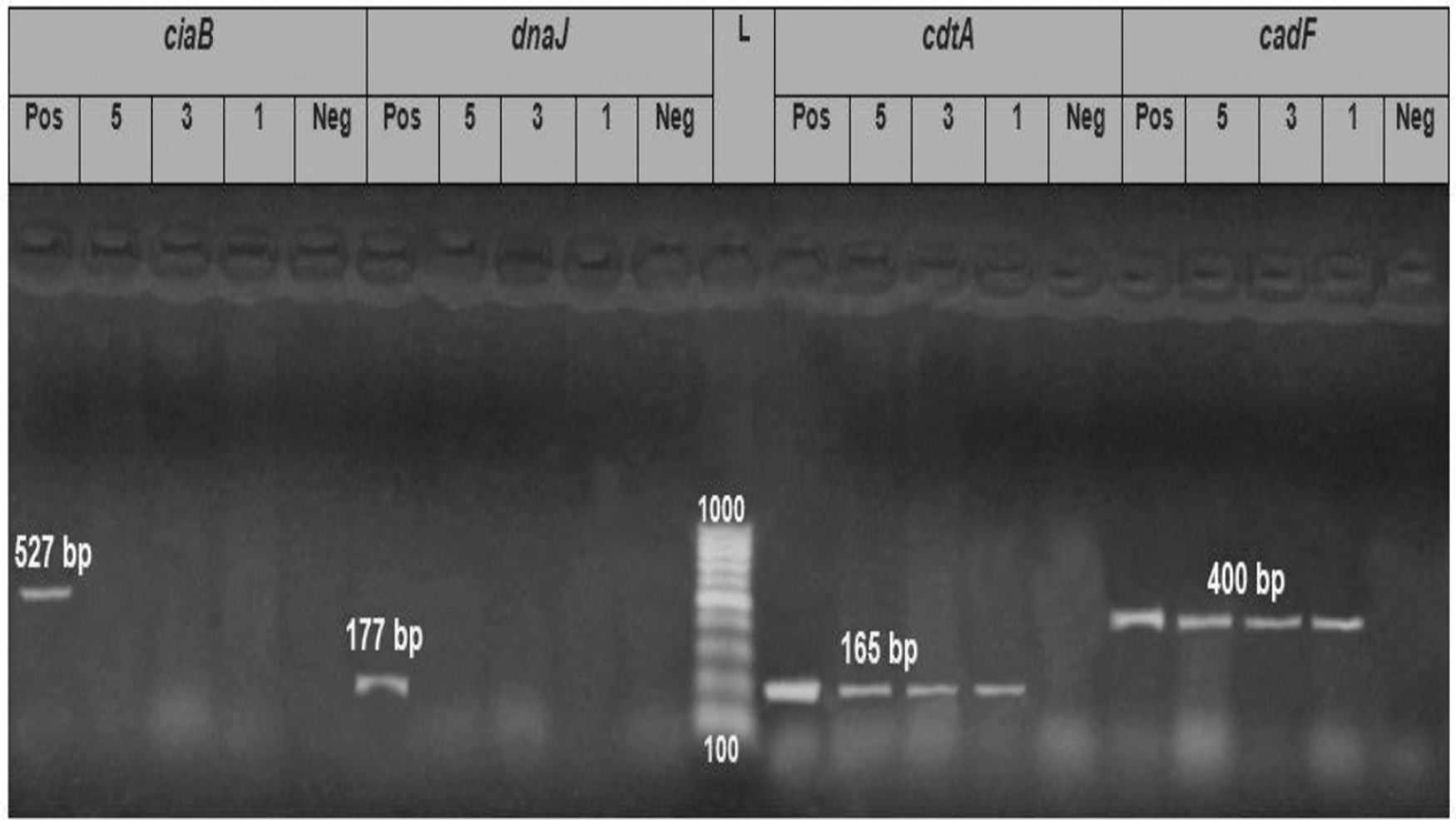
PCR detection of virulence gene in isolated C. jejuni. Lane L: Ladder, from left to right, Pos: Positive control for ciaB 527 bp, Lanes 1, 3, and 5 appear negative for ciaB; Pos: Positive control for dnaJ 177 bp, Lanes l, 3, and 5 appear negative for dnaJ. Pos: Positive control for cdtA 165 bp, Lanes 1, 3, and 5 appear positive for cdtA gene. Pos: Positive control for cadF 400 bp, Lanes 1, 3, and 5 appear positive for cadF gene.
Viability and control of C. jejuni in experimental Kareish cheese
Our results (Table 5) show that C. jejuni could survive in Kareish cheese for up to 12 d, which constitutes a public health hazard. Approximately 2.50 × 10⁷ CFU/mL was detected on day 0 of the experiment. Around 2 log reduction in the initial count of C. jejuni was observed on the first day (1.60 × 10⁵ CFU/mL) after inoculation, with no additional decline in the count on the second and the third day. The pathogen continued to decrease on day 4 (4.5 × 10³), day 6 (6.6 × 10²), day 11 (8 × 101), and was undetectable on day 13. Similar findings were described by El-Sharoud (2009) who was able to detect viability of C. jejuni in fresh Domiati cheese for up to 14 d.
Survival and Control by Cinnamon Oil and Lactobacillus acidophilus La5 on Viability of Campylobacter jejuni in Kareish Cheese
The experiment was repeated three times.
CFU, colony-forming unit; ND, not detected.
The ability of this microbe to survive in cheese for this period is dangerous; moreover, the resistance of C. jejuni to most antibiotics (Table 4), and the need for antibiotic-free products has led to the promotion of various alternative natural pathogen-control measures. One of these measures includes the application of EOs. These have been proposed to control Campylobacter in the gastrointestinal tract of broilers. Cinnamon oil at concentration of 1% was able to diminish C. jejuni after 10 d of storage at 4°C in artificially manufactured Kareish cheese, and with increasing concentration to 1.5%, we found that C. jejuni disappeared after 8 d of storage (Table 5). There was no significant difference between the control group and the treated group with both concentration of cinnamon oil (Table 6). Moreover, Ting and Deibel (1991) did not find inhibition of L. monocytogenes growth in meat slurry using cinnamon up to 3.0%. From the previous studies, it appears that the bactericidal power of cinnamon oil is largely dependent on the type of food to which it is added. Failure of these concentrations of cinnamon oil to eradicate C. jejuni in Kareish cheese may be attributed to the fact that C. jejuni is a Gram-negative bacteria and most EOs are more effective against Gram-positive bacteria compared with Gram-negative ones (Hyldgaard et al., 2012)
Log 10 Transformed Values of Campylobacter jejuni and the Treatment Groups by Two Concentrations of Cinnamon Oil and Lactobacillus acidophilus La5
Significantly different at p < 0.05.
N, number of days starting from day 0 till day 12; SD, standard deviation; SE, standard error.
Addition of lactic acid bacteria especially Lactobacillus and Bifidobacterium is an essential requirement in the manufacture of different types of cheeses including Kareish (Fox et al., 2000). L. acidophilus La5 showed a significant (p < 0.05) reduction of C. jejuni (Tables 5 and 6), the microorganism was viable during the 0 d, 3 log reduction in the first day, 5 log reduction in the second day, and was not detected on the third day, which give a promising control method for this pathogen. Other researchers found that the cell-free extracts of milk fermented by probiotic bacteria, involving L. acidophilus and bifidobacteria have a detrimental effect on the growth of C. jejuni (Ding et al., 2005). Another study stated that probiotic Lactococcus lactis prevents the enteric colonization of C. jejuni in chickens (Gorain et al., 2020). Ghareeb et al. (2012) also conducted an in vitro experiment and asserted that Enterococcus faecium, Pediococcus acidilactici, L. salivarius, and L. reuteri were able to inhibit the growth of C. jejuni. This positive achievement of probiotic L. acidophilus La5 in our study could be attributed to production of organic acids that lower the pH, bacteriocins, hydrogen peroxide, carbon dioxide, acetoin, and diacetyl (Fijan, 2016).
Conclusion
Higher incidence of C. jejuni in milk and Kareish cheese sold in Beni-Suef Governorate, Egypt, is of public health concern and is incriminated in the high incidence of human diarrheal infections. L. acidophilus La5 is a promising natural antimicrobial agent that inhibits microbial deterioration of cheeses and prolongs the shelf-life. Probiotic bacteria exert antimicrobial activity through various means such as reducing the pH or production of substances such as bacteriocins. On the contrary, other approaches involving incorporation of L. acidophilus with other probiotic bacteria or application of L. acidophilus along with other antimicrobial agents and preservatives such as EOs may be more efficient in prevention of microbial growth and enhancing cheese safety and quality, and should be investigated further in future studies.
Footnotes
Disclosure Statement
No competing financial interests exist.
Funding Information
No specific funding was received for this article.