




Abstract
Clostridium perfringens is a common foodborne pathogen, frequently associated with improper cooking, and cooling or reheating of animal products. The U.S. Food and Drug Administration Food Code outlines proper food preparation practices to prevent foodborne outbreaks; however, retail food establishments continue to have C. perfringens outbreaks. We qualitatively analyzed responses to two open-ended questions from the National Environmental Assessment Reporting System (NEARS) to understand patterns of unique circumstances in the retail food establishment that precede a C. perfringens outbreak. We identified three environmental antecedents, with three subcategories, to create nine operational antecedents to help explain why a C. perfringens outbreak occurred. Those antecedents included factors related to (1) people (a lack of adherence to food safety procedures, a lack of food safety culture, and no active managerial control), (2) processes (increased demand, a process change during food preparation, and new operations), and (3) equipment (not enough equipment, malfunctioning cold-holding equipment, and holding equipment not used as intended). We recommend that food establishments support food safety training and certification programs and adhere to a food safety management plan to reduce errors made by people and processes. Retail food establishments should conduct routine maintenance on equipment and use only properly working equipment for temperature control. They also should train workers on the purpose, use, and functionality of the equipment.
Introduction
C
Data obtained from investigations of C. perfringens outbreaks provide important insights into the prevention of C. perfringens illness; these data can identify food preparation practices and circumstances that lead to illness. For example, the Centers for Disease Control and Prevention's (CDC) outbreak investigation data indicate that C. perfringens outbreaks are commonly associated with foods prepared in large quantities (CDC, 2018).
The U.S. Food and Drug Administration (FDA) Food Code contains food safety guidelines intended to reduce foodborne illness risk from pathogens, such as C. perfringens, in retail food establishments. The Food Code lists specific time and temperature ranges for proper cooking, holding, cooling, and reheating (FDA, 2017b). Despite these guidelines and our increased understanding of the foods and practices associated with C. perfringens outbreaks, illnesses and outbreaks continue to occur (Hedeen and Smith, 2020).
Understanding environmental antecedents, the root causes, to C. perfringens outbreaks can help us prevent future outbreaks. Environmental antecedents are factors in the environment that ultimately lead to pathogen contamination, proliferation, or survival to cause an outbreak (CDC, 2015).
We examined data from the National Environmental Assessment Reporting System (NEARS), a voluntary reporting system that some state and local environmental health regulatory programs use to report data to the CDC from their investigations of retail food establishment outbreaks (CDC, 2019). NEARS data from C. perfringens outbreak investigations describe the environment in which the outbreaks occurred and can identify outbreak antecedents (Lipcsei et al., 2019). This study analyzed these data to better understand environmental antecedents of C. perfringens outbreaks. These data were used to identify operational antecedents of outbreaks, or the actions or factors that occur during food operations that explain the survival or proliferation of pathogens in food.
Methods
The NCEH/ATSDR Human Subjects Contact has reviewed this data collection system and determined that it is not research and does not require CDC Institutional Review Board (IRB) review. Ten state and local health departments reported 41 confirmed or suspected C. perfringens outbreaks that occurred from 2015 to 2018 to NEARS. We excluded seven outbreaks that were missing 75% or more NEARS data. The final data set consisted of 34 single-setting retail food establishment outbreaks that occurred in Connecticut, Georgia, Iowa, Minnesota, New York, Rhode Island, South Carolina, Tennessee, Washington, and Wisconsin.
During their investigations, environmental health staff interview outbreak establishment managers about establishment characteristics (e.g., food safety policies and practices that might have contributed to the outbreak). They also observe worker food preparation, especially of items suspected to be associated with the outbreak. Afterward, investigators report selected information and observations from their investigations to CDC through the NEARS web-based reporting system (Brown et al., 2017; Lipcsei et al., 2019).
Our analysis focused on qualitative data collected from two open-ended questions investigators answered about the outbreak establishments' food operations after they completed their establishment observations: Were there any differences to the physical facility, food handling practices you observed on your initial visit, or other circumstances that were different at the time of exposure? During the likely time the ingredient/food was prepared, were any events noted that appeared to be different from the ordinary operating circumstances or procedures as described by managers and/or workers?
The first question was designed to identify differences or unusual circumstances in establishment operations during the time customers were exposed to C. perfringens. If the investigation implicated a food item associated with the outbreak, investigators also answered the second question. These questions were asked because research suggests that unusual circumstances frequently precede outbreaks (World Health Organization, 2008). Understanding these circumstances can enhance our understanding of outbreak antecedents.
Analysis
We first calculated descriptive statistics on several outbreak and establishment characteristics collected through manager interviews and establishment observations to describe our sample (Table 1). We then conducted a qualitative analysis of the data from the two open-ended questions about differences in establishment operations at the time of C. perfringens exposure. We used the grounded theory approach, in which we identified patterns and groupings in the qualitative data using inductive reasoning (i.e., from the “ground up”) (Corbin and Strauss, 1990). The food system environmental antecedent conceptual model was used to categorize the data; researchers have theorized that five main variables of environmental antecedents influence food safety in establishments (Selman and Guzewich, 2014):
Outbreak and Establishment Characteristics of Clostridium perfringens Outbreaks, United States, 2015–2018 (N = 34)
Obtained from investigators' epidemiology and laboratory counterparts.
Contributing factors are food preparation practices that lead to pathogens contaminating, proliferating, and surviving in food.
Environmental health investigator determination.
Data obtained from the investigator's interview with the establishment manager.
Critical violations are those more likely to contribute to the contamination of food or the proliferation or survival of the pathogens if not corrected. These are determined on a routine inspection and unrelated to the foodborne outbreak.
People (characteristics and attitudes of people working in the establishments)
Processes (characteristics of the processes used to prepare food and food preparation complexity)
Economics (costs and profit margins)
Equipment (the physical layout and equipment of establishments)
Food (the inherent qualities of food prepared in establishments)
Two independent coders reviewed the raw text responses to the two open-ended questions with other NEARS variables to obtain a comprehensive view of the outbreak; they identified environmental antecedent themes based on the above model. They then again reviewed the raw text responses and further grouped the environmental antecedents into subcategories for each theme, or operational antecedents, applying theoretical comparison coding. For each review of the data, the coders independently identified their antecedents and then compared them. If the coders differed in their groupings, they each reviewed the data again, repeating this process until they reached a consensus. The final framework consisted of three environmental antecedents and nine operational antecedents (Fig. 1).
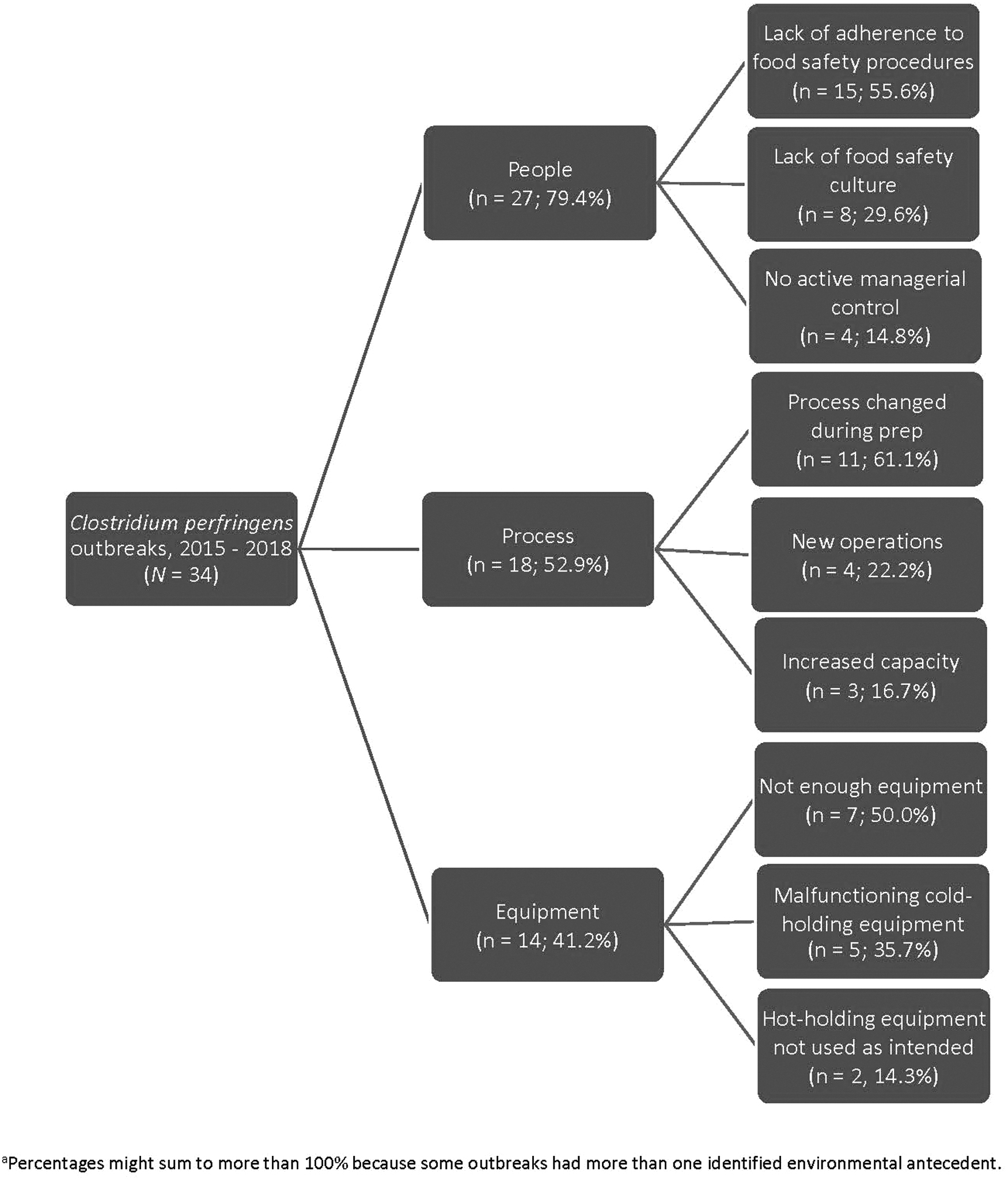
Operational antecedents in Clostridium perfringens outbreaks, National Environmental Assessment Reporting System, 2015–2018 (N = 34).
Results
Outbreak and establishment characteristics
In 41.2% of the outbreaks, the pathogen was confirmed in one or more clinical or environmental samples (Table 1). The primary outbreak contributing factor was pathogen proliferation (90.6%) and occurred while the food was at the establishment (i.e., during food preparation) (81.2%). Most of the outbreak establishments were restaurants (82.3%) and independently owned (84.0%). The majority served more than 100 meals per day on average (54.2%) and had a menu type classified as Latin cuisine (41.2%).
Among the outbreak establishments, 44.1% had two or more critical violations (i.e., violations more likely to contribute to pathogen contamination, proliferation, or survival) on their last routine inspection. All establishments engaged in complex food processes (i.e., food preparation requiring a kill step and holding beyond same-day service or a kill step and some combination of holding, cooling, reheating, and freezing). These processes present a higher risk for bacterial contamination, proliferation, and survival.
For 13 outbreaks (38.2%), investigators answered the question about differences or unusual circumstances in establishment operations during the time customers were exposed to C. perfringens. For 32 outbreaks (94.1%), investigators answered the question about differences from ordinary operating procedures at the time customers were exposed, as described by managers or workers. A qualitative analysis of these responses (see Table 2 for text excerpts) yielded the identification of three categories of antecedents: people, processes, and equipment. Further analysis of these antecedents led to nine operational antecedents. Although the antecedents of food and economics were considered, analysis found they were not applicable to this data set.
Text Excerpts from Two Open-Ended Questions
Were there any differences to the physical facility, food handling practices you observed on your initial visit, or other circumstances that were different at the time of exposure?
During the likely time the ingredient/food was prepared, were any events noted that appeared to be different from the ordinary operating circumstances or procedures as described by managers and/or workers?
Antecedents related to people
People antecedents were identified in 27 outbreaks (79.4%). All three operational antecedents in this category were related to workers' failure to follow food safety practices to prevent pathogen survival and proliferation.
In 15 outbreaks (55.6%), workers did not follow established food safety procedures designed to control bacterial survival and proliferation. In some of these outbreaks, investigators noted that the establishments had formal food safety procedures, but workers were not following them. For example, during one investigation, some pieces of meat required three attempts at reheating to achieve the proper internal temperature even though the establishment's process was to reheat only once.
A lack of food safety culture (i.e., the values, shared assumptions, and behaviors of workers) anteceded eight outbreaks (29.6%); examples included a documented pattern of poor inspections, long-standing critical violations, and a history of outbreaks. This antecedent is characterized by multiple, consistent poor food safety practices. For example, one investigator noted that the establishment was “in the exact same (poor) condition as during a previous norovirus outbreak investigation.”
Many establishments had multiple temperature issues; one investigator said, “there is a history of repeated temperature violations, including reheating, cold holding, hot holding and room temperature storage noted on 3 consecutive visits in the last 8 months.”
A lack of managerial control, or food safety supervision, to ensure adherence to food safety policies or processes was mentioned for four outbreaks (14.8%). In one outbreak, the manager was on leave at the time of the outbreak and many workers did not show up to work, leaving the establishment short-staffed and vulnerable to food safety errors. In two outbreaks, untrained persons were responsible for food safety at a catered event; they did not ensure that food temperatures were monitored and controlled.
Antecedents related to processes
At least one process antecedent was identified in 14 outbreaks; a total of 18 process antecedents (52.9%) were associated with these outbreaks. All three categories in this antecedent theme were characterized by insufficient processes to control foodborne pathogens.
In 11 of the outbreaks with process issues (61.1%), preparation of the implicated food item differed from the establishment's normal procedure. For example, in one establishment, time constraints caused by the late arrival of a food item led to suspension of standard preparation processes. Other observations included workers using ineffective cooling procedures (e.g., inappropriate food depth, cooling at room temperature), and failing to verify temperatures during cooling.
A new circumstance, such as a new establishment, food preparation process, or event type, was mentioned for four outbreaks (22.2%). For example, an establishment prepared a large roast for a holiday buffet, but the staff were not familiar with the proper procedure of cooking and holding this item. One establishment (which did not have a permit to operate) stored food in “a car from 6:00 a.m. to 6:00 p.m.,” and neglected to ensure that time or temperature parameters were met.
Increased capacity led to three outbreaks (16.7%). Because of increased demand, these establishments exceeded their typical operational volume and were unable to manage food safety risks. For example, one establishment experienced an extremely busy night, during which they prepared large quantities of food for a large number of people in a short time.
Another establishment catered three events on the same night. The investigator noted that “this is an unusually large amount of food for the establishment, a higher volume of food being prepared in the establishment at one time.” These establishments were not equipped to handle the increased volume and had difficulty properly cooling the food.
Antecedents related to equipment
Equipment antecedents were identified in 14 outbreaks (41.2%). Retail food equipment includes cold-holding (e.g., refrigerators, freezers) and hot-holding equipment (e.g., bain-marie or hot-holding cabinets), and food storage and insulated transportation containers. The three categories in this antecedent theme were related to failure of equipment intended to prevent bacterial growth in food.
In seven outbreaks (50.0%), the establishment did not have enough equipment or used inappropriate alternatives to approved equipment for food storage or holding. For example, in one outbreak, food was transported in cardboard boxes, which lacked appropriate temperature control, instead of in insulated or temperature-controlled units. In addition, in five outbreaks, investigators reported that the cold- or hot-holding equipment used was not large enough for the establishment's operational demand.
Malfunctioning cold-holding equipment that did not keep food cold enough to minimize pathogen proliferation anteceded five outbreaks (35.7%). Several investigators reported that establishments were using inoperable or malfunctioning refrigerators for cooling and storing hot foods. One investigator stated that the establishment's “walk-in was being repaired due to temperature issues on the meal date in question.”
Hot-holding equipment was not used as intended in two outbreaks (14.3%). Thus, foods were not held at temperatures hot enough to control pathogen proliferation. For example, one establishment held hot foods in an oven without power; another used containers designed for food transportation, rather than for maintaining appropriate temperatures, to hold hot foods.
Discussion
This qualitative analysis identified three environmental antecedents of C. perfringens outbreaks—people, processes, and equipment—which break down further into nine operational antecedents. These antecedents led to inadequate temperature control of food, which led to C. perfringens survival and proliferation in food and subsequent outbreaks among those who ate the food. Our findings suggest that establishments and regulators should consider focusing outbreak prevention efforts on workers, food preparation processes, and equipment used to prepare, store, and serve food.
People
Overall, most outbreaks had a people operational antecedent characterized by workers' lack of adherence to food safety procedures. In some outbreaks, workers did not follow established food safety procedures. This oversight could be attributed to several factors, including a lack of food safety culture, a lack of knowledge about proper procedures, and feelings of “burn-out” (Powell et al., 2011; Sahin, 2012).
Some research indicates that establishments with higher frequencies of regulatory inspections are less likely to be associated with foodborne outbreaks (Kufel et al., 2011). Regulatory programs might consider providing additional support to establishments with a pattern of poor inspections, long-standing critical violations, or a history of outbreaks. FDA data indicate that cooling violations are among the most common problems noted by inspectors in restaurants that engage in complex food preparation practices (FDA National Retail Food Team, 2018). Regulatory programs might consider developing a better understanding of complex food preparation to identify risks and target worker training.
Establishment workers with food safety training or certification have greater food safety knowledge than those without (Hedberg et al., 2006; Sumner et al., 2011; Brown et al., 2014, 2016; Hoover et al., 2020). Inspectors could educate managers about the public health reasoning behind food safety errors to empower managers to train other workers. By providing a train-the-trainer approach, establishments might be more likely to follow sustainable food safety practices to prevent risk factors and avoid errors.
Certification and training alone are likely not sufficient to control all foodborne risks. Active managerial control and a strong food safety management system, such as a hazard analysis critical control point (HACCP) plan, are strategic approaches to reduce food safety errors (FDA, 2017a). Corrective actions, including monitoring and recording of food temperatures, or the critical limits of critical control points, and the verification of the HACCP plan, are essential steps to ensure safe food. Regulatory programs and the restaurant industry should consider supporting food safety training and certification programs and active managerial control, cultivation of a food safety culture, and the use and verification of a robust food safety management system.
Process
Standard food preparation processes were not followed at many outbreak establishments; instead, a different process that contributed to food temperature abuse and pathogen proliferation was used. Often, these differences resulted from unusual circumstances, such as preparation of larger food amounts than usual and increased customer volume. Ensuring that workers follow their establishment's procedures, rather than revising processes (e.g., taking shortcuts) regardless of unusual circumstances, is key to outbreak prevention.
Studies show that proper cooling is critical to avoiding C. perfringens proliferation and that cooling errors are a common cause of C. perfringens outbreaks (Kalinowski et al., 2003; Smith-Simpson and Schaffner, 2005; Hedeen and Smith, 2020). Research suggests that many establishments do not follow proper cooling procedures (e.g., no recording or verification of cooling processes) (Brown et al., 2012; Hedeen and Smith, 2020). Establishments can help prevent C. perfringens proliferation by monitoring temperatures during cooling and taking corrective actions when temperatures are not met.
The use of HACCP principles to develop a risk control plan can help establishments identify process failures to avoid pathogen proliferation (FDA, 2017a). If process parameters (i.e., time and temperature) are too difficult to use, managers could consider using physical parameters, such as cooling pan depth, to ensure proper cooling. For example, one jurisdiction assesses whether foods are cooled using procedures likely to ensure rapid cooling (uncovered in shallow [≤2 inches] containers), rather than assessing time and temperature. This alternative method can help ensure proper cooling and increase verification efficiency for inspectors and operators (Oravetz, 2019).
Equipment
Equipment operational antecedents included a lack of or improper equipment for food storage and holding. Ensuring that an establishment has proper equipment for these processes requires an understanding of the establishment's operational capacity, which is based on the volume of complex preparation food items and the capacity and functionality of existing equipment. Other equipment issues included malfunctioning cold-holding equipment and improper use of hot-holding equipment.
Hedeen and Smith (2020) recently found that improper cooling procedures and inadequate equipment are prevalent in the retail food industry. Research has also found that equipment problems are the most common barrier to holding food properly in restaurants (Green and Selman, 2005), restaurants with sufficient refrigeration capacity were more likely to have properly cold-held food (Liggans et al., 2019), and restaurants with multiple refrigerators had a lower likelihood of bacterial outbreaks (Kramer, 2019).
Equipment issues also could be related to the antecedent theme of economics. Financial challenges might limit establishments' ability to buy new equipment or maintain existing equipment. The role that economics plays in outbreaks is difficult for outbreak investigators to evaluate. They might not understand establishments' financial situations and are likely unable to collect economic data (e.g., profit margins). Further research is needed to understand and identify economic antecedents to outbreaks.
To help prevent equipment antecedents to C. perfringens outbreaks, establishments can conduct routine maintenance of equipment used for temperature control and worker training on proper equipment use and maintenance. Regulators can also assess equipment during routine inspections to ensure it meets the establishment's capacity and operational requirements and to verify that workers know how to properly use and maintain the equipment.
Limitations
The generalizability of this study's findings is limited because the sample is only a subset of all C. perfringens outbreaks—outbreaks investigated by state and local agencies that report to NEARS. The qualitative data we analyzed consisted of observations and perspectives of the investigator, which might be influenced by their unique experiences. Therefore, the investigative approach and outbreak explanation might vary between investigators and reporting sites. The results are qualitative and should not be generalized to a larger population in any statistical sense. However, these results can be useful for guiding future work in food safety.
Conclusion
Data on outbreak operational antecedents can inform food safety interventions to prevent future foodborne outbreaks. We recommend that retail food establishments and regulators educate workers about why food safety tasks are performed. This will help instill a culture of food safety and support use of sustainable and robust food safety management systems.
We also recommend incorporating principles of HACCP, a prevention tool used to prevent foodborne outbreaks and correct process failures, to verify food safety processes at establishments. Finally, regulators and establishments can train workers to use equipment properly and to determine when corrective actions are required to avoid equipment failures that contribute to pathogen proliferation and survival. More research will help to further understand the underlying antecedents of C. perfringens outbreaks and prevent them.
Access to Data
Data is accessible at
Footnotes
Acknowledgments
This publication is based, in part, on data collected and provided by the Centers for Disease Control and Prevention's (CDC) Environmental Health Specialists Network (EHS-Net), which is supported by a CDC grant award funded under RFA-EH-15-001. We thank the NEARS site staff who collected and entered their outbreak data. The findings and conclusions in this report are those of the authors and do not necessarily represent the views of CDC or the Agency for Toxic Substances and Disease Registry.
Disclosure Statement
No competing financial interests exist.
Funding Information
This project was also supported, in part, by an appointment to the Research Participation Program at CDC administered by the Oak Ridge Institute for Science and Education through an interagency agreement between the U.S. Department of Energy and CDC.