




Abstract
Enterohemorrhagic Escherichia coli O157 (EHEC) causes severe complications such as hemolytic uremic syndrome. Contaminated ready-to-eat (RTE) food is one of the vehicles of multijurisdictional outbreaks of foodborne disease worldwide. Multijurisdictional (covering cities, towns, and villages) outbreaks of EHEC are usually linked to an increase in cases, and here we describe such an outbreak involving 29 cases in October 2017 in the Niigata Prefecture. After prefecture-wide active case finding, we conducted a case–control study of 29 cases with eligible data who tested positive for EHEC. To determine the association of the outbreak with risk factors, we compared these cases with 38 controls selected from family and acquaintances who were both symptom free and tested negative for EHEC. The largest number of cases was in the 20–29-year age group (7/29; 24%) and most were women (20/29; 69%). All 29 cases had an identical or similar multilocus variable number tandem-repeat analysis (MLVA) profile. Of these, 76% (22/29) had consumed some type of grilled skewered meat. Also, 69% (20/29) had consumed grilled skewered meat produced by company X. EHEC infection was strongly associated with the consumption of grilled skewered meat produced by any food processing company (odds ratio [OR] = 11.8, confidence interval [95% CI]: 3.7–37.4) and by company X (OR = 9.8, 95% CI: 3.2–30.7). At company X, the skewered meat was grilled to 95°C and then removed from the grilling area to meat trays. The meat trays were not sufficiently washed and disinfected. Testing indicated that the facility was negative for EHEC but four asymptomatic employees tested positive for EHEC. Company X was temporarily closed and voluntarily recalled the foods. We recommend that all employees sufficiently wash and disinfect meat trays to prevent contamination of RTE food, avoid cross-contamination of grilled skewered meat through the environment by regularly cleaning the facility, and appropriately practice self-health care.
Introduction
In 1982, a large outbreak of infection among humans caused by enterohemorrhagic Escherichia coli (EHEC) O157 was traced to a single fast food restaurant chain with operations in Oregon and Michigan in the United States (Riley et al., 1983). Since then, EHEC O157 transmission has been reported to include foodborne, human-to-human, waterborne, and animal contact transmission (Heymann, 2008). Approximately 4% of EHEC cases develop hemolytic uremic syndrome (HUS) and ∼0.5% are fatal (Sodha et al., 2011; National Institute of Infectious Diseases, 2017, 2018, 2019). Thus, prevention of EHEC is among the most important public health issues in developed countries.
Contaminated ready-to-eat (RTE) food is one of the vehicles of multijurisdictional outbreaks (involving multiple municipality levels, such as cities, towns, and villages) of foodborne disease worldwide (Harvey et al., 2017; Gambino-Shirley et al., 2018; Heiman Marshall et al., 2018). Among outbreaks related to RTE consumption that have been caused by contamination with the EHEC O157 organism, some very large outbreaks in Japan and other developed countries have involved various RTE foods moved through food distribution systems and served at chain restaurants (Donnan et al., 2012; King et al., 2012; Tabuchi et al., 2015; Yahata et al., 2015).
For example, raw beef and raw vegetables caused very large multijurisdictional outbreaks of EHEC in 2011 and 2012 in Japan (Tabuchi et al., 2015; Yahata et al., 2015). The various causes of foodborne outbreaks related to RTE food include cross-contamination within the distribution chain and poor agricultural practices (Donachie et al., 2018). Crucially, not all food processing companies handle food appropriately to prevent cross-contamination during processing.
In this study, we investigated the source of a multijurisdictional outbreak of foodborne disease linked to RTE grilled skewered meat in Japan. Based on the findings, we discuss control measures for the processing and handling of RTE grilled skewered meat.
Detection of the outbreak
On October 19, 2017, Niigata City Public Health Center (PHC) received notification from a general hospital about a case of EHEC O157 infection. Niigata City PHC investigated family members and acquaintances of the case who were close contacts and had common exposures. Then, reports of several additional EHEC O157 cases were received from several medical institutions in Niigata City.
In response, Niigata City PHC commenced prefecture-wide active case finding of gastrointestinal illnesses such as diarrhea, bloody diarrhea, and abdominal pain. The cases had consumed grilled skewered meat, including chicken, chicken cartilage, pork, and pork intestine. The presence of Shiga toxin 1 and 2 genes (stx1 and stx2) was confirmed in stool samples of the cases positive for EHEC O157. Niigata City PHC then began an investigation of a suspected outbreak of EHEC O157.
Materials and Methods
Case definition
In this study, a suspected case was defined as a resident of Niigata Prefecture (which includes Niigata City and four neighboring municipalities) with at least one instance of gastrointestinal illness such as diarrhea, bloody stool, and abdominal pain with date of onset during the period October 1, 2017–November 12, 2017. A confirmed case was a suspected positive for EHEC O157 with stx1 and stx2. An asymptomatic case was defined as a resident of Niigata Prefecture without gastrointestinal illness but positive for EHEC O157 with stx1 and stx2 during the same period of October 1, 2017–November 12, 2017. Controls were selected from the same families or from other relatives who had no symptoms and tested negative for EHEC O157.
Study design
The outbreak investigation consisted of an unmatched case–control study, trace-back investigation, and trace-forward investigation. The case–control study was conducted to determine associations with EHEC O157 infection. Univariate logistic regression analysis was performed to determine the source of infection. Statistical analyses were conducted using SAS 9.4 (SAS Institute, Inc., Cary, NC). The trace-back investigation was conducted by Niigata City PHC.
Data collection
Public health nurses and food hygiene inspectors interviewed the cases as well as family members and acquaintances who were close contacts. They collected information on meat purchases, history of food consumption, restaurant visits, travel, and contact with animals, water, or infected individuals during the target period. Data were collected for a total of 86 subjects; we excluded individuals with data deemed ineligible for investigation (i.e., unknown dates of food consumption), individuals with secondary infection, symptomatic or asymptomatic individuals who tested negative for EHEC O157 infection, and untested individuals (Fig. 1).
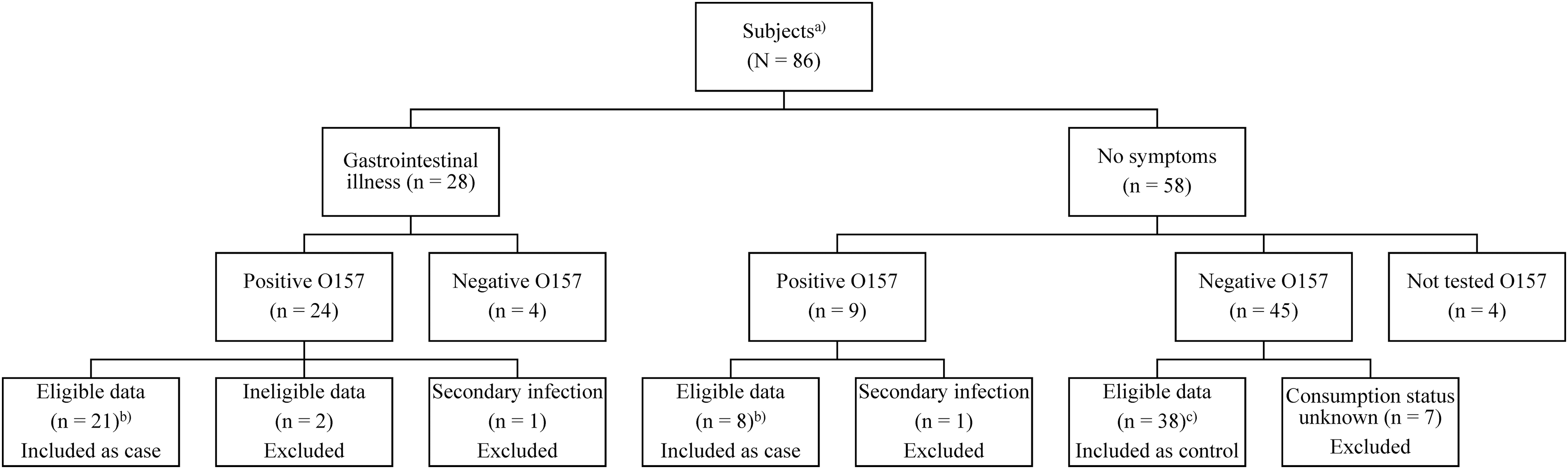
Flowchart of case and control enrollment in the outbreak investigation. aSubjects (n = 86): individuals with gastrointestinal illness (n = 28) and their family members or acquaintances (n = 58) whose epidemiological information was investigated. bCases (n = 29): individuals positive for enterohemorrhagic Escherichia coli O157 with eligible data (n = 21) and asymptomatic cases with eligible data (n = 8). cControls (n = 38): individuals with no symptoms who were negative for enterohemorrhagic E. coli O157 and were excluded because the date of consumption of grilled skewered meat was unknown.
We included cases with eligible data who tested positive for EHEC O157 and had gastrointestinal symptoms (n = 21) and also cases with eligible data who tested positive for EHEC O157 but had no symptoms of gastrointestinal illness (n = 8). For controls, we selected individuals with eligible data who had no symptoms and also tested negative (n = 38).
Laboratory testing
Stool specimens were collected from all of the cases for bacterial culture at Niigata City Institute of Public Health. We also tested the stool samples of controls who were culture negative for EHEC O157. In addition, we performed multilocus variable number tandem-repeat analysis (MLVA) on EHEC O157 isolated in the outbreak investigation. MLVA was performed in the department of bacteriology I at the National Institute of Infectious Diseases. The procedure followed that described in previous articles using 17 loci except O157-10 (Hyytiä-Trees et al., 2006; Izumiya et al., 2010).
In brief, template DNA was prepared by heat extraction of bacterial cells. PCR was performed using a QIAGEN Multiplex PCR Kit (Qiagen K.K., Tokyo, Japan) following the manufacturer's instructions. The amplified PCR products were separated, sized, and converted to repeat copy numbers using an Applied Biosystems 3500xL Genetic Analyzer and GeneMapper software (Thermo Fisher Scientific K.K., Tokyo, Japan).
Trace-back and trace-forward investigations
Niigata City PHC employed food inspectors who traced the suspected food vehicles implicated in the food exposure survey back through the distribution chain to identify distributors and processing companies. Trace-forward investigation was also conducted for distributors and processing companies.
Environmental sampling
Niigata City PHC performed environmental sampling involving 50 samples from 14 items, such as plastic curtains, cold storage, carrying cases and containers, the packing room, refrigerator handles, water in the processing room, the seasoning for the skewered meat, storage room, rubber gloves, rubber boots, and surfaces in the vehicle for transporting the meat, and examined the possible sources of contamination with EHEC O157.
Ethical statement
The outbreak investigation was based on the Act on Prevention of Infectious Diseases and Medical Care for Patients Suffering Infectious Diseases and the Food Sanitation Act in Japan and thus ethics committee approval was not required.
The authors assert that all procedures contributing to this study comply with the ethical standards of the relevant national and institutional committees on human experimentation and with the Helsinki Declaration of 1975, as revised in 2008.
Results
Characteristics of the cases
There were 29 cases eligible for study inclusion. These individuals had at least one symptom of gastrointestinal illness and/or were positive for EHEC O157. There were 38 eligible controls who had no symptoms and were negative for EHEC O157.
All 29 cases were culture positive for EHEC O157 with stx1 and stx2 in this outbreak. The onset of illness in the first four cases occurred on October 16, 2017 (Fig. 2). The dates of onset with the highest number of cases were October 16, 18, and 19, 2017, and the final date of onset was October 29, 2017.
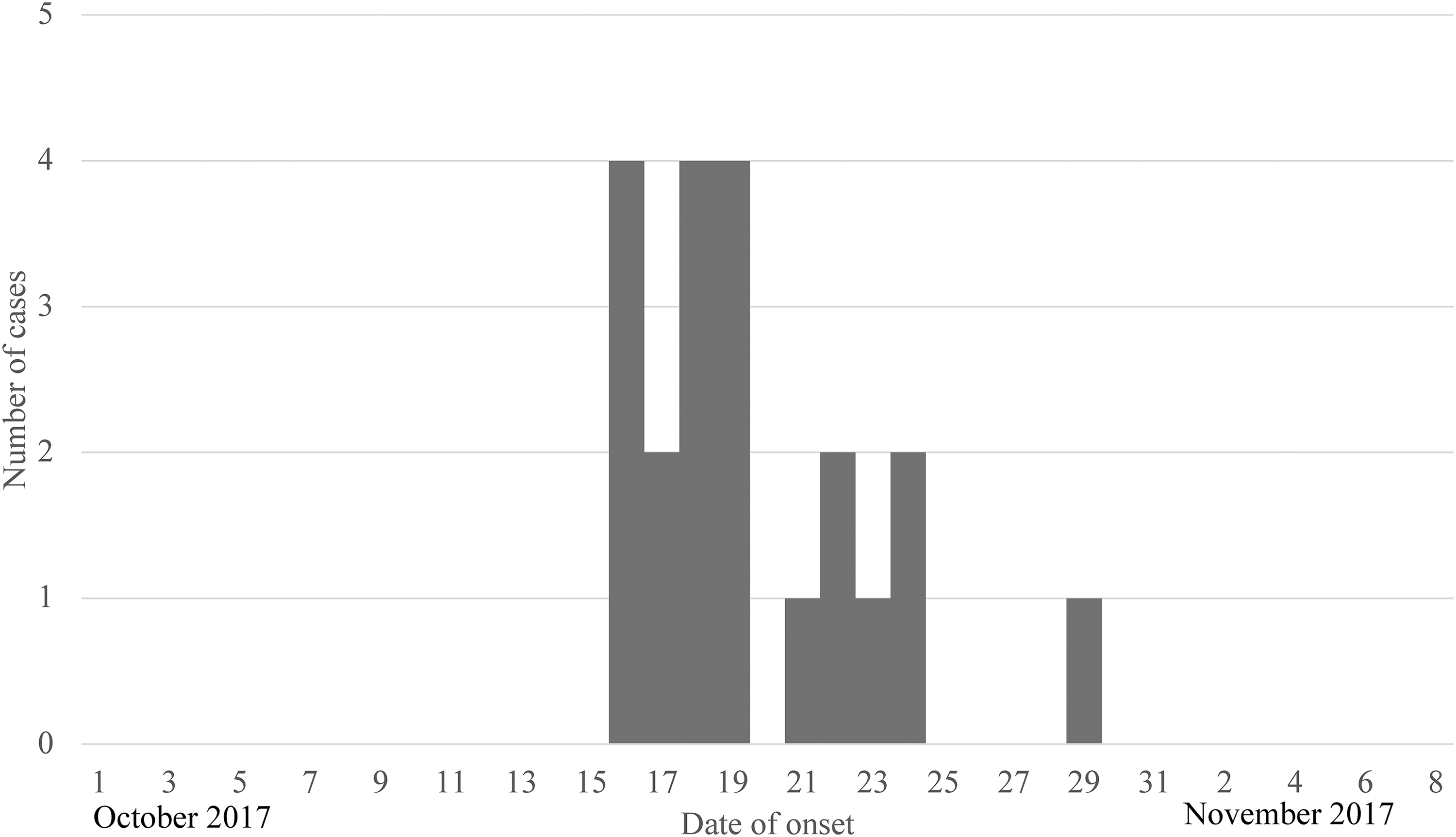
Distribution of the date of onset (n = 21).
Among the cases, the most common age range was 20–29 years (7/29; 24%), followed by 10–19 years (6/29; 21%) (Table 1). There were more women (20/29; 69%) than men (9/29; 31%) in the case group. All symptomatic cases had diarrhea. HUS was diagnosed in four cases (14%), and no cases had acute encephalopathy. Different kinds of grilled skewered meats were sold by six wholesale markets or food markets. Most cases consumed meat from market D (10/29; 34%), followed by market G (5/29; 17%). Molecular subtyping of EHEC O157 was conducted by MLVA. Five MLVA types were identified, with the most predominant being MLVA type 1 (18/29; 62%), followed by type 2 (4/29; 14%) and type 3 (4/29; 14%). Because all of the MLVA types were closely related to type 1 by one or two loci, all of the cases were included in the same MLVA complex.
Characteristics of the Subjects (N = 67)
Positive for enterohemorrhagic Escherichia coli O157, confirmed cases, and asymptomatic cases.
Excludes asymptomatic cases (n = 8).
Wholesale market or food market.
Diagnosed by antibody assay.
MLVA, multilocus variable number tandem-repeat analysis.
Consumption of grilled skewered meat and infection
The grilled skewered meat consumed included muscle, intestine, heart, liver, and cartilage of chicken or pork. Most of the cases consumed grilled skewered meat produced by food processing company X (20/29; 69%), which produced 13 kinds of grilled skewered meats. Of the 29 cases, 22 (76%) consumed at least one kind of grilled skewered meat produced by any company (Table 2). EHEC O157 infection was strongly associated with the consumption of at least one grilled skewered meat produced by any food processing company (odds ratio [OR] = 11.8, confidence interval [95% CI]: 3.7–37.4) and the consumption of at least one grilled skewered meat produced by food processing company X (OR = 9.8, 95% CI: 3.2–30.7).
Association Between Consumed Grilled Skewered Meat and Enterohemorrhagic Escherichia coli O157 Infection (n = 67)
Grilled skewered meat is defined in this study as a Japanese dish of bite-sized pieces of the muscle, intestine, heart, liver, and/or cartilage of chicken or pork.
Food processing company X included.
CI, confidence interval; OR, odds ratio.
Microbiological analysis
Niigata City PHC conducted stool tests with employees of food processing company X. From 56 stool samples, 4 asymptomatic employees (7%) were confirmed to be positive for EHEC O157. The strain found in all four employees was MLVA type 1, which was also the predominant case-related stool strain. All four employees worked on the processing line for pork intestine. We were unable to perform microbiological analysis of other grilled skewered meats produced in the same lot because those meats had already been distributed to consumers.
Inspection of food and meat processing companies
Food processing company X distributed grilled skewered meat to 18 companies, including 6 supermarket chains, 2 grocery stores, 2 wholesale companies, and 6 restaurants. The skewered meats were pork offal and chicken meat or cartilage. Pork offal included liver, tongue, colon, and cartilage. Chicken offal included heart and cartilage and were produced whole and as tsukune (meatballs made of finely minced chicken). Niigata City PHC inspected the company's facility and procedures. The company distributed ∼100,000 skewered meat items per month. In addition to grilled skewered meat, the company processed ∼60,000–70,000 boiled pork intestines per month for other products.
Food processing company X did not have processing records and did not keep receipts of materials. In the inspection carried out by Niigata City PHC, the company was found to have no records of employee dates of attendance or work duties in its operations. Employee handwashing was found to be insufficient before and after processing and was of inadequate duration. Of the four employees confirmed positive for EHEC O157, one had consumed skewered meat, but did not remember the date of purchase.
A tray washing machine was used to wash and disinfect trays at food processing company X. A single operator handled the washing machine. The operator wore an apron while washing and operating the machine but touched the washed trays after touching unwashed trays. The company distributed the trays to stores and retail companies, with the trays covered in plastic during distribution. Movement lanes within the company were not in one direction, and so cross-contamination of some materials might have occurred after grilling. Some of the employee cases did not use an apron and gloves. The company did not provide training on sanitation in food processing to new employees and did not conduct routine stool tests of its employees. Environmental sampling produced no evidence of EHEC O157 contamination in the facility.
There were several dedicated areas at food processing company X, such as an area for cutting and producing skewered meats, a grilling area, and a cooling area. The company used meat trays that were washed in a preparation room. There were two tray washing machines in the room, one for properly cooked products and the other for raw materials, and the machines were placed side by side. The washing machine was found to be unable to prevent cross-contamination through water. Only one person managed and handled product processing each day. The food inspectors found that washing and disinfection of meat trays were insufficient at the facility.
At food processing company X, some of the skewered meat items were boiled to an internal temperature of 90°C and then grilled to an internal temperature of 95°C for 9 min, as measured using a thermometer. After the grilled skewered meat was removed from the grill and placed onto meat trays, the trays were moved to a roofed cooling area. After this process, the skewered meat was packed and kept in the refrigerator. The skewered meat was then distributed to wholesale markets or restaurants that had placed an order.
Niigata City PHC conducted a trace-back investigation for foodstuffs at four food processing companies that kept stock for foodstuffs. Food processing company X purchased pork offal from meat processing company Z (Fig. 3). Company Z had a raw meat processing room with two separate cutting areas. One was for cutting stomach, lung, and intestine and the other was for cutting heart, liver, tongue, esophagus, and diaphragm. According to the inspection and evaluation carried out by the PHC, company Z handled pork and beef offal. Its employees' handwashing and sanitation practices, including the timing of these practices, were found to be insufficient. Movement lanes for workers within the company were not in one direction.
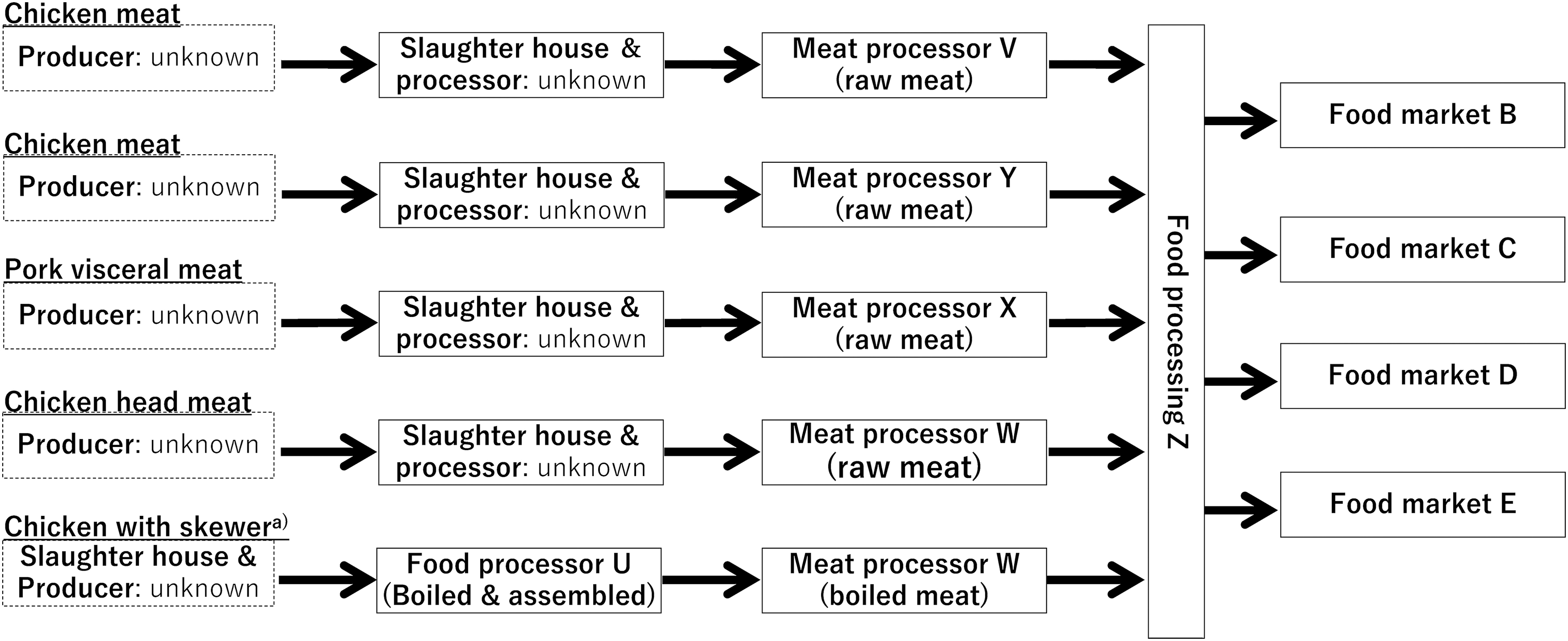
Trace-back investigation. aPork and chicken: Domestic producing except for “Chicken with skewer.”
Company Z did not conduct routine stool tests for its employees. Employees did not change their workwear after finishing the processing of beef viscera, and they processed pork while wearing the same workwear worn for processing beef viscera.
Niigata City PHC also conducted a trace-back investigation for foods. Pork viscera could be traced back to slaughterhouses, but not back to farms. For skewered chicken, the PHC could trace back to food processing company U in China, but not back to slaughterhouses and farms in China because this information could not be obtained from the relevant trading companies. Other types of meat could be traced back to meat processors, but not back to slaughterhouses because there were no records on distribution.
Management of control measures
Food processing company X was temporarily closed in accordance with the Food Sanitation Act on October 28 and 29, 2017. Moreover, the company recalled all skewered meat produced since November 3, also in accordance with the Food Sanitation Act. Although the company recalled all skewered meats and voluntarily recalled boiled intestines, we were unable to collect the same lot of skewered meat that was consumed by cases.
Discussion
Summary of the outbreak
Approximately two-thirds of the cases in this study consumed grilled skewered meat. The strains identified in all 29 cases had similar MLVA profiles, and two-thirds of the cases had the same MLVA type. EHEC O157 infection was strongly associated with consumption of the skewered meat from food processing company X. Inspection of the company revealed insufficient washing and disinfection of meat trays. Four of its employees were positive for EHEC O157 and did not change their workwear after finishing the processing of meat. Thus, based on inspection and laboratory findings, there is a strong likelihood that this multijurisdictional outbreak was caused by the consumption of contaminated skewered meat.
Control of cross-contamination to RTE foods
The skewered meat in this study was RTE food. One of the key control measures for EHEC O157 is that infected food employees must be excluded from the entire premise because any infected food handler, whether symptomatic or asymptomatic, poses the potential risk of food contamination (FDA, 2017). Another way to stop cross-contamination is effective cleaning and disinfection, which helps to prevent the possibility of microbes remaining on surfaces (Food Standard Agency, 2019). At food processing company X, the washing and disinfection of meat trays were insufficient, as was the separation between raw meat and grilled skewered meat as RTE food.
Moreover, the facility did not exercise sufficient care in personal hygiene, staff training, and management. Based on guidance for food business operators and local authorities in the United Kingdom, contamination of RTE food can include cross-contamination from food and the environment in a company (Food Standard Agency, 2019). One possible source of the EHEC O157 contamination in this study was the contamination of the skewered meat from an infected employee and/or at the facility of food processing company X. The company should take proper measures to control for cross-contamination from infected employees or the environment of the food processing company during the processing of RTE foods.
Food handling
“Guidance for food business operators and local authorities, EHEC O157 control of cross-contamination” refers to the following types of indirect sources of EHEC O157 cross-contamination: “surfaces,” “hands,” “equipment that has been used for raw food,” and “anything else that has been contaminated, for example, clothes” (Food Standard Agency, 2019). Employees of food processing company X did not change clothes, and curtains at the facility that might have been contaminated with EHEC O157 were a possible source of food contamination. The movement lanes in both company X and company Z were not in one direction, so cross-contamination of some materials might have occurred among the food staff.
At company Z, beef offal might have contaminated pork offal. Beef offal contain microbes that are pathogenic to humans (e.g., EHEC) but are normal intestinal flora in cattle, and implementing changes to beef offal handling would be difficult (Brown, 2000). Company Z did not conduct careful processing to prevent cross-contamination of foods, especially for beef offal. Moreover, the abovementioned guidance describes effective food safety management control as including the following good practices: (1) training, (2) corrective actions, and (3) verification and review (Food Standard Agency, 2019).
Four employees of company Z were positive for EHEC O157 but did not develop a gastrointestinal illness between October 1 and 26, 2017, and we could not rule out contamination with the agent among employees. Based on our findings, we recommended that the food processing companies implement good practices and maintain sustainable operating practices for all employees.
In the trace-back investigation, we were able to collect only limited information on meat processors and slaughterhouses. Food processing company X did not keep records on meat purchases from sales companies or other food processing companies. The “Guidance for food business operators and local authorities, EHEC O157 control of cross-contamination” emphasizes that “record keeping” is one of the most important factors in the management of control of EHEC O157 (Food Standard Agency, 2019). Thus, we recommended that food processing company X keep records and receipts.
Severity
In the outbreak investigated in this study, the proportion of cases that had HUS (10%) was higher than the average (∼5%) among symptomatic cases of EHEC (Gerber et al., 2002; Gould et al., 2009; National Institute of Infectious Diseases, 2019). Compared with other types of outbreaks, multijurisdictional outbreaks of foodborne diseases have shown a higher proportion of severe complications than other illnesses (Buchholz et al., 2011; Tabuchi et al., 2015; Yahata et al., 2015; Dewey-Mattia et al., 2018).
However, these types of outbreaks should be preventable by appropriate food processing. Food processing company X had several inappropriate food processing procedures in place, and we recommended that food processing company X implement appropriate sanitation, food processing, education, and practices. This would prevent severe cases of infection.
Limitation
This was a case–control study, so there was some susceptibility to recall bias. In addition, stool sampling was performed in acquaintances of cases only, which might have introduced selection bias. We were also unable to collect data on other meats from the same production lot of the suspected contaminated meat because they had already been distributed to consumers. Finally, although data collection in the trace-back investigation was insufficient because of complications with the distribution of food items, our data showed that contamination of the skewered meat occurred after grilling, so it was considered that this limitation did not affect the conclusion.
Conclusions
The cause of the outbreak is likely to have been grilled skewered meat contaminated with EHEC O157. The grilled skewered meat might have become contaminated after grilling through human contact or the facility environment. We recommend the following based on our findings: Before placing grilled meat on meat trays, employees should sufficiently wash and disinfect the trays. Cross-contamination of grilled skewered meat through the environment of the food processing company should be avoided by regularly cleaning the facility. Infected employees might be sources of contamination, and thus employees should practice appropriate self-health care.
Footnotes
Acknowledgments
We thank the local governments and community health centers of Niigata City and Niigata Prefecture as well as the Niigata City Institute of Public Health. We also thank Dr. Nakao of Miyazaki Prefectural Nursing University for providing advice on statistical analysis and interpretation.
Authors' Contributions
R.S. contributed to investigation, data curation, and writing—original draft. Y.Y. was involved in reviewing and editing the draft and funding acquisition. H.T., T.S., T.I., and S.Y. carried out outbreak investigation. K.Y. and R.K. carried out microbiological analysis. H.I. and S.I. were involved in multilocus variable number tandem-repeat analysis (MLVA). M.O. was in charge of supervision of microbiological analysis and MLVA. Y.T. was in charge of outbreak investigation—general supervision.
Disclosure Statement
No competing financial interests exist.
Funding Information
This study was supported by Japan Society for the Promotion of Science Grant (JSPS KAKENHI Grant No. JP17K09149). The funder played no role in the study design, data collection and analysis, decision to publish, or preparation of the article.