




Abstract
Small fruits such as strawberries have been increasingly implicated in outbreaks of foodborne illnesses. Salmonella enterica and Listeria monocytogenes may contaminate strawberries leading to potential public health concern. The objective of this study was to investigate the efficacy of a combined lactic acid bacteria (LAB) treatment of Lactobacillus plantarum and Pediococcus pentosaceus for controlling S. enterica and L. monocytogenes on fresh strawberries during storage at 4°C and 10°C. Strawberries purchased from a local grocery store were separately dip inoculated with Salmonella Newport, Salmonella Tennessee, Salmonella Thompson, or a three-strain cocktail of L. monocytogenes at ∼9 log colony-forming unit (CFU)/mL and allowed to air-dry for 1 h. Inoculated strawberries were then divided into three groups: (1) Control (pathogen alone), (2) Man, Rogosa, Sharpe (MRS) control (dipping in MRS broth), and (3) LAB treatment (dipping in a LAB cocktail of L. plantarum and P. pentosaceus). After treatment, strawberries were stored at 4°C or 10°C for 7 d in vented clamshell containers. Surviving Listeria, Salmonella, and LAB populations on strawberries were determined on 0, 1, 3, and 7 d post-treatment by plating on selective agars. At both 4°C and 10°C, LAB treatment significantly decreased Listeria populations by up to 2 log CFU/g compared to controls after 3 d of storage (p < 0.05). When strawberries were stored at 4°C, LAB treatment reduced ∼2.5 log, ∼2.7 log, and ∼2.9 log CFU/g in Salmonella Newport, Salmonella Tennessee, and Salmonella Thompson populations, respectively, compared to control on day 7. Similarly, ∼2.5 log CFU/g reductions of Salmonella populations were observed with LAB treatment at 10°C on day 7. LAB populations remained at ∼7.5 log CFU/g levels on strawberries at both temperatures throughout the entire study. Results of this study suggest that a combined LAB treatment can be potentially used as biocontrol agents against Salmonella and L. monocytogenes on strawberries at postharvest level.
Introduction
Strawberry is one of most popular summer fruits with world production of 8.3 million tons in 2018 (FAOSTAT, 2018). In the field, strawberries are harvested by hand and directly packed into retail containers for sale to consumers (Delbeke et al., 2015). Fresh strawberries receive no or minimal processing during production, making the fruit vulnerable to contamination by foodborne pathogens (Lynch et al., 2009; Ortiz-Solà et al., 2020a).
Contaminated strawberries have been implicated in outbreaks of foodborne illnesses worldwide. A multistate outbreak of hepatitis A was linked to frozen strawberries in the United States (CDC, 2016). Escherichia coli O157:H7 contamination of strawberries sickened 15 people in 2011 (Laidler et al., 2013). Salmonella enterica as an enteric bacterial pathogen has a similar environmental reservoir as E. coli O157:H7 and hepatitis A virus (Knudsen et al., 2001; Baker, 2018). Studies have also supported that Salmonella and Listeria monocytogenes could survive on the fresh strawberries during storage (Knudsen et al., 2001; Rodgers et al., 2004; do Rosário et al., 2017).
A postharvest washing treatment with sanitizers is commonly used to control microorganisms on fresh fruits (Lafarga et al., 2019). Chlorine is the most commonly used sanitizer for fresh produce. However, chlorine may pose occupational health hazards due to the production of carcinogenic trihalomethanes and haloacetic acid (Van Haute et al., 2015).
Other chemicals, including peracetic acid and hydrogen peroxide, have been investigated as potential strawberry washing treatments against Listeria spp., S. enterica, and native microbiota (Nicolau-Lapeña et al., 2019; Ortiz-Solà et al., 2020a). Ortiz-Solà et al. (2021) proposed a combination of water wash and ultraviolet light against L. monocytogenes and S. enterica on strawberries. As strawberries feature complex surface structure that provides cavities to protect microorganisms from disinfectating treatments (Ortiz-Solà et al., 2021), effective antimicrobial strategies are needed.
Lactic acid bacteria (LAB) are classified as Generally Recognized as Safe (GRAS) by the FDA and have shown antimicrobial capacities (Linares-Morales et al., 2018; Yin et al., 2020). LAB can survive under cold storage temperatures, which make them ideal for use as bioprotective agents on fresh produce (Olvera-García et al., 2015). The objectives of this study were to investigate the efficacy of a combined treatment of Lactobacillus plantarum and Pediococcus pentosaceus for reducing Salmonella enterica serotypes Newport, Tennessee, and Thompson and L. monocytogenes on fresh strawberries during storage at 4°C and 10°C. The effect of LAB treatment on indigenous yeast and mold on strawberries during storage was also determined.
Materials and Methods
Bacterial cultures
Three L. monocytogenes strains LIS0072 (serotype 1/2a; cantaloupe isolate), LIS0077 (serotype 1/2a; environmental isolate), and LIS0094 (serotype 1/2a; cantaloupe isolate) and three S. enterica serotypes Salmonella Newport (mango isolate), Salmonella Tennessee (thyme isolate), and Salmonella Thompson (thyme isolate) were selected from our culture collections.
Overnight cultures of each strain were transferred to tryptic soy broth (TSB; Fisher Scientific) and incubated at 37°C for 24 h. After incubation, each bacterial culture was centrifuged at 5000 × g for 15 min, and bacterial pellets were resuspended in phosphate buffer saline (PBS; Fisher Scientific). Equal amounts (670 mL) of the three resuspended Listeria cultures were mixed to prepare a three-strain Listeria cocktail (∼9 log colony-forming unit [CFU]/mL; 2 L volume). Individual Salmonella resuspension was used as inoculum (∼9 log CFU/mL; 2 L volume).
Canine fecal isolates L. plantarum 42-3 and P. pentosaceus 24-2 used in this study were kindly provided by Dr. Kumar Venkitanarayanan from University of Connecticut. L. plantarum and P. pentosaceus were separately cultured in De Man, Rogosa, Sharpe (MRS broth; Neogen) at 37°C for 48 h. After incubation, equal amounts (1 L) of overnight LAB cultures grown in MRS broth were mixed as LAB treatment (∼9 log CFU/mL).
Inoculation and treatment of strawberries
Fresh strawberries were purchased from local grocery stores and sorted for uniform size. Uninoculated strawberries were screened for the presence of target pathogens before the inoculation process as described by Yin et al. (2020).
The selected strawberries (48 berries, average weight 12 g/berry) were dip inoculated by 2 L inoculum of three-strain L. monocytogenes cocktail or individual Salmonella serotypes for 2 min, followed by air-drying in a biosafety cabinet for ∼2 h. After 2 h, the inoculated strawberries were divided into three groups (1) control (pathogen alone), (2) MRS (dip treated with fresh MRS broth), and (3) biocontrol (dip treated with a mixture of LAB cultures). For the dipping treatment, 16 inoculated strawberries were immersed in 2 L of MRS broth, or 2 L of LAB mixtures consisted of L. plantarum and P. pentosaceus for 2 min and air-dried in biosafety cabinet for 2 h. After treatments, strawberries for each group were separately stored in commercial clamshell vented plastic containers at 4°C or 10°C for 7 d.
Microbiological analyses
On 0, 1, 3, and 7 d during the refrigeration storage, strawberries were analyzed for the surviving populations of target pathogens and LAB. Two strawberries from each group (∼12 g/berry) were weighed, transferred to a Whirl-Pak bag (Fisher Scientific), and mixed with four-time volumes of TSB (∼80 mL), followed by 1 min of gentle hand-rubbing and 1 min of sonication in ultrasonicator (Branson Ultrasonics Corporation, Danbury, CT).
The strawberry-TSB homogenate was decimally diluted in PBS, and 0.1 mL of the selected dilutions were plated on Modified Oxford agar (MOX; Neogen), Xylose Lysine Tergitol-4 (XLT4; Neogen) agar, and MRS agar for enumeration of Listeria, Salmonella, and LAB, respectively. The MRS agars were overlaid by addition of 10 mL of semisolid MRS agar (0.8% agarose) to increase the selectivity of LAB. The plates were incubated at 37°C for 24 h for MOX and XLT4 and 48 h for MRS agars. The bacterial populations were expressed as log CFU/g.
Effect of LAB on the indigenous yeast and mold on strawberries
Uninoculated strawberries (48 berries) were dip treated with or without the LAB, stored, and analyzed as described above. Potato dextrose agar (PDA; Fisher Scientific) and Dichloran Rose Bengal Chloramphenicol (DRBC; Fisher Scientific) agar were used for total yeast and mold counts. Colonies were counted after 40 h of incubation at 25°C and expressed as log CFU/g.
Statistical analysis
Completely randomized design was used in this study for pathogen and mold and yeast studies with factorial structures. The factor included three treatments (Control, MRS, and LAB treatment), two storage temperatures (4°C and 10°C), and four sampling time points (days 0, 1, 3, and 7). For both pathogen and mold and yeast studies, each experiment was repeated thrice with duplicate samples per treatment per sampling time. Data were analyzed using the PROC-GLM procedure of SAS version 9.4 (SAS Institute, Cary, NC). The differences among the treatment means were detected at p < 0.05 using Fisher's least significant difference (LSD) test.
Results
Effect of LAB treatment against L. monocytogenes on strawberries
Figure 1 illustrates the survival of L. monocytogenes recovered from the fresh strawberries treated with LAB during a 7-d storage at refrigerated temperatures. L. monocytogenes populations recovered from control strawberries (pathogen inoculated only) were significantly decreased from ∼7 log CFU/g on day 0 to 5.6 ± 0.2 and 4.9 ± 0.5 log CFU/g after 7 d of storage at 4°C and 10°C, respectively.
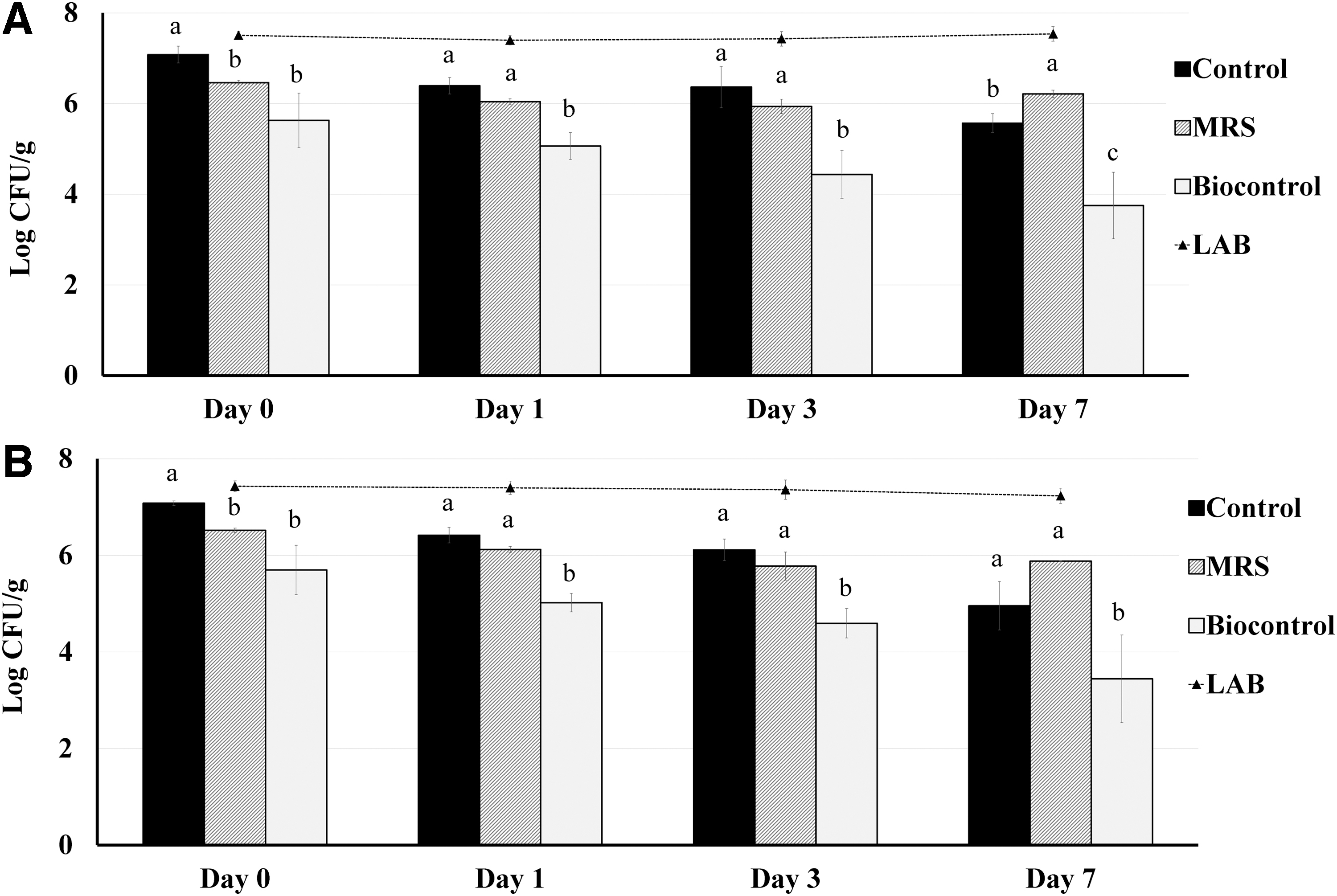
Effect of LAB treatments against Listeria monocytogenes on strawberries stored at
LAB exerted effective antibacterial activity against L. monocytogenes on strawberries throughout the entire storage period at both temperatures (p < 0.05). Listeria populations recovered from LAB-treated strawberries were significantly lower by 1.8 and 1.5 log CFU/g compared to that of control strawberries on day 7 at 4°C and 10°C, respectively. Washing strawberries with MRS broth alone did not significantly reduce L. monocytogenes during the 7-d storage at both temperatures, except on day 0 (p < 0.05). Populations of LAB were maintained at ∼7.5 log CFU/g during storage irrespective of the storage temperatures.
Effect of LAB treatment against S. enterica on strawberries
Antibacterial effect of LAB against Salmonella Newport, Salmonella Tennessee, and Salmonella Thompson on strawberries is shown in Figures 2 –4, respectively. Initial Salmonella populations (∼6 log CFU/g) on the control (pathogen-inoculated only) strawberries were significantly reduced to 3.5 ± 0.1, 3.7 ± 0.3, and 4.1 ± 0.1 log CFU/g for Salmonella Newport, Salmonella Tennessee, and Salmonella Thompson after 7 d of storage at 4°C, respectively.

Effect of LAB treatments against Salmonella Newport on strawberries stored at

Effect of LAB treatments against Salmonella Tennessee on strawberries stored at
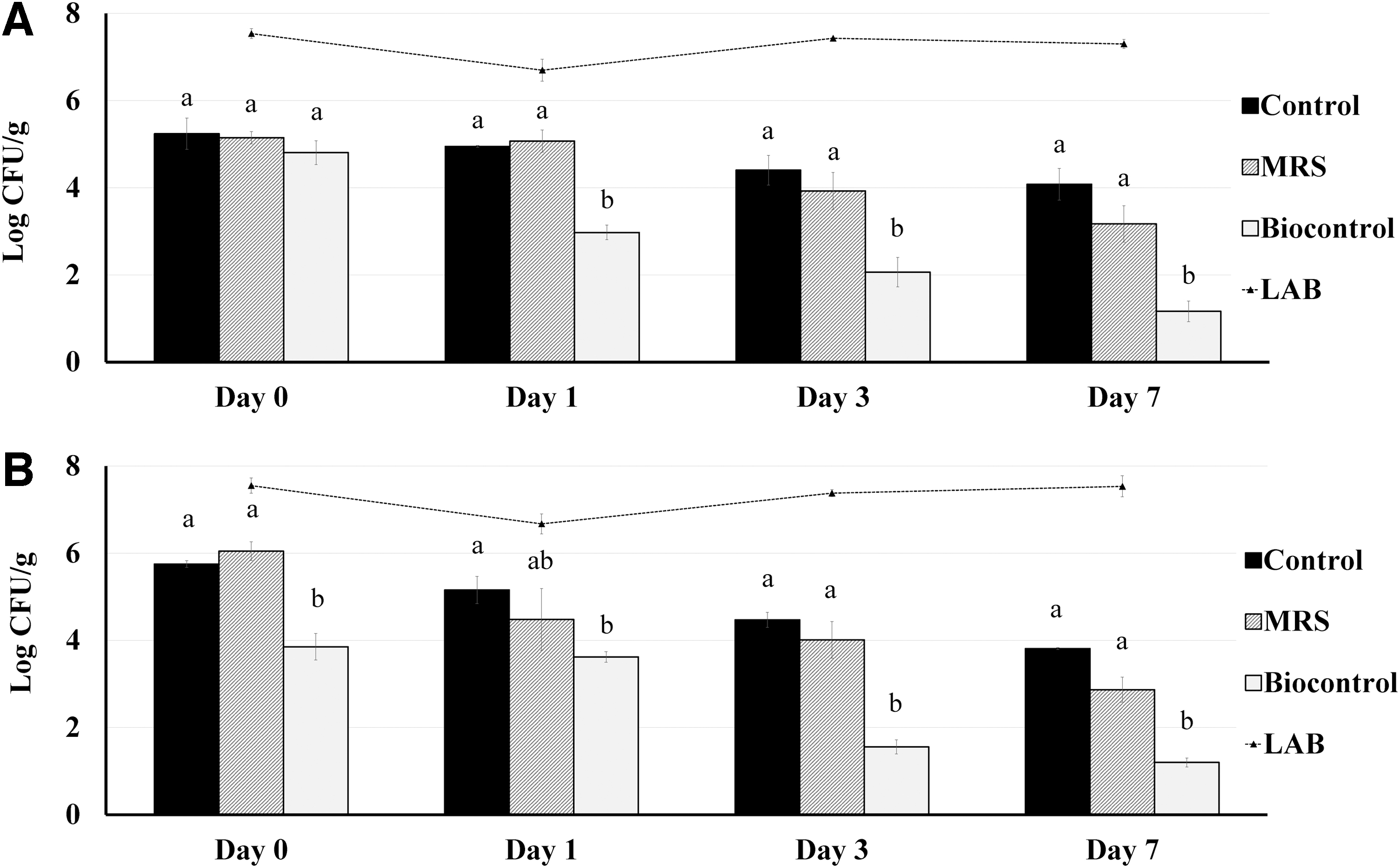
Effect of LAB treatments against Salmonella Thompson on strawberries stored at
Similar trend in Salmonella populations was observed in control strawberries stored at 10°C, in which 3.3 ± 0.1, 3.6 ± 0.3, and 3.8 ± 0.1 log CFU/g of Salmonella Newport, Tennessee, and Thompson were recovered after 7 d of storage at 10°C, respectively. There was no significant difference in Salmonella populations between the untreated control and MRS group regardless of the storage temperature throughout the entire storage period (p > 0.05).
LAB treatment significantly reduced populations of Salmonella Newport on the strawberries (Fig. 2) to 3.0 ± 0.2 and 1.0 ± 0.1 log CFU/g on days 1 and 7, respectively, at 4°C compared to the corresponding Salmonella populations of 5.4 ± 0.3 and 3.5 ± 0.1 log CFU/g on the control strawberries. At 10°C, Salmonella Newport populations on strawberries were significantly decreased by LAB treatment on day 7 by 2.3 log CFU/g compared to control (p < 0.05).
Salmonella Tennessee populations recovered from the LAB-treated strawberries were 1.4 log lower after 1 d of storage (Fig. 3) compared to control at 4°C (p < 0.05), and the LAB treatment further reduced Salmonella Tennessee populations by ∼2.7 log CFU/g strawberries on days 3 and 7. At 10°C, LAB treatment significantly reduced Salmonella Tennessee populations by 2.2–2.7 log CFU/g compared to the control strawberries throughout the entire storage period (Fig. 3). The LAB treatment also exerted significant antimicrobial effect against Salmonella Thompson on strawberries, in which 3.0 and 2.6 log CFU/g reductions in Salmonella Thompson were observed on day 7 at 4°C and 10°C, respectively, compared to control (Fig. 4). Approximately 7.5 log CFU/g of LAB populations were enumerated from the LAB-treated samples throughout the entire study.
Effect of LAB treatment on total yeast and mold on strawberries
Total yeast and mold populations recovered from the control strawberries were ∼4 log CFU/g on day 0, and slightly increased to ∼4.5 log CFU/g after 7 d of storage at 4°C, but not at 10°C, where the populations decreased to 4.2 logs (Table 1). The strawberries washed with MRS broth alone did not affect the total yeast and mold populations compared to the control regardless of the storage temperatures (p > 0.05).
Effect of Lactic Acid Bacteria Treatment on the Total Yeast and Mold Populations on the Strawberry During Storage at 4°C and 10°C
Fresh strawberries treated with MRS broth alone (MRS) or a mixture of lactic acid bacteria (Biocontrol). Untreated strawberries were included as control. Total yeast and mold were enumerated on PDA and DRBC agars. Results are mean values ± SEM expressed as log CFU/g.
Means with different superscripts in a column of the same agar type differ significantly (p < 0.05).
DRBC, Dichloran Rose Bengal Chloramphenicol; MRS, Man, Rogosa, Sharpe; PDA, potato dextrose agar; SEM, standard error of the mean.
LAB treatment significantly reduced total yeast and mold populations to be <3 log CFU/g immediately after treatment and on day 1 at both storage temperatures. The total yeast and mold populations gradually increased in control and LAB-treated strawberries during refrigerated storage of 4°C and 10°C; their populations in LAB-treated strawberries (3.2 log CFU/g on DRBC) were lower than in control (4.2 log CFU/g on DRBC) after 7 d at 10°C (p > 0.05).
Discussion
In this study, the antimicrobial activity of a combined LAB treatment that consisted of L. plantarum and P. pentosaceus against bacterial pathogens on strawberries during refrigeration storage was investigated. The antimicrobial activity of LAB strains used in this study has been described previously (Yin et al., 2020). A three-strain cocktail of L. monocytogenes was used in this study to ensure that the LAB treatment exhibited effective antimicrobial effect against different Listeria strains. As previously reported, since antimicrobial efficacy can vary with Salmonella serotype (Juneja et al., 2003; Snyder et al., 2019; Kumar et al., 2020), the three serotypes were individually used in this study to examine inactivation effects of antimicrobials on serotype.
Previous investigations have reported that S. enterica could survive on strawberry surface but not able to multiply, potentially due to the low pH or other intrinsic factors associated with fruit (Sreedharan et al., 2015; Wang et al., 2018). In the current study, populations of all Salmonella serotypes on the control strawberries declined by 1–2 log CFU/g within 3 d of storage at 4°C and 10°C. Our results of Salmonella reductions on untreated strawberries are similar to previously reported studies (Knudsen et al., 2001; Wang et al., 2018). Wang et al. (2018) reported a reduction of 1.4 log CFU/g in Salmonella Typhimurium on untreated strawberries during 3 d of storage at 4°C.
In addition, results of the current study revealed that populations of attached L. monocytogenes recovered from strawberries were ∼1 log CFU/g higher than the recovery of Salmonella on day 0 before the refrigerated storage. Similarly, Ziuzina et al. (2014) reported L. monocytogenes attachment at a higher level (∼7.5 log CFU/sample) on strawberries compared to Salmonella Typhimurium (∼6.5 log CFU/sample). A plausible explanation for lower attachment of Salmonella on strawberries could be due to the interactions between the bacterial pathogen and the indigenous epiphytic bacteria that have affected the survival of certain bacteria (Cooley et al., 2006; Ziuzina et al., 2014; Ortiz-Solà et al., 2020b).
Studies have suggested that LAB could remain biologically active on fresh produce as a postharvest intervention during refrigerated conditions (Snyder and Worobo, 2014; Olvera-García et al., 2015; Mokoena, 2017). In this study, LAB recovered from strawberries maintained at ∼7.5 log CFU/g throughout the entire storage period at both temperatures, indicating that these LAB strains were able to persist on strawberries for 7 d. Our results are in agreement with other studies, where L. plantarum populations remained stable on fresh-cut cantaloupe and pineapple flesh at the refrigeration temperatures for 7 d (Russo et al., 2014, 2015; Yin et al., 2020).
As foods are complex matrices with varied structures and nutritional components, the antimicrobial effect of LAB against pathogens could vary. Ramos et al. (2020) reported a 1.4–2.2 log CFU/g reductions in L. monocytogenes populations on fresh produce in the presence of P. pentosaceus during storage at 4°C. Another study by Siroli et al. (2015) stated that L. plantarum significantly inactivated E. coli O157:H7 and L. monocytogenes on sliced apple by ∼0.8 log CFU/g after 7 d of storage at 6°C.
Tenea et al. (2020) used antimicrobial peptides produced by L. plantarum and Lactococcus lactis and found a 1.4 log CFU/g reduction in Salmonella Infantis populations on pineapple slices after 5 d of refrigerated storage. Results of the current study showed that LAB cultures exhibited antimicrobial activities against Salmonella by ∼2.5 log CFU/g reductions and L. monocytogenes by ∼1.5 log CFU/g reductions on fresh strawberries at 4°C and 10°C storage.
The mechanisms of actions of LAB against foodborne pathogens have been attributed to the production of antimicrobial compounds and competence with target microorganisms (Linares-Morales et al., 2018). In this study, the overnight culture of LAB grown in the MRS was directly used as dipping treatments and exerted effective antimicrobial effects.
We have found that LAB grown overnight in the MRS containing both live LAB cells and the antimicrobial compounds exhibited greater antimicrobial effects against Listeria spp. on cantaloupes during storage compared to live LAB alone or cell-free supernatant alone (Yin et al., 2020). Studies have shown that Lactobacillus spp. and Pediococcus spp. could continuously produce organic acids and other metabolites during refrigeration storage in food products (Helland et al., 2004; Pérez and Saguir, 2012; Cauley, 2017); further studies are required to determine the active antimicrobials and the mechanisms of actions of these LAB on strawberries.
Russo et al. (2014) reported that inoculation of L. plantarum at ∼8 log CFU/g had no effect on sensory and physicochemical properties of pineapple pieces during storage at 5°C for 7 d. Similarly, Rößle et al. (2010) found that apple slices treated with Lactobacillus rhamnosus at 8 log CFU/g were well accepted by sensory panelist. Oliveira et al. (2021) reported that the incorporation of a LAB namely Bacillus coagulans did not affect the acceptability of dehydrated strawberries. Results of these studies suggest that LAB treatment may not adversely affect the sensory quality of fruits. The effect of a combined treatment of L. plantarum and P. pentosaceus on the sensory and physicochemical properties of strawberries requires further investigations to warrant the acceptability of LAB-treated strawberries.
Strawberry is a highly perishable fruit, and decay of strawberry caused by the growth of yeast and mold is an important factor that limits its shelf life (Wei et al., 2017). Results of the current study showed a reduction of total yeast and mold populations that were naturally occurring on the strawberries immediately after LAB treatment and during storage. Siroli et al. (2015) reported that the treatment with Lactobacillus paracasei reduced ∼1 log CFU/g of yeast populations on sliced apples after 16 d of storage at 6°C.
In this study, LAB strains were inoculated on strawberries by immersion in a dipping solution. As dipping/washing is a step frequently followed in the fresh produce facility to improve microbial quality of produce (Lukasik et al., 2003; Ortiz-Solà et al., 2020a), the LAB used in this study could be cultured in MRS broth and directly used as a dipping solution to apply LAB onto strawberries during the postharvest processing.
Conclusion
Results of this study revealed that L. monocytogenes and Salmonella serotypes Newport, Thompson, and Tennessee were able to persist on the strawberries during refrigeration conditions for the 7 d duration examined, suggesting potential public health concerns associated with fresh strawberries. The combined LAB treatment effectively killed these pathogens on strawberries by 1.5–3 log CFU/g at both 4°C and 10°C storage, supporting the use of LAB as an environmentally friendly biocontrol strategy at the postharvest level. The feasibility of the LAB treatment in a large-scale setting requires validation. Further investigations are required to investigate the effect of LAB on the quality of strawberries and to identify active antimicrobials produced by LAB.
Footnotes
Acknowledgments
Authors thank Suyeun Byun and Ashley Boomer for technical assistance. USDA is an equal opportunity provider and employer.
Disclosure Statement
No competing financial interests exist.
Funding Information
No funding was received for this article.