




Abstract
This study aimed to understand the epidemiological characteristics of foodborne disease outbreaks related to meat and meat products in China from 2002 to 2017. Data collected from the National Foodborne Diseases Surveillance System and searched databases were analyzed. From 2002 to 2017, China reported 2815 outbreaks caused by foodborne diseases related to meat and meat products, resulting in 52,122 illnesses and 25,361 hospitalizations, and 96 deaths. Outbreaks were markedly seasonal and concentrated from May to September, accounting for 66.93%. Outbreaks were concentrated mainly in China's eastern coastal and southern regions. Unidimensional attribution analysis revealed that livestock meat was the most commonly implicated food category causing the outbreaks, accounting for 28.67%. Bacteria were the most common pathogenic cause of outbreaks, accounting for 51.94%. Clostridium botulinum was the most common pathogenic cause of death, accounting for 34.38%. Improper processing was the most common contributing factor, accounting for 27.89%. Households were the most common food preparation location causing the outbreak, accounting for 34.39%. Two-dimensional and multidimensional attribution analysis found that Salmonella contamination occurred in different locations and regions, mainly caused by various contributing factors and improper processing. Nitrite poisoning is caused by improper processing in households in East China. Bacterial causes were the commonest agents associated with foodborne diseases related to meat and meat products, and improving the safety and quality of meat and meat product should be a priority.
Introduction
Foodborne disease is a public health problem worldwide, which places a heavy burden on medical resources and is associated with societal economic losses (Kirk et al., 2015; He and Shi, 2021). According to the World Health Organization (WHO), foodborne diseases occur in ∼600 million people worldwide each year, resulting in 420,000 deaths (Havelaar et al., 2015). The Centers for Disease Control and Prevention (CDC) estimate that ∼1 in 6 (or 48 million people) become sick, 128,000 are hospitalized, and 3000 die of foodborne diseases in the United States each year (Switaj et al., 2015; CDC, 2018).
Based on the incidence of 0.56 episodes of acute gastrointestinal illness (AGI) per person per year, it is estimated that there are 209 million cases of foodborne illness in China each year (Chen et al., 2013). As the actual fraction of AGI due to foodborne disease is unknown, extrapolation serves merely to include contexts from other studies.
The WHO has called for organizations in various countries to work together to establish a sound foodborne disease surveillance system, and China has made great efforts to improve its own system. Before 2011, outbreaks were reported through an inconvenient and straightforward web-based system. Starting in 2011, China's National Center for Food Safety Risk Assessment (CFSA) began establishing a foodborne disease surveillance system (Liu et al., 2018), including the Foodborne Disease Outbreak Surveillance Network, Foodborne Disease Case Surveillance Network, National Molecular Traceability Network for Foodborne Disease Surveillance (TraNet) (Li et al., 2018), and National Foodborne Disease Pathogenic Bacteria Drug Resistance Surveillance Network.
All provincial, municipal, and county-level disease control centers investigate foodborne disease outbreaks and submit outbreak reports using uniform standards following the requirements of the Food Safety Law (FSL, 2009). China's first Molecular Traceability Network for Foodborne Diseases based on whole genome sequencing was completed and put into use in 2019, which marked the development of China's foodborne disease surveillance system into a more complete and depth tool (Li et al., 2021).
As the dietary structure of Chinese citizens continues to change, the proportion of meat and meat products in their daily lives is increasing, and meat and meat products have become a significant source of foodborne diseases and public health problems (Fegan and Jenson, 2018). Meat and meat products (28.2%) were the most common food category causing foodborne illnesses in China (Li et al., 2020). Therefore, this study collated and analyzed foodborne disease outbreaks related to meat and meat products from 2002 to 2017 to understand the principal risk factors and epidemiological characteristics of foodborne disease outbreaks in China. This study aimed to provide countermeasures to optimize the prevention measures for foodborne diseases related to meat and meat products and to develop interventions that address the actual situation in China to ensure the food safety of meat and meat products and reduce the occurrence of foodborne diseases in China.
Materials and Methods
Data sources
Surveillance data
The National Foodborne Disease Surveillance System collected data on all foodborne disease outbreaks involving two or more illnesses or one or more deaths that the CDC at the provincial, municipal, and county levels nationwide participate in organizing and investigating. Data required for outbreak reporting included the reporting CDC, the date of occurrence, address of the outbreak region, the number of illnesses, hospitalizations, and deaths, implicated food vehicle, food categories, contributing factors, location of food preparation, and etiological agents (Li et al., 2020). Data on outbreaks in Hong Kong, Macao, and Taiwan were not collected in this system. Except for the Tibet Autonomous Region, 30 provinces, autonomous regions, and municipalities directly under the central government of China were included and 2336 foodborne disease outbreaks related to meat and meat products were reported by the National Foodborne Disease Surveillance System from 2002 to 2017.
Literature data
Using the subject terms “foodborne diseases,” “food poisoning,” and “outbreaks,” articles with occurrence dates from January 1, 2002, to December 31, 2017, were published publicly in major Chinese databases (China National Knowledge Infrastructure, Wanfang Database, China Science and Technology Journal Database, China Biology Medicine, etc.) and were searched. A total of 547 foodborne diseases related to meat and meat products were retrieved. EpiData 3.1 software was used for data entry and management, with double entry and verification, and the main items are the same as the national surveillance data.
Meat categories
Meat food includes the muscles and viscera of livestock and poultry animals and their products; common meat includes livestock meat and poultry meat. Livestock meat includes meat from pigs, cattle, sheep, horses, rabbits, and other animals; poultry meat includes meat from chickens, ducks and geese, and other animals; and animal viscera or thyroid mainly includes the heart, liver, kidneys, lungs, large and small intestines, and thyroid. China's Ministry of Health categorizes meat products according to their degree of processing into prefabricated meat products and cooked meat products (GB 2760-2007) (MHC, 2009).
Prefabricated meat products include livestock, poultry meat, or its edible byproducts as the primary raw material, which after processing, storage in low-temperature conditions, transportation, and sales, need to be cooked before consumption; cooked meat products include livestock, poultry meat, or its edible byproducts as the primary raw material, which after processing can be directly consumed (GB 2726-2016) (NHC and CFDA, 2016). Game meat are usually not raised on a farm and are allowed by law to be used for meat.
Data analysis
We combined surveillance data with literature data, and duplicates were checked for essential characteristics of outbreaks and excluded from the study; ultimately, 2815 outbreaks were analyzed. All relevant outbreak data were checked and analyzed using Excel 2013, and the map was performed using ArcGIS 10.8. Descriptive statistics was employed to analyze the outbreaks, illnesses, hospitalizations, and deaths in different provinces, autonomous regions, and municipalities directly over 16 years.
Results
Time and regional distribution
From 2002 to 2017, China reported 2815 outbreaks caused by foodborne diseases related to meat and meat products, resulting in 52,122 illnesses and 25,361 hospitalizations, and 96 deaths. Outbreaks were markedly seasonal and concentrated from May to September, accounting for 66.93% of total outbreaks, with August being the peak month, resulting in 539 outbreaks and 10,164 illnesses (Fig. 1).
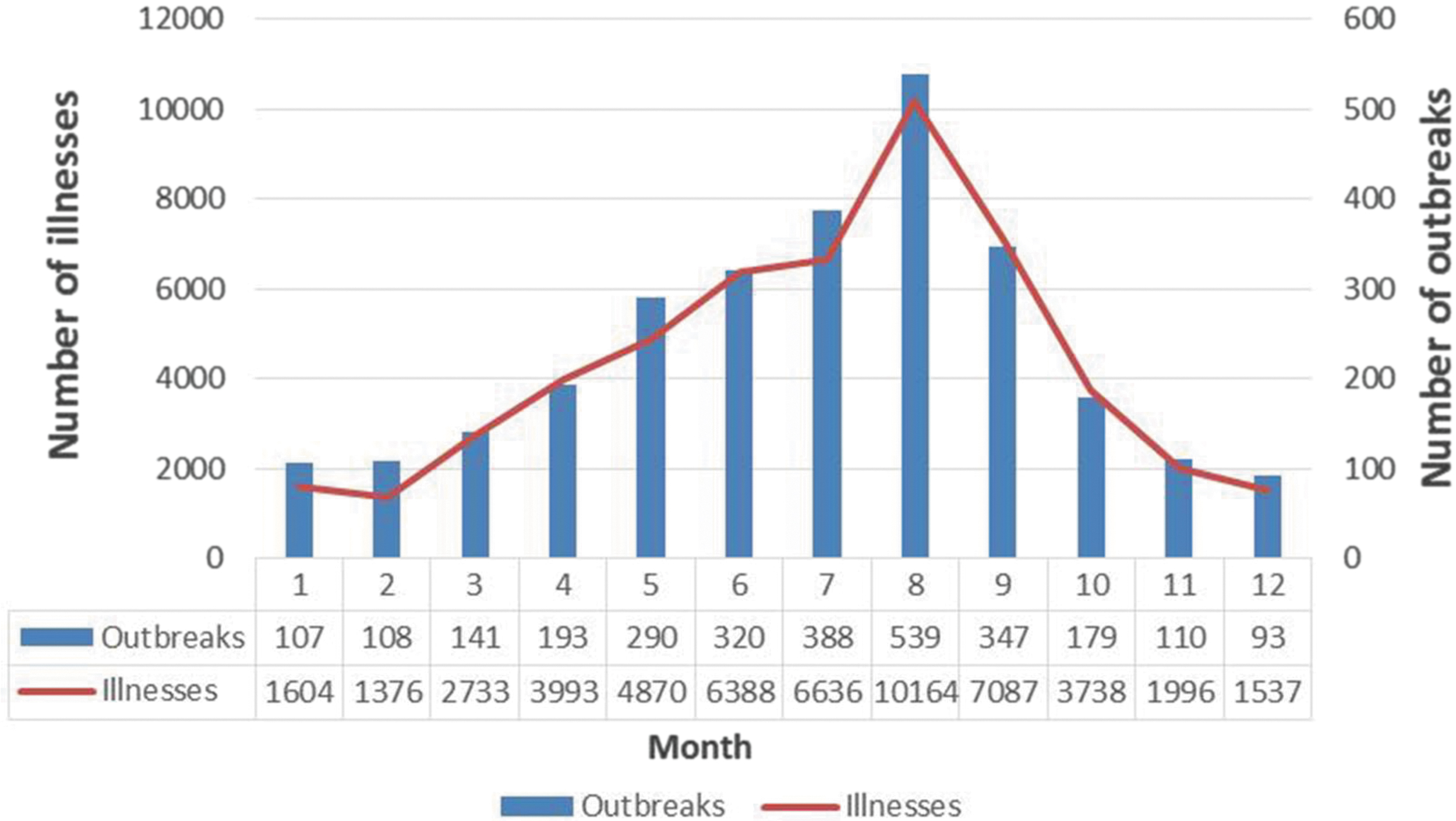
Number of foodborne disease outbreaks and cases related to meat and meat products reported monthly in China, 2002–2017.
Outbreaks were mainly concentrated in the eastern coastal region as well as in the southern region, with the most common provinces for outbreaks being Shandong Province (336), Jiangsu Province (193), and Guangdong Province (176). The most common provinces for illnesses were Jiangsu Province (3987), Yunnan Province (3951), and Guangdong Province (3796) (Fig. 2).
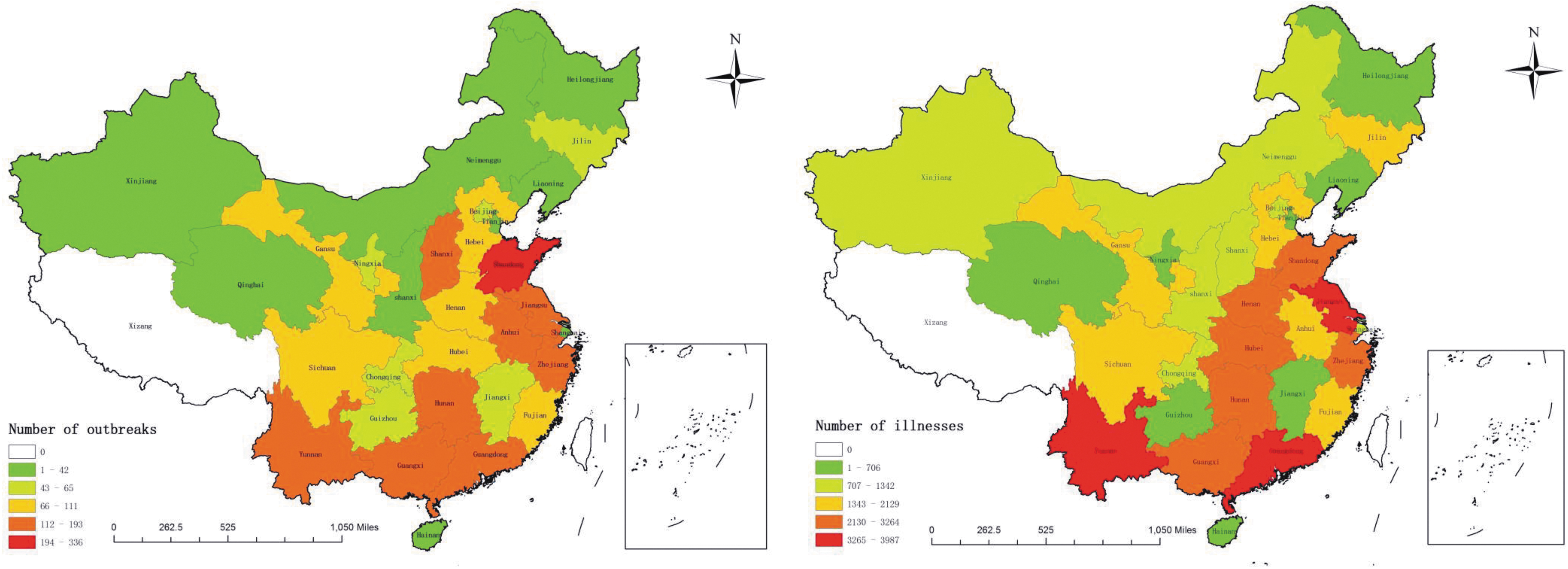
Number of outbreaks and illnesses of foodborne diseases related to meat and meat products by the province in China from 2002 to 2017.
Unidimensional attribution analysis
Foods
The food category most commonly associated with outbreaks was livestock meat (807, 28.67%), followed by poultry meat (600, 21.31%), prefabricated meat products (527, 18.72%), and cooked meat products (348, 12.36%). The food category most commonly associated with illnesses, hospitalizations, and deaths was livestock meat (13,339 illnesses, 25.59%; 6473 hospitalizations, 25.52%; and 39 deaths, 40.63%), followed by prefabricated meat products (10,587 illnesses, 20.31%; 4697 hospitalizations, 18.52%; and 24 deaths, 40.63%), poultry meat (10,216 illnesses, 19.60%; 4273 hospitalizations, 16.85%; and 9 deaths, 9.38%), and cooked meat products (6664 illnesses, 12.79%; 3625 hospitalizations, 14.29%; and 5 deaths, 5.21%).
Among livestock meat items, pork was the most common food item leading to outbreaks (393, 13.96%), illnesses (7415, 14.23%), and hospitalizations (3658, 14.42%), and beef (16, 16.67%) was the most common food item leading to deaths. Among poultry meat items, the chicken was the most common food item causing outbreaks (407, 14.46%), illnesses (7129, 13.68%), hospitalizations (3056, 12.06%), and deaths (6, 6.25%) (Table 1).
Number and Percentage of Foodborne Disease Outbreaks, Illnesses, Hospitalizations, and Deaths Related to Meat and Meat Products by Food Category in China, 2002–2017
Bold indicates not all values in a column are used to calculate the total (100%).
Etiologic agents
Among the etiological reports, bacteria were the most common cause of foodborne diseases related to meat and meat products, resulting in 1462 (51.94%) outbreaks, 38,581 (74.02%) illnesses, 19,037 (75.06%) hospitalizations, and 49 (51.04%) deaths, followed by chemical contaminants (387 outbreaks, 13.75%). Looking at individual causes, Salmonella was the most common cause of outbreaks (420, 14.92%), followed by Vibrio parahaemolyticus (240, 8.53%), Staphylococcus aureus (206, 7.32%), nitrite (201, 7.14%), Bacillus cereus (156, 5.54%), Escherichia coli (87, 3.09%), and banned drugs (84, 2.98%). Salmonella (13,374 illnesses, 25.66% and 7641 hospitalizations, 30.13%), V. parahaemolyticus (5953 illnesses, 11.42% and 2380 hospitalizations, 9.38%), B. cereus (4718 illnesses, 9.05% and 2113 hospitalizations, 8.33%), and S. aureus (3612 illnesses, 6.93%; 1412 hospitalizations, 5.57%) were the most common causes of illnesses and hospitalizations. Clostridium botulinum (33, 34.38%) was the most common cause of death, followed by nitrite (14, 14.58%) (Table 2).
Number and Percentage of Foodborne Disease Outbreaks, Illnesses, Hospitalizations, and Deaths Related to Meat and Meat Products by Etiology in China, 2002–2017
Bold indicates not all values in a column are used to calculate the total (100%).
Contributing factors
The most common contributing factors associated with outbreaks were improper processing (785, 27.89%), followed by various contributing factors (606, 21.53%), improper storage (232, 8.24%), and cross-contamination (225, 7.99%). The most common contributing factors associated with illnesses, hospitalizations, and deaths were various contributing factors, resulting in 16,638 (31.92%) illnesses, 9153 (36.09%) hospitalizations, and 23 (23.96%) deaths (Table 3).
Number and Percentage of Foodborne Disease Outbreaks, Illnesses, Hospitalizations, and Deaths Related to Meat and Meat Products by Contributing Factors in China, 2002–2017
Were defined as two or more contributing factors involving handling food that causes food poisoning.
Location
Among the reported outbreaks regarding the location of food preparation, households were the most common location, resulting in 968 (34.39%) outbreaks, followed by restaurants (686, 24.37%) and canteens (428, 15.20%). Restaurants were the most common location in terms of illnesses (14,055, 26.97%) and hospitalizations (7481, 29.50%). Households were the most common location in terms of deaths (65, 65.71%). Staff canteens were the most common type of canteens, resulting in 250 (8.88%) outbreaks, 6264 (12.02%) illnesses, 1747 (6.89%) hospitalizations, and 1 (1.04%) death (Table 4).
Number and Percentage of Foodborne Disease Outbreaks, Illnesses, Hospitalizations, and Deaths Related to Meat and Meat Products by Location in China, 2002–2017
Bold indicates not all values in a column are used to calculate the total (100%).
Two-dimensional attribution analysis
Food category—etiologic agents
Salmonella (125 outbreaks) and nitrite (60 outbreaks) were the most common causes of livestock meat contamination. Salmonella (102 outbreaks) and V. parahaemolyticus (73 outbreaks) were the most common etiologies leading to contamination of poultry meat. Salmonella (73 outbreaks), nitrite (56 outbreaks), V. parahaemolyticus (40 outbreaks), and S. aureus (36 outbreaks) were the most common causes of contamination of prefabricated meat products. Salmonella (60 outbreaks) and S. aureus (36 outbreaks) were the most common etiologic agents leading to contamination of cooked meat products. Banned drugs (38 outbreaks) were the most common cause of animal viscera or thyroid contamination (Table 5).
Attribution Analysis of Foodborne Disease Outbreaks Related to Meat and Meat Products in China from 2002 to 2017 Due to Food Category-Etiologic Agent
Contributing factors—etiologic agents
Various contributing factors and improper processing led to bacterial contamination of meat and meat products. Improper processing (102 outbreaks) was the most significant contributing factor to nitrite poisoning. Pollution or deterioration of raw materials (11 outbreaks) was the most important cause of foodborne illness related to meat and meat products due to banned drugs (Table 6).
Attribution Analysis of Foodborne Disease Outbreaks Related to Meat and Meat Products in China from 2002 to 2017 Due to Contributing Factor-Etiologic Agent
Multidimensional attribution analysis
Region—etiologic agents—location
Salmonella contamination occurred in different regions and locations, with the most significant outbreaks caused by households (34 outbreaks) in East China. V. parahaemolyticus contamination mainly occurred in restaurants (65 outbreaks) in East China. S. aureus contamination was primarily concentrated in East China, with the most occurrences in canteens (22 outbreaks) and restaurants (21 outbreaks). C. botulinum contamination mainly occurred in households (16 outbreaks) in the northwest. Nitrite contamination occurred in all regions, mainly in East China households (26 outbreaks). Foodborne diseases caused by banned drugs occurred mainly in households (24 outbreaks) in South China (Table 7).
Attribution Analysis of Foodborne Disease Outbreaks Related to Meat and Meat Products in China from 2002 to 2017 Due to Region-Etiologic Agent-Location
H* represents household.
R* represents restaurant.
C* represents canteen.
Discussion
During 1998–2008, an estimated 9.6 million foodborne diseases were assessed annually in the United States, and meat-poultry commodities (beef, game, pork, and poultry) attributed to 22.0%. Meat-poultry commodities accounted for 22.2% of the estimated 57,000 hospitalizations. Meat-poultry commodities accounted for 28.8% of the estimated 1451 deaths. China reported 2815 outbreaks of foodborne diseases related to meat and meat products, 52,122 illnesses, 25,361 hospitalizations, and 96 deaths from 2002 to 2017, which is much lower than the number of foodborne illnesses caused by meat and meat products reported in the United States from 1998 to 2008 (Painter et al., 2013). This may be related to the lack of mandatory surveillance by the foodborne disease surveillance system. The network reporting system was not well developed before 2011, resulting in many underreported foodborne diseases.
This was confirmed because the number of foodborne disease outbreaks between 2011 and 2017 was significantly higher than that between 2002 and 2010 (Li et al., 2020). Foodborne disease outbreaks related to meat and meat product are mainly concentrated during May–September and primarily concentrated in the eastern seaboard and the southern region because of the high temperature and humid climate during May–September in these areas, which are suitable for the growth and reproduction of pathogenic bacteria and other microorganisms.
Unidimensional attribution found that livestock meat was the most common food category linked to the outbreaks and illnesses, unlike the United States, where most foodborne disease outbreaks were associated with poultry (chicken) (Greig and Ravel, 2009; Dewey-Mattia et al., 2018). Bacteria were the essential etiological agents leading to foodborne diseases in meat and meat products. Salmonella was the most common bacteria causing outbreaks and illnesses, consistent with Omer et al. (Omer et al., 2018). The most common contributing factors associated with outbreaks was improper processing, and the most common contributing factors associated with illnesses, hospitalizations, and deaths were various contributing factors. The most common location of food preparation associated with outbreaks was the household, while the most common location of food preparation associated with illnesses was the restaurant, which was consistent with Li et al. (Li et al., 2020).
This study analyzed associations between food categories and etiologic agents, contributing factors and etiologic agents, and different regions, etiologic agents, and locations. Salmonella is a common pathogenic cause of foodborne illness worldwide and occurs in different locations and regions (Sun et al., 2021). The reason is related to the high ability of Salmonella to survive in the environment and survive in meat and meat products for more than several months (Milazzo et al., 2016). V. parahaemolyticus contamination was mainly found in restaurants in East China.
The reason was that the abundance of aquatic products in East China was vulnerable to V. parahaemolyticus contamination; restaurants that transport and store aquatic products and meat and meat products together often improperly disinfect kitchen utensils when processing and cooking aquatic products and then handle meat and meat products, resulting in the occurrence of cross-contamination (Geng et al., 2019). S. aureus contamination was mainly concentrated in East China's restaurants and canteens. S. aureus is widely distributed in nature and can grow in a wide range of temperatures (7°–48°) (Kadariya et al., 2014). East China's warm and humid climate makes it easy for S. aureus to grow and multiply due to improper processing, improper storage, and various contributing factors.
Botulism occurred mainly in households in the northwest. C. botulinum is bacteria that can grow and reproduce in an anaerobic environment with proper nutrition and produce botulinum toxin, the most potent natural biotoxin with a lethal dose of 0.1–1 ng/kg in humans (Arnon et al., 2001; Pernu et al., 2020). The northwest was prone to the growth and multiplication of C. botulinum due to its particular geographical location and dietary habits, improper processing and improper storage, and various contributing factors. Nitrite poisoning was seen in all regions, mainly in households and restaurants. Since 2012, nitrites have been banned from purchasing, storing, and using them in Chinese food service establishments. However, poisonings from the illegal use of nitrites continue to occur (MHA and CFDA, 2012).
Nitrite is a common food preservative and color preservative, which is not according to national standards (GB2760-2014) during use (NHC, 2014; Cvetkovic et al., 2019), resulting in excessive nitrite content in meat products. Second, nitrites are misused as ordinary salt leading to food poisoning in households and restaurants. Food poisoning caused by banned drugs occurs mainly in households in Southern China associated with consuming animal viscera or muscles contaminated by banned drugs. The most common banned drug was clenbuterol. Since 1997, clenbuterol has been strictly prohibited in livestock production, but clenbuterol poisoning still occurs occasionally. Therefore, we suggest that food regulatory authorities strengthen the management of nitrites and banned drugs.
The findings of this report are subject to at least four limitations. First, before 2011, there was no mandatory reporting to the foodborne disease surveillance system, and there was a certain amount of underreporting, which means that the supervisory abilities of this system should be strengthened. Second, some foodborne diseases were self-limiting and caused mild symptoms, so they were rarely identified or reported. Third, unknown food categories and etiologic agents make up a large part of this study, so an accurate picture of outbreaks was limited. Fourth, in the attribution analysis, only primary etiologic agents were analyzed. Future studies should expand the scope to be specific to each etiologic agent and look at single large-scale outbreaks in detail.
Conclusions
This study summarizes the foodborne disease outbreaks related to meat and meat products in China from 2002 to 2017. By combining national surveillance data with literature data, we provided a more comprehensive study of the epidemiological characteristics of foodborne disease outbreaks related to meat and meat products in China. We link food categories, etiologic agents, contributing factors, locations, and regions through attribution analysis and provide references for relevant departments to develop more targeted foodborne disease prevention strategies. In China, bacteria are the most critical pathogenic factors, so localities should strengthen meat and meat product regulation according to the epidemiological characteristics of foodborne disease outbreaks related to meat and meat products.
As the actual location of food preparation, households are involved in the health and safety of every resident. The food safety awareness of residents should be improved by strengthening food safety health education, thus reducing the occurrence of foodborne diseases related to meat and meat products.
Footnotes
Acknowledgments
The authors extend their gratitude to all foodborne disease detection systems and associated personnel for their hard work.
Authors' Contributions
J.Z.: data collation and analysis, methodology, and writing. H.C.: literature data collection and entering. Z.W.: literature data collection and entering. P.F.: surveillance data collection and curation. Y.G.: surveillance data collection and project administration. S.Y.: literature data collection and supervision, and project administration.
Disclosure Statement
No competing financial interests exist.
Funding Information
This article was funded by the National Key Research and Development Program of China (Grant number 2017YFC1601502).