




Abstract
Streptococcus suis is an important zoonotic pathogen that poses a serious threat to the pig industry and human health. The massive use of macrolides has led to the emergence of resistance in S. suis, and S. suis is suspected to be a reservoir of antimicrobial resistance genes. The mechanism to macrolide resistance in S. suis is mainly due to ermB and mefA. In this study, loop-mediated isothermal amplification (LAMP) methods were developed to detect ermB and mefA genes in S. suis through turbidimetry detection. The sensitivity and specificity of the LAMP reactions were determined. All results of LAMP and polymerase chain reaction (PCR) assay were compared to determine whether LAMP method was accurate and reliable. The results showed that all 100 nonstreptococcus clinical isolates tested negative, indicating the high specificity of LAMP assays. The detection limit of LAMP assay was 1 fg per reaction, and 102–104-fold lower than those of conventional PCR methods. Evaluation of the performance of the LAMP assay in S. suis clinical strains revealed a good consistency between LAMP and PCR assays. In conclusion, LAMP assays are specific, sensitive, and rapid methods to detect ermB and mefA in S. suis.
Introduction
S
Macrolides have been used as a growth promoter for prophylaxis of streptococcal disease in swine (Wisselink et al, 2006), and this may have led to the drug resistance of macrolides in some countries. The first report of macrolide resistance in S. suis was a retrospective study of historic pig isolates during a 15-year span in Denmark, which indicated macrolide resistance had begun in the early 1980s (Aarestrup et al, 1998). Since then, resistance to erythromycin in pigs has been reported worldwide, for example, the resistance rate was 87% in Spain (Vela et al, 2005), 66% in Belgium (Callens et al, 2013), and 46% in England (Hernandez-Garcia et al, 2017).
In China, the resistance rates of S. suis to erythromycin increased rapidly from 34.78% to 67.29% between 2014 and 2020, respectively (Huang et al, 2015; Tan et al, 2021). In humans, resistance of clinical S. suis isolates to macrolides has also been acknowledged, with higher prevalence in Thailand (92.4%) (Bamphensin et al, 2021) than previous studies in Hong Kong and southern Vietnam (∼20%) (Hoa et al, 2011; Ma et al, 2008).
Resistance to macrolide is mainly attributed to ribosomal methylase encoded by erm genes or macrolide efflux protein encoded by mef genes. Among the numerous erm genes, ermB gene was the most common gene in macrolide resistance S. suis and associated with macrolide–lincosamide–streptogramin B (MLSB) resistance phenotype (Holden et al, 2009; Martel et al, 2001). Whereas the mefA gene was associated with the resistance to 14- and 15-membered macrolides (known as M resistance phenotype) (Leclercq, 2002).
So far, only polymerase chain reaction (PCR) methods have been used to detect ermB and mefA genes in S. suis (Martel et al, 2001; Zhang et al, 2015), but PCR assays need expensive PCR instruments and gel imaging systems, and these instruments are not available in many places. To overcome the limitations of current PCR, loop-mediated isothermal amplification (LAMP) is more rapid and simple to perform (Notomi et al, 2000).
To date, few studies have been conducted to detect S. suis (Arai et al, 2015; Huy et al, 2012), serotype 2 (Zhang et al, 2013), and three virulence genes (mrp, epf, and sly) (Li et al, 2021) by the LAMP. In this study, simple, rapid, specific, and sensitive LAMP assays for detection of ermB and mefA genes were developed, and applied to investigate the frequency of these two genes among the clinical isolates in China.
Materials and Methods
Bacterial strains and genomic DNA extraction
Two S. suis strains (S41, ermB positive; S78, mefA positive) used for the optimization of LAMP assay were isolated from pig farms in Guangdong Province, China. In total, 160 known bacterial strains, including 100 nonstreptococcus strains (20 Staphylococcus aureus strains, 20 Enterococcus faecalis strains, 20 Escherichia coli strains, 20 Klebsiella pneumonia strains, and 20 Salmonella enteritidis strains) and 60 S. suis strains, were cultured and used in this study. In total, 100 nonstreptococcus strains were used to evaluate the specificity of LAMP assays (exclusivity test); the other 60 S. suis strains were included to apply the established LAMP assays for detection (inclusivity test).
All of the S. suis strains were cultured on Todd–Hewitt agar with 5% sheep blood. The other nonstreptococcus strains were cultured on Luria–Bertani agar. The susceptibility of 60 S. suis strains to erythromycin was determined by the agar dilution method according to the Clinical and Laboratory Standards Institute (CLSI, 2020). S. aureus ATCC 29213 was used as the quality control strain.
The genomic DNA extraction was performed according to the manual of Bacteria Genome Extraction Kit (Tiangen Biotech Co., Ltd). The concentration of the genomic DNA was measured by Nanodrop 2000 (Bio-Rad).
LAMP primer design and LAMP reaction
LAMP primers were designed using the PrimerExplorer V5 software based on the NCBI database sequences of ermB (738 bp, GenBank ID: NC_012926.1) and mefA (1218 bp, GenBank ID: KX077898.1). A cluster of primers were generated for ermB and mefA, respectively, including outer primers (F3 and B3) and inner primers (FIP and BIP). If we need to accelerate the reaction, loop primers (LF and LB) could be designed and added. The detailed information of primers is presented in Table 1.
Primers Used in This Study
LAMP, loop-mediated isothermal amplification; PCR, polymerase chain reaction.
The LAMP assays were carried out in a reaction mixture with a total volume of 25 μL containing 40 pmol (each) of the primers FIP and BIP, 5 pmol (each) of the primers F3 and B3, 20 pmol of the loop primer, 12.5 μL of 2 × reaction mixture, 1.0 μL (8 U) of Bst DNA polymerase, and 2.0 μL of target genomic DNA by using the Loopamp DNA Amplification kit (Eiken Chemical Co., Ltd., Shanghai, China).
PCR assay to detect the resistance genes ermB and mefA
As a comparative method for gene detection, PCR was performed using a TaKaRa PCR Amplification Kit (Takara Bio, Inc., Shiga, Japan) in a total volume of 25 μL containing 10 μL of 2 × Taq PCR buffer, 1 μL forward primer (10 μM), 1 μL reverse primer (10 μM), 2 μL of sample DNA, and 11 μL of distilled water (DW). Primer sequences of ermB and mefA for PCR assays are given in Table 1, and PCR cycling conditions were detailed in a previous study (Sutcliffe et al, 1996). All PCR products were analyzed through a 1.2% agarose gel by electrophoresis.
LAMP assay
To monitor the turbidity of reaction tube in real time, a real-time turbidimeter (Loopamp LA-320C; Eiken Chemical Co., Ltd) was used to read the optical density at 650 nm (OD650) at 6 s intervals. For ermB gene, each mixture was incubated at 63°C for 60 min and then heated at 80°C for 5 min to terminate the reaction. For mefA gene, the reaction temperature was 62°C.
Sensitivity of LAMP assay
The concentrations of genomic DNA from two isolates (S41 and S78) were adjusted to 10 ng/μL with DW. To determine the sensitivity of each LAMP assay, purified genomic DNA templates were detected through 10-fold serial dilution. In addition, PCR assays were performed using the same DNA templates. These experiments were done in duplicate.
Ethical statement
No animal-related tests were involved in this study, and the samples were provided by the farm owners who volunteered to participate in the study. All procedures were approved by the Animal Care and Use Committee of Shandong Academy of Agricultural Sciences (IASVM-2021-015).
Results
The sensitivity of LAMP and PCR assays
To compare the sensitivity of the LAMP and PCR assays, a series of 10-fold dilutions of template DNA was used, ranging from 1 ng per reaction to 0.1 fg per reaction. For sensitivity, the limit of detection is the lowest concentration that can be detected using the LAMP method. The results showed that the detection limit for the LAMP assay was 1 fg per reaction for both ermB and mefA (Fig. 1A, B). In comparison, the detection limits of PCR assays were 10 pg per reaction for ermB and 100 fg per reaction for mefA (Fig. 1C, D).
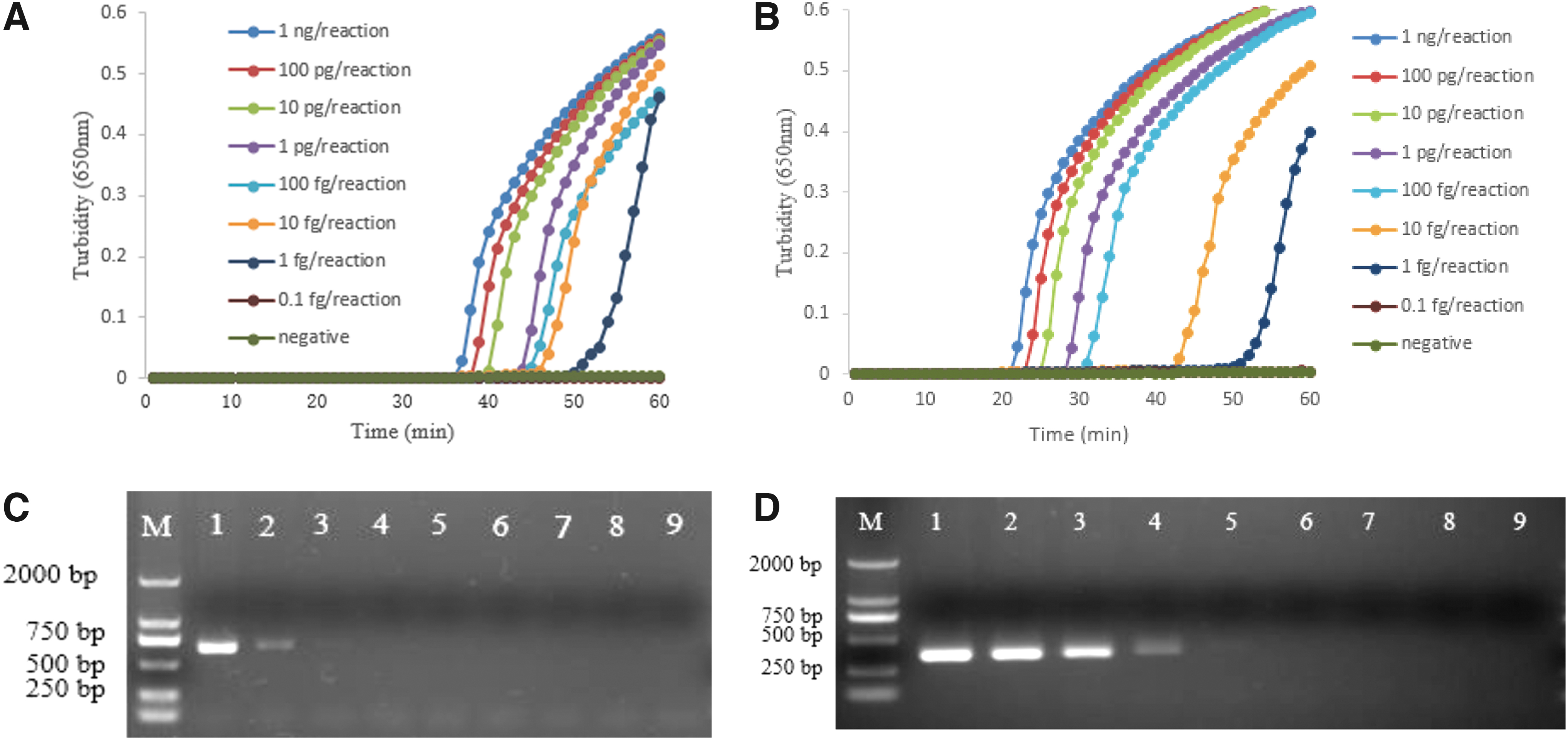
Sensitivity of LAMP and PCR assays.
Therefore, the sensitivities of the LAMP assays for ermB and mefA were 102–104 times lower than those of the PCR. In addition, the reaction time was 38 min for 1 ng per reaction and 54 min for 1 fg per reaction in the case of ermB, whereas the respective times were 23 and 54 min for mefA (Fig. 1A, B).
The specificity of LAMP assays in clinical isolates
In this study, 100 nonstreptococcus clinical isolates (including 5 bacterial species) were used to evaluate the specificity of LAMP assays. By detecting the turbidity of the reaction tube, ermB and mefA genes only could be detected in the known positive S. suis clinical strains (S41 and S78), no false positive amplification could be detected in other strains.
Application of LAMP assays in clinical S. suis isolates
According to the results of antimicrobial susceptibility testing, 55 strains were resistant to erythromycin. Minimum inhibitory concentrations of erythromycin are presented in Table 2. When LAMP assays were used to detect the resistance genes, 36 strains (60%) were positive for ermB, 11 strains (18.33%) positive for mefA, and 7 strains (11.67%) possessed both the ermB and mefA genes. These results were consistent with those of PCR assays (Table 2).
Clinical Streptococcus suis Isolates Evaluated
Unknown means that the strain carries neither the ermB nor the mefA gene.
MIC, minimum inhibitory concentration; R, resistant; S, susceptible.
Discussion
S. suis has been found in the upper respiratory tract of healthy pigs, and in recent years, it has been isolated from birds, mammalian species (excluding pigs), and the environment (Gottschalk et al, 2010). The resistance of S. suis can be transferred not only to humans, but also to other human streptococcal pathogens, such as S. pneumonia, S. pyogenes, and S. agalactiae (Palmieri et al, 2011). Macrolide resistance is common among streptococcus strains, and there are significant associations with the resistance to tilmicosin and three common virulence-related genes (mrp, epf, and sly) (Li et al, 2012). So it is imperative to monitor the resistance of macrolides in S. suis.
Thus, to meet the challenge, this study developed LAMP-based methods to detect ermB and mefA genes with high sensibility and specificity based on the actual situation in China. These two genes have been shown to be significantly associated with resistance phenotype. So the LAMP assays can be used not only to predict the phenotype of macrolide resistance, but also to detect the mechanism of macrolide resistance. The data presented in this study suggested that the developed LAMP assays are better than the PCR method, which will benefit clinical laboratories with the earlier detection.
LAMP assays have been applied to detect the macrolide resistance, such as msrA gene in S. aureus (Mu et al, 2016), erm(41) in Mycobacterium abscessus and Mycobacterium massiliense (Liu et al, 2019), and ermB gene in Clostridium difficile (Lin et al, 2015). The sensitivity of LAMP assays we developed in this study was 1 fg/μL, and is more sensitive than the mentioned studies.
When LAMP assays in this study were applied to clinical strains, the prevalence of ermB and mefA genes was 60% and 18.33%, respectively. This prevalence is higher than that of one study in Korea (Gurung et al, 2015), and lower than those of other studies in Japan and China (Huang et al, 2015; Southon et al, 2020; Zhang et al, 2015). In addition, seven strains carried both genes. The coexistence of the two genes was also found in three previous studies (Gurung et al, 2015; Huang et al, 2015; Ichikawa et al, 2020).
Though the detection of ermB and mefA genes by LAMP assay is rapid and accurate, there are some limitations. With regard to LAMP assays for the detection of resistance genes, the ultimate purpose is to apply in clinical samples. The LAMP assays established in this study could not be used for the direct detection from clinical samples. On the premise of culturing bacteria, if there is a rapid method or kit to extract bacterial DNA, this LAMP assay has a significant advantage over the PCR method. More work is required to apply LAMP assays for the gene direct detection in clinical samples.
Conclusions
LAMP is a simple and rapid method for the detection of resistance genes. The LAMP assays we established could successfully detect ermB and mefA with a detection limit 1 fg per reaction within 60 min. We anticipate this LAMP assay could be helpful to control the epidemic and spread of bacteria that contain ermB and/or mefA gene. To our knowledge, this is the first study to report the LAMP detection of ermB and mefA in S. suis.
Footnotes
Authors' Contributions
L.L. contributed to conceptualize the article, review relevant literature, and writing. J.R. and Q.Z. were responsible for getting familiar with the primer design process and designing related primers. Y.L., Y.Z., and J.Q. facilitated the data collection, and sample testing was done by L.L. J.R., X.Z., and M.H. assisted with the data analysis and interpretation of results. L.L. and Y.L. contributed to the construction of the article.
Disclosure Statement
No competing financial interests exist.
Funding Information
This study was supported by the National Key Research and Development Program of China (2019YFA0904002), Major Scientific and Technological Innovation Projects in Shandong Province (2019JZZY010719), and Open subject of State Key Laboratory of Infectious Disease Prevention and Control, China (2019SKLID317).