




Abstract
The cuisine of the Balearic Islands (Spain, southern Europe) has several products of a great tradition, recognized worldwide and covered by European Union quality schemes, such as Protected Designation of Origin (PDO) and Protected Geographical Indication (PGI). Among them, the most emblematic products are sobrasada de Mallorca (a type of raw curated pork meat), ensaimada de Mallorca (pastry product), and Mahón-Menorca cheese (cow's milk cheese). During 4 consecutive years (2018–2021), the presence/absence of Escherichia coli β-glucuronidase positive (henceforth as E. coli), Listeria monocytogenes, Salmonella spp., and Staphylococcus aureus in these products has been monitored, as well as the total yeast and mold count in ensaimada de Mallorca. The results of the microbiological analysis showed that sobrasada presented similar microbiological patterns to those of other raw curated meat products (some presence of E. coli and L. monocytogenes). Furthermore, the sobrasada de Mallorca made with white pork tended to be positive in E. coli compared to other sobrasada subtypes. In the case of ensaimada, only a reduced number of cases within filled ensaimadas (with higher moisture content) presented unacceptable mold and yeast counts (>500 colony-forming unit [CFU]/g). Finally, the Mahón-Menorca cheese presented a surprising microbiology pattern: higher E. coli contamination in the pasteurized milk cheese compared to its raw counterpart. This pattern was observed for all the years, being statistically significant in 2020. This study has detected good microbiological status in the three traditional products studied. However, worrisome issues in Good Hygienic Practices have been detected for some companies that produce pasteurized milk Mahón-Menorca cheese under the PDO quality label. The companies involved and even the competent authorities should address these problems to correct this deviation in food security.
Introduction
Foodborne pathogens significantly affect food safety and cause many human infectious diseases worldwide, also in high-income countries (Abebe et al, 2020; Boone et al, 2021). In 2019, the European Food Safety Authority (EFSA) reported 5175 outbreaks of food poisoning linked to pathogenic microorganisms from foods marketed in the European Union (EFSA, 2019). These data should be taken with caution, bearing in mind that there may be many more cases, since not all outbreaks are reported and, in many cases, the causative agent is not identified. Therefore, Good Hygiene Practices (GHP), Good Manufacturing Practices (GMP), and the implementation of a specific hazard analysis and critical control points (HACCP) for each food type and for each processing system are tasks that still require worldwide attention.
Since 1991, the European Union has created a food quality policy to protect the names of certain products and to promote their unique characteristics linked to their geographical origin and traditional knowledge: the geographical indication label (GI). The GI recognition allows consumers to trust and distinguish quality products, while helping producers to better market their products and assisting them with intellectual property rights. Furthermore, there is substantial evidence that Southern Europe consumers are well aware of the existence and importance of EU GI labels (Albuquerque et al, 2018) and their relationship to food quality, sensory perception, and consumer acceptance (Jarma Arroyo et al, 2020; Prache et al, 2022).
The GI comprises three categories: Protected Designation of Origin (PDO), Protected Geographical Indication (PGI), and GI. The first food products registered under that system as PGI were in 1996 for the meat product from the Spanish island of Mallorca (Sobrasada de Mallorca) and Mahón-Menorca cheese (Menorca Island, Spain) along with a wide range of French cheeses (see eAmbrosia web). This study examines whether three different GI-labeled products from the Balearic Islands (Spain) (Table 1) are microbiologically safe.
Main Characteristics of the Products Evaluated
FMFMGS, filling made from Malabar gourd and syrup; PDO, Protected Designation of Origin; PGI, Protected Geographical Indication.
To the best of our knowledge, no study has been focused on the microbiological quality of these traditional products of the Balearic Islands, commercialized and known worldwide. This study tries to fill this gap by providing results on the microbiological state of the final product (ready-to-eat) of these three typical foods studied for 4 consecutive years (2018–2021) from samples from Balearic Island food companies. This strategy allowed us to have a more accurate (nonexperimental) snapshot of the microbiological quality of these three typical foods.
Materials and Methods
To carry out this study, the analytical results of finished product samples (ready-to-eat) were collected for 4 consecutive years (2018–2021) from different subtypes of sobrasada/ensaimada/Mahón-Menorca cheese-producing companies located on the islands of Mallorca and Menorca (Spain).
Two types of sobrasada were analyzed according to the origin of the meat (Porc negre [Balearic islands pig breed] or white pork), two types of Mahón-Menorca cheese according to the type of milk (pasteurized or raw), and two types of ensaimada according to its filling (with or without filling).
The samples were sent by the producers or collected by technicians from an accredited laboratory based in Palma de Mallorca (see below for further details) and transported to laboratory facilities in isothermal containers at temperatures below 8°C (if refrigeration was required), monitored by a data logger. In detail, 1349 sobrasadas, 199 ensaimadas, and 1075 Mahón-Menorca cheese samples were analyzed in this study.
All analyses were performed at the Cidesal Análisis de Alimentos laboratory facilities in Palma de Mallorca. It is an independent laboratory with more than 25 years of experience in agri-food and environmental analysis, technical consultancy, and hygienic-sanitary training. It is registered in the Registry of Environmental Health and Food Safety Laboratories of the Balearic Islands and, since 2009, has been accredited by ENAC (Spanish accreditation agency recognized by European Accreditation, International Laboratory Accreditation Cooperation, and International Accreditation Forum) for a wide range of physical-chemical and microbiological analysis for different matrices. These included the following microbiological tests on which this study is focused: Staphylococcus aureus and Escherichia coli in cheese, meat products, and pastry products; Listeria monocytogenes, total yeast and mold count (TYMC) and Salmonella spp. in foods; and sulfite-reducing Clostridia in meat and pastry products.
Table 2 summarizes the microbiological parameters analyzed for each food matrix and its subtypes with the analytical method followed. All methods used come from the International Organization for Standardization (ISO) or its French (AFNOR, Association Française de Normalisation) or Spanish counterpart (AENOR, Asociación Española de Normalización y Certificación). Supplementary Document S1 briefly details all the microbiological methods used.
Microbial Parameters and Analytical Methods Used by Each Type of Product
FMFMGS, filling made from Malabar gourd and syrup; ISO, International Organization for Standardization; TYMC, total yeast and mold count.
Statistical analysis
Data analysis was performed using R statistical software, version 4.1.2 (R Core Team, 2022). Once descriptive statistics of the data was performed, specific variables of microbiological tests with enough data (see Results section) to perform more informative statistical analysis were selected. To tackle this statistical analysis with categorical variables, a two-predictor logistic regression model was fitted for each one of the microbiological analytical results (binary response variable: not detected or detected). Logistic regression is an excellent statistical approach when we have to model a dichotomous outcome variable, as is our case (presence/absence of the microorganism) (Hosmer and Lemeshow, 2000). Briefly, we had two predictor (independent) variables: year of production and type of food matrix, and the predicted (dependent) variable was the microorganism presence or absence.
Logistic regression models were performed using the glm() function, used to fit as a generalized linear model (GLM). The best logistic regression model was selected for its Akaike information criterion (AIC) value, and the anova() function was used to compare the models using the Chi-square test. In some cases, consideration of the interaction between the two predictor variables (Year and Type) did not improve the model. Some summary logistic regression plots were performed through ggplot function from ggplot2 package and plot_model function from sjPlot package.
The goodness-of-fit for our obtained logistic regression models was tested using the Hosmer-Lemeshow test, a statistical goodness-of-fit test for logistic regression models. The hoslem.test() function of the ResourceSelection R package (Lele et al, 2019) and HLgof.test() of the MKmisc R package (Kohl, 2021) were used for that purpose. In all cases, a p-value >0.05 was obtained, demonstrating the goodness-of-fit of our selected models. Moreover, it has been verified [using the vif() R function] that there was no multicollinearity. It was tested for its absence within our two independent variables, as multicollinearity is undesirable because it undermines the model's performance, and the statistical significance of the independent variable is affected.
Having more than one predictor variable, and to find if there were statistically significant differences between the presence of certain microorganisms in the specific food type and year, a post-hoc analysis was carried out, performing all pairwise comparisons with an adjusted Bonferroni p-value. A significance level of 0.05 was used throughout the statistical analysis.
Results
All the samples analyzed for each year according to their food type and subtype are depicted in Figure 1. The vast majority of the sobrasada sample type was of the white pork subtype. About ensaimada, the filled ones were the most common subtypes analyzed for all consecutive years. Concerning cheese, during the 4 years studied, it has been observed that there is a tendency to increase raw cheeses toward pasteurized ones.
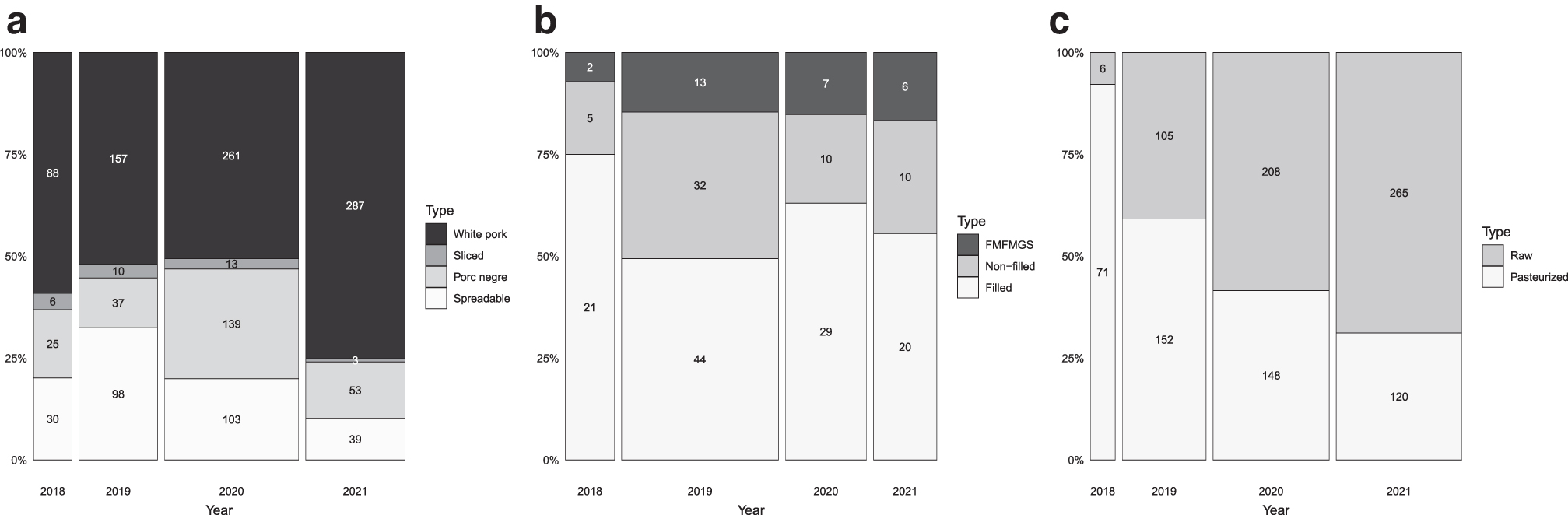
Samples number of
From the raw results obtained from microbiological analysis, Table 3 summarizes the descriptive statistics for all microbiological data collected in this study. As can be seen, for each staple food, type and year, the counts of samples with presence and not detected are indicated for each microorganism. In addition, a column with the total analyzed samples and not analyzed samples is also detailed. For some food staples, the microbiological analysis was scarce (e.g., ensaimada), and in general terms, the parameters of coliforms, S. aureus, and. Clostridia were the least determined (shallow analysis performed). Consequently, except for S. aureus in cheese, those data were not considered further in the study (logistic regression) due to their residual importance. Among all products, the ensaimada of Mallorca has been the least contaminated traditional specialty in microbiology terms, with only a few molds and yeasts detected, especially in the filled ensaimada subcategory (Table 3).
Descriptive Statistics for All Microbiological Data Collected
TA = D + ND.
D, presence; FMFMGS, filling made from Malabar gourd and syrup; n, number of samples; NA, not analyzed; ND, not detected; TA, total analyzed; TYMC, total yeast and mold count.
Focusing on those microbiological parameters with enough data collected, logistic regression was carried out to find out possible statistically significant differences. Table 4 summarizes the final logistic regression models selected (according to the Materials and Methods section) for a particular microorganism test. Specifically, E. coli for sobrasada (model A) and cheese (model C), L. monocytogenes for sobrasada (model B), and S. aureus for cheese (model D).
Logistic Regression Models Selected with Their Estimates, Parameters, and Post Hoc Analysis Performed by Pairwise Comparison (Bonferroni p-Adjusted Value)
Only statistically significant pairwise comparisons are depicted on the table.
p < 0.05, ** p < 0.01, *** p < 0.001.
AIC, Akaike information criterion. Model A: E. coli for sobrasada; Model B: L. monocytogenes for sobrasada; Model C: E. coli for cheese, and S. aureus in cheese.
The other microbiological tests detailed in Table 3 were not subjected to logistic regression analysis due to the small number of analyses available, as indicated above. Table 4 is accompanied by the coefficients for each model along with the AIC value, log-likelihood, deviance, and the n value. In addition, at the bottom of the table, only the significant results of the post-hoc analysis by pairwise comparison (Bonferroni p-adjusted value) were represented. Supplementary Figures S1 and S2 of the models are attached in Supplementary Document S2.
In the case of sobrasada, the presence of E. coli was statistically significant for two specific subcategories: Porc negre and white pork sobrasada. For both types, the number of positive samples of E. coli had a higher statistical significance in 2021 than in the rest of studied years (Tables 3 and 4). On the other hand, the L. monocytogenes presence/absence pattern was statistically significant for all the years between White pork and Porc negre.
For Mahón-Menorca cheese, the presence of E. coli and S. aureus has been evaluated. For the first one, in 2020, there were statistical differences in the E. coli between raw and pasteurized milk cheese, the latter presenting more positive samples. Furthermore, pasteurized milk cheese presented statistical differences in the presence of E. coli between the years 2020 and 2021. Concerning raw milk cheese, statistical differences in the presence of E. coli were detected between 2020 and 2019 (Table 4). For S. aureus, for all the years (not only for 2020 as was the case for E. coli), statistical differences were detected for the presence of this microorganism, being present practically exclusively in the raw milk cheeses (Tables 3 and 4).
Discussion
The results obtained for L. monocytogenes are not very different from data published on raw cured sausages such as sobrasada (Miller and Dickson, 2009; Thévenot et al, 2006), although no bibliographical reference has been found analyzing the sobrasada categories (and the origin of the meat). Moreover, in a thesis focused on the maturation stage of sobrasada (Antón, 1994), it was determined that the microbiological quality of the final product is determined not so much by the influence of the type of meat, but by the hygienic conditions: staff and facilities sanitary status.
In the case of Enterobacteriaceae, including E. coli, the aforementioned Thesis also associated its presence “with the poor quality of the raw materials or the lack of hygienic conditions during processing.” These hygienic conditions during handling are the most widely accepted source of contamination in the case of L. monocytogenes, according to Martin et al (2011) and Thévenot et al (2006).
Along with the Mahón-Menorca cheese, the critical number of samples detected as positive by E. coli is a source of concern regarding food safety and GHP.
E. coli is generally considered a commensal inhabitant of the gastrointestinal tract of humans and animals and rarely causes diseases (Foster-Nyarko and Pallen, 2022), except in immunocompromised humans or where the normal gastrointestinal barriers are breached (e.g., peritonitis) (Kaper et al, 2004). In addition, vulnerable people who follow a low-microbial diet to avoid foodborne disease should follow the guidelines described by Barbara Lund (2019, 2014).
Moreover it is one of the most frequently used indicator bacteria for fecal contamination in environments (soil, sediments, and water) (Franz et al, 2015; Jang et al, 2017). Consequently, it is considered a fecal indicator bacterium to evaluate water quality because fecally contaminated water can cause food poisoning outbreaks due to inadequate GHP (Jang et al, 2017).
The E. coli detected in the samples analyzed are beta-glucuronidase positive, which accounts for 97% of all E. coli species (ISO 16649-2, 2001; Kilian and Bülow, 1979).
Referring to the ensaimada de Mallorca, only the filled ones (with a high moisture content) (New Zealand Food Safety Authority, 2007), as expected, were more prone to the presence of molds and yeasts (as can be seen for filled ensaimadas in Table 3), but no type of ensaimada presented Salmonella spp. or L. monocytogenes. There is no TYMC legislation for pastry products, although a derogated Spanish law (RD 2419/1978) established a TYMC limit of 500 CFU/g. In detail, eight filled, two filling made from Malabar gourd and syrup (FMFMGS), and zero nonfilled samples exceed that limit (data not shown).
Nevertheless, the ensaimada de Mallorca (199 samples analyzed) presented a good microbiological quality compared to the results detected in different types of pastries. In university canteens in Greece (Kotzekidou, 2013), out of 51 oven-baked pastries, 4% and 14% presented L. monocytogenes and Salmonella spp., respectively. Moreover, Uhitil et al (2004) analyzed 283 samples of cake from Croatian hotels, restaurants, and pastry shops, isolating L. monocytogenes in 12 samples (4.3%), similar level to Kotzekidou (2013).
For Mahón-Menorca cheese, a contradictory result was obtained, as discussed on in the previous section. These results were opposite to the well-established findings that E. coli is frequent bacteria in raw milk cheeses (as opposed to pasteurized milk ones) (Costanzo et al, 2020; Gogov and Kaloianov, 1978). Moreover, it has been a microorganism responsible for numerous outbreaks between 2000 and 2019 (Caro and García-Armesto, 2007; Fusco et al, 2020; van Asselt et al, 2017). This undesirable presence of E. coli in pasteurized milk cheeses detected in our study raises suspicions that some of the producers of pasteurized milk Mahón-Menorca cheese (protected by PDO certification) might not adequately follow GHP- and HACCP-based procedures since E. coli presence in cheese is an indicator of unhygienic processing conditions (Domenech et al, 2013; Metz et al, 2020).
They might consider that after milk pasteurization, the resultant food product is free of vegetative pathogens (Domenech et al, 2013). However, this previous statement is not completely true: milk handling after pasteurization is crucial to avoid post-pasteurization contamination and, if the initial counts are higher than 5 log/mL (more common in summer than in winter), not all vegetative pathogenic organisms were killed (Domenech et al, 2013; Elizondo-Salazar et al, 2010; Özer and Yaman, 2014). Therefore, although its handling process is not as critical as that of raw milk, the use of GHP and HACCP program implementation as strategies to reduce foodborne events should be applied in the handling practices of both type of milks to produce cheese (Abebe et al, 2020; Akaike et al, 2022; Ehuwa et al, 2021; Levy et al, 2022).
In the case of the cheese and milk industry, a recent study (Chon et al, 2021) showed that implementing an HACCP program in South Korea improved milk quality in terms of bacterial counts. Moving to a previous study available in our country (Domenech et al, 2013), evaluating the effectiveness of the HACCP in the cheese industry, the presence of E. coli in cheese was detected in all pasteurized cheese samples analyzed, which denotes GHP and HACCP flaws (Scatassa et al, 2018).
Consequently, based on our results of E. coli in cheeses, some of the companies studied must improve their GHP and implement (if they do not have yet) an HACCP scheme to reach as soon as possible the results of the Irish cheeses (O'Brien et al, 2009) that out of 210 pasteurized cheese milk analyzed from different farmers, all were free from E. coli, and also, the negative results detected in a more recent study in Mexico (Chávez-Martínez et al, 2019).
Otherwise, the presence of S. aureus in raw milk cheeses is more common compared to treated milk ones, as detailed by Fusco et al (2020) and van Asselt et al (2017).
Limitations of the study
In this study, all the microbiological analytical results from three typical foods from the Balearic Islands have been collected for 4 consecutive years, preserving the anonymity of manufacturers. As seen in Table 3, not all samples for the same food type have been subjected to the same number of microbiological tests due to the limitation that each manufacturer requests a different quality microbiological specification from the laboratory. Furthermore, due to the nature of this study (documentary study), it has not gone beyond the harmful beta-glucuronidase E. coli (pathogenic specimens) because it has not been studied in the routine of the quality control laboratory that kindly facilitates all data anonymously.
Conclusions
This study, through the quality control results of different producers of three traditional foods from the Balearic Islands manufactured under EU quality scheme, states the prevalence of E. coli, L. monocytogenes, Salmonella spp., and S. aureus for these three food products analyzed during 4 consecutive years (2018–2021).
As outlined by Boone et al (2021), foodborne outbreaks not only occur in low-income countries but also in first-world countries, which are still having problems ensuring food quality, at least on microbiological terms (aim of this study). In addition, the three food products studied are supported by the European Union quality systems, which are considered by consumers as high-quality products that follow traditional and sustainable production methods.
The overall conclusion and main concern of this study was the significant contamination by E. coli in the pasteurized milk Mahón-Menorca cheeses in contrast to the raw counterparts, which demonstrates the absence or inadequate implementation of GHP and HACCP programs in some food companies.
In addition, to the best of our knowledge, this work addressed, for the first time, the microbiological profile over time of three traditional food specialties from the Balearic Islands, which are exported worldwide.
Footnotes
Acknowledgments
A.R. kindly thanks Prof. Dr. Antonio Mulet Pons from the Universitat Politècnica de València (Food and Technology Department) for facilitating us a physical copy of a thesis related to microbiology issues, performed by Dr. Nieves López Antón. A.R. is also grateful to the academic staff of the Nutrition & Health Master of Science where A.R. obtained her MSc.
Authors' Contributions
A.R. and D.B.-C. were responsible for the conception of the study. A.R. and D.B.-C. developed the study design. A.R. performed the data collection. D.B.-C. assisted with data analysis and interpretation of results. A.R. and D.B.-C. contributed to the writing of the article. All authors have read and agreed to the final version of the article.
Disclosure Statement
The authors declare no conflicts of interest.
Funding Information
D.B.-C. received a post-doctoral fellowship from Instituto de Salud Carlos III—grant CD21/00094 (co-funded by European Social Fund. ESF investing in your future). Both authors will bear the publication fees from their salaries.
Supplementary Material
Supplementary Document S1
Supplementary Document S2
References
Supplementary Material
Please find the following supplemental material available below.
For Open Access articles published under a Creative Commons License, all supplemental material carries the same license as the article it is associated with.
For non-Open Access articles published, all supplemental material carries a non-exclusive license, and permission requests for re-use of supplemental material or any part of supplemental material shall be sent directly to the copyright owner as specified in the copyright notice associated with the article.
