




Abstract
To conduct a study that examined the molecular epidemiology and pathogenesis of Salmonella Senftenberg isolates associated with an outbreak of foodborne disease in Guizhou Province and to provide a reference basis for the traceability of foodborne salmonellosis outbreaks and clinical diagnosis and treatment in the province. Fourteen strains of suspected Salmonella isolated from patient stool and food samples were used for pathogenic identification and serotyping by biochemical and mass spectrometry methods. Fourteen types of antibiotics were tested for drug sensitivity by the microbroth dilution method, and molecular typing was performed by pulsed-field gel electrophoresis (PFGE) and whole genome sequencing (WGS). After the sequencing data were spliced by SPAdes, the gene protein sequences were compared with the Comprehensive Antibiotic Research Database and Virulence Factor Database, drug resistance and virulence genes were predicted, and whole genome multilocus sequence typing (wgMLST) was performed. The results were compared with those for Salmonella strains of the same serotype from the past 5 years in China detailed on the TraNet website. All 14 strains were identified as Salmonella Senftenberg (with the antigenic formula 1,3,19:g,s,t:-), and in the PFGE cluster tree, the strains were divided into two band types, with a similarity of 88.9%. The 14 strains were sensitive to the 14 antibiotics. WGS analysis showed that the 14 strains carried the same drug resistance and virulence genes and that all strains carried 3 aminoglycoside and lipopeptide drug resistance genes, including 114 virulence genes. The wgMLST results showed that the strains were distributed on the same small branch as those obtained from previous outbreaks of infection in Tianjin and Jilin. Salmonella Senftenberg, which caused the outbreak, carries a variety of virulence genes, which suggests that the strain is highly pathogenic. These pathogenic bacteria may be associated with the Salmonella strain in Tianjin, Jilin, and other places and have caused foodborne disease outbreaks as a result of imported contamination.
Introduction
S
In recent years, surveillance of bacterial foodborne diseases in China has shown that foodborne disease outbreaks caused by Salmonella have become the most common microbial foodborne disease in China (Liu et al., 2022; Wang et al., 2018). Salmonella was classified among the major foodborne pathogens (Paudyal et al., 2018; Zhou et al., 2020). Currently, Salmonella remains an important foodborne pathogen worldwide and represents a major threat to public health with a significant economic burden (EFSA and ECDC, 2018; Kirk et al., 2015; Pan et al., 2019). Phenotypic serotyping is an important method of phenotypic characterization of Salmonella isolates and can provide a basis for epidemiological research.
A traceability analysis of pathogenic microorganisms is of great significance for the prevention, control, and risk assessment of Salmonella (Long et al., 2021). The antigen of Salmonella is complex, with more than 2500 serotypes. Foodborne illnesses caused by Salmonella Senftenberg have been occasionally reported overseas and in other parts of China (Haendiges et al., 2018; Zhang et al., 2021), but the serotype was not found by any previous food or case surveillance in Guizhou Province. In March 2020, the first outbreak of foodborne illness caused by Salmonella Senftenberg-contaminated food was consumed by nearly 200 students in Guizhou Province. In this study, the Salmonella strain isolated from this incident was identified pathogenically, and pulsed-field gel electrophoresis (PFGE) and whole genome sequencing (WGS) techniques were used to trace the strain and predict its distribution of drug resistance genes and virulence factors.
A molecular epidemiological study and a traceability analysis of the strains were then performed. Whole genome multilocus sequence typing (wgMLST) and clustering analysis were performed with Salmonella Senftenberg strains isolated from food linked to foodborne illnesses in other regions in China over the past 5 years to characterize the isolates from this incident. A correlation analysis between the isolates from this incident and isolates from other regions was performed to accumulate scientific data for the outbreak and epidemiological trend of Salmonella spp. in Guizhou Province and to thus provide a reference for food safety risk prevention and control and to guide clinical diagnosis and treatment. Increasing the surveillance of foodborne diseases in Guizhou is necessary.
Materials and Methods
Materials
Source of strains
On March 24, 2020, a foodborne illness outbreak occurred in a secondary school in Jinping County, Guizhou Province, and the consumption of cafeteria dishes contaminated with Salmonella Senftenberg led to the illness of 199 students. All patients presented with diarrhea (≥3 times/24 h) or with watery stools and other character changes accompanied or not accompanied by fever (≥37.3°C) and other acute gastroenteritis symptoms. The secondary school is in the town of Sanjiang, a more isolated township. The school is fully enclosed, and all students and staff eat their meals at the school in a uniform manner.
Fourteen strains of suspected Salmonella were isolated from a total of 76 samples, including 36 fecal specimens, 30 food samples, and 10 drinking water samples (source water from the school's own water supply facilities, water stored in the municipal water supply tank, water from the classroom drinking fountains, and water from the washroom pipeline).
Main instruments and reagents
The instruments and reagents used in this study included the VITEK 2-compact fully automated microbial biochemical identification system (bioMérieux, France), CHEF Mapper PFGE instrument, Gel Doc 2000 gel imaging system (Bio-Rad, USA), Vizion fully automated microbial drug sensitivity analysis system, Gram-Negative aerobic drug sensitivity test plate (Thermo), XbaI (Bao Biological Engineering Ltd.), and Salmonella diagnostic serum (SSI, Denmark). WGS was performed by Shanghai Biotechnology Co. All reagents were considered acceptable and used within the warranty period.
Methodology
Pathogen identification
The suspected strains were identified simultaneously by a fully automated microbial biochemical identification system (VITEK 2-compact) and matrix-assisted laser desorption ionization–time-of-flight mass spectrometry. The confirmed Salmonella strains were serotyped by slide agglutination using the Danish SSI Salmonella diagnostic serum.
Antimicrobial susceptibility tests
In accordance with the recommendations of the Clinical and Laboratory Standards Institute and the European and Laboratory Committee for antimicrobial susceptibility testing, 15 antibiotics were selected for drug sensitivity testing, namely cefotaxime, cefoxitin, ceftazidime, cefazolin, ampicillin, ampicillin/sulbactam, chloramphenicol, gentamicin, colistin, trimethoprim–sulfamethoxazole, imipenem, nalidixic acid, azithromycin, tetracycline, and ciprofloxacin. The broth microdilution method was used to test for the drug susceptibility of the Salmonella strains. The quality control strain was Escherichia coli ATCC25922.
PFGE typing
All Salmonella strain isolates were analyzed using the PFGE method following the PulseNet standardized protocol (Ribot et al., 2001). In brief, restriction digestion was carried out by using XbaI and run on a CHEF Mapper PFGE system (Bio-Rad Laboratories, Hercules, CA, USA) for 16 h on SeaKem gold agarose (Lonza, Rockland, ME, USA) in 0.5 Tris borate-ethylenediaminetetraacetic acid. Enzymatic digestion of Salmonella with DNA restriction endonuclease XbaI, reference strain Salmonella Branderup serotype global reference strain H9812.
Gel images were analyzed using BioNumerics software version 7.6 (Applied Maths, Kortrijk, Belgium), and the cluster typing map of the strains was generated by the unweighted pair group average method (UPGMA). The similarity coefficient was Dice, and the difference tolerance and optimization value of strip position were both set to 1.5%. A band type with a similarity of at least 85% was defined as belonging to the same cluster, and 100% similarity was defined as indicating the same band type.
WGS and analysis
The 14 strains were sent to Shanghai Biotech Biological Co., Ltd., for genomic DNA extraction and WGS. NCBI Blast+ was used to align the gene protein sequences against the Comprehensive Antibiotic Research Database (CARD) (McArthur et al., 2013). The Virulence Factor Database (VFDB) (Chen et al., 2016) was used to match the genes and their corresponding annotated information on drug resistance and virulence factor functions for the prediction of drug resistance and virulence genes.
Whole genome multilocus sequence typing
The sequencing results of the 14 strains were uploaded to the national foodborne disease molecular tracing network (TraNet), and a wgMLST analysis was performed using BioNumerics 7.6 software to compare the strains with a total of 47 Salmonella Senftenberg strains detected in various regions of China over the past 5 years. The UPGMA was used to construct a cluster analysis dendrogram.
Results
Sample test results
A total of 10 Salmonella strains were detected in 36 fecal specimens, and 4 Salmonella strains were detected in 30 food samples (including stir-fried cabbage, stir-fried pork with shredded seaweed, and fried tofu with minced meat). Fourteen strains were identified by serum agglutination tests (with the antigenic formula 1,3,19:g,s,t:-) and were identified as Salmonella Senftenberg according to the Kauffman–White antigen table.
PFGE typing
The 14 strains were all clearly banded after XbaI digestion, and the clustering analysis showed that the 14 strains were highly homologous and divided into 2 band types (GZSWZD01 and 02) with 88.9% similarity (Fig. 1).
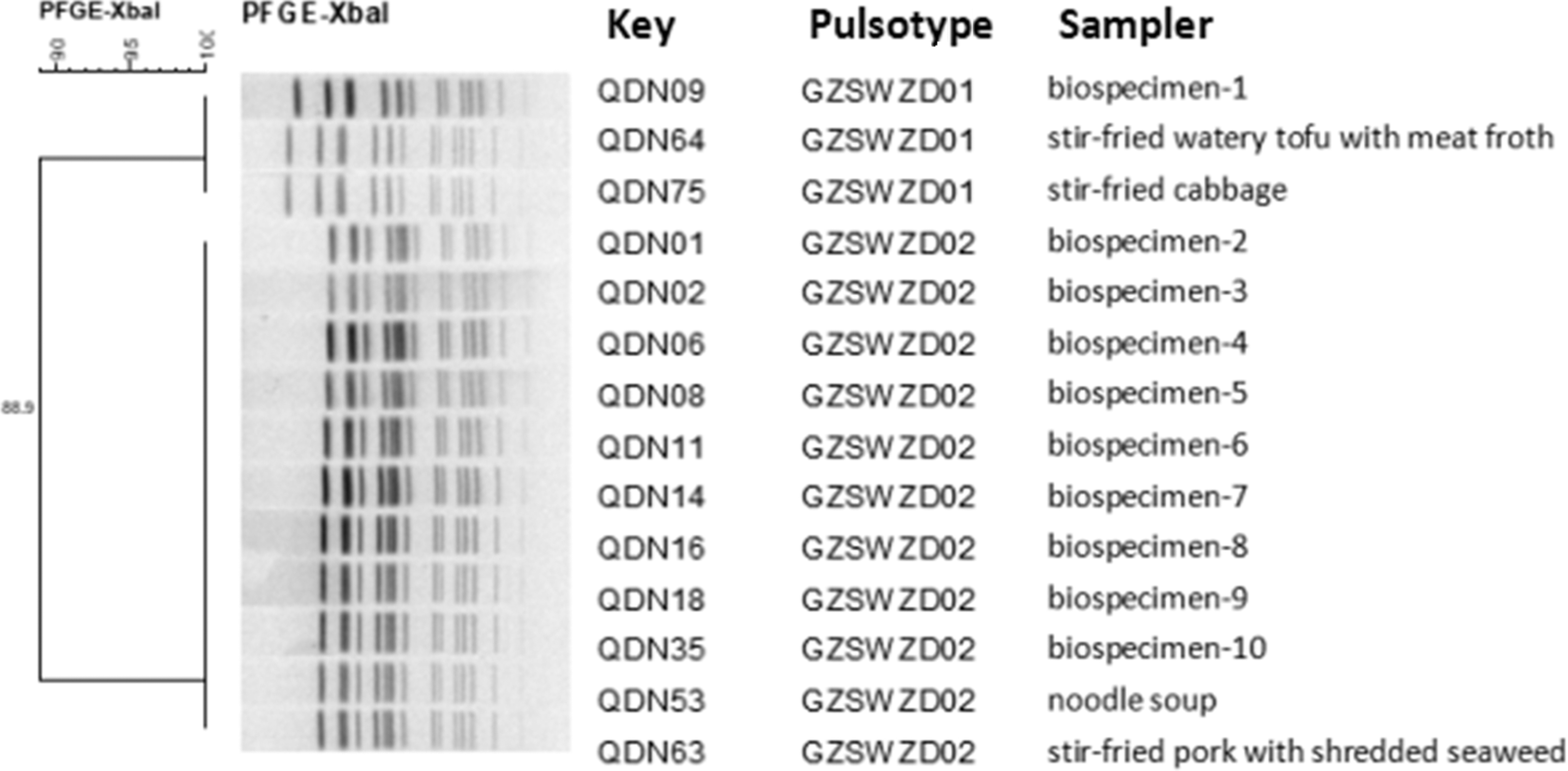
PFGE clustering typing results for 14 strains of Salmonella Senftenberg. PFGE, pulsed-field gel electrophoresis.
Antimicrobial resistance phenotypes and detection of antimicrobial resistance genes
The results of the drug sensitivity test showed that all 14 strains of Salmonella Senftenberg were sensitive to all 14 of the antibiotics tested. After splicing, the data of 14 strains were compared with the CARD and analyzed, which revealed that the 14 strains carried identical resistance genes, namely aminoglycoside [aac(6’)-laa, aac(6’)-ly] and lipopeptide [pmr(B)], whereas the remaining resistance genes were not detected.
Carriage of virulence genes
The virulence factors of the four isolates were annotated based on the VFDB (identity ≥80), and all 14 strains carried the same number of virulence factors. A total of 114 genes in 9 categories were annotated. Virulence islands 1 and 2 (SPI-1 and SPI-2) encoded most of the factors, namely with 37 and 27, respectively, including avr, hil, inv, prg, org, sic, sip, sif, spa, spr, sop, slr, ssa, and sse, as well as genes related to fimbrial adhesion, flagella, and enterotoxin. Virulence island 3 encoded 20, 9, 8, and 3 factors, including csg, fim, lpf, fli, flg, flh, fep, ent, mgt, and mis, respectively. In addition, genes related to regulation, antimicrobial peptide resistance, lipopolysaccharide fur, pho, rpo, mig-14, omp, iro, gtr, and lps were identified and annotated (see Fig. 2 for details).

Circular genome of Salmonella Senftenberg. Note: Black square indicates CG content, green square indicates positive strand, violet square indicates antisense strand, red font indicates virulence genes, and blue font indicates drug resistance genes.
wgMLST analysis
Multilocus sequence typing results showed that ST14 was the type of more than 50 strains collected in China. The wgMLST phylogenetic analysis showed that the 14 strains isolated in the current study belonged to the same branch as the one isolated from a patient in Jilin Province and Tianjin City in 2018 and to the 8 strains isolated from Guangdong and Shanghai in 2018 and 2019, which exhibited <10 allelic differences from the current isolate. The remaining 35 strains had >10 allelic differences from the 14 strains in the current study and were distributed on different branches (Fig. 3).

Phylogenetic tree based on wgMLST for 47 strains of Salmonella Senftenberg. wgMLST, whole genome multilocus sequence typing.
Discussion
Salmonella is the most significant pathogen causing foodborne illness in Guizhou Province. The food safety risk surveillance results have shown that food and disease cases in Guizhou Province are dominated by Salmonella Enteritidis and Salmonella Typhimurium (Zhang et al., 2019). The pathogenic agent of this outbreak, Salmonella Senftenberg, is the first time this serotype was detected in Guizhou Province. Unlike the results of our provincial study, Salmonella Senftenberg has a high detection rate in the United States and is one of the top five serotypes detected in food; in Europe, Salmonella Senftenberg is the most common serotype in poultry (Oastler et al., 2022). Globally, several cases of food poisoning caused by Salmonella Senftenberg have been reported, involving a variety of foods such as pistachios, papaya, sausages, basil leaves, peanut butter, and cereals (Srednik et al., 2022).
Unlike the results found for other serotypes in Guizhou Province that exhibited multidrug-resistant strains, the 14 strains of Salmonella Senftenberg detected were highly susceptible to 14 antibiotics. Resistance genes, as novel environmental contaminants, can be stably and vertically passed on to the next generation through the strains (Wang et al., 2022; Weng et al., 2021), and the WGS results showed high concordance between most resistance genes and resistance phenotypes. Only the aminoglycoside and lipopeptide resistance genes were inconsistent with the corresponding resistance phenotypes; presumably, these two types of resistance genes were expressed at low levels or not at all in the strains.
A study in the United States showed that Salmonella Senftenberg isolated from patients was susceptible to all antibiotics tested, consistent with the results of the current study (Stepan et al., 2011), but studies in Beijing (Qu et al., 2016) and Zhangjiagang (Shi et al., 2018) showed that isolates of Senftenberg that were associated with foodborne disease in Beijing and Zhangjiagang were highly drug resistant; thus, Guizhou Province should continue to pay attention to the drug resistance status and trend of Salmonella Senftenberg isolates from food and case specimens and take effective measures to prevent the outbreak and spread of diseases caused by these isolates.
Studies have shown that Salmonella pathogenicity shows a positive correlation with the number of virulence genes carried (Shi et al., 2020). The 14 strains of Salmonella Senftenberg in this study were annotated by the VFDB and contained 114 virulence factors belonging to 9 categories. The secretory system encoded by the virulence islands on the Salmonella chromosome serves as the basis for survival in and virulence to the host (Zhang et al., 2021).
The hil, inv, and sop genes encoded by virulence islands 1 and 2 are most closely associated with Salmonella invasiveness; mgtB, C, and misL encoded by virulence island 3 are associated with Salmonella survival in the host; fimbrial adhesion virulence factors such as agf and fim are associated with host recognition biofilm formation; the fli, flg, and flh genes present in the flagellum of the strain enable forward movement in a fluctuating environment (Han and Lee, 2020); and stn, a gene associated with enterotoxin (Nakano et al., 2012), enhances the pathogenicity of the strain by regulating the ompA membrane. The detection of so many virulence factors suggested that the pathogenic strain of Salmonella Senftenberg, which caused this incident, had high invasiveness and virulence, so it was highly pathogenic. This finding also confirms that this incident can cause a large range of people, including nearly 200 students, to suffer from gastroenteritis.
Molecular traceability analysis of strains is indispensable for the identification of foodborne disease outbreaks, particularly for cross-regional identification. The molecular typing of different pathogenic bacteria using PFGE technology and real-time online collection and analysis of fingerprint profiles are common methods for molecular epidemiological traceability analysis (Bai et al., 2022). Most reports in the literature show that a PFGE analysis of isolated pathogenic strains from different biological and food samples collected during the same event, based on band patterns showing 100% similarity, is used as a basis for determining the traceability of the event and for laboratory diagnosis (Qi et al., 2021; Shi et al., 2021). The PFGE results of the 14 strains isolated from this incident showed 2 band types, each of which contained strains from both food and patient samples.
The 2 band types showed 88.9% similarity, suggesting that the 14 strains of Salmonella were highly homologous, and this finding, combined with the WGS results and the field epidemiological investigation, reveals that the two different band types of this incident originated from the same source of contamination. The difference in PFGE bands could be due to genetic recombination during the transmission of the strain through the host or mutation of the restriction endonuclease site, resulting in a change in the PFGE profile (Flórez et al., 2021; Yu et al., 2020). This result suggests that for the management of public health emergencies, the consistency of the PFGE typing bands of pathogens in the laboratory should not be the only basis for event tracing but should be combined with on-site epidemiological investigations and other factors for event determination.
WGS is the gold standard for the identification of pathogenic bacteria (Bai et al., 2022). wgMLST was performed by searching for accessory alleles based on cgMLST (core enterobase), which has higher discriminatory power (Wang and Xiao, 2021). A comparison of the 14 Salmonella spp. strains from this event with isolates of the same serotype from other regions in China revealed that the current pathogenic strains were located on the same branch and had the closest affinity with the 2 strains from Jilin and Tianjin in 2018. Six strains with allelic differences <10 from Hubei, Shanghai, Hunan, and Guangdong in 2018 were also closely related to <10 allelic differences, suggesting that the Salmonella strain that caused this outbreak may be associated with these strains and that the cause may be due to the regional movement of people carrying the bacteria or the food trade.
The pathogenic foods detected as being responsible for this foodborne illness included meat and vegetable foods, suggesting the existence of cross-contamination in school cafeterias during the meal preparation process. The monitoring results of foodborne disease outbreaks in Guizhou Province have shown that bacterial contamination is the first factor causing foodborne diseases in schools and that an inadequate heating temperature or time, improper processing and storage, and cross-contamination of raw and cooked food are the main causes of contamination of pathogenic factors in school canteens in China (Zhuang et al., 2022). Therefore, relevant departments for food safety management should strengthen the food safety guidance, supervision, and management of school canteens. The regular training of canteen staff such that they can manage high-risk foods that easily cause bacterial foodborne diseases and the key link that easily causes cross-contamination is key to reducing and preventing the occurrence of foodborne diseases in schools.
Footnotes
Authors' Contributions
Q.Z. and Y.-j.Z.: Conceptualization, experimental detection, data curation, and writing—original draft manuscript. L.Z.: Methodology and writing—review and editing. Z.-z.S., X.-x.P., J.-y.H., J.-s.X., and D.-z.Z.: Experimental detection, acquisition of data and strains, and investigation. W.-w.L., J.L., and Y.L.: Statistical analysis, validation, and supervision. S.-j.L.: Conception and design of study, resources, and project administration.
Compliance with Ethics Guidelines
This article does not involve a research protocol requiring approval by the relevant institutional review board or ethics committee.
Disclosure Statement
All authors declare no conflicts of interest.
Funding Information
This study was supported by Guizhou Provincial Science and Technology Support Program Project (Qiankehe Support [2021] General 435) and by Guizhou Province Infectious Disease Prevention and Control Talent Base Scientific Research Team (RCJD2105, RCJD2102).