




Abstract
Increasing world population parallelly also brings an increase in food production and consumption. As food consumption increases, so do foodborne infections. In cases where adequate food safety and hygiene is not provided in places such as restaurants, dormitories, prisons, hospitals where mass feeding is made outside the home, many parasitic agents can be transmitted to people through food. People working in the food processing and distribution sector and who are in the position of porters play an important role in the spread of parasites, as they can transmit parasitic agents to food through fingernails and hands. Parasites such as Enterobius vermicularis, Entamoeba histolytica, and Giardia intestinalis can be transmitted to food and then to patients through nails and hands. This study was planned to investigate the presence of parasites in hospital food production and distribution workers, such as cooks and waiters, using various methods. Stool and serum samples were taken from 100 food production and distribution workers. Stool samples were examined by native-Lugol, concentration, trichrome, acid-fast staining, and cellophane tape methods. E. histolytica antigen in stool and Toxoplasma and Taenia antibodies in serum were searched by enzyme-linked immunosorbent assay. Parasites were detected in 59% people, and 41 were evaluated as negative. This positivity was 71.9% (23/32) in the 45–61 age range. Blastocystis sp. (27%), Toxoplasma (25%), E. histolytica (10%), Taenia spp. (7%), E. vermicularis (7%), Entamoeba coli (7%), G. intestinalis (5%), Chilomastix mesnili (1%), and I. butschlii (1%) were detected in food handlers. High Toxoplasma antibody positivity (25%) suggests the possibility of transmission to kitchen workers through ways, such as infected raw meat. However, the detection of E. histolytica, Taenia spp., E. vermicularis, G. intestinalis parasites in workers at significant levels poses a significant risk for society consuming these foods. As a result, it is important to investigate the presence of parasites in the employee dealing with food production and distribution to protect patients from parasitic infections especially in hospitals where the people are immunocompromised and more susceptible, and where mass meals are eaten.
Introduction
Parasites are common all over the world, especially in developing or underdeveloped countries, and are one of the leading parasitic agents that threaten public health (Kurtoğlu et al., 2007; Kusolsuk et al., 2011). It is estimated that around half a million people are infected and more than three billion people are affected by parasites (Hotez, 2018). Even in developed countries, an estimated one-third of the population is affected by microbiological foodborne diseases yearly (Schlundt et al., 2004).
Although some parasitic infections can cause serious clinical signs and death, most of them are chronic and they can be asymptomatic. Therefore, infected individuals are carriers and are primarily responsible for the spread of the disease. Continuous exposure of children to parasitic factors can cause growth and developmental retardation and limit their learning and perception abilities (Çelik et al., 2006; Hotez, 2018; Uyar et al., 2014). In adults, it also affects workforce and efficiency, psychological disorders, and economic consequences such as high health expenditures (Uyar et al., 2014).
The most common way of transmission of parasitic infections is the fecal-oral consumption of contaminated food and water. Food handlers, people dealing with food preparation and serving, people infected with parasites and poor personal hygiene constitute a very dangerous group in terms of being parasite carriers (Aycan et al., 2008; Ayeh-Kumi et al., 2009; Kurtoğlu et al., 2007; Sharifi-Sarasiabi et al., 2021). Humans may ingest Toxoplasma, Cryptosporidia, Giardia, Cyclospora, Trichinella spiralis, and Taenia species through water and/or food, which may lead to serious symptoms and even death (Gülel et al., 2015; Rousseau et al., 2018). In the opposite direction, parasites can be transmitted from food to handlers during the processing of contaminated food, and this may pose a risk in terms of food safety (Yıldırım and Felek, 2006). Parasites can live in the human body for a long time without being diagnosed, so porters are effective in the long-term spread of the disease (Hajere et al., 2021).
Owing to today's working conditions and time constraints, more and more people eat out. In parallel with the growth in the food sector, food safety problems are increasing recent years. Especially in countries where hygiene conditions are low, a large number of people suffer from foodborne diseases (Toktaş and Ceylan, 2020).
According to the data of the Ministry of Food, Agriculture, and Livestock in Turkey, ∼19% of the total population of the country works at approximately 477,000 food establishments. The health-related habits and behaviors of people working in the food industry, which are based on intense manpower, directly affect the final safety of the food offered for consumption (Toktaş and Ceylan, 2020).
Stool examination is limited to “direct microscopic examination” in most of the laboratories across Turkiye. For stool examination to be an accurate and reliable diagnostic tool, it must be fully implemented; in other words, “direct microscopy”, “painting,” and “condensation” techniques should be used together (Akbaş, 2014). Since enzyme-linked immunosorbent assay (ELISA) has high sensitivity and specificity, it is preferred for stool antigen and serum antibody tests (Entamoeba histolytica, Toxoplasma, etc.) (Gamblea et al., 2005; Özer et al., 2011; Pritt and Clark, 2008).
This study aims to investigate the presence of parasites in workers who provide food production and distribution services in areas with immunosuppressed patients such as hospitals, by supporting them with different methods besides native-Lugol (NL).
Methods
This study was conducted between November 2020 and May 2021 at Van Yüzüncü Yıl University, Faculty of Medicine, Department of Parasitology. Stool and serum samples taken from 100 personnel working in food distribution, production, and control in the hospital. Of the 100 people included in the study, 8 work as cleaning staff, 58 as waiters, 27 as cooks, 3 as warehouse clerks, and 4 as dieticians. Employees who work in food production and distribution and who do not have any chronic disease or drug use that suppresses the immune system were included in the study.
The subjects included in this study were divided into 22–34, 35–44, and 45–60 age groups. An informed consent form was obtained from the individuals included in this study. Those who did not give consent were excluded. This study was conducted after the ethical approval of the Non-Interventional Clinical Research Ethics Committee (22.02.2019 date 2019/04-08).
Collection of samples
A sterile wide-mouth plastic container was given to each of the employees involved in the production, distribution, and control of food. During their stay in the hospital, they were asked to take 20–30 g of stool in a plastic container with a screw cap and deliver it to the parasitology laboratory immediately. Stools that were taken into an unsuitable container, mixed with foreign materials, kept frozen, or incubated were not evaluated. About 10 g of the samples delivered to the laboratory were taken by us into a screw and spooned container to be used for ELISA and stored at −18°C until used.
For serological tests, blood samples were taken in the blood collection unit with ethylenediaminetetraacetic acid tubes and serums were separated by centrifugation at 1100g for 5 min. It was stored at −18°C until analysis.
Parasitological examination of samples
Before the samples were kept, they were examined macroscopically in terms of consistency, color, helminth adult, larva, and ring. Afterward, 1 g was taken and examined for the presence of protozoan trophozoites and cysts, helminth larvae and eggs with the NL method at 100 × and 400 × magnification. Immediately afterward, zinc sulfate flotation, formol-ether precipitation and staining methods were applied (Akbaş, 2014; Garcia, 2007) to increase the probability of detecting helminth eggs and larvae and cysts and oocysts of protozoa. To increase the diagnosis, samples were taken from each person three times. Trichrome staining method was used to identify protozoa that could be overlooked in direct examination more easily. Modified Kinyoun acid-fast staining was applied for the diagnosis of coccidian parasites Cryptosporidium spp., Cyclospora cayetanensis and Cystoisospora belli (Akbaş, 2014; Garcia, 2007).
The method of sampling with the cellophane tape method, which is the most suitable method for detecting Enterobius vermicularis eggs, was explained and they were delivered to the laboratory on the same day (Garcia, 2007; Vermund and Wilson, 2000).
Stool samples were examined at 100× and 400 × magnification by NL, and concentration (ZnSO4 flotation and formol-ethyl acetate precipitation), trichrome, acid-fast staining, and cellophane tape methods.
Trichrome and acid-fast staining samples were examined at 1000 × magnification. Cellophane tape samples were examined at 400 × magnification. The examined samples were evaluated in terms of morphological structures such as size, movement, core structure, and staining features, by looking at the parasitology atlas and the literature (Garcia, 2007; Korkmaz and Ok, 2011).
Entamoeba histolytica antigen in stool (Leo et al., 2006; Mollah et al., 2000) and Toxoplasma and Taenia antibodies in serum were searched by ELISA. For this purpose, commercial kits NovaLisa Taenia solium IgG (TAEG0420, Dietzenbach, Germany), Dia. Pro Toxo IgG (Milan, Italia) and DRG E. histolytica Antigen (stool) (EIA-3473; Marburg, Germany) were used in accordance with the protocols and the results were evaluated by reading in a spectrophotometer immediately.
Statistical analysis
In this study, categorical variables from the features emphasized were expressed as numbers and percentages. The Z (t) test was used to compare the ratios for categorical variables. In addition, the chi-square test was used to determine the relationship between categorical variables. Statistical significance level was taken as 5% in the calculations and SPSS (ver:13) and MINITAB (ver:14) statistical package programs were used for calculations.
Results
The individuals included in this study were between the ages of 22 and 61, 91 were males and nine were females. Twenty-two of them were aged 22–34, 46 of them 35–44, and 32 of them 45–61.
Parasites were detected in 59 of 100 people, and 41 people were evaluated as negative. The infection positivity was 36.4% (8/22) in the 22–34 age group, 60.9% (28/46) in the 35–44 age group, and 71.9% (23/32) in the 45–61 age group (x2 : 6.9195, p: 0.031). 55.6% (5/9) of women and 59.3% (54/91) of men were detected as positive. Since the gender distribution was far from each other, the infection–sex relationship was not taken into account (x2 : 0.0485, p: 0.825).
Parasites were detected in 31% of the patients by microscopy and detailed images of Enterobius were specified (Fig. 1). No causative agent was observed by flotation method, NL, and sedimentation methods evaluated in the microscopy. Of these, only Blastocystis sp. observed in 17, Blastocystis sp.+Entamoeba coli in seven, Blastocystis sp.+Giardia intestinalis in three, only G. intestinalis in two (Fig. 2), and Chilomastix mesnili and Iodamoeba butschlii in one each.
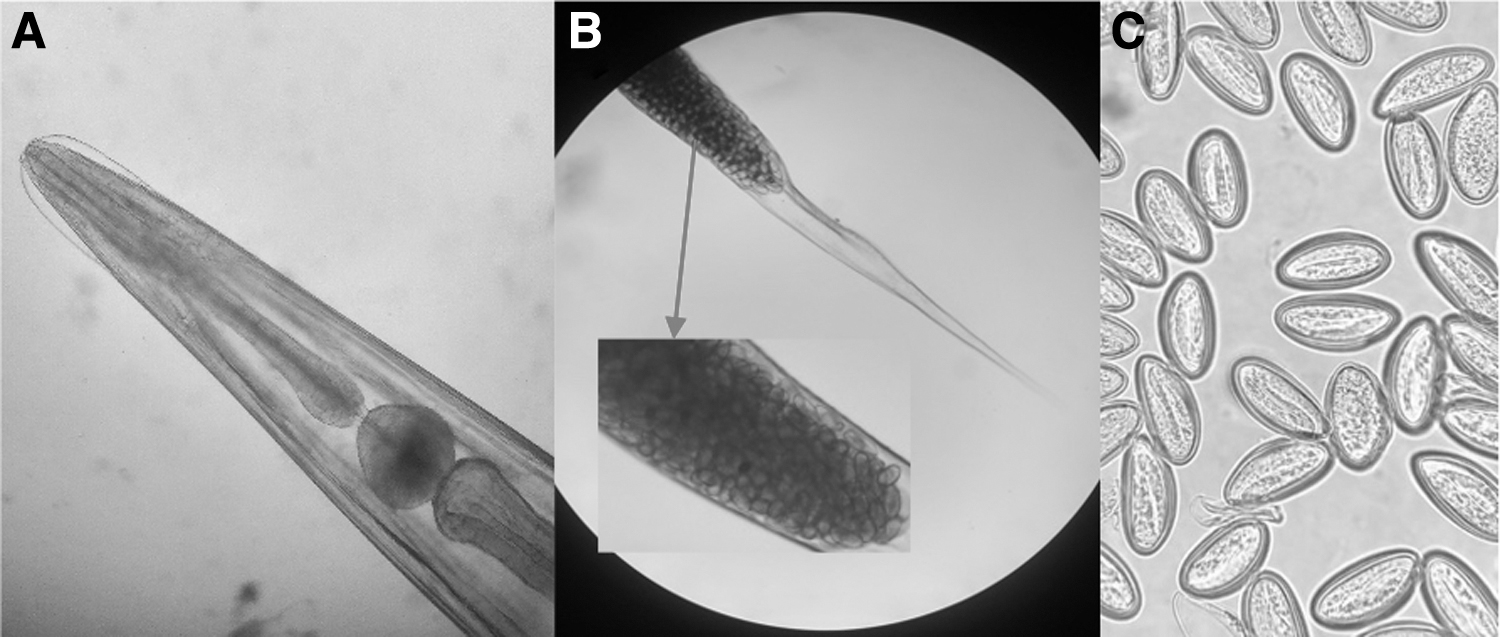
Anterior part of Enterobius vermicularis
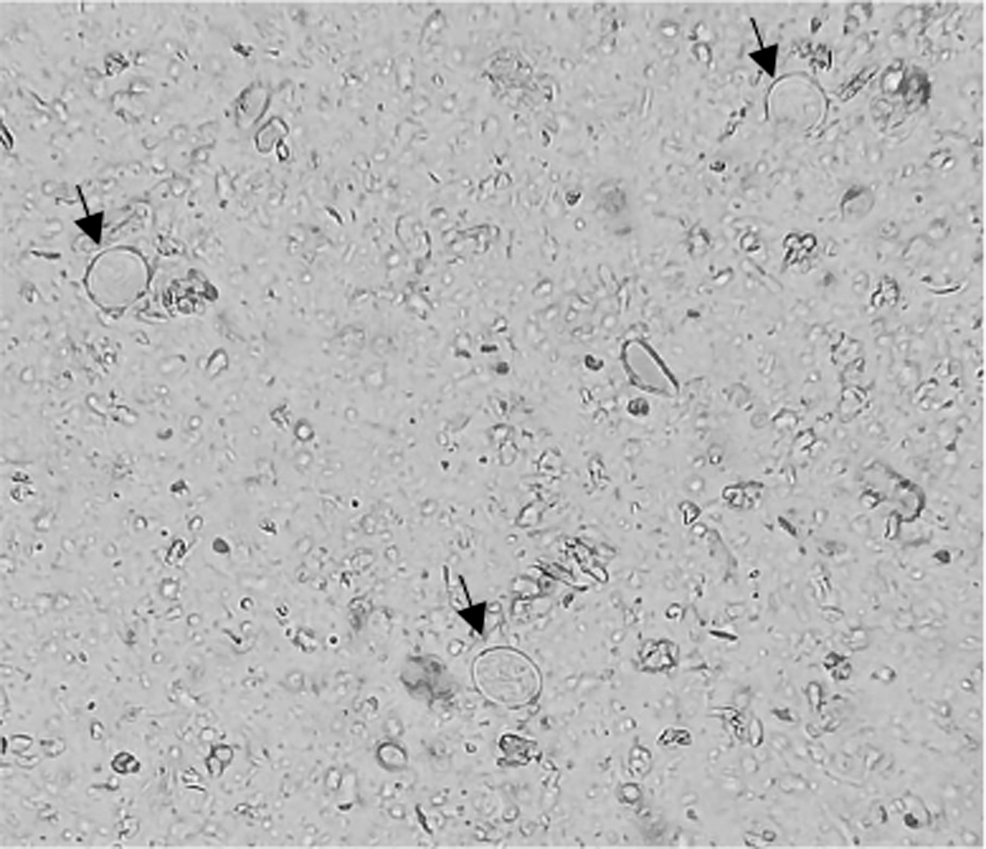
Giardia cysts.
Anti-Toxoplasma gondii antibody positivity was detected in 25% of patients. The positivity was 9.1% (2/22), 21.7% (10/46), and 40.7% (13/32) by age groups, respectively (x2 : 3.9729, p: 0.137). E. vermicularis eggs were found in seven people (7%) and E. histolytica antigen positivity was found in 10. Whereas E. vermicularis positivity was 8.8% (6/68) in 22–44 age group, and 3.1% (1/32) in 45 and above. E. vermicularis was found significantly more in age under 44 (x2 : 1.0854, p: 0.297). On the contrary, E. histolytica was not detected in the 22–34 age, whereas it was found in 10.9% (5/46) in the 35–44 and 15.6% (5/32) in the 45–61 age groups. The presence of E. histolytica was significantly detected in the older ages (x2 : 3.608, p: 0.164). Whereas the presence of Taenia spp. antibodies was observed in seven people (7%), and it was borderline in six. According to age groups, positivity was 13.6% (3/22), 2.2% (1/46), and 9.4% (3/32), respectively (x2 : 3.4114, p: 0.181).
Totally, Blastocystis sp. (27%), Toxoplasma (25%), E. histolytica (10%), Taenia spp. (7%), E. vermicularis (7%), E. coli (7%), G. intestinalis (5%), C. mesnili (1%), and I. butschlii (1%) were detected in food handlers (Table 1).
Age, Gender, and Detected Parasites in Positive Individuals
f, female; m, male.
Enterobius vermicularis (7%) was mostly detected in waiters (58/6, 10.3%). Parasites were also found in the family members of all individuals with E. vermicularis. In one specimen, a female, egg-filled and adult E. vermicularis was detected (Fig. 1). There was no significant difference between the groups (cook, waiter, etc.) in terms of the presence of general parasites. Also sector role of each participant was included in the analysis and was not found to be statistically significant.
Conclusion/Discussion
Globally, ∼3.5 billion people are affected by intestinal parasite infections and >200,000 deaths are reported annually. They constitute a public health burden, especially in low- and middle-income countries (Wakid and Hamdi, 2009).
Owing to the increasing population and food consumption, many parasitic agents can be transmitted to humans through food. Places that produce mass meals, such as canteens, restaurants, hotels, factories, hospitals, schools, and prisons, facilitate the transmission of these agents as they serve a large number of consumers. Since industry workers can infect food, especially through fingernails and hands, their effects on the spread of parasites are high (Fung et al., 2018; Saeed and Hamid, 2010; Tessema et al., 2014).
Today, many studies have been conducted on parasitic agents in food workers. In the study conducted on 1041 people working in the food industry in Iran, intestinal parasites were found in 15.5% of the samples. Giardia lamblia (53.9%) was detected in the study the most, followed by Blastocystis sp (18.5%), E. coli (15.5%), E. histolytica/dispar (5.5%), Cryptosporidium sp (3.1%), I. butschlii (3.1%), and Hymenolepis nana (Sharif et al., 2015).
In Ethiopia, the prevalence of parasites was much higher (46.3%) among catering workers. E. histolytica was the most dominant parasite (33.3%), with Ascaris lumbricoides at 22.2%, Taenia saginata at 19%, hookworm at 14.3%, and G. lamblia at 11.1% (Hajare et al., 2021). In Sudan, food handlers (n = 1500) who came to the public health laboratory for annual checkups were screened for intestinal parasites by direct stool examination, formol-ether concentration, and flotation techniques, and 29.4% of the food handlers were infected. E. coli (15.3%), G. lamblia (9.7%), E. histolytica (4.3%), H. nana (1.6%), Schistosoma mansoni (0.7%), T. saginata (0.3%), and Strongyloides stercoralis (0.1%) were detected (Babiker et al., 2009). In Brazil, 38.2% of the parasites were detected in the fecal material of food handlers. Endolimax nana (67.9%) was the dominant species, followed by E. coli (35.9%) and B. hominis (28.2%) (Takızawa et al., 2009).
In studies conducted on food workers in different cities in Turkey, different types and rates of parasites were detected. In Antalya, 5.9% of 136 stool samples taken from the kitchen staff of the hotel serving mostly tourists, and the cooks and waiters of the restaurants in the city were positive, and G. intestinalis, E. histolica, T. saginata, and A. lumbricoides were detected (Yıldırım and Felek, 2006). Intestinal parasites were examined by NL, formol-ethyl acetate precipitation, trichrome and acid-fast staining and cellophane tape methods in a total of 58 kitchen staff working in the food production and distribution departments of different hospitals in Aydın, and 17 (29.3%) were positive. The most common Blastocystis sp. (15.5%) and E. vermicularis (8.6%) were found in this study (Yazıcı et al., 2007).
Parasites were detected at the rate of 4.6% in 152 people working in the food sector in Mersin. Since only the NL method was applied, G. intestinalis was seen in five individuals and A. lumbricoides in two individuals (Delialioğlu et al., 2003). Stool and cellophane slide samples were analyzed from 47 personnel working in a meat and meat products company in Malatya. NL and formol-ethyl acetate precipitation methods were applied to all stool samples. Intestinal parasites were detected in 11 (23%) of the samples, the most common parasite being G. intestinalis (12%) (Aycan et al., 2008). Various parasite species were found in 297 (5.5%) of 5392 stool samples sent for porter examination at Ankara Gülhane Military Medical Academy.
G. intestinalis 30%, E. coli 9%, E. histolytica 4%, Entamoeba hartmani 1%, E. nana 4%, I. butschlii 12%, Blastocystis sp. 17%, Trichomonas hominis 0.3%, Trichuris trichiura 3%, E. vermicularis 5%, Taenia sp. 4%, A. lumbricoides 2%, and H. nana 6% were detected (Ayçiçek, 2000). Parasites were detected in 17.7% of 739 people working in the food industry who applied to the Public Health Laboratory in Van for porter examination. In the study, Blastocystis sp. was 4.9%, E. coli 3.2%, G. intestinalis 2.8%, A. lumbricoides 1.2%, and I. butschlii 2%. Fifty-two people working in food production and distribution in the kitchen of the University Medical Faculty in Malatya were investigated regarding intestinal parasites. B. hominis, G. intestinalis, T. saginata, E. vermicularis, and E. coli were detected in eight (15%) of the collected samples (Daldal et al., 2004).
Studies on the presence of parasites in food handler in worldwide and also in Turkey are limited. In most of the investigations, only direct microscopic examinations, such as NL, have been used. In this study, in addition to microscopic methods, the presence of antibodies and antigens belonging to the parasites was investigated by immunological methods. Whereas the presence of parasites in food workers was 31% by microscopic examination, this rate reached 59% together with other methods. Considering that Toxoplasma antibody positivity is as high as 25%, this finding suggests the possibility of handlers getting this infection from infected raw meat. However, detecting E. histolytica, Taenia spp., E. vermicularis, and G. intestinalis parasites in workers at significant levels poses a significant risk for society consuming these foods.
Enterobius vermicularis (7%) being detected at the highest rate in waiters can be explained by the fact that waiters are more in the same environment. The presence of parasites in all of their families indicates that the parasite is contagious and a family infection.
Opportunistic parasitic infections are infections of parasite species that are mild or asymptomatic in immunocompetent people; however, in immunocompromised people they become fatal (Baiomy et al., 2010). Alteration in their cellular and humoral responses leads to hindrance of T and B lymphocytes from efficiently acting against opportunistic pathogens. Accordingly, immunocompromised patients present increased susceptibility to different microorganisms, including viral, bacterial, fungal, and parasitic infections (Hassanein and Fanaky, 2021).
The commonest parasites causing morbidity and/or mortality in the immunocompromised patients were those of the Cryptosporidium parvum, Cyclospora cayetanensis, Microspora, Isospora belli, G. lamblia and S. stercoralis, T. gondii, and Leishmania donovani and the free living amoebae (Baiomy et al., 2010: Hassanein and Fanaky, 2021).
Entamoeba coli, I. butschlii, and C. mesnili are commensal and nonpathogenic intestinal protozoa (Issa, 2014). These nonpathogenic parasites can be transmitted to humans through consumption of contaminated water or food. This high prevalence rate detected in our research may reflect poor environmental sanitation, and also increases the likelihood of exposure to pathogenic organisms (El-Nadi et al., 2017; Koshak and Zakai, 2003).
Toxoplasma does not pose a risk of transmission from humans in institutions where mass feeding is provided. In addition, although there is a general opinion that E. coli, C. mesnili, and I. butschili are not pathogenic for humans, it has been reported in some studies that it causes diarrhea for C. mesnili, whereas it is a hygiene indicator for E. coli in terms of cleaning and sanitation in the environment, and it is important in this sense (Morimoto et al., 1996; Miman and Saygı, 2018).
As a result, it is seen that the personnel working in food production and distribution in places where mass nutrition is provided can play an important role in the spread of parasitic diseases. It is important to provide personal hygiene training, to ensure that they use personal protective equipment during work, to follow up their porters and treatments, in places where there are people who are more sensitive to infections such as Diabetes Mellitus (DM), Chronic Renal Failure (CRF), AIDS, leukemia, organ transplant patients, and where there is mass nutrition, such as hospitals.
As a result, it is seen that personnel working in food production and distribution in places where mass nutrition is provided can play an important role in the spread of parasitic diseases. In environments where people who are more susceptible to infections such as DM, CRF, AIDS, and leukemia are present, it is important to provide regular personal hygiene training, to ensure that they use personal protective equipment during work, to be examined in detail in terms of portership, and to be treated and followed up. In addition, at certain stages of food production and service, the distribution of parasitic agents can be examined by taking samples from vehicles used outside of employees, equipment, and food produced.
Footnotes
Authors' Contributions
Conceptualization, methodology, formal analysis, and writing—original draft by M.S. Conceptualization, methodology, and formal analysis by N.O. Conceptualization by H.Y. Conceptualization, writing, supervision, review, and editing by Y.E.B.
Disclosure Statement
No competing financial interests exist.
Funding Information
This study was supported by Van Yüzüncü Yıl University Scientific Research Projects Presidency for financially supporting this research (project no. TSA-2020-8018).