




Abstract
The purpose of this research was to analyze the functional portraits and genomic features of carbapenem-resistant Pseudomonas mendocina carrying NDM-1 and IMP-1. The resistance mechanism of the strain was verified by in vivo experiments. Genomic data were aligned and analyzed in the NCBI database. Growth curve measurements were used to describe the growth characteristics of the bacteria. The virulence of P. mendocina strain was analyzed by serum killing assay and biofilm formation assay. Plasmid conjugation experiments were performed to verify the transferability of plasmids carrying drug-resistance genes. The P. mendocina strain was highly resistant to carbapenems. In addition, ST typing is unknown and has been submitted to Genebank. The strain carried two carbapenemase genes, including NDM-1 and IMP-1. Among them, blaNDM-1 was located on a 5.62832 Mb chromosome, and blaIMP-1 was located on a 172.851 Kb transferable plasmid, which was a very close relative of pIMP-NY7610 in China. The strain also had a variety of virulence genes, which were expressed in the siderophore, capsule, pilus, alginate, flagella, etc. The study suggests that the functional portrait and genomic features of carbapenem-resistant P. mendocina harboring blaNDM-1 and blaIMP-1 are unique to China. This outcome represents antibiotic resistance exhibited in the genus Pseudomonas by acquiring chromosomes and plasmid genes. The monitoring and supervision of antimicrobial usage must be strengthened since the multi-drug-resistant and moderately virulent P. mendocina will attract much attention in the near future.
Introduction
P
Common carbapenemases include KPC, NDM, IMP, VIM, and OXA-48. What's more, NDM and IMP belong to the class B enzymes (metallo-β-lactamases [MBLs]). Among them, NDM is the most common metalloenzyme in Enterobacteriaceae. Above all, the NDM-1 gene was first identified in 2010. At the same time, it had attracted people's attention to carbapenem-resistant bacteria. It had been reported in the literature that the gene NDM-1 could be discovered in Klebsiella pneumoniae (Gao et al., 2020), Enterobacter cloacae (López-Hernández et al., 2020), Escherichia coli, Acinetobacter baumannii, and Citrobacter freundii (Zhu et al., 2018). IMP-1 was the first acquired MBLs to be identified, and it was more common in Gram-negative bacteria, for example, Acinetobacter (Suzuki et al., 2019), Pseudomonas (Urbanowicz et al., 2021), and Enterobacterale (Aoki et al., 2018).
Although a few cases of P. mendocina have been reported, the functional and genomic characteristics of this strain have not been previously published. To research the drug resistance and virulence characteristics of P. mendocina, de novo sequencing was used to sequence the genome of a moderately virulent and carbapenem-resistant P. mendocina strain.
Materials and Methods
Patient and isolates
A 37-year-old female with persistent abdominal pain was hospitalized at a tertiary hospital on October 31, 2021. The patient had bilateral kidney stones and right ureteral stones. Meanwhile, she had a family history of diabetes mellitus and no experience abroad. The white blood cell (WBC) count was 14.52 × 10⁹/L at the admission time, with 81.1% granulocytes and 10.3% lymphocytes and 1.27 mg/L C-reactive protein (CRP). The patient was given empirical piperacillin–tazobactam sodium as an anti-infection treatment. However, on November 7, her WBC count was up to 20.22 × 10⁹/L with 81.1% granulocytes and 11% lymphocytes and 126.49 mg/L CRP. The symptoms were severe abdominal pain that was disgusting and accompanied with vomiting.
P. mendocina strain was obtained from a midstream urine culture specimen of the patient. The strain was identified by VITEK 2 (France; BioMérieux). Biapenem combined with etimicin was adjusted according to drug sensitivity. After renal laser lithotripsy on November 12, 2021, the patient was treated with the compounds dextran, aminomethylbenzoic acid, and ranitidine. On November 15, 2021, the patient's symptoms resolved. Eventually, she was discharged from the hospital.
Antimicrobial susceptibility testing
Drug-sensitive assay was performed by the VITEK 2 system (France; BioMérieux) for P. mendocina and the transconjugant. Broth microdilutions (for piperacillin/tazobactam, cefepime, imipenem, ciprofloxacin, levofloxacin, gentamicin, tobramycin, and amikacin) were used. E-test was performed using Mueller–Hinton AGAR (MHA) according to package instructions (Zhang et al., 2019). Individual colonies were removed from broth and diluted to 0.5 McFarland turbidity. E. coli ATCC 25922 was used as a reference. MHA powder and broth powder were purchased from Solebo Co (Shanghai), and DNA 2000 bp ladder was purchased from Tiangen Co (Beijing). The experimental results were analyzed on the basis of the Clinical and Laboratory Standards Institute (M100-S30).
Conjugation experiment
Conjugation experiments were modified according to the reported methods (Chen et al., 2022). P. mendocina and E. coli EC600 were mixed in broth and inoculated onto screening plates (600 μg/mL rifampicin and 200 μg/mL imipenem). Individual colonies were inoculated onto new plates for passage. In parallel, P. mendocina and E. coli EC600 were inoculated on screening plates. They were used as negative controls, respectively.
Serum resistance experiment
The serum resistance test was modified according to the reported method (Tot et al., 2021). Serum from healthy individuals was inactivated. The bacterial solution was diluted to 1 × 10⁶ cfu/mL and added to normal and inactivated serum, respectively. In the end, 20 μL of bacterial solution was coated on the plate and incubated overnight. ATCC19606 was regarded as the reference. The results of the serum test were judged by calculating the bacterial survival rate.
Biofilm formation assay
The biofilm formation assay was modified according to the reported method (Vuotto et al., 2017). The bacterial suspension was adjusted to 0.5 McFarland turbidity. The 96-well plate was successively stained with crystal violet and dissolved in ethanol. Optical density (OD) values were recorded for each well, and negative control values (Nc) were the mean ± 3 times the standard deviation (X ± 3s). The results of the biofilm formation assay were evaluated according to the following criteria: strong positive (4 × Nc < OD); positive (2 × Nc < OD ≤4 × Nc); weak positive (Nc < OD ≤2 × Nc); negative (OD ≤ Nc).
Growth curve measurements
Growth curve measurements were modified according to the reported method (Li et al., 2022). Strains CR-HvKP NUHL 30457, P. mendocina PM005238, Pseudomonas aeruginosa PA1470, and PM005238-Ec600 were grown in Luria–Bertani medium at 37°C with shaking (180 rpm).
Nucleotide sequence accession numbers
The genome sequence of P. mendocina PM005238 was primarily submitted to the GenBank database. Meanwhile, the P. mendocina strain's accession number was PRJNA916818.
Whole genome sequencing
A 10K database was constructed using the SMRT Bell™ Template Kit, Version 1.0. Electrophoresis qualified DNA samples were lysed, and DNA fragments were ligated with DNA adhesin, and purified with magnetic beads. Fragments of a specific size were screened, and magnetic beads were used to screen and purify SMRT Bell libraries. The complete genome sequence of the strain was obtained (Martin and Bachman, 2018).
Phenotypic analysis
Phenotypic analysis of the P. mendocina strain was performed. To obtain sequences with its high homology, the genome sequence of PM005238 was aligned at NCBI. These sequences were also compared using Mega software to generate visualized phylogenetic trees.
Result
Antimicrobial susceptibility testing
In this study, the P. mendocina strain was found to be resistant to tetracyclines, sulfonamides, aminoglycosides, fosfomycin, and β-lactams, indicating that the bacterium was multidrug-resistant (Table 1 and Supplementary Fig. S2). Contrarily, it was macrolide-sensitive, but the mechanism of action is currently unknown, and the results are shown in Table 1.
Antibiotic Susceptibility of Pseudomonas mendocina Strains and Zygomycetes (EC600-PM005238)
PM005238 was P. mendocina, and EC600-PM005238 was the conjugation Of EC600 and PM005238. R stands for resistance and S for susceptibility.
AMK, amikacin; ATM, aztreonam; CIP, ciprofloxacin; FEP, levofloxacin; GEN, gentamicin; IMP, imipenem; LEV, levofloxacin; MIC, minimum inhibitory concentration; TOB, tobramycin; TZP, piperacillin tazobactam sodium.
Identification and transferability of blaIMP-1 and blaNDM-1 in 005238
The plasmid carrying IMP-1 gene to be transferred between bacteria was well detected by the conjugation experiment (Fig. 1 and Fig. 2b). The results of antimicrobial susceptibility were consistent before and after plasmid conjugation experiments (Table 1). This indicates that the plasmid carrying IMP-1 carries not only IMP-1 gene but also aminoglycoside and macrolide resistance genes (Supplementary Table S1).

Functional characteristics of Pseudomonas mendocina strain and PM005238-EC600.

Resistance and phenotypic characteristics of Pseudomonas mendocina strain and PM005238-EC600.
Virulence testing of P. mendocina
The survival rates of P. mendocina and PM005238-EC600 were 13.125% and 5.23%, respectively, when they were exposed to healthy human serum and inactivated serum. However, the survival rate of the standard strain was 28.8%. Statistical analysis showed that the two groups had statistical significance (p < 0.05) (Fig. 1b). In the biofilm formation experiment, we found that P. mendocina had a greater ability to produce biofilms by the crystal violet staining assay than the reference group (Fig. 1a). P. mendocina had a moderate biofilm formation ability and serum killing level in this study, as well as efflux pump genes MexB, MexD, and MexF, which were moderately pathogenic. This phenomenon indirectly indicates that the pathogenicity of bacteria is related to their virulence.
Growth curve measurements
The fastest-growing bacteria in this analysis were 30457, followed by PA1470, while PM005238 and PM005238-EC600 grew at a similar rate (Fig. 1c), and the real mechanism needs further research.
Phenotypic analysis
P. mendocina strain was highly homologous to strains GCA 002353005 (Australia) and GCF000287395 (Hong Kong) in NCBI (Fig. 2a).
Genomic features
In this study, P. mendocina was composed of a circular chromosome (5.62832 Mb) and a plasmid (172.851 bp). The GC contents were 62.47% and 56.83%, respectively (Table 2). The strain was resistant to most antibiotics and was multidrug-resistant. In addition to the carbapenemase genes blaNDM-1 and blaIMP-1, the isolate also carried other resistance genes, including floR, algA, aph(3′)-vla, floR, and so on. Among them, aminoglycosides included aph(3′)-vla and fosfomycin included the fosc gene. Meanwhile, the genes algA, algI, alg8, and algC belonged to N-glcosylation (Fig. 3).
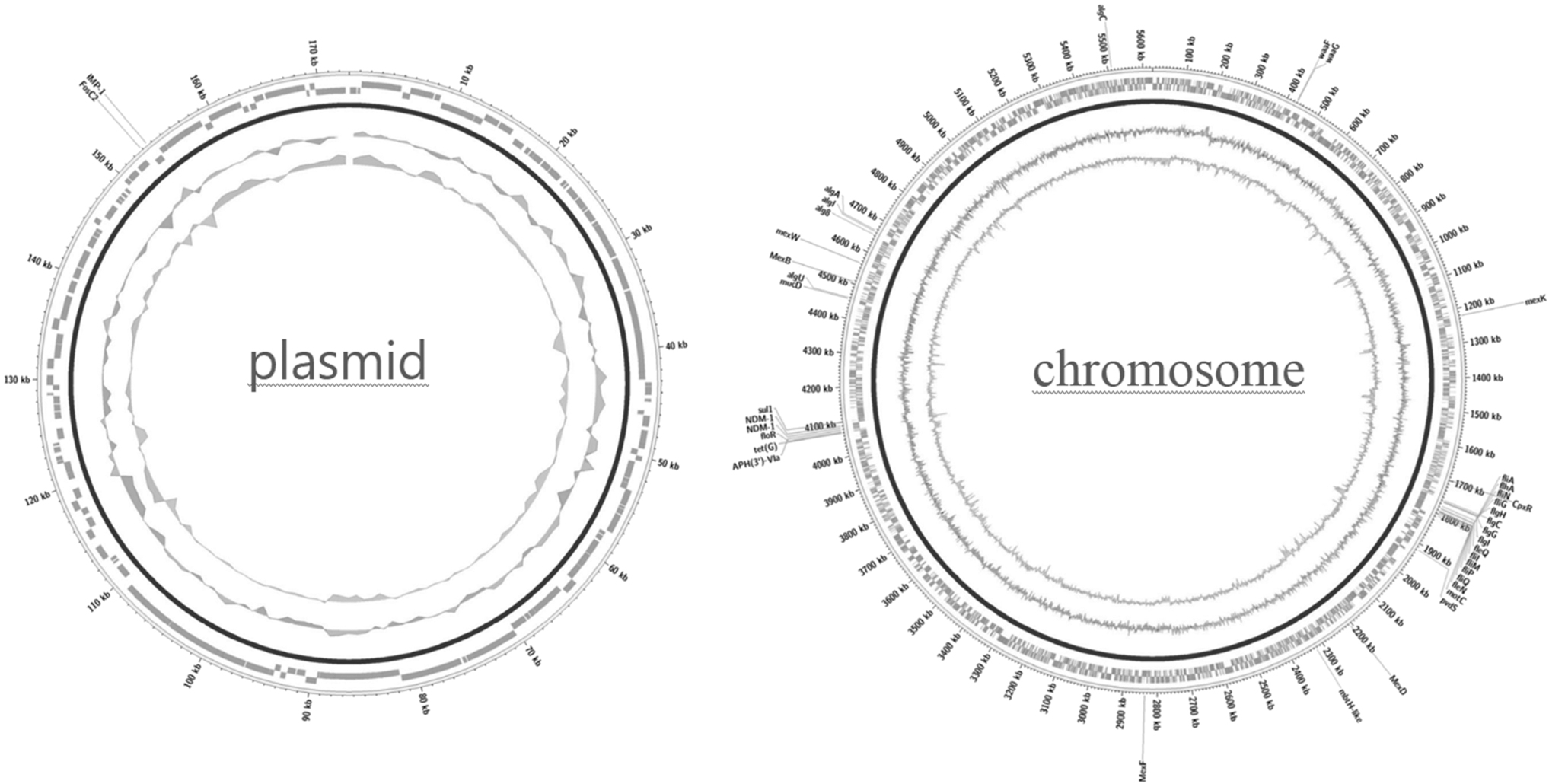
Plasmid and chromosome maps of the Pseudomonas mendocina strain.
General Characteristics of the Genome of the Pseudomonas mendocina Strain
P. mendocina strain was composed of a circular chromosome (5.62832 Mb) and a plasmid (172.851 bp). The GC contents were 62.47% and 56.83%, respectively.
There were >400 virulence genes, mainly in the capsules, lipopolysaccharide, flagella, siderophore, pilus, and so on. Among them, lipopolysaccharide included waaF, waaC, waaG, waaP, and other genes, which mainly mediate biological effects, including anti-serum killing and phagocytosis. The capsular O antigen type was wzt2 and it included the genes Fphi and oPPF. The pilus genes included pilV, pilA, pilC, pilD, etc.
There were more than 600 pathogenic genes, which were mainly manifested in invasive pulmonary aspergillosis, gut-associated diseases, pneumococcal pneumonia (Supplementary Fig. S1).
Discussion and Conclusion
In recent years, related reports of P. mendocina at home and abroad have been relatively rare. According to Wei et al., 2012, a carbapenem-resistant strain of P. mendocina is what causes severe hospital-acquired infections such as pneumonia, urinary tract infections, and limb wound infections. Therefore, herein, we explore the features of carbapenem-resistant P. mendocina from both a functional and genetic standpoint.
The beneficial functions of this bacteria include its use as a biological preservation agent and biological control agent, as well as its involvement in sewage treatment and the enhancement of water quality, etc. Lumbar discitis and septicemia were identified as negative functional findings (Zhang, 2019). At present, most of the reports on this strain are related to infection, and it has the characteristics of high drug resistance and refractory treatment. The virulence and drug resistance of the carbapenem-resistant P. mendocina carrying the NDM-1 and IMP-1 genes were higher than those of previously reported strains. This means that these super-drug-resistant bacteria are likely to be widely prevalent in hospitals and communities in the near future, causing severe clinical manifestations and causing great harm to anti-infection treatment.
A whole-genome sequence alignment analysis of our findings revealed that P. mendocina PM005238 was resistant to most antibiotics. Horizontal gene transfer allows the floR gene (florfenicol-resistance gene) to spread among bacteria of the same species or different genera. The research conducted by Lu et al. (2018) suggested that the process by which drug-resistance genes spread from bacteria to humans requires further explanation. The majority of algA, algI, algE, and algC genes confer aminoglycoside resistance. We believe that the pathogenic genes argGH, ptsN, BceR, and RpoB are the reasons for the abnormally high WBC count in our instance, which is comparable to the findings of Merry et al. (2015) and Mestrovic and Ljubin-Sternak (2018). García et al. (1995) demonstrated that the high level of fosfomycin resistance in this strain is linked to the fact that it has the fosC gene Carbapenemase resistance that was encoded by the blaNDM-1 and blaIMP-1 genes on the chromosome and plasmid, respectively.
Antibiotic resistance testing in our study revealed that PM005238-EC600 was resistant to carbapenem and aminoglycosides, suggesting that the resistance genes for these drugs present in strain PM005238 could be transferred via conjugation (Supplementary Fig. S2). Transfer of the IMP-1 gene, but not the NDM-1 gene suggests that numerous factors influence the mechanism of drug resistance gene transfer, which must be further clarified in future research. Therefore, the plasmid harboring IMP-1 served as a mobile genetic element capable of transporting and passing on P. mendocina resistance genes.
Research on P. mendocina has been rarely reported, especially in terms of bacterial growth, virulence, and drug resistance. Generally, the faster a bacteria replicate, the greater the likelihood it will spread infectious diseases and cause harm to humans (Guillén et al., 2022). This hypothesis was also supported by our findings. In our findings, decreased pathogenicity and a slower growth rate were found in carbapenem-resistant P. mendocina when compared to the reference strain, CR-hvKP 30457. Previous studies have shown a correlation between P. mendocina virulence and the formation of biofilm (Warrier et al., 2021). The reasons behind this phenomenon have been explored but not fully elaborated. However, the BfmRS gene is involved in biofilm formation (Kim et al., 2022), further suggesting that the pathogenicity and biofilm development of this bacteria may be associated with the BfmRS genes (Han et al., 2022).
In addition, the P. mendocina strain was resistant to a wide variety of antibiotics, including aminoglycosides, beta-lactams, sulfonamides, tetracyclines, and fosfomycin. The results could provide a reference for the prevention of urinary tract infections caused by P. mendocina infections. Contrarily, it was macrolide-sensitive, but the mechanism of action is currently unknown. It has been reported in the relevant literature that alginate is the main component of the cell membrane. Macrolides work primarily by inhibiting the enzyme mannose dehydrogenase, which is essential for alginate synthesis. As a result, the synthesis of alginate is reduced, which makes it easier for antibacterial drugs to penetrate the bacterial membrane and finally exert a bactericidal effect (Elmouaden et al., 2019). In addition, the results of our biofilm and serum of the conjugative strain were different from those of the preconjugative strain, which further speculated that the virulence plasmid of the strain had not been transferred or that the virulence plasmid had been transferred but one or several virulence gene clusters were lost (Russo and Marr, 2019). Further research is required to fully understand the implications of our findings regarding P. mendocina's drug resistance, virulence, and genome.
In addition to virulence genes and proteins, PM005238 had a quorum-sensing system, capsular polysaccharide, siderophore, and pili. Heme is associated with the hurI heme uptake regulator and is involved in hemoglobin metabolism. Flagellar genes such as flgB, flgD, flgC, and others may play a role in the motility, pathogenicity, and biofilm effects of P. mendocina (Minamino et al., 2000). Evidence suggests a role for fliT in bacterial motility. Moreover, it has been postulated that kdtB contributes to bacterial pathogenicity by taking part in the synthesis of the core of lipopolysaccharides. Type IV pili may have a link to the proteins PilH and PilG. Biological effects, such as resistance to serum killing and phagocytosis, are mediated by waaA, waaC, waaG, waaP, and waaF. These results not only demonstrated the extreme difficulty in treating rare bacteria like P. mendocina but also demonstrated the public health hazard posed by such bacteria due to their aggressiveness and antibiotic resistance. Therefore, additional research is needed to understand how this strain acquired its virulence and resistance to rare carbapenems like NDM-1 and IMP-1.
The main limitations of this study include our inability to transconjugate NDM-1 gene, which shows that conjugational plasmid transfer was subject to a variety of environmental influences and was not completely effective in controlling carbapenem bacterial resistance and virulence.
In summary, our patient was young, had diabetes and surgery, but had no history of ICU ward hospitalization or international travel. P. mendocina was cultivated after admission. The drug-resistance properties of carbapenem-resistant P. mendocina were studied using whole-genome sequencing, and it was discovered that the strain was multi-drug resistant, resistant to routinely used medications in clinics, and possessed a range of drug-resistance genes. The strain's main carbapenem resistance mechanism was NDM-1 synthesis. Through conjugation, the secondary resistance mechanism, IMP-1 synthesis, can achieve horizontal transfer of resistance genes. The multidrug-resistant and moderately pathogenic P. mendocina will attract more attention in the near future in hospital and clinic settings, so the monitoring and oversight of antimicrobial usage need to be strengthened.
Footnotes
Authors' Contributions
J.F. and T.X. contributed to the study design. J.Y. and X.K. participated in data analysis. G.W., J.L. and Y.M. participated in data collection. J.F. and Q.L. contributed to the writing of the article.
Ethics Statement
This study had been approved by the Ethics Committee of the First Affiliated Hospital of Nanchang University [NO: (2023) CDYFYYLK (01-033)].
Consent for Publication
Informed consent had been obtained from the patient for the publication of this case report.
Availability of Data and Materials
All data for this study are available by contacting the authors.
Disclosure Statement
No competing financial interests exist.
Funding Information
Funding sources for this study were offered by the 2020 Clinical Research Training Program of Nanchang University (YFYLCYJPY202001-3), the National Natural Science Foundation of China (82000601), the Technology Program of the Health Commission of Jiangxi Province (202130167), Zhong Nanshan Foundation of Guangdong Province (ZNSXS-20220067).
Supplementary Material
Supplementary Figure S1
Supplementary Figure S2
Supplementary Table S1
References
Supplementary Material
Please find the following supplemental material available below.
For Open Access articles published under a Creative Commons License, all supplemental material carries the same license as the article it is associated with.
For non-Open Access articles published, all supplemental material carries a non-exclusive license, and permission requests for re-use of supplemental material or any part of supplemental material shall be sent directly to the copyright owner as specified in the copyright notice associated with the article.
