




Abstract
Pork products were the most common media of Salmonella in China, breaded pork products as a very popular meat presently, whose Salmonella risk should be drawn to attention. Given that quantitative risk assessment is a more scientific method for risk evaluation, a quantitative risk assessment model of Salmonella in breaded pork products was first constructed from processing to consumption, and was used for assessing the risk and the effective interventions in this study. The data of Salmonella contamination in breaded pork products during processing were obtained from the actual detection data of samples from a representative meat processing plant. With combining the predictive microbial modeling and dose–response relationship, the risk of Salmonella in breaded pork products was charactered, and the probability of Salmonella infection per meal was found to be 5.585 × 10⁻⁹. Based on the results of sensitivity analysis, the curing and seasoning process was found to be the key control point for Salmonella contamination during the processing, and consumer behavior was the key control point affecting the probability of Salmonella infection from processing to consumption. The model was also applied for assessing the effectiveness of risk interventions, and among the nine interventions given, control of thawing temperature before cooking such as microwave thawing could reduce the risk of infection by 30.969-fold, while cooking the products thoroughly, Salmonella would not pose a pathogenic hazard to consumers. The model and the assessed results in this study may provide guidance on microbial control in producing process and safety consumption of breaded pork products.
Introduction
Foodborne diseases continue to pose a significant global public health concern, among which, Salmonella stands out as one of the most common pathogens (He et al., 2023). The World Health Organization reported that Salmonella infections claimed 52,000 lives worldwide in 2010 (WHO, 2013). In China, contaminated pork is the main attribution of foodborne Salmonella infections (Liu et al., 2018). The detection rate of Salmonella in Chinese pork is notably high (Zhou et al., 2018), posing an infection risk to consumers who consume pork products processed from contaminated meat. Monitoring and assessing the risk of Salmonella throughout the pork production chain are crucial for improving product quality and ensuring consumer health safety.
Quantitative microbial risk assessment (QMRA) is a reliable method that enables scientific evaluation for microbial hazards, which can identify the key aspects of microbial risk introduction during production and consumption, and propose more effective risk control measures (Lien et al., 2022). Until now, several studies have been conducted on quantitative risk assessment of Salmonella in pork during consumption (Dong et al., 2015; Jia et al., 2021) in China; however, there are no relative reports on pork products, such as breaded pork products, one of the most popular pork products in China.
In this study, a quantitative risk assessment model for Salmonella was established in breaded pork products during the process of raw pork to terminal products and then to consumption, which aimed to explore the key control point of Salmonella contamination during producing and consumption, and to assess the infection risk of Salmonella to consumers.
Materials and Methods
Sample collection
A representative large meat-processing plant was selected for sampling. Breaded pork product processing was divided into three processing workshops. The pretreatment workshop included the thawing and cutting process; here, the raw pork was cut into strips after thawing and seasoned for some time. The seasoning workshop included the curing, mixing, and flour-coating process. Here, the seasoned pork was completely covered with flour. The third workshop included frying and quick-freezing, along with the sorting and packaging processes. Here, the flour-coated pork was fried for several tens of seconds, immediately frozen, and then sorted and packed. Sampling of 153 processing products and 150 environmental swabs was carried out according to the production process for 3 times, and sample information is shown in Supplementary Table S1.
For each sampling, 6–10 samples (about 100 g per sample) of the end pork production from different containers in each workshop were collected in a sterile plastic bag; 5 environmental samples of each meat in direct contact with environmental surface and water, air and ground surface, were collected into sterile EP tubes. Swab sample was collected by using a disposable sterile cotton swab soaked with phosphate-buffered saline (PBS) smeared for about 100 cm2 of different environmental surfaces or the whole surface of worker's hand, and quickly put into EP tubes. Water samples were directly collected, 10 mL of procession water, air samples were collected by the air sedimentation method. All samples were placed in a holding box with ice and afterward transported to a laboratory the same day.
Salmonella detection
All collected swab samples were thoroughly shaken with a vortex for the preliminary isolation of Salmonella with reference to ISO 6579-1:2017 (2017) and identified by matrix-assisted laser desorption-ionization time-of-flight mass spectrometry (MALDI-TOF-MS). The most probable number (MPN) method (USDA/FSIS, 2014) was used to quantify Salmonella in all the processed product samples. To estimate the value of MPN/g, Salmonella was assumed to distribute uniformly in each piece of meat. For calculation, the MPN value was considered 0.015 if it was less than that.
Model construction
The exposure scenarios of Salmonella during the process of breaded pork products from raw pork to terminal products and then to consumption are shown in Figure 1. Thawing and cutting process, curing and seasoning process, and sorting and packing process are the main microbial exposure processes of Salmonella during the production link. Given that the breaded pork products are kept at around 4°C from packing to consumption, and Salmonella do not grow or die at 4°C (Beauchamp et al., 2010; Yang et al., 2022), the quantitative change of Salmonella during storage and distribution was ignored in this study. The growth of Salmonella was considered during breaded pork products thawing before cooking. Dose–response relationship was combined to finally assess the risk of Salmonella infection per meal for consumers. The parameters, equations, and other relevant information involved in the quantitative risk assessment model are shown in Table 1.
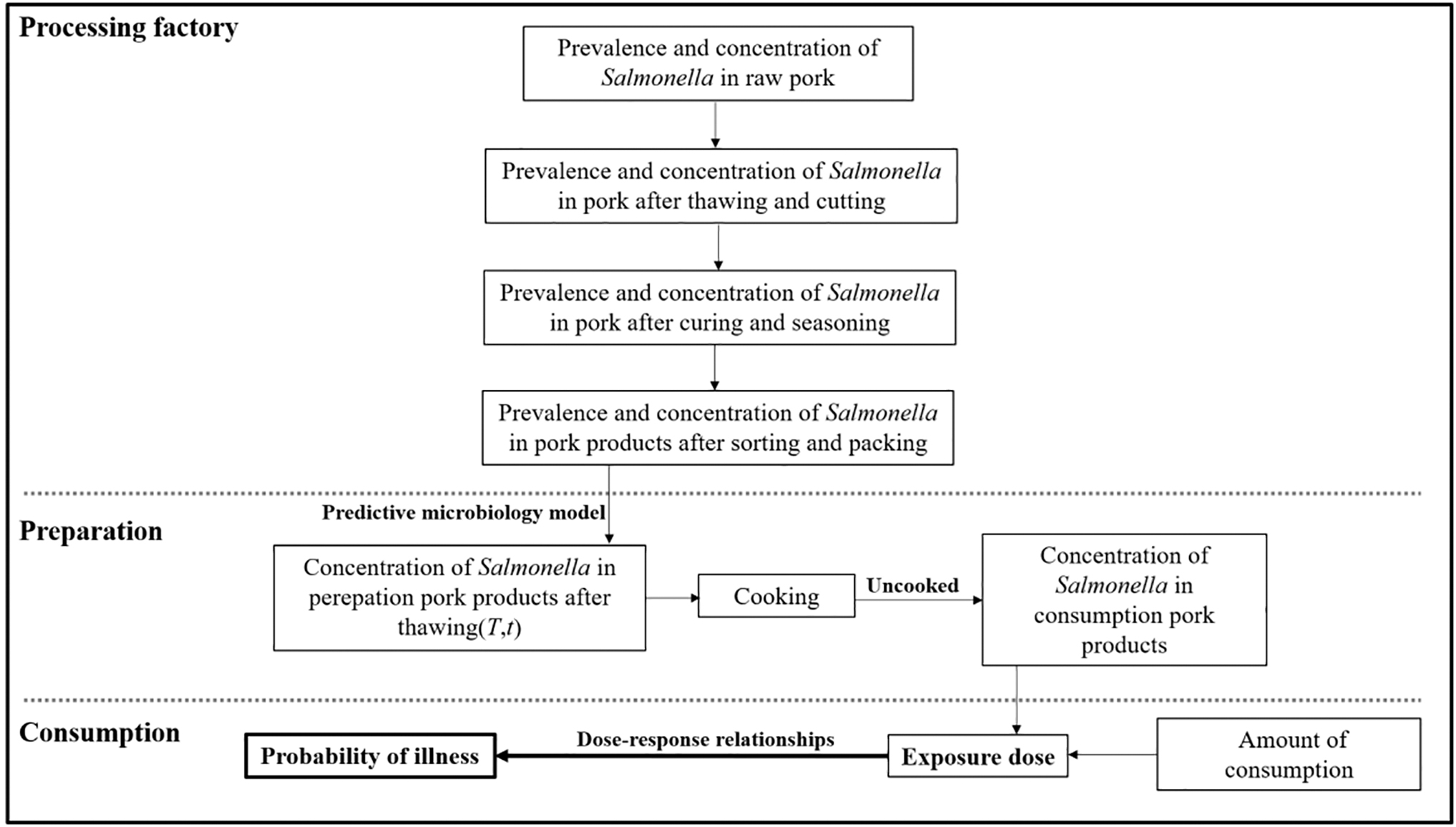
Risk model of Salmonella modularization process from processing to consumption of breaded pork products.
Summary of Variables and Parameters Used in the Quantitative Risk Assessment Model
MPN, most probable number.
Processing
The level of Salmonella contamination in positive samples at each processing stage of raw pork to terminal products is described with RiskDiscrete function as follows. RiskDiscrete ({0,1},{a,b}), where “0” represents the sample was negative for Salmonella, “1” represents the sample was positive for Salmonella, “a” represents the rate of negative for Salmonella and “b” represents the rate of positive for Salmonella. The best-fitting distribution expression of Salmonella concentration in positive samples was obtained by fitting for the quantitative Salmonella data using @Risk (v.7.0; Palisade, NY) software. The Salmonella concentration in negative samples was described by the formula M = −(2.303/m) × lg(Nneg/Ntot) (Jarvis, 2000), where “m” represents the quality (25 g) of samples, and “Nneg” represents the number of Salmonella-negative samples, and “Ntot” represents the total number of samples.
Preparation and consumption
Depending on their preferences, consumers choose whether to thaw the meat at room temperature before cooking. This research showed that the room temperature was generally 25°C and not more than 28°C. The recommended thawing time for the meat before consumption was 2 h. Consumers' cooking experience shows that thawing is generally less than half a day (5 h). At the same time, in the initial stage of taking breaded pork products from the freezer to room temperature environment, the temperature is low and does not meet the growth requirements of Salmonella. We assume that Salmonella will grow after 1 h at room temperature.
The RiskPert function was used to describe the growth time and temperature of Salmonella when the consumer thaws the breaded pork products. RiskPert(a,b,c), “a” represents the shortest growth time or the lowest growth temperature of Salmonella, “b” represents the most common growth time or the most common growth temperature, and “c” represents the longest growth time or the largest growth temperature. The contamination concentration (Lf) of Salmonella in breaded pork products after thawing was predicted by the first-level model (Baranyi), and by the second-level model (Ratkowsky square root). The equation of Baranyi model is shown in Equation (1) (Liu et al., 2021), and the equations of Ratkowsky model are shown in Equations (2) and (3) (Zhao et al., 2022b).

N t is the corresponding concentration of Salmonella at t (MPN/g); N 0 is the initial concentration of Salmonella (MPN/g); t is the growth time of Salmonella (h); μ max is the maximum growth rate of Salmonella (h−1); λ is the growth delay time of Salmonella (h); and T is the growth temperature of Salmonella (°C).
Due to the Chinese people's consumption habits, it is rare to have uncooked breaded pork products in the daily diet, and so, we assume that there is only one uncooked case in every 10,000 meals. In this uncooked case, 0.1% of the meat is uncooked, and so, the percentage of uncooked meat is 0.001%. Here, referring to the modeling approach of Wongnak et al. (2020), it is assumed that the reduction of Salmonella in uncooked breaded pork products is uniformly distributed with a reduction proportion from 0 to 1, represented by the function RiskUniform(a,b), with “a” representing the minimum Salmonella reduction ratio and “b” representing the maximum Salmonella reduction ratio. The breaded pork products will be consumed immediately after cooking, and so, the growth of residual Salmonella after cooking could be ignored.
Dose–response relationship
The consumption quantity (g) of breaded pork products per mealtime was calculated by RiskUniform (100,250). The residual amount of Salmonella in breaded pork products after cooking was multiplied by the weight per mealtime to calculate the amount of Salmonella ingested per mealtime. In this study, referring to the β-Poisson model established by the WHO as a dose–response relationship model, the probability of pathogenicity of Salmonella in breaded pork products per mealtime was calculated using Equation (4) (FAO/WHO, 2016). Here, 1 MPN was 1 colony-forming unit (CFU) (Zhao et al., 2020a).

P ill is the infection probability of Salmonella-contaminated breaded pork products per meal, DOSE is the concentration of Salmonella ingested per contaminated serving, and α and β are model parameters.
Risk characterization
Quantitative microbial risk assessment
For model simulation, Monte Carlo simulations were performed using the Latin hypercube sampling method in @Risk, and the corresponding results were obtained. A total of 10 simulations were performed, and each simulation run of the model consisted of 10,000 iterations. The results of the first simulation were selected to evaluate the model.
Sensitivity analysis
Using sensitivity analysis function of @Risk, Spearman correlation analysis was used to analyze the correlation between each factor in the process of breaded pork products from production to consumption and the development of salmonellosis in consumers, to determine each factor's contribution to the risk of Salmonella infection.
Evaluation of the intervention
To reduce the risk of salmonellosis infection in consumers when consuming breaded pork products, nine interventions were brought into the constructed quantitative risk assessment model, replaced, or additional steps were added, and the effectiveness of these interventions was compared based on the mean values of the probability of pathogenicity output from the model.
Results
Salmonella contamination during breaded pork product processing
The Salmonella contamination status in the samples of each process is shown in Supplementary Table S1 and Table 2. The result showed that 66 Salmonella strains (41.3%) were isolated from 153 product samples, and 2 (1.3%) were from 150 environmental samples. The contamination of Salmonella began to increase after the thawing and cutting process (20/30, 66.7%; 0.1532 ± 0.3027 MPN/g), increased to peak (26/43, 60.5%; 0.3111 ± 0.8921 MPN/g) after the curing and seasoning process, and was effectively controlled (3/30, 10%; 0.0712 ± 0.1825 MPN/g) in the sorting and packing process.
Contamination of Salmonella During the Process of Production
SD, standard deviation.
The model constructed in this study simulated the Salmonella contamination status at each of the three processing stages, used to describe the changes of Salmonella contamination during the processing of breaded pork products. As shown in Figure 2, the change of Salmonella contamination concentration in each process predicted by the model was consistent with the trend of the actual monitoring results. It indicated that the constructed model is suitable for predicting the contamination of Salmonella in actual processing. As shown in Figure 3, the concentration of Salmonella in the terminal products fitted by the model was 0.008 MPN/g, with a 90% possible distribution between 0.000 and 0.040 MPN/g.
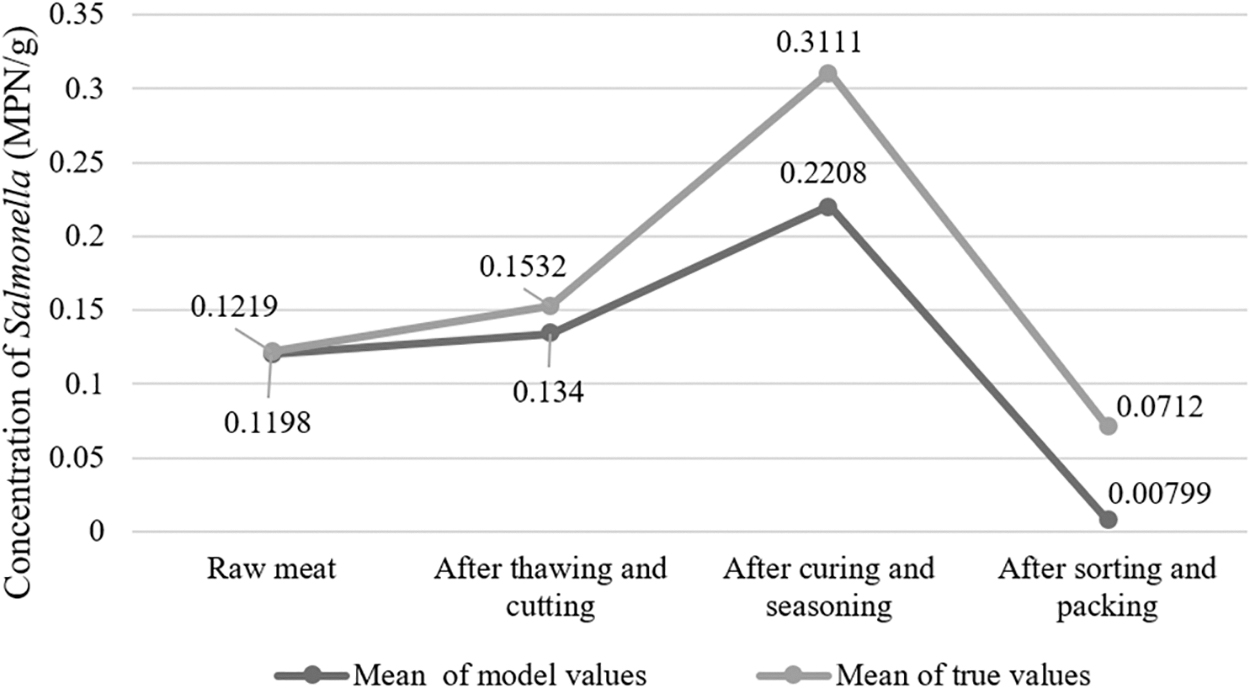
Contamination changed model of Salmonella during the process of production.
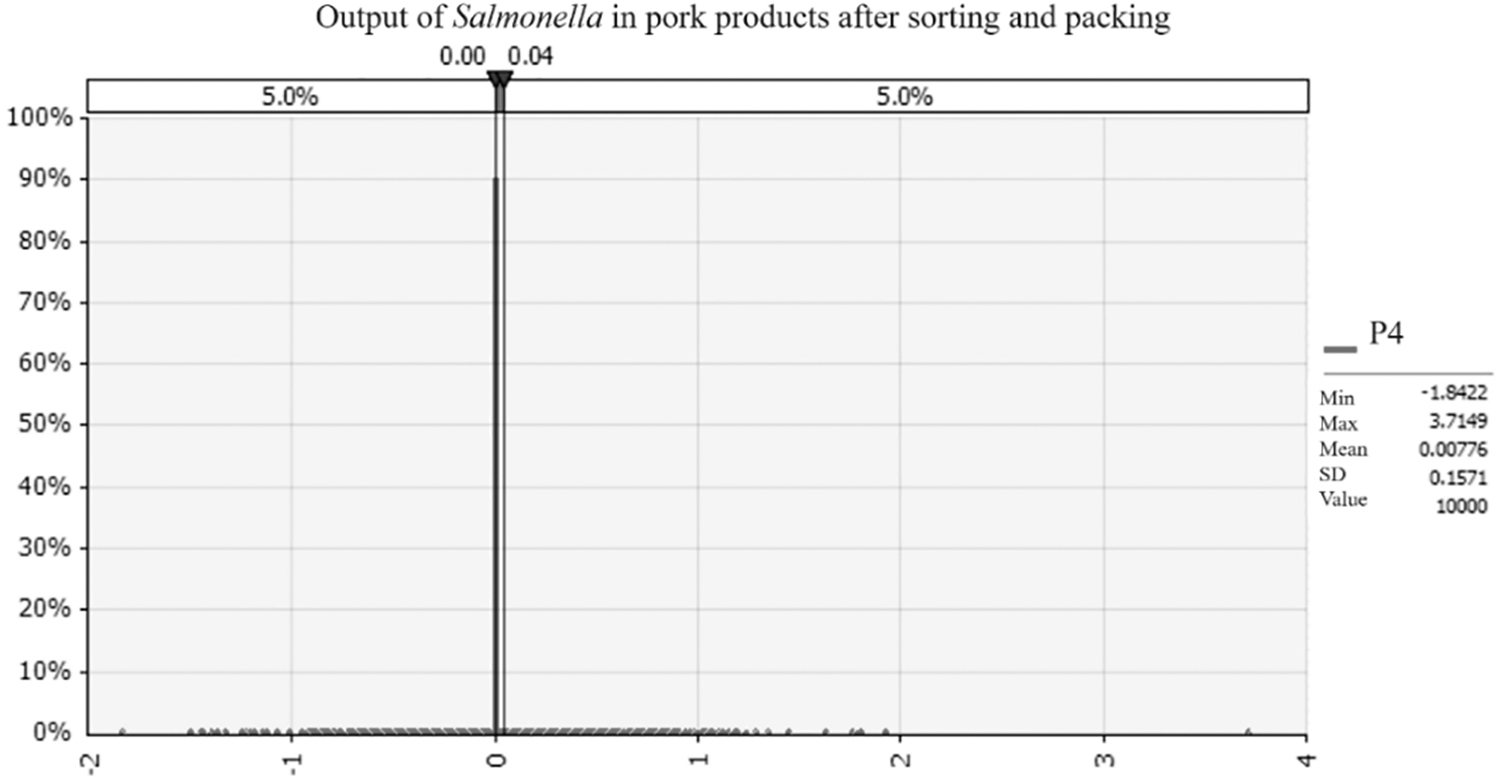
Concentration of Salmonella in terminal breaded pork products analyzed using a model.
Risk assessment result
Through the analysis by using the constructed quantitative risk assessment model, the mean concentration of residual Salmonella in uncooked breaded pork products at the time of consumption was 0.125 MPN/g, with a 90% possible distribution between 0.003 and 0.431 MPN/g (Fig. 4a). The pathogenic risk of Salmonella in uncooked breaded pork products was assessed by combining dose–response relationships. The probability of pathogenicity distribution is shown in Figure 4b, and it was found that the probability of salmonellosis per meal due to the consumption of uncooked breaded pork products was predicted to be 5.585 × 10⁻⁹, with a 90% possible distribution between 1.000 × 10⁻⁹ and 1.950 × 10⁻⁷.
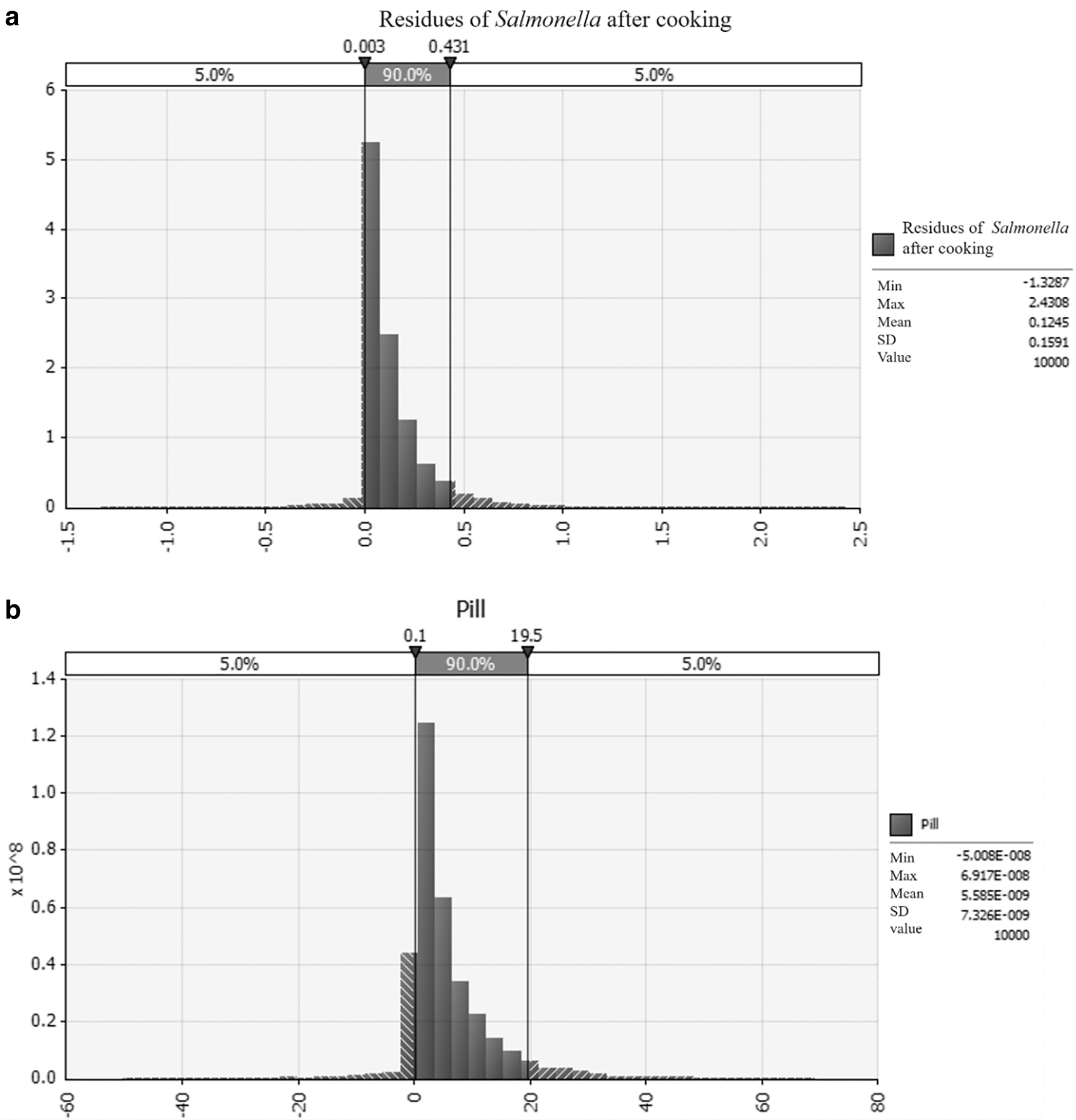
Repeatability of the model
As shown in Table 3, the mean value of the probability of salmonellosis caused by the consumption of breaded pork products in this study was 5.596 × 10⁻⁹/meal, and the standard error was 4.628 × 10⁻¹¹, with an error of <1%, indicating that the quantitative risk assessment model constructed in this study had good repeatability and can accurately assess the risk of Salmonella in breaded pork products to consumers.
The Model Simulates the Result of 10 Times of Disease Probability
SD, standard deviation.
Sensitivity analysis
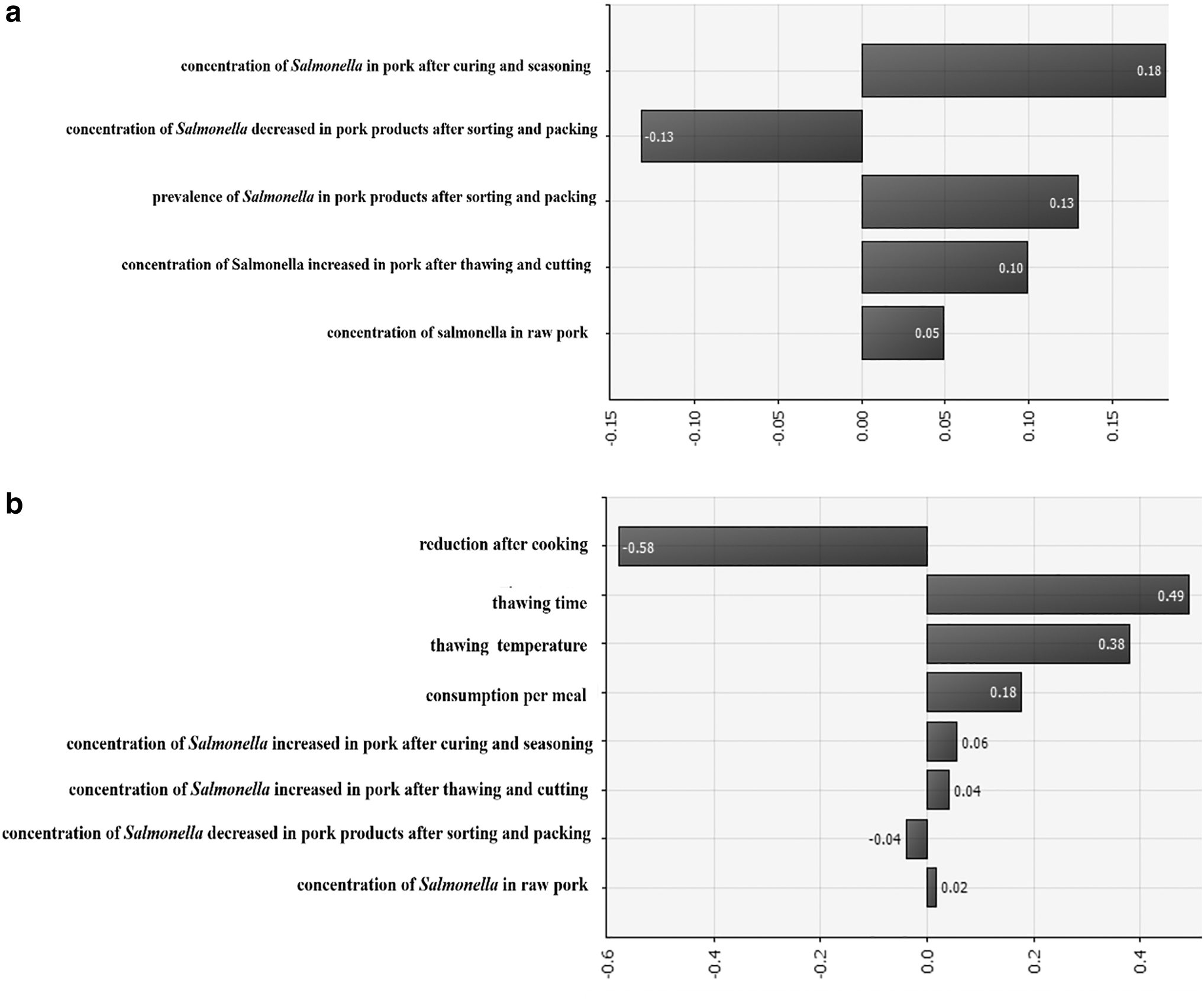
Only for processing, the concentration of Salmonella increasing after the curing and seasoning process was the main risk factor for Salmonella contamination during processing raw pork to terminal products, with a correlation coefficient of 0.18 (Fig. 5a). The correlation coefficient of Salmonella concentration after the sorting and packing process was −0.13, which was negative, indicating that this process was the main factor in reducing Salmonella contamination. From processing to consumption, Salmonella after cooking was the main factor for reducing the risk of disease to consumers with a correlation coefficient of 0.58, and the thawing time was the main factor of increasing the risk with a correlation coefficient of 0.49 (Fig. 5b), indicating that consumer behavior was the main influencing factor.
Evaluation of intervention measures
Based on the sensitivity analysis results, we set different interventions for the main risk factors to reduce the risk of salmonellosis when consuming breaded pork products. Table 4 shows the infection probability of Salmonella in breaded pork products after adding different interventions. The reduction in infection risk ranged from 0.001- to 30.969-fold. The most pronounced effect was breaded pork products to be well-cooked, which reduced the risk of pathogenicity to 0. The next most effective measure was the breaded pork products to be microwave thawed before cooking, which reduced the infection risk by 30.969-fold. Refrigerator thawing of breaded pork products before cooking reduced the infection risk by 24.502-fold. Reducing the thawing time of products by 1 and 2 h before cooking reduced the risk by 1.722- and 3.168-fold, respectively, while the impacts of interventions in processing, such as refrigerator curing and seasoning, irradiation sterilization of terminal products, were limited.
Risk of Salmonella with Different Scenarios in Breaded Pork Products from Processing to Consumption
Discussion
There is limited statistics on Salmonella infections due to the consumption of meat products in China until now. In this study, the quantitative risk assessment model of Salmonella in breaded pork products was first constructed, and using it, the Salmonella infection risk per meal was evaluated to be 5.585 × 10⁻⁹. Assuming that at least half of the Chinese people (1.4/2 billion) consume 100 meals of breaded pork products yearly, it is evaluated that 391 people are infected with Salmonella each year.
Li et al. (2016) reported that 440 people were infected with Salmonella from meat or its products in the Guangxi Province between 2010 and 2014. Song et al. (2022) conducted a meta-analysis and found 2120 salmonellosis cased by Salmonella in food in China between 2005 and 2019. However, no reported cases of Salmonella outbreaks were associated with breaded pork products. The main reason for the bias in infection data may be that not all infected people went to the hospital or that some community hospitals were not included in the data. A quantitative risk assessment of Salmonella in meatballs has been conducted in Denmark (Mller et al., 2015), with the assessed risk significantly higher than the risk in this study. The main reason may be related to the different consumption habits, for example, people in China are used to eating completely cooked food (Bai et al., 2023).
Curing and seasoning was the main process of introducing Salmonella contamination during processing of breaded pork products through the sensitivity analysis of the constructed model. When the curing temperature could not be kept within the range of inhibiting bacterial growth, there was enough time for Salmonella to grow and spread downstream. Chui et al. (2020) similarly found that the curing process increases the microbial contamination during meat product processing. Notably, Salmonella might have evolved to adapt to harsh environments and survive more easily (Mutz et al., 2019). Thus, after curing and seasoning, Salmonella in products would be more difficult to kill when it entered the subsequent stages.
Using multilocus sequence typing (MLST), we found that ST11 (shown in Supplementary Fig. S1) was introduced from the thawing and cutting process, and spread along the production chain to become the dominant sequence type in the link. ST11 was also detected in the environmental samples, indicating that Salmonella cross-contamination between products and environments would have happened. Therefore, controlling Salmonella contamination strictly during producing is very important for product safety, in addition, it is also important for consumers to cook products completely.
Based on the results of intervention evaluation, it is known that well-cooked is effective in reducing the risk of Salmonella infection. Several previous studies have shown that cooking is a major factor in reducing foodborne microbial contamination (Dogan, 2019; Jeong et al., 2018). Control of thawing temperature before cooking was another effective intervention to reduce risk. Two different thawing methods were used to intervene on the breaded pork products before cooking. Microwave thawing is more effective compared with refrigerator thawing because microwave thawing inhibits not only microbial growth but also kills small amounts of microorganisms (Manios and Skandamis, 2015).
Although interventions during breaded pork product processing showed poor effect on reducing Salmonella infection risk to consumers, while for enterprise, reducing microbiological contamination in terminal products by taking some interventions such as irradiation or other hygienic controlling measures was important. Irradiation sterilization was an effective way of controlling the hygienic quality of the terminal products with effectively killing 90% of microorganisms (Nguyen et al., 2022).
This study involved many models and parameters for assessing the risk of Salmonella in breaded pork products. The missing or assumed data for some parameters led to uncertainty and variability in the assessment. First, we did not consider Salmonella changes during product storing. Second, when using a predictive microbiology model for Salmonella growth during product thawing, we drew on the predictive Salmonella growth model in raw pork, which did not sufficiently consider salinity and humidity in pork products. Finally, there is a significant lack of data on the uncooked product for our consumption behavior. This study assumes that the proportion of uncooked product is 0.001%, directly affecting the assessment result uncertainty.
Conclusion
A quantitative risk assessment model of Salmonella in breaded pork products from processing to consumption was established and used for evaluating Salmonella risk for production and for consumers, and clarifying the effective methods of risk intervention in the whole chain, which provided a theoretical basis for hygienic control of microbial contamination during processing and provided scientific guidance for consumers during cooking.
Footnotes
Acknowledgment
The authors thank Prof. Wang Jun of Qingdao Agricultural University for his guidance in this article.
Authors' Contributions
H.C.: methodology, software, data curation, and writing—original draft. G.Z.: conceptualization, data curation, and writing—review and editing. Y.X.: visualization and investigation. J.Z.: visualization and investigation. X.H.: visualization and investigation. X.Z.: investigation. N.L.: visualization. L.W.: visualization. J.L.: visualization. J.W.: writing—review and editing and supervision.
Disclosure Statement
The authors declare that they have no known competing financial interests or personal relationships that could have appeared to influence the work reported in this article.
Funding Information
This work was funded by the National Key Research and Development Program of China (2022YFC2303902).
Supplementary Material
Supplementary Table S1
Supplementary Figure S1
Contamination Changing Model Excel file
MLST Excel file
Risk Assessment Data Excel file
References
Supplementary Material
Please find the following supplemental material available below.
For Open Access articles published under a Creative Commons License, all supplemental material carries the same license as the article it is associated with.
For non-Open Access articles published, all supplemental material carries a non-exclusive license, and permission requests for re-use of supplemental material or any part of supplemental material shall be sent directly to the copyright owner as specified in the copyright notice associated with the article.

