




Abstract
Rice (Oryza sativa) is a major cereal crop that balances the food demand of the worldwide population. The crop quality drops daily due to their exposure to biotic and abiotic stresses, especially pathogens. It needs to be improved to maintain the consumption level to cope with increasing population demands for food. The current study was designed to analyze the comparison of the effects of green synthesis approaches on pathogens associated with rice seeds. In this study, essential oils were extracted from Cymbopogon citratus, Thymus vulgaris, and Origanum vulgaris medicinal plants and used as fungicides on fungal strains of Aspergillus spp. T. vulgaris effectively controlled the growth of Aspergillus niger, Aspergillus flavus, and Aspergillus terreus as compared with O. vulgaris and Cymbopogon. Further, silica nanoparticles (SiNPs) were synthesized from rice husk to evaluate their antifungal activities. SiNPs were characterized by ultraviolet-visible spectroscopy with a broad peak at 281.62 nm. Fourier-transform infrared spectroscopy spectrum confirms the presence of Si–H, Si–OH, and Si–O–Si bonds functional groups, and SiO4 tetrahedral coordination unit. X-ray diffraction pattern describes the crystalline structure with a sharp peak at 2θ = 22°. Scanning electron microscopy and energy-dispersive spectroscopy confirmed the spherical shape, size 70–115 nm, and elemental composition with pure silica contents. SiNPs showed no significant antifungal activity against Aspergillus strains. Moreover, Trichoderma was isolated from the rhizosphere of rice fields and showed a surprising antifungal effect against A. terreus, A. niger, and A. flavus. The current study successfully revealed environment-friendly and cost-effective green synthesizing approaches for analyzing biocontrol potential against rice seed-related Aspergillus spp. They will also help to improve pathogen control strategies in other cereals.
Introduction
“R
The loss of rice grain quality is a significant barrier to increasing rice yield. Various rice diseases are caused by pathogenic microorganisms, which gradually become complicated. These harmful microorganisms target the crop and produce toxins that directly hit animal and human life (Raghu et al., 2020). More than 70 pathogens affect the rice crop, including bacteria, viruses, fungi, and nematodes (Singh et al., 2018).
The fungal diseases caused over 1.6 million deaths annually and over one billion people suffer from fungal diseases. More than 250 species of Aspergillus spp. are found, and among them Aspergillus flavus and Aspergillus fumigatus are the most common human pathogens. Plants and crops are also damaged by these fungal diseases, causing losses in major crops globally (Rice, wheat, maize, potatoes, and soybean) (Almeida et al., 2019; Park et al., 2005; Tafinta et al., 2013).
Different steps have been taken to eliminate plant diseases over centuries. Fungicides are used as a broad spectrum of disease control in rice seeds but their continuous application harms human health and the environment. Moreover, due to their continuous application pathogens also develop resistane against fungicides (Elshafie et al., 2015; Kumar et al., 2013; Muthukumar et al., 2016). So it gained a lot of attention to develop natural products that replace synthetic fungicides that are safe, environmentally friendly, sustainable, and efficacious (Amini et al., 2012).
Globally, the population is increasing day by day and needs a continuous supply of sustainable and healthy food production. Biological control using beneficial microbes has been used in plant pathology for many years against pathogens to suppress diseases (Pal and Gardener, 2006). Introducing novel microorganisms, using Nano biotech tools, and producing biocontrol agents from different natural products may enhance yield and protect the ecosystem, leading to a sustainable agriculture system and can completely replace fungicides (Iftikhar et al., 2020).
Another new approach to combat these pathogens is the synthesis of nanoparticles by green methodology and is manageable, sustainable, economical, and reliable (Babu et al., 2018). They act as a stimulus for activating many defense systems in plants in critical conditions and act as fertilizers because of their high soluble behavior, surface area, and nominal size (Akhtar et al., 2022). Scientists are preparing nanoparticles such as calcium, copper, gold, iron, silver, zinc, and silica from different medicinal plants (Babu et al., 2018). Among them, silica (SiNPs) nanoparticles are reactive, highly stable, and have low toxicity. SiNPs are used for industrial purposes, packaging, cancer therapy, drug delivery, bio-sensing activities, food, and agriculture (Patil et al., 2018).
Plant extracts and essential oils can also be used as a replacement for pesticides. Essential oils have encouraging results on fungal growth suppression, proving successful in controlling plant diseases. They have several biological and other applications in the food industry to preserve food, aroma, and flavoring (Carpena et al., 2021; Khaledi et al., 2015).
Essential oils from plants such as Origanum vulgaris, Thymus vulgaris, Cymbopogon citratus, and many more possess strong anti-fungal properties and exhibit a high capability for inhibiting fungal strains and food preservation (Nguefack et al., 2009).
Therefore, the focus of the current study was to analyze the effects of different green synthesis approaches, that is, the use of beneficial microbes as biocontrol agents, the impact of SiNPs on controlling rice pathogens, and the use of essential oils in controlling pathogens associated with rice seeds. This study will clarify the most effective green approach as compared with other methods for combating pathogenic Aspergillus spp. in rice seeds. The significance of this study lies in reducing time consumption and cost and will also help to improve pathogen control strategies in various crops.
Materials and Methods
The present study followed national guidelines of Pakistan National Bioethics Committee for Research for animal treatment. The Pakistan National Bioethics committee and Institutional Review Board and Ethics Committee of International Islamic University, Islamabad reviewed and approved this study.
Fungal cultures
The fungal cultures used in this study were Aspergillus niger, A. flavus, Aspergillus terreus, and Trichoderma. Aspergillus spp. used in this were isolated from the seed-rice (Monajjem et al., 2014). At the same time, the fungus used as a beneficial microbe was Trichoderma, separated from the rhizosphere of rice fields. All the fungi were cultured on sabouraud dextrose agar, incubated at 28–30°C for 1 week, and subcultured to attain pure culture. The stock cultures were preserved at 4°C for later applications.
Isolation of rice seed-associated fungi
For the isolation of fungal pathogens associated with rice seeds, almost 20 accessions of rice seeds were used and obtained from the BioResources Conservation Institute's gene bank of the National Agriculture Research Centre (NARC) Islamabad (Table 1).
List of Rice Accessions
Rice accessions were collected from different agro-ecological zones of Pakistan and conserved in the National GenBankof Pakistan, Plant Genetic Resources Institute, National Agriculture Research Centre.
The conventional blotter method was used according to Ora et al. (2011) methodology to determine the presence of fungal pathogens related to seeds. Briefly, seeds were sterilized with 1% sodium hypochlorite for 3 min, placed on sterilized blotting paper, covered, and sealed with Parafilm. The plates were incubated at 25°C, and fungal growth was monitored daily for 7 d. The resulting cultures were identified based on cultural and morphological characteristics. The percentage of contaminated seeds was determined by counting the number of infected seeds and the total number of seeds:
Purification and identification of fungal cultures
The pure culture of fungus was obtained by continuously subculturing on potato dextrose agar (PDA). Streptomycin was added to the media to avoid bacterial growth, and a pure culture of fungus was characterized based on morphological characteristics by following the methodology of Tafinta et al. (2013).
The slide culture technique was used to find out the pattern of colony growth, conidial morphology, and pigmentation. Further, a little section of mycelia from related culture was inoculated on solidified PDA for 2–3 d. After 3 d, mycelia were observed under the light microscope (40 × ) magnifying lens for detecting spores, hyphae, and other structural features.
Isolation of antagonists
The soil was collected from the rhizosphere of the rice field. By following Yadav's methodology (2012), antagonists were separated by the soil dilution plate technique. Serial dilutions (up to 10−5) were prepared by adding 1 g of soil in 10 mL saline solution. One ml of soil sample was poured on sterile PDA plates and swapped with sterile cotton buds, and streptomycin was added to inhibit the growth of bacterial colonies. The plates were covered and wrapped with Parafilm and incubated at 25°C for 3–5 d for the isolation of beneficial fungal Trichoderma.
Collection of plant material
The aerial parts of C. citratus (lemon grass), T. vulgaris (thyme), and O. vulgaris (oregano) were collected from the fields of NARC, Islamabad. Plant leaves were washed with distilled water and shade dried for 2 weeks, cut into small pieces, hashed into powder form, and stored in plastic bags.
Extraction of essential oils
For extraction of essential oils, 100 g of plant material was subjected to hydro-distillation for 3 h using the Clevenger apparatus. Oil was separated from water layers by micro-pipetting and stored at 4°C.
Synthesis of SiNPs
SiNPs were synthesized by following the methodology of Elamawi et al. (2020) with minimal modifications. One hundred milliliters HCl was added to 20 g of dried rice husk and heated to 70°C for 2 h with continuous stirring. A blackish solid product was obtained and dried in an oven at 60°C for 24 h. The dried mass was crushed and placed in ceramic boats, covered with aluminum foil, and kept in a muffle furnace for 3 h at 700°C. The final material was ground and stored at room temperature for further analysis.
Characterization of SiNPs
Ultraviolet-visible spectroscopy
SiNPs were characterized by using a UV-Visible Spectrophotometer (Perkin Elmer, Lambda 35, Germany). The sample was prepared by mixing a small amount of SiNPs into ethanol solvent. The absorbance SiNPs were evaluated at wavelength ranges from 200 to 700 nm.
Fourier-transform infrared spectroscopy
Fourier-transform infrared spectroscopy (FTIR) analysis was done on FTIR spectrometer 1760X (Perkin-Elmer) by using potassium bromide (KBr pellets) by applying infrared radiation at room temperature for 1 h. The sample was mixed with 250 mg of potassium bromide powder, grounded, and 13 mm size pellets were exposed to scanning in transmission mode 4 cm−1 at resolution ranges 4000–600 cm−1.
X-ray diffraction
The crystalline structure of SiNPs was observed using X-ray diffraction (XRD) equipped with Cu and Kα radiation source (λ = 1.540562 Å) for 2 h at 30–40 kv and 15 mA on 20 scales with a step size of 0.02 degree.
Scanning electron microscopy
The morphological features and size of SiNPs were acquired by high vacuum scanning electron microscopy (JEOL JSM 5910 LV) with voltage ranges from 15 to 200 kv and a resolution of 2.4 Å. The SiNPs sample was mounted on copper adhesive tape, and a thin gold layer was applied on the surface of the nanoparticles to make them conductive.
Energy-dispersive spectroscopy
Scanning electron microscopy (SEM) did the elemental analysis with energy-dispersive spectroscopy (EDS) for analyzing the metal composition of SiNPs. It also confirmed the exact design of SiNPs with other elements such as impurities.
Antifungal activity of essential oils, SiNPs, and microbial antagonists
Antifungal activity was performed by the disk diffusion method followed by Elamawi et al. (2020) and Li et al. (2022) with some modifications. One hundred microliters of freshly prepared pathogenic fungal inoculum was swabbed on PDA plates, and sterile filter paper disks loaded with different concentrations (25, 50, 75, 100, 125, 150, 175, and 200 ppm) of essential oils (lemongrass, oregano, thyme), SiNPs, and microbial antagonists (Trichoderma) were incubated with fungal cultures.
In case of Trichoderma, dual culture methodology was adopted. The well was made in the middle of the plate from the back side of the sterile pipetting tip and discarded and replaced with a freshly prepared culture. The plates were incubated at 28–30°C for 5–7 d, and zone of inhibition was observed regularly. Nystatin (5 μL) and dimethylsulfoxide (DMSO) were used as positive and negative controls, respectively. All the experiments were performed in triplicates.
Results
Percentage of infection rate
Aspergillus was obtained from rice seeds present in a wide variety of environments throughout the world. Three fungal strains, that is, A. niger, A. flavus, and A. terreus, were isolated and the infection rates in the observed accessions ranged from 10% to 50%. The highest fungal infection rate (50%) was examined in accession no. 6729, followed by accession no. 6511 (40%). Five accessions (6561, 6742, 6772, 6808, and 6821) showed 30%, and seven accessions (6705, 6722, 6575, 6767, 6787, 6831, and 6836) showed 20%. The accessions (6700, 6711, 6782, and 6803) showed 10%, and two (6751 and 6826) showed no infection rate.
Morphological features and characteristics of isolated fungi
The strains from the culture plates were identified on behalf of morphological features and microscopic characteristics and their comparison with standard Aspergillus strains: Aspergillus niger (ATCCRI-01), Aspergillus flavus (ATCCRI-02), Aspergillus terreus (ATCCRI-03), and Trichoderma.
The appearance of the species on PDA media was observed as dense white color that turns into dark black mycelia. Generally, clustered conidia with long conidiophores, faintly brownish near the apex, globule vesicle pooped out covered completely with philades was observed under the microscope. The result confirmed that A. niger is associated with organisms in plants, soil, and decaying vegetation.
The colony of A. flavus on the incubated plate was green hues ranging from light to deep green. The texture was powdery mass, and microscopic analysis confirmed simple, colorless, transparent, unbranched, and smooth conidiophores. The conidia were typically globular to sub-globular in shape. A. terreus produces colonies of yellow color that turn to cinnamon brown. They were spherical, oval shaped, and smooth-walled with 2 μm in diameter.
Trichoderma grew fast on culture medium; first, white concentric rings appeared and converted to green conidia. The microscopic analysis showed dense, spherical conidia, branched conidiophores, and flask-shaped phialides.
Antifungal activity of medicinal plant's essential oils
The results demonstrated the antifungal properties of C. citratus, T. vulgaris, and O. vulgaris essential oil at different concentrations on the mycelial growth of Aspergillus spp. They exhibited fungi-toxic activity by inhibiting the mycelial growth of fungi.
C. citratus essential oil showed good antifungal activity against A. flavus, followed by A. niger and A. terreus. The considerable antifungal activity, that is, 11 mm zone of inhibition was recorded in the case of A. flavus at 200 ppm. At the same time, A. terreus and A. niger showed 2 mm at highest concentration (200 ppm) (Fig. 1A).
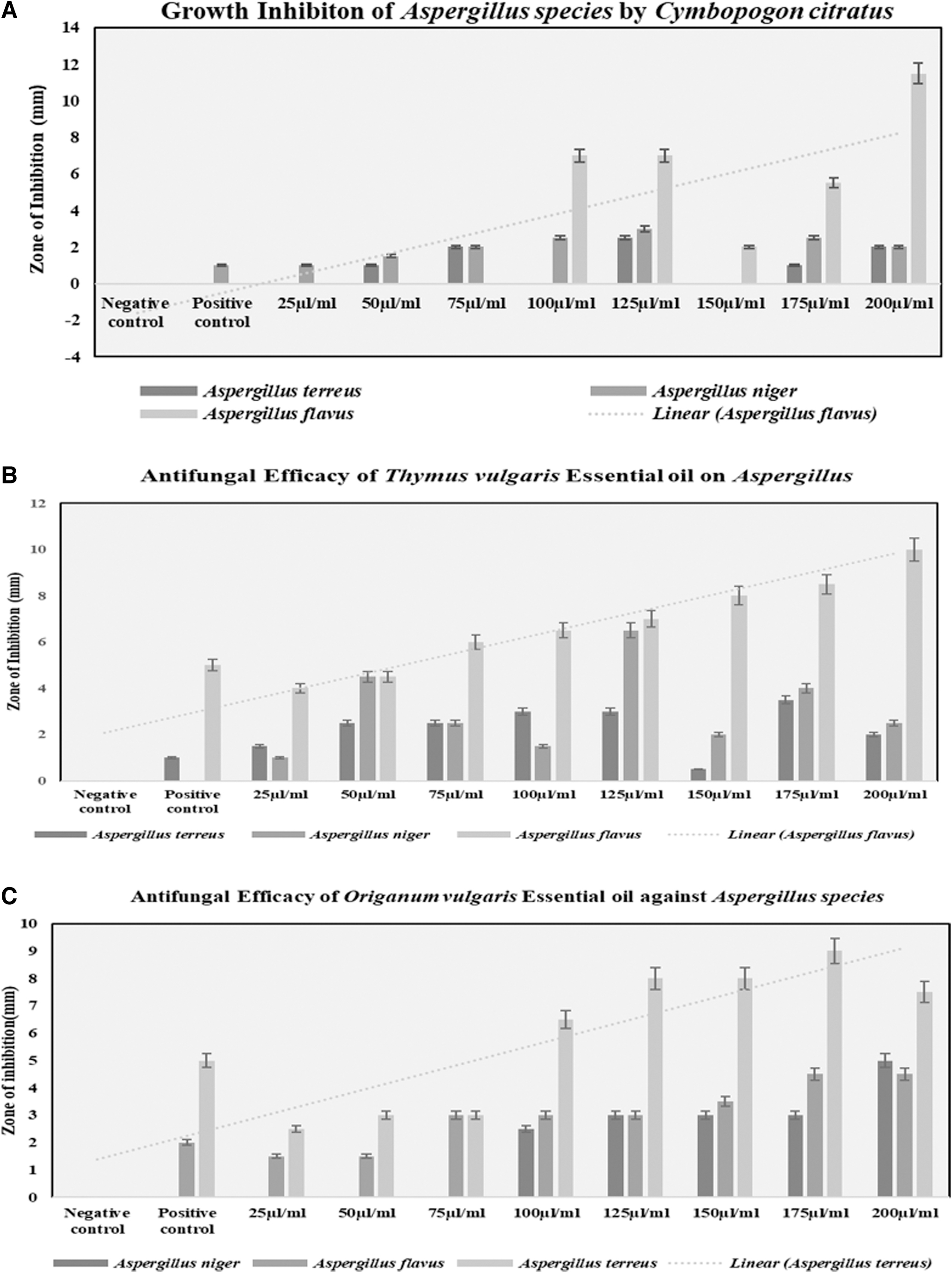
Antifungal activity of essential oil on the growth of Aspergillus spp.
T. vulgaris essential oil expressed the strongest antifungal activity against all strains of Aspergillus. A. flavus at all concentrations was strongly inhibited followed by A. niger and A. terreus. The highest zone of inhibition was 10 mm in A. flavus at 125 ppm, 6.5 mm in A. niger at 125 ppm, while a 3 mm inhibition zone was recorded in A. terreus at 175 ppm (Fig. 1B).
O. vulgaris showed the highest antifungal activity against A. terreus at all concentrations. Zone of inhibition was recorded at 9 mm in A. terreus, followed by 4.5 mm in A. flavus and A. niger with slight activity at high concentrations (Fig. 1C).
Analysis of the antifungal activity of SiNPs
Synthesis of SiNPs
The SiNPs were synthesized successfully by treating dried rice husk with HCl at constant stirring and heating. After 2 h, the solution color changed to a blackish solid powder and white colored powder after heating at 700°C for 3 h in muffle furnace confirmed synthesis of SiNPs.
Characterization of SiNPs
Ultraviolet-visible spectroscopy
The SiNPs showed absorption peak ranges between 200 and 700 nm. The radiation absorbed at 204.33, 281.662, and 692.91 nm plotted against wavelength was recorded (Fig. 2A).
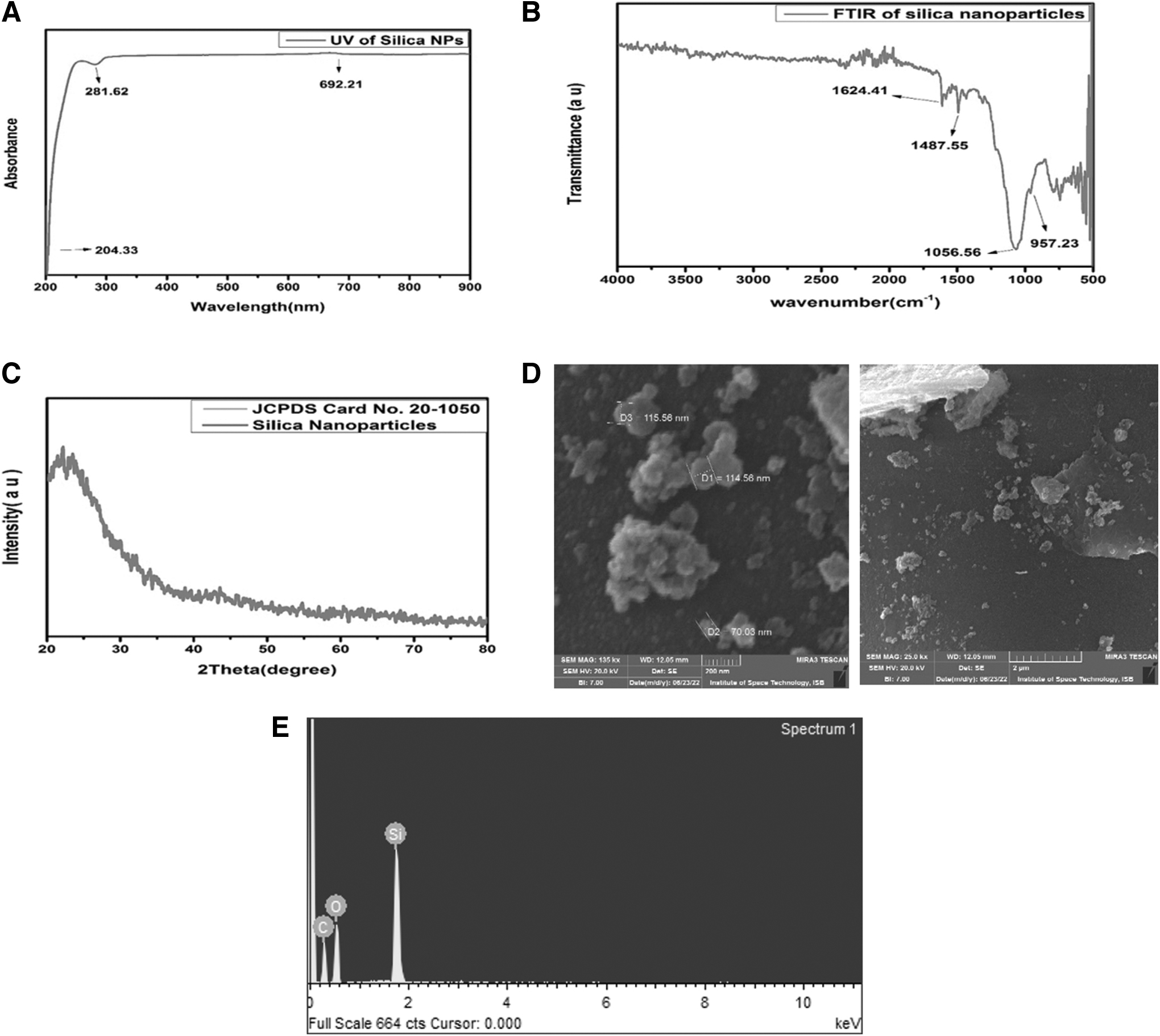
Characterization of silica nanoparticles.
Fourier-transform infrared spectroscopy
The FTIR results displayed four main peaks. The dense vibrational line between 2000 and 2300 cm−1 confirmed the presence of the silane group (Si–H). The band peak at 1624.41 cm−1 indicated that the deformation of the water molecules takes place on the surface of SiO2. The peak at 1487.55 was due to the presence of the Si–OH group. The peak formed at 1056.56 cm−1 showed the asymmetric vibration of Si–O–Si. The broad shoulder 957.23 can be attributed to the vibration of the tetrahedral SiO4 coordination unit (Fig. 2B).
X-ray diffraction analysis
The XRD pattern confirmed the nanoparticle structural properties. The biogenic SiNPs displayed an amorphous structure and a broad halo peak absorbed between 2θ = 20° and 24° region. The highest peak of amorphous SiNPs was recorded at 22° angle (Fig. 2C).
SEM analysis
The particle size, shape, and morphology of green synthesized SiNPs showed that particles were agglomerated and spherical in shape. The micrograph of SiNPs indicates that the average particle size was about 70–115 nm in diameter (Fig. 2D).
Energy-dispersive spectroscopy
The elemental analysis of nanoparticles was obtained from EDS analysis using data and graph peaks (Fig. 2D; Table 2). The EDS data confirmed the presence of elements Silicon (Si), Carbon (C), and a negligible amount of oxygen (Fig. 2E).
Energy-Dispersive Spectroscopy Data of Silica Nanoparticles
Antifungal activity of SiNPs
The SiNPs did not show any significant activity against tested fungi. The growth of inhibition of A. terreus was not in an appropriate manner. However, A. niger was not inhibited by any concentration of SiNPs. However, A. flavus was slightly controlled by SiNPs. Maximum control of mycelial growth by SiNPs was 6.5 mm (Fig. 3).

Antifungal activity of SiNPs on the growth of Aspergillus spp. All values are expressed as the mean value of triplicate ± standard deviation. SiNPs, silica nanoparticles.
Antifungal activity of antagonists
Among all the treatments, Trichoderma showed the highest reduction in mycelial growth of pathogens by dual culture methodology. Biocontrol effect of antagonists against A. terreus showed a maximum zone of inhibition ≥13 mm, followed by A. niger with 11 mm and A. flavus with 8.5 mm (Fig. 4).

Antifungal activity of Trichoderma on the growth of Aspergillus spp. All the values are expressed as the Mean value of triplicate ± standard deviation.
Comparative evaluation of biocontrol of rice seed-associated fungal pathogens by green synthesized approaches
Comparative evaluation of biocontrol of rice seed-associated fungal pathogens by green synthesized approaches indicated the difference between the activity of Essential oils, SiNPs, and Trichoderma on the growth of Aspergillus spp. This study confirmed that each pathogen shows a significant effect in growth against these treatments.
The highest zone of inhibition was shown by Trichoderma followed by T. vulgaris essential oil. O. vulgaris essential oil showed lower activity and lowest activity was observed by C. citratus essential oil. The SiNPs exhibited very minimum effect or no effect at all. A. niger, A. flavus, and A. terreus are numbered as 1, 2, and 3 versus each treatment because they fluctuate according to each treatment as shown in Table 3, and Figure 5.
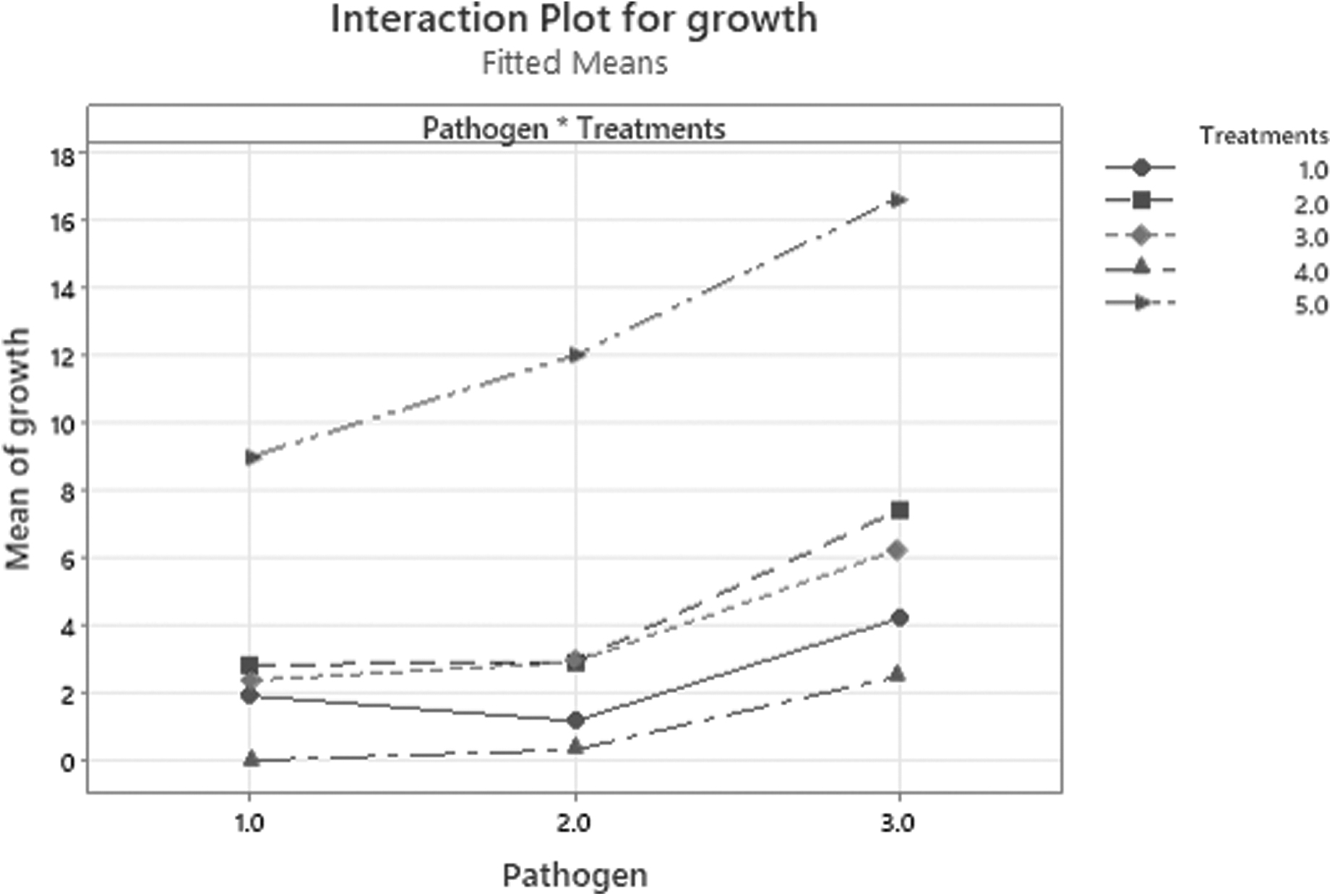
Evaluation of interactions of pathogens with treatments.
Effect of Average Inhibition of Growth of Aspergillus spp. By Green Synthesis Approaches
Recorded data treatments verses pathogen growth inhibition of A. niger, A. terreus, and A. flavus showed highly significant results as p < 0.001.
Significant at 0.05.
SD, standard deviation.
Overall pathogen × treatment/pathogen verses treatment interactions data described that pathogens are significantly controlled by treatments (Fig. 5). Data expressed as p < 0.05* means that the growth of pathogens is significantly controlled by biocontrol agents.
The comparison in activity of different treatments revealed highly significant results as p < 0.001***. Similarly, the comparison of growth inhibition of A. niger, A. terreus, and A. flavus showed highly significant results as p < 0.001***. This means that each treatment possessed good antifungal activity and pathogen growth is remarkably inhibited.
This graph manifested visible differences that pathogen 3 is highly controlled by every treatment. Then, pathogen 2 against each treatment is inhibited. Pathogen 1 exhibits very low activity or no activity on the application of these treatments.
The other side elucidated the efficacy of Trichoderma as highly beneficial against rice pathogens. Medicinal plant essential oils demonstrated significant control in the growth of rice fungal pathogens. Among them, T. vulgaris essential oil spotted good inhibition activity, followed by O. vulgaris and finally C. citratus against these strains of Aspergillus. Biosynthesized SiNPs possessed very low activity.
(Treatment 1 = Cymbopogon citratus, Treatment 2 = Thymus vulgaris, Treatment 3 = Origanum vulgaris, Treatment 4 = Silica Nanoparticles, Treatment 5 = Trichoderma)
Discussion
Globally, rice holds more than half of the world's population as a primary source of food. Rice crop quality is badly affected by seed-borne fungal pathogens, which drastically drops its nutritional importance (Begum et al., 2022). The demand for rice consumption level in Asia and overall in the world is increasing everyday, so there is a need to grow rice that is pathogen free, full of nutrients, cost-effective, and can meet the increasing world population demand (Sethy et al., 2020).
Synthetic fungicides are replaced by various green methods to produce bioactive natural constituents that not only act against pathogens but also are eco-friendly, socio-economically, and pharmaceutically important (El-Baky and Amara, 2021). Therefore, the main objective of the present study was extracting natural substances from different natural resources and their comparative outcomes against rice seed-related pathogens.
The present study investigated the antifungal activity of essential oils on Aspergillus isolates of rice seeds (Fig. 1A–C). The results demonstrated that T. vulgaris essential oil showed a good antifungal impact on all fungal strains. T. vulgaris showed maximum effect in controlling the growth of A. flavus as compared with A. niger and A. terreus. O. vulgaris essential oil generally indicated moderate activity.
On high concentrations of O. Vulgaris, the growth of A. terreus was inhibited to maximum ratio. However, the growth of A. flavus showed lower inhibition ratio and the lowest effect on inhibition of hyphal growth was recorded in A. niger. The overall activity of C. citratus essential oil expressed low potential against Aspergillus spp. These results align with the studies of Střelková et al. (2021) and Amini et al. (2012) with the same findings.
Further, the present study focused on the synthesis of SiNPs from rice husk and their activity against Aspergillus isolates. Change in color indicated the production of SiNPs, and confirmation was carried out by common analytical techniques. Ultraviolet-visible spectroscopy showed the absorption peak between 200 and 700 nm, forming a broad peak at 281.62 nm (Fig. 2A).
Babu et al. (2018) and Azhakesan et al. (2020) also observed SiNPs at 350 nm wavelength. FTIR absorption band peaks at 2300–2100, 1624.41, 1487.55, 1056.56, and 957.23 cm−1 and the infrared (IR) spectrum clearly showed the pure silica (Fig. 2B), which correlates with the findings of Agi et al. (2020).
The XRD pattern showed the crystalline nature of SiNPs and formed a broad halo peak at 2θ = 22° region (Fig. 2C). The pattern of the peak is supported by the studies of Biradar et al. (2021). The SEM analysis (Fig. 2D) also revealed the spherical shape of nanoparticles with particle size 70 and 115 nm. The data are closely related to the particle size of silica 73.6 and 133.7 nm (Kalboush Za et al., 2017). EDS confirms the elemental composition of SiNPs (Table 2; Fig. 2E). These results are in accordance with the findings of Wang et al. (2011).
Moreover, the present study showed that SiNPs did not show significant antifungal activity. No activity was observed in the case of A. niger and very low activity against A. flavus and A. terreus (Fig. 3). The observed activity is not supported by the previous findings (Goswami and Mathur, 2021). The possible reason might be the maintenance of pH, which is necessary for the stability of nanoparticles.
The modifications in methodology might be another reason, different pathogenic strains were used, and the source of isolation may also vary. Lastly, isolated Trichoderma (Fig. 1D) showed very significant antifungal activity with a 13 mm zone of inhibition in A. terreus followed by A. niger 11 mm and A. flavus 8.5 mm (Fig. 4). Arumugam et al. (2013) achieved a broad spectrum of activities against rice pathogens, and our findings are broadly in line with their findings.
Until now, there are no reports of the comparative effect of biocontrol of rice seed-associated Aspergillus pathogens by green approaches. The results of the present study indicated that the control of pathogens by another microbe (antagonists) seems significantly more important and will help to combat fugal pathogens in cereal crops.
Conclusion
The current study successfully revealed significant green synthesizing approaches for analyzing biocontrol potential against rice seed-related Aspergillus spp. The advantage of comparing them is understanding the effect of efficient, economically important, biologically, and environmentally friendly approaches. The extraction of essential oils from medicinal plants C. citratus, T. vulgaris, and O. vulgaris and their action against isolated A. niger, A. flavus, and A. terreus.
T. vulgaris strongly manifested impact in controlling Aspergillus spp. The SiNPs did not show any significant antifungal activity. Trichoderma from the soil rhizosphere exhibited significant antifungal activity against all test fungal strains. Conclusively, maximum growth inhibition of Aspergillus spp. was observed in Trichoderma spp. followed by medicinal plant essential oils and SiNPs.
Therefore, the current study successfully reported environment-friendly and cost-effective green synthesizing approaches controlling rice seed-related Aspergillus spp. These strategies will also help to improve pathogen control methods in other cereals.
Footnotes
Authors' Contributions
B.H.K. supervised and designed the study. A.S., S.E., and M.I.U.H. performed the research. B.H.K. and M.A.A.M. wrote the manuscript. M.K.O., A.R.A.K., and W.H.A.Q. revised and finalized the manuscript.
Ethics Approval and Consent to Participate
No ethical considerations apply to this paper.
Disclosure Statement
No competing financial interests exist. This original manuscript has not been submitted for publication in another journal or elsewhere.
Funding Information
The funding for this project was provided by the Researchers Supporting Project number (RSPD2023R725) King Saud University, Riyadh, Saudi Arabia.