




Abstract
Clostridium botulinum is a foodborne pathogen responsible for severe neuroparalytic disease associated with the ingestion of pre-formed toxin in food, with processed meats and canned foods being the most affected. Control of this pathogen in meat products is carried out using the preservative sodium nitrite (NaNO2), which in food, under certain conditions, such as thermal processing and storage, can form carcinogenic compounds. Therefore, the objective was to use nanoemulsified essential oils (EOs) as natural antimicrobial agents, with the aim of reducing the dose of NaNO2 applied in mortadella. The antimicrobial activity of nanoemulsions prepared with mixtures of EOs of garlic, clove, pink pepper, and black pepper was evaluated on endospores and vegetative cells of C. botulinum and Clostridium sporogenes (surrogate model) inoculated in mortadella prepared with 50 parts per million NaNO2. The effects on the technological (pH, water activity, and color) and sensory characteristics of the product were also evaluated. The combinations of EOs and their nanoemulsions showed sporicidal effects on the endospores of both tested microorganisms, with no counts observed from the 10th day of analysis. Furthermore, bacteriostatic effects on the studied microorganisms were observed. Regarding the technological and sensorial characteristics of the product, the addition of the combined EOs had a negative impact on the color of the mortadella and on the flavor/aroma. Despite the strong commercial appeal of adding natural preservatives to foods, the effects on flavor and color must be considered. Given the importance of controlling C. botulinum in this type of product, as well as the reduction in the amount of NaNO2 used, this combination of EOs represents a promising antimicrobial alternative to this preservative, encouraging further research in this direction.
Introduction
The current market demand for “Clean Label” food products, known for their healthiness and clear labeling, has spurred the food industry to explore natural preservation methods. This aims to enhance food security and improve consumer quality of life by offering healthier options free from synthetic additives (Yong et al., 2021).
As a result, research has been carried out in search of natural additives with preservative properties that can totally or partially replace conventionally used synthetic additives (de Oliveira et al., 2011; Pilevar et al., 2017; Tomović et al., 2020), mainly in processed meat products, in which sodium nitrite (NaNO2) and nitrate stand out. These preservatives are necessary to maintain the characteristics of cured products, but they pose a risk to consumer health when consumed in excess, leading to controversies regarding their use (Bedale et al., 2016; Sindelar and Milkowski, 2011; Ziarati et al., 2018).
Processed meat preservation involves nitrate, nitrite, and other additives, with NaNO2 playing a pivotal role in product attributes such as color, flavor, and antimicrobial action (Sebranek and Bacus, 2007). Despite being widely used for preventing and controlling microbial growth, especially in the case of the pathogenic bacterium Clostridium botulinum (Jo et al., 2020), NaNO2 use requires attention since it can lead to the formation of carcinogenic chemicals known as N-nitrosamines during thermal processing and product storage (Herrmann et al., 2015).
C. botulinum, a pathogenic bacterium causing botulism, necessitates attention due to its resilience and neurotoxin production (Lonati et al., 2020). Recent research uses Clostridium sporogenes, a nontoxin-producing surrogate, to study spore resistance (Brown et al., 2012).
To address negative perceptions of synthetic preservatives, the industry and consumers have turned to natural compounds, particularly essential oils (EOs) from plants, which possess antimicrobial and antioxidant properties (Bakhtiary et al., 2018; Dias et al., 2022; Hastaoğlu et al., 2021). However, EOs' volatility and low solubility in water limit their application in food (Fernández-López and Viuda-Martos, 2018; Lv et al., 2011; Rao et al., 2019).
Nanotechnology, particularly nanoemulsions, holds promise in enhancing EO application by improving solubility and stability, aiding controlled release, and reducing sensory impact (Benjemaa et al., 2018; Moazeni et al., 2021; Moghimi et al., 2016; Yazgan, 2020). Nanoemulsions encapsulate and protect lipophilic compounds, thus potentially improving antimicrobial activity (Barradas and de Holanda e Silva, 2021).
In search of an alternative to the use of high concentrations of nitrite, this study compared the synergistic antimicrobial activity between combinations of EOs of garlic, clove, pink pepper, and black pepper and their nanoemulsions on endospores of C. botulinum and C. sporogenes inoculated in mortadella with a low nitrite content and on the sensory and technological characteristics of the product, such as pH, water activity, and color.
Materials and Methods
Essential oils and chemical characterization by gas chromatography/mass spectrometry and gas chromatography/flame ionization detection
The garlic (Allium sativum), clove (Eugenia caryophyllus), pink pepper (Schinus terebinthifolia), and black pepper (Piper nigrum) EOs (100% pure) were procured from Ferquima Ind. and Comércio LTDA (Vargem Grande, São Paulo, Brazil). The constituents of EOs were characterized by gas chromatography/mass spectrometry (Shimadzu; GCMS-QP2010 Plus). The main chemical constituents are presented in Supplementary Data.
Microorganism, obtaining and standardizing the inoculum (endospores)
The C. botulinum National Institute for Quality Control in Health (INCQS) 00054 and C. sporogenes INCQS 00004 used in this study were provided by the INCQS of Fundação Oswaldo Cruz, Rio de Janeiro, Rio de Janeiro, Brazil. The methodology proposed by Martins et al. (2021) was used with minor changes for reactivation, obtaining, and standardization of endospores.
The endospores were obtained after strain reactivation, standardization, inoculation on sporulation medium Agar AK No. 2 (Himedia®, Mumbai, India), and incubation at 37°C/120 h under anaerobic conditions (ANAEROBAC anaerobiosis generators) (Probac do Brasil®, São Paulo, Brazil). The culture containing the endospores was subjected to thermal shock (75°C for 15 min/0°C for 15 min) and the presence of endospores was confirmed by observation under an optical microscope using the Wirtz-Conklin staining technique. The culture was centrifuged (10,000 g/5 min) and the endospores were stored in a freezing medium. The spore suspension was standardized at 107 colony-forming units (CFUs)/mL by counting the number of colonies on plates using the DRCB agar (Himedia) by the pour plate method with overlay.
In vitro antimicrobial activity
The minimum inhibitory concentrations (MICs) of the EOs were determined using the broth macrodilution technique (NCCLS, 2019). The oils were diluted in Differential Reinforced Clostridium Base Broth (DRCBB) plus 0.5% (v/v) of Tween 80. The EO concentrations evaluated were as follows: 0%; 0.09375%; 0.1875%; 0.375%; 0.75%; 1.5%, and 3.0% (v/v). Twenty-five-microliter aliquots of the standardized endospore suspension (107 CFU/mL) were transferred to screw tubes containing 5 mL of DRCBB plus 0.5% Tween 80 and EOs at concentrations desired. After homogenization, the tubes were incubated at 37°C for 24 h under anaerobic conditions. After this period, 200 μL aliquots of cultures were transferred again to screw tubes containing 5 mL of DRCBB and incubated at 37°C/48 h under anaerobic conditions. The lowest concentration of each one where no growth of the microorganism was observed in the tubes after incubation was considered, observing the turbidity of the medium and gas formation.
The experiment was carried out in triplicate with three replications.
The study of the antimicrobial synergy between the oils was carried out according to the methodology proposed by Pinelli et al. (2021) based on the MIC of each oil. Due to the similarities found between the two bacteria studied, a combination of EOs to be tested for both strains was defined based on one out of three of the MIC values found for each EO on the endospores of C. sporogenes to compare the behavior of both bacteria studied. The variations in the concentrations of the oils were generated using the central composite rotational design (CCRD) in the program Chemoface version 1.5, using “Experimental design” through 27 tests. The variables +2 and −2 were calculated according to the MIC (Table 1).
Coded Variables and Actual Values of Essential Oil Concentrations (%) Used in the Tests of the Combinations
The percentages were calculated based on one out of three of the minimum inhibitory concentrations of each essential oil on Clostridium sporogenes endospores.
Preparation of nanoemulsions of EOs
After the tests defined by the CCRD were carried out, a test of the combination of oils was selected that showed antimicrobial activity against the endospores of both microorganisms evaluated for the elaboration of the emulsion and its respective nanoemulsion, considering the sensory impact of their application in mortadella. Thus, two treatments were evaluated for each strain: one containing the emulsified oils and one with the nanoemulsified oils. The nanoemulsion was prepared according to the methodology proposed by Pinelli et al. (2021), with 10% EOs, 30% nonionic surfactant, Tween 80, and 60% distilled water in 100 mL. It should be noted that, despite having been prepared with 10% EOs, the elaborated nanoemulsion was added to the meat product in the same proportion as its respective combination of emulsified oils (Table 2). For particle size analysis, field emission scanning electron microscopy was performed (see the section “Field emission gun scanning electron microscopy”).
Formulation of Mortadellas and the Different Treatments Used
CCB: control, no addition of EOs and added 50 ppm of NaNO2 (Clostridium botulinum); CCS: control, no addition of EOs and added 50 ppm of NaNO2 (Clostridium sporogenes); T1CB: emulsion consisting of 0.29% garlic oil; 0.10% clove oil; 0.29% pink pepper oil; and 0.29% black pepper oil; and 50 ppm of NaNO2 (C. botulinum); T1CS: emulsion consisting of 0.29% garlic oil; 0.10% clove oil; 0.29% pink pepper oil; and 0.29% black pepper oil; and 50 ppm of NaNO2 (C. sporogenes); T2CB: nanoemulsion consisting of 0.29% garlic oil; 0.10% clove oil; 0.29% pink pepper oil; and 0.29% black pepper oil; and 50 ppm of NaNO2 (C. botulinum); T2CS: nanoemulsion consisting of 0.29% garlic oil; 0.10% clove oil; 0.29% pink pepper oil; and 0.29% black pepper oil; and 50 ppm of NaNO2 (C. sporogenes).
Nanoemulsions (T2CB and T2CS) were prepared containing 10% of EOs and applied to the meat product in the same proportions used in treatments 1 and 2 (0.97%). To be used in the formulation in the same proportions as in treatments 1 and 2, 9.7% of the nanoemulsion (prepared at 10%) was added to treatments 3 and 4, with a reduction in the amount of water added.
EOs, essential oils; NaNO2, sodium nitrite; ppm, parts per million.
Nanoemulsion stability
The inherent instability of a nanoemulsion makes it susceptible to destabilization during storage. To assess the stability of the prepared nanoemulsion, the method outlined by de Abreu Martins et al. (2021) was followed, focusing on pH and temperature variations—parameters commonly linked with food processing.
After ultrasonication, the nanoemulsion's pH was adjusted to 7.0 and 3.0 using HCl and NaOH. After division into glass tubes, samples were stored at 4°C and 25°C in the absence of light. Visual assessments of color and turbidity changes were conducted at 0 and 60 d of storage to evaluate stability. Triplicate analyses were conducted.
Field emission gun scanning electron microscopy
The study assessed nanoemulsion particle size and its impact on microorganisms' endospores via field emission gun scanning electron microscopy (FEG-SEM), following Bozzola and Russell's (1999) methodology. A 0.97% aliquot of EO-containing nanoemulsion was mixed with DRCBB medium and standardized endospore suspension (7 log CFU/mL). After anaerobic incubation at 37°C for 4 h, microscopic analysis was performed. A control test with just nanoemulsion was conducted for particle size verification.
Circular coverslips were treated with poly-L-lysine and bacterial suspension. After fixation, samples were dehydrated, dried, and gold-metallized for electron microscopy. The ultrahigh resolution field-emission gun scanning electron microscope at the Laboratory of Electron Microscopy and Ultrastructural Analysis of the Federal University of Lavras (UFLA) was used for observations, operating at 20 keV and 430 pA with a 10 mm working distance.
Manufacture of mortadella
The mortadella preparation involved modifying Dutra et al.'s (2011) procedures (Table 2) and using EOs selected based on antimicrobial synergy via CCRD statistical planning (Table 3). The emulsification process incorporated EOs to preserve their volatility. The resulting dough was stuffed into polyamide casings, cooked at 72°C, and then stored at 4°C for 24 h.
Proportions (%) of Essential Oils Used in the Combination and Their Antimicrobial Activity on Clostridium botulinum and Clostridium sporogenes Endospores According to Rotational Central Composite Design
The essay 1 was used for application in mortadella formulations.
(+) Growth in plates; (−) no growth in plates.
For microbiological analysis, 25 g portions of mortadella were ground, inoculated with C. botulinum and C. sporogenes endospores (5 log CFU/g), vacuum-packed, and stored at 14°C ± 1°C. The temperature of 14°C was used assuming that there may be changes in the refrigeration temperature of this type of product when it is sold. Physicochemical analysis used 60 g vacuum-packed portions stored at 4°C ± 1°C.
Quantification of C. botulinum and C. sporogenes in mortadella
Vegetative cells and endospores were quantified with modified methods from Dutra et al. (2016) and de Oliveira et al. (2011). Peptone water of 0.1% (225 mL) was added to 25 g mortadella packages and homogenized for 3 min in Stomacher Metroterm ® (490 strokes/min). Vegetative cells were counted by plating appropriate dilutions on sulfite polymyxin sulfadiazine agar (SPS agar; Himedia) and incubated under anaerobic conditions at 37°C for 48 h.
Endospores were also quantified using deep plating. After homogenization, heat shock was applied to inactivate viable cells. One milliliter aliquots of dilutions were plated on SPS agar and incubated under anaerobic conditions at 37°C for 48 h. All analyses were conducted in triplicate.
Quality analysis
Approximately 2 g of ground mortadella was used in the analysis of water activity (aw ) in Aqualab Model 3TE Series (Dacagon Devices, Inc.), conducted at 25°C ± 0.3°C. The pH values of the mortadella were measured by inserting a combined electrode coupled to a potentiometer (DM20-Digimed, São Paulo, SP, Brazil). All measurements were performed in triplicate.
A Nix Pro Color Sensor spectrophotometric colorimeter (MAST, Santo André, SP, Brazil) was used for the color analysis, following the recommendations described by Ramos et al. (2009) for cured products. To calculate the color indexes, the illuminant A and the CIELAB color system were established (Ramos and Gomide, 2007). The global difference (ΔE*) were calculated using the equation ΔE*
Sensory analyses
Sensory analysis received ethical clearance from the Ethics Committee on Research with Human Subjects at the UFLA (CAAE: 94921318.8.0000.5148). Sixteen evaluators, aged 18 to 60, regular mortadella consumers, were part of a focus group following Pinelli et al.'s (2021) procedure. They assessed three refrigerated samples for aroma, appearance, flavor, and texture. Taste buds were cleansed between evaluations.
A facilitated discussion with a moderator identified key sample characteristics. Participants were questioned about meat consumption habits, NaNO2 understanding, health implications, and purchase intentions. Purchase intent was rated on a 5 to 1 scale (5 = definitely buy to 1 = definitely not buy), while liking was rated on a 9-point scale (1 = extremely dislike to 9 = extremely like) for appearance, aroma, flavor, texture, and overall impression.
Statistical analyses
The experiment was carried out in a completely randomized design in a factorial scheme 6 (treatments) × 5 (storage times) for microbiological analysis and 3 (treatments) × 5 (storage times) for technological analyses, with triplicates. Data analyses were performed using the SAS University Edition statistical package, which is free for academic use (SAS Institute Inc., 2018). For the variables log CFU/g and time, descriptive statistical analyses were performed for each treatment applied. In each treatment, triplicates were performed, and in each repetition, triplicates were made. Data analyses were submitted to ANOVA, considering a 5% significance level. When necessary, treatment means were separated by the Tukey's test (p < 0.05%).
Results and Discussion
In vitro antimicrobial activity of EOs and their combinations
The MICs of the EOs on C. botulinum endospores were as follows (v/v): garlic, 1.5%; clove, 3.0%; pink pepper, 3.0%; and black pepper, 3.0%. For C. sporogenes endospores, the MIC values found were as follows (v/v): garlic, 3.0%; clove, 0.75%; pink pepper, 3.0%; and black pepper, 3.0%. Table 3 shows the sporicidal effect of the different concentrations of EOs contained in the combination on the endospores of each microorganism studied.
Despite using concentrations of EOs lower than their respective MICs, significant inhibitory effects were observed in both strains under investigation. Notably, around 26% of the tests involving endospores of C. sporogenes exhibited no growth on the plates. For C. botulinum endospores, this number was even higher: in 40.74% of the trials, no growth was observed. This fact confirms the high similarity between the two microorganisms, since, even using the MIC data of EOs on the endospores of C. sporogenes, there was an inhibition of bacterial growth, almost twice as high, for the spores of C. botulinum.
The close relationship between these two bacteria is well described in the literature (Lee and Riemann, 1970; Wu et al., 1972). Both species have the ability to produce endospores, which can germinate under favorable conditions and develop into vegetative cells that multiply and release toxins or enzymes. While heat can destroy the cells of both species, the endospores require temperatures above 100°C to be inactivated. The germination process of the endospores is initiated when specific amino acids are recognized by germinant receptors located in the membrane of the spore (Brunt et al., 2014). Both C. botulinum and C. sporogenes share physiological characteristics, such as being Gram positive, rod shaped, motile, and having proteolytic abilities (Dobritsa et al., 2017). Genome sequencing studies and whole-genome analysis using DNA microarrays and other typing techniques confirm the close genetic relationship between C. sporogenes and C. botulinum Group I (Brown et al., 2012; Brunt et al., 2020; Wentz et al., 2022).
The effectiveness of EOs against microbes has been closely linked to the existence of two or three major compounds present in higher concentrations (reaching up to 70%) (Shaaban, 2020). These major compounds work in conjunction with components present in lower concentrations, referred to as minority or trace components (Pandey et al., 2014). The combined action of both major and trace components contributes to the antimicrobial activity of the EO and can lead to additive, synergistic, or even antagonistic effects (Cakir et al., 2004; Chouhan et al., 2017), thus allowing for lower concentrations of EOs to be used for this purpose, reducing the sensory impacts on the product.
A range of chemical components were observed in the oils studied (Supplementary Data), with the major components identified in garlic oil being diallyl trisulfide (23.89%) and diallyl disulfide (17.51%); in clove oil, m-eugenol (89.87%); in pink pepper oil, δ-3-carene (35.61%) and limonene (19.85%); and in black pepper oil, (E)-β-caryophyllene (40.07%).
The antimicrobial activity of the EOs used in this work is already known and has been attributed mainly to their major components. For example, the sulfur compounds diallyl trisulfide and diallyl disulfide, present in garlic EO, act mainly on the microbial cell membrane, modifying its structure and breaking it (Tang et al., 2021; Wang et al., 2019).
In clove EO, eugenol, the major identified compound, is a phenolic compound known for its strong antimicrobial and antioxidant action, acting on the cytoplasmic membrane of cells, altering its permeability and causing it to rupture, and may also bind to proteins, preventing the action of specific enzymes (Devi et al., 2010).
δ-3-Carene and limonene, present in pink pepper, are monoterpene hydrocarbons that act mainly on the cell membrane due to their high hydrophobicity, accumulating in the phospholipid bilayer and causing loss of membrane integrity, causing cells not to manage to maintain their intracellular homeostasis and being unable to carry out the desired transformation reactions (Sikkema et al., 1994).
Finally, (E)-β-caryophyllene, the major identified compound in black pepper, is a sesquiterpene hydrocarbon with actions similar to those of the monoterpene hydrocarbons mentioned above. Moreover, the growth of spores can be hindered by EOs through the interaction between the polar groups present in the spore coat and the hydrophobic constituents of the surfactant components (Cho and Chung, 2020).
The combination selected for use as a preservative in mortadella in the form of an emulsion was CCRD test number 1, which showed antimicrobial action against the two microorganisms studied, with the lowest concentrations of EOs: 0.29% garlic oil, 0.10% clove oil, 0.29% pink pepper oil, and 0.29% black pepper oil.
Although the chosen combination showed antimicrobial activity in vitro, it is known that, when in a food, the oils have this activity reduced (Speranza et al., 2010). Thus, in search of an increase in the antimicrobial activity of the mixture, a nanoemulsion was prepared from this combination.
The size of the nanoemulsion was verified by FEG-SEM, as well as its possible mechanism of action and damage to the endospores of the microorganisms studied (Fig. 1).
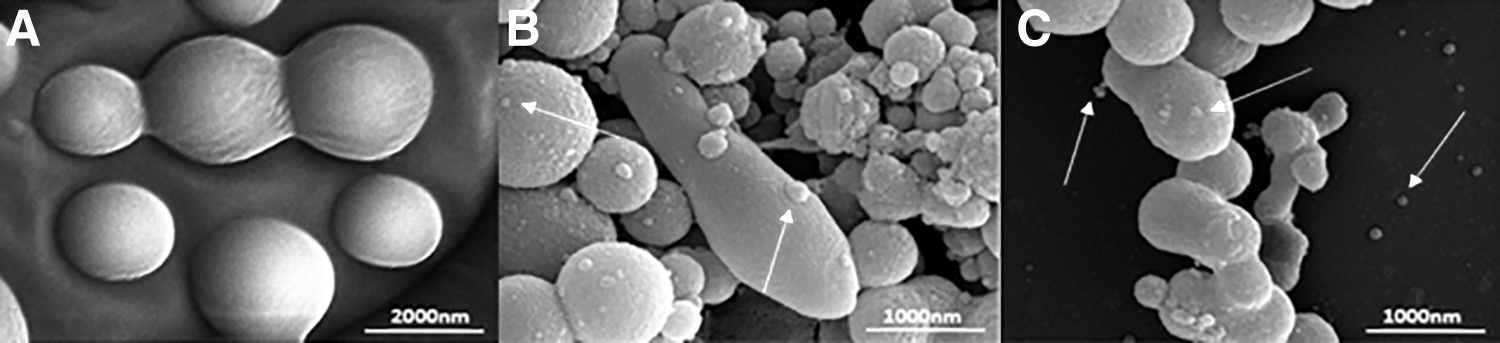
When analyzing the micrographs, it was possible to perceive the presence of nanoemulsion particles on the cell surface of the evaluated microorganisms, both in the endospores (rounded cells) and in the vegetative cells (rod-shaped cells).
The mechanisms of action of EOs are not yet fully elucidated and vary from oil to oil since their chemical constitution is variable and responsible for determining their antimicrobial properties. Some proposed mechanisms mainly refer to the hydrophobicity of the oils, which allows for them to act on the cell wall and membrane, damaging them, altering their permeability, and leading to irregularities on bacterial surfaces (Álvarez-Martínez et al., 2021; Jiang et al., 2011). In addition, due to damage to cellular integrity, they can inhibit cellular respiration and, consequently, ATP synthesis and the transport of critical ions that lead to cell death (Djihane et al., 2017; Oulkheir et al., 2017). The use of EOs in the nanoemulsified form increases the bioavailability of these active compounds in foods, improving their physical–chemical stability and biological activity.
The antimicrobial activity of EOs is basically increased through the following four mechanisms of interaction with the microbial cell membrane: passive transport across the cell membrane, fusion with the phospholipid bilayer, partition in the aqueous phase, and electrostatic interaction with the cell membrane (Donsì and Ferrari, 2016).
Stability of EO nanoemulsions
Nanoemulsions are thermodynamically unstable colloidal systems that can decompose over time due to several destabilizing mechanisms, such as flocculation, gravitational separation, and coalescence (de Oca-Ávalos et al., 2017). Despite being more stable than traditional emulsions due to the small size of their droplets and, consequently, a greater surface area, having high stability to particle aggregation and gravitational separation, nanoemulsions have stability, influenced mainly by formulation and processing parameters, such as surfactant type and preparation method, as well as environmental factors, such as pH, ionic strength, temperature, and storage time (Kumar and Mandal, 2018; Qian et al., 2012). Thus, the stability of the EO nanoemulsion prepared under different conditions during storage was visually evaluated (Fig. 2).
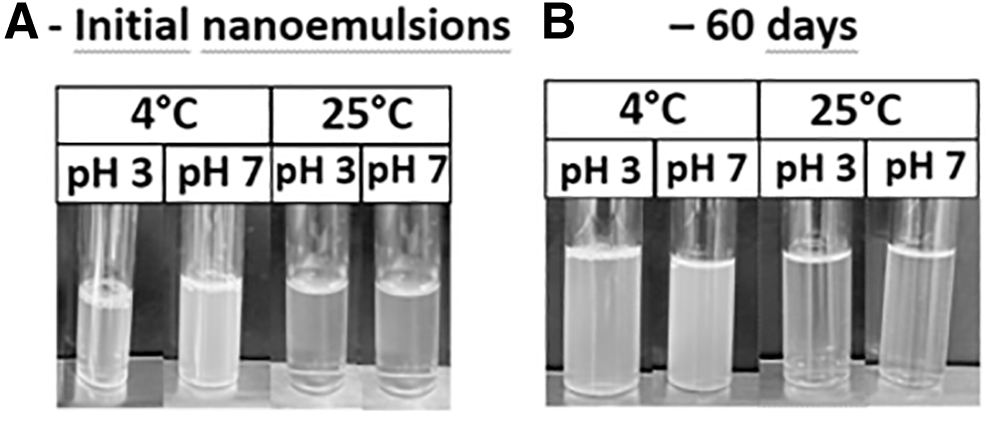
Nanoemulsions stored at rest. Initial nanoemulsions
By visual analysis of the elaborated nanoemulsions, it was possible to verify that with the elapse of the storage period, the nanoemulsions became more turbid and yellowish, with a higher viscosity, especially those stored at 4°C, with the treatment with pH 7 presenting the highest turbidity. When analyzing the effects of pH and temperature, it was possible to conclude that, under the conditions evaluated, the storage temperature showed a greater effect on the stability of the nanoemulsions than the pH, since visually, the differences in turbidity and viscosity were greater with the different temperatures than with different pH values.
Storage temperature and time can affect emulsion viscosity. Li et al. (2016) evaluated the changes that D-limonene nanoemulsions underwent during storage at 4°C, 25°C, and 50°C and found a greater increase in viscosity during the initial 49 d at 4°C and 25°C, with the first temperature (4°C) showing the greatest change, similar to the results found. This change in viscosity due to temperature and storage time occurs since crystallization in the oil phase can lead to an induction of partial coalescence of its droplets. Furthermore, conformational changes may occur in the biopolymer of the surfactant molecules.
Microbiological analyses in the food matrix
The antimicrobial activity of emulsified and nanoemulsified EOs was compared on endospores and vegetative cells of C. botulinum and C. sporogenes inoculated into mortadella during storage at 14°C for 20 d (Fig. 3).

Antimicrobial action of EO blends in emulsions and nanoemulsions on Clostridium botulinum and Clostridium sporogenes inoculated in mortadella and stored at 14°C for 20 d.
The endospore count was significantly influenced by the treatments, the period of analysis, and the interaction between them (p < 0.05) (Fig. 3C and D). The storage period of the product significantly influenced the endospore count, with a reduction of 2.94 log CFU/g after 20 d of analysis (Fig. 3C).
When comparing the effects of the treatments (Fig. 3D), it was possible to observe that the treatments containing the emulsified EOs (T1CB and T1CS) had the greatest effect on the endospores of both microorganisms tested, with average counts (± standard deviation) of 1.17 ± 1.54 (T1CB) and 0.96 ± 1.55 (T1CS), confirming the antimicrobial effects of the EOs used.
By observing the effects of the interaction between treatments and the storage period of the product on the endospores of C. sporogenes, it was possible to verify that the treatments containing the emulsified (T1CS) and nanoemulsified (T2CS) EOs showed a better sporicidal action than the control treatment, which contained only NaNO2, and the T1CS treatment showed the greatest reduction in endospore count (3.00 ± 0.26 log CFU/g) after 10 d of analysis. For both treatments (T1CS and T2CS), after 10 d of analysis, no endospore counts were observed. In the case of the bacterium C. botulinum, the treatment containing the emulsified EOs (T1CB) had the greatest effect on reducing the number of endospores (2.85 ± 0.52 log CFU/g) after 10 d of analysis, with no counts observed after this period (Fig. 3D).
It is worth noting that the observed differences in sporicidal action between the EOs and the control treatment might be influenced by the experimental design, as it is possible that some of the nitrates in the control treatment had been converted by the time Clostridium was introduced, potentially diminishing their effectiveness.
The vegetative cell count was influenced (p < 0.05) only by the period of analysis (Fig. 3A). The treatments did not significantly affect the vegetative cell count of either microorganism or their interaction with the storage period (Fig. 3B).
The mean values (± standard deviation) found referring to the vegetative cell counts of the microorganisms studied were as follows (Log CFU/g): CCB (1.08 ± 1.29); CCS (1.03 ± 1.30); T1CB (1.12 ± 1.38); T1CS (1.15 ± 1.46); T2CB (0.61 ± 1.05); and T2CS (0.76 ± 1.37). Thus, it is possible to observe that the treatments containing the EO nanoemulsions (T2CB and T2CS) presented, on average, the lowest microbial counts, differing mainly from the control treatments (CCB and CCS), which presented the lowest microbial counts and therefore the highest scores.
At the end of the analysis period (20th day), it was possible to observe a total reduction in the number of vegetative cells of C. sporogenes with the control treatment (CCS) and with the treatment containing the nanoemulsion of EOs (T2CS), demonstrating a greater sensitivity of this microorganism when compared with C. botulinum to NaNO2 and to the nanoemulsified bioactive compounds evaluated in the meat product (Fig. 3B).
The results obtained confirm the antimicrobial effects of EOs on the vegetative cells of the microorganisms tested, both in the form of emulsion and in the form of nanoemulsion, indicating that their use as a replacement for NaNO2 is a viable alternative for the meat industry, since similar results were found for all treatments.
The antimicrobial activity of EOs against foodborne pathogens has been extensively studied for several years (Gutierrez et al., 2009; Moleyar and Narasimham, 1992; Shan et al., 2007; Wang et al., 2020), mainly because they treat a natural preservative with the potential to replace traditionally used synthetic preservatives, fitting perfectly into the healthier lifestyle that many have been looking for. However, most studies have been carried out with vegetative cells, with few studies reporting the action of EOs on bacterial endospores, especially due to their greater resistance. Ismaiel and Pierson (1990) evaluated the antimicrobial effects of different concentrations of EOs of clove, thyme, black pepper, oregano, garlic, onion, and cinnamon on the germination and vegetative growth of C. botulinum in liquid medium, with all EOs tested preventing endospore germination at 0.2%. Chaibi et al. (1997) studied the antimicrobial activity of nine EOs on vegetative cells and spores of C. botulinum and Bacillus cereus.
The EOs under examination hindered the germination of C. botulinum endospores but did not affect their growth. In a related study, Aleixo et al. (2022) investigated the impact of oregano and clove EOs, along with the primary compound carvacrol, on C. botulinum endospores in mortadella. They noted a decrease in the microorganism's population due to these treatments.
Although EOs are widely used in foods mainly for their safety, their use in the form of nanoemulsions can increase their bioavailability, improving their solubility and stability, protecting them from interactions with food constituents, and reducing the sensory stimulation of food (Donsì and Ferrari, 2016; Odriozola-Serrano et al., 2014). However, most of the studies that demonstrate a greater antimicrobial activity of nanoemulsified oils when compared with emulsified oils concern in vitro assays (Cecchini et al., 2021; Roy and Guha, 2018; Shahbazi et al., 2019). When applied to food, this characteristic can vary (Mendes et al., 2018; Moraes-Lovison et al., 2017; Pinelli et al., 2021) since it is a complex matrix, and the nutrients themselves in the medium may promote cell repair, thus decreasing the effectiveness of these antimicrobial agents (Gill et al., 2002).
A similar fact was observed in the present work, in which the emulsified oils and nanoemulsions showed similar action, both against vegetative cells and against the bacterial endospores studied. Nevertheless, some physicochemical properties of the nanoemulsion may influence its antimicrobial action, such as the particle size, electrical properties, and concentration of antimicrobial compounds, as well as the type of emulsifier chosen and/or other additives and the method of preparation (Özogul et al., 2021), making further studies on these characteristics necessary. Therefore, the addition of the same concentration of free and nanoencapsulated EOs to the same food matrix can provide similar and satisfactory antimicrobial effects, however, with the advantage of a possible reduction of unwanted sensory effects when added in the form of nanoemulsions.
Although the combination of EOs evaluated, both in emulsified and nanoemulsified forms, did not prevent the germination of the endospores of either tested microorganism during the processing of the meat product (cooking), it presented a sporicidal effect during the storage period, since from the 10th day of analysis, the presence of spores in the food matrix was not observed (T1CB, T1CS, and T2CS). Furthermore, the combination of EOs prevented the germination of endospores of both microorganisms, since the vegetative cell count remained constant throughout the experiment, reinforcing the bacteriostatic effects of the selected combination. EOs exert their sporicidal effects mainly by blocking endospore germination, growth, and multiplication, and this action is mainly impacted by the intrinsic characteristics of the food matrix such as pH and constituents such as fats and proteins (Mukurumbira et al., 2022).
The EOs used presented very similar antimicrobial effects on the bacteria C. botulinum and C. sporogenes in this study. This fact can be explained by the close relationship of these bacteria, which share very similar metabolic properties, in addition to genetic similarities (Brown et al., 2012; Weigand et al., 2015).
Since there are few works that highlight the effects of EO nanoemulsions on endospores, especially in the case of Clostridium, the present work is extremely important for the food industry, since it was possible to verify that the combined EOs, both in the emulsion and nanoemulsion form, had sporicidal action on the endospores of C. botulinum and C. sporogenes and bacteriostatic effects, indicating that they may be safe and effective alternatives to partially replace the NaNO2 traditionally used as a preservative in this type of meat product. Nevertheless, the addition of EOs combined as a natural preservative in Clean Label products can point to a great differential for the food industry, adding value to an innovative and quality product.
Quality analysis
A significant difference (p < 0.05) was observed only between treatments, both for aw and for pH (Table 4). Mean values (± standard deviation) found for pH and aw regarding storage times are described in Table 4.
Effect of Treatments and Period of Analysis (Mean ± Standard Deviation) on the a w and pH of the Prepared Meat Product
Means followed by the same letter in the same column do not differ from each other according to Tukey's test (p > 0.05). C: control, no addition of essential oils and added 50 ppm of NaNO2; T1: emulsion consisting of 0.29% garlic oil; 0.10% clove oil; 0.29% pink pepper oil; and 0.29% black pepper oil +50 ppm of NaNO2; T2: nanoemulsion consisting of 0.29% garlic oil; 0.10% clove oil; 0.29% pink pepper oil; and 0.29% black pepper oil +50 ppm of NaNO2.
NaNO2, sodium nitrite; ppm, parts per million.
Although the evaluated treatments presented values very close to both aw and pH, the treatment containing the nanoemulsion of EOs (T2) showed the lowest value for both parameters (aw = 0.96 ± 0.01 and pH = 6.24 ± 0.16). These data reflect the satisfactory antimicrobial effects of nanoemulsions incorporated with EOs since higher pH values may be related to microbial growth and consequently the production of metabolites (Liu et al., 2020), thus explaining why this treatment was significantly different from the others. The pH and aw values found for all treatments are in agreement with those found in the literature and in commercial mortadella (Fiorda and de Siqueira, 2009; Pinelli et al., 2021; Rödel et al., 1990).
Color is an essential parameter for choosing and purchasing meat products, especially in the case of cured meats whose characteristic pink color is desired. As for the objective color analysis, there was an effect (p < 0.05) of the treatments and their interaction with the storage period for the parameters lightness (L*), yellowness (b*), redness (a*), chroma (C*), and hue angle (h*) (Tables 5 and 6).
Mean Values (± Standard Deviation) of Lightness (L* ), Yellowness (b* ), Redness (a* ), Chroma (C* ), and Hue Angle (h* ) Obtained for Treatments and Mortadella Storage Times at 4°C
Means followed by the same letter in the same column do not differ from each other according to Tukey's test (p > 0.05). C: control, no addition of essential oils and added 50 ppm of NaNO2; T1: emulsion consisting of 0.29% garlic oil; 0.10% clove oil; 0.29% pink pepper oil; and 0.29% black pepper oil +50 ppm of NaNO2; T2: nanoemulsion consisting of 0.29% garlic oil; 0.10% clove oil; 0.29% pink pepper oil; and 0.29% black pepper oil +50 ppm of NaNO2.
NaNO2, sodium nitrite; ppm, parts per million.
Effects of Interaction Between Treatments and Storage Time (Mean ± Standard Deviation) on Lightness (L* ), Yellowness (b* ), Redness (a* ), Chroma (C* ), and Hue Angle (h* ) of Mortadellas Stored at 4°C
Means followed by different lowercase letters on the lines differ from each other according to Tukey's test (p < 0.05). Means followed by different capital letters in the columns differ from each other according to Tukey's test (p < 0.05). C: control, no addition of essential oils and added 50 ppm of NaNO2; T1: emulsion consisting of 0.29% garlic oil; 0.10% clove oil; 0.29% pink pepper oil; and 0.29% black pepper oil +50 ppm of NaNO2; T2: nanoemulsion consisting of 0.29% garlic oil; 0.10% clove oil; 0.29% pink pepper oil; and 0.29% black pepper oil +50 ppm of NaNO2.
NaNO2, sodium nitrite; ppm, parts per million.
During the storage of mortadella, very close mean values of L* were found for all treatments and for the entire storage period, suggesting that the mortadella maintained the same clarity throughout the experimental period (12 d). The treatment containing the emulsion of EOs (T1) showed slightly less clarity than the others (C and T2), mainly between the third and sixth day of analysis. This treatment also had the highest pH value (6.42b ± 0.10). Higher L* values can be explained through a negative correlation between this index and pH: higher pH values correspond to less shiny meat, as observed in the present study (Mancini et al., 2015).
According to Brewer et al. (2001), the parameter that provides more information about the visual intensity of the pink color characteristic of cured meat products is lightness, which has an extreme influence on the quality of this type of product. The water content, the type and concentration of pigments, the addition of additives, the intramuscular amount of fat, the pH, and the absorption of the moisture content of the soluble substances of the matrix are factors that affect the brightness of meat products (Abbasi et al., 2020; do Amaral et al., 2013). Therefore, the fact that the treatment containing the nanoemulsion of oils had similar lightness to the control treatment is extremely relevant for the processed meat industry.
For the yellowness (b*), the treatment containing the nanoemulsion of EOs (T2) presented the highest value, differing statistically from the other treatments, suggesting that the mortadella in this case was more yellow. Similar results were found by Pinelli et al. (2021), who also found higher values of b* for treatments containing combined EO nanoemulsions.
Food characteristics have a strong influence on the values of the yellowness (b*). However, changes in pH, water activity, oxidation, and the type of EO used can also affect this parameter (Cofrades et al., 2004).
The redness (a*) is one of the most important parameters when analyzing the color of meat products, since the redness of these products is fundamental for their purchase. Among the treatments evaluated, it was observed that the control treatment had the highest a* value, followed by treatments T1 and T2. The higher intensity of red for this treatment can be explained by the strong antioxidant action of the added NaNO2, which, even at low concentrations, contributes to color stabilization, delaying the discoloration of the product (Monteschio et al., 2021). According to Jafari and Emam-Djomeh (2007), nitrite concentrations of 50 parts per million are sufficient to provide the characteristic color of cured products and flavor.
The treatment containing the EO nanoemulsion (T2) showed the highest b* value and lowest a* value, suggesting a fading of the cured color in the meat product. This fading can be explained by possible interactions between the chemical constituents present in the aromatic fraction of the EOs and the added nitrite, making NO2 unavailable to combine with myoglobin, thus preventing the formation of the characteristic pink color (de Oliveira et al., 2011).
The h* and C* parameters make it possible to determine the intensity of the color and its saturation, respectively, in addition to being useful for estimating the actual browning of the meat (Andrade et al., 2010). In relation to C*, the treatment containing the EO nanoemulsion (T2) presented the highest value, different from the others and indicating a greater color saturation. This treatment also had the highest b* value, suggesting a mortadella with a more intense yellow color compared with the other treatments. For h*, lower values in cooked meat products suggest a more distinct red color (Szymański et al., 2020).
When comparing the treatments, we noticed that the control treatment (C) had a lower value of h* and a higher value of a*, indicating a greater red hue. The treatment containing the EO nanoemulsion (T2), as it has the highest h* value, lowest a* value, and highest b* value, suggests a mortadella with a less red and more yellow hue.
The global color difference (ΔE*) was used to compare the color of all treatments in relation to the control at the zero time of analysis (Day 1), and no significant differences were found between treatments (p > 0.05). The mean values (± standard deviation) of ΔE* found were as follows: C, 3.18 ± 2.15; T1, 2.80 ± 0.93; and T2, 4.82 ± 2.17. According to Ramos and Gomide (2007), global differences smaller than 3.0 cannot be detected by the human eye. Therefore, only the treatment containing the nanoemulsion (T2) showed a difference in its color perceptible to the human eye (Fig. 3).
For the analysis of ΔE* with the storage period, very similar values were found (mean ± standard deviation): Day 1, 2.12 ± 2.07; Day 3, 4.24 ± 2.28; Day 6, 4.47 ± 2.34; Day 9, 3.68 ± 1.67; and Day 12, 3.49 ± 1.10. With this, it is possible to conclude that the color stability of the products remained at a very similar level throughout the experiment (Supplementary Fig. S1).
Sensory analyses
As shown in Supplementary Figure S1, it is observed that the evaluators identified different sensory descriptors between the samples evaluated, with the sensory attributes of appearance, aroma, flavor, and texture relevant for their description. Sample C (control) was characterized by the highest percentages for a bright, pink, homogeneous appearance, with the presence of eyes, a pleasant visual characteristic of mortadella. This description is in agreement with the results obtained by the color analysis, in which the control mortadella presented the highest values of a* and L*, with the sample being redder and clearer than the other samples. The aroma was pleasant and characteristic of mortadella, and in terms of flavor, it was mild/light, pleasant, and characteristic of bologna. The texture descriptors were hard, firm, and nice.
It was noted that these sensory descriptors led the evaluators to accept/buy sample C (control), in which the average of the scores ranged from “7—I liked it moderately” to “8—I liked it very much” for the appearance attributes, aroma, flavor, texture, and overall impression, and the average purchase intention was between “4—would probably buy” and “5—would certainly buy.”
Regarding samples T1 (emulsion) and T2 (nanoemulsion), it was observed that the addition of EO directly impacted the sensory descriptors, making the samples paler, less pink, whitish, and with yellowish edges, again confirming the results obtained by the color analysis, in which T2 presented a greater yellowish color, mischaracterizing the typical color expected in this type of meat product for the consumer. Nevertheless, the samples were described to have a strong aroma reminiscent of herbs and garlic; a strong flavor of spices, such as garlic, with a bitter aftertaste, in addition to a bitter taste and crumbly texture.
However, it was noted that the T1 sample had lower percentages of some of these attributes mentioned above than the other samples, with the average of the acceptance scores for the global impression between “4—slightly disliked” and “5—neither liked/nor disliked” and intention to purchase between “2—probably would not buy” and “3—maybe would buy/maybe not buy.” Sample T2, on the contrary, presented the lowest average acceptance scores (from “2—I disliked it a lot” to “4—I disliked it slightly”) in relation to flavor, texture, and overall impression.
Due to their small size, nanoemulsions of bioactive compounds, such as EOs, have a high surface area. This property intensified the effects of the nanoemulsion. Most likely, for this reason, the taste and aroma were perceived by the tasters as stronger in the T2 sample than in the others. Nevertheless, another factor that could contribute to the lower acceptance of this sample compared with the others would be the fact that it has a higher content of the surfactant Tween 80, used as a surfactant for its preparation, leaving the sample with an undesirable bitter aftertaste.
Although EOs have an impact on meat products, this study indicates the relevance and need to increase the available information on healthiness in the development of new products with natural ingredients to replace the use of artificial preservatives such as NaNO2 in both packaging and packaging at points of sale since when the evaluators were asked if they would consume a mortadella-type product on the market with the addition of natural preservatives with EOs and if they would buy this type of product, 93.75% said they would but underscored the importance of new products presenting the sensory attributes of appearance, aroma, flavor, and texture similar to the traditional ones.
It is clear that health information is important to increase consumer confidence in the product they are purchasing since consumers are often not fully aware of the harm and benefits of traditional commercial products. In the present study, although 75% of the evaluators said they were aware of the application of NaNO2 and its technological advantages, most did not know the relationship with human health, but 93.75% stated that they would consume a product with the health appeal.
Conclusions
Emulsified and nanoemulsified EOs demonstrated significant antimicrobial activity against endospores and vegetative cells of C. botulinum and C. sporogenes in mortadella. However, the addition of EOs caused changes in the technological characteristics of the mortadella, notably affecting its color. Sensory analysis revealed that the inclusion of emulsified and nanoemulsified EOs had a negative impact on the appearance, flavor, and aroma of the meat product, requiring additional adjustments in the concentrations of oils and surfactants to mitigate these undesirable sensory effects. Although this study is significant in exploring the effectiveness of EO nanoemulsions against endospores, future research should delve deeper into the physicochemical properties, stability, and bioavailability of these nanoemulsions in food products. Furthermore, a deeper assessment of how different food compositions affect the antimicrobial properties of emulsified and nanoemulsified EOs is needed.
Footnotes
Acknowledgments
The authors thank Coordenação de Aperfeiçoamento de Pessoal de Nível Superior (CAPES), Foundation for Research of the State of Minas Gerais, and the UFLA for their financial support.
Authors' Contributions
J.J.P.: Conceptualization, methodology, investigation, and writing—original draft. A.S.G.: Formal analysis and investigation. M.S.S.: Investigation. T.S.J.M.: Investigation. M.C.G.: Investigation. R.H.P.: Conceptualization, methodology, resources, supervision, writing—review and editing, project administration, and funding acquisition.
Disclosure Statement
The authors of this work declare that there is no conflict of interest.
Funding Information
This study was financed, in part, by the CAPES—Brasil—Finance Code 001.
Supplementary Material
Supplementary Data
Supplementary Figure S1
References
Supplementary Material
Please find the following supplemental material available below.
For Open Access articles published under a Creative Commons License, all supplemental material carries the same license as the article it is associated with.
For non-Open Access articles published, all supplemental material carries a non-exclusive license, and permission requests for re-use of supplemental material or any part of supplemental material shall be sent directly to the copyright owner as specified in the copyright notice associated with the article.
