




Abstract
This study holds significant importance due to its focus on Campylobacter, the leading bacterial cause of gastroenteritis worldwide, responsible for ∼96 million cases each year. By investigating the prevalence of both Campylobacter jejuni and Campylobacter coli in humans, animals, and the environment, this research sheds light on the broader impact of these pathogens, which can harm both human and animal populations. Traditional microbiological methods were implemented followed by optimized multiplex polymerase chain reaction targeting 16S rDNA and virulence gene markers by using specific primers. The findings revealed that a total of 219 Campylobacter isolates were recovered from 528 collected specimens from human, animal, and environmental sources. Campylobacter species showed a prevalence of 41.5%, with C. jejuni accounting for 53% and C. coli for 47%. Antimicrobial resistance rates were high, with tetracycline at 89%, ceftriaxone at 75%, cefotaxime at 70%, erythromycin at 69%, nalidixic acid at 54%, ciprofloxacin at 39%, and gentamicin at 23%. Commonly prevalent virulence-associated genes observed in the Campylobacter were cadF at 93%, flaA at 91%, cdtB at 88%, cheY at 86%, sodB at 78%, and iamA at 32%. The study confirmed multidrug-resistant Campylobacter prevalence at the human–animal–environment interface, harboring virulence-associated genes with potential harm to humans. Data analysis showed a nonsignificant (p ≥ 0.05) correlation between virulence genes and antibiotic susceptibility. To effectively manage Campylobacter infections, a multifaceted strategy incorporating preventative interventions at different levels is required. This strategy should take into account practicability, effectiveness, and sustainability while strengthening surveillance systems and addressing the economics of disease prevention.
Introduction
Food contaminations with bacterial pathogens are responsible for causing varying degrees of diseases. Foodborne diseases are distributed worldwide, thus threatening public health (Ali and Alsayeqh, 2022). Approximately 600 million foodborne illness cases and 420,000 fatalities worldwide are attributed to the consumption of contaminated food every year, with children under the age of 5 accounting for 30% of these instances (Lee and Yoon, 2021).
The most common foodborne bacteria include Listeria monocytogenes, Campylobacter species, Shiga toxin–producing Escherichia coli, Salmonella enterica, Shigella flexneri, Clostridium botulinum, Bacillus cereus, Vibrio cholerae, Yersinia enterocolitica, and Staphylococcus aureus (Mahmood et al., 2022; Liu et al., 2023; Lee and Yoon, 2021; Tao et al., 2020). Animals, the environment, human handlers, and contaminated water used during processing can be the sources of foodborne pathogens (Telli et al., 2022).
Campylobacter species have risen to prominence as a primary cause of intestinal infections on a global scale among all food pathogens (Rawat et al., 2018). Campylobacter prevalence is influenced by predisposing variables such as inadequate sanitation, animal interaction, a lack of information and resources, and warm weather. Water supplies can get contaminated by poor sanitation and waste management (Andrzejewska et al., 2022). The bacteria can be spread by close contact with animals, such as chickens.
Prevention efforts may be hampered by a lack of knowledge about resources and practices for food safety. High temperatures, especially in humid environments, encourage the growth and spread of Campylobacter (Sheppard and Maiden, 2015). Campylobacteriosis is a common cause of bacterial gastroenteritis worldwide, affecting >2.4 million people annually (Liu et al., 2022). Moreover, Campylobacter species are also known to cause abortive infections in small ruminants (Hailat et al., 2022).
Campylobacter species are nonspore-forming Gram-negative bacteria that typically possess a spiral, curved, or rod shape. However, they can change into a coccoid shape under adverse conditions, corresponding to a dormant state under stressful conditions. Exposure of multiple antimicrobial agents during food production as growth promoter or therapeutics may lead to emergence of antimicrobial resistant (AMR) strains of bacterial pathogens. Combating this AMR is essential, and it is a significant concern within the One Health framework.
Countries are addressing this issue across the food chain, with campylobacteriosis included in EU Regulation 429 for disease prevention and control (Kashoma et al., 2015; Shen et al., 2018). Attempts to stop the spread of Campylobacter are made more difficult by the fact that it can create biofilms and go into a viable but unculturable condition (Oh et al., 2015a; Oh et al., 2015b). In this state, known as viable but nonculturable, pathogens can survive for up to 7 months at temperatures as low as 4°C and modify their metabolism to endure hostile conditions.
Among various sources, poultry meat has been identified as the primary source of Campylobacter in many recent investigations on the pathogen (Gölz et al., 2014). Among two prevalent species (Campylobacter jejuni and Campylobacter coli), C. jejuni accounts for 80–90% of infectious cases in human campylobacteriosis cases (Facciolà et al., 2017). C. jejuni are the commensals of various animals such as cattle, poultry, sheep, and swine, playing a vital role in the food chain by producing meat and milk products, consumed by humans (McKenna et al., 2020). The primary source of infection in humans is poultry, which plays an important role in its transmission to humans (Ma et al., 2014).
The One Health concept allows for the monitoring of campylobacteriosis control due to the interdependence of human and animal health. Effective management of Campylobacter in the food chain requires a One Health approach, with preventive measures implemented at multiple levels. The protection of the public's health depends on establishing a One-Health strategy and better management techniques (Heimesaat et al., 2021).
When considering pragmatism, efficacy, and long-term sustainability, it is imperative to combine multiple preventive measures at various levels, including the food chain, farms, production units, processing facilities, and health care settings. To create a comprehensive health system, it is essential to reinforce monitoring systems and improve information exchange across sectors by combining control mechanisms that are realistic, efficient, and long-lasting (Schiaffino et al., 2019).
Multiple virulence factors impact the survival and pathogenicity of Campylobacter species. These virulence factors help the pathogen for adherence, motility, colonization, and cytotoxicity to host cells (Konkel et al., 1999). These virulence factors can be identified by several genes expressed by the Campylobacter species (Muller et al., 2006). Moreover, increased prevalence of antibiotic resistance in Campylobacter isolates is a serious concern regarding its pathogenicity in humans and animals.
Research on the antibiotic resistance and virulence factors of Campylobacter isolates from poultry meat in Pakistan is scarce. Therefore, this proposed study on Campylobacter in Pakistan will provide valuable information on putative virulence gene markers, antibiotic resistance, and relatedness among isolates, enabling the implementation of effective One Health approaches and policies to prevent and control campylobacteriosis.
Materials and Methods
Determining the size of the sample for human, animal, and environment
The following formula with a 95% confidence interval was used to determine the sample size for the prevalence study of human and animals:
Z = is standard normal variate (at 5% type 1 error; p < 0.05) it is 1.96.
P exp = expected prevalence = 12.9% or 20.8% or 7%, d = absolute error or precision = 0.05.
Sample size (n) = [1.962 × 0.129 (1 − 0.129)] ÷0.052 = 173 (for humans).
Sample size (n) = [1.962 × 0.208 (1 − 0.208)] ÷0.052 = 253 (for animals).
Sample size (n) = [1.962 × {0.07 (1 − 0.07)}]÷0.052 = 100 (environment).
Sample collection
Humans (healthy, at-risk, and sick people), animals (raw poultry meat, mutton, and beef), and environmental sites (hospitals and livestock barns) were among the sources from which samples were gathered following ethical procedures approved by the Institutional Ethics Review Committee, University of Agriculture, Faisalabad (Ref. No. 23585-88). The Institute of Microbiology, University of Agriculture, Faisalabad laboratory received these samples within 4 h at a temperature of 4°C for further examination (Fig. 1-I).

Conventional isolation
The isolation and identification of Campylobacter species from the collected samples were done through conventional microbiological procedures such as culturing on selective media modified charcoal cefoperazone deoxycholate agar (mCCDA) agar (Oxoid) after incubation at 41.5°C for 48 h in the presence of a microaerophilic environment to facilitate the growth of only thermophilic Campylobacter species. The biochemical testing comprised catalase, oxidase, and Hippurate hydrolysis for confirmation (Wieczorek et al., 2015).
Antibiotic sensitivity testing
Using Kirby–Bauer disk diffusion method, Campylobacter species were tested for antibiotic susceptibility following Clinical and Laboratory Standards Institute (CLSI) guidelines (CLSI, 2016), and multiple drug resistance was evaluated using the multiple antibiotic resistance indexing algorithm and interpreted as a/b: “a” = the number of antimicrobials against which the microorganism was resistant. “b” = the total number of antimicrobials that were tested (Krumperman, 1983).
To detect the Campylobacter species from the humans, animals, and environmental samples, the additional step of enrichment is highly recommended as it helps in the recovery of damaged cells. Bolton broth was used for this purpose. The specimens collected from the different sources were enriched in the Bolton broth (Oxoid) after an incubation at 41.5°C for 48 h. The enriched samples were then allowed to grow on mCCDA by adding the mCCDA-selective supplement (Oxoid) after an incubation of 41.5°C for 36–48 h in microaerophilic conditions (Campygen sachets; Oxoid).
The grayish white, flat, easily spreadable, and mucoid colonies of Campylobacter species were further subcultured on Mueller Hinton Agar supplemented with defibrinated 5% horse blood under microaerophilic conditions at 41.5°C for 48 h.
DNA extraction
Genomic DNA was extracted from three to five colonies by suspending isolated colonies in Tris-ethylenediaminetetraacetic acid (EDTA) buffer, heating them at 100°C for 10 min, chilling, centrifuging, and storing the supernatant at −20°C (Han et al., 2019). The quantification of the extracted DNA was measured by Thermoscientific® NanoDrop spectrophotometer.
The primer sequences used in this study for the confirmation of Campylobacter strains through the molecular technique of multiplex polymerase chain reaction (m-PCR) are described in Table 1. The primers were selected corresponding to 16S rDNA sequence for the confirmation of the Campylobacter genus, whereas hipO gene-specific primer detected C. jejuni and ceuE gene primers identified the presence of C. coli.
Primers Sequences for Detection of Campylobacter Strains and Virulence Factors
Characterization of Campylobacter species using m-PCR
To confirm and differentiate isolated Campylobacter species, an m-PCR assay was optimized. PCR mixture comprised a total 25 μL volume including 1 μL of 10 ng/μL purified bacterial DNA followed by10 μmol/L of primer sequences (2 μL of 16S rDNA, 1 μL of hipO gene, and 0.5 μL of ceuE primers). Subsequently, 12.5 μL of master mix was added along with 4.5 μL of nuclease-free water.
The conditions and cycles of thermocycler were maintained according to Han et al. (2019) as described. PCR amplification was carried out with an Aeris™ PCR Thermal Cycler as follows: Initial denaturation took place at 95°C for 10 min, followed by 35 cycles of denaturation at 95°C for 30 s, annealing at 65°C for 50 s, extension at 72°C for 60 s, and final extension at 72°C for 10 min.
Gel electrophoresis and imaging
A 1.2% agarose gel was used to see the m-PCR results. Ethidium bromide was added to a prepared agarose gel that had been chilled to 60°C in 1 × TAE (Tris base, acetic acid, and EDTA) buffer. After being placed into a casting tray with combs already in place, the gel was left to polymerize. After combining the loading buffer with the reaction mixture, the gel was loaded. Bio-Rad gel imaging equipment was used for the gel visualization process (Han et al., 2019).
Statistical analysis
Comparative prevalence of virulence gene factors and antibiotic resistance of Campylobacter species isolated from various sources were statistically analyzed through a chi-square test. Moreover, chi-square (χ2) test was implemented to investigate the correlation between antibiotic resistance and the presence of virulence genes.
Results
Conventional identification of Campylobacter species
Conventional microbiological methods were used to isolate/culture Campylobacter strains. Both C. jejuni and C. coli were catalase and oxidase-positive, according to biochemical testing. Hippurate hydrolysis was used to distinguish between the two strains, which is positive for C. jejuni and negative for C. coli. A total of 219 Campylobacter isolates were cultured from 528 samples, showing an overall prevalence of 41.5%.
Campylobacter at human–animal–environment interface
Animals were discovered to have large numbers of Campylobacter species, with raw chicken meat and poultry cecum showing the highest incidence 76% and 50%, respectively. Human prevalence percentages varied, with sick or diarrheic people showing the highest prevalence (41%) and healthy people showing the lowest prevalence (20%). The prevalence of Campylobacter from environment samples was highest in the corpse disposal tank (73%), then on cutting boards (41%), hospital laboratories (33%), shop walls (27%), and butcher's hands (24%). Overall, animals had the highest prevalence of Campylobacter species.
Antimicrobial susceptibility testing
The study investigated the profile of Campylobacter species isolated from people, animals, and the environment for antibiotic resistance. Among all Campylobacter isolates, the least resistance was observed against gentamicin (20–32%), whereas the highest resistance was observed against tetracycline (82–94%). Animal Campylobacter isolates showed higher erythromycin resistance (71%) than human (69%) or environmental (67%) isolates.
Human isolates showed β-lactam drug resistance (70–77%), whereas resistance by animal and environmental against these antibiotics ranged from 51–75% to 71–76%, respectively. In comparison with C. coli, which exhibited comparably strong resistance to ciprofloxacin (42–61%) and gentamicin (31–44%), C. jejuni isolates demonstrated lower levels of ciprofloxacin (23–40%) and gentamicin (11–26%) resistance. The highest erythromycin and tetracycline resistance (61–73% and 84–94%, respectively) were seen in C. coli. Antibiotic resistance profiles of Campylobacter species are described in Table 2 and Figure 1-III.
Antibiotic Susceptibility Profiling of Campylobacter Isolates
AMP, ampicillin; CIP, ciprofloxacin; CN, gentamicin; CRO, ceftriaxone; CT, cefotaxime; DO, doxycycline; ER, erythromycin; NAL, nalidixic acid; NOR, norfloxacin; T, tetracycline.
Multiplex polymerase chain reaction
m-PCR was employed in the investigation to validate Campylobacter isolates obtained using culture-based techniques. A total of 206 out of 219 isolates were positively identified as C. jejuni and C. coli, whereas 13 belonged to other species. A total of 118 samples of raw chicken meat were examined, and 54 of these (46%) tested positive for C. jejuni and C. coli. Moreover, out of these 54 positive samples, 38 were confirmed as C. jejuni and 16 as C. coli. Furthermore, among 40 isolates from diseased humans, 27 were confirmed as C. jejuni and 13 as C. coli. Moreover, among all environmental isolates (34), 15 were confirmed as C. jejuni and 19 as C. coli, details are shown in Table 3 and Figure 2.
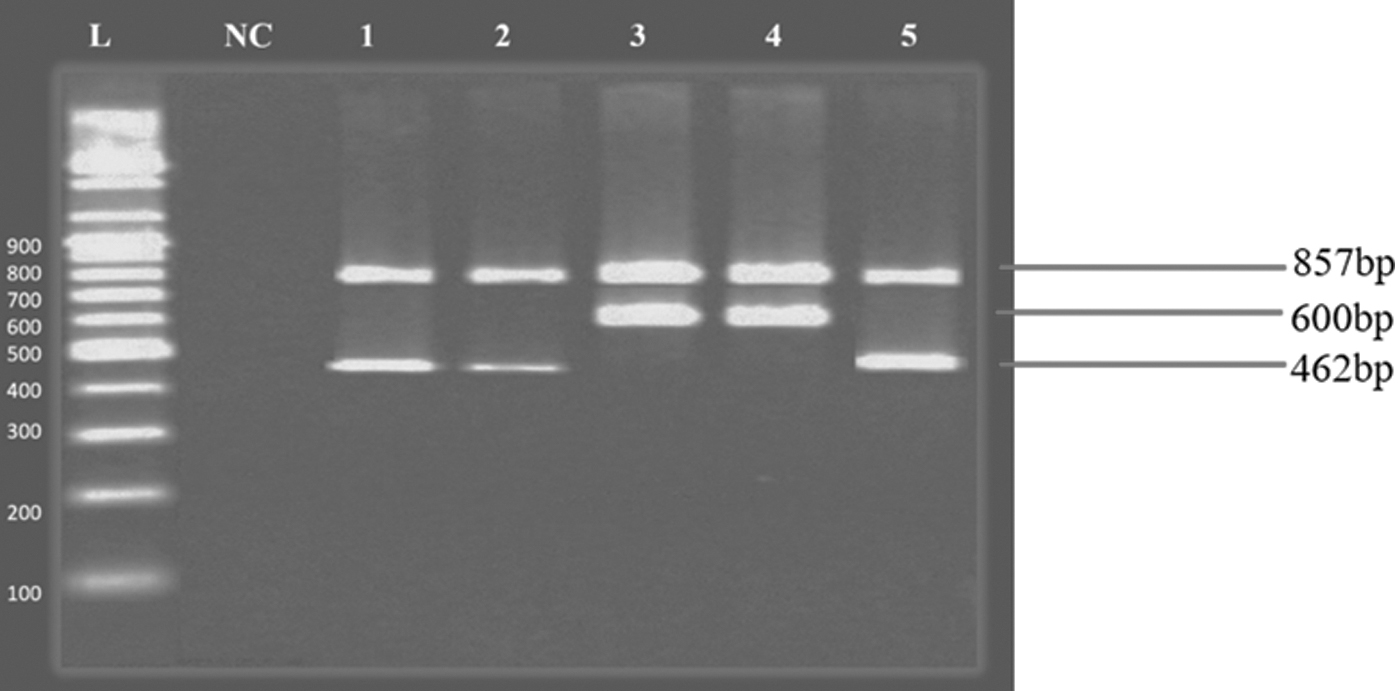
Molecular detection of Campylobacter jejuni and Campylobacter coli through multiplex-PCR. (L) Indicates 100 bp plus ladder, (NC) represents negative control, (1, 2, 5) depicts amplification of 16S rDNA and ceuE genes configuring genus Campylobacter at 857 bp and C. coli at 462 bp, respectively. (3, 4) Represents the amplification of 16S rDNA and hipO genes configuring genus Campylobacter at 857 bp and C. jejuni at 600 bp. PCR, polymerase chain reaction.
Molecular Confirmation of the Campylobacter jejuni and Campylobacter coli Among the Positive Campylobacter Isolates
PCR, polymerase chain reaction.
Presence of pathogenic genes in thermophilic Campylobacter
In this study, confirmed isolates of C. jejuni and C. coli were analyzed for the presence or absence and co-sharing of six targeted genes, including flaA, cadF, cdtB, iamA, cheY, and sodB through m-PCR. These virulence factors genes were highly prevalent in the majority isolated strains of Campylobacter, including humans (diseased, high risk, and healthy), animals (poultry chicken cecum, raw chicken meat, mutton, and beef), and environment (livestock and hospital laboratories). Among human isolates of C. jejuni, cadF (100%), cdtB (97%) and flaA and cheY (92%) were detected in these isolates.
Except for iamA, five virulence genes were found in healthy persons. Animal samples of chicken meat, mutton, and chicken cecum contents had a significant prevalence of flaA, but samples of beef were predominately cadF positive. In chicken cecum contents, mutton, and raw poultry meat, low prevalences of iamA were found. Among environmental samples, cdtB was more prevalent in hospital samples than in carcass disposal tanks, butcher's hands, cutting boards, and shop walls. The least prevalent genes were iamA and sodB environmental sources. A total of 130 out of these 206 positive isolates shared at least five virulence factors (Table 4).
Prevalence of Virulence Gene Markers Among the Campylobacter jejuni and Campylobacter coli Isolates from Various Sources
Discussion
Among common foodborne pathogens in the world, Campylobacter colonizes several settings, including humans, animals, and environment. This flexibility results in complex disease patterns and presence of antibiotic resistance makes it difficult to treat gastroenteritis caused by this pathogen. Genomic, clinical, or epidemiological research are used to identify patterns of antibiotic resistance, which reveals alarming multidrug-resistant profiles in many isolates (Bunduruș et al., 2023).
By investigating the prevalence of both C. jejuni and C. coli in humans, animals, and the environment, this research sheds light on the broader impact of these pathogens, which can harm both human and animal populations. The evidence gathered in this research has indicated that Campylobacter bacteria is highly prevalent in raw poultry meat 46%, followed by beef 30% and mutton 19%. Sabzmeydani et al. (2020) also reported the similar high prevalence in poultry meat samples (68%) from Iran.
This can be interpreted from this study results that the bacteria Campylobacter exists as the normal microbiota of poultry birds, colonizing the intestine and ceca of the birds. The bacteria can be transmitted to poultry birds through the fecal-oral route imitating the study of Chaloner et al. (2014).
The detection of Campylobacter species from apparently healthy chicken describes that the pathogen colonizes poultry birds asymptomatically, these findings were similar to Humphrey et al. (2014). This persistent existence of Campylobacter species in poultry chickens might be taken as main reservoir of transmitting the pathogenic bacteria to humans. During the study, it has been observed that a wide variety of risk factors may play a vital role in the continuous transmission of Campylobacter species at the human–animal interface.
These factors include the lack of biosecurity measures at the poultry sheds as described by Sabzmeydani et al. (2020) and improper management of other animals near the poultry farms as illustrated by Sommer et al. (2013). Improper handling of equipment and hygienic status of handler's hands during processing of food also plays a role in the transmission of pathogens (Fahim et al., 2022; Hadiyan et al., 2022).
Out of 528 samples, 206 isolates from different sources displayed significant antibiotic resistance, with varying resistance patterns depicted by isolates from humans, animals, and environment. The high resistance detected in Campylobacter isolates against tetracycline in this study was consistent with research work by Kim et al. (2019), which reported high prevalence of fluroquinolones and tetracycline in C. jejuni isolated form retail raw chicken and duck meat in Korea.
High resistance to tetracycline in this study may be resultant due to tetO and tetA plasmids; however, Campylobacter isolates from different locations need further investigation on prevalence and resistance profile of these plasmids. High prevalence of tetA (83.3%) and tetO (83.3%) has been described in a recent study by Eidaroos et al. (2023).
Among the environmental samples, Campylobacter species (C. jejuni and C. coli) have been isolated from the hospital laboratory workplace, cutting boards, butcher's hands, carcass disposal tanks, and walls of retail meat shops. These findings were found in accordance with Cardoso et al. (2021) that implies that poultry meat with low bacterial counts in retail meat shops can, nevertheless, spread infection by contaminating neighboring objects and healthy meat.
In this study, molecular characterization of Campylobacter species isolated from healthy individuals, high-risk persons, and diarrheal patients has indicated 36 C. jejuni and 18 C. coli confirmed isolates. This can be assumed that infected raw meat consumption as well as contaminated drinking water might be the source of infection infecting humans. Recent research has reiterated that Campylobacter species, specifically C. jejuni, have been detected not only in raw poultry meat but also in water reservoirs, where they play a significant role in the spread of this pathogen (Strakova et al., 2022).
In this study, it has been observed that the Campylobacter species are most abundant in broiler chickens as these findings were similar to the previous studies (Awad et al., 2023; Schets et al., 2017). Correspondingly, the highest prevalence of Campylobacter species was found at the butcher's retail meat shop as compared with the hospital laboratories' environmental samples, which corresponds with Pérez-Arnedo and González-Fandos (2019).
To verify the pathogenic potential of these isolates, PCR was used to examine the presence of six virulence genes. There were variations in the prevalence of virulence genes; isolates of C. jejuni showed more potential for virulence than isolates of C. coli. These findings were consistent with Awad et al. (2023) and Wieczorek et al. (2013). Our results showed high prevalence of flaA, cadF, cdtB, sodB, and cheY from C. jejuni isolates from humans and animals. The presence of flaA plays an important role during the passage of the pathogen through the stomach and gut. Campylobacter adhesion to fibronectin F (cadF) gene helps the pathogen during the process of adhesion (Andrzejewska et al., 2022).
The presence of flaA and cadF genes in majority of the C. jejuni isolates has also been reported by Awad et al. (2023) and Rossler et al. (2019). Cytotoxicity ability is an important feature of Campylobacter pathogenicity. Among cdtA, cdtB, and cdtC, the presence of cdtB gene was investigated in Campylbacter isolates from various sources. High presence of cdtB gene (88–97%) in isolates from humans and animals suggests transmissibility and pathogenicity of the Campylobacter within these species.
AMR in commensal and zoonotic intestinal bacteria is a result of the overuse or misuse of antibiotics in food animals (Abbas et al., 2022). It is vital to regularly monitor antibiotic resistance and resistance mechanisms in Campylobacter to prevent its spread across the food chain. The high frequency of AMR in Campylobacter isolates from all sources indicates a serious situation.
The lower frequency of resistance to fluoroquinolones and aminoglycoside in this study could be attributed with non-usage of these drugs during this investigation. Altogether, it may be concluded that efficacy of the AMR control program can be assessed by continuous monitoring of resistant strains from animals, humans, and environment as suggested by recent studies (García-Sánchez et al., 2018; Umair et al., 2023).
Conclusion
Public health can be ensured through the One Health strategy and improved management techniques. By keeping the public's health in mind, a number of preventive actions have been taken to date to lower the load of Campylobacter in the food chain, at agricultural levels, in production and processing units, and health care institutions. It is probable that the rate of Campylobacter infections will not be significantly decreased by a single preventive method implemented at each level.
To overcome these numerous obstacles, a variety of control strategic plans must be created while taking into account their viability, effectiveness of their mechanisms of action, and sustainability. By distributing crucial information among many sectors, this strategy will strengthen the monitoring systems and create a successful health system.
Footnotes
Disclosure Statement
No competing financial interests exist.
Authors' Contributions
K.Y. and S.A. designed the project. K.Y. and M.S.S. did the bench work. S.A., M.S.S., and S.-U.-R. did data analysis. K.Y., S.A., and M.S.S. did the drafting of the article. All the authors reviewed the draft critically.
Funding Information
This study was partially funded by “Project No. NHCG-21-41 funded by the National Institute of Health Islamabad, Pakistan.”