




Abstract
The aim of this study was to evaluate the antibacterial activity of Cymbopogon citratus essential oil against bacteria isolated from the oral cavity of dogs and applied directly to artificially contaminated feed. The commercial dry dog feed received the inoculum of the bacteria prevalent in the oral cavity of the dogs where C. citratus was deposited in the feed by spray. In total, 42 isolates were obtained, 38 Gram-positive and 4 Gram-negative. Staphylococcus spp. was the most prevalent bacteria in the oral cavity of dogs (76.2%). The isolates showed high levels of resistance to different antimicrobials. The minimum inhibitory concentration capable of inhibiting oral bacteria was 0.38 mg/mL. C. citratus essential oil showed positive results with a significant bacterial reduction when applied to feed, signaling the need for further studies to enable its use in the control of pathogens transmitted by animal feed.
Introduction
Bacterial diseases in humans have been associated with contaminated commercial dog foods. This fact highlights the need to control pathogens in pet food to protect public and animal health (Chen et al., 2019).
As most microorganisms proliferate rapidly, the improper or excessive use of drugs by the population facilitates the development of bacterial resistance. This resistance has sparked interest in natural antimicrobials such as essential oils. These substances are isolated from plant sources that have the potential to cause physical, chemical, or biochemical changes in microorganisms that may include alteration of the fatty acid profile of the cell membrane, damage to the cytoplasmic membrane, and reduction of the proton motive force (Rao et al., 2019).
Cymbopogom citratus essential oil presents several potentially bioactive compounds that have been constantly registered with the potential to inhibit pathogenic bacteria, including those associated with pets (Ebani et al., 2020; Silva et al., 2017).
Despite the expressive population of dogs, studies looking for alternative sources for microbiological control in dog food are scarce. For this reason, this study aimed to identify the potential of C. citratus essential oil against bacteria isolated from the oral cavity of dogs in vitro and in artificially contaminated pet feed.
Methods
Bacterial isolates
Oral swabs from 28 domestic dogs (Canis lupus familiaris) were collected in a private veterinary clinic in Umuarama municipality, Paraná. The samples were composed of domiciled dogs, without distinction of breed, sex, or age. The swabs containing Stuart medium were introduced into the oral cavity and circular movements were performed.
Posteriorly, the swabs were introduced individually in Brain Heart Infusion medium and incubated. Afterward, the cultures were streaked on plates containing Blood Agar and incubated at 37°C for 24 h to to get isolated colonies. Each isolate was subjected to analysis of macroscopic characteristics, Gram staining, and specific biochemical tests, to define the bacterial genus (Quinn et al. 1994).
Antibiotic susceptibility testing
The disk diffusion test was performed according to the criteria established by the Brazilian Committee on Antimicrobial Susceptibility Testing (BrCAST, 2021). The antimicrobials were those with greater use in clinical practice, different mechanisms of action, and isolated microorganisms.
Essential oil antibacterial activity in vitro and in pet feed
C. citratus (DC.) Stapf essential oil (CcEO) was purchased from Laszlo Aromaterapia LTDA.
The minimum inhibitory concentration (MIC) of CcEO was determined by the broth microdilution test (CLSI, 2018). Ten isolates of Staphylococcus (most prevalent in the dogs) and the S. aureus ATCC 29213 were tested. The concentrations of CcEO ranged from 6 to 0.046 mg/mL.
The treatment of the feed was carried out according to Chen et al. (2019) with adaptations. In this stage, one isolate of the genus Staphylococcus spp. with a resistance profile to several antibiotics was selected. Sterilized dry feed portions were individually inoculated with a spray of the bacterial inoculum containing 106 colony-forming unit (CFU)/g. Afterward, solutions of CcEO (using vegetable soybean oil as a diluent) were sprayed on the feed contaminated to obtain final concentrations of 0 × MIC, 1 × MIC, and 2 × MIC (mg/g). After 0, 10, and 20 days at 25°C, serial dilutions were prepared from the feed in sterile buffered water (PBS pH 7.2) and seeded in Plate Count Agar plates and incubated. The number of CFU/g was obtained by the bacterial count corrected by the sample dilution factor.
The data were compared using analysis of variance and Tukey's test. For all tests, the significance level of 5% was considered.
Results
It was possible to isolate 42 bacteria. Regarding the identification of Gram-positive microorganisms, 5 were characterized as Streptococcus spp. (11.9%), 1 as Enterococcus spp. (2.4%) and 32 samples as Staphylococcus spp., among which 31 were positive coagulase (73.8%) and 1 negative coagulase (2.4%).
Among the samples of Gram-negative bacilli, three species were isolated, two Escherichia coli (4.8%), one Moellerella wisconsensis (2.4%), and a Pragia fontium (2.4%).
When it comes to Staphylococcus, the most prevalent bacteria, the highest resistance index were ciprofloxacin (100%), rifampicin (93.7%), clindamycin (84.4%), erythromycin (78%), oxacillin (75%), and ampicillin (71.8%).
The most efficient concentration to inhibit bacteria in vitro was 0.38 mg/mL. Based on this MIC, the oil antibacterial activity in the feed was evaluated. CcEO did not show immediate antibacterial action in the pet model, and it is necessary to evaluate it for a longer period. On day 10, there were no significant differences in relation to day 0, but on the 20th day, CcEO reduced the microorganisms in the diet (p < 0.01). This reduction varied between 2 and 3 Log CFU/g of feed, indicating the bioactive potential in bacterial control (Fig. 1). Additional data on the methodology and results are available in the Supplementary Material (Supplementary Data S1 and Supplementary Table S1).
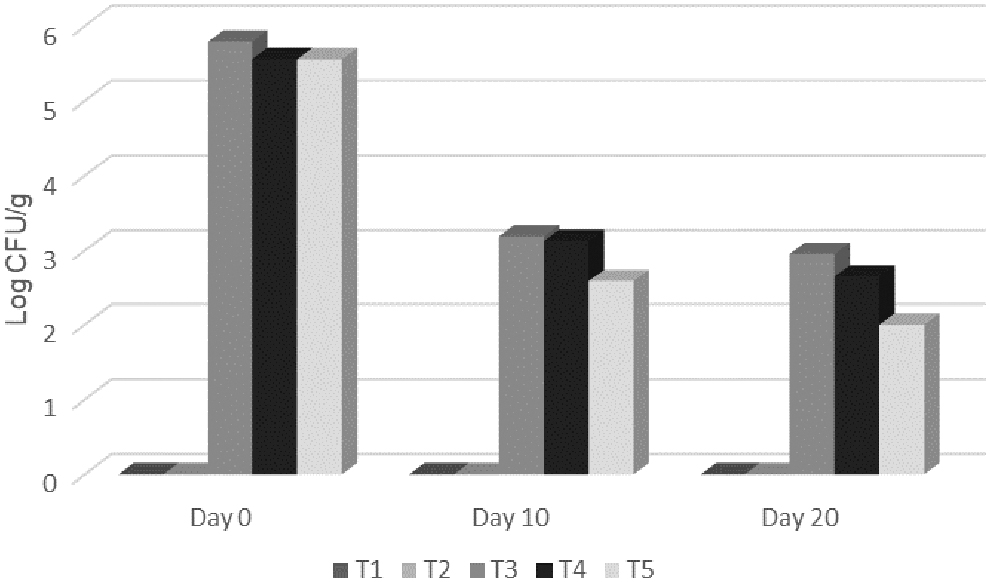
Log CFU/g of Staphylococcus added artificially in dry feed treated with different concentrations of the essential oil of Cymbopogon citratus on days 0, 10, and 20 of storage. *T1: feed; T2: feed with soy oil; T3: feed contaminated with isolated bacteria; T4: feed contaminated with isolated bacteria and treated with 1 × MIC; T5: feed contaminated with isolated bacteria and treated with 2 × MIC. CFU, colony-forming unit; MIC, minimum inhibitory concentration.
Discussion
Pets can be sources of dissemination of potentially pathogenic microorganisms, including resistance to available antimicrobials, evidencing the search for new ways to control these microorganisms, becoming an important impact factor in One Health.
The CcEO presents several metabolites capable of interacting with different target molecules in bacteria and their cellular functions, mainly in the inhibition of nucleic acid synthesis, promoting disturbances in the properties of the cytoplasmic membrane and the energy metabolism (Barbosa et al. 2015).
Possamai et al. (2019) also identified the antimicrobial activity of C. citratus for different microorganisms. In the same research were associated essential oil with antimicrobials, obtaining significant results against the microorganisms present in feline diets. In addition, Chen et al. (2019) also observed the effectiveness of natural products against microorganisms isolated from dog food.
In our studies, CcEO showed antibacterial action in the pet feed, obtaining positive results between day 0 and 20. Dairiki et al. (2013) commented on the need for the biweekly application of essential oils as a strategy to maintain their stability in the feed due to its volatility for better microbiological control.
A reduction in the number of bacteria recovered from the feed between days 0 and 10 was also observed, signaling that the soybean oil used as a diluent acted synergistically with CcEO in bacterial inhibition. This is explained by the fact that the oil reduces the water activity of the samples.
Thus, studies on the reapplication of essential oil are necessary to ensure effectiveness, where the reapplication of the CcEO on day 10 could have shown a greater action.
Conclusion
CcEO is a natural antibacterial alternative and more studies are needed to evaluate its over time in dry pet food to reduce the incidence of transmission of pathogenic bacteria between animals and humans.
Footnotes
Acknowledgment
We thank CAPES (Higher Education Personnel) for the concession of the school fee.
Authors' Contributions
Conceptualization by L.N.B., M.A.C.D.V., and D.D.G. Data curation by L.N.B., I.C.S., K.B., J.M.O., J.E.S., and M.A.C.D.V. Formal analysis and writing—original draft by I.C.S., M.A.C.D.V., D.D.G., and L.N.B. Funding acquisition, validation, and visualization by L.N.B and D.D.G. Investigation by L.N.B., I.C.S., K.B., J.M.O., J.E.S., M.A.C.D.V., and D.D.G. Methodology by L.N.B., I.C.S., K.B., J.M.O., J.E.S., D.D.G., and M.A.C.D.V. Project administration and resources by L.N.B. Supervision by L.N.B., I.C.S., and D.D.G. Writing—review and editing by I.C.S., K.B., J.M.O., J.E.S., M.A.C.D.V., D.D.G., and L.N.B.
Ethics Approval and Consent for Sampling
Ethical approval was obtained from Committee For Ethics In Research Involving Animal Experimentation (CEPEEA) of Universidade Paranaense—UNIPAR under protocol number 37133/2020.
Disclosure Statement
No competing financial interests exist.
Funding Information
UNIPAR and National Council for Scientific and Technological Development (CNPq) granted funding for this research.
Supplementary Material
Supplementary Data S1
Supplementary Table S1
References
Supplementary Material
Please find the following supplemental material available below.
For Open Access articles published under a Creative Commons License, all supplemental material carries the same license as the article it is associated with.
For non-Open Access articles published, all supplemental material carries a non-exclusive license, and permission requests for re-use of supplemental material or any part of supplemental material shall be sent directly to the copyright owner as specified in the copyright notice associated with the article.
