




Abstract
Unsafe food causes 600 million cases of foodborne diseases and 420,000 deaths every year. Meanwhile, biological toxins such as poisonous mushrooms, saponins, and aflatoxin can cause significant damage to humans. Therefore, it is particularly important to study foodborne disease outbreaks caused by biotoxins (FDOB). We collected FDOB in Yantai City from 2013 to 2022 and further established a corresponding database. Statistical analysis was carried out according to time, place, pathogen, and contamination of pathogenic factors. There were 128 FDOB, resulting in 417 patients and 6 deaths. The third quarter was a high season for foodborne disease outbreaks, the number of events, patients and deaths accounted for 65.63% (84/128), 55.88% (233/417), and 100% (6/6) of the total number, respectively. The highest number of outbreaks per 10,000 persons was Qixia (0.41), followed by Zhifu (0.36) and Laiyang (0.33). The top three causes of outbreaks were poisonous mushroom toxin, saponins and hemagglutinin, and Lagenaria siceraria (Molina) Standl. Sixty-five (50.78%) outbreaks were attributed to poisonous mushroom toxin, 18 (14.06%) outbreaks to saponin and hemagglutinin, and 12 (9.38%) outbreaks to L. siceraria (Molina) Standl. The largest number of outbreaks, patients and deaths all occurred in families, accounting for 82.81% (106/128) outbreaks, 66.19% (276/417) patients, and 100% (6/6) deaths, respectively. Followed by catering service establishments, accounting for 14.84% (19/128), 30.22% (126/417), and 0% (0/6), respectively. The main poisoning link of outbreaks was ingestion and misuse, accounting for 72.66% (93/128), followed by improper processing, accounting for 20.31% (26/128). It is necessary to carry out targeted family publicity and education, strengthen the integration of medical and prevention, explore innovative monitoring and early warning mechanisms for foodborne diseases, and reduce the occurrence of underreporting of foodborne disease outbreaks.
Introduction
Research has found that biological toxins can cause significant damage to humans. The symptoms caused by poisonous mushrooms can be divided into six groups: cytotoxic, neurotoxic, myotoxic (rhabdomyolysis), metabolic (including endocrine and related toxicity), gastrointestinal irritation, and miscellaneous adverse reactions. Most of the lethal poisonings are associated with cytotoxic and myotoxic poisonous mushrooms (He et al., 2022).
Saponins can change the integrity of the intestinal epithelial cells and alter the permeability of the intestinal epithelial layer, which can let toxic substances present in the gut easily enter the circulatory systems and cause toxicity (Belmar et al., 1999). Saponins were also reported to be able to lyse erythrocytes by damaging the membrane structure (Baumann et al., 2000). The toxic effect of aflatoxin B1 on the liver tissue of humans and animals can lead to liver cancer and even death (Gao et al., 2021).
Fumonisins were positively related to the occurrence of esophageal cancer (Claeys et al., 2020), and can also cause neural tube defects in children (Eze et al., 2018). Zearalenone mainly affects the reproductive system and poses a threat to human health (Dong et al., 2021). Deoxynivalenol and its derivatives have cytotoxicity, immunotoxicity, and impact on gene expression (Martins et al., 2021).
Yantai is located in the middle of Shandong Peninsula, between 119°34′–121°57′E and 36°16′–38°23′N. It has a temperate monsoon climate with moderate rainfall, moist air, and mild climate, with an average annual precipitation of 524.9 mm. The terrain is low mountains and hills, with mountains accounting for 36.62% of the total area, hills accounting for 39.7%, plains accounting for 20.78%, and depressions accounting for 2.90%.
Its geographical location is shown in Figure 1. After the rainy season, poisonous mushrooms in mountainous and hilly areas grow easily and spread everywhere. Because of their delicious taste, some local people have the habit of picking wild mushrooms to eat, there is a high incidence resulting in mushroom poisoning. This is the main risk factor for foodborne disease outbreaks caused by biological toxins of Yantai city.
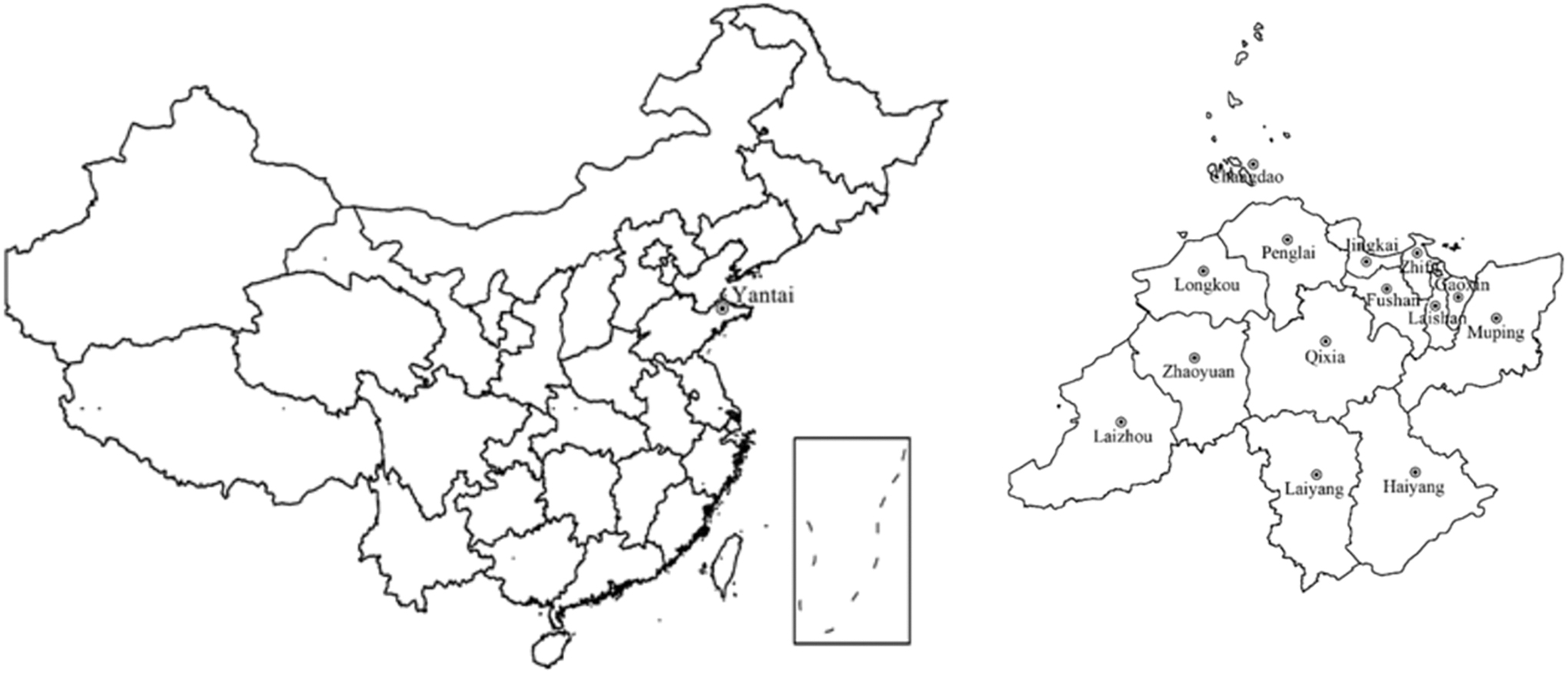
The location of Yantai in China and the 14 administrative regions of Yantai city.
Foodborne diseases are a global health problem (Havelaar et al., 2015). World Health Organization estimated that each year worldwide, unsafe food causes 600 million cases of foodborne diseases and 420,000 deaths (World Health Organization, 2023). The preventive management of foodborne diseases has significant public health implications for developing and developed countries (Havelaar et al., 2010; World Health Organization, 2020).
To understand the regularity and epidemiological characteristics of foodborne disease outbreaks caused by biotoxins (FDOB) in Yantai City, and to provide scientific basis for its prevention and control, the epidemiological characteristics of FDOB reported from 2013 to 2022 in Yantai City in the foodborne disease outbreak surveillance system of the Food safety risk assessment business application platform of national health insurance information project were described and analyzed. Similar incident reports published by the China National Knowledge Network (CNKI) were also searched.
Materials and Methods
Data source
Yantai Center for Disease Control and Prevention collected reports of FDOB through the food safety risk assessment business application platform of national health insurance information project. Foodborne disease outbreaks refer to two or more cases with similar clinical manifestations, confirmed through epidemiological investigation to have a history of common food exposure, and foodborne disease events related to food (including one death event). Information collected for each outbreak included the year, district, number of patients, pathogen, and implicated food. We also searched the database of CNKI for FDOB in Yantai City from 2013 to 2022.
Ethical statement
The study procedure was reviewed a priori and approved by the Yantai Preventive Medicine Association Ethics Committee [YYLLS 2023-01]. The Ethic Committee waived informed consent.
Methods
Epidemiological methods were used to analyze the epidemiological characteristics of reported foodborne disease outbreaks conforming to the criteria of biotoxins. The FDOB included bacterial, fungal, and toxic animal and plant foodborne diseases. Bacterial foodborne disease referred to the poisoning caused by ingestion of food contaminated by pathogenic bacteria or their toxins. This article only studied the poisoning caused by pathogenic toxins, for example, staphylococcal enterotoxin.
Foodborne disease outbreaks caused by fungi and their toxins referred to poisoning caused by the consumption of food contaminated by fungi and their toxins, including large fungi (toxic mushrooms), aflatoxin, fumonisins, and zearalenone. Toxic animal and plant foodborne disease outbreaks referred to the outbreaks caused by some animals and plants containing some natural toxic ingredients, or by the formation of toxic substances due to improper storage conditions, including saponins and hemagglutinin, Lagenaria siceraria (Molina) Standl, scopolamine (Datura, belladonna, etc.), puffer fish toxins, and histamine (Sun, 2007).
Statistical analysis
The PASW Statistics 18 trial version statistical software was used to establish the database, collate the data, and statistical calculations. Descriptive epidemiological studies and analytical epidemiological methods, such as case–control studies, were used to investigate single foodborne disease outbreak. Descriptive analysis was mainly used to describe the basic characteristics of variables by providing a basic description of data. In the analysis of overall outbreaks, we mainly used constituent ratio, rate, and other indicators for descriptive analysis (Supplementary Data).
Results
Basic information
A total of 128 FDOB were reported in Yantai from 2013 to 2022, resulting in a total of 417 patients and 6 deaths. Among them, there were 65 outbreaks of fungal infections, resulting in 159 patients and 6 deaths; 3 outbreaks of bacterial infection, resulting in 23 patients and 0 deaths; 54 outbreaks of vegetative infection, resulting in 200 patients and 0 deaths; and 6 outbreaks of animal-related diseases, resulting in 35 patients and 0 deaths.
The number of deaths in recent years showed an increasing trend year by year. Thirty-five suspicious food samples, 4 biological samples, and 4 environmental samples were collected, among which 20 food samples (18 mycotoxin, 1 staphylococcus aureus, 1 saponin and hemagglutinin), 1 biological sample and 0 environmental samples were detected positive (Table 1). The staff of China Center for Disease Control and Prevention used ITS fragments to analyze the sequence of poisonous mushroom, and the specific types were given.
Overview of Foodborne Disease Outbreaks Caused by Biotoxins in Yantai City from 2013 to 2022
The data come from the food safety risk assessment business application platform of national health insurance information project.
Time distribution
FDOB occurred in all months in Yantai City. The third quarter (July, August, and September) was a high season for foodborne disease outbreaks, the number of events, patients, and deaths accounted for 65.63% (84/128), 55.88% (233/417), and 100% (6/6) of the total number, respectively (Table 2). August was the month with the highest incidence of outbreaks, and the number of outbreaks, patients, and deaths accounted for 27.34% (35/128), 23.74% (99/417), and 33.33% (2/6) of the total, respectively.
Time Distribution of Foodborne Disease Outbreaks Caused by Biotoxins in Yantai City from 2013 to 2022
The data come from the food safety risk assessment business application platform of national health insurance information project.
The number of outbreaks and patients was the largest in autumn (According to the latitude of China, we divide September, October, and November into Autumn), accounting for 58.59% (75/128) and 56.12% (234/417), respectively. There are too few outbreaks in the animal and bacterial categories to make a reliable statement. Vegetative does not seem to follow the same trend as fungous, so it would see that fungous is the category with the seasonal trend here.
Regional distribution
FDOB were widely distributed in every region of Yantai City. From the number of outbreaks and patients, Zhifu District was the main occurrence area, with the largest number of outbreaks (25%, 32/128) and patients (18.94%, 79/417). The highest number of outbreaks per 10,000 persons was Qixia (0.41), followed by Zhifu (0.36) and Laiyang (0.33), with zero outbreaks in Laishan, Gaoxin, and Changdao. The highest prevalence rate was Qixia (0.11‰), followed by Zhifu (0.09‰), the zero incidence rate of Laishan, Gaoxin, and Changdao.
The highest fatality rate was Laiyang (6.25%), followed by Qixia (2.13%) and Zhifu (1.27%) (Table 3). Among the definite plant pathogenic factors, poisonous mushroom poisoning ranked first in Haiyang City, Laiyang City, and Qixia City, respectively. Longkou City was more poisoned by eating L. siceraria (Molina) Standl by mistake (50%, 5/10); both saponin and hemagglutinin poisoning occurred in Zhifu District (100.00%, 10/10). The main animal pathogenic factor was tetrodotoxin, which mainly occurs in Zhifu District.
Regional Distribution of Foodborne Disease Outbreaks Caused by Biotoxins in Yantai City from 2013 to 2022
The data come from the food safety risk assessment business application platform of national health insurance information project and the bulletin of the seventh national population census of China.
Distribution of biotoxins
The top three causes of FDOB were poisonous mushroom toxin, saponins and hemagglutinin, and L. siceraria (Molina) Standl. Sixty-five (50.78%) outbreaks were attributed to poisonous mushroom toxin, 18 (14.06%) outbreaks to saponin and hemagglutinin, and 12 (9.38%) outbreaks to L. siceraria (Molina) Standl. The number of outbreaks, patients and deaths caused by mushroom poisoning were the highest, accounting for 50.78% (65/128), 38.13% (159/417), and 100% (6/6), respectively.
The top 3 factors outbreaks caused by toxic plants and their toxins (54 outbreaks) were saponin and hemagglutinin, L. siceraria (Molina) Standl, scopolamine (Datura, belladonna, etc.), and colchicine. Eighteen (33.33%) outbreaks were attributed to saponin and hemagglutinin, 12 (22.22%) outbreaks to L. siceraria (Molina) Standl, and 6 (11.11%) outbreaks to scopolamine. The poisonings caused by toxic animals and their toxins were the fugu toxin, accounting for 50.00% (3/6), but histamine caused the largest number of poisonings, accounting for 65.71% (23/35) of poisonings from toxic animals and their toxins (Table 4).
Distribution of Pathogenic Factors in Foodborne Disease Outbreaks Caused by Biotoxins in Yantai City from 2013 to 2022
The data come from the food safety risk assessment business application platform of national health insurance information project.
TTX, tetrodotoxin.
Distribution of places of occurrence
The largest number of outbreaks, patients, and deaths all occurred in families, accounting for 82.81% (106/128) outbreaks, 66.19% (276/417) patients, and 100% (6/6) deaths, respectively. Followed by catering service establishments, the number of outbreaks, patients, and deaths accounting for 14.84% (19/128), 30.22% (126/417), and 0% (0/6), respectively (Table 5).
Distribution of Foodborne Disease Outbreaks Caused by Biotoxins in Yantai City from 2013 to 2022
The data come from the food safety risk assessment business application platform of national health insurance information project.
The main toxic plants and their toxins in family sites were L. siceraria (Molina) Standl, plant agglutinin and saponin, and hyoscyamine, accounting for 28.95% (11/38), 26.32% (10/38), and 15.79% (6/38), respectively. The toxic animals and their toxins in family sites were fugu toxin, dog liver, and fish, accounted for 50.00% (2/4), 25.00% (1/4), and 25.00% (1/4), respectively. Fungus and toxin poisoning in family sites were poisonous mushroom poisoning, accounting for 98.46% (64/65).
Plant pathogenic factors in catering service places were mainly phytoagglutinin and saponin, accounting for 53.85% (7/13), followed by colchicine, accounting for 38.46% (5/13). The animal pathogenic factors in catering service places were histamine and tetrodotoxin, which accounted for 50.00% (1/2), respectively. The outbreaks in school canteens and campuses were mainly caused by plant toxins, which was wisteria seed poisoning.
The main poisoning link
The main poisoning link of FDOB was ingestion and misuse, accounting for 72.66% (93/128), followed by improper processing, accounting for 20.31% (26/128) (Table 6). Misuse of food mainly occurred at home, and improper processing mainly occurred at home, restaurants, and canteens (Table 7). The main food of ingestion and misuse were poisonous mushroom (69.89%, 65/93), L. siceraria (Molina) Standl (9.68%, 9/93), scopolamine (Datura, belladonna, etc.) (6.45%, 6/93), and poisonous wild vegetable (4.30%, 4/93). The main reasons for improper processing was undercooked Phaseolus (65.38%, 17/26) and fresh daylily (19.23%, 5/26).
Distribution of Triggering Factors for Foodborne Disease Outbreaks Caused by Biotoxins in Yantai City from 2013 to 2022
The data come from the food safety risk assessment business application platform of national health insurance information project.
Triggering Factors and Location Distribution of Outbreaks of Toxic Animal and Plant Borne Foodborne Diseases in Yantai City from 2013 to 2022
The data come from the food safety risk assessment business application platform of national health insurance information project.
Discussion
Analysis of FDOB has highlighted the epidemiological characteristics and the important control regulations of outbreaks in China, which has been useful in the improvement of public health control measures. Continued surveillance for outbreaks is crucial to understand changes in the etiologic agents, the implicated food vehicles, and contributing factors associated with illness. Only one hospital was included in the monitoring scope in 2013, and it increased to two hospitals in 2014.
Owing to the fact that this work has just been carried out and there are few monitoring sites, there are no relevant reports. It expanded to 15 hospitals in 2015, 30 hospitals in 2016, and 171 hospitals in 2018. With the expansion of the monitoring scope, the foodborne disease reporting system has been gradually improved, and the reporting of foodborne disease incidents has been included into the legal requirements, and the reporting awareness has been enhanced, and the sensitivity and capacity of foodborne disease monitoring has been significantly improved.
It is possible that the increased number of outbreaks in recent years reflects improvements in surveillance rather than a true increase of outbreaks. The number of deaths showed an upward trend in the past 3 years, indicating the need to strengthen publicity and education on the prevention of poisonous mushroom poisoning (Wu et al., 2018).
FDOB were mainly concentrated in the third quarter, especially in August. The main cause of poisoning was the ingestion of toxic mushrooms, which is consistent with the situation in China (Li et al., 2020). The events were mostly concentrated in Zhifu District, Laiyang City, Longkou City, and Qixia City (74.22%, 95/128), resulting in 100% (6/6) of the total number of deaths caused by biological toxins. This may be related to the geographical characteristics of these areas, the diet habits of the people, and the growth characteristics of plants.
The harm of eating wild poisonous mushrooms is great, which poses a great threat to the life safety of the masses. Over the past decade, 159 people were poisoned by wild poisonous mushrooms in Yantai City, and 6 people died, all of which were picked by themselves. The local Centers for Disease Control and Prevention (CDC) staff collected uneaten wild poisonous mushrooms from the poisoned person's home, or picked wild poisonous mushrooms on-site in the area where the poisoned person picked wild poisonous mushrooms, and the poisonous mushroom samples were physically dried and sent to China Center for Disease Control and Prevention for testing.
The highly toxic Amanita subjunquillea, which can cause acute liver damage, has been detected. Also identified the neuropsychiatric toxicity of Amanita fritillaria, Gastroenterotoxic Lactarius oomsisiensis, Tylopilus felleus, and Suillus luteus; Conditionally edible milk liver (Suillus granulatus), which is toxic to gastroenteritis after improper processing, edible red and yellow Amanita similar (Amanita chatamagotake), Amanita princeps, the waxy red mushroom (Russula cerolens), with various red mushrooms, succulent lactis, and filamentous fungi species, as well as edible Agaricus flocculosipes, Lactarius hatsudake (orange), and Russula sanguinea (red-covered).
We believe that the health department should strengthen the monitoring of foodborne diseases, report the poisoning patients in a timely manner, and do a good job in medical treatment. The critically ill patients should be referred for treatment in a timely manner to improve the public's awareness of medical treatment and the level of medical treatment at the grassroots level. Meanwhile, we should also enhance the analysis and utilization of monitoring data and make risk warning timely.
Strengthen the use of new technologies and methods as whole genome sequencing subtyping technology (Wellman et al., 2023), Online Consumer Complaint Forms (Kim et al., 2023), Global Food-source Identifier (Duarte et al., 2020) for clinical, environmental, and food isolates of foodborne pathogens, and the ability to share and compare the data on public platforms, present new opportunities to identify earlier links between patients and their potential sources. Misuse or improper processing are the main causes of poisoning, which fully reflects the lack of understanding of the people about poisonous mushrooms, poisonous animals, and plants.
The government and relevant regulatory departments should strengthen publicity and education, carry out publicity activities through various forms and according to the characteristics of different groups, especially to guide rural families not to pick wild ingredients at will and eat them blindly. Food safety supervision department should strengthen the supervision and management of the circulation field such as the agricultural market and the catering service field, focusing on the supervision of food processing methods and storage conditions.
Owing to many patients with mild diseases did not go to the hospital, there is a phenomenon of underreporting and concealment of foodborne disease outbreaks. A nationwide survey reported by Lin (2015) found that only 37.1% people with diarrhea sought medical attention, regardless the severity of diarrhea. In contrast, due to the limitation of human and material resources, and no in-depth investigation was carried out on mild disease events, resulting in data omission, which needs further in-depth analysis.
A research reported that only 51% of foodborne outbreaks reported to the CDC include a confirmed etiology in United States (Dewey-Mattia et al., 2018). Some food samples, biological samples, and environmental samples were not collected, because the food samples have not been retained or have been consumed at the time of intervention; or because the patients had already received infusion or medicine, or because the tableware has been disinfected, and so on.
A study in the United States also shows that public health professionals face multifaceted barriers when trying to collect stool specimens from ill person during an outbreak investigation (Torok et al., 2023). Our findings emphasize the need to continually improve data collection to be able to accurately describe the causes of foodborne disease outbreaks. Maintaining a robust foodborne illness complaint system may improve foodborne illness surveillance, outbreak detection, and response (Kim et al., 2022).
Routine inspections of food service premises, training of food handlers, and selected community-based education programs have been shown to be effective in promoting food safety (Rossi et al., 2003). Proper handling, preparation, and storage of foods, regardless of production method, are necessary to prevent foodborne illness (World Health Organization, 2006). With proper knowledge, everyone can play an important role in foodborne disease prevention.
Footnotes
Acknowledgments
The authors are grateful for the support of these foundations.
Disclosure Statement
No competing financial interests exist.
Authors' Contributions
The authors declare that they have no known competing financial interests or personal relationships that could have appeared to influence the work reported in this article. All authors have contributed to editing and revising the article. All authors have given approval to final version of the article.
Methodology, investigation, validation, data curation, formal analysis, writing—original draft, and funding acquisition by F.D. Data curation, formal analysis, conceptualization, and writing—original draft by T.N. Data curation, investigation, and writing—original draft by Y.C. Project administration, writing—original draft, and supervision by Y.S. and Z.Z. Data curation and writing—original draft/reviewing and editing by Y.L., G.G., and L.R. Conceptualization, project administration, funding acquisition, writing—original draft/reviewing and editing, and supervision by X.Y. and G.W.
Funding Information
This research was financially supported by Scientific Research Project of Shandong Provincial School Health Association in 2023 (SDWS2023192), Yantai Social Science Planning Research Project (YTSK-2023-464), Yantai science and technology innovation development plan project in 2020 (2020YJGG007), the Medicine Natural and Science Foundation of Shandong in 2019 (2019WS260), and the Natural and Science Foundation of Yantai in 2017 (2017WS118).
Supplementary Material
Supplementary Data
References
Supplementary Material
Please find the following supplemental material available below.
For Open Access articles published under a Creative Commons License, all supplemental material carries the same license as the article it is associated with.
For non-Open Access articles published, all supplemental material carries a non-exclusive license, and permission requests for re-use of supplemental material or any part of supplemental material shall be sent directly to the copyright owner as specified in the copyright notice associated with the article.
