




Abstract
Plasmid-mediated quinolone resistance (PMQR) genes and mobile colistin resistance (MCR) genes in Escherichia coli (E. coli) have been widely identified, which is considered a global threat to public health. In the present study, we conducted an analysis of MCR genes (mcr-1, mcr-2, mcr-3, mcr-4, and mcr-5) and PMQR genes [qnrA, qnrB, qnrC, qnrD, qnrE1, qnrVC, qnrS, aac(6')-Ib-cr, qepA, and oqxAB] in E. coli from China, 1993–2019. From the 3,663 E. coli isolates examined, 1,613 (44.0%) tested positive for PMQR genes, either individually or in combination. Meanwhile, 262 isolates (7.0%) carried the MCR genes. Minimum inhibitory concentration (MIC) analyses of 17 antibiotics for the MCR gene-carrying strains revealed universal multidrug resistance. Resistance to polymyxin varied between 4 μg/mL and 64 μg/mL, with MIC50 and MIC90 at 8 μg/mL and 16 μg/mL, respectively. In addition, fluctuations in the detection rates of these resistant genes correlated with the introduction of antibiotic policies, host origin, temporal trends, and geographical distribution. Continuous surveillance of PMQR and MCR variants in bacteria is required to implement control and prevention strategies.
Introduction
The widespread use of antibiotics has accelerated the emergence of antibiotic-resistant bacteria, posing a global threat to public health (Andersson and Hughes, 2016). A recent systematic analysis estimated that nearly 4.95 million deaths were associated with bacterial antimicrobial resistance (AMR) worldwide in 2019, with 1.27 million of these deaths being directly attributable to bacterial AMR (Antimicrobial Resistance Collaborators, 2022). Increasing antibiotic resistance in multidrug-resistant (MDR) Gram-negative bacteria presents significant health problems worldwide, since the vital available and effective antibiotics, including broad-spectrum penicillins, fluoroquinolones, aminoglycosides, and β-lactams, often fail to fight MDR Gram-negative pathogens. Unfortunately, MDR, extensively drug-resistant, and pan-drug-resistant strains of Escherichia coli, Klebsiella pneumoniae, Acinetobacter baumannii, and Pseudomonas aeruginosa are globally found to harbor multiple resistance mechanisms (Ramaloko and Osei Sekyere, 2022), especially E. coli. In 2021, Gram-negative bacteria, particularly E. coli, accounted for a significant portion of drug-resistant cases in China (71.1%) and globally (76.5%) (CARSS, 2023; Tacconelli et al., 2018).
Polymyxin, a polypeptide antibiotic derived from Bacillus polymyxa var., includes five members, with polymyxin B and E being the most commonly used clinically. These antibiotics are considered the “last line of defense” against many multidrug-resistant Gram-negative bacteria (Moffatt et al., 2019). Polymyxin resistance in Gram-negative bacteria can be classified as innate or acquired (Olaitan et al., 2014). Breaking from prior understandings, Liu et al. were the first to report the mcr-1 gene’s role in disseminating polymyxin resistance through plasmids, drawing significant attention (Liu et al., 2016; Castanheira et al., 2016). Subsequently, ten mobile colistin resistance (MCR)-family genes (mcr-1 to mcr-10) and their variants have been identified. While mcr-6 is chromosome-located, the other MCR genes are typically found on plasmids, facilitating horizontal gene transfer and leading to increased colistin tolerance across various bacterial species (AbuOun et al., 2017; El-Sayed Ahmed et al, 2020).
Fluoroquinolones (FQs) are highly effective antibiotics, used extensively in clinical treatments for over three decades, but their resistance is increasing (Bush et al., 2020). The first plasmid-mediated quinolone resistance (PMQR) gene, qnr, was identified, with approximately 100 variants grouped into six families (qnrA, qnrB, qnrS, qnrC, qnrD, and qnrVC). Another significant PMQR mechanism, aac(6')-Ib-cr, was discovered in 2006, reducing the efficacy of ciprofloxacin and norfloxacin (Tran and Jacoby, 2002). Efflux pumps, qepA and oqxAB, were subsequently identified (Yamane et al., 2007). Pathogens with PMQR genes are prone to mutations, leading to high antibiotic resistance, especially when combined with extended-spectrum β-lactamase (ESBL) genes, limiting treatment options for ESBL-producing bacteria (Hansen et al., 2007). In recent decades, antibiotic resistance in Enterobacteriaceae has challenged medical treatment. China, a global leader in antibiotic production and consumption, faces this crisis, necessitating a thorough investigation of antibiotic-resistant genes within the nation (WHO, 2019).
This study analyzed 3,663 E. coli strains collected nationwide from 1993 to 2019. We detected PMQR genes [qnrA, qnrB, qnrC, qnrD, qnrE1, qnrVC, qnrS, aac(6)-Ib-cr, qepA, and oqxAB] and MCR genes (mcr-1, mcr-2, mcr-3, mcr-4, and mcr-5) using polymerase chain reaction (PCR) and multidimensional analysis. We unveiled the epidemiological characteristics of these genes in E. coli and compiled crucial epidemiological data. Estimating the prevalence of bacteria in China that are resistant to critically important antimicrobials is required to implement control and prevention strategies, yet such data are lacking.
Materials and Methods
Isolation and identification of E. coli
Between 1993 and 2019, we isolated 3,663 E. coli strains from various sources across China. The breakdown of these isolates is as follows: humans (614), chickens (1,532), ducks (67), geese (250), pigs (846), cattle (113), goats (90), monkeys (92), rabbits (8), pigeons (25), guinea pigs (1), minks (3), cats (1), dogs (7), mice (1), squirrels (1), quails (1), river deer (2), peacocks (1), turtles (2), red pandas (2), antler deer (3), and deer (1). The samples consisted of diverse types, including meat products, milk, eggs, offal, padding, and more. These strains were collected from all the 31 provinces in China, namely Beijing, Shanghai, Tianjin, Chongqing, Inner Mongolia, Xinjiang, Ningxia, Guangxi, Tibet, Heilongjiang, Jilin, Liaoning, Hebei, Henan, Shandong, Shanxi, Hunan, Hubei, Anhui, Jiangsu, Zhejiang, Fujian, Jiangxi, Guangdong, Hainan, Guizhou, Yunnan, Sichuan, Shaanxi, Qinghai, and Gansu. Identification of all strains was performed using PCR with the following primers: forward: 5′-AGAGTTTGATCCTGGCTCAG-3′; reverse: 5′-AAGGAGGTGATCCAGCC-3′. Sequencing results were then aligned using the NCBI database (http://blast.ncbi.nlm.nih.gov).
Identification of antibiotic-resistance genes
Based on sequences from the literature and GenBank, specific primers were designed (Supplementary Table S1). All isolates positive for oqxA were also screened for oqxB (Kim et al., 2009). Two strands of the purified PCR products were sequenced, and the qnr alleles were identified by referencing the qnr gene naming conventions (Jacoby et al., 2008). In addition, all isolates testing positive for aac(6')-Ib-cr were further analyzed either by FokI digestion or through direct sequencing.
Antimicrobial susceptibility testing
In accordance with the standards recommended by the Clinical and Laboratory Standards Institute (CLSI) (CLSI et al., 2018), the MICs of 17 antibiotics were determined for the 262 MCR-positive isolates using the microbroth dilution method. The quality control strain, E. coli ATCC 25922, was utilized to assess the efficacy of the drugs. The concentration of the antibacterial drug SXT was set at 256/4,846 μg/mL, while the concentration for other drugs was maintained at 2,048 μg/mL (Supplementary Table S2).
Results
Overview of MCR and PMQR genes in E. coli during 1993–2019
Of the 3,663 E. coli isolates collected from various sources between 1993 and 2019, 262 strains (7.2%) contained mcr genes: 258 strains had mcr-1 (7.0%), five strains had mcr-3 (0.1%), and one strain possessed both mcr-1 and mcr-3. Moreover, 1,613 strains (44.0%) tested positive for PMQR genes. Specifically, the presence of qnrA (0.3%), qnrB (3.8%), qnrS (17.1%), qnrVC (0.4%), aac(6')-Ib-cr (7.3%), qepA (0.9%), and oqxAB (21.9%) was identified either individually or in combination (Table 1 and Supplementary Table S3). None of the strains contained qnrC, qnrD, qnrE1, mcr-2, mcr-4, or mcr-5. In addition, a polygenic distribution was observed that 9.1% (332/3,663) of isolates contained multiple PMQR genes concurrently (Supplementary Table S4). Besides, 7.8% (287/3,663) had two PMQR genes, and 1.2% (45/3,663) contained three PMQR genes. The combinations oqxAB + qnrS (3.2%) and oqxAB + aac(6')-Ib-cr (2.4%) were prevalent, followed by qnrS + aac(6')-Ib-cr (0.9%). Among strains with three PMQR genes, the combination oqxAB + qnrS + aac(6')-Ib-cr was the most common (0.9%).
The Overall Resistance of MCR-Detection Strains
CTX, cefotaxime; MCR, mobile colistin resistance; MIC, minimum inhibitory concentration; SXT, Trimethoprim-Sulfamethoxazole.
Among the MCR-positive strains, 142 isolates (3.9%) also harbored PMQR genes (Supplementary Table S4). For instance, 1.8% (67/3,663) contained mcr-1 + oqxAB, and 0.9% (34/3,663) had mcr-1 + oqxAB + qnrS. A particular strain sourced from pigs carried four resistance genes: mcr-1, qnrS, oqxAB, and aac(6')-Ib-cr. Moreover, one strain possessed both mcr-3 and qnrS, while another had mcr-1, mcr-3, and qnrS.
Prevalence of PMQR and MCR genes in different hosts
The prevalence of mcr in 3,663 strains of E. coli from various host sources is detailed in Supplementary Table S5. The detection rate of mcr-1 in pig isolates was the highest at 11.5% (97/846). This was significantly higher than any other host. It was followed by goose isolates at 8.0% (20/250) and chicken isolates at 7.5% (115/1532). The prevalence of MCR genes in poultry isolates was 7.5% (138/1,849) and 9.9% (104/1,049) in livestock isolates. Out of the human samples, 1.5% (9/614) tested positive for MCR genes, and among monkey samples, one strain, or 1.1% (1/92), was mcr-1-positive.
The detection rate of PMQR genes in pig isolates was notably high at 76.4% (647/846), succeeded by goose isolates at 66.8% (167/250) and sheep isolates at 55.5% (50/90). The PMQR genes were identified in 52.0% (961/1,849) of poultry samples, 71.4% (749/1049) of livestock samples, and 22.3% (137/614) of human samples. The genes oqxAB and qnrS were detected as early as 1994 and 2003 in chickens or pigs, with detection rates higher than other genes at 21.9% and 17.1%, respectively. The earliest detection years for mcr-1 and mcr-3 were 2009 and 2016, respectively. In addition, a new PMQR gene, qnrVC4, was first identified in E. coli in 2017 from a chicken (two samples) and a pig (one sample). Its detection rate stood at 0.3% (3/820) (Supplementary Table S6).
Geographical distribution of PMQR and MCR genes in China
In this study, the prevalence of mcr-1 exceeded 15% in Central China, followed by Northeast China (above 10%), and then by East and South China (Fig. 1). However, North China, Southwest China, and Northwest China displayed lower prevalence rates. When regions were segmented according to the” Heihe-Tengchong line” the mcr-1-positive isolates were significantly more frequent in the eastern part than in the western region. A total of five strains tested positive for mcr-3 across the following three provinces: Jiangsu (two strains), Henan (two strains), and Qinghai (one strain) (Fig. 2).

The prevalence and distribution of mcr-1 in China from 1993 to 2018.

The prevalence of novel plasmid-mediated resistance gene mcr-3 and qnrVC in China.
The overall detection rate of PMQR genes was highest in Northeast China, surpassing 20%. This was closely followed by Central China and Southwest China, both registering over 15% (Fig. 1). The aac(6')-Ib-cr detection rate peaked in Central China. The novel PMQR gene, qnrVC, was identified in the following seven provinces: Xinjiang (two strains), Ningxia (one strain), Yunnan (four strains), Qinghai (two strains), Guizhou (one strain), Chongqing (one strain), and Jiangsu (five strains) (Fig. 3).
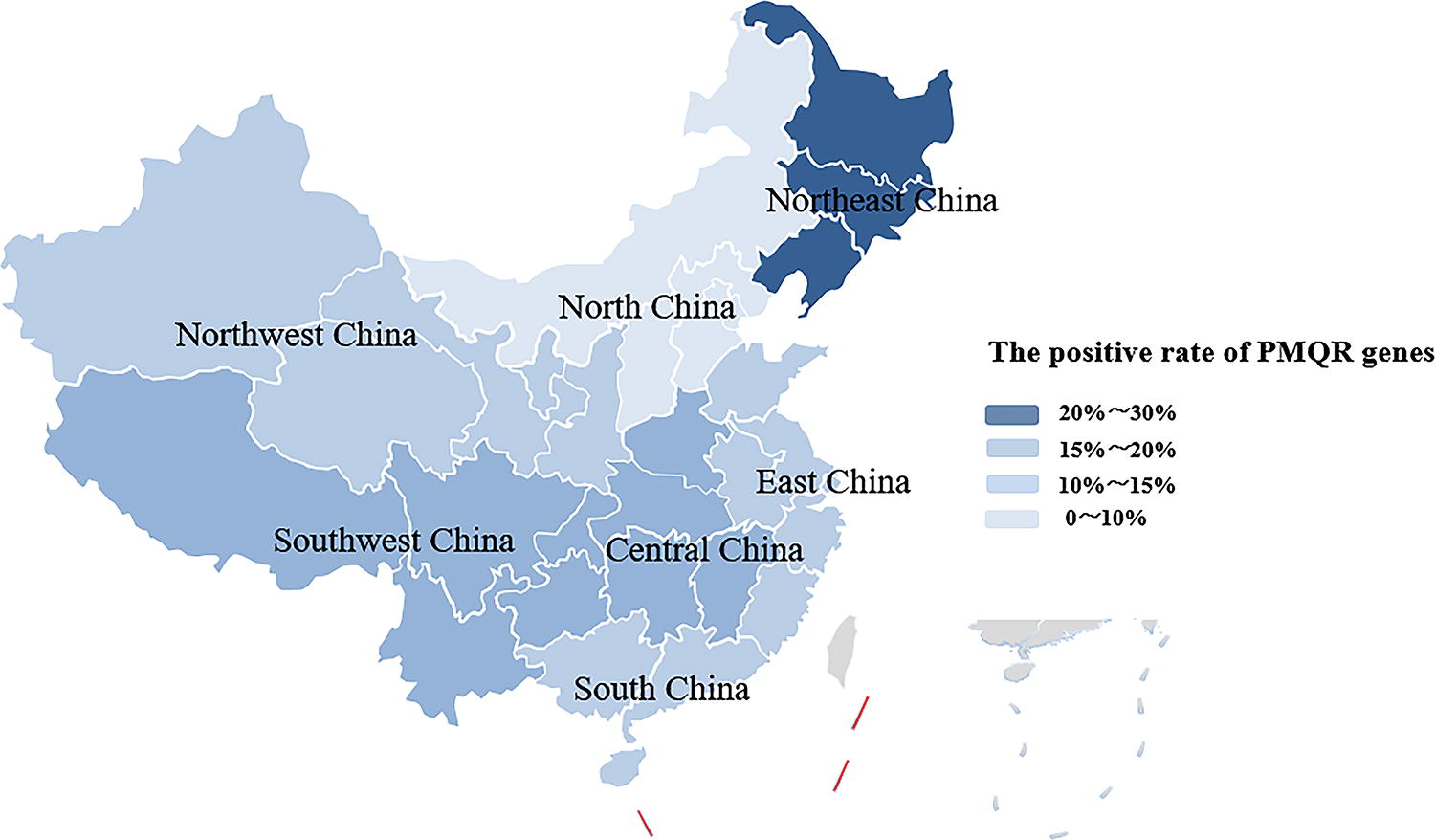
The prevalence and distribution of PMQR genes in China from 1993 to 2018. PMQR, plasmid-mediated quinolone resistance.
Temporal changes of PMQR and MCR genes
When analyzing the relationship between the number of veterinary drug approvals and the prevalence of mcr-1 over time (Fig. 4), a distinct correlation emerged. The rate of mcr-1 positivity appeared to correspond closely with the number of veterinary drugs sanctioned in any given year. This finding suggested that the increased approval of veterinary drugs might be influencing the prevalence of the mcr-1 gene. mcr-1 was first identified in chicken strains in 2009. Following this, the detection rate of mcr-1 surged from 2009 to 2013, peaking at 16.8% (34/202) in 2013. Between 2014 and 2015, this rate consistently hovered around 16%. However, after the 2017 ban on using colistin as an animal growth promoter (Supplementary Fig. S1 at http://www.ivdc.org.cn/; Supplementary Fig. S2), the prevalence of mcr-1 swiftly declined to 5.0% (17/339) by 2019 (Walsh and Wu, 2016).
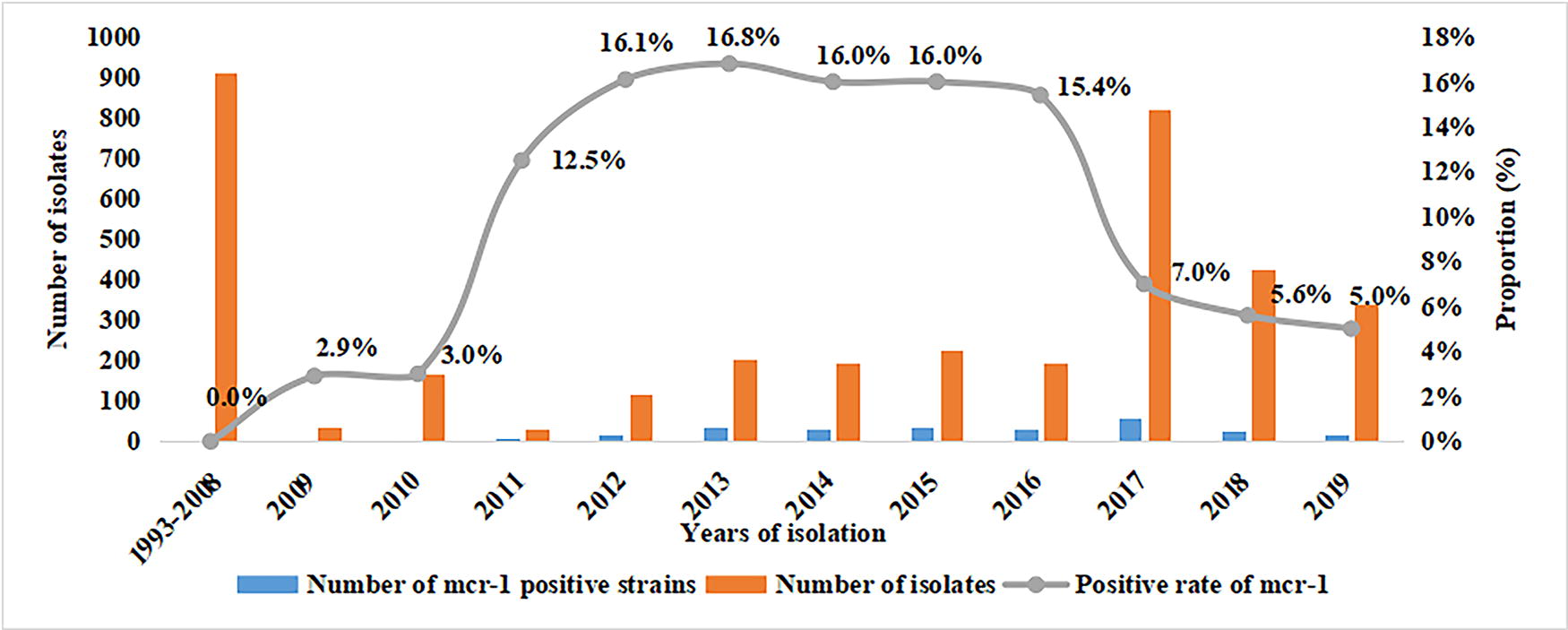
The detection rate of mcr-1 in Escherichia coli between 1993 and 2019.
Historical data suggested that the overall detection rate of E. coli in samples was high from 1993 to 2000. Even though the detection rate of E. coli in samples significantly dropped after the approval of enrofloxacin in the late 1980s, the carrying rates of qnr and oqxAB began to climb. By 2013, oqxAB-positive strains reached their zenith at 45.5% (92/202) (Supplementary Fig. S3). In response to such trends, China has been progressively curtailing the approval of veterinary drugs (Supplementary Fig. S4 at http://www.ivdc.org.cn/). In subsequent years, the detection rate of oqxAB consistently fell. By 2017, the rate dwindled to just 13.3% (109/820). Subsequently, three types of veterinary drugs were prohibited for use in food animals, quinolinol being one of them (details available at http://www.moa.gov.cn/nybgb/2015/jiuqi/201712/t20171219_6103873.htm). Contrary to expectations, the prevalence of oqxAB and qnr, particularly qnr, surged (Supplementary Fig. S5). In 2018, the detection rate for qnrS was a substantial 35.1% (150/427). The qnrB rate was minimal before 2016 but exhibited a modest uptick in 2017 and 2018, recording 8.4% and 9.8%, respectively.
Antimicrobial susceptibility of MCR gene isolates
We assessed the MICs of 17 antimicrobial drugs against 262 MCR-positive isolates. All of these isolates displayed multidrug resistance (Table 1). Each MCR-positive strain demonstrated resistance to polymyxin, resulting in a 100% match rate between MIC phenotype and genotype. Resistance values ranged from 4 μg/mL to >64 μg/mL. The MIC50 and MIC90 were 8 μg/mL and 16 μg/mL, respectively. For six strains, the MIC of polymyxin exceeded 64 μg/mL. In the context of β-lactam drugs, the resistance rates were as follows: ampicillin (95%), cefotaxime (73.3%), cefazolin (78.2%), and aztreonam (70.6%). Notably, six MCR-positive strains were simultaneously resistant to meropenem, with a resistance rate of 2.3% and the highest resistance value being 16 μg/mL. Regarding aminoglycosides, resistance rates were 56.9% for gentamicin, 63.7% for streptomycin, and 22.9% for amikacin. For quinolones, ciprofloxacin had a resistance rate of 82.4%, while nalidixic acid stood at 93.1%. Furthermore, resistance rates for other drugs were as follows: tetracycline (94.3%), cotrimoxazole (97.7%), fosfomycin (68.7%), chloramphenicol (85.1%), florfenicol (77.1%), and nitrofurantoin (18.3%).
From an overall drug resistance standpoint, isolates with MCR genes exhibited multidrug resistance. The resistance rate for most drugs hovered around 50% and often exceeded 80%. Only three drugs, meropenem, amikacin, and nitrofurantoin, demonstrated commendable antibacterial effects with resistance rates below 30%. Meropenem stood out with a notably low resistance rate of just 2.3%.
When analyzing the 262 MCR-positive strains based on host differences, our findings indicated (Table 2) that human MCR-positive strains had significantly lower drug resistance rates compared with other hosts. Whether considering β-lactam, aminoglycosides, or fosfomycin, chicken strains consistently displayed higher resistance rates than those from pigs. This was particularly evident for amikacin (34.5% vs. 11%) and fosfomycin (80.2% vs. 61%).
Multidrug Resistance of MCR-Positive Strains from Different Hosts
Discussion
E. coli is a major human pathogen (Moura et al., 2012). Numerous studies have reported the prevalence and characteristics of mcr-1-positive Enterobacteriaceae in China, and E. coli was found to be a critical host of mcr-1 in both medical and veterinary settings (Liu et al., 2016). Researchers often conduct retrospective studies on preserved strains to study resistance genes in-depth (Yang et al., 2022). This study found a high prevalence of PMQR and MCR genes in Chinese E. coli, indicating a serious AMR issue. Overuse of antibiotics and the presence of mobile genetic elements worsen drug resistance.
FQ antibiotics, widely used for human and animal infections, inhibit bacterial DNA synthesis and account for 20% of global antibiotic use (Van Doorslaer et al., 2014). Our research found that 44.0% of strains (1,613) were PMQR-positive, primarily with oqxAB. Multiple PMQR genes were observed in 9.1% (332 strains), 7.8% carried two genes, and 1.2% had three. Overall, PMQR gene detection was lower in China than in many Latin American countries [e.g., aac(6')-Ib-cr: 7.3% vs. 60.6%] (Vieira et al., 2020).
Since 2016, the WHO classified colistin as a critical antibiotic. The global spread of MCR genes raises concerns (Poirel et al., 2017). In our study, MCR genes were found in 7.2% of strains, with mcr-1 at 7.0% and mcr-3 at 0.1%. One strain carried both genes, while mcr-2, mcr-4, and mcr-5 were absent. This aligns with mcr-1 predominance in Asia, followed by mcr-3. Livestock had a higher MCR gene rate than poultry. Pigs showed an 11.5% mcr-1 detection, while human strains were at 1.5%. This is consistent with the existing research results (Bastidas-Caldes et al., 2022). The estimated overall prevalence in the animal and food samples was higher than in the human samples, and this supports the hypothesis that the food chain plays a role in mcr transmission.
Central China exhibits a higher prevalence of mcr-1-positive isolates and PMQR genes. As previously reported, the prevalence of mcr-1-positive isolates was the highest in pig and pig products than other sources, such as chicken, vegetable, and patient (Lu et al., 2023). The overall distribution trend of these two resistance genes appears to be similar, potentially influenced by regional practices in pig farming and diets. Within Jiangsu, Henan, and Qinghai provinces, five mcr-3-positive isolates were identified. The absence of mcr-2, mcr-4, and mcr-5 indicates a limited spread of newer MCR variants in China. These investigations highlight the fluctuating prevalence of mcr-1-carrying E. coli, dependent on factors such as sampling region, sampling time, and research methodology.
Between 2009 and 2013, mcr-1 was first identified in chicken strains, with a peak detection rate of 16.8% in 2013. This period saw an 8.7-fold increase in antibiotic resistance among global E. coli clinical strains (Dadashi et al., 2022). In 2016, due to concerns, the European Medicines Agency raised colistin resistance risk classification from low to high, leading several countries, including Brazil, Thailand, China, Japan, Malaysia, Argentina, and India, to ban colistin as a livestock feed additive (Wang et al., 2020). Consequently, mcr-1-positive rates in China declined sharply from 15.4% in 2016 to 5.0% in 2019, but it is still higher than the average of other developed countries, highlighting the impact of veterinary drug regulations on public health and ecological safety (Elbediwi et al., 2019).
E. coli strains carrying MCR genes exhibited multidrug resistance, with most drugs showing resistance rates exceeding 50% and some exceeding 80%. Notably, only three drugs had significant antibacterial effects, with resistance rates below 30%: meropenem, amikacin, and nitrofurantoin. Meropenem had the lowest resistance rate at 2.3%. This suggests that in cases of multidrug-resistant Gram-negative infections, especially with polymyxin resistance, treatment options are limited. Carbapenems, particularly meropenem, may emerge as viable clinical alternatives.
When examining multidrug resistance in E. coli strains carrying MCR genes from various hosts, human strains displayed significantly lower resistance compared with other sources. Among different categories such as β-lactam, aminoglycosides, and fosfomycin, chicken strains consistently exhibited higher resistance than pig strains. This disparity was especially noticeable for drugs such as amikacin and fosfomycin. All strains with MCR genes showed resistance to colistin, with resistance levels ranging from 4 μg/mL to >64 μg/mL. This confirmed that the presence of MCR genes could induce colistin resistance, highlighting the escalating detection of MCR in wild-type E. coli, which correlated with the increase in clinical strains resistant to polymyxin. The emergence of six strains with an MIC > 64 μg/mL indicated the potential development of super-resistant strains, emphasizing the need for proactive measures.
While drug-resistant bacteria have impacted antibiotic efficacy, we cannot deny their crucial role in preserving human and animal health. Monitoring antimicrobial resistance is essential in combating this issue. China has implemented a comprehensive National Action Plan to Contain Antimicrobial Resistance (2017–2020) and the subsequent three-year action plans to address antibiotic-resistant animal-borne bacteria. These policies are expected to improve antimicrobial regulation and usage in both human and veterinary medicine, safeguarding public health.
Footnotes
Acknowledgments
The article is already preprint: https://doi.org/10.1101/2023.10.02.560564  All the authors read and approved the submitted version of the article. We declare no conflict of interest.
Authors’ Contributions
X.J. and X.C.: designed the study protocol and supervised all parts of the project. Y.W. and D.S.: performed all experiments and wrote the article. Z.X. and X.C. revised the article and advised the experiment. All the authors approved the final version.
Disclosure Statement
No competing financial interests exist.
Funding Information
This work was supported in part by the “National Key Research and Development Program of China” (2021YFD1800403), the 111 Project (D18007), and the Priority Academic Program Development of Jiangsu Higher Education Institutions (PAP D).
Supplementary Material
Supplementary Figure S1
Supplementary Figure S2
Supplementary Figure S3
Supplementary Figure S4
Supplementary Figure S5
Supplementary Table S1
Supplementary Table S2
Supplementary Table S3
Supplementary Table S4
Supplementary Table S5
Supplementary Table S6
References
Supplementary Material
Please find the following supplemental material available below.
For Open Access articles published under a Creative Commons License, all supplemental material carries the same license as the article it is associated with.
For non-Open Access articles published, all supplemental material carries a non-exclusive license, and permission requests for re-use of supplemental material or any part of supplemental material shall be sent directly to the copyright owner as specified in the copyright notice associated with the article.
