




Abstract
Methicillin-resistant Staphylococcus aureus (MRSA) can easily form biofilms on food surfaces, thus leading to cross-contamination, which is difficult to remove. Therefore, there is an urgent need to find alternatives with good antibacterial and antibiofilm effects. In this study, two indole sesquiterpene compounds, xiamycin (
Introduction
In recent years, food safety problems have emerged endlessly, among which microbial contamination is an important triggering factor (Ripolles-Avila et al., 2020). Staphylococcus aureus (S. aureus) is one of the common foodborne pathogens, after massive propagation, the toxic substances of the bacteria often exist in starchy foods and milk products, resulting in food poisoning-related diseases (Bravo-Santano et al., 2019; Bravo-Santano et al., 2018; Gao et al., 2018; Thwaites and Gant 2011).
Bacterial biofilm is an aggregate formed by bacteria that actively adhere to the surface of animate or inanimate objects and encapsulate themselves in the extracellular matrix, to protect themselves during environmental changes (Colagiorgi et al., 2016). Extracellular matrix of biofilm mainly consists of extracellular polysaccharide (EPS), extracellular protein, and extracellular DNA, among which EPS plays an important role in maintaining the structure and function of biofilm, enhancing the resistance of the bacterium in nature (Flemming et al., 2016; Xie et al., 2017). Therefore, it is one of the main concerns of health problems and economic losses in the food industry. As a strain with biofilm-forming ability, S. aureus can continue to exist on various food contact surfaces, including food processing equipment or packaging materials, which is difficult to remove. Hence, there is an urgent need for food preservative candidates to control the bacterium and its biofilm contamination.
The natural product indole alkaloids have attracted the continuous attention of pharmacologists due to their complicated structure and promising bioactivities. Among them, the indole sesquiterpenes represent a little group of secondary metabolites mainly originating from fungi, plants, and actinomycetes as exemplified by the family of xiamycin. They comprise a six-membered benzene ring fused to a five-membered nitrogen-containing pyrrole ring and three isoprene units. Until 2012, some indole sesquiterpenoids derived from marine actinomycetes were found (Zhang et al., 2012). Many of them were reported to have antibacterial, anticancer, and anti-HIV activities (Marcos et al., 2013).
In this article, two indole sesquiterpenes, xiamycin (
Materials and Methods
The preparation of compounds
General experimental procedures
The 1H and 13C NMR chemical shifts were recorded relative to the solvent signal Dimethyl sulfoxide-d 6 (DMSO-d 6) (1H 2.5 ppm; 13C 39.5 ppm) on a Bruker AVANCE NEO 600 MHz instrument (Bruker Biospin AG, Fällanden, Germany) using Tetramethylsilane (TMS) as an internal standard. Medium-pressure liquid chromatography (MPLC) was performed using a Bonna-Agela FLEXA purification instrument. Silica gel (200–300 mesh, Qingdao), C18 reversed-phase silica gel (50 μm, YMC Co., Ltd.), was used for column chromatography. HRESIMS were recorded on a Waters (Milford, MA, United States) G2-XS Q-TOF Liquid Chromatography Mass Spectrometry (LC/MS) system. Compound purification was carried out by Agilent Technologies 1260 High Performance Liquid Chromatography (HPLC) equipped with a semipreparative C18 column (YMC Pack ODS-A, 250 × 10 mm, 5 μm, Tokyo, Japan).
Bacterial strains
The actinomycete used in this experiment was Streptomyces sp. NBU3429, which was isolated from marine sponge Spongia sp. collected from Paracel Islands, China (16°02'24.60''N 111°48'35.49''E) in May 2020. The BLAST analysis showed that the rDNA sequence was most similar (99.8%) to the sequence of Streptomyces olivaceus. The sequence data for this actinomycete strain have been submitted to NCBI (Accession No. OP055907). A voucher specimen (No. NBU3429) was preserved at the Ningbo University, Ningbo (deposited in the bacterial collection of China General Microbiological Culture Collection Center, CGMCC, accession number 24623). Methicillin-resistant S. aureus (MRSA) ATCC 43300 was purchased from the American Type Culture Collection (ATCC) (VA, USA).
Fermentation, extraction, and isolation
The endophytic actinomycete Streptomyces sp. NBU3429 was inoculated into a 1000 mL Erlenmeyer flask containing 400 mL of A medium (soluble starch 2%, peptone 0.5%, yeast extract 0.2%, KBr 0.01%, CaCO3 0.1%, Fe2(SO4) H2O 0.004%, NaCl 3%). The flask was shaken on a rotary shaker (180 rpm) at 28°C for 3 days. The seed culture (3 mL) was transferred into 300 1000-mL Erlenmeyer flasks, each containing 400 mL of YMG liquid medium (soluble starch 2%, glucose 1%, yeast extract 0.5%, malt extract 0.5%, CaCO3 0.05%, NaCl 3%). The inoculated flasks were shaken on a rotary shaker (180 rpm) at 28°C for 10 days.
The fermented broth (120 L) was repeatedly and batchically extracted with ethyl acetate (EtOAc) (3 × 120 L, for 1 h each) to afford 25.14 g of organic extract by evaporating under reduced pressure. The EtOAc extract (25.14 g) was subjected to a silica gel column (200–300 mesh) using gradient mixtures of petroleum ether (PE) and EtOAc (from 1:0 to 0:1, v/v, flow rate 80 mL/min, 150 min) to afford 5 fractions (Fr.1−Fr.5). Fr.3 (6.5 g) was further separated using a reversed-phase silica gel (ODS) column to afford 12 fractions (Fr.3.1−Fr.3.12), eluting with a step gradient of MeOH/H2O (from 1:9 to 1:0, v/v, flow rate 20 mL/min, 100 min). Fr.3.7 was further separated using semipreparative HPLC (YMC Pack ODS-A, 250 × 10 mm, 5 μm; 35% CH3CN−H2O; containing 0.1% FA; 2 mL/min) to give compounds 1 (t R 36 min; 3.5 mg) and 2 (t R 42 min; 5.5 mg).
Antimicrobial activity
Minimum inhibitory concentration
The minimum inhibitory concentration (MIC) values of xiamycin (
Effects of chloroxiamycin (2) on cell wall and membrane
Observation of bacterial morphology by scanning electron microscope
The bacteria of midlogarithmic phase were diluted to 1 × 10⁸ CFU/mL with PBS and treated with 4×MIC of chloroxiamycin (
Membrane permeabilization analysis
The effect of chloroxiamycin (
Ability of chloroxiamycin (2) to inhibit MRSA biofilm
Effect of chloroxiamycin (2) on MRSA biofilm formation
To test the effect of chloroxiamycin (
Biofilms observed by SEM
To evaluate the effect of chloroxiamycin (
Effect of chloroxiamycin (2) on EPS in biofilms
To determine the effect of chloroxiamycin (
Results
Structural identification and MICs of xiamycin (1) and chloroxiamycin (2)
The molecular formula of xiamycin (
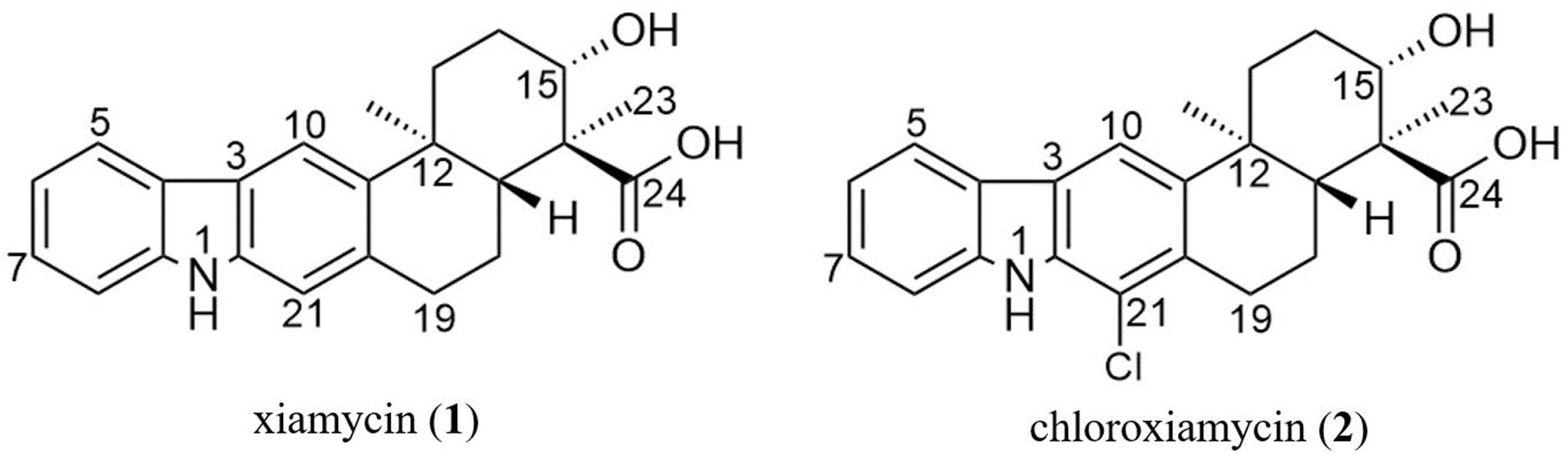
Structures of xiamycin (
The 1H and 13C NMR Data of Compounds Xiamycin
The molecular formula of chloroxiamycin (
Notably, it has long been shown that halogen-containing compounds possess excellent antimicrobial activity. The inhibition activity of xiamycin (
Effects of chloroxiamycin on cell wall and membrane
SEM observations
SEM was used to observe the morphology and cell membrane integrity of MRSA ATCC 43300. In the untreated control group, normal bacterial morphology was observed and the cell membrane remained relatively intact, however, after 2 h of treatment with chloroxiamycin (

Scanning electron micrographs of randomly chosen areas of MRSA ATCC 43300 biofilm at 2 h.
Membrane permeabilization analysis
PI is a nucleic acid fluorescent dye that penetrates damaged bacterial cell membranes, and therefore, it was used to assess the effect of chloroxiamycin (

Membrane permeability of MRSA ATCC 43300 treated by chloroxiamycin (
Ability of chloroxiamycin (2) to inhibit MRSA biofilm
Effect of chloroxiamycin (2) on MRSA biofilm formation
Crystalline violet staining was used to test the inhibitory effect of chloroxiamycin (

The effect of chloroxiamycin (
Biofilms observed by SEM
To further test the effect of compound chloroxiamycin (

Scanning electron micrographs of randomly chosen areas of MRSA ATCC43300 biofilm formation.
Effect of chloroxiamycin (2) on EPS in biofilms
The effect of chloroxiamycin (

The effect of chloroxiamycin (
Discussion
S. aureus can continue to exist on various food contact surfaces, including food processing equipment or food packaging materials, through its biofilm-forming ability. Bacterial biofilm is one of the main concerns of health problems and economic losses in the food industry. Bacterial biofilm can form an extracellular matrix to wrap the bacterial cell within a biofilm to be protected from an antibacterial agent, which means the difficulty of cleaning is increased (Avila-Novoa et al., 2018).
In this study, xiamycin (
In addition, chloroxiamycin (
In addition, S. aureus is prone to form biofilms on the food surface, and due to the protection of the biofilm matrix, the tolerance of the bacteria inside the film to the bacteriostatic and bactericidal substances in the external environment is tens to thousands of times higher than that of the free bacteria (De la Fuente-Núñez et al., 2014), which makes it difficult to remove the pathogenic bacteria from the food. Currently, the traditional methods applied for biofilm control in the food industry include physical and chemical methods, but they are prone to problems such as bacterial resistance. Natural antibiofilm active substances have the advantage of being green and safe compared with traditional methods and have received wide attention both at home and abroad (Mishra et al., 2020). In addition, extracellular polymers are mainly composed of EPS, proteins, and DNA, and are essential for biofilm formation and maintenance of the three-dimensional structure of biofilms (Di Martino 2018). The secretion of extracellular polymers is reflected by measuring the amount of polysaccharide production. In this study, we discussed the effect of chloroxiamycin (
Based on the quoted content (Dakhili et al., 2019), it has been observed that compounds containing halogens consistently show higher antibacterial activities compared with compounds that are halogen-free. This indicates that the presence of halogens in the molecular structure plays a crucial role in enhancing antibacterial properties. Furthermore, researchers have conducted structure–activity relationship (Abd Halim and Ngaini 2017) studies to understand the relationship between the position of halogens in aromatic groups and their impact on antibacterial activities. These studies have revealed that halogens situated at different positions within the aromatic groups contribute significantly to the differing activities against microorganisms. For example, thiourea derivatives with fluorine atoms attached to the ortho position of an aromatic group have been found to exhibit excellent activities against various fungal strains such as Rhizopus oryzae, Fusarium oxysporum, Aspergillus niger, and A. fumigatus. These findings suggested that the presence of halogens at specific positions in the molecular structure can enhance the efficacy of compounds against fungal infections. Moreover, the concept of halogen-bonding has been identified as a key factor in guiding antibacterial activities. Maja Kokot’s (Kokot et al., 2021) research further supported the significance of halogen bonding in influencing the effectiveness of antibacterial compounds. Halogen bonding refers to the interaction between halogen atoms and other atoms or molecules, and it is believed to contribute to the enhanced antibacterial properties of halogen-containing compounds. In addition, investigations into chitosan quaternary ammonium salts (Zhang et al., 2018) have shown that the antibacterial performance of these compounds was influenced by the electron-withdrawing ability of different halogenated chitosan quaternary ammonium salts. Chitosan quaternary ammonium salts with stronger electron-withdrawing ability display relatively higher antibacterial activities. In summary, various research studies have highlighted the importance of halogens in enhancing the antibacterial activities of compounds. The position of halogens within aromatic groups, the concept of halogen bonding, and the electron-withdrawing ability of halogenated compounds all play crucial roles in determining the effectiveness of these compounds against microorganisms.
In conclusion, indole sesquiterpene compound chloroxiamycin (
Footnotes
Data Availability
All data analyzed in this study are included in this published article and its supplementary files.
Ethics Approval
This article does not contain any studies with human participants or animals performed by the authors.
Consent to Participate
The participant has consented to the participants of the article.
Disclosure Statement
The authors declare no competing interests.
Author Contribution
L.D. and X.W. designed this project. Q.W., J.L., and H.W. conducted the experiments. L.D., Q.W., G.H., and S.H. analyzed the data. G.H., Q.W., and H.W. wrote the article. All authors discussed the results and approved the article.
Funding Information
This study was supported by the Ningbo Key Science and Technology Development Program (2021Z046), the National 111 Project of China (D16013), and the Li Dak Sum Yip Yio Chin Kenneth Li Marine Biopharmaceutical Development Fund.
Supplementary Material
Supplementary Figure S1
Supplementary Figure S2
Supplementary Figure S3
Supplementary Figure S4
Supplementary Figure S5
Supplementary Figure S6
Supplementary Figure S7
Supplementary Figure S8
Supplementary Figure S9
Supplementary Figure S10
Supplementary Figure S11
Supplementary Figure S12
Supplementary Figure S13
Supplementary Figure S14
Supplementary Figure S15
Supplementary Figure S16
References
Supplementary Material
Please find the following supplemental material available below.
For Open Access articles published under a Creative Commons License, all supplemental material carries the same license as the article it is associated with.
For non-Open Access articles published, all supplemental material carries a non-exclusive license, and permission requests for re-use of supplemental material or any part of supplemental material shall be sent directly to the copyright owner as specified in the copyright notice associated with the article.
