




Abstract
Despite heavy contamination of the Bogotá River with domestic and industrial waste, it remains vital for various purposes, including agricultural use at La Ramada Irrigation District. There are important concerns regarding pathogen concentrations in irrigation water at La Ramada, including the presence of antibiotic-resistant Salmonella spp. This study aimed to estimate the risk of Salmonella-related illness from consuming lettuce irrigated with Bogotá River water at La Ramada. We collected lettuce samples from 4 different sites, all irrigated with water from La Ramada. The methodology involved a process to detach Salmonella spp. from lettuce leaves, quantification through plate counts on SS agar, and establishment of antibiotic-resistant bacteria concentrations through growth on media supplemented with ampicillin or ciprofloxacin. The results showed concentrations of Salmonella spp. of 103.59,102.66, and 104.56 CFU/g lettuce at sites 1, 2, and 3, respectively, and ampicillin-resistant Salmonella spp. of 101.93, 101.31, and 102.07 CFU/g lettuce at sites 1, 2, and 3, respectively. No colonies were obtained from lettuce samples collected from site 4. Notably, we detected no isolates resistant to ciprofloxacin at any of the sites. Salmonella spp. concentrations varied greatly among sampling sites. Salmonella spp. concentrations were used to predict the daily probability of illness, with a probability of 0.59 (0.33 to 0.78, CI 95%) for Salmonella spp. and 0.3 (0.03 to 0.53, CI 95%) for ampicillin-resistant Salmonella spp.
Introduction
The Bogotá River is one of the world’s most heavily contaminated rivers, receiving important wastewater discharges (CAR, 2021). Despite its contamination, the water continues to be used for agricultural purposes. La Ramada Irrigation District is an important agricultural user of this water. It captures water from the middle basin of the Bogotá River (Fig. 1) to irrigate crops (CAR, 2011, 2010). Covering approximately 18,000 hectares, this district supports a variety of crops, including lettuce (CAR, 2011, 2010).
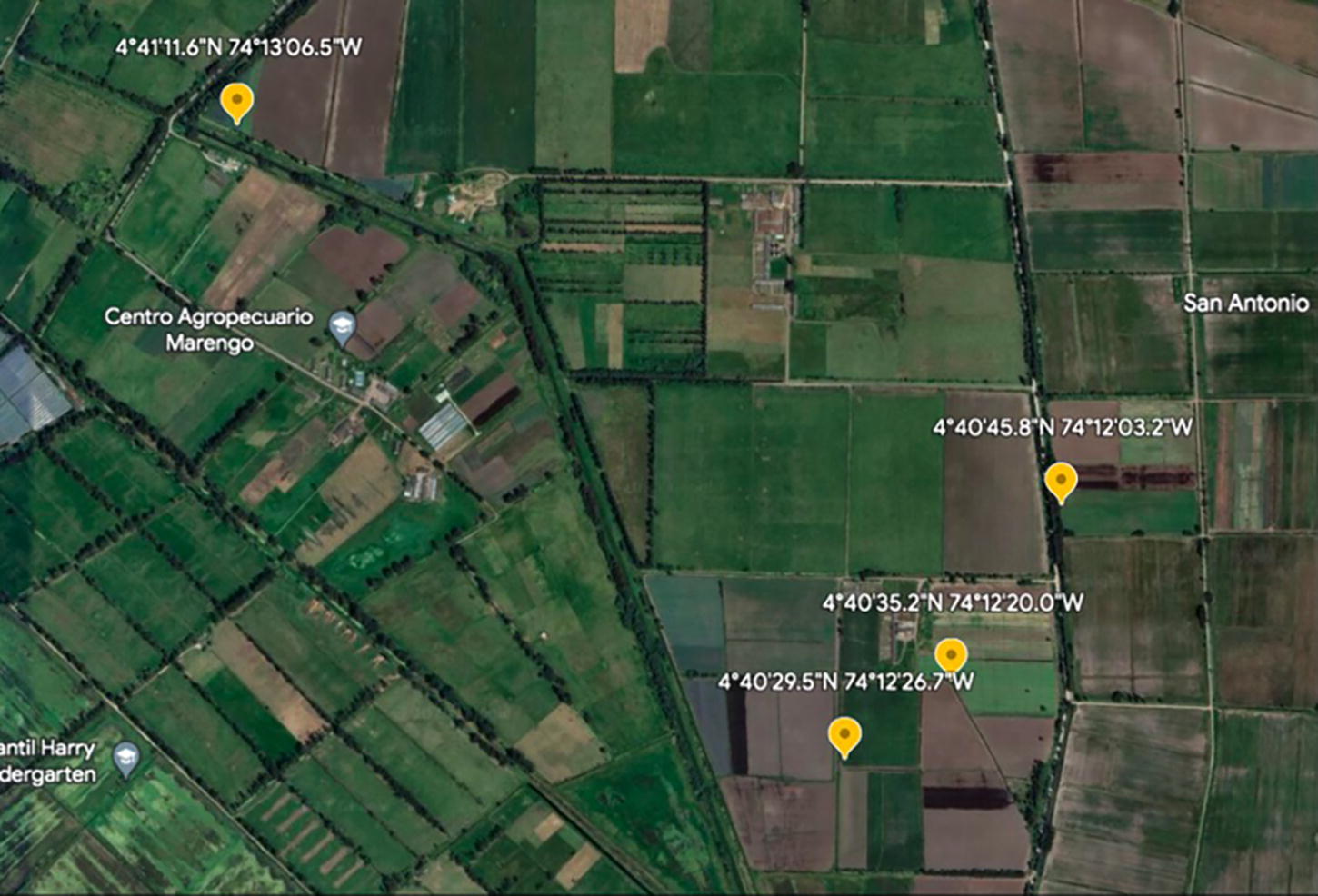
Overview of La Ramada Irrigation district and sampling points (yellow marks).
There is greater incidence of infectious diseases in populations using contaminated water for irrigation (Steele and Odumeru, 2004). After irrigation (Kowalska, 2023; Oliveira et al., 2019), pathogenic microorganisms frequently persist on produce until harvest; this process facilitates pathogen spread through the oral–fecal route (Gerba, 2009; Steele and Odumeru, 2004).
Salmonella is one of the most prevalent isolated foodborne pathogens (Eng et al., 2015; Hoffmann et al., 2015; Scallan et al., 2011). It can be transmitted through contaminated food, especially food that is eaten raw (Herman et al., 2015; Kowalska, 2023). Several studies have described the contamination of vegetables with Salmonella spp. (Begum et al., 2015; Herman et al., 2015; Kisluk and Yaron, 2012; Kowalska, 2023; Oliveira et al., 2019). Lettuce is often linked to produce-related disease outbreaks (Gajraj et al., 2012; Oliveira et al., 2019), and Salmonella species are among the most frequently identified pathogens (Ilic et al., 2012; Oliveira et al., 2019). Pathogenic Salmonella species can cause enteric fever, gastroenteritis, and bacteremia (Eng et al., 2015; Fatica and Schneider, 2011; Majowicz et al., 2010).
Contaminated water bodies can act as reservoirs for antibiotic-resistant bacteria (ARB) and lead to the emergence of wider antibiotic resistance (Berendonk et al., 2015; Felis et al., 2020). It has been previously shown that water from the La Ramada irrigation district has high concentrations of pathogens, including Salmonella spp., and that some of these pathogens are resistant to commonly used antibiotics, including ampicillin and ciprofloxacin (Oviedo-Cancino, 2021).
According to the World Health Organization (WHO), antimicrobial resistance is one of the main threats to public health (World Health Organization, 2014). Antibiotic resistance in Salmonella species has been described worldwide (European Food Safety Authority, 2022), including to antibiotics previously used as first-line treatment (i.e., ampicillin)(Eng et al., 2015). Other studies have reported an increased number of infections caused by Salmonella strains resistant to fluoroquinolones (i.e., ciprofloxacin), antibiotics now used to treat these infections (Cuypers et al., 2018; Eng et al., 2015).
To estimate the risk of infection or illness resulting from exposure to bacteria through contaminated food, researchers use a modeling approach called Quantitative Microbial Risk Assessment (QMRA) (Gerba, 2015). QMRA integrates exposure and dose–response models to estimate the response to harmful microbes (Gerba, 2015). From this approach, users can propose solutions or take corrective actions to reduce exposure (Gerba, 2015).
Recently, a study used QMRA to estimate the risk of illness caused by Salmonella spp. due to the consumption of vegetables irrigated with water from the Bogotá River by using Salmonella spp. concentrations in irrigation water to predict Salmonella spp. concentrations on the vegetables; the estimated risk greatly exceeded the acceptable value recommended by U.S. EPA (10−4/person/year) (Henao-Herreño et al., 2017; Rose and Gerba, 1991). Despite these findings, no studies have evaluated the risk from exposure to Salmonella spp. in this region, by measuring microorganism concentrations directly from lettuce leaves. Also, there are no reports that estimate the risk of illness with antibiotic-resistant Salmonella spp. from consumption of lettuce irrigated with contaminated water at La Ramada Irrigation District. The objective of this study was to estimate the risk of illness with Salmonella spp., and antibiotic-resistant Salmonella spp. resulting from the ingestion of lettuce irrigated with water from the Bogotá River at La Ramada Irrigation District using as input data Salmonella spp. concentrations directly measured from lettuce leaves to reduce the uncertainty of previous models. To do so, we employed a methodology that enabled the detachment of Salmonella spp. cells from lettuce leaves. Quantification was conducted through plate count on selective Salmonella–Shigella (SS) agar. ARB concentrations were established by evaluating bacterial growth on selective medium with inhibitory concentrations of ciprofloxacin or ampicillin.
Materials and Methods
Reagents and culture media
We used SS agar (BD), ciprofloxacin, and ampicillin sodium salt (Sigma-Aldrich); Na2HPO4 (Millipore); and KH2PO4 (Sigma-Aldrich).
Sample collection
Lettuce samples were collected from La Ramada irrigation district. Sample sites were selected after the identification of fields in which lettuce would be ready for harvesting during the development of this study. Lettuce samples were collected between March and May of 2023 and placed in sterile plastic bags and maintained below 4°C until analysis. Samples were collected from four different crops (Fig. 1). We analyzed a total of 96 lettuce samples, 24 samples per crop.
Salmonella spp. quantification
Typically, the quantification of Salmonella spp. from food requires pre-enrichment to facilitate pathogen detection. However, in this study, pre-enrichment was omitted, directly measuring pathogen concentrations from lettuce leaves, after an initial detachment process and subsequent growth on SS agar. The detachment process consisted of shaking a mixture of 10 g of lettuce with 20 mL of phosphate buffer solution (NaCl 27 g/L, Na2HPO4 1.15 g/L, KH2PO4 0.2 g/L) at room temperature for 20 h and 150 rpm.
Samples were treated as composite samples; from the 24 lettuce samples collected at each crop, we obtained 24 solutions containing the detached microorganisms. These 24 solutions were split randomly into groups A, B, C, and D. One milliliter solution was taken from each flask and combined with the solutions of the other flasks in each group, obtaining mixtures A, B, C, and D, each containing 6 mL of liquid sample. Serial dilutions were prepared using 0.85% sodium chloride solution, spread on selective SS agar, and incubated at 37°C for 24 h (in duplicate). Salmonella spp. colonies were identified according to morphology and color. We considered the sensitivity and positive predictive value (PPV) of the method (64.9% and 18.7%, respectively) (Ruiz et al., 1996), to calculate the expected Salmonella spp. concentrations in CFU per gram of lettuce, based on the number of colonies observed on SS agar (Fig. 2). Concentrations of antibiotic-resistant Salmonella were calculated from colonies observed on SS agar when grown with ciprofloxacin or ampicillin. Antibiotics were supplemented directly to SS agar (ampicillin 32 μg/mL or ciprofloxacin 0.125 μg/mL). Ampicillin was selected as it was a common antibiotic for treating salmonellosis but has now limited use due to microbial resistance. Ciprofloxacin is currently one of the main antibiotics used to treat this infection. The ampicillin concentration was selected based on minimum inhibitory concentrations reported for several Enterobacterales, and the ciprofloxacin concentration was selected as it is the tentative epidemiological cutoff value for Salmonella enterica (European Committee on Antimicrobial Susceptibility Testing, 2024).

Method for quantification of Salmonella spp. from lettuce leaves without pre-enrichment in CFU/g considering the sensitivity and positive predictive value for Salmonella spp. on SS agar. Figure made using BioRender.
Quantitative microbial risk assessment
The daily risk of illness from Salmonella spp. ingestion can be predicted through a beta-Poisson dose–response model (Henao-Herreño et al., 2017; WHO, 2002):
Distributions and Fit Parameters Used for Risk Illness Analysis
For samples with concentrations lower than the detection limit (DL) of 5.76 CFU/g, half of this value was taken to establish the distribution and fit parameters.
Ct distribution was modeled as a lognormal distribution from experimental data obtained in this study (from measurements of the 96 lettuce samples) and K distribution was obtained from literature (Table 1).
The calculation of the annual risk of illness (Py) was used to conduct the risk assessment. According to Haas et al. (1993), Py can be written as (Haas et al., 1993):
Oracle Crystal Ball was used to run Monte Carlo simulations to determine the likelihood of illness using 10,000 iterations.
Results
After several attempts to detach bacteria from lettuce leaves, we identified a method for which we obtained higher reproducibility (10 g lettuce, 20 mL phosphate buffer, glass jars, 20-h shaker at 150 rpm). We were able to obtain Salmonella spp. and ampicillin-resistant Salmonella spp. in lettuce samples from three out of the four crops. However, none of the samples contained ciprofloxacin-resistant Salmonella spp. in concentrations above the detection limit of 5.76 CFU/g. We used the sensitivity and positive predictive value to estimate Salmonella spp. concentrations from colonies identified on SS agar as potential Salmonella spp. Average Salmonella spp. concentrations were different for each crop, being higher at crops 1 and 3 (103.59 and 104.56 CFU/g, respectively) (Fig. 3). For those two sites, ampicillin-resistant Salmonella spp. were 101.93 and 102.06 CFU/g, respectively. We found Salmonella spp. in two out of the 4 composite samples from crops 1 and 2, and only one of the composite samples from crop 3. The concentrations of Salmonella spp. in many of the composite samples were below the detection limit of 5.76 CFU/g.
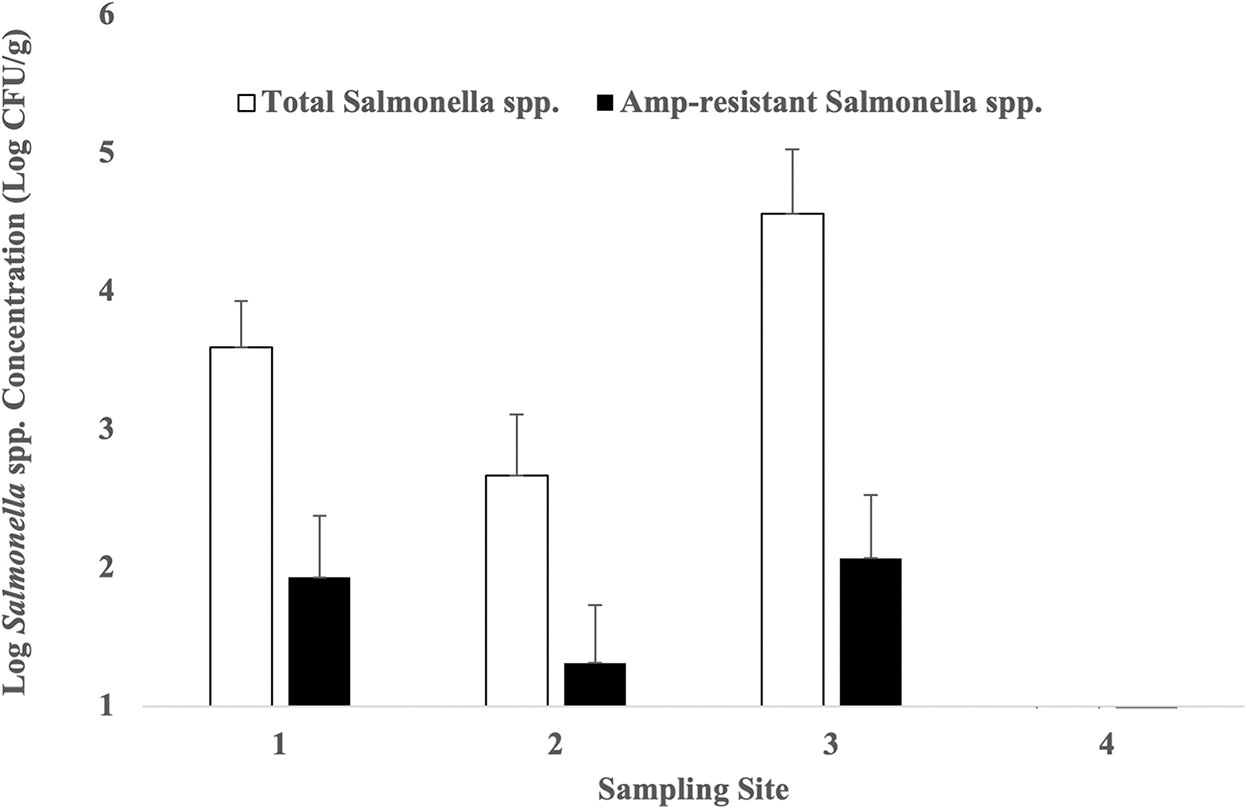
Concentrations of Salmonella spp. (Log) from lettuce samples from each crop (CFU/g). Bars show average concentration of the composite samples and error bars show the (positive) standard deviation.
From bacterial concentrations found in this study, we were able to predict the daily probability of illness due to the consumption of lettuce irrigated with contaminated water at La Ramada Irrigation District. The daily probability of illness was 0.59 (0.30–0.78, CI 95%) for Salmonella spp. and 0.3 (0.03–0.53, CI 95%), for and ampicillin-resistant Salmonella spp. (Fig. 4). As a result of the high daily probability of illness for both scenarios, the annual probability of illness was 1.
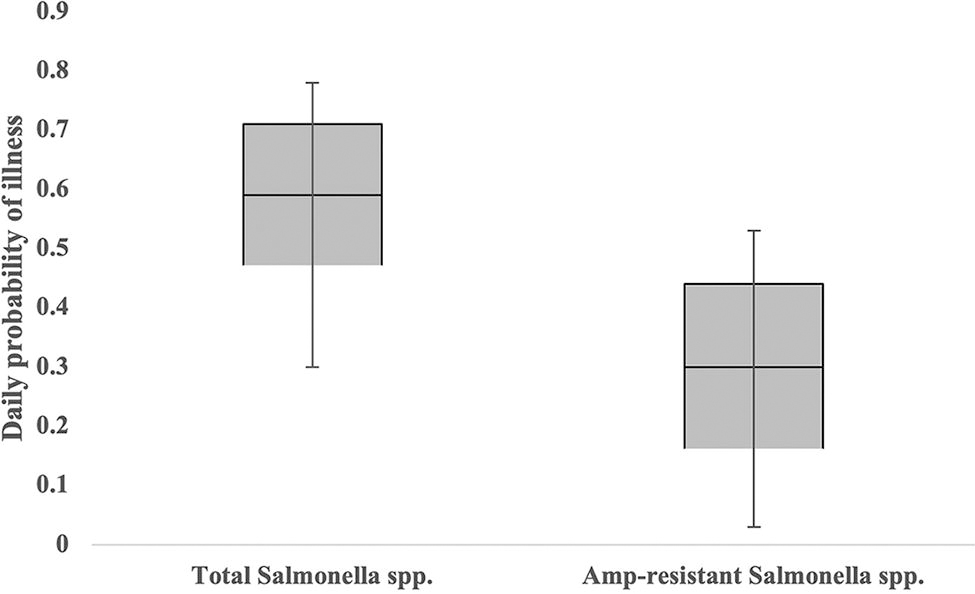
Daily probability of illness caused by Salmonella spp. and ampicillin-resistant Salmonella spp. resulting from the consumption of (unwashed) lettuce irrigated at La Ramada Irrigation District. Boxes show average ± standard deviation. Error lines show a 95% confidence interval.
Discussion
The variability of Salmonella spp. concentration among samples was important. The quantification method has a high detection limit and does not detect microorganisms within vegetable tissue (Kim et al., 2023), increasing study uncertainty. Not using the C8-esterase test (or other molecular tests) on the colonies to verify Salmonella spp., but relying on the positive predictive value and the sensitivity, also increases the uncertainty of the model.
Detection of Salmonella spp. on raw lettuce has been linked to the use of poor water quality for irrigation (Steele and Odumeru, 2004). Once on the vegetable, variations in bacterial counts on produce result from bacteria’s capacity to survive and reproduce, which is influenced by hydrometeorological fluctuations (Desiree et al., 2021). Increased precipitations, temperatures, and humidity have been associated with increased bacterial levels on vegetables (Desiree et al., 2021). In addition to contamination through direct contact with polluted water, Salmonella spp. can reach lettuce through contact with soil (Desiree et al., 2021). Polluted water may contaminate soil during irrigation, allowing Salmonella spp. cells from soil to colonize vegetables (Fatica and Schneider, 2011). Precipitation events can increase pathogen counts on lettuce due recontamination with soil-borne microorganisms (Bastos and Mara, 1995; Steele and Odumeru, 2004). During the three months of sampling, accumulated precipitation at the site decreased 2.5-fold from March (128.8 mm) to May (50.6 mm)(CAR, 2023a, 2023b). Reduced precipitations in May could explain, in part, the absence of colonies in samples from site 4.
Bacterial levels found in this study exceed the allowable limit established by the Colombian government (0 CFU/25 g) (Ministerio de Salud y Protección Social, 2022). A high fraction of the lettuce consumed in Bogotá (city) is farmed at La Ramada Irrigation District (DANE, 2017), and Salmonella spp. contamination has been reported in lettuce from local markets in Bogotá and the surrounding areas (Patiño et al., 2020; Urrego Cabezas, 2021). Bogotá reported almost 25% of the confirmed Salmonella spp. infections nationwide between 1997 and 2018 (Instituto Nacional de Salud INS, 2019). Although further studies are required to assess lettuce consumption’s role in disease occurrence, the bacterial densities found on lettuce pose a latent public health threat even without establishing a direct link to specific outbreaks.
The average ampicillin-resistant Salmonella spp. concentrations in lettuce were as high as 102.06 CFU/g (site 3). Ampicillin-resistant Salmonella spp. infections are frequently reported in clinical samples in Colombia, with Salmonella Enteriditis, Salmonella Typhimurium, and Salmonella Typhi being the prevalent serotypes (Instituto Nacional de Salud INS, 2019). While ARB have been detected in water from this irrigation district (Oviedo-Cancino, 2021), ampicillin-resistant Salmonella species have not been found in crops or water samples from La Ramada before (Bautista Sánchez, 2021; Oviedo-Cancino, 2021). The fact that we did not detect any ciprofloxacin-resistant bacteria suggests that the resistance to this antibiotic is not as widely spread at La Ramada district. However, monitoring resistance to this antibiotic in Salmonella spp. isolates is necessary, given its prevalence in Escherichia coli isolates from the irrigation district (Oviedo-Cancino, 2021).
The daily probabilities of illness from this study are slightly lower than those predicted in a previous study using Salmonella spp. concentrations in irrigation water from the same area to indirectly predict Salmonella spp. concentration on lettuce (Henao-Herreño et al., 2017). The fact that the predicted risk in this study is slightly lower, probably resulted from inaccuracies in the model used to predict Salmonella spp. concentrations on lettuce leaves from water, from lower Sallmonella spp. concentrations in irrigation water during this sampling period, or climatologic aspects, among other factors.
Despite slightly lower estimated risks, both studies’ probabilities of illness far exceeded EPA threshold (1/10,000 per year) (Rose and Gerba, 1991). However, these results must be viewed with caution, considering model limitations. This study predicts the risk of illness from consuming raw unwashed lettuce the same time it is harvested. Environmental factors during lettuce shelf-life can alter the quantity of Salmonella spp. on the vegetable (Desiree et al., 2021). Storing lettuce at 4°C allows some bacteria to persist on the vegetable, whereas higher temperatures (12°C) result in an increase in bacterial load (Waitt et al., 2014). Furthermore, washing or disinfecting leaves before consumption can highly decrease exposure to the pathogens (Possas et al., 2023). In terms of lettuce consumption, the distribution was determined from data for the whole country (Colombia) from data recollected in 2005, the only information available. Also, the dose–response model used for this study was constructed from a combination of several models and may not be as accurate for predicting Salmonella spp. illnesses with the most common strains found in the area and is not specific for exposure through lettuce ingestion. Finally, in the case of ampicillin-resistant bacteria, the model predicted the worst-case scenario, assuming that in the absence of antibiotics, the dose–response model for antibiotic-susceptible bacteria can be applied to antibiotic-resistant bacteria (Chandrasekaran and Jiang, 2019). These latter often exhibit reduced fitness in the host due to the additional metabolic burden associated with acquired resistance (Giraud et al., 2003; Schulz zur Wiesch et al., 2010).
Conclusions
The findings of this study reveal a significant contamination of Salmonella spp. on lettuce cultivated in La Ramada District. Ingesting this contaminated lettuce poses a high risk of illness, involving both ampicillin-resistant and antibiotic-susceptible microorganisms. While further research is necessary to determine the contribution of vegetable consumption irrigated with Bogotá River water to the incidence of salmonellosis in Bogotá, the results strongly suggest that lettuce from La Ramada is unsafe for consumption. It is imperative to reconsider current farming practices not only due to the potential exposure of individuals to these microorganisms, but also to curb the spread of antibiotic resistance. To enhance the model’s accuracy, more recent data on lettuce consumption in Bogotá are required. Additionally, incorporating variations in postharvest bacterial growth and utilizing strain-specific dose–response models, including those for antibiotic-resistant Salmonella spp., could yield more precise outcomes. This model represents an initial step in assessing the likelihood of illness from Salmonella spp. through lettuce consumption, directly measuring pathogen concentrations in samples from La Ramada. It can serve as a foundational resource for developing guidelines on the use of Bogotá River water for irrigating food crops.
Footnotes
Acknowledgment
The authors thank Natalia Sierra-Payares for her help in sample analysis.
Authors’ Contributions
N.B., L.H., and J.H. worked together to complete this work. J.H. supervised the project, and mostly focused on the experimental/conceptual design, the analysis of results, and the interpretation of data; N.B. did most of the experimental work, collected samples, and processed them in the laboratory, and helped with the interpretation of data. Most of Laurás work focused on data validation, analysis, and interpretation, and the critical review of the work. The article was written and reviewed by all three authors.
Disclosure Statement
The authors have no conflicts of interest for the development of this work.
Funding Statement
Funding for this work was provided by Universidad de los Andes. Nicolás Bulla received funding from Fundación CEIBA.