




Abstract
Listeria monocytogenes, one of the main foodborne pathogens, is commonly found in milk and dairy products. This study aimed to estimate the presence of L. monocytogenes in milk and dairy product supply chains using a meta-analysis based on PubMed, Embase, Web of Science, and Scopus databases. A total of 173 studies were included in this meta-analysis. The pooled prevalence in the supply chain environment was 8.69% (95% confidence interval [CI]: 5.30%–12.78%), which was higher than that in dairy products (4.60%, 95% CI: 1.72%–8.60%) and milk products (2.93%, 95% CI: 2.14%–3.82%). Subgroup analysis showed that L. monocytogenes prevalence in raw milk (3.44%, 95% CI: 2.61%–4.28%) was significantly higher than in pasteurized milk (0.60%, 95% CI: 0.00%–2.06%). The highest prevalence of L. monocytogenes in milk and dairy products was observed in North America (5.27%, 95% CI: 2.19%–8.35%) and South America (13.54%, 95% CI: 3.71%–23.37%). In addition, studies using culture and molecular methods (5.17%, 95% CI: 2.29%–8.06%) had higher prevalence than other detection methods. Serogroup 1/2a and 3a (45.34%, 95% CI: 28.74%–62.37%), serogroup 1/2b and 3b (14.23%, 95% CI: 6.05%–24.24%), and serogroup 4b/4e (13.71%, 95% CI: 6.18%–22.83%) were dominant in these studies. The results of this study provide a better understanding of the prevalence of L. monocytogenes in milk and dairy product supply chains and suggest a potential foodborne pathogen burden.
Introduction
Listeria monocytogenes is a zoonotic pathogen that causes listeriosis in humans and animals, the main manifestations of which are sepsis, meningitis, and mononucleosis. L. monocytogenes strains are pathogenic and exist widely in soil, feces, food commodities, and supply chain environments (Paudyal et al., 2018; Smith et al., 2018). According to a World Health Organization report on L. monocytogenes food poisoning, 4–8% of aquatic products and 5–10% of milk and dairy products are contaminated by bacteria (Abdeen et al., 2021). Milk and dairy products are regarded as good substrates for microbial growth, owing to their microbiological hazards (Teng et al., 2024). Unlike other foodborne pathogens, L. monocytogenes can adsorb onto food contact surfaces and form biofilms, hindering the effectiveness of its bactericidal effects (Ballom et al., 2020). Hot boiling and pasteurization are considered as effective measures to prevent contamination and keep microbiological safety (Lee et al., 2020).
L. monocytogenes is exposed to various environmental stresses in food supply chains, and its survivability differs from that in food chain environments (Wang et al., 2023). L. monocytogenes has been isolated from food processing environments, tracing sources, and surviving from farms to retail in Slovakia (Minarovičová et al., 2023) and Southern Chile (Barría et al., 2020). A critical review of published quantitative risk assessment models of L. monocytogenes in dairy products appraised the intervention strategies implemented using the full farm-to-table approach (Gonzales-Barron et al., 2023). Several studies have indicated that a greater risk of listeriosis was associated with raw milk consumption obtained from retail and farms as compared with milk obtained from bulk tanks through illness from raw milk (Latorre et al., 2011; Bemrah et al., 1998). L. monocytogenes is normally divided into 4 serogroups and 13 serotypes. Serotypes 4b, 1/2b, and 1/2a are responsible for most human listeriosis cases (Szymczak, 2023). Earlier studies have reported that serotypes 1/2a and 1/2b are frequently found in L. monocytogenes isolated from food and processing environments (Vázquez-Sánchez et al., 2017).
Previous studies have identified L. monocytogenes as an important public health concern. Meta-analyses are gaining popularity and are useful in the food industry for investigating the prevalence of L. monocytogenes in milk and dairy product supply chains. Therefore, this study aimed to compare the prevalence of L. monocytogenes in milk and dairy chains worldwide and estimate the potential risks of foodborne pathogens.
Materials and Methods
Search strategy
In this study, with reference to the Preferred Reporting Items for Systematic Reviews and Meta-Analyses guidelines (Supplementary Table S1), a meta-analysis was conducted on the prevalence of L. monocytogenes in milk and dairy product supply chains. The registration ID registered in the International Prospective Register of Systematic Reviews is CRD42022295381. A literature search was conducted for articles published between January 2000 and December 2023 in the PubMed, Embase, Web of Science, and Scopus databases. The detailed search and retrieval terms for the four databases are shown in Supplementary Table S2.
Inclusion and exclusion criteria
After removing duplicate literature, two reviewers screened the literature independently using the eligibility inclusion and exclusion criteria to review the articles’ titles and abstracts first and read the full texts in detail. Any discrepancies were reached an agreement by consultation with a third person. Studies were included if they satisfy as following: cross-sectional or descriptive studies, studies that focused on the prevalence in milk and dairy product supply chains, studies reporting positive results and sample size in total, and peer-reviewed articles.
Studies were not considered if they met the following criteria: listeriosis outbreaks, sporadic case reports, experimental or methodological studies; sample size <30; low-quality literatures; conference articles, letters, comments, and articles in no English language. A flowchart for the literature search and selection is shown in Figure 1.
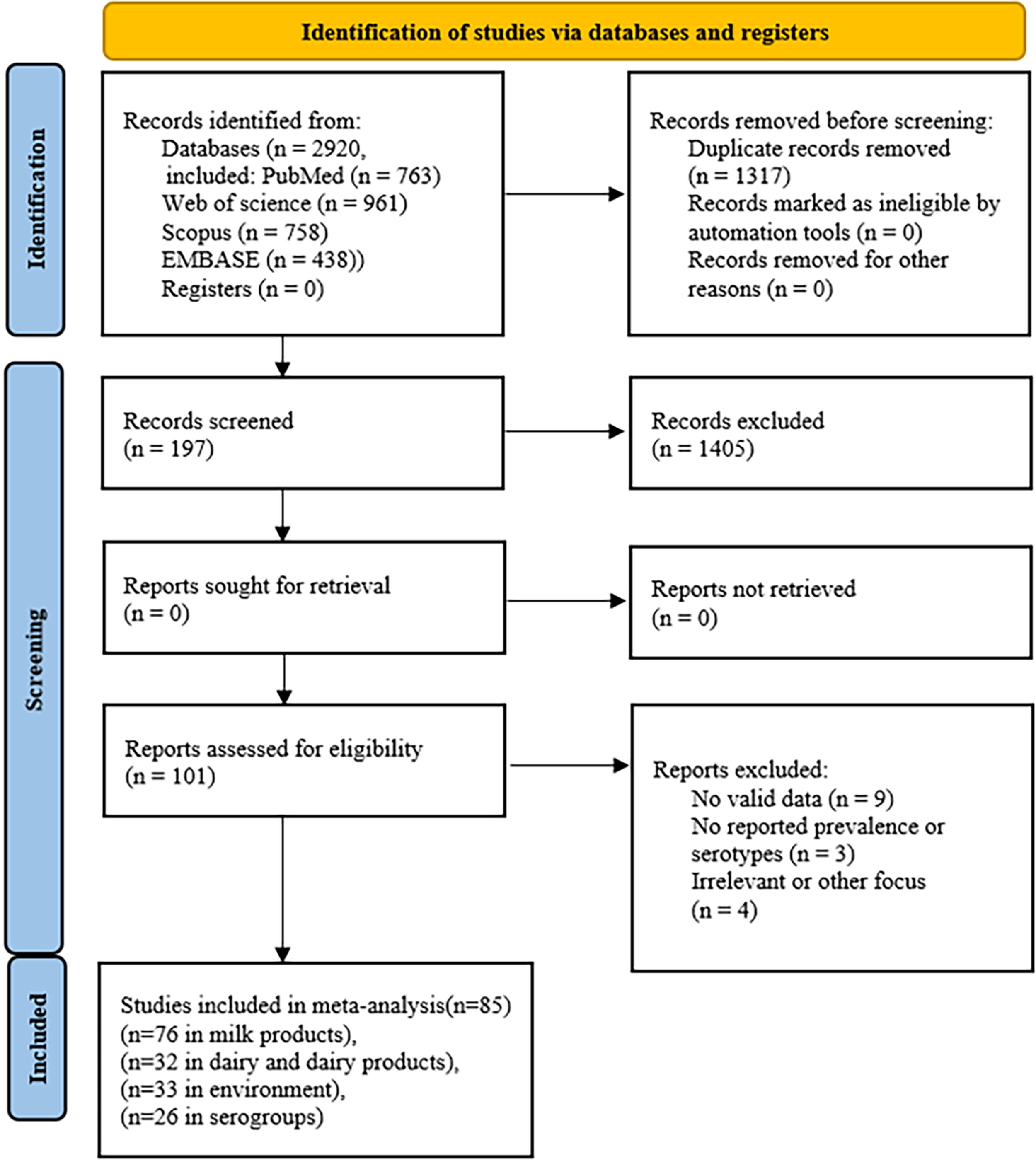
A flowchart for the literature search and selection.
Quality assessment
The Joanna Briggs Institute (JBI) Critical Appraisal Checklist was used to evaluate the risk of bias assessed (Joanna Briggs Institute, 2020). It is a nine-item model that assesses the quality of design, conduct, and analysis of studies. The studies were categorized into three groups based on risk bias score: high, 0–3; moderate, 5–6; and low-risk, 7–9 Supplementary Table S3.
Data extraction
The variables extracted from the studies were the first author’s name, publication year, country of publication, study region, sample source, sample type, number of sample size, detection method, number of positive samples, contamination rate, and serogroup. A database was established and managed using Microsoft Office Excel 2010. Two reviewers collected the data separately, and experienced reviewers validated all obtained data in a second round.
Statistical analysis
Meta-analysis was performed by using the R version 4.1.2 “meta,” “metaprop,” “metainf,” and “metareg” packages. The data were transformed into normally distributed data using the arcsine transformation or Freeman–Tukey double arcsine transformation. Heterogeneity was assessed by Cochran’s Q test and I 2 statistics (Higgins and Thompson, 2002). The I 2 statistic was >50%, indicating high heterogeneity. A random-effects model was used to estimate the pooled prevalence of high heterogeneity. Subgroup and regression analyses were conducted to explore possible sources of heterogeneity. Sensitivity analysis was performed by serially excluding individual studies to evaluate the influence of each study. Publication bias was estimated using funnel plots and Egger’s regression tests (Egger et al., 1997). p-Value of <0.05 was considered statistically significant.
Results
Characteristics of searching results
A total of 2920 articles were collected from four databases, and 1317 duplicate records were removed during the first screening. Through title, abstract, and keyword screening, 101 papers were included for full-text reading. Articles with no valid data, no prevalence data, serogroups, or irrelevant or other focus were excluded. In total, 173 studies were included. In total, 76, 32, 33, and 26 studies have reported the prevalence of L. monocytogenes in milk, dairy products, supply chain environments, and serogroups, respectively (Fig. 1).
Detailed information on the studies included in the meta-analysis is summarized in Supplementary Tables S4, S5, S6, S7. Most of the milk product studies were from Iran, followed by Turkey, Brazil, and Italy. Moreover, studies on dairy products have been conducted in the United States, Italy, and Turkey. Most studies on the supply chain environment have been conducted in Spain, Italy, Turkey, and the United States. In total, there were 6376 samples from 26 eligible studies, among which 711 were positive for L. monocytogenes. Of these positive samples, serogroups 1/2a, 3a, and 4b/4e were predominantly isolated from 5592 and 4562 samples. Among these, biochemical identification and culture methods were frequently used.
Study quality assessment
Based on the JBI Critical Appraisal Checklist, 54 of the 73 milk product studies were considered low-risk. Most of the 32 dairy product studies scored 7 (53.13%), followed by 8 (28.13%) for low risk, and only 6 studies scored 6 for moderate risk. Twenty-seven of the 33 supply chain environment studies were considered high-quality literature with a score of 8, and the rest were moderate-risk literature. Six studies were recognized as moderate risk because they did not provide adequate evidence for the sampling method, did not describe subjects and the setting in detail, and described the sample collection vaguely. The quality assessment of the included studies is shown in Supplementary Tables S4, S5, S6, S7.
Prevalence of L. monocytogenes
Overall analysis
The prevalence of L. monocytogenes in milk, dairy products, and supply chain environments was statistically significant (p < 0.01). The overall analysis of prevalence in milk, dairy products, and the supply chain environment is presented in Figure 2 and Supplementary Figures S1, S2. The pooled prevalence in the supply chain environment was 8.69% (95% confidence interval [CI]: 5.30%–12.78%), which was significantly higher than that in dairy products (4.60%, 95% CI: 1.72%–8.60%) and milk products (2.93%, 95% CI: 2.14%–3.82%). However, remarkable heterogeneity was observed from the aforementioned studies in the prevalence of milk products (p < 0.01; I 2 = 91.2%), dairy products (p < 0.01; I 2 = 96.8%), and supply chain environments (p < 0.01; I 2 = 98.4%).
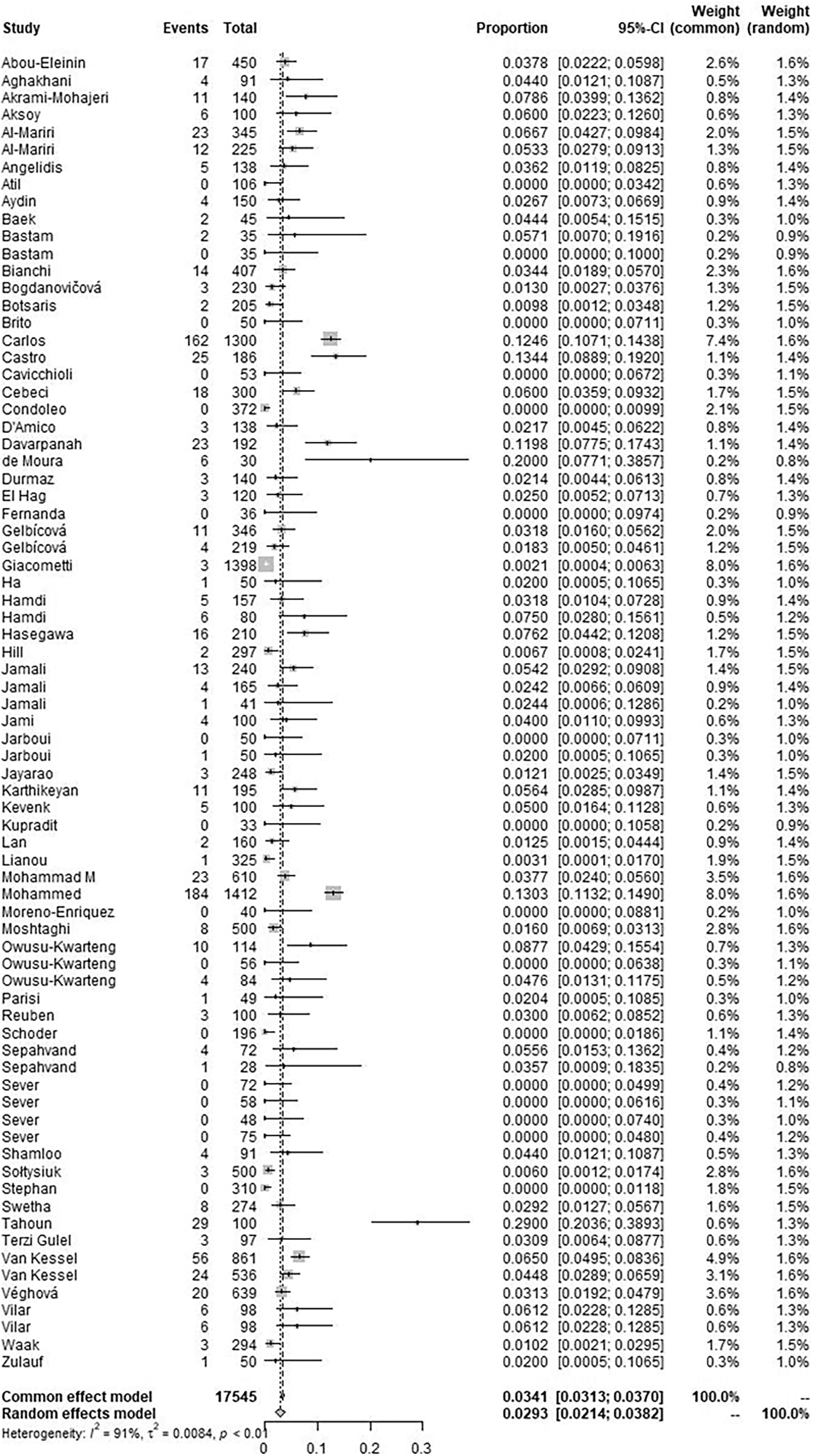
Forest plot of the estimated prevalence of Listeria monocytogenes in milk products. Events: sample size of positive L. monocytogenes; total: total sample size.
Subgroup analysis
The subgroup analysis of eligible studies was stratified based on sample type, sample source, region, and detection method (Table 1). Briefly, the higher L. monocytogenes prevalence of subgroup sample types was detected in raw milk (3.44%, 95% CI: 2.61%–4.28%), followed by pasteurized milk (0.60%, 95% CI: 0.00%–2.06%). No significant differences were found in the milk products (p > 0.05). Based on the different sources, the L. monocytogenes prevalence in milk products isolated from farms, dairy products from factories and retail, and supply chain environments from farms and factories is high. Significant differences were observed among the subgroup analyses (p < 0.01). For region subgroup analysis, the highest prevalences in milk, dairy products, and supply chain environments are from North America (5.27%, 95% CI: 2.19%–8.35%), South America (13.54%, 95% CI: 3.71%–23.37%), and Africa (16.23%, 95% CI: 0.00%–46.44%). Significant differences were also found in the prevalence of L. monocytogenes according to region (p < 0.01). Regarding the detection method, the highest prevalence was observed in the culture and molecular methods, followed by biochemical tests and molecular methods. Statistical significance varied according to the detection method (p < 0.01).
Summary of Subgroup Meta-analyses of Listeria Monocytogenes Contamination in Milk and Dairy Product Supply Chains
CI. confidence interval.
Regression analysis
Meta-regression analysis explained an association between sample type and study heterogeneity (R 2 = 7.75%); however, the heterogeneity was not remarkable (Fig. 3). Moreover, the sample size was significant (I 2 = 2.88%, p = 0.0269) (Supplementary Fig. S3). This also suggests that the detection method accounted for 7.53% of the heterogeneity sources (Supplementary Fig. S4). However, there was no significant influence of the publication year (R 2 = 0%, p = 0.8409), sample source (R 2 = 0%, p = 0.6109), or region (R 2 = 1.51%, p = 0.0889) (Table 2).

Changes in Listeria monocytogenes prevalence according to the sampling sources. 0 = raw milk, 1 = pasteurized milk, 2 = dairy products, and 3 = supply chain environment samples. Gray circles and their size indicate individual studies and the weight attributed to each study.
Results of the Meta-Regression Analysis on Listeria Monocytogenes Prevalence in Milk and Dairy Product Supply Chains
Indicate a significant relationship between the prevalence estimate and the covariate.
SE, standard error.
Sensitivity analysis
Sensitivity analyses eliminate a single study, combine the remaining literature for meta-analysis, and observe the changes in the combined results. The sensitivity analysis noted that there were subtle changes, and results were significantly steady by eliminating any single study, suggesting that pool prevalence was reliable (Supplementary Fig. S5, S6, S7).
Publication bias
Funnel plots and Egger’s tests analysis were to evaluate potential publication bias. The funnel plots of milk products (Fig. 4), dairy products (Supplementary Fig. S8), and supply chain environment samples (Supplementary Fig. S9) were almost visually symmetric. Moreover, Egger’s test revealed no publication bias in the prevalence analysis of milk products (p = 0.1889), dairy products (p = 0.8893), or supply chain environment (p = 0.1405).
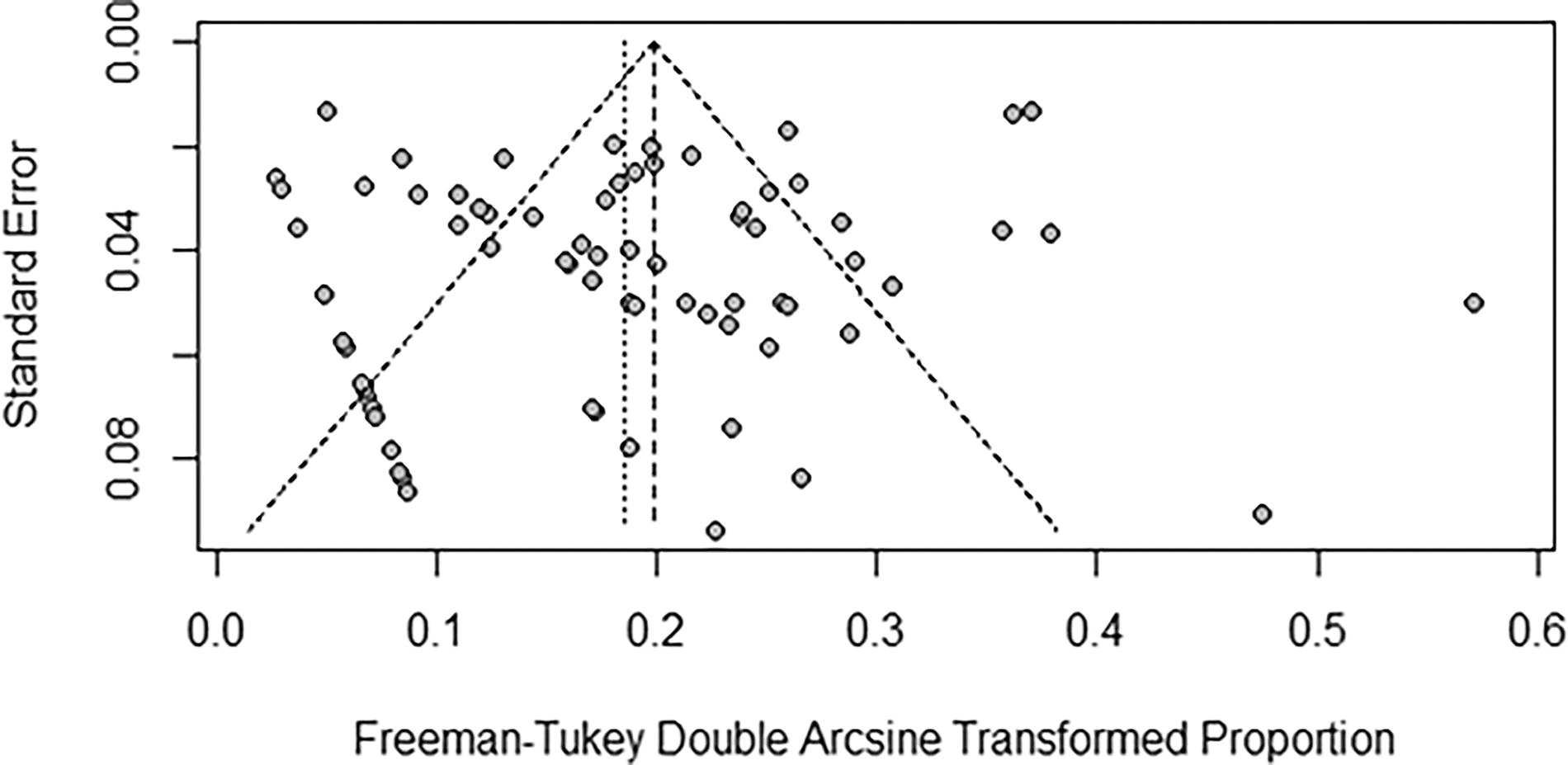
Funnel plot for pooled prevalence of Listeria monocytogenes in milk products.
Serogroups of L. monocytogenes
Serogroups 1/2a and 3a (45.34%, 95% CI: 28.74%–62.37%), 1/2b and 3b (14.23%, 95% CI: 6.05%–24.24%), and 4b/4e (13.71%, 95% CI: 6.18%–22.83%) were most frequent. Notably, only one study reported serogroup 4c, with two detected strains (Fig. 5). Serogroups 1/2a and 3a were likely to appear in the supply chain environment, with a prevalence estimate of 55.75% (95% CI: 31.81%–79.70%) (Supplementary Fig. S10). Serogroups 1/2a and 3a were dominantly observed from factories (56.94%, 95% CI: 9.71%–100.00%) and retail (56.60%, 95% CI: 40.46%–72.74%) (Supplementary Fig. S11).

Forest plot of the estimated prevalence of Listeria monocytogenes by subgroup serogroup. (a) sergroups1/2a, 3a; (b) serogroups 1,2 b,3b; (c) serogroups 1/2c, 3c; (d) serogroups 4b, 4e; (e) serogroup 4c.
Discussion
L. monocytogenes is an important foodborne pathogen that is widely distributed and mainly transmitted through contaminated food, especially during food handling stages that are highly susceptible contamination (e.g., storage, transportation, and processing) (Pérez-Baltar et al., 2021). There is an increased risk of listeriosis from milk and dairy products that are not boiled or pasteurized prior to consumption. According to previous studies (Iglesias et al., 2022) (Schoder et al., 2023), L. monocytogenes infections can be transmitted from primary production to consumption in the supply chain. Therefore, we conducted a study on the prevalence of L. monocytogenes in the milk and dairy product supply chains.
Although there was considerable heterogeneity among the studies, the prevalence estimate for supply chain environments was significantly high. The reasons for this tendency are multifactorial. A processing environment with high humidity and low temperature provides a good external environment for bacterial growth and reproduction (Lake et al., 2023). Moreover, a study focusing on the persistence and prevalence of L. monocytogenes in cheese factories in southern Chile indicated that processing environmental sites and preparation areas without disinfection frequently lead to cross-infection with L. monocytogenes (Barría et al., 2020). Ineffective hygiene and poor manufacturing practices of equipment and processing facilities are important reasons for the increased risk of L. monocytogenes cross-contamination (Melero et al., 2019).
Subgroup analysis of the sample types showed that the prevalence in raw milk was significantly higher than that in pasteurized milk. Meta-regression analysis also revealed that this difference in contamination rates was owing to sample type, accounting for 7.75% of the heterogeneity. Raw milk is rich in nutrients for growth, and milk animals are natural hosts for bacterial carriers (Reuben et al., 2020). Promoting animal health and enhancing milking hygiene can improve raw milk safety. Pasteurization can destroy L. monocytogenes, reducing the consumption risks of fresh milk, pasteurized milk, and other related dairy products. A study conducted by Food and Drug Administration (FDA)–Health Canada (FDA-Health Canada, 2015) quantified the effectiveness of milk pasteurization as a crucial means of reducing bacterial contamination in milk products. This study estimated that the average risk per serving of raw milk products increase by 156 times to that of pasteurized milk products.
Although it was effective for the pasteurization of raw milk materials, a high L. monocytogenes prevalence was detected in udder swabs and milk filter samples. Thus, if pasteurization fails, cross-contamination may occur within the supply chain environment. Under normal processing temperature conditions, the growth ability of L. monocytogenes is enhanced and proliferate in damp spots or environments (Bolívar and Pérez-Rodríguez, 2023). Furthermore, if cleaning, disinfection, and rinsing are not performed well, bacteria can form biofilms that are difficult to remove from food surfaces (Manville et al., 2023). Subgroup analysis showed that the prevalence of milk products isolated from farms, dairy products from factories, and supply chain environments was noticeably high. Compared with the contamination from many sources on the farm and cross-contamination in the processing environment, most milk and dairy products entering the distribution chain or retail establishments are sanitized and well packaged, leaving no exposed contact surfaces at the retail stage to cause L. monocytogenes contamination (Selvaganapathi et al., 2018). Some studies (Huang et al., 2023; Robinson et al., 2013) have also reported that L. monocytogenes outbreaks occur frequently in farms or processing environments, and L. monocytogenes contamination risk in retail was due to refrigerator temperature fluctuations, longtime storage, and improper food handling.
Although epidemiological features on L. monocytogenes reported vary significantly according to sampling methods and detection techniques, the prevalence of L. monocytogenes isolated from milk and dairy products is relatively high in North America and South America. In the United States, foodborne illnesses affect approximately 48 million people. Consumer trends favor unprocessed or less-processed foods and foods directly from local farms, such as raw milk and dairy products, without pasteurization (Stubbs and Galer, 2020). In addition, some proponents believe that pasteurization may reduce the health benefits of milk products (Brady et al., 2014). However, awareness and attention regarding milk and dairy hygiene and safety have gradually increased, ensuring the number of studies included in the subgroup analysis.
Compared with other methods, culture and molecular methods performed well. The conventional culture method is regarded as the gold standard for the detection. However, L. monocytogenes is susceptible to heating, freezing, freeze-drying, salt, preservatives, and other chemical additives or natural antibacterial compounds, which are in a sublethal state, making it difficult to detect using traditional detection methods (Khan et al., 2013). Molecular biology methods typically use oligonucleotide primers to amplify target genes. The target bacteria can be identified by detecting specific DNA or RNA sequences of the target pathogen. Currently, the commonly used molecular biological methods for detecting L. monocytogenes include polymerase chain reaction (Rawool et al., 2016). To a certain extent, the combination of culture and molecular methods compensates for the deficiency of cultivation methods and can detect targeted bacteria accurately.
Notably, serogroups 1/2a and 1/3a were frequently detected in raw milk and samples from the supply chain environment. Angelidis et al. reported that most isolates from bulk tank milk in Greece belong to serogroups 1/2a and 3a (Angelidis et al., 2023). Serotype 1/2a is one of the most common types associated with outbreaks and sporadic listeriosis (Dos Santos et al., 2021). Our results indicated that most strains detected in milk and dairy farms belonged to serogroups 1/2a, 3a and 1/2b, 4b. This finding is consistent with those of previous studies (Fox et al., 2011; Ricchi et al., 2019). L. monocytogenes strains with serogroups 1/2b and 4b were reported in human listeriosis outbreaks in Switzerland, which were traced to a persistent cheese production environment (Nüesch-Inderbinen et al., 2021).
Conclusion
This study systematically showed the prevalence of L. monocytogenes in the milk and dairy supply chains. The sample type, sample source, region, and detection method significantly affect L. monocytogenes prevalence in milk and dairy supply chains. The contamination rate of L. monocytogenes poses a threat to food safety. Thus, further assessment efforts should focus on the factors influencing L. monocytogenes contamination levels to ensure milk and dairy product safety.
Footnotes
Authors’ Contributions
X.L. and W.Z. contributed to the concept and the design of the work. X.L. and J.Z. searched the databases, and Y.W. participated in literature screening. X.L. and Y.W. analyzed the data and wrote the original draft and modified the article. All authors contributed to article revisions, read, and approved the submitted version.
Disclosure Statement
The authors declare no competing interests.
Funding Information
This article was funded by Jilin Province Science and Technology Development Plan Project (20220203032SF).
Supplementary Material
Supplementary Figure S1
Supplementary Figure S2
Supplementary Figure S3
Supplementary Figure S4
Supplementary Figure S5
Supplementary Figure S6
Supplementary Figure S7
Supplementary Figure S8
Supplementary Figure S9
Supplementary Figure S10
Supplementary Figure S11
Supplementary Table S1
Supplementary Table S2
Supplementary Table S3
Supplementary Table S4
Supplementary Table S5
Supplementary Table S6
Supplementary Table S7
References
Supplementary Material
Please find the following supplemental material available below.
For Open Access articles published under a Creative Commons License, all supplemental material carries the same license as the article it is associated with.
For non-Open Access articles published, all supplemental material carries a non-exclusive license, and permission requests for re-use of supplemental material or any part of supplemental material shall be sent directly to the copyright owner as specified in the copyright notice associated with the article.
