




Abstract
Listeria monocytogenes (L. monocytogenes) is a pathogen of significant concern in food due to its ability to survive and multiply under harsh environmental conditions, such as high osmotic pressure, low temperatures, and freezing. This bacterium can cause listeriosis, a severe infection particularly dangerous for high-risk groups including newborns, pregnant women, and immunocompromised patients, due to its high morbidity and mortality rates. This study aimed to investigate the molecular epidemiological characteristics of L. monocytogenes isolated in Chongqing, southwest China. A total of 72 L. monocytogenes isolates collected between 2015 and 2022 were analyzed using whole-genome sequencing (WGS). Multilocus sequence typing (MLST) revealed 15 sequence types (STs), with ST9 (20.83%), ST87 (19.44%), and ST8 (13.89%) being the most prevalent. The isolates were classified into two phylogenetic lineages and four serotypes, with serotypes 1/2b (lineage I) and 1/2a (lineage II) representing 36.11% and 41.67%, of the isolates, respectively. Antibiotic resistance gene analysis showed a high prevalence of the tetracycline resistance gene tet(M), β-lactam resistance gene blaZ, and erythromycin resistance genes msr(A), msr(D), and mef(A). All isolates contained Listeria pathogenicity islands (LIPI-1) and LIPI-2; 12 isolates carried LIPI-3, and 17 isolates carried LIPI-4, with all ST87 isolates harboring LIPI-4. The ST87 isolates were primarily sourced from meat products. These findings indicate that L. monocytogenes isolates in Chongqing harbor multiple virulence and antibiotic resistance genes, underscoring the need for ongoing surveillance and risk assessment, particularly for ST87 in meat products.
Introduction
Listeria monocytogenes (L. monocytogenes) is a Gram-positive bacterium identified in the 1980s as a significant foodborne pathogen (Schlech et al., 1983). It exhibits complex regulatory mechanisms and diverse stress responses, allowing survival in various environments, including low temperatures, high osmotic pressures, and acidic conditions (Radoshevich and Cossart, 2018). This adaptability makes it a persistent threat to food safety. Infection by L. monocytogenes, also known as listeriosis, can be fatal, particularly in older adults, neonates, and immunocompromised individuals, and can cause septic abortion or stillbirth in pregnant women. Globally, the incidence of listeriosis was estimated at 0.337 per 100,000 persons in 2010, with case fatality rates ranging from 20% to 44% (Scobie et al., 2019). In China, listeriosis cases are mostly sporadic, with a high mortality rate among newborns. Studies from 1964 to 2013 and 2000 to 2009 reported newborn mortality rates of over 50% (Feng et al., 2011; Sun et al., 2016). Between 2013 and 2017, there were 211 reported cases of L. monocytogenes infection in China, with an overall mortality rate of 26.1% and a perinatal mortality rate of 31.2% (Li et al., 2019). In the context of encouraging fertility in China, tracing L. monocytogenes infection and providing clinical treatment guidance are crucial for protecting high-risk groups, especially newborns.
L. monocytogenes is not only a health concern due to its high mortality rates but also because of its widespread presence in various food products. The bacterium is commonly found in raw and processed foods, including dairy products, meats, and vegetables, making it a significant public health concern worldwide. The pathogen’s ability to form biofilms on food processing equipment further complicates its eradication and control, leading to persistent contamination in food production environments (Kadam et al., 2013). In addition, the bacterium ability to persist in cold environments exacerbates the difficulty of controlling it in refrigerated foods. Recent advancements in whole-genome sequencing (WGS) have enhanced our understanding of the genetic diversity and epidemiology of L. monocytogenes, aiding in the identification of specific strains and their associated virulence and resistance factors (Maury et al., 2016). Moreover, the global increase in antibiotic resistance poses a serious challenge to treating bacterial infections, including listeriosis. The identification of antibiotic resistance genes in L. monocytogenes isolates is critical for developing effective treatment strategies and preventing the spread of resistant strains. Studies have shown that L. monocytogenes can harbor multiple resistance genes, which can be transferred between bacteria, exacerbating the issue of antibiotic resistance (Olaimat et al., 2018). Therefore, performing comprehensive genomic studies to understand the mechanisms of resistance and devising measures to combat the spread of resistant L. monocytogenes strains.
This study aims to provide genomic insights into antibiotic resistance and virulence genes of L. monocytogenes isolates from food and patients in Chongqing, southwest China. By performing WGS on 72 isolates obtained between 2015 and 2022, this research provides a detailed analysis of the molecular epidemiological characteristics of these isolates. The findings offer a laboratory basis for the traceability of listeriosis and a reference for the prevention and control of this disease, emphasizing the importance of long-term surveillance and risk assessment of L. monocytogenes, particularly in high-risk groups and contaminated food products.
Materials and Methods
Sample collection
Seventy-two isolates were provided by 13 District Centers for Disease Prevention and Control in Chongqing, including Jiulongpo, Yuzhong, Nanan, Shapingba, Wanzhou, Hechuan, Yongchuan, Tongliang, Nanchuan, Chengkou, Youyang, Yubei, and Liangping. These isolates were collected in microbiological surveillance of food and a special surveillance initiative for listeriosis from 2015 to 2022.
The identification of L. monocytogenes was performed following standard protocols (Jadhav et al., 2012) used in the respective District Centers for Disease Prevention and Control. Briefly, samples were enriched in Listeria enrichment broth and incubated at 30°C for 24 h. Following enrichment, samples were plated onto, PALCAM Agar selective agar media, and incubated at 37°C for 48 h.
Presumptive Listeria colonies were then subjected to confirmatory biochemical and molecular testing. Isolates confirmed as L. monocytogenes were stored in brain heart infusion broth with 20% glycerol at −80°C for subsequent genomic analysis.
WGS
Genomic DNA was extracted from pure cultures using the whole-genome DNA extraction kit (Guangzhou Magen Biotechnology) according to the manufacturer’s instructions. The quality and concentration of the extracted DNA were assessed using a Nanodrop spectrophotometer and agarose gel electrophoresis to ensure high-quality DNA for sequencing. DNA samples with an A260/A280 ratio between 1.8 and 2.0 and showing intact bands on agarose gel were selected for sequencing. Genomic DNA was sequenced using the Illumina NovaSeq 6000 platform following the PE 150 protocol. Sequencing data quality requirements include genome coverage ≥ 95%, gene region coverage ≥ 98%, overall coverage depth ≥ 100 ×, and base data quality value Q30 ≥ 85%. Assembly and analysis were conducted using the National Foodborne Disease Molecular Traceability Network (TraNet) Data Delivery Center (srs.genesclouds.com.cn). The data from this study was deposited in the National Center for Biotechnology Information (NCBI) Sequence Read Archive under accession: PRJNA1147907 and PRJNA1145127.
Multilocus sequence typing (MLST), lineages, and serotypes analysis
MLST classifies the strains by sequence types (STs), defined as the unique association of alleles from seven housekeeping genes. Based on the results of WGS, the Bacterial Isolate Genome Sequence Database website (https://bigsdb.org) was used for MLST and lineages. Serotype determination was performed using WGS-based predictions, as MLST can provide reliable serotype information by analyzing the genetic sequences.
Antibiotic-resistance genes analysis
The genome sequences were compared with the antibiotic-resistance genes in the ResFinder database to identify the antibiotic-resistance genes carried by the strains. If the gene coverage and consistency threshold were > 80%, the gene was considered present; if < 80%, the gene was considered absent. In addition to the genomic analysis for antibiotic-resistance genes, the minimum inhibitory concentrations (MICs) of eight antibiotics were determined for each L. monocytogenes sample using the broth microdilution method, following the guidelines of the Clinical and Laboratory Standards Institute (CLSI M100, 30th edition, 2020). Quality control for MIC testing was performed using L. monocytogenes ATCC 19115.
Virulence genes analysis
The virulence genes carried by the standard strain L. monocytogenes EGD-e (NC_003210), along with the sequence information of strains F2365 and LM9005581 obtained from the BIGSdb website (https://bigsdb.org), were used as references. The selection of these reference strains was based on their well-documented virulence profiles and their widespread use in comparative genomic studies. The virulence factors encoded in Listeria pathogenicity islands [(LIPI-1), LIPI-2, LIPI-3, and LIPI-4] and stress survival islets (SSI-1 and SSI-2) were identified by comparing the genome sequences of our isolates with these reference sequences. Gene coverage and consistency thresholds of > 80% indicated the presence of a gene, while < 80% indicated its absence.
Results
Source information on listeria isolates
A total of 72 L. monocytogenes isolates were collected, with 71 isolates derived from various food samples and one isolate from cerebrospinal fluid. The food samples included a diverse range of sources: 5 isolates (6.94%) from aquatic products, 1 isolate (1.39%) from baked goods, 5 isolates (6.94%) from catering food, 12 isolates (16.67%) from cooked meats, 9 isolates (12.50%) from edible fungi, 6 isolates (8.33%) from raw livestock meats, and 33 isolates (45.83%) from raw poultry meats. The human isolate, representing 1.39% of the total, was obtained from cerebrospinal fluid. Detailed source information is presented in Table 1. Further information about each bacterial isolate, including sampling site, district, and sampling time, is provided in Supplementary Table S1.
The Source Information of 72 Listeria monocytogenes Isolates
Distribution of lineages, serotypes, and STs
The 72 L. monocytogenes isolates were classified into two phylogenetic lineages and four serotypes. The predominant serotypes identified were 1/2b (lineage I) and 1/2a (lineage II). MLST analysis revealed 15 distinct STs. The most common STs identified in Chongqing were ST9 (20.83%), ST87 (19.44%), and ST8 (13.89%). Notably, the isolate obtained from cerebrospinal fluid was classified as lineage I, serotype 4b, and ST2 (Table 2).
Distribution of Lineages, Serotypes, and STs of 72 Listeria monocytogenes Isolates
STs, sequence types.
Antibiotic-resistant genes
All isolates harbored the fosX gene, which confers intrinsic resistance to fosfomycin in L. monocytogenes. In addition to fosX, nine isolates carried other antibiotic-resistant genes, predominantly associated with the sequence type ST87. The most frequently detected genes were the tetracycline resistance gene tet(M) and the β-lactam resistance gene blaZ, each present in seven isolates. The msr(A) and msr(D) genes, which encode efflux pumps conferring resistance to macrolides and some other antibiotics such as streptogramins, were found in three and two isolates, respectively. The mef(A) gene, which encodes an efflux pump conferring resistance to 14- and 15-membered macrolides, was found in two isolates. Notably, one isolate harbored up to five different antibiotic-resistant genes. Detailed characteristics of these nine isolates are presented in Table 3.
Antibiotic-Resistant Genes Carrying Characteristics of Nine Listeria monocytogenes Isolates
ST, sequence type.
The antibiotic susceptibility testing of 72 L. monocytogenes samples revealed varied resistance patterns as shown in Table 4. Ampicillin and penicillin G showed a wide range of MIC values, indicating differing levels of susceptibility and potential resistance in some samples. Tetracycline also showed varied resistance.
Minimum Inhibitory Concentrations (MICs) in µg/mL for a Range of Antibiotics Tested Against Different Listeria Samples
Meropenem and vancomycin consistently had low MIC values, indicating high effectiveness against all samples. Trimethoprim/sulfamethoxazole also showed strong efficacy with low MIC values. Erythromycin and ciprofloxacin presented a broader range of MIC values, with some samples showing reduced susceptibility, suggesting emerging resistance. Overall, meropenem and vancomycin remain highly effective, while ampicillin, penicillin G, and ciprofloxacin show significant variability in effectiveness among Listeria samples. This underscores the need for continuous monitoring of antibiotic resistance.
Virulence genes
All isolates carried the genes associated with LIPI-1 (prfA, plcA, hly, mpl, and plcB) and LIPI-2 (inlA, inlB, inlC, inlJ, and inlK). Twelve isolates, representing 16.67% of the total, carried LIPI-3; all were of serotype 1/2b and lineage I. LIPI-3 encodes listeriolysin S (LLS), a bacteriocin associated with enhanced virulence in vivo, meaning it increases the bacterium’s ability to cause severe infections by damaging host tissues and evading the immune response (Quereda et al., 2017). Similarly, 18 isolates, or 25.00% of the total, harbored LIPI-4, and these were also exclusively of serotype 1/2b and lineage I. The sequence type ST87 was the most prevalent among the LIPI-4 carrying isolates. Notably, three isolates simultaneously carried both LIPI-3 and LIPI-4. The LIPI-4 positive isolates did not carry the stress survival islets SSI-1 or SSI-2. Details of the distribution of these virulence factors among the isolates are illustrated in Figure 1.
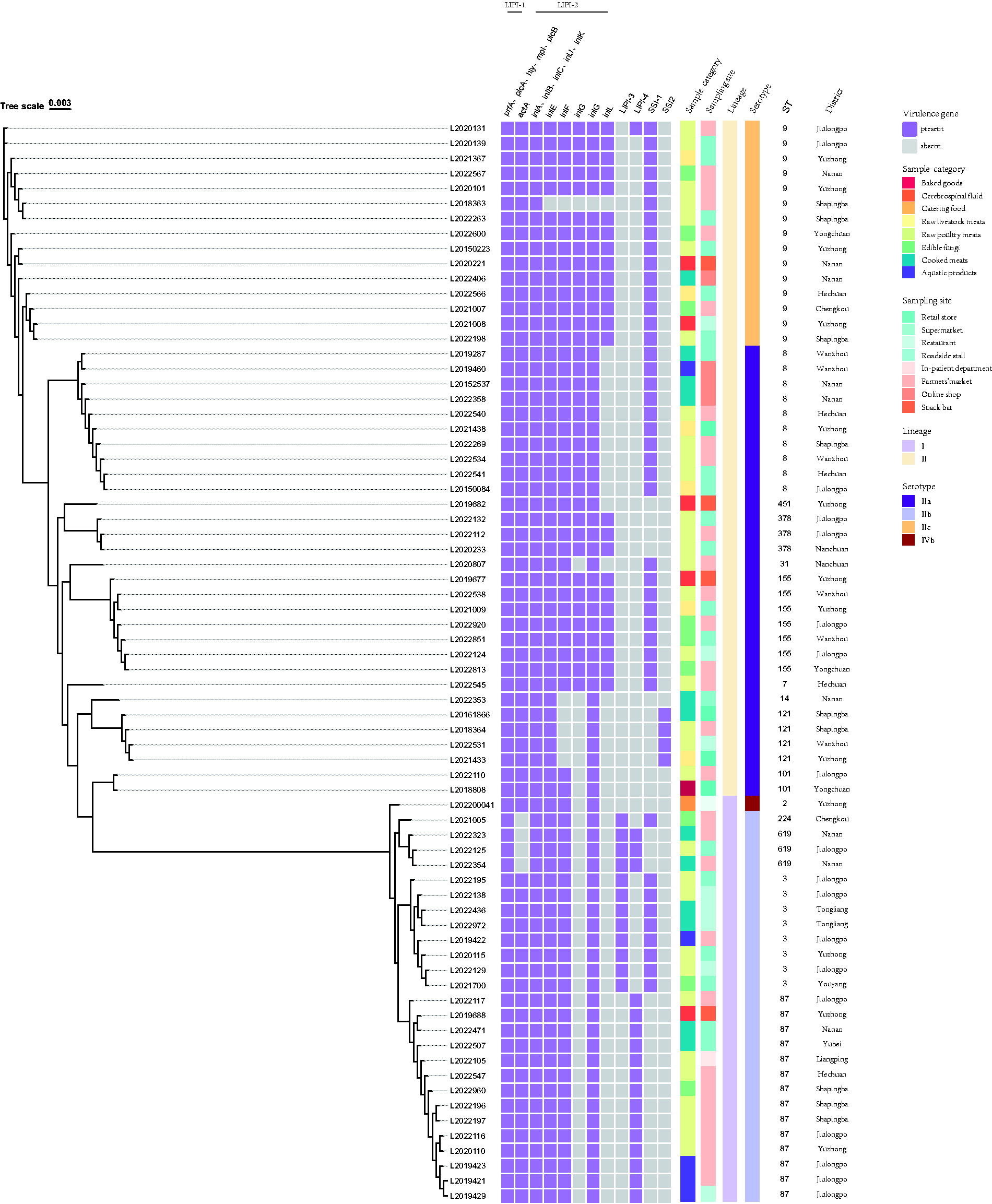
Virulence gene carrying characteristics of 72 Listeria monocytogenes based on WGS analysis
Discussion
Surveillance data on foodborne L. monocytogenes in Chongqing indicate that the detection rates in food for the years 2020, 2021, and 2022 were 3.07%, 3.10%, and 5.41%, respectively, showing an annual increase (He et al., 2023). The Chongqing Center for Disease Prevention and Control has conducted extensive studies on the prevention and control of this pathogen. The application of WGS has proven invaluable in providing critical insights into the genetic backgrounds of strains and facilitating epidemiological investigations and molecular traceability.
L. monocytogenes is genetically diverse, classified into 13 serotypes and four phylogenetic lineages. Over 95% of listeriosis cases worldwide are associated with serotypes 1/2b, 4b (lineage I), and 1/2a (lineage II) (Bergholz et al., 2018). This study found that serotype 1/2a (lineage II) was predominant, accounting for 41.67% of cases, similar to findings from Guangxi where L. monocytogenes serotype IIa is prevalent (43.53%) (Lv et al., 2023).
Among the 72 isolates, ST9 (20.83%), ST87 (19.44%), and ST8 (13.89%) were the primary STs. ST9 and ST8 primarily originated from food or food processing environments and are less frequently associated with clinical infections (Fang et al., 2016). In contrast, ST87 shows a high detection rate in clinical settings in China (Chen et al., 2021) and has been notably linked with infections in pregnant women, leading to abortions or neonatal listeriosis (Zhang et al., 2019; Zhang et al., 2018).
The principal virulence factors of L. monocytogenes are organized within genomic regions known as LIPIs. All isolates carried LIPI-1 and LIPI-2. Some lineage I isolate also harbored LIPI-3 or LIPI-4, which are frequently linked to outbreaks of listeriosis (Quereda et al., 2018). LIPI-3, encoding LLS, is associated with enhanced virulence in vivo (Quereda et al., 2017), while LIPI-4 is known for its high virulence, particularly in cases involving the central nervous system and maternal/fetal infections (Hilliard et al., 2018). All ST87 isolates in this study harbored LIPI-4, with a majority originating from raw and cooked poultry products. This highlights the urgent need for increased public awareness and enhanced food safety surveillance to prevent contamination.
In this study, 13 antibiotic-resistant genes were identified across the 72 isolates. All isolates inherently carry the fosX gene, conferring resistance to fosfomycin. Beyond fosX, the most frequently detected genes were tet(M), blaZ, msr(A), msr(D), and mef(A). These findings are consistent with a high detection rate of the tetracycline resistance gene noted in several studies within China (Lv et al., 2023; Wang et al., 2023). The resistance to β-lactams and erythromycin in Chongqing shows notable consistency between phenotypic and genotypic resistance profiles (He et al., 2023).
The treatment of listeriosis typically involves antibiotics such as ampicillin, often combined with gentamicin for synergistic effects (Temple and Nahata, 2000). For penicillin-allergic patients, trimethoprim-sulfamethoxazole is an alternative. However, antibiotic-resistant strains complicate treatment. Resistance mechanisms in L. monocytogenes include β-lactamases, which hydrolyze β-lactam antibiotics, and efflux pumps encoded by the msr and mef genes, which expel macrolides and other antibiotics. The tet(M) gene confers tetracycline resistance by protecting the ribosome (Roberts and Schwarz, 2016).
Nine isolates harbored antibiotic-resistant genes other than fosX, with five originating from raw poultry meat. Research suggests that L. monocytogenes may acquire antibiotic-resistant genes within the poultry intestinal tract (Yan et al., 2021). Monitoring drug resistance in poultry products and associated industries remains a focal point in Chongqing. Of these nine isolates, three belong to the highly pathogenic ST87 type. In cases where infection impacts the central nervous system, mortality rates can reach up to 30% even with appropriate anti-infection treatment (Theisen and Sauer, 2016), highlighting the severe risks associated with inadequate medical response.
Emerging studies suggest that environmental factors, such as the use of antibiotics in agriculture, may contribute to the spread of antibiotic resistance genes among L. monocytogenes isolates (Olaimat et al., 2018). The impact of global trade and travel on the distribution of these resistant strains highlights the need for international collaboration in surveillance and control efforts. Furthermore, advancements in rapid detection methods and integrative genomic approaches will be crucial in identifying and responding to outbreaks in a timely manner, ultimately enhancing food safety and public health protection (Chen et al., 2021).
This study emphasizes the role of L. monocytogenes in food safety and the challenges it poses in outbreaks. The consistent detection of virulence factors in poultry isolates highlights the need for strict control in food processing. Our findings reflect global trends of increasing genetic diversity in L. monocytogenes populations. The use of WGS demonstrates the importance of integrating genomic surveillance with traditional methods to address antibiotic resistance and virulence.
In conclusion, L. monocytogenes isolates in Chongqing province have demonstrated diverse antibiotic-resistance patterns, particularly against β-lactam, tetracycline, and erythromycin, posing a significant public health threat. In addition, these isolates consistently harbor multiple virulence genes, emphasizing the necessity for sustained surveillance and targeted risk assessments, especially concerning ST87 in meat products.
Footnotes
Authors’ Contributions
Y.H.: Designed the studies, obtained funding, and wrote the article. Y.H., Z.L., H.D., Q.L.C., and Y.Y.L.: Performed the experiments. Y.H., Z.L., Z.F.L., and H.L.: Analyzed the results. W.G.T. and H.L.: Contributed to the article revision. Y.H., Z.L., H.D., Q.C., Y.L., Z.L., W.T., and H.L.: Read and approved the submitted version.
Disclosure Statement
No competing financial interests exist.
Funding Information
This work was supported by the General Project of
Supplementary Material
Supplementary Table S1
References
Supplementary Material
Please find the following supplemental material available below.
For Open Access articles published under a Creative Commons License, all supplemental material carries the same license as the article it is associated with.
For non-Open Access articles published, all supplemental material carries a non-exclusive license, and permission requests for re-use of supplemental material or any part of supplemental material shall be sent directly to the copyright owner as specified in the copyright notice associated with the article.
