




Abstract
Subclinical mastitis (SCM) is a prevalent serious disease among dairy cows worldwide. It poses a significant challenge to the dairy industry, animal welfare, and a threat to public health. The present study aimed to investigate the molecular detection, prevalence, and antimicrobial resistance of Staphylococcus spp. and Streptococcus spp. isolated from raw composite milk samples obtained from SCM dairy cattle in Bangladesh. A total of 612 quarters milk samples obtained from 153 cows were analyzed for SCM using the California Mastitis Test. Bacterial isolation and identification were carried out and bacterial species were confirmed using molecular polymerase chain reaction methods. Antimicrobial susceptibility testing was performed using disc diffusion method. The findings revealed that the prevalence of SCM was 70.3% (26/37), 35.95% (55/153), and 23.04% (141/612) in the herd, cow, and quarter levels, respectively. Among the positive samples, 92.7% (51/55) were Staphylococcus spp. (S. aureus, S. chromogenes, and S. simulans) and the remaining isolates were 7.3% (4/55) Streptococcus spp. (Streptococcus agalactiae and Streptococcus dysgalactiae). The most prevalent species was S. chromogenes, accounting for 67.3% (37/55). Antimicrobial susceptibility testing showed that 65.5% of isolates were susceptible to cefoxitin, whereas, 89.1% were resistant to penicillin. Overall, 12 isolates (21.8%) out of 55 were resistant to more than three classes of antimicrobials and were defined as multidrug-resistant isolates. Methicillin-resistance gene was detected in 61.1% of the cefoxitin-resistant isolates. A multivariate logistic regression analysis identified five potential risk factors including the lack of post-milking teat disinfection (OR: 3.06), absence of immediate feeding after milking (OR: 9.81), poor udder hygiene (OR: 7.83), tick infestation (OR: 13.76), and absence of dry cow therapy (OR: 3.31). The findings of the current study underscore the urgent requirement for targeted interventions, considering the identified factors to effectively manage and control SCM in dairy cows.
Introduction
Bovine mastitis is a frequent and highly prevalent infectious disease in dairy cattle. It remains a major challenge for global dairy industries. This complex disease in dairy cows poses significant risks to public health and dairy industry worldwide, when unpasteurized milk is consumed (Paramasivam et al., 2023). Since milk has high microbial populations, the risk of antimicrobial residues and compounds derived from an immune response and inflammation process may lead to food safety concerns (Paramasivam et al., 2023; Schadt, 2023). The disease is characterized by physical, chemical, and microbial alterations in the milk, as well as structural changes in the glandular tissue, which affect the normal flow and grade of the milk (Tezera and Aman Ali, 2021). Mastitis can be divided into clinical and subclinical (SCM) form with global prevalence rates of 42% and 15%, respectively (Krishnamoorthy et al., 2021; Paramasivam et al., 2023). Subclinical mastitis is a form of mastitis in dairy cows where there are no visible signs of inflammation or illness in the udder or milk, but there is an increase in somatic cell count (SCC) and/or the presence of pathogenic bacteria in the milk (Abebe et al., 2016). Despite its public health implications, such as milk-based foodborne illness and gastrointestinal symptoms, mastitis has a profound economic impact on the dairy industry globally, mainly by reducing milk production, milk quality, retail value, and increasing treatment and labor costs (Guimarães et al., 2017). However, as with other infectious diseases, the risk factors associated with mastitis primarily depend on three key elements: exposure to microorganisms, cow immune system, and environmental and maintenance factors (Tezera and Aman Ali, 2021). Previous investigations evaluating risk factors for mastitis included age, lactation stage, milk production, breed, and body condition score (Busato et al., 2000; Oliveira et al., 2015; Sarker et al., 2013). Various microorganisms are significant etiological agents of mastitis (Ferdaus et al., 2019; Kakooza et al., 2023). Among the causative bacteria, different strains of Staphylococcus spp. and Streptococcus spp. are more frequent and transmissible from animals to humans (El-Sayed et al., 2017; Juhász-Kaszanyitzky et al., 2007).
The widespread use of antimicrobials in dairy cows to combat mastitis plays a key role in the emergence of antimicrobial resistance (AMR) in dairy cows (Rafif Khairullah et al., 2022). There were no distinctive AMR patterns observed among the typical microorganisms associated with causing SCM in Bangladesh (Chowdhury et al., 2024; Rana et al., 2022).
As mastitis is a global issue both for dairy industry and public health, it requires extensive investigation to develop strategies to pull the reins on its potential threats (Hoque et al., 2023). Therefore, the present study aimed to determine the current prevalence of SCM using molecular methods and AMR pattern, as well as assessing the associated risk factors by building a multilevel regression model at particular regions in Chattogram, Bangladesh.
Materials and Methods
Ethics statement
Ethical Approval Committee of Chattogram Veterinary and Animal Science University (CVASU), Bangladesh approved both field and laboratory procedures of the current study [Approval no. CVASU/Dir (R&E) EC/2022/023].
Study area and design
A cross-sectional study was conducted in 11 upazilas (sub-district) of Chattogram district from January to April 2023, as shown in Figure 1. The inclusion criteria of the farms in the study were as follows: the farm should have a population of dairy cows exceeding five, a minimum establishment period of three years, and each cow should yield a minimum of 5 L of milk.
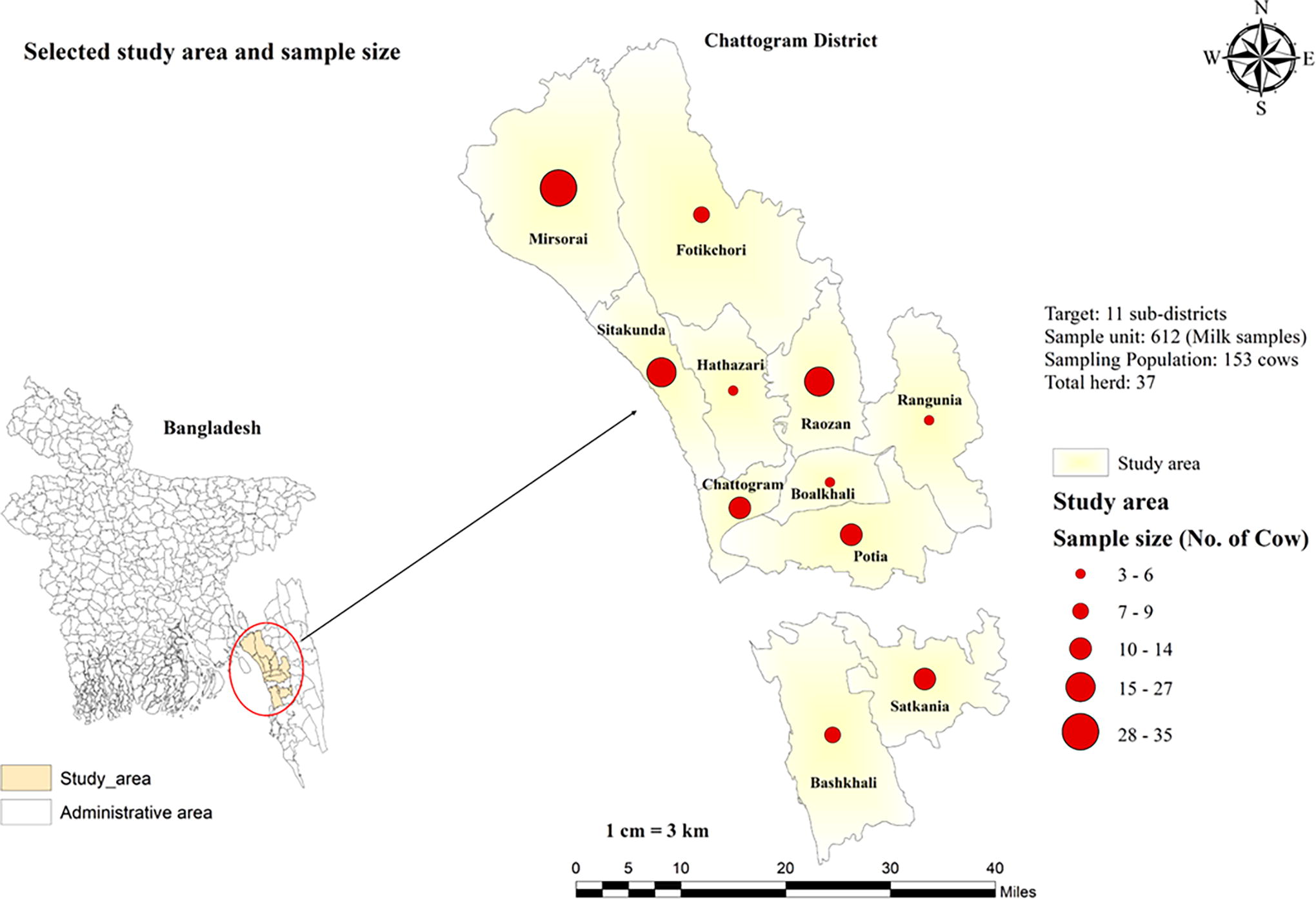
Geo-spatial map showing the locations and sample size in the present study. The map was created using ArcMap 10.7. (ESRI, CA, USA).
Determination of sample size
A combination of cluster and random sampling scheme was incorporated for the selection of study farms and animals. The desired criteria-based herd list was compiled and organized by sub-district categories. A minimum of two herds and ten milch cows (each herd is considered as a cluster) from each sub-district were selected randomly. The minimum number of sample size was estimated according to the formula of Al Naser et al., (2024) and Rahman et al., (2024). Following the calculation, a total of 384 milk samples were determined as necessary for estimating SCM. The study was then conducted using 612 milk samples collected from 153 cows across 37 herds.
Data and sample collection
A customized version of the KOBO Tool Box (accessible at www.kobotoolbox.org) was utilized for the comprehensive collection of explanatory, predictor, and risk factor-associated data pertaining to multiple dimensions: animal well-being, husbandry practices, and individual animal characteristics (Supplementary Data S1). Data were carefully collected through a combination of well-structured, pre-tested questionnaire encompassing both open and closed questions, thorough on-site observations, and meticulous assessments of the farm environment. The variables were carefully selected through analysis of previous studies with modifications (Hoque et al., 2023; Rana et al., 2022; Sarker et al., 2013).
Milk sampling was carried out following aseptic procedures as described by National Mastitis Council (NMC, 2004). For sampling, approximately 2 mL of milk was collected using the stripping milking technique from the cow which appeared in a good health. The process of sample collection involved an initial step of cleansing then dried the teat, followed by discarding the initial milk drops. The teat orifices were further cleaned by gently swabbing with a cotton ball soaked in 70% ethanol.
Disease screening by California mastitis test (CMT) and bacteriological methods
The California mastitis test (CMT) was used as a screening test for subclinical mastitis. The CMT was performed for each quarter as previously described by Abebe et al., (2016). If the CMT test showed positive results, then the samples were amalgamated to form a composite sample (Al Emon et al., 2024) for identifying selected pathogens according to the sampling process of the NMC guidelines (NMC, 2004). In the present study, the isolation and identification of Staphylococcus and Streptococcus spp. from milk samples involved both culture and biochemical techniques along with molecular detection methods using polymerase chain reaction (PCR). For Staphylococcus spp., 1 mL of the milk sample was enriched in 9 mL of Tryptic Soy Broth and incubated at 37°C for 24 h. A loopful of the enriched broth was streaked onto Mannitol Salt Agar (Oxoid, Cambridge, UK) plates and incubated at 37°C for 24 h. Yellow colonies indicative of mannitol fermentation was observed, suggesting the presence of Staphylococcus spp. Suspected colonies were subcultured onto Blood Agar plates for further isolation and incubated at 37°C for 24 h. Hemolysis patterns were examined, followed by Gram staining, which revealed Gram-positive cocci in clusters. A catalase test was performed using 3% hydrogen peroxide, and the presence of bubbling confirmed a positive result, identifying the isolates as Staphylococcus spp.
For the isolation of Streptococcus spp., after a similar pre-enrichment, a loopful of the broth was streaked onto Blood Agar plates and incubated at 37°C for 24–48 h. The plates were examined for beta-hemolytic colonies, indicative of pathogenic Streptococcus spp. Gram staining of suspected colonies revealed Gram-positive cocci arranged in chains. A catalase test was conducted, and the absence of bubbling confirmed a negative result, consistent with Streptococcus spp. Finally, molecular identification using PCR was conducted to confirm the species-level identification of the isolates as previously reported by Hoque et al., (2023) and Rana et al., (2022).
DNA extraction and PCR
Freshly cultured bacterial isolates were used for chromosomal DNA isolation using the boiling method as previously described by Hoque et al., (2023). Species-specific primers targeting different Staphylococcus and Streptococcus spp. were used for the molecular detection as previously described by Shome et al., (2011) as shown in Supplementary Table S1. All genomic DNA and the PCR confirmed bacterial isolates were stored at −80°C for further analysis.
Antimicrobial susceptibility testing
To determine the AMR profiling, disk diffusion method was used according to the guidelines of Clinical and Laboratory Standards Institute (CLSI, 2020). Eight different antimicrobial agents from six different antibiotic classes were used, namely ampicillin (AMP) 10 µg, cefoxitin (FOX) 30 µg, ciprofloxacin (C) 5 µg, erythromycin (E) 15 µg, gentamicin (CN) 10 µg, penicillin G (P) 10 µg, trimethoprim-sulfamethoxazole 1.25/23.75 µg, and tetracycline (TE) 30 µg. The zone of inhibition was measured in (mm) and results were interpreted according to the CLSI (2020) guidelines. Isolates showing resistance against at least three different classes of antimicrobial agents (≥3) were defined as multidrug resistant (MDR) as previously reported by Magiorakos et al., (2012).
Detection of methicillin-resistance (mecA) gene
Detection of mecA gene was performed using PCR as previously reported by Fazal et al., (2023). Nuclease-free water was used as a negative control and a previously confirmed methicillin-resistant S. aureus isolate was used as a positive control.
Multiple antibiotic resistance (MAR) index
The MAR index was calculated and interpreted according to Mahen et al., (2024) using the formula:
MAR index value ranged from 0 to 1. Close to zero indicated highly susceptible and near 1 indicated extremely resistance.
Statistical analysis
Both the parametric and nonparametric data were coded, sorted, and thoroughly checked to minimize errors. Following this, the data were analyzed for multivariate regression and Spearman’s correlation using SPSS v26 (IBM Corporation, USA) and R-Studio (Version 4.2.1), respectively. Prevalence was estimated using following formula of Asha et al., (2024).
The precessions of this estimate were ensured by 95% confidence interval (CI) estimated using Binomial exact calculation. All the relevant predictor variables associated with the response variable were chosen for univariate analysis. The univariate and multivariate logistic regression process was fully followed by Hoque et al. (2018). To evaluate the “goodness-of-fit” of the final model, the susceptibility was assessed using the Hosmer−Lemeshow test. The regression coefficients were converted into odds ratios (OR; eβ). Finally, the results were reported following multivariate regression reporting guidelines (Leibovici et al., 2020).
Plot and geo-spatial mapping
The Pearson’s correlation coefficient (r2) was calculated, and its significance was assessed using the “corrcoef” function. The resulting coefficient values were then visualized using the “metan” package in R and RStudio (Version 4.3.2). The sample size dot map and choropleth map for prevalence were constructed using ArcMap 10.7 (ESRI, CA, USA).
Results
The demographic characteristics of purposively selected cows (n = 153) were depicted as different category and frequency of mastitis positive, as detailed in Supplementary Table S2.
Prevalence of SCM
In the present study, SCM was detected based on the results of the CMT. The overall prevalence of SCM at herd level, animal level, and quarter level were 70.3% (26/37), 35.95% (55/153), and 23.04% (141/612), respectively (Table 1). In cases, where a cow exhibited positive results for SCM in each quarter, it was still considered as a single positive instance at the animal level. Out of 153 cows, 64.1% (98/153) showed CMT score of zero as negative (presumptive SCC < 0.2 million), whereas 11.1% (17/153) cows showed CMT score of three (presumptive SCC > 5 million), 8.5% (13/153) showed CMT score of two (presumptive SCC ranged 1.2–5 million), 13.1% (20/153) cows showed CMT score of one (presumptive SCC ranged 0.4–1.2 million). Moreover, 3.3% (5/153) were considered as trace (presumptive SCC 0.2–0.4 million).
Prevalence of Subclinical Mastitis in Milch Cow Estimated from Milk Samples (n = 612) Obtained from 153 Randomly Selected Cows in 14 Upazila in Chattogram District in the Present Study
The Holstein Friesian breed exhibited a higher prevalence (41.5%) compared to other breeds. Regarding age categories, older animals (52.6%) displayed a greater susceptibility to SCM in comparison to other adult-young cows. However, the occurrence of mastitis did not show any notable variation based on the parity, lactation stage, and others explanatory and predictor variables (Supplementary Table S3). The cow’s factor associated with herd showed the cows, which were reared in muddy flooring were more likely to have SCM than brick and concrete flooring. On organism level, S. chromogenes showed significantly (p < 0.001) the highest positive rates among the SCM positive isolates (67.3%; 37/55) as shown in Supplementary Table S4. The location-based prevalence was visualized on geo-spatial mapping (Fig. 2).
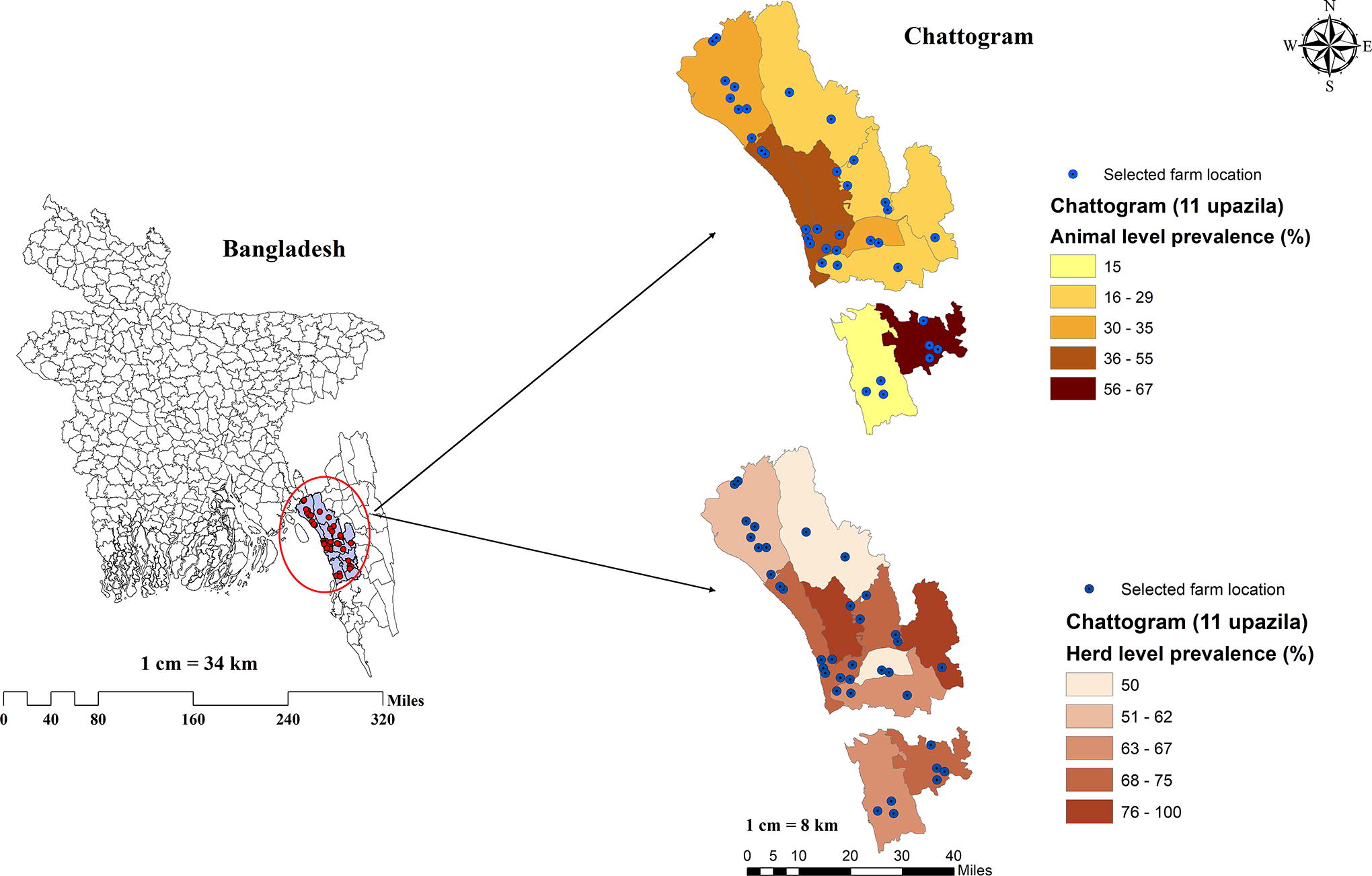
Choropleth mapping showing location-based prevalence of SCM in 11 sub-districts of Chattogram, Bangladesh. The location of the selected farms was shown by XY-coordination mapping. SCM, subclinical mastitis.
Epidemiologically plausible risk factors
The outcomes of the univariate screening of explanatory, predictor variables, and epidemiologically plausible risk factors using Chi-square (χ2) analysis were shown in Supplementary Tables S2 and S3. After screening, seven variables with p values ≤ 0.20 were included in multivariable logistic regression (MLR) analysis. However, the MLR modeling revealed that the likelihood of SCM increased with: no post milking teat disinfection (OR = 3.06, p = 0.006), no feeding immediately after milking (OR = 9.81, p = < 0.001), udder hygiene (OR = 7.83, p = < 0.001), tick infestation on the udder (OR = 13.76, p = < 0.001), and no dry cow therapy (OR = 3.31, p = 0.001), which were identified as biologically plausible risk factor of SCM (Table 2). The likelihood ratio test statistics (LRTS) were also significant (p < 0.05) for these risk factor. The “Hosmer–Lemeshow goodness-of-fit test” statistic (χ2 = 3.15, p = 0.87) was nonsignificant, indicating the model was good fitted for the data.
Multivariate Logistic Regression Analysis of Biologically Plausible Risk Factors of Subclinical Mastitis in the Present Study
OR, Odds ratio, LRTS, Likelihood Ratio Test Statistics.
The correlation matrix plot revealed the interconnectedness of various risk factors, indicating their joint influence on SCM. The majority of the risk factor were positively correlated with each other as shown in Figure 3. The body condition score, udder hygiene, “no post milking teat disinfection,” and “no/delayed feeding immediately after milking” showed moderately positive correlation with the occurrence of SCM (light blue), whereas tick infestation on udder showed negative correlation (light red).
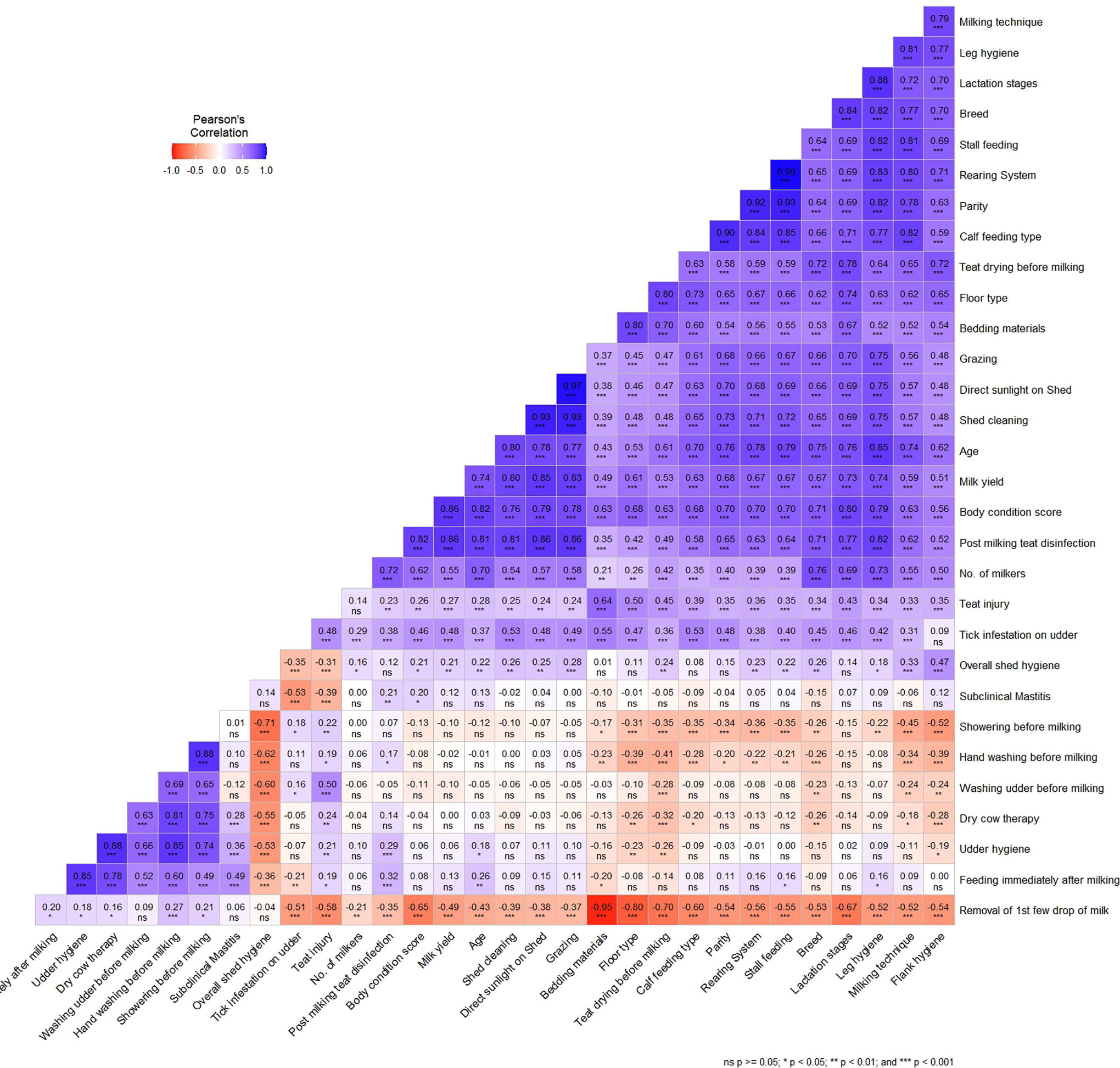
Pearson correlation matrix plot showing the interconnectedness of various risk factors, indicating their joint influence on SCM in the present study. SCM, subclinical mastitis.
Occurrence of etiologic agents
Out of 55 pooled SCM positive samples, it was found that Staphylococcus spp. (S. aureus, S. chromogenes, S. simulans) were identified in 92.7% (51/55) of the samples and Streptococcus spp. (Streptococcus agalactiae and Streptococcus dysgalactiae) were identified in 7.3% (4/55) of the samples, whereas S. uberis, S. epidermidis, and E. coli were not detected in the present study. Among the identified Staphylococcus spp., the most prevalent species was S. chromogenes, accounting for 67.3% (37/55; 95% CI: 53.29–79.32) of the cases (Supplementary Table S4). Conversely, the lowest frequency was observed in S. agalactiae, accounting for 1.8% (1/55; 95% CI: 0.05–9.72).
Antimicrobial susceptibility testing
Among the nine S. aureus isolates, a notable pattern emerged in their antibiotic susceptibility. They exhibited complete resistance (100%) to ampicillin and penicillin. Conversely, ciprofloxacin demonstrated the highest susceptibility (77.8%). For S. chromogenes, a significant percentage of the isolates exhibited susceptibility, particularly with cefoxitin (67.6%). Interestingly, S. simulans displayed high levels of susceptibility to the majority of antibiotics. S. simulans and Streptococcus dysgalactiae isolates showed 100% susceptibility to cefoxitin, ciprofloxacin, and tetracycline, whereas they showed 100% resistance to ampicillin and penicillin. The detailed resistance profiles of Staphylococcus spp. and Streptococcus spp. were shown in Table 3.
Antimicrobial Susceptibility Patterns of Staphylococcus Spp. and Streptococcus Spp. Isolated from Bovine Subclinical Mastitis Milk Samples in the Present Study
AMP, Ampicillin; FOX, Cefoxitin; CIP, Ciprofloxacin; E, Erythromycin; CN, Gentamicin; P, Penicillin; SXT, Trimethoprim-Sulfamethoxazole; TE, Tetracycline.
MDR and MAR profiles
The MAR index values ranged from 0.25 (resistant to at least two antibiotics) to 0.75. One isolate was resistant to six out of eight selected antimicrobial agents, and three isolates were resistant to five antimicrobial agents. Overall, 12 (21.8%) out of 55 isolates were resistant to more than three different categories of antimicrobial agents and were defined as MDR. Extensively drug-resistant or pan-drug-resistant isolates were not observed in the present study.
Distribution of mecA gene
Among Staphylococcus spp., 18 isolates were resistant to cefoxitin. The mecA gene was detected in 61.1% (11/18; 95% CI: 35.75–82.70) in the cefoxitin-resistant isolates. Specifically, mecA gene was detected in 83.3% (5 out of 6; 95% CI: 35.88–99.58) in the cefoxitin resistant S. aureus, and those isolated were defined as methicillin-resistant S. aureus (MRSA).
In the present study, mecA gene was not detected in cefoxitin-negative Staphylococcus spp.
Discussion
The prevalence of SCM varies globally, influenced by factors such as management practices and geographical location. The present study identified a lower prevalence indicating improved management practices in the study area than was observed in previous studies in Bangladesh (Rana et al., 2022). Risk factors such as udder cleanliness and post-milking teat disinfection were significant contributors to the occurrence of SCM. AMR patterns revealed concerning levels of multidrug resistance in Staphylococcal and Streptococcal isolates, emphasizing the need for prudent antibiotic use and further genomic surveillance investigations.
Among three different levels of prevalence including herd, animal, and quarter level, we mainly focused on animal level that was recorded 35.95% while Ndahetuye et al., (2019) reported a much higher prevalence of 76.2%. Besides, Mbindyo et al., (2020) also reported 73.1% dairy cows were affected by SCM in Kenya. However, Tezera and Aman Ali, (2021) reported a much lower rate (28.34%) of SCM in Ethiopia, while the overall cow level prevalence was 40.3%. The variation of different level of prevalence influenced by a variety of factors ranging from characteristics of individual animal to hygienic management of the herds.
The spectrum of SCM etiologic agents in the present study was aligned with a recent study by Fazal et al., (2023) in Bangladesh while differ from previous studies by Kakooza et al., (2023) in Uganda, Abebe et al., (2016) in Ethiopia, and Ferdaus et al., (2019) in Bangladesh. All these previous studies reported S. aureus as the most common causative agent of SCM, whereas in the present study, S. chromogenes was the most prevalent (67.27%) agent among other bacterial species, which were similar to the results reported by Fazal et al., (2023).
The environmental risk factors associated with herd level differ from place to place. The present study has highlighted five key factors, which resulted in a significant influence on the occurrence of SCM. In contrast, a recent study by Fazal et al., (2023) in Bangladesh highlighted different risk factors, such as age, number of lactations, udder condition, and teat positioning (right-left or front-back), which were different from the current findings in the present study. In multivariate logistic regression analysis, the absence of post-milking teat disinfection showed a noteworthy association, with cows having a 3.08 times higher likelihood of SCM compared to their non-risk counterparts. This situation creates a window of opportunity for organisms to easily enter the teat canal shortly after milking, which underscores the importance of teat dipping in iodine-based solutions. Udder cleanliness emerged as a substantial factor, with dirty udders carrying a 7.83 times higher risk of SCM. This aligns closely with the findings of Abebe et al., (2016) who reported an even higher odds ratio (OR = 8.7) for acquiring SCM among cows with unclean udders. Notably, the absence or delay in feeding post-milking was associated with a substantial 9.81 times higher risk of mastitis occurrence. This phenomenon can be explained by the cow typical post-milking behavior of resting and sitting down, which leaves their teats open. This open state provides an opportunity for opportunistic microorganisms to enter the udder through the teat canal. Conversely, offering feed immediately encourages cows to remain standing while consuming feed.
The inappropriate use of antimicrobial agents to treat subclinical and clinical mastitis may lead to the development of multidrug resistance. In the present study, all S. aureus isolates showed resistance to ampicillin and penicillin. This trend is consistent with the findings by Fazal et al., (2023). However, ciprofloxacin exhibited noteworthy effectiveness against S. aureus, demonstrating susceptibility rates of 77.8% of isolates, aligning with the finding by Abed et al., (2021). Among the 37 S. chromogenes isolates, a substantial majority displayed susceptibility to cefoxitin (67.6%). All S. simulans isolates exhibited 100% susceptibility to cefoxitin, ciprofloxacin, and tetracycline, consistent with the previous findings by Kim et al., (2019).
A considerable proportion of the total isolates (21.8%) in the current study exhibited patterns of MDR. Similar findings were previously reported by Rana et al., (2022) and Dabele et al., (2021). The potential development of MDR can be attributed to the excessive use of similar groups of antimicrobial agents and the repetitive administration of antimicrobials sharing similar modes of action, as noted by Das et al., (2022).
The mecA gene is a critical genetic determinant associated with antibiotic resistance, specifically with resistance to beta-lactam antibiotics (Rafif Khairullah et al., 2022). In the present study, mecA gene was identified in 61.1% (11/18) cefoxitin-resistant isolates, while Fazal et al., (2023) detected the gene in 32% of S. aureus species. Moreover, Rafif Khairullah et al., (2022) reported that 53.3% of S. aureus carried mecA gene. In the present study, a relatively high percentage of cefoxitin-resistant Staphylococcus spp. isolates were found to be negative for the mecA and mecC genes, which differs from findings in other studies. This variation may be attributed to alternative resistance mechanisms. Alterations in penicillin-binding proteins or the overexpression of efflux pumps may contribute to cefoxitin resistance in the absence of mecA or mecC. Additionally, regional variations in AMR patterns, differences in the bacterial strains isolated, or the methods used for detecting resistance genes may also explain these findings. Previous studies have reported variations in the prevalence of these resistance genes, and the results of the current study highlight the need for further investigation of other genetic or phenotypic mechanisms contributing to cefoxitin resistance in Staphylococcus spp. in this region (Fazal et al., 2023; Rafif Khairullah et al., 2022).
One limitation of the current study was the use of composite milk samples from all four quarters of each cow, rather than individual quarter samples, which is recommended by the NMC guidelines. While this approach provided a broader representation of the udder health status at the cow level and the employed bacteriological methods still allowed for the accurate identification of the bacterial pathogens, it may have impacted the prevalence of bacterial pathogens, potentially leading to underestimation or overestimation of the prevalence of bacterial pathogens. The decision to use composite samples was made to streamline sample collection and analysis in field conditions, but future studies should consider quarter-level sampling for more precise bacteriological assessment. Due to limited resources, molecular characterization and genomic investigations were not performed. Further investigations involving large number of farms may be included. Moreover, our recommendation is to study the biotype pathogenic bacteria by accurate real-time technology such as matrix-assisted desorption/ionization time of flight mass spectrophotometry.
Conclusions
The present study highlights the significant prevalence of SCM in cows, emphasizing its economic and public health implications. S. chromogenes was identified as a prominent causative agent, with varying antibiotic resistance patterns observed. The high prevalence of MDR in the present study is concerning for both animal and public health. Key risk factors include poor udder hygiene, tick infestation, and lack of post-milking teat disinfection and dry cow therapy. Targeted interventions and improved antibiotic stewardship are essential measures to enhance disease management, and to ensure dairy sustainability, and mitigate AMR.
Footnotes
Acknowledgments
The authors thank staff from the Department of Microbiology and Veterinary Public Health, Chattogram Veterinary and Animal Sciences University (CVASU), Bangladesh for their support and collaboration. The researchers are also thankful to the Sylhet Agricultural University, Bangladesh for their support. The authors acknowledge Princess Nourah bint Abdulrahman University Researchers Project number (PNURSP2024R304), Princess Nourah bint Abdulrahman University, Riyadh, Saudi Arabia their support. Authors would like to thank AlMaarefa University, Riyadh, Saudi Arabia, for supporting this research. The authors would like to thank the two anonymous reviewers for their insightful comments, which significantly improved the manuscript.
Authors’ Contributions
A.A.F.: Conceptualization, data curation, methodology, investigation, resources, writing—original draft, reviewing and editing. H.H.: Conceptualization, investigation, methodology, data curation, writing—original draft, reviewing and editing, data analysis, data curation. M.H.R.: Methodology, data and sample collection. M.R. and K.A.B.: Methodology, data and sample collection, writing—original draft, reviewing and editing. M.S.S., M.A., A.S., R.B., H.M.S., A.N., and Y.A.H.: Investigation, validation, writing—original draft, reviewing and editing. M.E.Z., M.M.R., and H.B.: Conceptualization, designing, investigation, supervision, resources, software, data analysis, validation, writing—original draft, reviewing and editing. All authors read and approved the final article.
Disclosure Statement
The authors declare that they have no competing interests.
Funding Information
The project was supported by the Department of Microbiology and Veterinary Public Health, Chattogram Veterinary and Animal Sciences University, Bangladesh. This research was funded by Princess Nourah bint Abdulrahman University Researchers Supporting Project number (PNURSP2024R304), Princess Nourah bint Abdulrahman University, Riyadh, Saudi Arabia. The funding agencies have no role in study design, data collection or analysis, article preparation or the decision to publish the article.
Supplementary Material
Supplementary Data S1
Supplementary Table S1
Supplementary Table S2
Supplementary Table S3
Supplementary Table S4
References
Supplementary Material
Please find the following supplemental material available below.
For Open Access articles published under a Creative Commons License, all supplemental material carries the same license as the article it is associated with.
For non-Open Access articles published, all supplemental material carries a non-exclusive license, and permission requests for re-use of supplemental material or any part of supplemental material shall be sent directly to the copyright owner as specified in the copyright notice associated with the article.
