




Abstract
Brazil plays a significant role in the global tomato market and research into the microbiological characteristics and optimal storage conditions for this fruit is fundamental. Additionally, the recurrent outbreaks of salmonellosis linked to tomato consumption underscore the importance of understanding the prevalence and persistence of this bacterium in this product to ensure food safety. This study evaluated the incidence of Salmonella in commercially available tomatoes and determined the growth potential (δ) of a pool of Salmonella strains (Salmonella Enteritidis [503, 504], Salmonella Typhimurium [271], Salmonella Infantis [2883], and Salmonella Senftenberg [587]) on pulp of three tomato cultivars (Sweet Grape, Salad Sensation, and Débora) under different storage scenarios. None of the 240 tomato samples collected in Campinas (São Paulo State, Brazil) showed surface contamination by Salmonella. Tomato pulps of the Débora and Sweet Grape varieties, with lower pH values (3.0 and 4.0, respectively), inhibited the growth of Salmonella at all tested temperatures (10°C, 20°C, and 30°C). However, the Salad Sensation pulp (pH 6.0) allowed for Salmonella multiplication, especially at 30°C with δ of 2.88 ± 0.12 log10 colony-forming unit/g. These results indicate that pH is a critical factor for Salmonella growth in tomato pulps of different varieties stored at various temperatures.
Introduction
The tomato (Solanum lycopersicum) is a global culinary staple, with a production of 186 million tons in 2022 (FAO, Food and Agriculture Organization of the United Nations, 2023). It is enjoyed fresh, processed into sauces and juices, and used in a variety of dishes, from soups to ketchup (Bolaño et al., 2024; Pravitha et al., 2024). Tomato spoilage, exacerbated by inadequate packaging and improper storage, results in substantial postharvest losses in the food supply chain (Khalid et al., 2024). Therefore, consuming tomatoes in their raw form requires strict production and handling practices, as the fruit has been linked to numerous foodborne illness outbreaks, such as salmonellosis (Bidol et al., 2007; Corby et al., 2005; Cummings et al., 2001; Jungk et al., 2008; Toth et al., 2002).
The tomato quality is determined by a combination of preharvest factors, including fruit maturity stage; the composition of the microbiota present in the plant, soil, and fruit; insect presences; and soil nutritional characteristics and microbiological safety of the irrigation water used (Fekadu and Andarege, 2024; Hassani et al., 2023). Following harvest, tomato quality is impacted by several factors, including fruit respiration and transpiration, the potential for seed germination inside the fruit (vivipary), and mechanical damage or other injuries incurred during transportation and storage (Fekadu and Andarege, 2024). For these reasons, pre- and postharvest management practices seek to incorporate different approaches such as temperature, the application of essential oils and other chemical agents with bactericidal properties in an attempt to significantly improve the quality of tomatoes and their preservation over time (Joseph et al., 2023; Zhao et al., 2021).
When these measures are not enough, the physicochemical characteristics of tomatoes, such as the acidity, high water activity, citric acid, carotenoids, and soluble solids content of tomatoes create conditions that allow Salmonella to grow and reach levels capable of causing foodborne illness (Pinheiro and Almeida, 2008; Rehman et al., 2023; Rosa-Martínez et al., 2021). Salmonella’s ability to adapt to acidic environments (Foster, 2001; Leyer and Johnson, 1993; Muller et al., 2009) further exacerbates this risk for consumers.
Given the possibility of Salmonella contamination in tomatoes (Beuchat and Mann, 2008), particularly through wounds (Gurtler et al., 2018). The objective of this study was to determine Salmonella contamination levels in tomatoes marketed in Campinas, SP, and to examine the growth of Salmonella enterica serotypes in three commercially significant tomato varieties (Débora, Sweet Grape, and Salad Sensation).
Material and Methods
Salmonella prevalence on tomato surfaces
A total of 240 tomato samples were collected from three tomato cultivars and maturity stages in different supermarkets in the Campinas region, São Paulo, Brazil, between May and August 2015. One hundred grams of small tomatoes and four units of large tomatoes were sampled. The tomatoes were placed in sterile bags and washed using a 1:1 (w/v) sterile buffered peptone water solution (Merck, Darmstadt, Germany). The washing solution was then filtered through a 0.45 µm membrane. Detection of Salmonella was performed according to the ISO 6579 methodology (ISO, International Organization for Standardization, 2017). Membranes were placed in sterile plastic bags containing 225 mL of Maximum Recovery Diluent (Oxoid) and homogenized for 2 min using a stomacher (Stomacher, 400, Seward, London, UK) followed by incubation at 37°C for 18 h. Samples were then subjected to selective enrichment in Rappaport Vassiliadis Soy Peptone broth (Merck, Darmstadt, Germany) (41.5°C/24 h) and Muller-Kauffman Tetrathionate/Novobiocin broth (Oxoid, Basingstoke, UK) (37°C/24 h). After incubation, both broths were seeded onto xylose lysine deoxycholate agar (Oxoid, Basingstoke, UK) and Mannitol Lysine Crystal Bright Green (MLCB; Oxoid, Basingstoke, UK) agar and incubated at 37°C for 24 h. Presumptive colonies on both plates were isolated on nutrient agar (Merck, Darmstadt, Germany) (37°C/24 h), and then subjected to tests for glucose fermentation, urea hydrolysis, lysine decarboxylation, β-galactosidase production, acetoin production (Voges-Proskauer test), and indole. The colonies were also subjected to agglutination reaction using polyvalent Salmonella antiserum (Probac, São Paulo, Brazil). The results were expressed as the presence/absence of Salmonella per tomato sample.
Assessing Salmonella growth in tomatoes
Samples
Based on the Brazilian and global consumer markets (CONAB, Companhia Nacional de Abastecimento [National Supply Company], 2019), three different tomato cultivars (Sweet Grape, Salad Sensation, and Débora) were used for the challenge test. The selection of tomato varieties was based on their extreme pH values: Sweet Grape (pH 4.0), Salad Sensation (pH 6.0), and Débora (pH 3.0). The fruits were sanitized with a 150 mg/L chlorine solution/15 min (Rezende et al., 2009) and then aseptically peeled using sterile utensils. The extracted pulp, with seeds removed, was pasteurized in an autoclave at 105°C for 10 min and subsequently divided into 25 g samples. These samples were then packaged in sterile bags and frozen at −80°C to preserve their physicochemical properties for subsequent analyses.
Experimental procedure for the tomato challenge test
A pool of five S. enterica strains was used: Salmonella Enteritidis (503, 504), Salmonella Typhimurium (271), Salmonella Infantis (2883), and Salmonella Senftenberg (587). Each strain was inoculated into Tryptic Soy Broth (TSB) and incubated at 37°C for 24 h. A 2 mL aliquot from each was then transferred to 200 mL TSB, incubated again, centrifuged (at 8°C, 10 min, 2810 × g), and washed with sterile peptone water. The strains were combined into a single pool, adjusted to an optical density of 0.60 at 630 nm, equating to 108 colony-forming unit (CFU)/mL (Sant’Ana et al., 2012).
Tomato pulps (25 g portions) (Débora, Sweet Grape, Salad Sensation) were inoculated with 103 CFU/g (Sweet Grape and Salad Sensation) and 106 CFU/g (Débora) of Salmonella (IFT/FDA, Institute of Food Technologists for the Food and Drug Administration, 2003) and stored at 10°C, 20°C, and 30°C. Experiments were performed in duplicate and repeated three times. Salmonella was enumerated at time zero and specific intervals based on the tomatoes’ pH levels: pH 3.0 (24 h), pH 4.0 (168 h at 10°C, 56 h at 20°C, 26 h at 30°C), and pH 6.0 (168 h at 10°C, 56 h at 20°C, 26 h at 30°C). Presence–absence tests for Salmonella were also conducted before inoculation and at the end of storage. Serial dilutions and pour-plate counting on MLCB agar were used for enumeration, with incubation at 37°C for 24 h. Results were expressed in log CFU/g.
Growth potential (δ) of Salmonella in tomato pulp
The growth potential (δ) of Salmonella in each tomato variety was determined by calculating the difference between the microorganism counts (log10 CFU/g) at the final time point (24, 26, 56, or 168 h, as previously described) and the initial time point (time “0”) of the storage period (Beaufort, 2011) (Equation 1). Tomatoes were considered a suitable growth medium for Salmonella when the growth rate (δ) exceeded 0.5 log10 CFU/g, a value corresponding to the uncertainty of microbiological methods (AFSSA, Agence Française de Securité Sanitaire des Aliments, 2004; EURLLM, European Union Reference Laboratory for Listeria monocytogenes, 2008). Conversely, the bacteria were deemed incapable of multiplying in tomato pulp when the value of δ was negative or less than 0.5 log10 CFU/g (AFSSA, Agence Française de Securité Sanitaire des Aliments, 2004; EURLLM, European Union Reference Laboratory for Listeria monocytogenes, 2008).

Physicochemical analyses
The physicochemical characteristics of the pulp from different tomato varieties, including soluble solids content (in °Brix) and pH, were evaluated in duplicate at the beginning and end of the storage period, following AOAC (2008) protocols.
Statistics
A one-way analysis of variance with Tukey’s posttest was used to compare multiple groups. Statistically significant differences were only considered if p ≤ 0.005. Statistical analyses were carried out using R software.
Results
Initially, 240 tomatoes obtained from markets in the Campinas, SP region were analyzed, and none of the samples showed the presence of Salmonella on their surface.
Next, the growth potential (δ) of Salmonella in the pulp of three fresh tomato varieties was evaluated under different temperatures (10°C, 20°C, and 30°C) (Table 1). The growth potential of Salmonella in tomatoes was assessed using the parameter δ (EURLLM, European Union Reference Laboratory for Listeria monocytogenes, 2008). Values of δ greater than 0.5 log10 indicated conditions conducive to bacterial growth. Conversely, negative values or values less than 0.5 log10 suggested that the tomato environment was unsuitable for pathogen growth.
The results indicated that both pH and temperature influence bacterial multiplication. In fresh tomatoes, for instance, Salmonella multiplied preferentially in samples with a pH close to neutrality (6.0, Salad Sensation), present a maximum growth potential of 2.88 ± 0.12 log10 CFU/g when stored at 30°C for 26 h and 0.93 ± 0.37 log10 CFU/g at 10°C for 168 h. In more acidic samples, multiplication was inhibited, characterized by negative growth potential values such as −4.13 ± 0.47 and −5.37 ± 0.36 for Débora (pH 3.0) and Sweet Grape (pH 4.0) tomatoes stored at 10°C for 24 and 168 h, respectively. Additionally, higher temperatures (30°C and 20°C) favored bacterial growth compared with 10°C.
Subsequently, the pH and soluble solids content (°Brix) were evaluated for the three tomato varieties stored at 10°C, 20°C, and 30°C (Table 2). Here, it is noteworthy that neither pH nor soluble solids content differed significantly (p < 0.05) for the same tomato variety among the different storage temperatures (p < 0.05).
Growth Potential (δ) a of Salmonella in the Pulp of Three Different Tomato Varieties (Sweet Grape, Salad Sensation, and Débora) Under Different Storage Temperatures
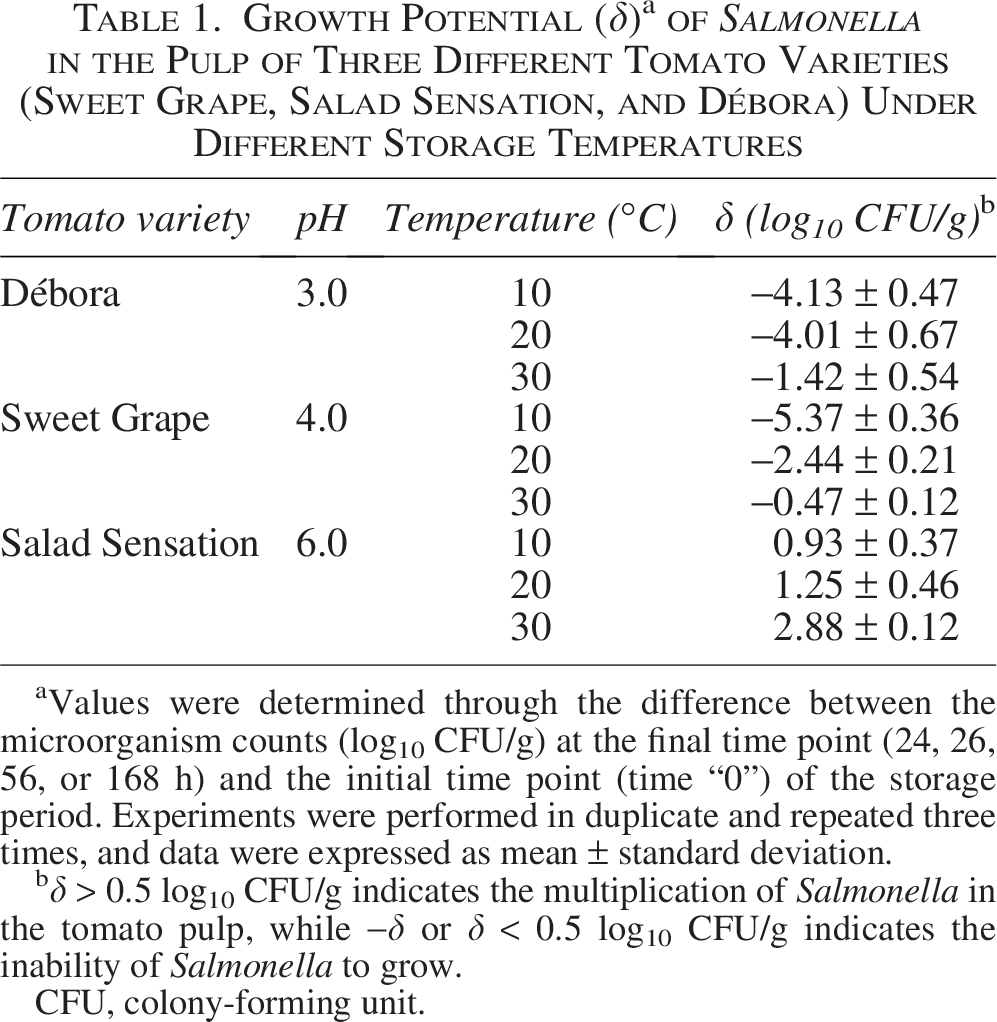
Values were determined through the difference between the microorganism counts (log10 CFU/g) at the final time point (24, 26, 56, or 168 h) and the initial time point (time “0”) of the storage period. Experiments were performed in duplicate and repeated three times, and data were expressed as mean ± standard deviation.
δ > 0.5 log10 CFU/g indicates the multiplication of Salmonella in the tomato pulp, while −δ or δ < 0.5 log10 CFU/g indicates the inability of Salmonella to grow.
CFU, colony-forming unit.
pH and Soluble Solids (°Brix) Values for Tomato Pulp Stored at 10°C, 20°C, and 30°C
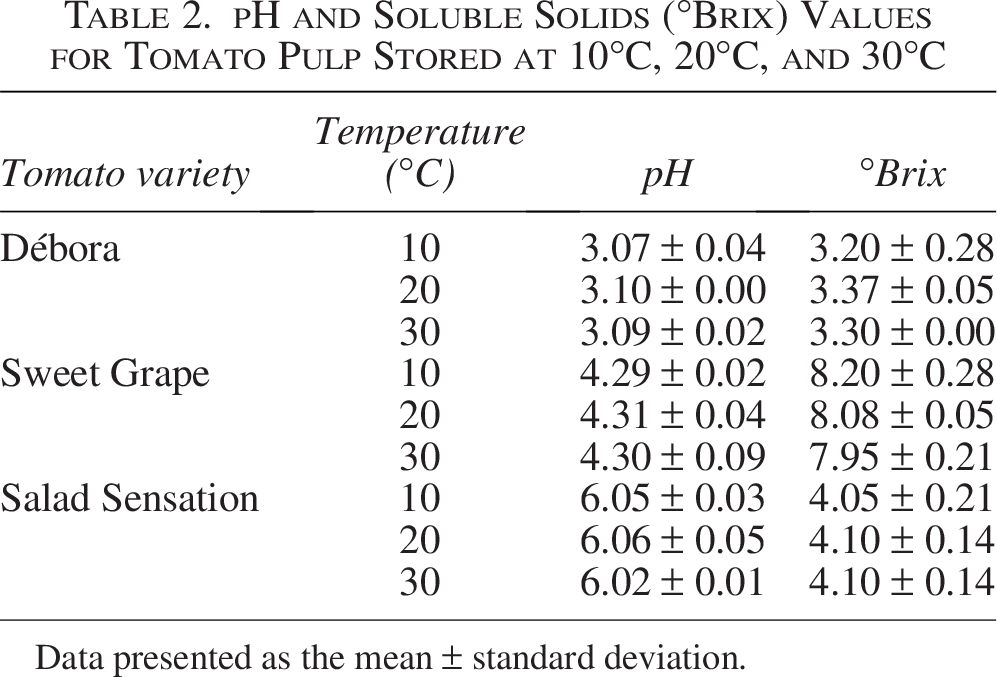
Data presented as the mean ± standard deviation.
It can be observed that the “Sweet Grape” variety presented a higher soluble solids content (8°Brix) when compared with the “Salad Sensation” and “Débora” varieties, with 4 and 3°Brix, respectively.
Discussion
Outbreaks of Salmonella associated with tomato consumption (Bidol et al., 2007; Corby et al., 2005; Cummings et al., 2001; Jungk et al., 2008; Toth et al., 2002) highlight the importance of investigating the presence of this pathogen in tomatoes. Although studies such as Hanning et al. (2009) have demonstrated the potential for contamination through various routes, including irrigation water, washing water, and food preparation environments, the prevalence of Salmonella in tomatoes has historically been low (less than 1% of samples positive) (Cao et al., 2023; Godínez-Oviedo et al., 2022; Vojkovská et al., 2017; Yang et al., 2020). Consistent with these findings, the present study did not detect the presence of Salmonella, corroborating similar results found by Richter et al. (2021) for tomato samples obtained from different suppliers. The lack of Salmonella on the tested tomatoes suggests good handling practices. Nevertheless, washing tomatoes before eating is crucial due to the possibility of other contaminants and the common practice of consuming the skin.
Temperature fluctuations throughout the fruit production chain significantly influence the proliferation of pathogens (Qadri et al., 2015), contributing to increased outbreaks of foodborne illnesses. Understanding the pathogen’s growth potential at different temperatures is crucial for preventing product contamination. Given Brazil’s significant tomato production for both domestic and export markets (CONAB, Companhia Nacional de Abastecimento [National Supply Company], 2019), the temperatures used in this study (10–30°C) are in line with other studies on the prevention of Salmonella adhesion on the surface of cultivars from other countries (Cabrera-Díaz et al., 2022; Pao et al., 2012), making the findings applicable to the investigated Brazilian tomato cultivars.
In this respect, Strawn and Danyluk (2010) observed rapid growth of Salmonella in mangoes and papayas stored at 23°C, reaching maximum populations of 6.1 and 7.8 log CFU/g after 24 and 72 h, respectively. At 12°C, growth was slower, with maximum populations reached after 3 and 8 days in mangoes and papayas, respectively. In another study, Penteado et al. (2014) found that mango pulp stored at 25°C provided ideal conditions for the growth of Salmonella Enteritidis, with an increase of approximately 4.8 log CFU and a maximum population of 7.6 log CFU. At 10°C, no bacterial growth occurred.
In contrast to the results obtained in this study, Beuchat and Mann (2008) reported that storage temperature (12 or 21°C) was the primary determining factor for Salmonella growth in different tomato pulp varieties (round [pH 4.37, 4.41°Brix], Roma [pH 4.40, 3.9°Brix], and grape [pH 4.67, 6.62°Brix]). The temperature of 21°C provided a more favorable environment for bacterial multiplication. On the other hand, most storage studies have investigated the surface contamination of tomatoes by Salmonella and other pathogens. In this sense, Tokarskyy et al. (2018) found that bruising on tomatoes (round tomatoes [Lycopersicum esculentum cv. FL 47]) does not significantly affect Escherichia coli O157:H7 survival, but red ripeness stages show a significant effect on Salmonella survival at both 10°C and 20°C. Another study found that Salmonella and Listeria monocytogenes could attach to the surface of Roma tomatoes and persist for as long as 10 days without multiplying (Cabrera-Díaz et al., 2022). According to the authors, higher temperatures (25–30°C) and high relative humidity favored the attachment of these pathogens, enhancing their persistence on the tomato surface.
Chemical changes in fruits directly influence the growth of microorganisms. The Débora variety, with a lower amount of soluble compounds, restricts the multiplication of Salmonella. However, pH was shown to be the determining factor in the Salmonella’s growth, as evidenced by the “Salad Sensation” variety, which allowed Salmonella to multiply despite having a lower content of soluble solids.
Conclusion
In conclusion, Salmonella was not detected on the surface of the analyzed tomato samples, suggesting low contamination in the Campinas region. Regarding growth potential, pH emerged as a critical factor for bacterial growth, with the “Salad Sensation” variety (pH 6.0) being more susceptible to Salmonella multiplication, even with a lower soluble solids content than the “Débora” cultivar. Finally, neither the “Débora” nor “Sensation salad” tomato pulp were able to withstand the growth of Salmonella in this challenging test for none of the temperatures evaluated (10°C, 20°C, and 30°C).
Authors’ Contributions
A.C.B.: Conceptualization, methodology, visualization, investigation, data curation, formal analysis, visualization, writing—original draft, and writing—review and editing. T.G.M.: Conceptualization, methodology, formal analysis, and writing—original draft. D.P.A.N.: Resources, investigation, visualization, formal analysis, writing—original draft, and writing—review and editing. A.S.S.: Conceptualization, methodology, visualization, investigation, formal analysis, visualization, supervision, funding acquisition, project administration, and writing—review and editing. All authors have read and agreed to the published version of the article.
Footnotes
Author Disclosure Statement
No competing financial interests exist.
Funding Information
The authors acknowledge the financial support of the “Conselho Nacional de Desenvolvimento Científico e Tecnológico (CNPq)”: Grants #306644/2021-5 and #305804/2017-0 and “Coordenação de Aperfeiçoamento de Pessoal de Nível Superior (CAPES)”: Finance code 001.